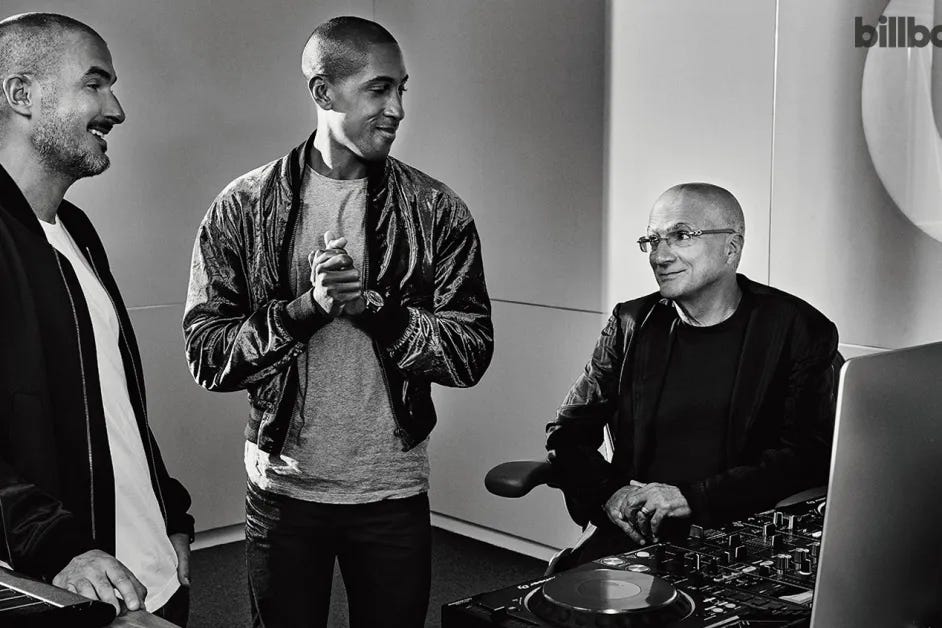
I was walking down Queen Street in Toronto last week, completely zoned out, listening to Episode #391 of David Senra’s Founders podcast. If you don’t listen to Founders, you should. Senra obsessively analyzes the careers of history’s greatest entrepreneurs. This particular episode was a two-hour deep dive into the life and mind of one of my biggest heroes - Jimmy Iovine.
Iovine is arguably the most important living bridge between music and tech. He co-founded Interscope Records, built Beats by Dre, and then sold it to Apple for $3 billion to help launch Apple Music. He knows where the bodies are buried because he dug half the graves.
About an hour into the podcast, Jimmy Iovine starts discussing the current state of the music business. I literally stopped walking. I had to pull out my phone and rewind it three times just to make sure I heard him correctly.
Speaking about Spotify and Apple Music, Iovine flatly stated: “The streaming services, to me, are minutes away from being obsolete.”
“Minutes away from obsolete?” I repeated to myself. “What do you mean DSPs are going to become obsolete..?” We’ve spent the last ten years optimizing the entire global music industry around a single, undisputed higher power: The Digital Service Provider. I spent basically my entire career in music being told to beg for editorial playlists. I was told to obsess over pre-saves and learning the algorithm. We built our entire ecosystem on the assumption that streaming platforms were the final, ultimate evolution of music consumption. For the first time in history, anyone with a smartphone could basically listen to any song to ever exist in an instant.
But the more I stood there, freezing on the sidewalk, listening to him speak, the more I realized he is absolutely right.
I’m going to take the diplomatic hat off here and say with brutal honesty: Basically everybody in the music business hates Spotify except for the people who work there. It’s a platform that sucks artists for everything they have, it actively prevents community building, and, despite all of that, the platform still struggles to maintain a healthy profit margin.
The streaming business model is fundamentally broken. And eventually, its demise will become more and more obvious to recognize. I’ll break down exactly why the DSP era is coming to a grinding halt, why the major labels are quietly terrified, and why the artists who don’t pivot now are going to go down with the ship.
I was discussing the state of the industry with a VP at Warner Music Canada a few months back, and he said something that has stuck with me since. He said, “For the first time in history, we (the majors) don’t control the entire means of consumption.”
Quick history lesson on who actually used to control the pipes:
For the entire 20th century, major labels didn’t only own the copyrights - they owned the hardware. They were basically integrated tech and manufacturing monopolies wearing the disguise of art companies.
RCA (Radio Corporation of America) owned RCA records (Elvis Presley, David Bowie, John Denver, to name a few…) But they also invented the 45 RPM vinyl format and manufactured the physical record players you had to buy to listen to it.
Philips owned PolyGram Records. They also literally invented the Compact Cassette tape in the 1960s.
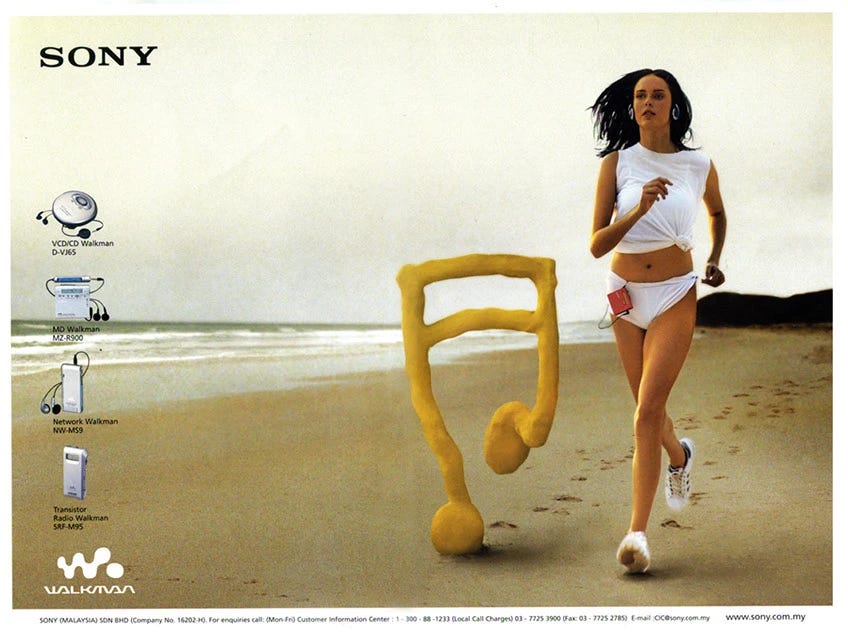
Sony owned CBS Records (Michael Jackson, Bruce Springsteen and more). But they also co-invented the Compact Disc in 1982 (with Philips), and manufactured the Sony Walkman and Discmans that played them.
In simpler terms, they owned the artist, they owned the plastic the art was printed on, and they built the machine you played it on. They controlled the entire means of consumption.
But today, the labels have lost the pipes.
For the first time in history, the music industry is entirely dependent on third-party tech giants to distribute its product. Apple, Google, Amazon, and Spotify own the distribution, the algorithms, the hardware (iPhones, Echo speakers), and most importantly, the customer data.
Sure, the “Big Three” labels (Universal, Sony, Warner) secured equity stakes in Spotify early on in licensing deals. But owning a sliver of the stock does not mean you control the ecosystem. Their scope has been reduced to those who create and provide content while renting space on Daniel Ek’s servers.
Since the labels lost control of the formats, tech companies have started to commoditize the product.
Look at the video streaming wars. Netflix, HBO Max, Disney Plus are in a bloodbath. But they have a distinct weapon: Differentiation. If you want to watch Stranger Things, you need Netflix. If you want The Last of Us, you need HBO.
Yet, if you look at music: Spotify, Apple Music, Amazon Music, and Tidal all offer the exact same product: A library of 100 million songs. As Jimmy points out in the podcast, this lack of differentiation turns music into a utility. Music is now indistinguishable from tap water or electricity. “Right now, music streaming is a utility,” he says. “All the services are exactly the same, they do the same trick. If one of them lowered their price the rest are toast, because there’s no unique offering.”
When music is treated like a utility, it’s unconsciously devalued by the consumer. Its background noise. If you read my piece a few weeks back on this, you realize how dangerous this is for many reasons.
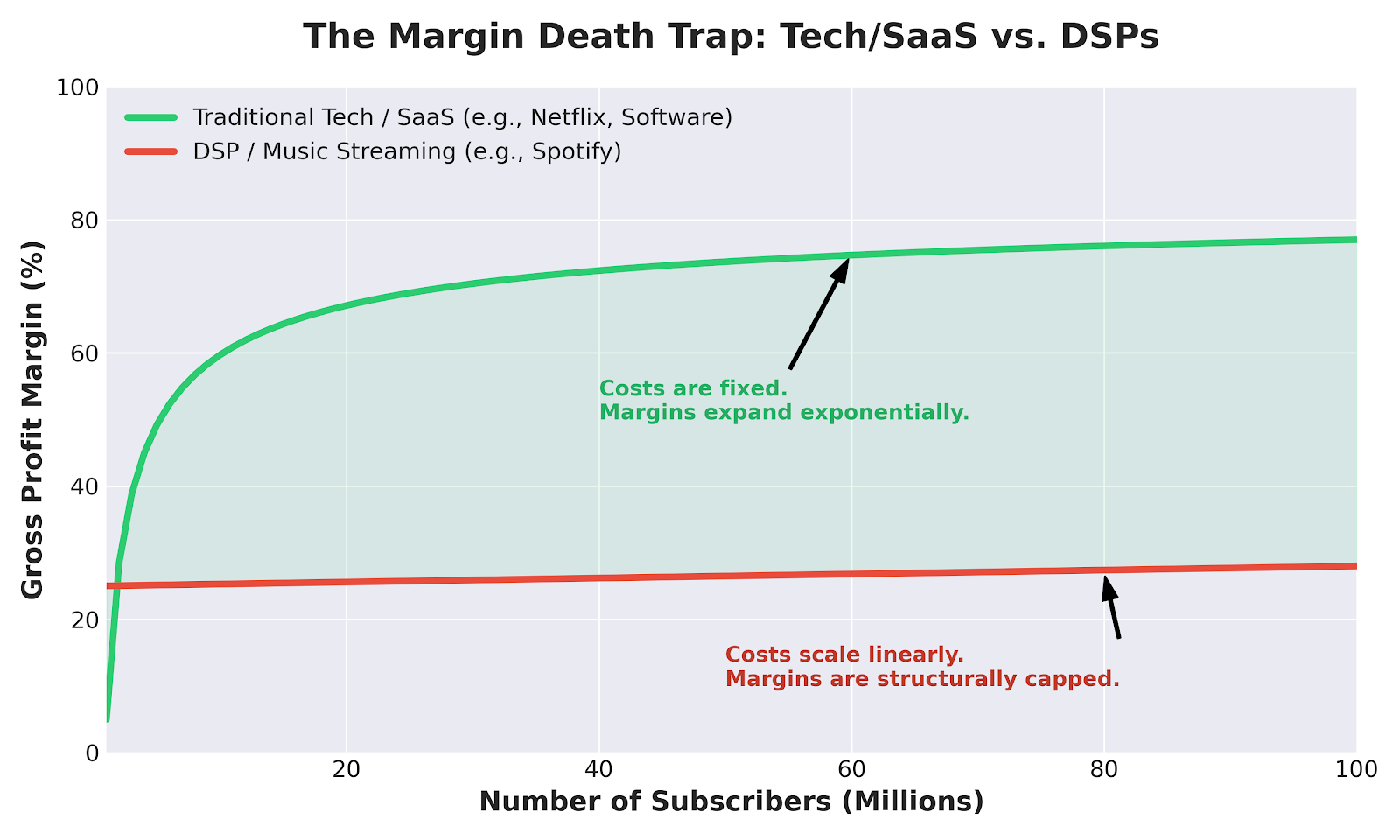
Here is the financial reality that Wall Street has historically hated about standalone DSPs like Spotify.
In a normal tech business (like SaaS or Netflix), as you gain more subscribers, your profit margins increase exponentially because your fixed costs stay relatively stable. Once Netflix pays $20 million to produce an original movie, that cost is fixed. Whether 1 million or 100 million people watch it, the cost doesn’t change. The margin expands.
Streaming music operates in reverse. Because DSPs pay out roughly 70% of every dollar earned back to rightsholders (labels and publishers), their costs scale linearly with their user base. Every time a song is streamed, a fraction of a cent leaves the building.
Iovine put it bluntly: “The streaming services have a bad situation, there’s no margins, they’re not making any money.”
This model only works for Apple, Amazon, and Google, because they don’t need their music platforms to be wildly profitable. Amazon uses music as a loss-leader to keep you paying for Prime. Apple uses it to sell $1,000 iPhones.
As for Spotify, or any standalone music streaming company, they’re kind of screwed. And guess what - when the platform’s margins are structurally squeezed, guess who gets squeezed first? The artists.
This is the most damning part of Iovine’s critique, and it validates exactly why we need new metrics to measure fandom.
Iovine argues that DSPs have completely failed to become “cultural hangars” where artists and fans can actually interact.
"It's one-dimensional. It's an ATM machine. You put your money in, you get your music," Iovine stated. "They don't do anything for the artist. The artist wants to communicate with their fans, period... and the streaming services are still saying, 'We'll put you on our list if you're nice to us.' That's bullshit."
In nicer words, the truth is: Spotify does not want you to have a relationship with your fans. Spotify wants your fans to have a relationship with Spotify.
They guard the listener data with their lives because that data is the only moat they have left. If you build your entire career on a platform that actively prevents you from getting an email address or a phone number, you are building a house on rented land. You are an unpaid employee for a Swedish tech company that views your life's work as "content" to fill their pipes.
To add insult to injury, the financial mechanics of DSPs actively punish the middle class of musicians.
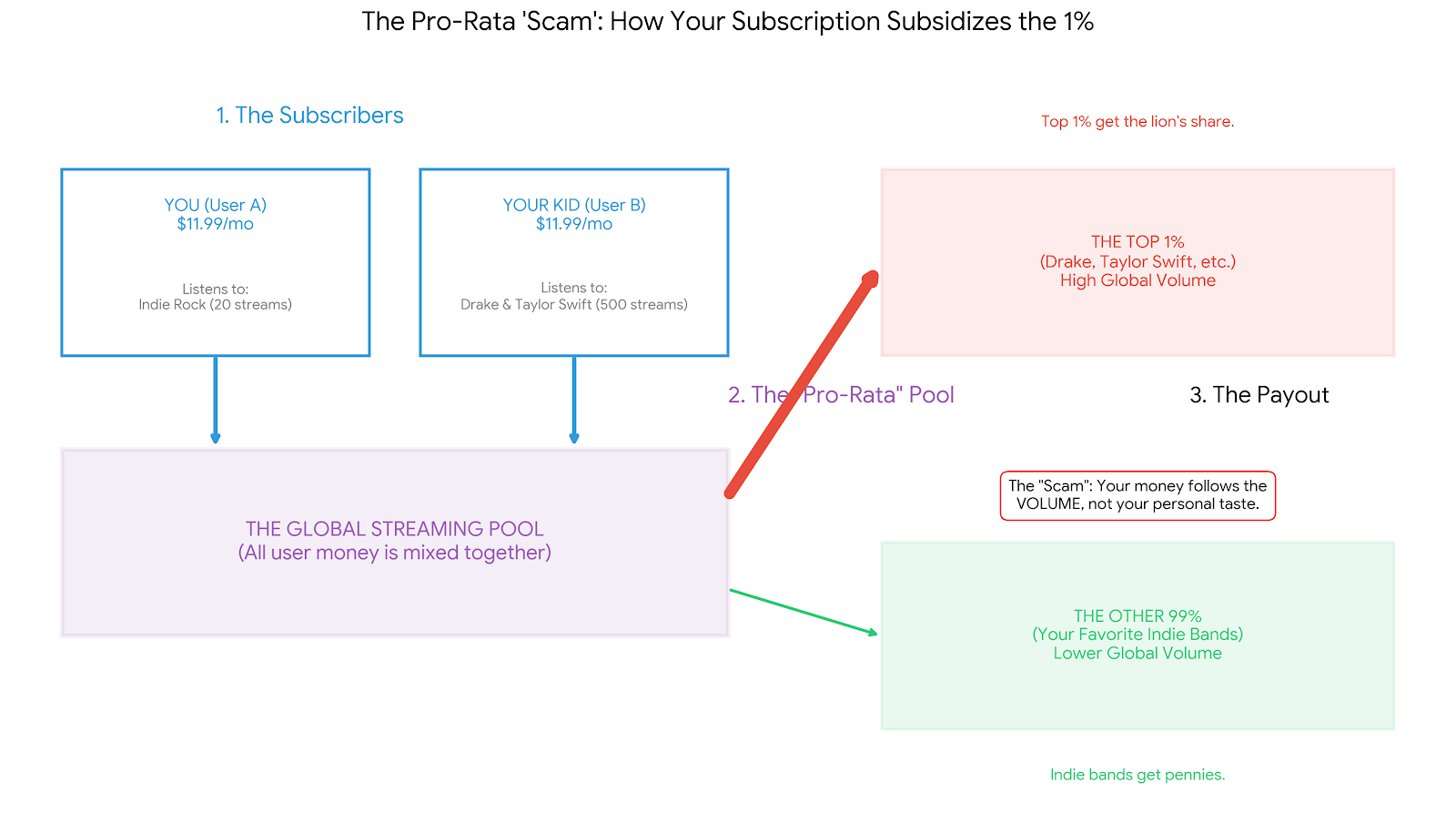
Under the current “pro-rata” payment system, all subscription money goes into one giant pool and is distributed based on total market share.
Let’s say you are a 35-year-old who exclusively listens to indie rock bands. You pay your $11.99 a month. But your 14-year-old kid is on your family plan, streaming Drake and Taylor Swift on repeat for 8 hours a day.
Because of the pro-rata model, your $11.99 does not go to the indie bands you love. The vast majority of your money is funneled directly to the top 1% of pop stars, simply because they command the highest volume of streams globally. The system is rigged to subsidize the mega-stars while starving the middle class.
What if Jimmy is right? If the DSPs are “minutes away from obsolete,” what replaces them? Well, I’m not sure the DSPs are going to disappear overnight, but if you’re an artist or a manager trying to sustain yourself in this evolving music economy, the answer is direct ownership.
The artists who will survive the next five years are the ones who are quietly shifting their focus away from the “ATM Machine.” They are building their own cultural hangars.
They are capturing phone numbers on Laylo. They are driving fans to private Discord servers. They are focusing on ARPF (Average Revenue Per Fan) through high-margin merch, vinyl, and hard tickets, rather than begging for fractions of a penny from a playlist placement.
We are witnessing the death of the “Mass Audience” and the birth of the “Micro-Community.”
The music industry has spent a decade obsessing over how to get a million people to listen to a song once. The next decade will be defined by artists figuring out how to get 1,000 people to care forever.