This article — a long, long, long, article — reveals the life and death of innovation in the drone war between Ukraine and Russia. Innovation creates success and success attracts retribution.
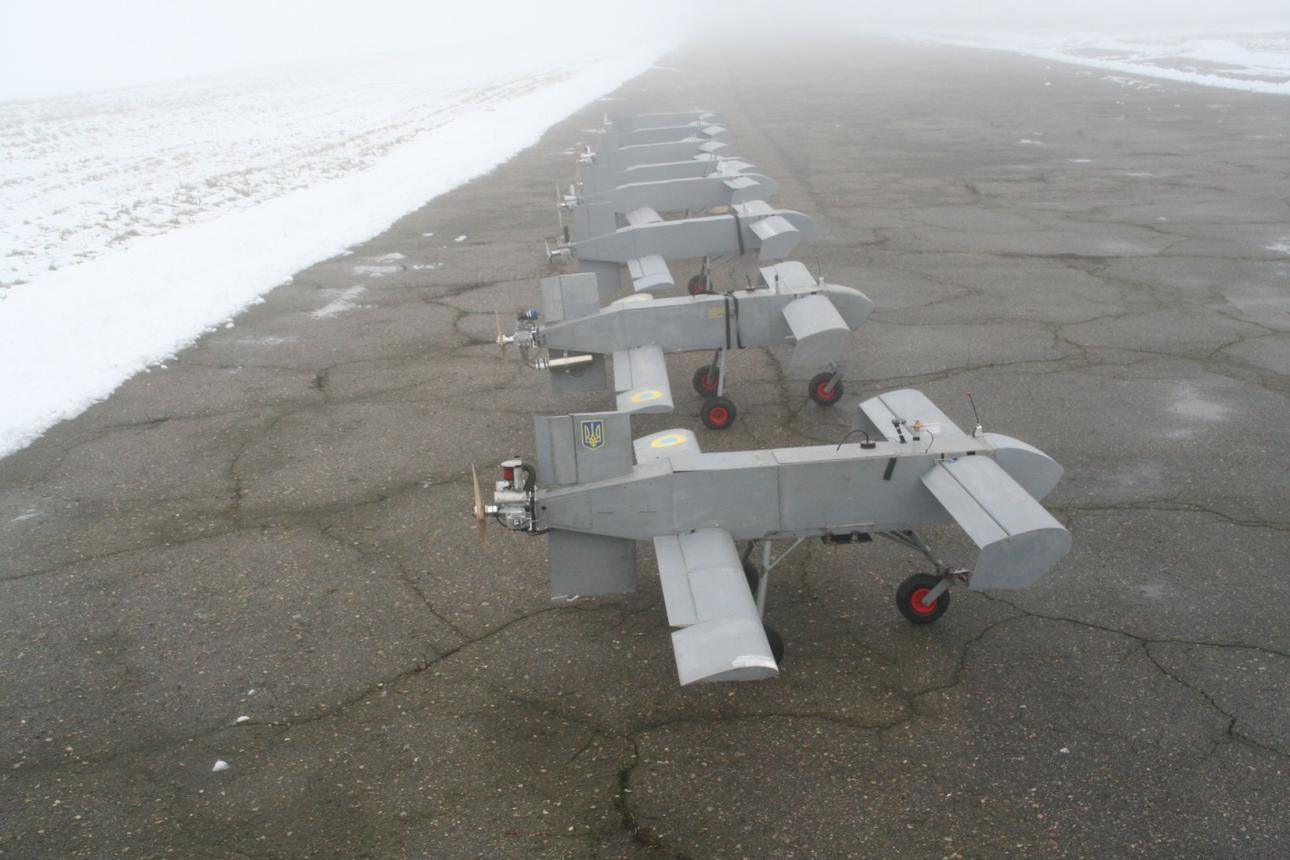
Terminal Autonomy — an Ukrainian/American drone innovator and manufacturer — is a wartime, battlefield-inspired drone manufacturer built around a simple proposition:
Ukraine does not need a handful of exquisite, million-dollar weapons nearly as much as it needs thousands of inexpensive, rapidly manufactured aircraft capable of operating despite Russian electronic warfare.
The company began in Ukraine in 2022 under the name One Way Aerospace, founded by three men with military, engineering and investment backgrounds.
It initially concentrated on small tactical loitering munitions but quickly expanded into long-range one-way attack drones, reconnaissance aircraft and increasingly autonomous weapons able to navigate and identify targets when GPS, communications and conventional remote control are unavailable.
Its best-known products are:
The AQ-400 Scythe, a low-cost, 750-kilometer-class deep-strike drone.
The AQ-100 Bayonet, a smaller tactical loitering munition.
The RQ-100 Scout, a reconnaissance version of the AQ-100 airframe.
These weapons, initially delivered in small quantities and then delivered at scale, were and are effective.
The bloody Orcs — perhaps acting on human intelligence, but intelligence of some kind — launched a ballistic missile atack that destroyed one of Terminal Autonomy’s Kyiv production facilities during the July 24, 2026 Russian attack on the Ukrainian capital.
The attack appears to have been the first publicly identified Russian strike on a Ukrainian weapons factory owned by a US-registered defense company. The Russians are making a lot of this, but it really means nothing.
Ahhh, yes, the founder story. Everybody wants to know the founder story of a startup.
Well, Terminal Autonomy originated as One Way Aerospace, a Ukrainian wartime startup established in late 2022, roughly six months after the unprovoked Russian invasion.
The original name came from the US military expression “one-way attack drone”—an unmanned aircraft intended to fly into and destroy its target rather than return. The company’s ambition was to give Ukraine a domestically produced family of such weapons that could be manufactured cheaply and in large quantities.
The three publicly identified founders were:
James Earl, described in early reporting as a former British Royal Air Force instructor or veteran. He became the company’s principal technical and operational voices, articulating its objective of producing an inexpensive substitute for expensive conventional cruise missiles.
Francisco Serra-Martins brought military and investment experience. Contemporary accounts described him as a former Australian combat engineer and an investor who had appeared on a Forbes “30 Under 30” list. He had investment interests involving technology, renewable energy and development projects.
Roman Antonov supplied the Ukrainian aeronautical-engineering component. He was described as an engineer formerly associated with Ukraine’s Antonov Design Bureau and as a former chief technology officer of Doroni Aerospace. His experience was particularly relevant to designing extremely simple fixed-wing aircraft that could be manufactured without the industrial infrastructure normally associated with military aviation.
It would be fair to say these guys all had practical and relevant experience, but were not weapons developers.
When One Way Aerospace was founded, Ukraine faced three interlocking shortages:
It lacked sufficient conventional long-range missiles.
Western governments imposed restrictions on the use of certain supplied weapons against targets inside Russia. Damn the Americans and President Trump for hampering the Ukrainian’s rights to strike as deeply into Russia as Russia was striking into Ukraine. Damn you.
Russian electronic warfare increasingly disrupted GPS navigation and radio-controlled drones. Huuuuge advantage Russia.
The founders’ response was not to imitate expensive Western cruise missiles. It was to design aircraft that were:
expendable;
cheap enough to launch in groups;
manufacturable inside Ukraine;
simple enough to assemble without highly skilled aerospace labor;
adaptable to different payloads and guidance packages; and,
capable of continuing toward their targets after losing GPS or communications.
The concept was essentially quantity over exquisite engineering. Losing several drones to air defenses would be acceptable if enough reached the target—and if the interceptors used against them cost substantially more than the drones themselves.
This exchange ratio of inexpensive Ukrainian attack weapons attacking enmasse for expensive Russian air defensive weapons was identified from the beginning.
By April 2023, One Way Aerospace had emerged from relative secrecy and was publicizing its Scalpel tactical loitering munition.
The company planned a large Ukrainian production facility — multiple facilities — to support production of its developing long-range system.
Its public message was unusual for the traditional defense industry: the company openly emphasized low cost, minimal tooling, commercially available materials, and designs that could be assembled rapidly.
This is everything that the American and Nato weapons procurement is not. Sleek, simple, fast.
The company subsequently adopted the name Terminal Autonomy.
The new name reflects the most important part of its technological proposition. “Terminal autonomy” is the final portion of an attack in which the aircraft can independently navigate or recognize its target after radio links, satellite navigation or mobile connectivity have been jammed or lost.
In other words, the drone is not merely following GPS coordinates while being remotely piloted. During the terminal phase, onboard sensors and software can assume a greater role in completing the mission thereby rendering Russian EW impotent. Enter also on-board artificial intelligence that moves so quickly it is impossible to thwart.
Terminal Autonomy’s importance does not arise from a revolutionary airframe. Its competitive advantage lies in combining:
intentionally inexpensive aircraft;
modular construction;
distributed production;
rapid battlefield modification; and,
an autonomy package intended to survive Russian jamming.
The AQ-400’s early production methods exemplified this approach.
Its fuselage and structural sections were fashioned from CNC-cut sheets, including plywood and other materials that could be processed by civilian furniture and woodworking factories.
Any modestly competent wood butcher company could be turning out the fuselage and structural components as quickly as you could write a CNC cut sheet. This is cabinet shop tech, the same tech that made your cabinets and countertops in your kitchen.
The aircraft was designed so components could be manufactured at multiple locations and then transported for final assembly.
This had several advantages, the overall advantage being it avoided the ponderous tech and slothlike manufacturing of the aerospace and aviation industries and skill levels.
Fiberglass, carbon composites and specialized aviation-grade structures can create production bottlenecks. Plywood and CNC-cut panels can be made using equipment already distributed throughout Ukraine’s civilian economy.
The company claimed its designs could be assembled without specialized tooling and, in some cases, by personnel with limited training. The current AQ-100 description says assembly requires no tools and can be performed by untrained personnel.
A conventional missile factory depends on large machine tools, clean rooms, chemical-processing areas and specialized suppliers. Terminal Autonomy’s simpler architecture lends itself to smaller, distributed production cells.
The company’s original ambition was to move from roughly 100 AQ-400s per month to 500 and eventually as many as 1,000 per month. Current company material claims that its wider production system manufactures thousands of units monthly.
The AQ-400 Scythe is Terminal Autonomy’s best-known weapon and the product most closely associated with the destroyed factory.
It is a long-range, propeller-driven, ugly-as-second-hand-sin, one-way attack drone designed to strike logistics centers, ammunition depots, fuel facilities, airfields, industrial plants and other fixed targets hundreds of kilometers behind the front.
Its published specifications are impressive:
Wingspan — 3.2 meters
Maximum takeoff weight — 100 kilograms
Payload — up to 43 kilograms
Cruise speed — approximately 144 km/h
Range — approximately 750 kilometers
Ceiling — 4,000 meters
Endurance — approximately seven hours
The Scythe is under continuous development, so these specs could be superseded by the time you read this article.
Airframe — The Scythe uses a highly distinctive tandem-wing configuration: one set of wings toward the front and another toward the rear. The boxlike body reflects its manufacturing priorities rather than aerodynamic elegance.
Propulsion — Early aircraft used a conventional gasoline engine driving a rear-mounted pusher propeller. The drone could take off on its own tricycle landing gear from a short strip or be launched from a catapult, including with rocket assistance.
Transportation — Its compact geometry was also intended to simplify transport. Earlier reporting indicated that numerous fully assembled aircraft could be packed into a standard shipping container, allowing launch units to move and deploy sizable salvos without conspicuous support infrastructure.
Payload and warheads — Early public descriptions mentioned a roughly 32-kilogram warhead within a larger payload allowance. Suggested configurations included purpose-built explosive charges, thermobaric warheads or adapted Soviet-standard artillery ammunition.
Guidance is where the Scythe shines and routinely overcomes Russian air defenses and electronic warfare.
The original Scythe was conceived as a relatively basic autopilot-guided attack drone, but its guidance architecture has become more sophisticated.
The AQ-400 can use:
visual navigation/FPV;
terrain data;
AI-assisted guidance; < this is huge in the final attack run or descent
an onboard terrain-navigation module; and,
operation without GPS or communications links.
The stated purpose is to maintain accurate routing in a heavy-jamming environment and to deny the Russians any system with which they can interdict or misdirect.
Earlier versions reportedly used low-altitude flight — 30 meters altitude, nap of the earth — and laser-altimeter assistance to reduce vulnerability to Russian air defenses and electronic warfare.
At higher altitude, visual positioning could compare roads, terrain and landmarks against stored data. Optional video control was contemplated for shorter-range missions against targets requiring operator confirmation.
The Scythe’s exact present price is not public.
Early estimates — at much lower levels of production and prior to any efficiencies of scale — placed:
the basic airframe at approximately $15,000;
and a more complete aircraft with guidance and mission equipment at roughly $30,000.
Those figures came from the early production period and should not be assumed to represent the current price of an AI-navigation-equipped version. Nevertheless, even a substantially more expensive Scythe would remain far cheaper than a conventional Western cruise missile.
The Scythe can be employed individually, but its economics favor salvos and swarms. Large numbers may:
force Russia to activate a broad swath of air defenses thereby unmasking targets;
reveal radar locations;
consume interceptor missiles;
distract defenses from more accompanying or follow on sophisticated weapons; and,
increase the probability that at least some attackers reach the target.
An early concept involved a better-equipped lead aircraft guiding or assisting several less expensive followers, reducing the number of costly navigation packages required in a mass attack.
Terminal Autonomy announced delivery of the first publicly acknowledged AQ-400 batch to Ukrainian forces in December 2023. At that point, it said initial monthly capacity was approximately 100 aircraft, with planned expansion to 500 and eventually 1,000.
The company says the Scythe has been mass-produced and actively used in combat, but Ukraine generally does not identify which domestic drone type conducted a particular deep strike.
Consequently, linking individual attacks inside Russia to the AQ-400 is often speculative unless wreckage or official information is available.
So here’s what we “know:” the most authoritative public account to date states that Russian ballistic missiles struck and destroyed a Terminal Autonomy drone factory in Kyiv on Friday, July 24, 2026.
The facility manufactured the:
AQ-400 Scythe;
AQ-100 Bayonet;
and possibly associated combat and reconnaissance systems.
No deaths were reported at the Terminal Autonomy facility.
The factory belonged to Terminal Autonomy Inc., the Delaware-registered US corporate entity. This made the incident noteworthy as what appears to be the first publicly documented Russian destruction of a Ukrainian production site owned by an American defense company.
Russian state news agency TASS reported the strike first, citing the Russian Defense Ministry. Russian reporting said specialists from a “Ukrainian-American company” worked at the plant and correctly identified the AQ-400 and AQ-100 as products made there.
One has to believe the Orcs obtained this intel in the usual manner — betrayal, human intel, or sleuthing and that Russian intel had detailed information about:
the location;
the facility’s function;
the company’s international connections; and
the specific drone models being manufactured.
It is not publicly known whether Russia located the plant through human intelligence, satellite imagery, signals intelligence, cyber penetration, analysis of supply movements or some combination of sources.
Stepping back, it is clear there was a mistake made locating that plant where it was located four years into this war.
Damn good question. The Ukrainians are starved for Patriot missiles, so it’s a good bet the Russians used a ballistic missile to exploit that vunerability.
Reporting describes the weapon as a Russian ballistic missile, but no reliable public account has identified the exact missile model used against the Terminal Autonomy facility.
Possible Russian ballistic systems used against Kyiv include Iskander-M and North Korean-supplied KN-23-class missiles, but assigning either to this factory strike without forensic evidence would be speculation.
The known point is that a ballistic rather than a slow cruise missile or Shahed-type drone reportedly delivered the destructive blow. That choice would be logical against a hardened or time-sensitive industrial target because ballistic missiles:
arrive at very high speed;
provide little warning;
are difficult to intercept;
and can deliver a substantial warhead with high impact velocity.
No casualties, but the facility was destroyed, not merely damaged. However, no detailed public inventory has emerged identifying:
the floor area lost;
the number of completed drones destroyed;
work in progress;
engine or electronics stocks;
CNC machinery;
autonomy computers;
test equipment;
warhead components;
or production records.
There are also no publicly authenticated before-and-after satellite images establishing the exact scale of destruction.
Really, amigo, why?
Terminal Autonomy threatens Russia in three distinct ways.
The AQ-400 gives Ukraine an inexpensive, reliable means of attacking targets roughly 750 kilometers away.
Depending on launch location, that places portions of western and southwestern Russia, occupied Crimea and numerous Russian logistics and military sites within reach.
Russia has invested heavily in GPS jamming, communications disruption and electronic countermeasures.
Terminal Autonomy’s core selling point is that its aircraft can increasingly navigate or complete attacks without uninterrupted GPS or radio control.
That does not make the drones immune to electronic warfare, but it raises the cost and complexity of stopping them.
A plant producing a few advanced aircraft each month is dangerous.
A network producing hundreds or thousands of inexpensive autonomous munitions is strategically more troubling.
Russia must then decide whether to:
expend costly surface-to-air missiles;
tolerate some penetrations;
deploy guns and helicopters across a huge area;
build physical defenses around thousands of possible targets; or,
devote additional aircraft and electronic-warfare systems to rear-area protection.
Terminal Autonomy’s business model was therefore itself a strategic target, not merely the individual drones leaving its factory.
Nope.
This is an important consideration for any American company contemplating a joint production arrangement with Ukraine.
I think it also floats a note of caution to any defense contractor manufacturing anywhere in Europe. I think there is a real chance a progressively more desperate Putin would attack any manufacturing company anywhere in Europe if that facility was dedicated to arming the Ukrainians. Just my thought.
OK, here we go, amigo.
Terminal Autonomy is one of the clearest examples of how the Ukraine war has changed defense manufacturing.
Unlike American and European weapons procurement programs, it did not begin with a decades-long procurement program, a giant aerospace campus or a multibillion-dollar government contract.
It began during an invasion, with military veterans, an investor and a Ukrainian aircraft engineer attempting to build expendable weapons faster than Russia could adapt. It came from the market and innovation.
Its products are deliberately inelegant. The Scythe looks closer to an improvised cargo aircraft than a sleek cruise missile. That appearance is part of the design philosophy: every unnecessary curve, composite mold and specialized fastener is a potential obstacle to mass production.
Russia’s destruction of the Kyiv factory validates both sides of Terminal Autonomy’s proposition.
It validates the threat: Russia considered the plant important enough to assign a ballistic missile to it.
And it validates the need for the company’s manufacturing strategy: a defense industry intended to survive a war cannot rely on one exquisite factory. It must be dispersed, modular, replaceable and capable of resuming production after being hit.
The central question is therefore not whether Russia destroyed a Terminal Autonomy factory. It did.
The more consequential question is whether Russia destroyed Terminal Autonomy’s production system. On the evidence currently available, the answer is probably no.
Parting shot: that ballistic missile got through Ukrainian defenses because they are short on Patriot missiles. That is on the United States and President Trump. Stop jacking around and get Ukraine more Patriots. Now.