
“Twin studies…provide the bulk of the evidence for the widespread influence of genetics on behavioral traits.”
—Behavioral genetic researchers Robert Plomin and colleagues, in the 2013 edition of Behavior Genetics
“There is a danger of concealing assumptions which have no factual basis behind an impressive façade of flawless algebra.”
—Medical statistician Lancelot Hogben in his 1933 book Nature and Nurture
Mainstream science and the media correctly identify eugenics as a 20th-century pseudoscience. Behavioral twin research, by contrast, remains widely accepted as good science, even though it was developed by the eugenics and German “racial hygiene” movements in the first four decades of that century. These origins, of course, do not invalidate twin studies as a legitimate area of research, but examining their methods and underlying assumptions could. In this post, I explain why we should reject the most commonly used method for studying twins.
I will argue that studies of human behavior (for example, IQ, personality, criminality) and psychiatric conditions (for example, schizophrenia, major depression, ADHD) using the classical twin method (or “twin method”) should be abandoned as a genetic research method, and that genetic conclusions and heritability estimates from prior twin studies should be reevaluated and likely rejected. Building on nearly a century of criticism of twin research, I will show that the central assumption underlying these studies is false—an argument I have developed in books, peer-reviewed articles, and online articles since 1998. (This post is adapted with major revisions from Chapter 4 of my 2023 book, Schizophrenia and Genetics: The End of an Illusion.)
Behavioral twin studies fall into two main categories: (1) thousands of twin method studies of twin pairs reared together in the same family home, and (2) six studies of “twins reared apart” (TRA studies). Here, I focus on the first method: twin pairs reared together in the same family home.
In his 1924 book Die Zwillingspathologie (Twin Pathology), the eugenicist Hermann Werner Siemens introduced the classical twin method. Siemens, a dermatologist, was a major figure in the German “racial hygiene” movement between the World Wars. Siemens’s twin method compares the behavioral (or medical condition) resemblance of reared-together MZ (monozygotic, identical) pairs with that of reared-together same-sex DZ (dizygotic, fraternal) pairs. MZ pairs are assumed to share 100% of their segregating genes, whereas DZ pairs are assumed to share an average of 50%.
Results from the twin method usually show that, at a statistically significant level, MZ pairs behave more alike or correlate more highly on psychological tests than same-sex DZ pairs. I will designate this finding “rMZ > rDZ,” where r represents the behavioral or psychological test-score correlation or concordance rate. Concordance means that both members of a twin pair were diagnosed with or judged to have the same psychiatric condition. Based on the assumption that MZ and DZ environments do not differ, twin researchers since Siemens’s time have interpreted rMZ > rDZ as evidence for genetic influences.
Twin researchers estimate heritability by doubling the difference between MZ and DZ group correlations using “Falconer’s formula”: heritability = 2(rMZ - rDZ). For example, researchers who find mean group IQ correlations of 70% for MZ twins and 40% for DZ twins would estimate heritability at 60%. Modern behavioral genetic researchers often estimate heritability using the “ACE” model-fitting technique. Both Falconer’s formula and model-fitting techniques assume that MZ and DZ twins experience the same levels of environmental similarity.
Heritability estimates (ranging from 0% to 100%), however, rely on several questionable or unsupported assumptions. Researchers originally developed these estimates as animal-breeding statistics, where they could control genetic and environmental conditions. Contrary to popular belief, heritability estimates do not indicate the strength or magnitude of genetic influences on psychiatric conditions or on human behavioral characteristics such as IQ, nor do they indicate the relative importance of genetic and environmental influences. Some critics argue that researchers in the human behavioral sciences should abandon heritability estimates altogether. I’m one of them.
Twin researchers study adolescents and adults who grew up in environments they did not design, control, or observe. Twin researchers must therefore make assumptions about these environments. An assumption is something taken for granted or accepted as true without proof. The study treats the assumption as true, and researchers draw their conclusions accordingly.
As shown below, genetic interpretations of behavioral rMZ > rDZ depend on accepting several assumptions.
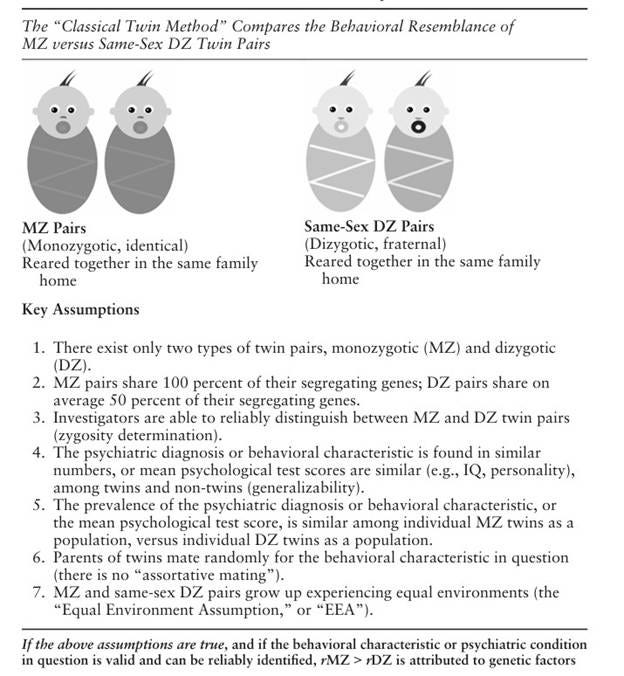
In this post, I focus on Assumption #7, the MZ-DZ “equal environments assumption” (EEA). The EEA is, by far, the most controversial assumption in twin research. Twin researchers argue that MZ and DZ pairs grow up experiencing roughly equal environments, and that the only behaviorally relevant factor distinguishing them is their degree of genetic relatedness (100% versus an average of 50%). As one group of twin researchers observed, the EEA “is crucial to everything that follows from twin research.”
From the twin method’s inception in the 1920s until the mid-1960s, twin researchers assumed—without qualification—that MZ and same-sex DZ pairs grow up experiencing roughly equal environments. Here I cite three examples of this “traditional” EEA definition: by twin researchers Horatio Newman and colleagues in 1937, by geneticists James Neel and William Schull in 1954, and by schizophrenia twin researcher Einar Kringlen in 1967.
The [twin] method…assum[es] that environmental differences are the same for both identical and fraternal twins.
In the comparison of MZ with DZ twins the assumption is made that the individual members of a twin-pair enjoy comparable or equivalent environments.
The basic underlying assumption for the classical twin method is, of course, that environmental conditions of monozygotic twins do not differ from those of dizygotic twins.
Critics have argued since the 1930s that the evidence does not support the EEA, because when compared with same-sex DZ pairs, MZ pairs grow up experiencing:
More similar treatment by parents and others, including being dressed alike.
More similar physical and social environments, including spending more time together, attending classes together, and sharing friends.
More similar treatment by society due to their very similar physical appearance.
A greater tendency to model behavior after each other.
Identity confusion and a much stronger level of emotional attachment to one another.
By the late 1960s, twin researchers were compelled to recognize what the rest of us already knew: MZ environments are far more similar than DZ environments. In 1978, for example, behavioral geneticist John Loehlin acknowledged that in his 1976 twin study he “found, as nearly everybody else has found who has investigated the point, that identical twins are indeed treated more alike — they are dressed alike more often, are more often together at school, play together more, and so forth.” A year later, twin researchers Sandra Scarr and Louise Carter–Saltzman concluded that “the evidence of greater environmental similarity for MZ than DZ twins is overwhelming.”
Twin researchers could have abandoned the twin method at that point. Instead, they chose a second approach: to subtly redefine the EEA to become what critics have dubbed the “unequal-environments-don’t-matter assumption.” Below, I explain how they carried out this transformation and why we should reject it.
More recently, in a 2014 article that ironically defended twin research, criminologist J. C. Barnes and colleagues acknowledged, “Critics of twin research have correctly pointed out that MZ twins tend to have more environments in common relative to DZ twins, including parental treatment…closeness with one another…belonging to the same peer networks…being enrolled in the same classes…and being dressed similarly.” Critics indeed point to these and other environmental influences that MZ twin pairs share to a much greater degree.
While recognizing MZ pairs’ greater environmental similarity, twin researchers and their supporters often overlook MZ pairs’ much higher levels of attachment, conscious efforts to be alike, and identity confusion. Psychiatrist Don Jackson raised these important points in his groundbreaking 1960 analysis of genetic research on schizophrenia. Far from being “equal,” most studies found much higher levels of identity confusion (“ego fusion”) and attachment among MZ pairs than among DZ pairs. These findings further challenge the EEA’s validity because we would expect higher levels in these areas to produce greater MZ behavioral similarity for non-genetic reasons.
The table below is adapted from Table 7.1 of my 2015 book, The Trouble with Twin Studies. It presents results from all studies I was aware of that assessed identity confusion and attachment levels among reared-together MZ and DZ twin pairs (references and sample sizes are listed here). As we see, the levels differ dramatically.
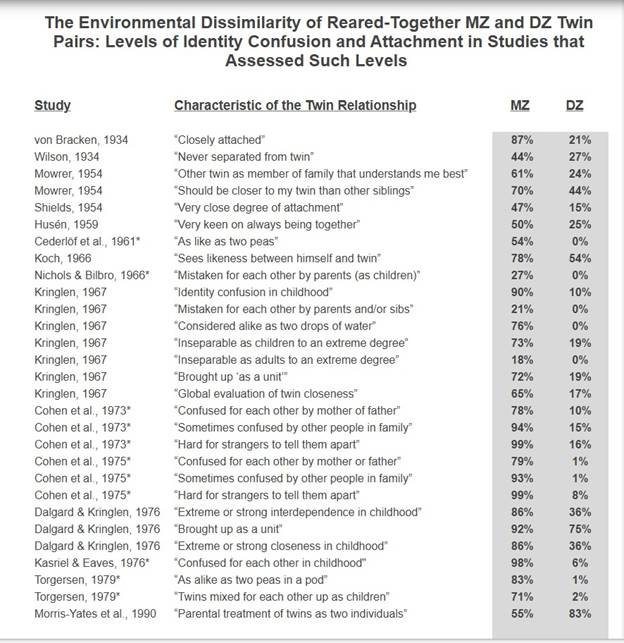
(* Studies that collected data in the context of using or developing questionnaires designed to distinguish between MZ and DZ pairs, known as “zygosity determination questionnaires.”)
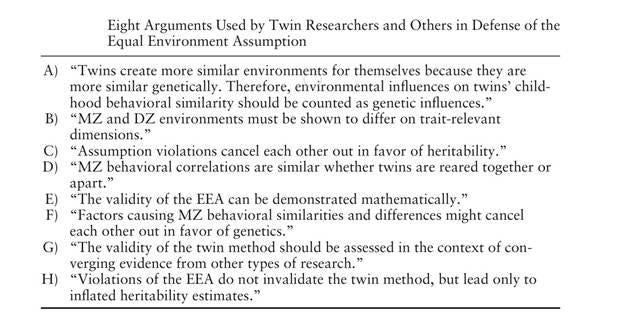
Twin researchers and their critics rarely argue anymore about whether MZ and DZ environments are equal, since almost everyone now agrees they are unequal. Nevertheless, twin researchers continue to argue that the EEA is valid by invoking one or more of the eight arguments I describe and analyze below.
I will briefly review eight arguments twin researchers have used to support the EEA, along with the main problems with each. I then discuss a 2015 meta-analysis of twin studies, analyze problems in the “EEA-test” study literature, and describe DNA-based (molecular genetic) failures in the context of twin studies.
In the twin research literature, the authors addressed the EEA in one of three main ways: (1) by stating that MZ and same-sex DZ environments do not differ (are equal); (2) by ignoring the EEA entirely, thereby implicitly endorsing it; or (3) by recognizing that MZ and DZ environments are different, but then claiming that the EEA has been tested and validated, often invoking one or more of the eight arguments listed below. Twin researchers and their supporters who use this third approach most often cite Arguments A, B, and H.
Argument A: “Twins create more similar environments for themselves because they are more similar genetically”
Twin researchers using Argument A acknowledge that MZ pairs grow up in more similar environments than DZ pairs. However, they insist that the EEA is valid because MZ pairs, due to their genetically influenced behavioral similarities, “create” or “elicit” more similar environments and parental treatment for themselves. In doing so, they count environmental influences on twins’ childhood behavioral similarity as genetic influences.
An example of Argument A appeared in a 2000 article by genetic researchers David Evans and Nicholas Martin, who sought to defend the “validity of twin studies.” Although they acknowledged that “there is overwhelming evidence that MZ twins are treated more similarly than their DZ counterparts,”
the more similar parental treatment of MZ vs. DZ twins occurs in response to the greater similarity of actions initiated by MZ pairs.…It seems…likely that the increased similarity in treatment of MZ twins is a consequence of their genetic identity and the more similar responses this elicits from the environment. (Italics in original)
An additional example appeared in a 2009 publication by twin researchers Nancy Segal and Wendy Johnson:
It is important to note that if MZ twins are treated more alike than DZ twins, it is most likely associated with their genetically based behavioral similarities.
These statements align with psychiatric twin researcher Kenneth Kendler’s 1987 argument that studies designed to test the EEA (discussed below) “suggest that the environmental similarity of MZ twins is the result and not the cause of their behavioral similarity” (italics in original). According to Kendler, the EEA is supported because “MZ twins might create for themselves more similar environments” (italics in original). Many more examples of Argument A, dating back to 1954, appear in Appendix C of The Trouble with Twin Studies.
Supporters of Argument A argue that genetic factors explain rMZ > rDZ by relying on a premise that assumes the very thing it is meant to prove—a premise largely based on genetic interpretations of earlier twin studies. Twin researchers using Argument A, therefore, cite the genetic premise to support the genetic conclusion, then cite the genetic conclusion to support the genetic premise, creating a circular loop of faulty reasoning. Simply put, they use the twin method to validate the twin method.
Argument A portrays twins, as children, as able to create more similar environments for themselves due to their inherited behavioral “blueprints,” as leading behavioral geneticist Robert Plomin called them in 2018. At the same time, it illogically portrays twins’ parents as possessing an amazing ability to override their own behavioral blueprints by responding to and adapting to their twins. Even in this mythical twins-versus-parents “Battle of the Blueprints,” the parents would prevail because they have power and authority, along with their own rigid behavioral blueprints.
Argument A fails because it is an illogical “heads I win, tails you lose” claim that twin researchers cannot lose, since they count non-genetic influences on twins’ behavior as genetic influences.
Argument B: “MZ and DZ environments must be shown to differ on trait-relevant dimensions”
Twin researchers who use Argument B also acknowledge that MZ and DZ environments differ, but argue that the EEA remains valid until critics identify “trait-relevant” environmental factors that cause MZ pairs to behave more similarly. An example of Argument B appeared in a 1993 publication by Kendler and colleagues, who defined the EEA as follows:
The traditional twin method, as well as more recent biometrical models for twin analysis, are predicated on the equal-environment assumption (EEA)—that monozygotic (MZ) and dizygotic (DZ) twins are equally correlated for their exposure to environmental influences that are of etiologic relevance to the trait under study. (Italics added)
In a 1966 twin study of personality, twin researcher Irving Gottesman was perhaps the first to use Argument B. Gottesman revised the traditional definition of the EEA by adding an italicized qualifying term, now defining it as the assumption “that the average intrapair differences in trait-relevant environmental factors are substantially the same for both MZ and DZ twins” (italics in original). This tactic allowed twin researchers to subtly abandon the EEA as they had defined it since Siemens’s time and to shift the burden of proof onto critics to show that MZ and DZ environments differ in trait-relevant ways.
An example of supporters of Argument B explicitly shifting the burden of proof to critics appeared in a 1991 publication by Michael Lyons, Kendler, and colleagues. These researchers argued that “it would seem that the burden of proof rests with critics of the twin method to demonstrate that ‘trait-relevant’ environmental factors are more similar for identical than same-sex fraternal twins.” And yet, it doesn’t.
A basic principle of science is that the burden of proof rests squarely on those making a claim, not on their critics. Therefore, because they recognize that MZ and DZ environments are different, behavioral twin researchers using Argument B—not their critics—must identify the specific and exclusive trait-relevant environmental factors involved in the behavioral characteristic or psychiatric condition in question. After doing so, they must then show (1) that MZ and DZ pairs did not experience such factors, or (2) that MZ and DZ pairs experienced them to roughly the same degree. Until they do so, Argument B defenses of the EEA fail completely.
Argument C: “Assumption violations cancel each other out in favor of heritability”
A third defense of the EEA, Argument C, holds that violations of the “random mating” assumption (sometimes called the “no assortative mating assumption”) and violations of the EEA roughly cancel each other out in favor of genetics and “heritability.” Supporters of Argument C claim that, whereas unequal MZ and DZ environments might lead to an overestimation of heritability, non-random mating patterns among twins’ biological parents might lead to an underestimation of heritability. Non-random mating is usually defined as the tendency for people to choose mates more similar to themselves in characteristics (“phenotypes”) than chance would predict. Argument C was a major aspect of Barnes and colleagues’ 2014 failed defense of behavioral twin research, and was discussed in a 2025 post by Scott Alexander. It was also taken up in 2020 by IQ-hereditarian author Charles Murray, who “summed up” the argument as follows:
Twin studies have come under criticism for overstating the role of genes. The reality is that violations of the random mating assumption are common and lead to modest understatement of the role of genes, whereas violations of the equal environments assumption have even more modest effects in the other direction and are uncommon. Overall, heritability as estimated by twin studies appears to be accurate, with errors tending on net to slightly underestimate heritability rather than overestimate it.
Countering Argument C is straightforward. To do so, let’s first suppose that the “environmental null hypothesis”—which states that genes that directly cause human behavioral differences do not exist—is true. In that case, mating patterns would have no direct genetic influence on human behavior, and non-genetic factors would fully explain rMZ > rDZ. The claim that non-random mating patterns lead to a “modest understatement of the role of genes” assumes in advance that the environmental null hypothesis is false. A twin study, however, is an experiment designed to test whether it is false. The findings of this experiment cannot rest on the built-in assumption that the environmental null hypothesis is false. For this and other reasons, Argument C fails to support the EEA.
Argument D: “MZ correlations are similar whether twins are reared together or apart”
Twin researchers invoking Argument D cite a handful of TRA (twins reared apart) studies to claim that MZ pairs behave similarly whether reared together or apart. However, TRA studies are deeply flawed and rest on questionable assumptions. I describe these flaws and assumptions here, here, and here. In any case, a research method such as the twin method must stand or fall on its own logic (see Argument G below), and twin researchers cannot use other types of studies to validate disputed genetic interpretations of rMZ > rDZ.
Argument E: “The validity of the EEA can be demonstrated mathematically”
In 2014, Barnes and colleagues argued that the EEA can be validated mathematically using computer simulations, simulated data, and algebra:
We have shown empirically that violations of the assumptions of behavioral genetics studies do not invalidate heritability estimates. This is not a matter of opinion but a matter of mathematical evidence.
“There is no room for subjective opinion….There is only algebra,” they wrote in a subsequent article. However, the EEA debate has little to do with “algebra” and everything to do with twins’ real-life experiences and development. These experiences include their childhood and adult social and family environments, as well as their levels of identity confusion and attachment.
Argument F: “Factors causing MZ similarities and differences might cancel each other out in favor of genetics”
Twin researchers sometimes argue that the environmental similarity of MZ twins could cause behavioral differences, suggesting that similarity biases and differentiating biases might cancel each other out, leaving genetics as the dominant factor. Although “reverse biases” may exist in twin research, biases that make twin pairs more behaviorally similar are substantially larger.
Argument G: “The validity of the twin method should be assessed in the context of converging evidence from other types of research”
According to psychologist Scott Lilienfeld and colleagues, proponents of pseudosciences “typically maintain that scientific claims can be evaluated only within the context of broader claims and therefore cannot be judged in isolation.” Barnes and colleagues used a version of this argument in 2014, and it appeared in a 1999 passage by leading psychiatric genetic researchers Stephen Faraone and Ming Tsuang:
Any conclusion about the role of genes and environment must rely not on a single study or class of study but on the converging evidence provided by a variety of research paradigms.
The validity of the EEA, however, must stand or fall on its own logic, and other sources of “converging evidence” have their own set of potentially invalidating problems. When the twin method’s key assumption fails, twin researchers cannot rescue it by citing supposed findings from other methods. Minnesota twin researcher Thomas Bouchard and I exchanged opposing views on this issue in two 2023 publications (linked here and here).
Argument H: “Violations of the EEA do not invalidate the twin method, but only lead to inflated heritability estimates”
An example of Argument H appeared in the 2013 edition of Behavioral Genetics, a textbook by Robert Plomin and colleagues:
If the assumption [EEA] were violated because identical twins experience more similar environmental than fraternal twins, this violation would inflate [heritability] estimates of genetic influence.
Twin researchers and others who use Argument H believe that finding “violations of the EEA” in a particular twin study indicates only that the heritability estimate is inflated. However, the discovery of uncorrected environmental confounding leads not to the conclusion that “heritability is overestimated,” but rather to the conclusion that rMZ > rDZ should not be interpreted genetically. (A confound is an unforeseen or uncontrolled factor that threatens the validity of conclusions drawn from the data. A third factor could cause an association between two variables by influencing both.) This conclusion applies to both simple MZ-DZ comparisons and twin-data model-fitting techniques. In addition, I have shown that the concept of heritability itself is disputed.
Like the first seven arguments, Argument H fails to support the EEA. The only remaining relevant question in assessing the EEA is whether—not why—MZ and DZ environments differ.
In 2015, behavioral geneticist Tinca Polderman and colleagues published a meta-analysis (a synthesis of studies) based on 2,748 previously published twin studies. The authors of this frequently cited study calculated heritability estimates, based on genetic interpretations of rMZ > rDZ, for more than 17,000 physical, medical, and psychological characteristics (traits). Remarkably, they did not mention the EEA, or cite any evidence that MZ and DZ environments are similar.
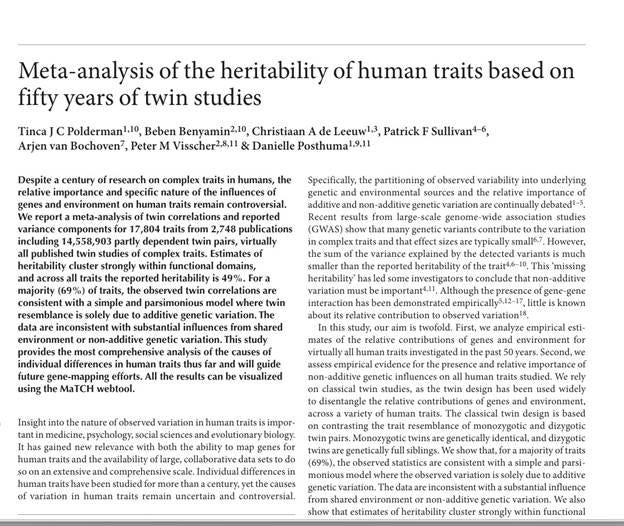
If the EEA is false, it doesn’t matter whether researchers pool the results of five, 500, or 2,748 twin studies. If the individual studies don’t prove anything about genetics, neither do the pooled results. This meta-analysis merely repeated, on a grand scale, the same interpretive error found in each behavioral twin study it counted.
As the medical statistician Lancelot Hogben warned in 1933, almost as if he had the Polderman study in mind, “There is a danger of concealing assumptions which have no factual basis behind an impressive façade of flawless algebra.” With advances in technology since then, we could update Hogben’s warning by adding the phrase “…and computer-generated online or PDF color graphics, diagrams, and statistical analyses” that appeared in the meta-analysis and elsewhere.
When challenged to defend genetic interpretations of rMZ > rDZ, twin researchers and their supporters often cite a series of “EEA-test” studies that have appeared since the late 1960s. In these studies, researchers “tested” the validity of the assumption in ways other than the only way it can be tested, which is a simple determination of whether MZs and same-sex DZs grow up experiencing roughly equal environments—yes or no? If the answer is no, the EEA is false, and genetic interpretations of rMZ > rDZ are not supported. It’s that simple.
Ironically, most EEA-test publications begin by acknowledging that MZ and DZ childhood environments are not equal. In most cases, however, these researchers concluded that MZ pairs’ greater environmental similarity did not create a major bias in twin studies, typically by using one or more of the eight arguments discussed earlier.
Reviewing 60 years of EEA-test studies would be as tedious for me to write about (again) as it would be for most people to read. Those interested should consult Chapter 9 of my 2006 book, The Missing Gene.
Instead, I will address four problem areas in the EEA-test study literature. These problems also apply to more recent EEA-test studies, which I will briefly discuss. In general, EEA-test researchers:
Conducted studies that were subject to the problems identified in the replication crisis.
Arbitrarily evaluated family studies and twin studies very differently, even though both types of studies compare groups experiencing different environments.
Assumed or implied that most psychiatric and behavioral genetic assumptions, methods, techniques, and diagnoses are valid and largely unchallenged, even though they are controversial.
Focused narrowly on selected comparisons while overlooking the larger picture, suggesting that rMZ > rDZ can be interpreted environmentally.
Problem #1: EEA-test Studies Were Subject to Problems Identified in the Replication Crisis.
Science has been embroiled in a “replication crisis” for over a decade. The crisis began in academic psychology, where anonymous surveys suggested that researchers often engaged in “questionable research practices” to produce desired or publishable conclusions. A key concept in the replication crisis is p-hacking, the practice of researchers manipulating definitions, data, and comparisons—openly or behind the scenes—to turn non-findings into publishable “findings” that fall below the conventional .05 level of statistical significance. The replication crisis has revealed that major behavioral science fields have passed off and accepted obviously bad science as good science for decades. It has called into question decades of publications across science and has led to the retraction of thousands of research articles, including those by eminent field leaders (see the Retraction Watch website).
A 2013 EEA-test study by sociologist Dalton Conley and colleagues used the “misclassified twins” method to test the EEA. They concluded in favor of “the validity of the equal environment assumption.” Like other EEA-test studies, we have no way of knowing whether Conley and colleagues, after reviewing the data, conducted and described their study as originally planned, based on their original definitions and hypotheses. In his 2017 book The Genome Factor, Conley defended the twin method and the EEA based on Argument A and Argument C.
Most EEA-test studies were conducted by twin researchers expecting to validate the EEA (though not Conley’s study, according to his account in The Genome Factor). Is it realistic to expect them to conclude that their life’s work should be abandoned and invalidated? The publication of confirmation-biased false conclusions could be reduced by the recently initiated replication-crisis-era practice of research “pre-registration.”
Problem #2: Arbitrary and Radically Different Evaluations of Family Studies and Twin Studies.
In stark contrast to how they evaluate differing MZ and DZ environments, most twin researchers correctly recognize that a behavioral and psychiatric genetic family study finding that behaviors “run in families” cannot disentangle potential genetic and environmental influences. However, because MZ and DZ environments differ, the same conclusion holds true for twin studies. EEA-test study authors treat family studies and twin studies as entirely different events, even though both are relative-risk studies that face similar problems of environmental confounding. The table below shows how twin researchers arbitrarily evaluate family studies and twin studies very differently, even though both methods face major environmental confounding (the table shows only Arguments A and B).
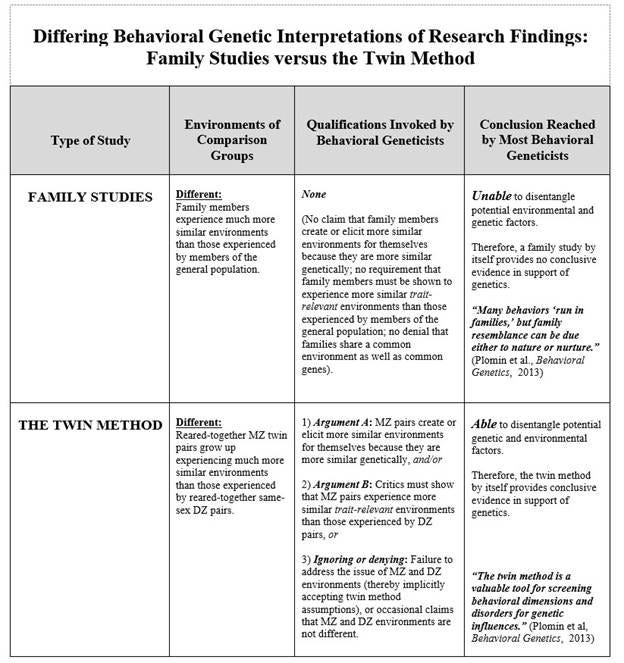
Conclusion: Due to environmental confounding, neither family studies nor twin studies are able to separate (disentangle) the potential influences of heredity (nature) and environment (nurture) on human behavior. Therefore, genetic interpretations based on either type of study are not supported.
Problem #3: Acceptance of Controversial Psychometric, Psychiatric Genetic, and Behavioral Genetic Assumptions and Methods.
Most EEA-test researchers accepted psychometric, psychiatric genetic, and behavioral genetic assumptions, concepts, and methods as valid, even though most are controversial. These include heritability estimates, model-fitting techniques, “general intelligence” or IQ, “personality,” and “schizophrenia.” Critics have challenged the reliability and validity of the major psychiatric diagnoses. Even Plomin, in Blueprint, wrote that we should “tear up our diagnostic manuals based on symptoms” because “there are no disorders to diagnose and there are no disorders to cure.” What he failed to explain is how psychiatric conditions can be studied, predicted, and “substantially genetically influenced” if they don’t exist.
Problem #4: Narrow Focus on Selected Comparisons.
Looking at the broader twin research picture, if we evaluate all behavioral twin studies going back to the 1920s, they together constitute the grandest EEA-test study ever seen. These studies have consistently shown that twin pairs experiencing similar environments and high levels of attachment and identity confusion—MZs—behave much more alike than pairs experiencing less similar environments and much lower levels of attachment and identity confusion—DZs. A reasonable interpretation of this century-long EEA-test study is that environmental (non-genetic) factors can explain rMZ> rDZ.
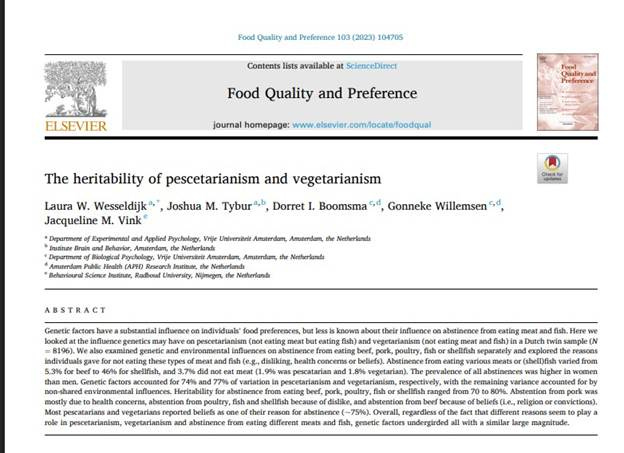
EEA-test researchers answer only the questions they choose to ask and don’t test the EEA in ways that might suggest the assumption is false. For example, the authors of twin studies of “dog ownership” and “vegetarianism” interpreted rMZ > rDZ as evidence of important genetic influences, and estimated heritability for these behaviors. However, the results could easily be recast as an EEA-test study asking: “Would a twin study of an agreed-upon environmentally caused behavior produce rMZ > rDZ?” We could call this procedure a “reverse EEA-test study.”
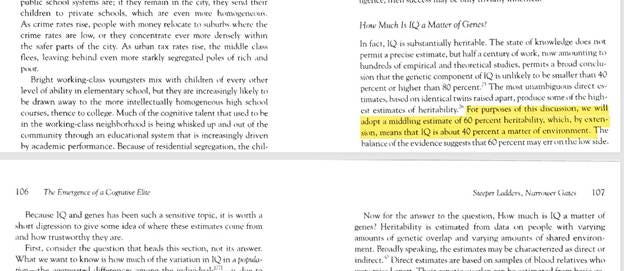
I can’t think of a human behavior less “genetic” than choosing not to eat meat when it is available and affordable. Nevertheless, the authors of a twin study concluded that “abstention from meat (i.e., vegetarianism/veganism) was 75% heritable.” This heritability estimate exceeds the 51-57% estimate for dog ownership and is only slightly lower than current schizophrenia heritability estimates. Both estimates are comparable to the 60% IQ heritability estimate from twin studies.
“Dog ownership” heritability based on MZ-DZ comparisons: 51-57%
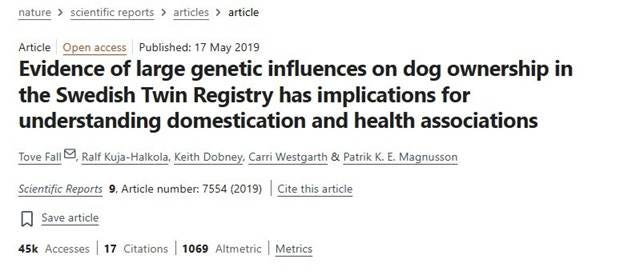
“Vegetarianism” heritability based on MZ-DZ comparisons: 75%
“IQ” heritability based on twin studies (from The Bell Curve, 1994): 60%
Something is seriously wrong here, and the behavioral sciences and society at large must confront it.
Segal and Colleagues’ Study. In Segal and colleagues’ 2018 EEA-test study, which used “genetically unrelated look-alike” pairs, the authors reached the astonishing conclusion that “appearance is not meaningfully related to personality similarity and social relatedness.” I call it astonishing because, most often, common sense and research from other fields better inform our understanding of human beings and human development than narrowly focused behavioral genetic “findings” and “laws.” “It is quite striking,” wrote child psychiatrist and critical behavioral geneticist Michael Rutter in 2006, “that behavioral genetics reviews usually totally ignore the findings on environmental influences. It is almost as if research by non-geneticists is irrelevant.”
Segal’s study was flawed for additional reasons and, at best, eliminated only one of many environmental factors that contribute to behavioral resemblance among MZ twin pairs. The researchers’ conclusion in favor of “genetic influences on personality and self-esteem” did not follow from their findings.
The “Augmented Classical Twin Design.” Liang-Dar Hwang and colleagues published an EEA-test study in 2021, in which they developed the “augmented classical twin design” to test the EEA. To their credit, they acknowledged that their proposed method was based on “strong assumptions…which may not hold in reality,” and recommended “extreme caution” when “applying and interpreting” it. To the extent that academic journals continue to publish studies using the twin method, a similar disclaimer should appear at the top of every published behavioral twin study.
Large differences between earlier twin-based and later DNA-based (molecular genetic) heritability estimates have created what genetic investigators since 2008 have called the “missing heritability problem.” Since the 1960s, researchers have conducted DNA-based gene searches because they believe, with certainty, that twin studies have established the substantial heritability of behavioral characteristics and psychiatric conditions.
The late 1980s and early 1990s marked the rise of candidate-gene association studies. The candidate-gene heyday (roughly 1990-2010) included IQ quantitative trait loci (QTL) studies by Plomin and others, as well as literally thousands of psychiatric “gene association” publications. However, these claims ultimately failed to replicate for IQ, schizophrenia, depression, and other areas. In Blueprint, Plomin concluded that the twin-study-inspired behavioral candidate-gene era was a “flop” and a “fiasco” that “failed everywhere.”
Gene-association claims from subsequent genome-wide association (GWAS) and polygenic score (PGS) studies refer to potentially spurious gene-behavior associations, not to causes. Like earlier candidate-gene researchers, GWAS and PGS researchers often say their work is guided by heritability estimates produced by earlier twin studies.
Instead of trying to squeeze more “heritability” out of GWAS/PGS associations, researchers and entire academic fields should revisit what critics have said about twin studies of behavior since the 1930s. They might finally conclude that the behavioral sciences and DNA-based researchers have been massively misled by twin research, and that DNA-based research has produced the ultimate “EEA-test” studies. The missing heritability problem is really a “genetic misinterpretation of rMZ > rDZ” problem.
I began this post by describing how the classical twin method compares reared-together MZ and DZ twin pairs, and I emphasized the importance of the twin method’s MZ-DZ equal environments assumption (EEA). Although almost everyone now agrees that MZ pairs grow up experiencing more similar environments than DZs, twin researchers and their supporters have advanced various arguments in support of the EEA’s validity. I examined each argument and showed that none supports the EEA. After briefly reviewing a widely cited meta-analysis of twin studies, I evaluated the problematic “EEA-test study” literature and discussed the “missing heritability problem.”
Implausible “findings” from MZ-DZ twin comparisons seem endless. Among these (in addition to twin studies of dog ownership and vegetarianism) are a twin study whose authors concluded that being a “born-again Christian” has a genetic basis; a twin study that found important genetic influences on tea and coffee-drinking preferences; a twin study that found the heritability of “loneliness in adults” to be 48%; a twin study that found important genetic influences on “happiness”; a twin study that found a moderate genetic component for political orientation; and a twin study of “people’s desire to be in nature.”
MZ pairs behave more similarly and correlate higher on psychological tests than DZ pairs across nearly all behavioral domains (that is, rMZ > rDZ is true). Twin researchers and their critics agree on this point. The crucial question is what explains rMZ > rDZ, and I am unaware of any valid argument supporting genetic explanations. As political scientist Evan Charney concluded in 2013, “That twin studies generate results that even partisans of the methodology acknowledge as absurd is further evidence that they are to many what they have always seemed to be: an obviously confounded, unreliable methodology.”
Barnes and colleagues argued against rejecting the twin method. “Scholars should not abandon research or research methods,” they wrote. “Instead, they should work to revise their methodologies and statistical models to address known problems.” But once environmental confounding in family studies was widely recognized, most genetic researchers eventually did abandon genetic interpretations of data showing that behaviors and psychiatric conditions run in families. Similarly, we must abandon genetic interpretations of twin-method findings showing rMZ > rDZ. In simple terms, if the twin method is no good, it’s appropriate and necessary to junk it.
The century-long misinterpretation of behavioral twin studies in favor of genetics is a fallacy of epic, history-of-science proportions. DNA-based research has helped confirm this conclusion by failing to identify causal “genes for behavior” after more than half a century of attempts. As the disastrous candidate-gene era showed, reported gene associations are potentially spurious correlations, not causes.
It’s time to abandon the “classical twin method” as a genetic research method, and to reject genetic interpretations of rMZ > rDZ in all behavioral twin studies dating back to the 1920s. Behavioral science and psychiatry textbooks will need to be rewritten, and DNA-based researchers must recognize that their failures stem from their misplaced faith in twin studies and the heritability estimates that accompany them. A major reason behavioral and psychiatric genetics continue to defend the twin method is that, without it, these fields may need to close up shop. That is a problem their leaders will need to confront. For the rest of us, removing twin studies from the behavioral-science genetics literature—much like the earlier removal of eugenic junk science that gave birth to behavioral twin research—is a long-overdue, necessary step.