Enterprise software has been trending towards better buyer-seller-alignment for a long time.
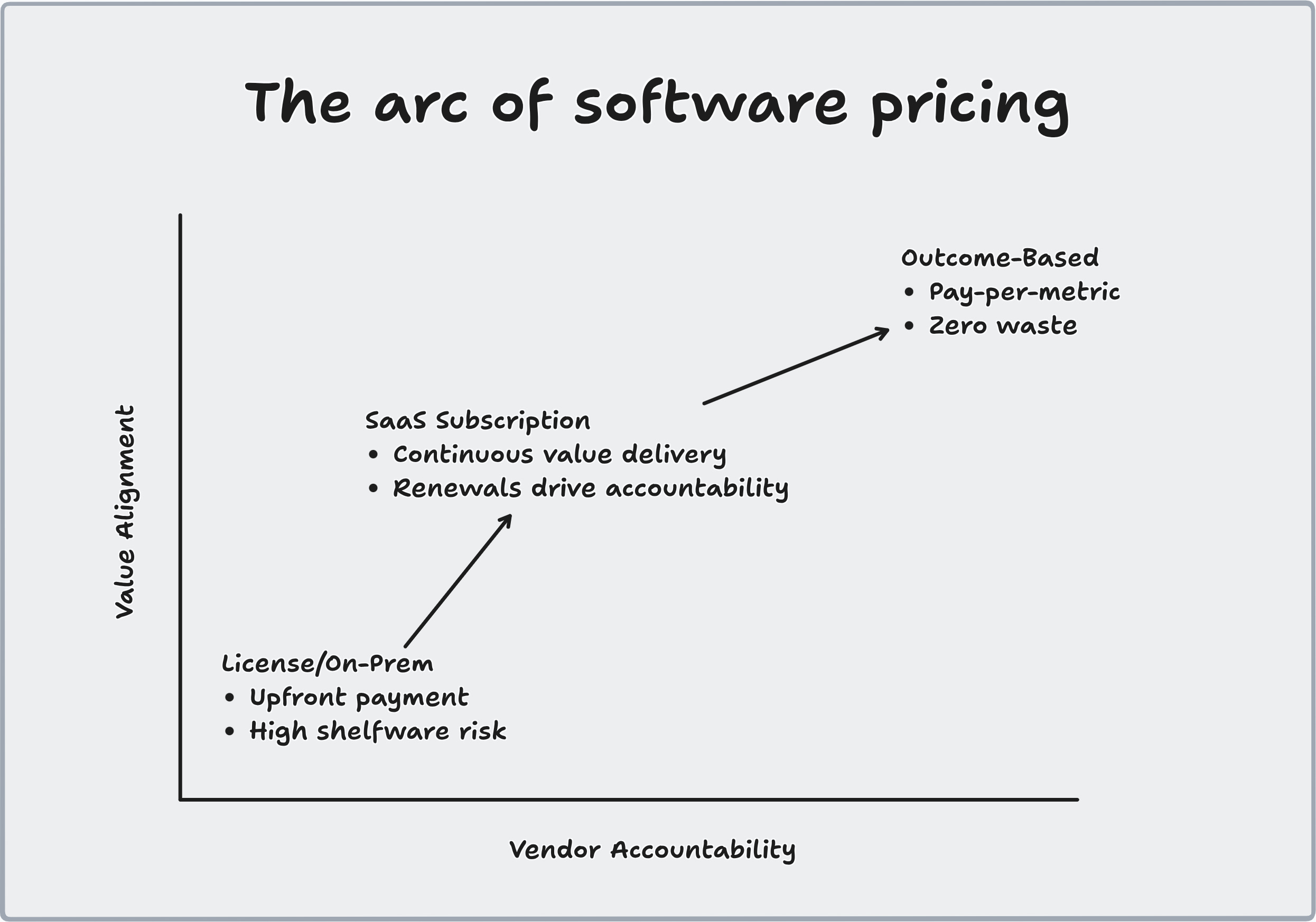
An important caveat up front: the reality is, of course, not as clear as this nice graphic I made would have you believe. Lots of enterprise software still locks customers in unfairly, shelfware is still an issue and CFOs are trained to dislike outcome-based pricing, but nevertheless, the general vibe is accurate.
This shift toward “a better deal” for customers, has of course been happening at the same time as software switching costs have been steadily decreasing. SaaS is far easier to rip out than on-premise was, and AI promises to make switching costs even lower.
Born of this continuous change, a new power dynamic within the software industry is emerging. I’m seeing it with my own eyes, from within the SaaS trenches, every day. The bar is being raised. Enterprise customers finally hold more of the cards. Value alignment and vendor accountability have never been higher than they are today.
Of course, customers always had “power” (manifested as a threat to cancel), but vendors have historically held more power. “Sorry, that just isn’t possible” and “We’ll look at getting that into our roadmap for next quarter” were perfectly reasonable canned responses for vendors to give its customers relating to requests, priorities and needs.
The way I think about it is that customers have held power in a cute sort of “the customer is always right” kind of way. Ultimately, customers require their software to work, and vendors, as the entity that ensures “things work”, have as a result been in total control. This is why SaaS is the greatest business model ever invented. Sure, a customer could threaten to not renew or cancel, but they still had to go and find another vendor, get it all implemented and then inevitably, that customer would find themselves back where they started, beholden to a software vendor desperately trying to juggle the needs of many diverse customers and keep the plates spinning in the air.
Put simply, customers tolerated shitty enterprise software for a long time.
The times they are a changin’ though. One way to think about this is that perhaps the SaaS industry is going to become increasingly immune to enshittification, simply because customers and the market will no longer tolerate it, at least not to the same degree.
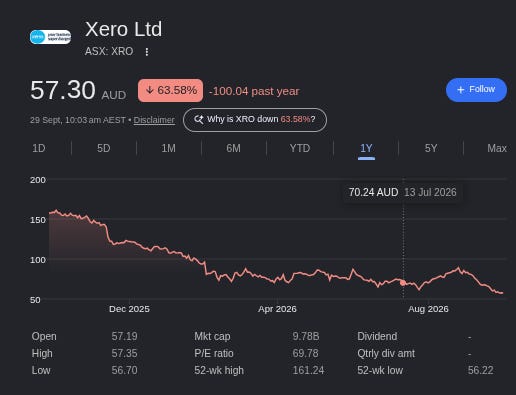
Let’s illustrate this with an example. Xero has had a very rough 2026.
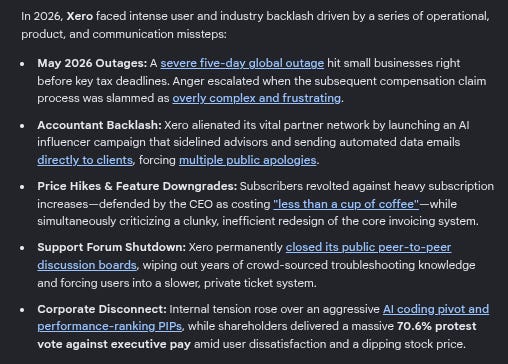
I think in some ways it’s the perfect encapsulation of this idea of enshittification. A once-great (and loved) company that starts to turn its back on its core users and customers, optimising for value-extraction as opposed to customer delight and growth.
“Goodwill towards Xero has been draining for two or three years, slowly and then all at once. [...] The word people keep reaching for is corporate. Not broken. Not failing. Corporate. A company that used to feel like it was building something with you now feels like it is running a set of plays at you.” Damon Anderson “We need to talk about Xero”
Simply put, extraction works way less than it used to. You can only take advantage of customers for so long. Until you can’t. Value extraction is a tricky game of risk vs reward.
For me, this all ladders up to a big question: what if we need to unlearn everything we were taught about the “right” way to build an enterprise software business?
Here’s how I am approaching this personally in my role as Chief Product Officer at Komo.
We (our team and our product) now have to do more of the work for the customer. Whether it’s migrating across from a competitor, setting up integrations or doing ad-hoc analysis or data work, the customer now expects us to take a more leading role in the solution they’ve bought us to implement. To be clear, more often that not, we’re paid for this work, but as a result, I expect services revenue to be an increasingly key role in our growth and retention numbers.
Monthly check-ins and quarterly QBR’s don’t cut it anymore. We are trying to get as many of our customers to weekly touch points, and even into dedicated Slack channels. We’re leveraging the power of AI to help us manage this effectively and maintain our margins.
For the first time, we’re “bespoke-curious”. When previously we’d say “NO!” before even reading the proposal (like every other SaaS company), we’ve started to explore how we can help our customers build more bespoke experiences, on top of our API’s and SDK’s. The amount of raw horsepower we get from agents (both to build and maintain) means this is now suddenly a lot more viable. To say this is a huge change in how we think about SaaS is an understatement.
We’re optimising for being “easy to work with”. We want to be our customer’s favourite vendor. We think that in and of itself is going to be a huge moat.
All of this means, it’s a wonderful time to be a buyer of enterprise software. For the first time ever, customers are well and truly in a position to demand more of their vendors. Ultimately, that’s good for everyone! Oh, except lazy legacy incumbents :)