In recent weeks climate coverage has been dominated by a bizarre combination of: 1. Scientists reassuring humanity the risk has been averted of the planet reaching cataclysmic average temperatures, as predicted in the IPCC’s worst-case scenario ‘RCP8.5’, thanks allegedly to the ‘transition to renewables’ and 2. News that the actual, accelerating global temperatures since 2022 and those confidently forecast for the remainder of 2026 to 2029, undeniably mean we will far exceed the worst extremes imagined by this same RCP8.5.
Less surprisingly, our corporately-controlled global media seized on these scientists’ unfounded optimism as either: 1. evidence business-as-usual is just fine, we just need to push the renewables agenda harder and ‘be more like China’ or 2. evidence all climate science must therefore be wrong, as endorsed by the denier-in-chief, Donald Trump.
We now expect moronicity from the leader of the free world, but these delusional announcements from a ‘consensus of climate scientists’, including Michael E. Mann and Zeke Hausfather, parroted by the likes of AP News, the BBC and the Guardian were as astonishing as they were negligent. Many tens, possibly hundreds, of millions of lives are at urgent risk from the cataclysmic impacts of excess heat in the Earth system plus a climate-change-enhanced, developing ‘super’ El Niño. Such misinformation can only reduce both understanding of this urgency and the chances of funding being allocated to at least mitigate these desperate consequences.
This article will detail the simple facts that show these reassurances to be groundless before considering, why are these highly-educated scientists behaving so dangerously?
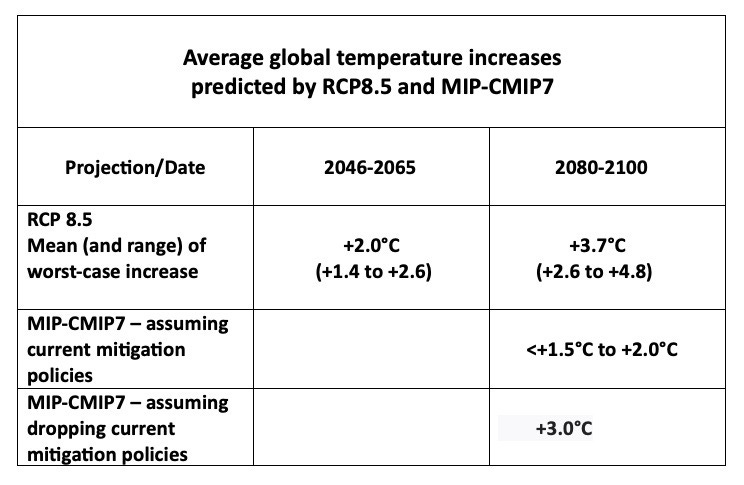
A ‘representative concentration pathway’ (RCP), is a climate change scenario used to project future atmospheric greenhouse gas concentrations and the global heating they cause. Each RCP is measured in terms of the amount of additional trapped energy they lead to, measured in watts per square metre, relative to pre-industrial levels. A range of RCP pathways were adopted by the Intergovernmental Panel on Climate Change (IPCC) in 2008, based on the science available then, with RCP8.5 representing a ‘worst-case scenario’ featuring an increase of 8.5 watts per square metre of trapped heat.
Cutting an exhaustingly-complex story short, RCPs have been replaced by new models, linked to socio-economic pathways, called ‘SSPs’. These in turn represent only one of a range of predictive methods, studied in a comprehensive review commissioned by the World Climate Research Program and published by the European Geosciences Union (EGU) in April 2026 entitled, ‘The Scenario Model Intercomparison Project for CMIP7’ (MIP-CMIP7).
Buried in MIP-CMIP7’s labyrinthine detail is the conclusion an ‘8.5’ scenario has become, ‘implausible, based on trends in the costs of renewables, the emergence of climate policy and recent emission trends.’ The review claimed instead, if we maintained current policy and the ‘energy transition’, heating could stay within the range of less than +1.5°C to a maximum of +2.0°C by 2100. They added a worst-case scenario of +3.5C° but only if, these current policies were ‘rolled back’. This is the ‘good news’ many public-facing scientists chose to promote.
The problem with all this is, not one of the methods reviewed predicted the alarming, accelerating temperatures of 2022-2028. And no reference to this crucial flaw was made in any media commentary – even though these temperatures show the review’s reassuring predictions to be ludicrously under-stated, as follows:
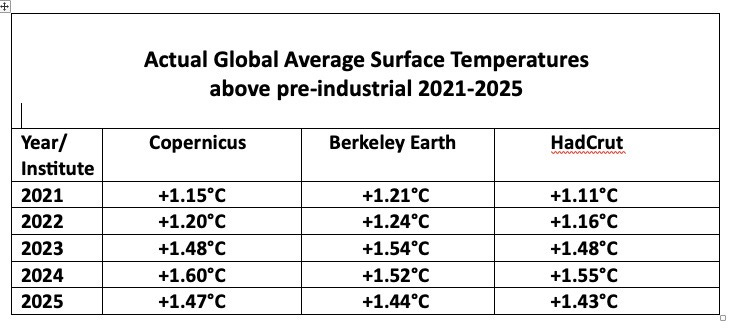
The combined average increase for 2023-2025 from these three measuring institutions, happens to be precisely +1.5°C. The intense heat of June 2026 has provoked many to forecast this will be the hottest year ever, with 2027 being hotter still.
Significantly before this developing super El Niño Jim Hansen was forecasting +1.7°C by 2030, while Klaus Richter, president of the German Physical Society, and Frank Böttcher, chairman of the German Meteorological Society together predicted +3.0°C by 2050 – on current policy tracks. And, at +3.0°C or more by 2050, one of the rare studies brave enough to contemplate this published by the University of Exeter and the UK Institute Of Actuaries in January 2025, estimated we could see 4 billion deaths, along with ‘significant socio-political fragmentation worldwide’.
You don’t need a PhD to conclude the +2.0°C average predicted for 2046-2065 by RCP8.5 will certainly be exceeded, and any claim current ‘mitigation policies’ could keep us within a +2.0°C maximum range by 2100 is both absurdly unrealistic and dangerously complacent.
The answer is simple - the time it took to develop the complex methods reviewed by MIP-CMIP7, meant these simply could not keep up with what was actually happening. This problem was compounded by the timeline of the review itself; the delay before publication alone was as follows:
MIP-CMIP7 Received: 05 Dec 2024
Discussion started: 30 Jan 2025
Revised: 09 Dec 2025
Accepted: 07 Jan 2026
Published: 07 Apr 2026
So, MIP-CMIP7 took 18 months to discuss/revise the historical data in the review and – because most of their references pre-date 2023 - gave no consideration to the wildly-accelerating temperatures which have since invalidated their conclusions.
This is also a perfect illustration of why IPCC reports and advice consistently lag even further far behind real life. The IPCC’s self-imposed methods require them to ‘re-review’ thousands of such already out-of-date studies, before ‘synthesising’ them into one mega-report every 7 years. This massive problem for both this MIP-CMIP7 review and the IPCC – that new data invalidates their conclusions by the time of publication because climate change is happening so fast - is known technically as ‘limited temporal validity’.

It is true that some fossil fuel use has been lower than anticipated by RCP8.5 but – as all scientists know - a range of other factors that RCP8.5 failed to consider, have combined to make even faster accelerating temperatures happen anyway, including:
- A reduction in ‘global dimming’ – lower coal and heavy-diesel emissions, whose sulphate particles radiated significant heat back into space, have actually facilitated extra heating.
- The rate of ocean heating – reducing ocean absorption of both excess heat and carbon.
- The rate of global ice melt – altering deep ocean currents and reducing ‘albedo’ effect, where less snow and ice reflect less light/heat.
- The rate and impact of methane emissions.
- Changes to jet streams significantly reducing agriculture yields.
- Higher climate ‘sensitivity’ to greenhouse gases – where these cause more heating than expected.
Countless studies since 2008 have reported ‘shocked’ scientists observing multiple heating phenomena happening, ‘faster than expected’. Worse, all these factors combine to activate ‘feedback-loops’ which provoke still further acceleration, another underestimated mega-factor.
None of this, however, answers the question; why scientists chose to ignore these simple, undeniable facts and spread false reassurances instead? The answer to this is less scientific...
So… WHY misinform?!
Idiotic denialists accuse climate scientists of being paid to overstate what is happening – ironically, the opposite is true. The 50+ climate scientists employed to undertake the MIP-CMIP7 review were professionally obliged to follow strict, time-consuming, scientific methods. They did not know when doing so, that temperature accelerations (unpredicted by the same methods) would lead to their conclusions being so understated.
MIP-CMIP7’s lead authors, however, should have drawn attention to this obvious problem on publication. Perhaps they were hiding behind the defence they performed ‘good science’ - because the review’s calculations were correct based on the contemporary data available. This is the same feeble rationale the IPCC still uses for their hopelessly-outdated processes, reports and advice. Given the undeniable ‘temporal validation’ problem affecting all climate studies and the IPCC’s methods, however, this defence is no longer scientifically or ethically justifiable.
The MIP-CMIP7 leads should be criticised for voicing the unscientific opinion that lower temperature rises could now be predicted, thanks to our climate actions and policies. This was speculation, even before reality bit so hard.
Minimisation is the new denial.
The MIP-CMIP7 authors also, like the vast majority of scientists, probably wanted little to do with communications beyond academia. Few scientists choose to face the public. The small group that does fills the media space where the IPCC should be - because the IPCC refuses to comment ‘live’ – and has a long track record of minimising what is happening. The reasons they so conspicuously failed to highlight the problems with MIP-CMIP7, and instead communicated false reassurances, no doubt include:
1. Guilt and fear. Michael E. Mann announced in December 2023, in an article in ‘The Hill’, that ‘real’ average temperatures were still only +1.1°C above pre-industrial and the spike caused by the El Niño in progress then, would be temporary. He has been provedspectacularly wrong. Zeke Hausfather is a highly-vocal advocate of ‘clean energy’ and ‘carbon removal’ as ‘solutions’, when neither has had any meaningful impact, nor can this rationally be expected. There are many more examples. Continuing to minimise narrows the gap between their mistakes and being held accountable.
2. ‘Celebrity’ status preservation; this is both threatened by their mistakes and enhanced by encouraging false-hope.
3. Distraction from the fact the people Mann labelled, ‘dangerous’ doomers were right. The uncomfortable truth is the minimisers were the real danger.
4. Minimisation is a form of denial. Perhaps some still can’t bring themselves to ‘go there’, although their misrepresentations must be ever harder to sustain.
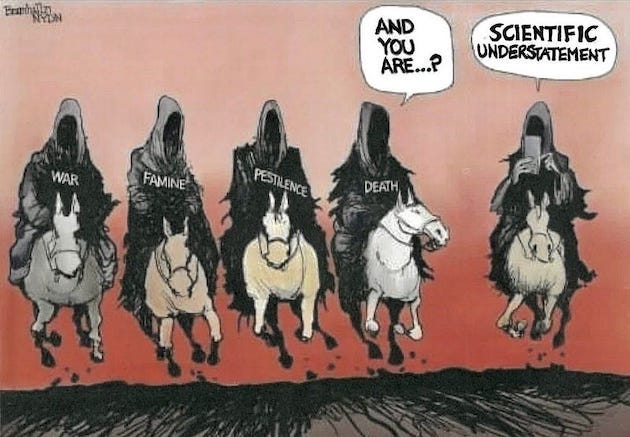
Our political and corporate leaders are, of course, the most responsible for our climate predicament, but they are individually powerless to provoke radical change. Trump pretends he can do anything he wants, but if he, rationally, proposed diverting all non-essential activity to preparation for the cataclysmic impacts on their way - he would be gone. The same goes for any corporate person. Our scientists have more freedom – and they are abusing it.
Nothing will change in response to articles like this. Only scientists can hope to get enough leaders and our media to understand the realistic prospect of more than +3.0°C by 2050 above pre-industrial, means it’s their children too.
The World Meteorological Office (WMO) has just endorsed a belated plea for emergency resources to be targeted at the hundreds of millions in those countries most likely to be devastated by this El Niño. But the WMO is one of 3 organisations who control the same World Climate Research Program that commissioned the MIP-CMIP7 review. Their plea will go unheard in large part because they are complicit in allowing leaders, and everyone else, to believe misinformation like temperature rises are under control because the ‘energy transition’ is the answer.
Everything above has been obvious to individual climate scientists for years. They know the few, egotistical scientists communicating publicly, minimise what is happening and exaggerate ‘solutions’. Just as they also know these odd characters would have no influence if the IPCC itself was telling the truth ‘live’, instead of being the worst minimiser of all. Every scientist knows the IPCC’s choice to ignore the undeniable problem of ‘temporal validity’, renders their crucial advice hopelessly out-of-date. As they also know this choice contributes to the shameful absence of sufficient funding to mitigate the unprecedented suffering on the way.
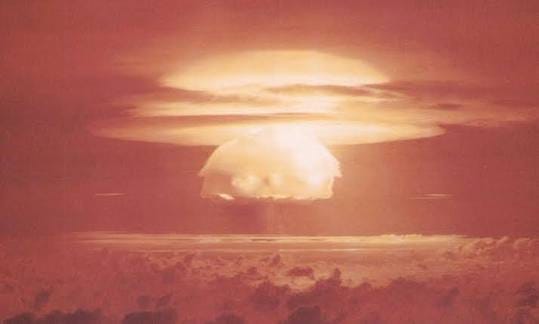
Oppenheimer struggled with the moral dilemma of the consequences of pursuing his scientific discoveries. ‘We knew the world would not be the same’, he said, but, ‘most people were silent’. Neither the few public-facing climate scientists nor the IPCC are silent – but what they say genocidally understates both imminent impacts on the world’s poorest, and the risk these escalate to equal the worst omnicidal fears of nuclear physicists. At least Oppenheimer and his peers had a sense of morality; the IPCC’s moral compass is broken and needs fixing. It’s way past time for the silent majority making up the rest of the scientific community, to confront this unprecedented ethical problem.