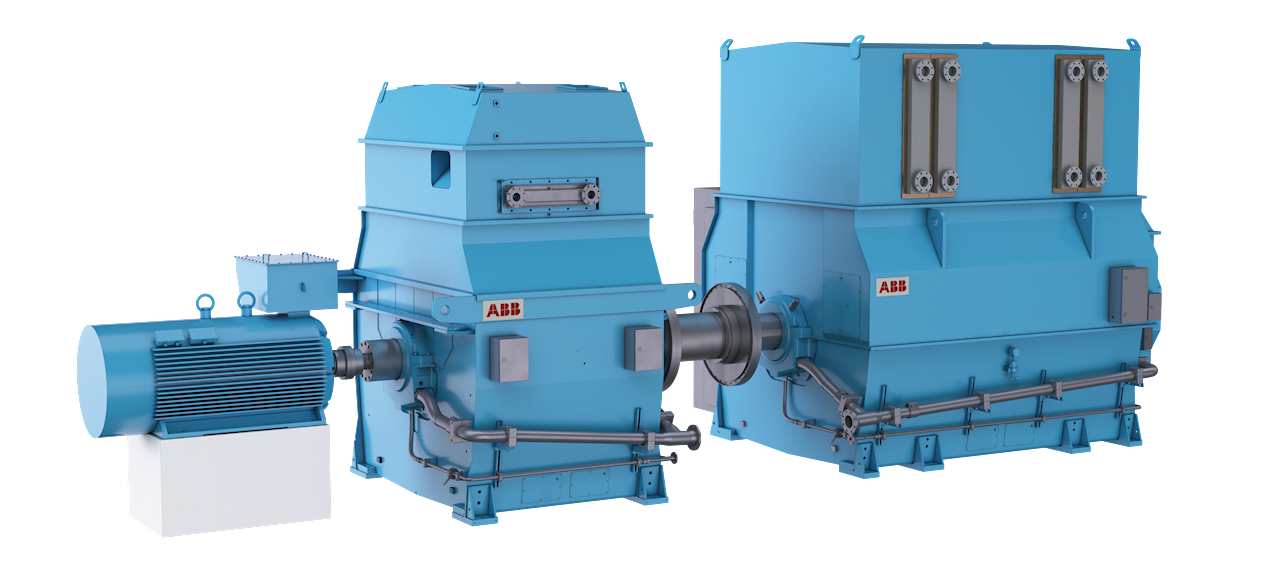
Figure 1. Condenser right (about 15ft tall), flywheel center, pony motor left. The pony motor is needed to spin the condenser up to grid frequency.
I don't regard myself as being pro-nuclear. I'm a naval architect who built the largest double hull tankers ever. I doubt if nuclear powered commercial ships will ever be economic. I don't want anybody to waste money, especially my money, on this nonsense unless they are. If nuclear electricity is expensive, I don't want nuclear electricity. Even if nuclear power is as cheap as it should be, I don't want an all nuclear grid. I just go with the numbers. That's what engineers do. And the numbers say an optimal grid will always have some fossil, even if your social cost of CO2 is extremely high.
Similarly I'm not anti-wind or anti-solar. I helped my brother install what at the time was one of the largest solar plants in the Bahamas. I've been a sailor all my life. I'm prepared to accept the environmental costs of wind/solar for the right numbers. But once again I have to go with the numbers. Like any engineer, I'm always trying to improve the numbers.
It is possible that a contributing factor to the recent Iberian black out was lack of synchronous inertia. A big turbogenerator operating at 3000 rpm has quite a bit of kinetic energy stored in its rotating mass. The inertia of this spinning metal will automatically resist and slow down any frequency change due to a disturbance somewhere on the grid, allowing time for the other control systems to kick in.
We don't yet know what happened in Spain; but whatever started the cascade, the grid was unable to respond quickly enough to keep things from getting out of hand. At the time, about local noon in a low demand hour and season, Spain was generating about 63% of its electricity from wind and PV solar.1 Wind and PV solar have no synchronous inertia which meant the system had less time to react.
Whatever the importance of this lack in this case, the black out piqued my interest. How expensive would it be to replace the missing inertia in a wind/solar based system? Should this be included in my numbers? So I did a little back of the envelope.
Power engineers measure a generator's inertia in seconds of rated power stored as kinetic energy. This is weirdly called the inertia constant. The inertia constant for a fossil fuel generator can run from 2 to 7 seconds, with a typical value being 4. Thus a 1 GW 50 Hz coal plant will have something like 4 GW-s (4 GJ) of stored rotating energy. Wind and solar have no synchronous inertia. One way of replacing this inertia is a synchronous condenser and a flywheel. This is simply a synchronous motor driving a flywheel and nothing else, Figure 1. The flywheel is operated in a vacuum to reduce losses.
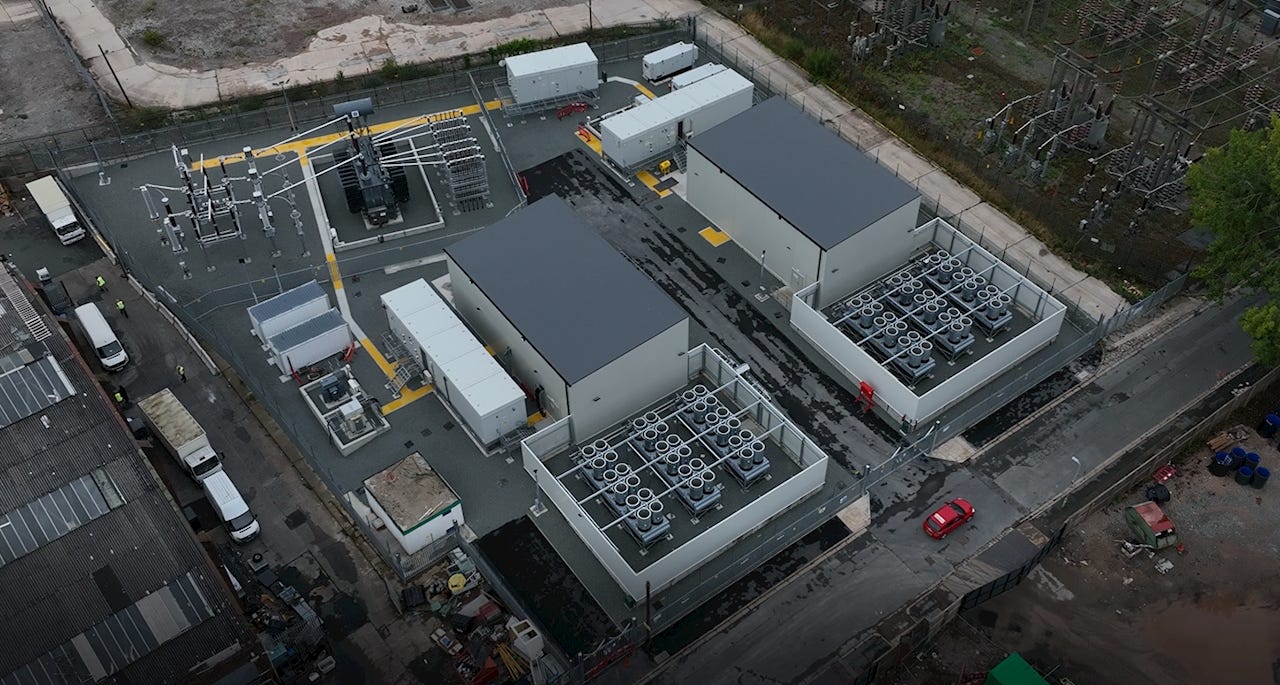
Figure 2.Lister Drive. The syncons are in the two dark gray roofed buildings. Note the induced draft cooling fans in the foreground to dissipate the wasted energy.
The UK grid operator recently installed two such devices at the Lister Drive facility near Liverpool. Together they can provide 900 MW-s of stored energy, about the same as a 225 MW coal plant. The reported cost was 25 million pounds or about $33 million. That's roughly 7% of what it would cost to build an entire 225 MW coal plant. The Lister Drive plant will also eat up about 1 MW of power.
If we assume solar costs about $1000 per nameplate kW or a billion dollars per GW installed capacity, and we want to provide coal plant equivalent inertia for this capacity, we would need to spend about $150 million on synchronous condensers. This would add something like 15% to the cost of the plant! Of course, our 1 GW solar plant will actually average something like 300 MW depending on location, so the inertia will cost us something like $500/kW of effective capacity.
We may be able to get by with less inertia, but only at the cost of decreased system reliability. It's also possible that a combination of enough batteries and fancy electronics can more cheaply substitute for the inertia; but obviously the UK grid operator doesn't think so.
I found this number surprising. It's quite possible that it is badly wrong. This is not an area where I have any experience. But if it is anywhere near right, this is something we will have to factor in in any non-misleading grid model. Right now the GKG Grid Model fails to do this.