Ultradiffuse galaxies (UDGs) are a class of galaxies that have very low surface brightness (g-band central surface brightness of μ0,g > 24.0 mag arcsec−2) but large physical size (effective radius of Re > 1.5 kpc). Significant attention has been focused on UDGs since their initial identification en masse by P. G. van Dokkum et al. (2015) using the Dragonfly Telephoto Array (R. G. Abraham & P. G. van Dokkum 2014). P. G. van Dokkum et al. (2015) first identified a large number of UDGs in the Coma cluster by their distinctive smooth, diffuse emission. Subsequently, thousands of UDGs were found in various rich galaxy clusters as well as low-density field environments (e.g., D. Martínez-Delgado et al. 2016; M. Yagi et al. 2016; C. Wittmann et al. 2017; S. Danieli & P. van Dokkum 2019; D. A. Forbes et al. 2019; S. R. Janssens et al. 2019; J. Román et al. 2019; S. Danieli et al. 2020; D. A. Forbes et al. 2020 ; S. Lim et al. 2020; F. R. Marleau et al. 2021, 2025).
Many UDGs identified to date host exceptionally large globular cluster (GC) populations: 5–7 times more GCs on average than typical galaxies with the same luminosity (E. W. Peng & S. Lim 2016; P. van Dokkum et al. 2017; N. C. Amorisco et al. 2018; S. Lim et al. 2018; D. A. Forbes et al. 2020; S. Danieli et al. 2022). Some of the most extreme GC-to-stellar mass ratios to date were found in NGC 5846-UDG1 (D. A. Forbes et al. 2019; O. Mueller et al. 2021) with ∼54 GCs that make up ∼9.8% of the total stellar mass (S. Danieli et al. 2022); UGC 9050-Dw1, with ∼52 GCs making up ∼16%16 of the stellar mass (C. E. Fielder et al. 2023); and VLSB-B with ∼26 GCs taking up ∼23.7% of the total stellar mass (S. Lim et al. 2020; E. Toloba et al. 2023; J. S. Gannon et al. 2024).
The discovery of numerous UDGs with large GC populations pushes the boundaries of galaxy formation theories, and begs the question: are UDGs at the bright end of an even more diffuse class of galaxies? These galaxies could be so diffuse that they are almost entirely dominated by dark matter, with the majority of their stellar populations contained in GCs (D. D. Li et al. 2022). In other words, could almost dark galaxies exist?
Under the star formation scenario proposed by S. Danieli et al. (2022) where nearly all stellar populations may have originated from GCs for NGC 5846-UDG1 and UGC 9050-Dw1, it should not be a wild speculation that almost dark galaxies can exist. The discovery of these galaxies would have profound implications, as they would provide evidence for extreme star formation scenarios as opposed to the typical one where stars are born in loose agglomerations and then slowly disperse such as in the Milky Way (R. C. Kennicutt & N. J. Evans 2012). In addition, further constraints on GC mass loss may be established by these dark galaxies. Moreover, they could be ideal objects to test dark matter models such as the ultralight axionic dark matter model (W. Hu et al. 2000; M. G. Walker & J. Peñarrubia 2011; L. Hui et al. 2017). For example, the famous dark matter dominated UDG Dragonfly 44 (P. van Dokkum et al. 2016; A. Wasserman et al. 2019) has been utilized to constrain the ultralight scalar field mass within the fuzzy dark matter model framework. Additional massive dark galaxies can provide further constraints on these dark matter models (A. Wasserman et al. 2019; A. Burkert 2020).
Conventional methods of searching for diffuse stellar light to find UDGs (e.g., P. G. van Dokkum et al. 2015) will fail at identifying dark galaxies, even if they exist. To this end, D. D. Li et al. (2022) proposed a statistical approach that bypasses the search for diffuse stellar light and instead looks for overdensities of GCs that seemingly do not belong to any bright galaxy. GCs would not clump together spatially without sufficient mass (such as dark matter) binding them gravitationally. Thus, the identification of GC spatial overdensities could imply the existence of UDGs/dark galaxies.
D. D. Li et al. (2022) applied their method to GC data obtained from the Program for Imaging of the PERseus cluster (PIPER) survey (W. E. Harris et al. 2020)—a Hubble Space Telescope (HST) imaging program targeting the Perseus cluster. D. D. Li et al. (2022) successfully detected 11 overdensities of GCs, 10 of which correspond to previously confirmed UDGs with GC number NGC ≥ 3. However, a clump of four tightly grouped GCs with no apparent diffuse emission was also found. This spatial clump of GCs does not belong to any previously known galaxy, and was therefore labeled Candidate Dark Galaxy-1 (CDG-1; D. D. Li et al. 2022). A follow-up study based on a deep HST/UVIS imaging program (P. van Dokkum et al. 2024) still did not reveal any significant diffuse component in CDG-1. In addition, F. R. Marleau et al. (2025) did not find an optical counterpart for the diffuse emission in the Euclid Early Release Observations (ERO) either. Thus, the nature of CDG-1 remains uncertain.
Later, D. Li et al. (2025a) addressed several shortcomings of the detection method in D. D. Li et al. (2022) and proposed an improved statistical model to detect overdensities of GCs that may be associated with UDGs/dark galaxies. The new method includes additional information such as GC color to boost the clustering signals of GCs within UDGs/dark galaxies. Using the new method and the same GC data from the PIPER survey, D. Li et al. (2025a) found another tight grouping of three GCs that was missed in D. D. Li et al. (2022). This spatial clump of GCs was labeled Candidate Dark Galaxy-2 (CDG-2; at coordinates  ).
).
In this study, we use the same PIPER imaging material and apply the method in D. Li et al. (2025a) to a new GC catalog with photometry more sensitive to the faint end completed in D. Li et al. (2025b). In this updated analysis, a new GC candidate was detected in CDG-2 and the detection signal for CDG-2 increases by almost tenfold compared to that in D. Li et al. (2025a). This puts CDG-2 in the same category as CDG-1 in terms of the clustering strength of its constituent GCs. In other words, the probability that CDG-2 is a clump of GCs arising by chance from the GC population of the intergalactic medium (IGM) is extremely low.
We subsequently noted that CDG-2 was observed in two different imaging visits of the PIPER survey. In this work, we stack these two images and find that there is extremely faint but significant diffuse emission around CDG-2. In addition, we utilize the newly released imaging data from the Euclid ERO targeting the Perseus cluster (F. R. Marleau et al. 2025). The Euclid data also reveal extremely faint diffuse emission with the same morphology as that from the HST data. The existence of diffuse emission from both HST and Euclid data provides almost definitive evidence that CDG-2 is a galaxy and it is the first one discovered through its GC population. Using the Euclid imaging, which is optimized for detecting diffuse structure, we conduct a simple analysis, which suggests that at least 16.6% of light in CDG-2 comes from its GC population, while a much higher ratio of 33% is possible if additional but unobserved GCs are present. Thus, CDG-2 may be the galaxy with the most extreme GC stellar light and mass ratios ever discovered.
The GC data were constructed from the PIPER survey (W. E. Harris et al. 2020). The survey targeted the Perseus galaxy cluster at a distance of 75 Mpc (W. E. Harris et al. 2020) and was conducted by the HST with its onboard Advanced Camera for Surveys (ACS) and Wide Field Camera 3 (WFC3).
Ten imaging visits of the PIPER survey targeted the outer regions of Perseus, where each visit consists of an imaging pair—one captured by ACS and the other by WFC3. The ACS images were taken using the F475W and F814W filters, while the parallel WFC3 images used the F475X and F814W filters. Each image is assigned an ID denoting the visit number and the camera, e.g., V6-ACS is the image captured by ACS during the sixth visit.
The majority of GCs appear unresolved (point-like or near-point-like) at the distance of Perseus. Therefore, photometric software such as DAOPHOT and DOLPHOT designed for this purpose can be used to construct GC catalogs. In the initial PIPER survey paper (W. E. Harris et al. 2020), a GC catalog was constructed via the point-source list obtained from DAOPHOT (P. B. Stetson 1987). Later, in D. Li et al. (2025b), DOLPHOT (A. E. Dolphin 2000; A. Dolphin 2016) was used to construct a new GC catalog to conduct a GC population study for UDGs in Perseus. Details of the GC catalog construction are provided in W. E. Harris et al. (2020, 2023) and D. Li et al. (2025b). Briefly, for both catalogs, an initial list was constructed from all objects detected in F814W, and magnitudes were measured through point-spread function (PSF) fitting. Objects successfully measured in both filters were retained, and clearly nonstellar objects were removed with the sharp and chi parameters generated by DOLPHOT (see W. E. Harris et al. 2020, 2023, for a more extended description). Although the the final measurements from both DOLPHOT and DAOPHOT were in close agreement, it was felt that an independent check on the previous data would be of some value (for a much more exhaustive comparison of the codes in practice, see M. Monelli et al. 2010).
A careful manual selection of the DOLPHOT point-source list was also performed to finalize the GC catalog. The final GC catalogs were determined through a (extinction-corrected) color–magnitude diagram: in W. E. Harris et al. (2020), sources with magnitudes 22.0 ≤ F814W ≤ 25.5 mag and colors 1.0 ≤ F475W − F814W ≤ 2.4 mag were deemed to be likely GCs; in D. Li et al. (2025b), a different method was used to obtain a probabilistic GC catalog. In this study, for simplicity, we consider GC selection criteria of 22.0 ≤ F814W ≤ 25.75 mag and colors 1.0 ≤ F475W − F814W ≤ 2.4 mag based on the point-source list from D. Li et al. (2025b). The faint limit of 25.75 mag corresponds to the 50% completeness fraction obtained from an artificial star test using DOLPHOT (see D. Li et al. 2025b, for more details), while the canonical GC luminosity function (GCLF) turnover point is MTO ∼ 26.3 mag at the distance of Perseus (W. E. Harris et al. 2020; S. R. Janssens et al. 2024).
With the recent public release of the Euclid ERO targeting the Perseus cluster (F. R. Marleau et al. 2025), we also utilize the Euclid ERO data in this work. While the PIPER survey from HST is optimized to detect point sources such as unresolved GCs, in Perseus, Euclid is better suited for detecting and analyzing extremely diffuse emission that would validate the nature of CDG-2 (J. C. Cuillandre et al. 2024).
CDG-2 was detected in the images V12-ACS and V14-ACS. The spatial distributions of GC candidates in DOLPHOT and DAOPHOT catalogs of both images are shown in Figure 1. The GC candidates that constitute CDG-2 from both images are highlighted in the zoomed-in images on the side of Figure 1. Since a portion of large GCs at the distance of the Perseus cluster (75 Mpc) are partially resolved and not exactly starlike, the point-source selection criteria under DOLPHOT took this into account, as it did with the previous study of W. E. Harris et al. (2020). Additionally, the faint limit of the DOLPHOT GC catalog was deliberately set to be slightly deeper (a lower signal-to-noise ratio (SNR) threshold) with less stringent point-source selection criteria (based on the sharp and chi parameters) than those used in the previous study, and thus more GC candidates are included in the present DOLPHOT catalog.
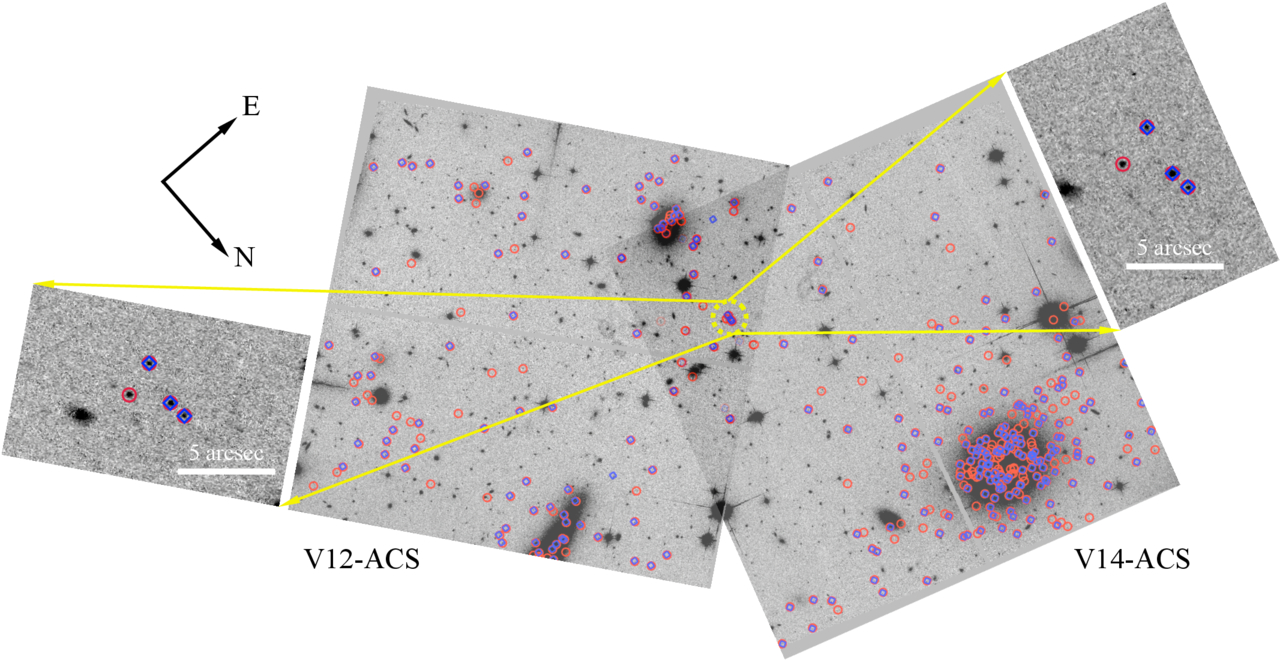
Figure 1. Spatial distributions of GC candidates in the F814W images V12-ACS (left) and V14-ACS (right). Red circles are GC candidates from DOLPHOT while blue diamonds are from DAOPHOT. The GC candidates that constitute CDG-2 from the two images are enlarged and annotated on the side.
Download figure:
Standard image High-resolution image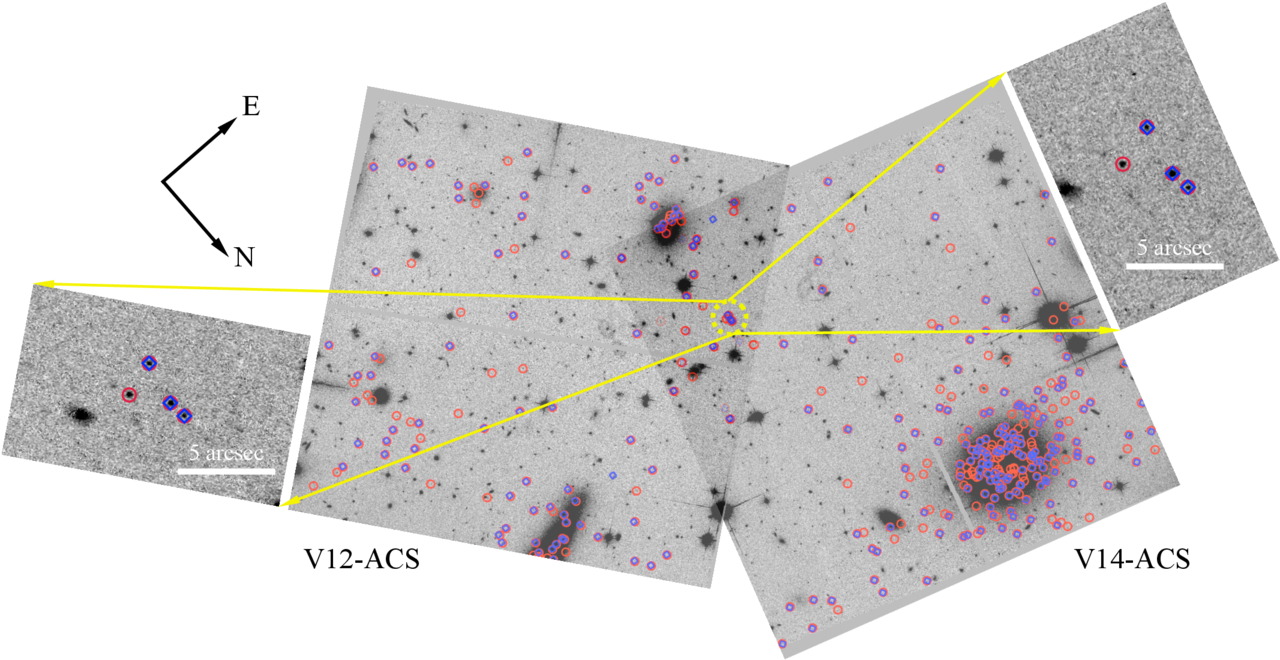
Although the less stringent GC selection criteria mean there are more contaminating objects, it also means that fainter or marginally resolved GC candidates previously excluded in the DAOPHOT catalog are now included in the present GC catalog. A direct implication here is that our DOLPHOT catalog contains an additional GC candidate (see Figure 1) in close vicinity to the original three GC candidates from W. E. Harris et al. (2020) in CDG-2. Table 1 shows the (averaged) properties of the four GC candidates from both V12-ACS and V14-ACS measured in the present study. The half-light radii rh were measured with the ISHAPE profile-fitting code (S. S. Larsen 1999) as described in W. E. Harris et al. (2020) and D. D. Li et al. (2022). The additional GC candidate from the DOLPHOT catalog is CDG-2-GCC1. This GC candidate was missed in the previous catalog most likely because it is marginally resolved (see Figure 1) and did not pass the point-source selection thresholds that were adopted previously. Close visual inspection of CDG-2-GCC1 suggests that it has the morphology expected from a GC at the distance of Perseus, and it also has the magnitude and color of a typical GC. Additionally, we compared the magnitude measurements from DOLPHOT to that from DAOPHOT for the three GC candidates that are present in both catalogs, and found the measurements are consistent within the measurement uncertainty (a few hundredths of magnitude difference). Based on the results in Table 1, all four of the GC candidates have luminosities, intrinsic colors, and half-light radii that are consistent with identification as GCs.
We use the method of D. Li et al. (2025a) for detecting UDGs/dark galaxies based on the clustering of GCs that do not belong to any apparent bright galaxy. The locations of GC candidates in an image are modeled as three overlapping point processes corresponding to GCs in the IGM, in luminous normal galaxies, and in UDGs/dark galaxies. The latent point pattern corresponding to the unknown UDG centers is the object of inferential interest. Inference is conducted via a transdimensional Markov Chain Monte Carlo (MCMC) algorithm where each MCMC sample is a point pattern of UDG centers. This allows calculation of the posterior predictive probability that any region in an image contains a UDG. New UDGs are detected by partitioning an image into a fine grid and plotting this probability on a color scale. A visual inspection is then performed to identify regions with relatively high probability of containing a UDG/dark galaxy.
A significant advantage of the detection method by D. Li et al. (2025a) is that the effects of background GCs are fully incorporated in the detection model. In fact, the method by D. Li et al. (2025a) is able to produce posterior estimates of the probability that GC candidates in the image belong to a detected UDG.
D. Li et al. (2025a) applied their method to GC data from 12 images from the DAOPHOT GC catalog (W. E. Harris et al. 2020) to test their model performance. The model successfully detected all previously known UDGs with NGC ≥ 3 in these 12 images as well as CDG-1. Additionally, a very strong clustering signal made up of three tightly clumped GCs was detected in both the images V12-ACS and V14-ACS, and this was the initial discovery of CDG-2.
In the next section, we present the detection results and analysis of CDG-2 based on the new DOLPHOT GC catalog.
Figure 2 shows the detection results for CDG-2 using the DOLPHOT data. The purple circles in both panels of Figure 2 indicate the location of CDG-2 in V12-ACS and V14-ACS, respectively. For better visualization and comparison, the color scale is the relative posterior probability of a UDG/dark galaxy present at a given location, i.e., it is the ratio of the posterior probability to the prior probability. For the prior probability, it is assumed that there are on average 2.5 UDGs/dark galaxies in an image and that they are uniformly distributed across the image. From the posterior distribution, the probability that there is a UDG/dark galaxy at the location of CDG-2 is ∼2000 times that of the prior probability.
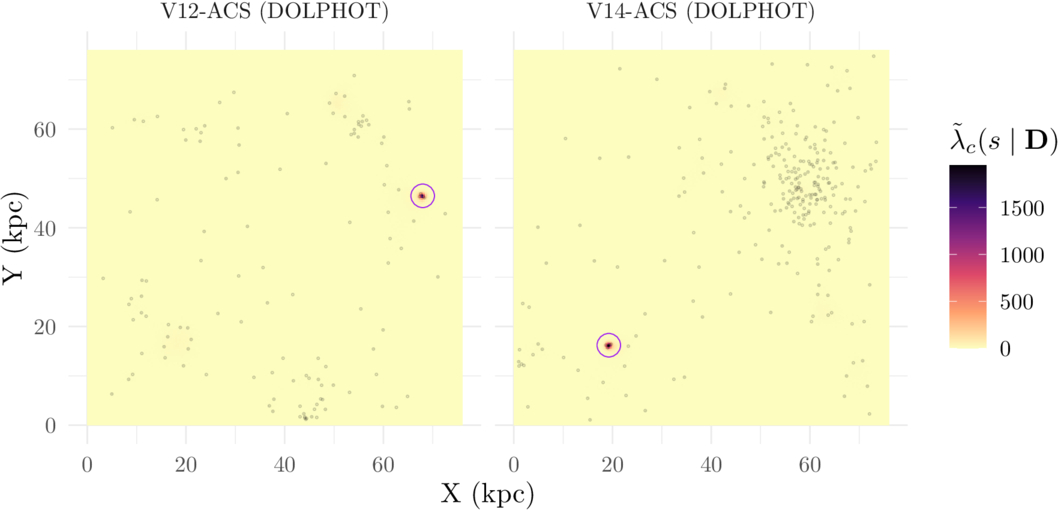
Figure 2. Scaled posterior probability (posterior/prior probability) of the potential locations of UDGs/dark galaxies in the images V12-ACS (left) and V14-ACS (right) obtained using the detection method in D. Li et al. (2025a) based on the DOLPHOT GC data (W. E. Harris et al. 2020). Purple circles are the locations of CDG-2 in both images. Gray points are the locations of GC candidates.
Download figure:
Standard image High-resolution image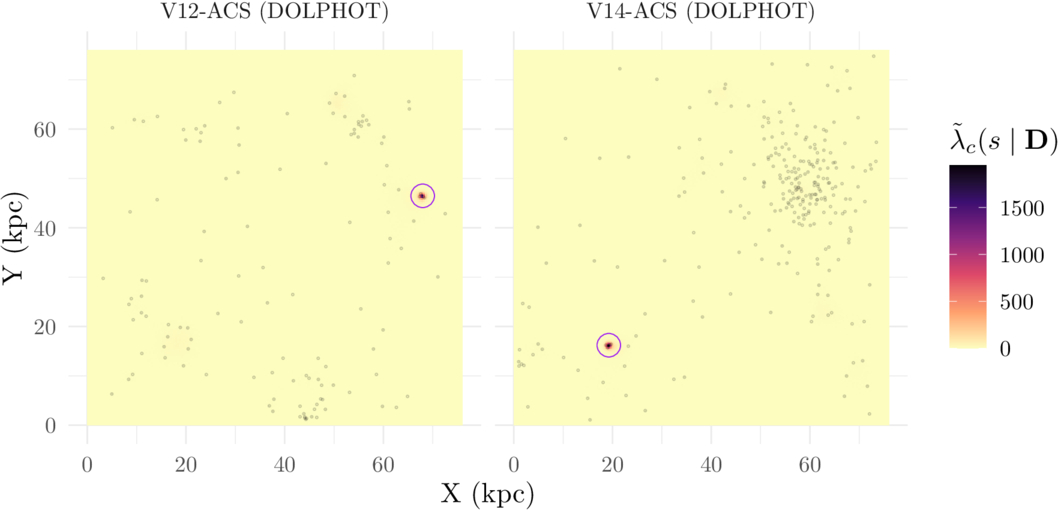
On the other hand, based on the results from D. Li et al. (2025a) using the DAOPHOT data (see Figure 4 in D. Li et al. 2025a), the scaled posterior intensity for CDG-2 is ∼200 times that of the prior probability. The detection signal of CDG-2 thus increases by tenfold when using the new data from DOLPHOT.
The main reason that there is an increase in the detection signal of CDG-2 is the inclusion of the additional GC candidate CDG-2-GCC1. Adding one GC candidate in the close vicinity of the original three GC candidates in a region with a relatively uncrowded background drastically increases the intensity profile of CDG-2. Another reason the detection signal is stronger under the new analysis is that we now consider and model the GC spatial distributions from all bright galaxies in both images, which reduces the noise affecting the detection of CDG-2. For simplicity, D. Li et al. (2025a) did not include the modeling of GC distributions in these smaller galaxies, and their weaker GC clustering signals affected the signal strengths of CDG-2.
The four GC candidates in CDG-2 span a diameter of 3 2, which corresponds to ∼1.2 kpc at 75 Mpc. The probability that four GC candidates in CDG-2 occur due to random chance is ∼1.5 × 10⁻⁵, or one in every ∼67,000 images with the same size and noise level as V12-ACS and V14-ACS, based on the posterior estimates of the background GC counts. In comparison, the GC candidates in CDG-1 span a diameter of ∼2 kpc, while the same probability for CDG-1 under the DOLPHOT catalog is estimated to be ∼2 × 10⁻³. Thus, the GC candidates in CDG-2 are even more unlikely to arise randomly from the IGM than CDG-1 since the GCs in CDG-2 are much more compact.
In addition, for both V12-ACS and V14-ACS, the maximum a posteriori (MAP) estimate for the probability that all four GCs we analyze belong to a detected UDG (i.e., CDG-2) is 94% ± 0.5%. On the other hand, for all other GC candidates in both images, each of them has an MAP estimate of a ≲0.5% chance that they belong to CDG-2. Therefore, we have strong statistical evidence (purely based on spatial distribution) that the four GCs indeed constitute the GC population of CDG-2 down to the detection limit.
Given the high statistical significance that CDG-2 is not a random grouping of four GCs, we subsequently stacked the two images of V12-ACS and V14-ACS. The middle cutout image in Figure 3(a) shows the result: extremely diffuse emission surrounding the four GCs.
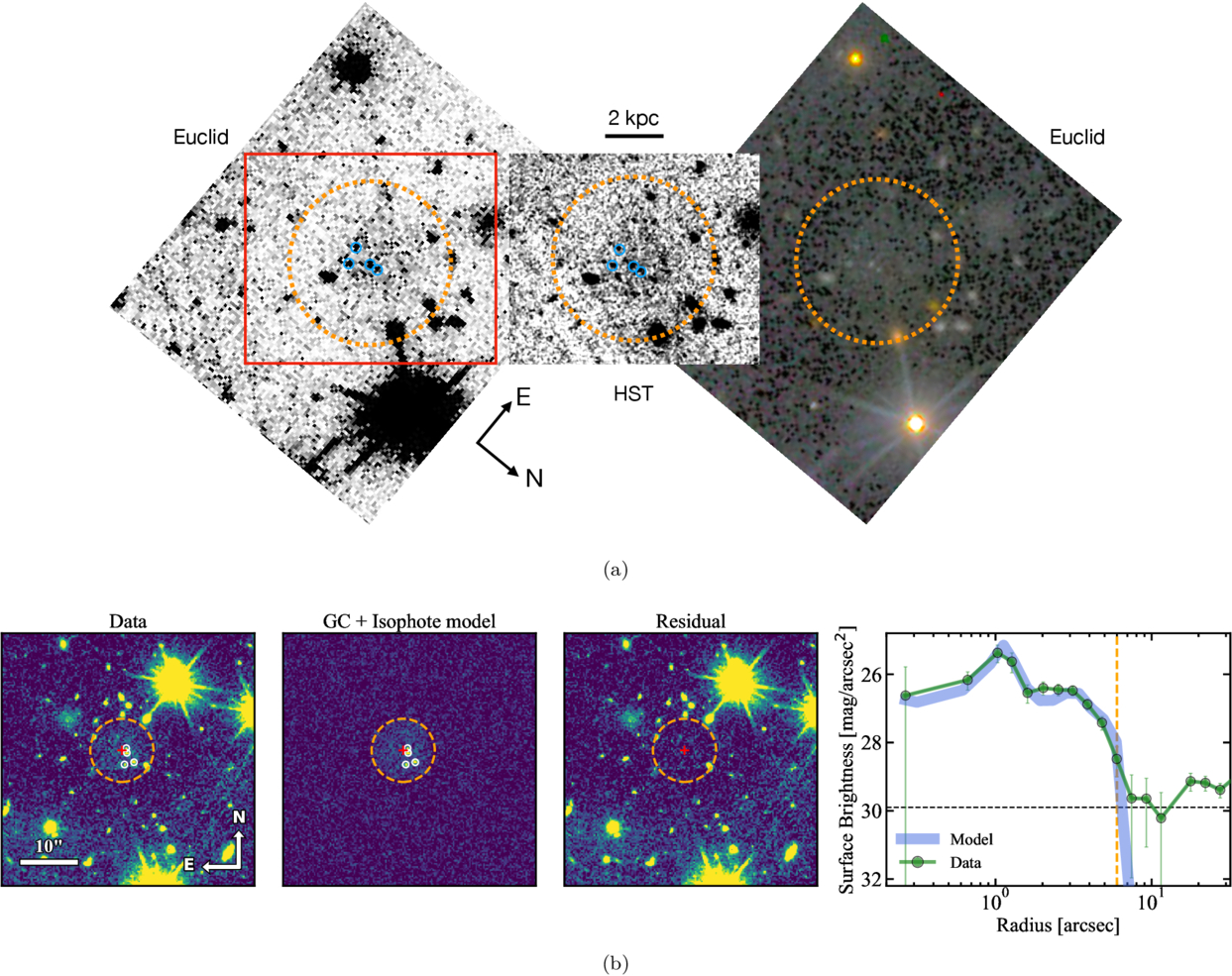
Figure 3. (a) Cutout images of CDG-2 obtained from binning IE-band (VIS imager) data from Euclid (left); stacked and smoothed F814W images from V12-ACS and V14-ACS images from the PIPER HST survey (middle); VIS, Y-band, and H-band combined color image from Euclid (right). Blue circles indicate the four GCs in CDG-2 while the orange dashed circle roughly outlines the region occupied by the diffuse emission in CDG-2. The diffuse emission in CDG-2 is clearly present in both data sets with similar morphology. (b) Left: Euclid IE-band data used for modeling and analyzing CDG-2. The image scale is displayed in arcsinh stretch using [0.25, 0.95] quantiles of the image. Middle left: the combined model of GCs and diffuse emission. A simulated noise level matching the data is added. Middle right: residual of the image with the combined model subtracted. Right: radial profiles of the GC + isophote model (blue) and the data (green). The orange dashed line indicates the range of isophote fitting. In the left three panels, CDG-2 is marked with a orange circle and GCs are marked with white circles.
Download figure:
Standard image High-resolution image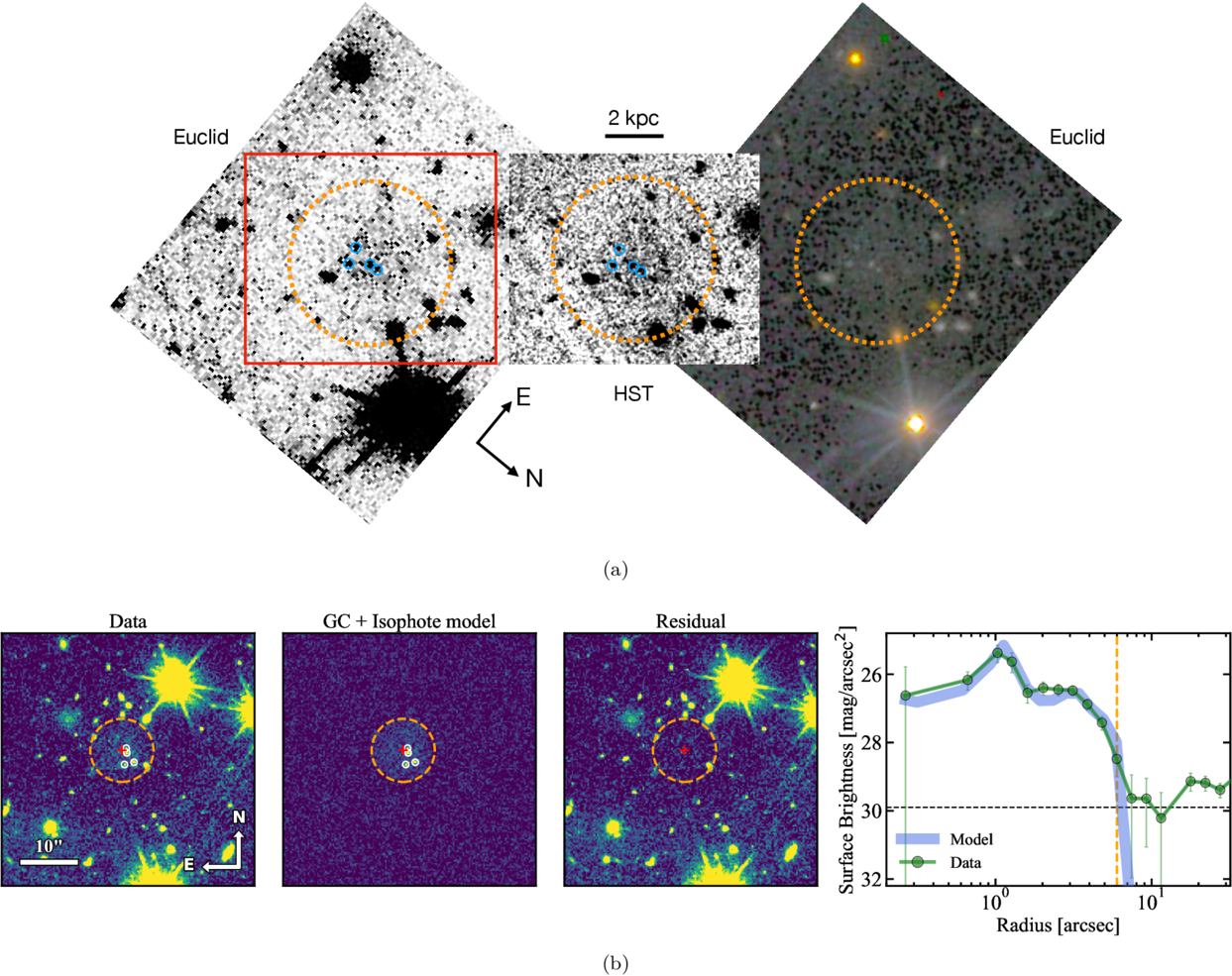
Next, we checked for diffuse emission in CDG-2 using the newly released public data from the Euclid ERO (F. R. Marleau et al. 2025). The Euclid data confirm that the diffuse emission is present, as shown in the left- and right-hand cutouts of Figure 3(a). The morphology of the diffuse emission in both the HST and Euclid data is almost identical. This means its presence is not due to imaging artifacts in either survey. The nonspurious diffuse emission coincident with the extremely high GC clustering signal provides us with exceptionally strong evidence that CDG-2 is an almost dark galaxy. Certainly, the ultimate confirmation requires spectroscopic data obtained by powerful telescopes such as the James Webb Space Telescope.
Another significant advantage of the Euclid data over the HST data from the PIPER survey is that Euclid is optimized for detecting and analyzing diffuse structure in images (J. C. Cuillandre et al. 2024). Thus, we used the single broadband IE ≃ r + i + z imaging data from the VIS imager on board Euclid to conduct a preliminary analysis of the diffuse emission and GC photometry. Note that the Euclid data are in AB mag instead of Vega mag like the HST data. Moreover, 3 × 3 pixel binning was applied to the imaging data to improve the diffuse emission analysis. We then obtained a rough estimate on the fraction of light contained in the GCs for CDG-2.
Specifically, we carried out combined modeling, using PSF photometry for the GCs and ellipse isophote fitting for the extended light, with the photutils software as follows: First, we removed the diffuse light in the background of CDG-2 using a SExtractor-like local background estimator and masked other nearby sources. CDG-2 was masked using an aperture with a radius of 6″. The background scale was chosen to be larger than CDG-2 to not remove the galaxy. Next, we ran PSF photometry on the background-subtracted image in which the target point sources (here the four GCs) were simultaneously fitted with the Euclid PSF to obtain their integrated flux. The fitted GCs were subtracted from the image and the image was then smoothed by a Gaussian kernel with a standard deviation of 1 pixel to enhance the SNR for diffuse light modeling. We then ran elliptical isophote fitting on the GC-subtracted, smoothed image.
The above procedures were performed iteratively to mitigate the issue of point-source modeling and diffuse light modeling affecting each other from one iteration to the other. For the isophote fitting, we set a maximum semimajor axis length of 6″ (∼2.2 kpc), beyond which the surface brightness of the isophote shows a sharp decrease. Since for low surface brightness galaxies, the very faint outskirt regions can contain a significant fraction of their total flux (e.g., J. C. Mihos et al. 2015), we also conducted a simple mock galaxy injection test to correct for the flux outside the range of the isophote model (see details in the Appendix). We found that roughly 86% of the diffuse light is contained within the isophote range. The total flux of the diffuse emission was first computed from the isophote model and then corrected based on the mock galaxy injection test. Due to the low surface brightness of CDG-2, its perceived center is quite uncertain. Moreover, there is an offset between the center of the four GCs and the perceived center of the diffuse emission. Thus, we did not fix the centers of the isophotes but added constraints on their geometries to reject unrealistic results. Uncertainties in the PSF photometry, background estimates, and isophote intensities were propagated to the calculation of the integrated flux of the GCs and the diffuse emission.
As mentioned in Sections 3 and 4, the nature of our detection method and its results mean the effect of potential background GC contamination is of minimal concern. Therefore, it is safe to proceed our analysis by assuming the four GC candidates in CDG-2 are the contributors to its GC population down to the detection limit of the images.
Figure 3(b) shows the data and our analysis of isophote fitting for CDG-2. The combined GC and diffuse light model averaged over 100 iterations is shown in middle left panel of Figure 3(b), and the middle right panel shows the residual of the data and the model. The absolute AB magnitude of the four GCs is  mag. After converting IE-band magnitude to V-band magnitude17
(F. R. Marleau et al. 2025; T. Saifollahi et al. 2025), the total GC luminosity is LV,GC = 1.03 ± 0.2 × 10⁶ L⊙ at the distance of 75 Mpc. Due to the extreme low surface brightness of CDG-2 (
mag. After converting IE-band magnitude to V-band magnitude17
(F. R. Marleau et al. 2025; T. Saifollahi et al. 2025), the total GC luminosity is LV,GC = 1.03 ± 0.2 × 10⁶ L⊙ at the distance of 75 Mpc. Due to the extreme low surface brightness of CDG-2 ( 27.0 mag arcsec−2), the inferred absolute magnitude of the diffuse light within the isophote fluctuates around
  mag, which leads to the diffuse light component of CDG-2 within the isophote range having a total luminosity of
  at the same distance. The right panel of Figure 3(b) shows the radial profiles of the combined GC and isophote model and the data using the light-weighted center of the isophote model as the center, indicating a good match between the data and the model. The measured mean fraction of light in GCs within the isophote range stands at 18.2% ± 2.0%. The uncertainty combines the fluctuations over 100 iterations and the average measurement uncertainty in each iteration. After correcting for the flux outside of the isophote range based on our injected mock galaxy test, the final estimate of the total luminosity for CDG-2 is LV,gal ≈ 6.2 ± 3.0 × 10⁶ L⊙. This translates to our final estimate for the mean GC light fraction of fL,GC = 16.6% ± 2.0% in CDG-2.
For robustness, we also considered the 20,000 s Subaru Hyper Suprime-Cam g-band data (S. Miyazaki et al. 2018) and the archival CFHT/MegaCam g-band data to determine the GC light fractions in CDG-2. The modeling and data analysis procedures are similar to that for Euclid. For simplicity, we do not illustrate the details here. We found that the resulting GC light fraction based on Subaru data is ∼18%, while the much noisier CFHT data yielded a GC light fraction of ∼22%. The results here indicate that our estimates of the GC light fraction in CDG-2 are quite robust.
6.1. Globular Cluster Stellar Mass Ratio
As a first-order estimate, our results demonstrate that CDG-2 has some of the most extreme properties among all known galaxies. Based on the GC colors shown in Table 1, the GCs in CDG-2 are rather blue and thus metal poor, which is similar to GCs in NGC 5846-UDG1. If we make a similar assumption on the mass-to-light ratio as in S. Danieli et al. (2022) where M/LV ≈ 2M⊙/L⊙ for field stars and M/LV ≈ 1.6M⊙/L⊙ for GCs, we find an estimated GC stellar mass ratio of fM,GC ∼ 13.7%. However, the light and mass ratios are likely much higher since we did not correct for the GCLF. Indeed, based on the stacked HST images in Figure 3(a), there does seem to be quite a few faint unresolved point-like sources around the four detected GC candidates that could potentially be undetected GCs.
Assuming CDG-2 has a GCLF similar to the canonical GCLF in I band (MTO = 26.3 mag and σM = 1.1 mag), we here obtain rough estimates on the GCLF-corrected GC-to-field starlight and mass ratios. Based on the completeness fraction of DOLPHOT data (see D. Li et al. 2025b, for more details), the 50% completeness limit is 25.75 mag while the 90% limit is 24.3 mag. If we, for simplicity, assume the photometry is complete at the faintest magnitude of the four GCs (25.2 mag)18 in Table 1, the cumulative GC luminosity at 25.2 mag is ∼50% of the total GC luminosity in CDG-2. This translates to a GC stellar light ratio of fL,GC ∼ 33%, while the GC stellar mass ratio is fM,GC ∼ 28%. Comparing this to known galaxies with extremely high fM,GC estimates, such as NGC 5846-UDG1 at ∼9.8% (S. Danieli et al. 2022), UGC 9050-Dw1 at ∼16% (C. E. Fielder et al. 2023), and VLSB-B at ∼23.7% (J. S. Gannon et al. 2024), CDG-2 may indeed be the galaxy with the highest GC-to-stellar mass ratio discovered to date.
Certainly, the above results heavily depend on the distance to CDG-2, dCDG-2, which causes changes in the GCLF.
Figure 4 shows the GCLF-corrected fL,GC and fM,GC of CDG-2 as a function of dCDG-2. Under the canonical GCLF assumption, the result here shows that the GCLF-corrected light and mass ratios are respectively well above 23% and 18% even if CDG-2 is 20 Mpc closer than previously assumed (dCDG-2 = 55 Mpc).
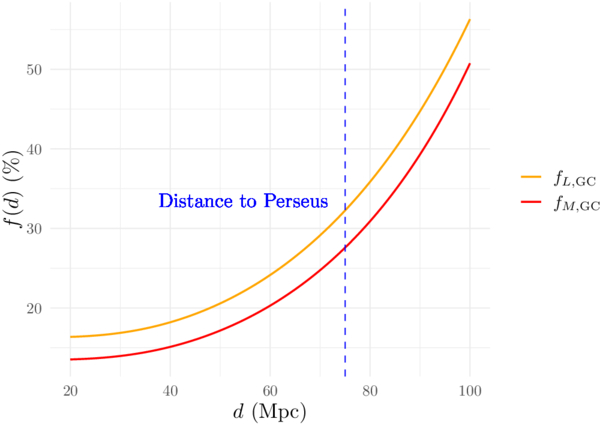
Figure 4. GCLF-corrected GC stellar light (fL,GC) and mass (fM,GC) ratios as a function of distance to CDG-2. The ratios here are corrected for potentially unobserved faint GCs by assuming a canonical GCLF adjusted for the possible distance to CDG-2. For example, if the true distance to CDG-2 is ∼20 Mpc, the canonical GCLF would be similar to the magnitude distribution of the four observed GCs, and the GCLF-corrected ratios are the same as the calculated ratios based on the four GCs. Blue vertical dashed line indicates the distance of 75 Mpc assumed for Perseus.
Download figure:
Standard image High-resolution image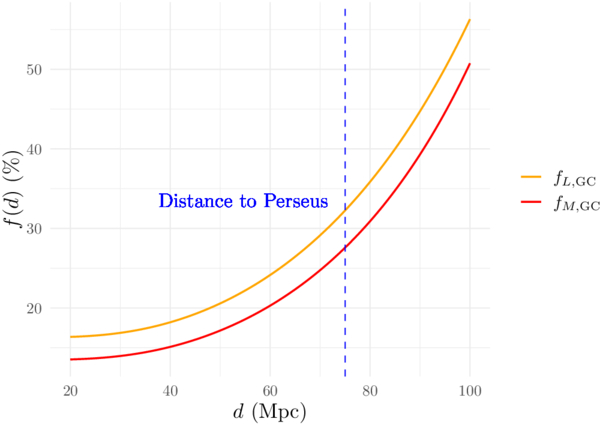
Moreover, the true value of dCDG-2 should be ≳35 Mpc. Otherwise, based on the measurements in Table 1 and the completeness fraction for DOLPHOT, CDG-2 would become a system with a bottom-heavy GCLF. Such a system is rather unlikely since, to our best knowledge, it has never been found before. Given this constraint, the GCLF-corrected fL,GC and fM,GC should be at least 18% and 15% for CDG-2.
Despite all previous discussions, further observations are required to confirm the distance to CDG-2 as well as its GC population. For simplicity, we assume dCDG-2 = 75 Mpc in all subsequent discussions unless specified otherwise.
In addition, we only supply with strong confidence the estimates of 16.6% and 13.7% as lower bounds for fL,GC and fM,GC of CDG-2. We intentionally restrain ourselves from concluding definitive estimates based on GCLF correction since it is well-known that there are significant variations in the GCLFs of dwarf-regime galaxies and UDGs (A. Jordán et al. 2007; B. W. Miller & J. M. Lotz 2007; D. Villegas et al. 2010; Z. Shen et al. 2021; D. Li et al. 2025b). Therefore, claims for the true ratios based on the canonical GCLF and a mere four GCs are highly uncertain.
Due to the distance to CDG-2 and the lower quality of data, we are not able to run a detailed GC evolutionary model as in S. Danieli et al. (2022) to infer the initial fM,GC of CDG-2. However, given the present-day lower-limit of 16.6%, the initial ratio should not be much different from unity as inferred for NGC 5846-UDG1. Therefore, CDG-2 can serve as a strong piece of evidence for the extreme star and galaxy formation scenario outlined in S. Trujillo-Gomez et al. (2021) and S. Danieli et al. (2022) where most of the star formation happened in extremely high gas surface density environments that produce massive GCs, while very little unbounded star formation occurred. In addition, the existence of CDG-2, along with other galaxies having high fM,GC, points to a potentially prevalent GC formation–destruction scenario of high GC formation efficiency and modest or very low rates of GC destruction (D. A. Forbes et al. 2024).
The confirmation of CDG-2 also brings back CDG-1 into the conversation and may provide constraints on the nature of CDG-1. Even though previous observations (D. D. Li et al. 2022; F. R. Marleau et al. 2025; P. van Dokkum et al. 2024) did not reveal detectable diffuse emission around CDG-1, the extremity of CDG-2 begs the question as to whether CDG-1 could be an even more extreme “twin” of CDG-2 with hardly any stars formed outside of its GCs or that the GC populations were barely dissolved.
We compare the properties of GC candidates in CDG-1 versus the ones in CDG-2 in Table 1. Interestingly, the GCs in CDG-1 are on average brighter and bigger in size than those in CDG-2. The four GCs in CDG-1 are in total ∼1.5× brighter and twice as massive than those in CDG-2. This could hint at the possibility that CDG-1 is a copy of CDG-2 but at an earlier evolutionary stage where its GCs have not or barely dissolved, which would result in the appearance that CDG-1 does not have any detectable diffuse emission.
Regardless of the possible formation mechanisms for CDG-1, if fL,GC ∼ 33% is possible for CDG-2, then it is not unreasonable to suspect that CDG-1 may be a galaxy with fL,GC ≳ 50% (P. van Dokkum et al. 2024). In fact, based on the result in Figure 4, it is entirely possible even for CDG-2 to achieve fL,GC ≳ 50% if it is at a slightly farther distance of 95 Mpc. In addition, we plot in Figure 5 the relationship between the total galaxy luminosity versus the GC system luminosity for various galaxies. CDG-1 and CDG-2 together with VLSB-B indeed seem to be in a league of their own given their high values of fL,GC and extremely low luminosities. Further observations through radial velocities are certainly needed to provide more constraints on CDG-1.
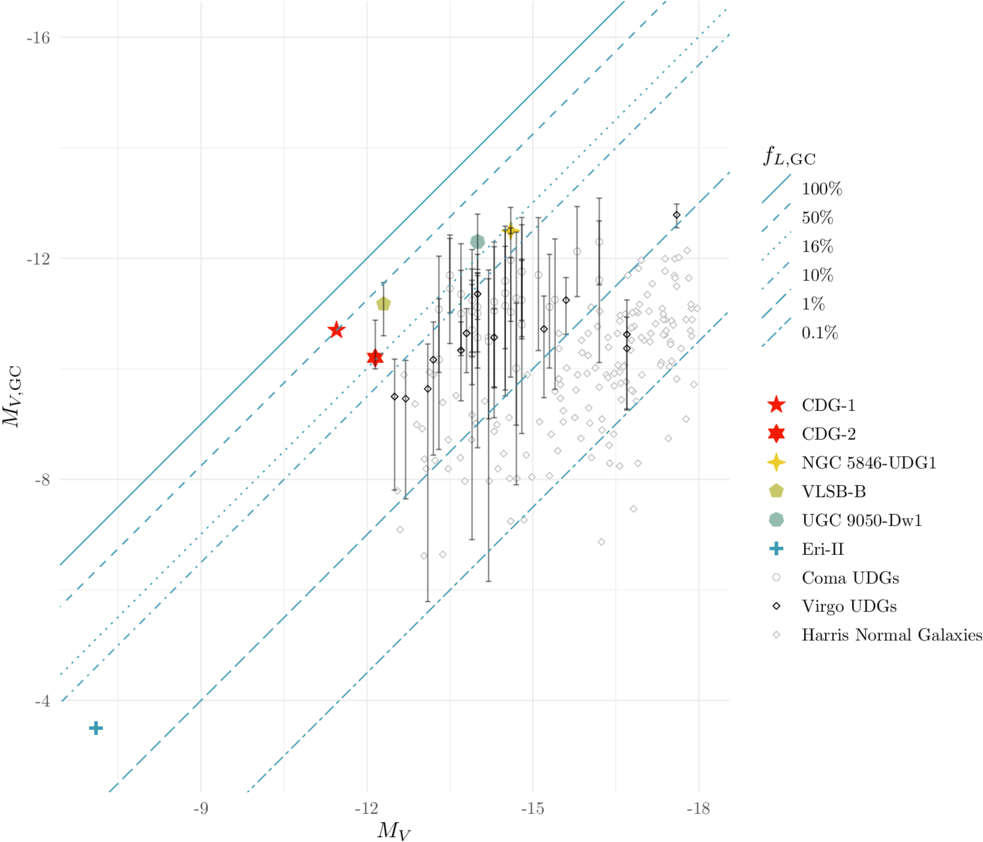
Figure 5. Galaxy total luminosity (MV) as a function of GC system total luminosity (MV,GC) for various galaxies: Harris Normal Galaxies (W. E. Harris et al. 2013); Coma UDGs (E. W. Peng & S. Lim 2016; P. van Dokkum et al. 2017; S. Lim et al. 2018); Virgo UDGs (S. Lim et al. 2020); NGC 5846-UDG1 (S. Danieli et al. 2022); VLSB-B (S. Lim et al. 2020; E. Toloba et al. 2023; J. S. Gannon et al. 2024); UGC 9050-Dw1 (C. E. Fielder et al. 2023); and Eri-II (D. Crnojević et al. 2016). Lines indicate various values of GC stellar light ratios. Note that the measurements for two dwarf spheroidal galaxies (KKs 55 and IKN) in the W. E. Harris et al. (2013) catalog are updated based on S. Okamoto et al. (2019) and O. Müller et al. (2021). Values for CDG-1 are taken from P. van Dokkum et al. (2024) assuming fL,GC ≥ 50%. Among all (confirmed) galaxies with GC populations, CDG-2 has one of the highest GC stellar light ratios while also being one of the faintest.
Download figure:
Standard image High-resolution image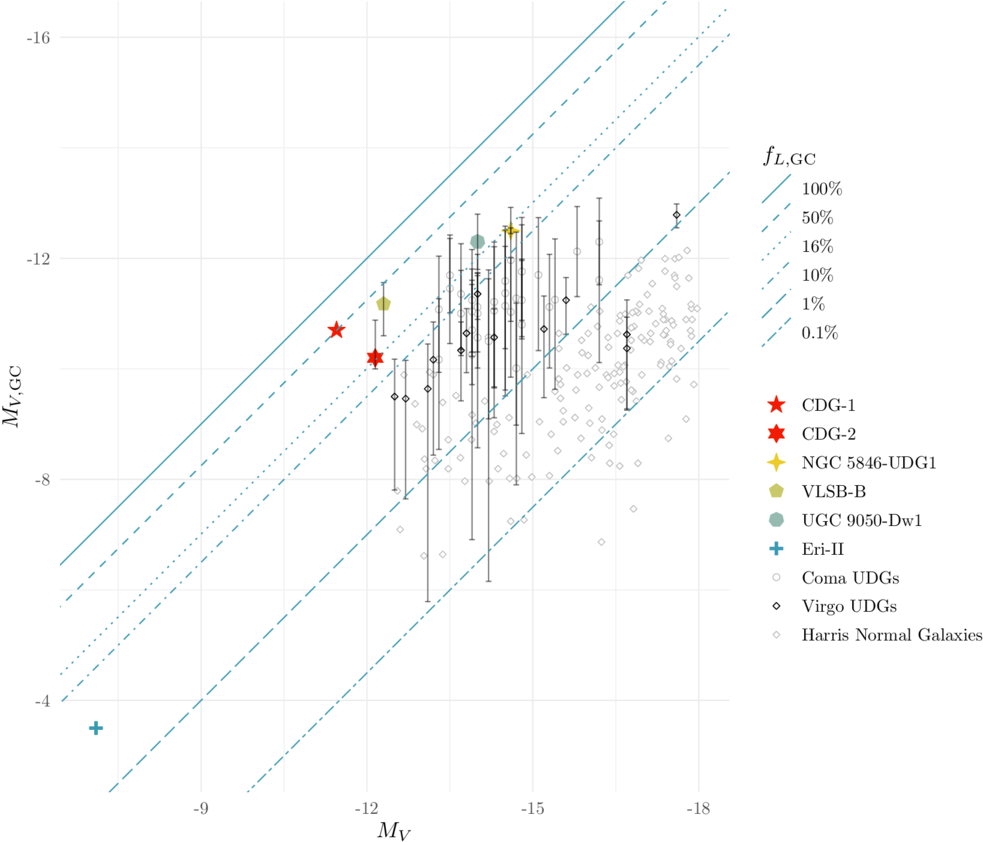
6.2. Overly Massive Dark Matter Halo
In terms of the lowest surface brightness galaxies, the mean surface brightness for CDG-2 of 〈μ〉V ∼ 27.5 mag arcsec−2 (〈μ〉g ∼ 27.8 mag arcsec−2), although a rough one, indicates that CDG-2 approaches the likes of RCP-32 (〈μ〉g = 28.6 mag arcsec−2; J. Román et al. 2021). The difference is that the latter galaxy does not have a confirmed GC population as in CDG-2. In fact, CDG-2 is one of the lowest surface brightness galaxies with GC populations. As shown previously in Figure 5, CDG-2 clearly stands out in terms of having one of the highest value of fL,GC while also being one of the faintest among the considered sample. The currently known faintest galaxy having a GC population is Eridanus II (D. Crnojević et al. 2016), with a central surface brightness of μV,0 ∼ 27.2 mag arcsec−2 and one single GC. However, the GC stellar light ratio as shown in Figure 5 is at a much lower 4% for Eridanus II. In contrast, even though many famous UDGs with significant GC populations, such as NGC 5846-UDG1, UGC 9050-Dw1, and some other UDGs in the Virgo and Coma clusters, may have similar or potentially higher GC stellar light ratios, they are all much brighter than CDG-2 both in terms of the mean surface brightness and total luminosity.
There has been increasing evidence that the number or the mass of GCs rather than the stellar mass is more indicative of the total galaxy halo mass (e.g., J. P. Blakeslee 1997; E. W. Peng et al. 2008; W. E. Harris et al. 2017; A. Burkert & D. A. Forbes 2020; S. Lim et al. 2020; D. A. Forbes & J. Gannon 2024; L. Haacke et al. 2025). D. A. Forbes & J. Gannon (2024) found that UDGs with more GCs generally have higher halo masses and they do not follow the typical stellar-to-halo mass relations observed for normal galaxies. Therefore, the unique location CDG-2 occupies in Figure 5 means that it could be an extreme case of galaxies with overly massive dark matter halos (M. A. Beasley et al. 2016; P. van Dokkum et al. 2016; D. A. Forbes et al. 2020; S. Lim et al. 2020; E. Toloba et al. 2023), and it may well be the most extreme one known to date.
Assuming CDG-2 has four GCs, its total stellar mass based on our previous estimations of luminosity and assumed mass-to-light ratio is M* ≈ 1.2 × 10⁷ M⊙, while the GC stellar mass is MGC ≈ 1.6 × 10⁶ M⊙. As a rough estimate, if the GC-to-halo mass relation of MGC/Mh ≈ 2.9 × 10⁻⁵ in W. E. Harris et al. (2017) holds, then CDG-2 will have a halo mass of Mh ≈ 5.7 × 10¹⁰ M⊙. Likewise, if the Mh/M⊙ ≈ 5 × 10⁹NGC scaling relation in A. Burkert & D. A. Forbes (2020) holds for CDG-2, it would yield a similar total halo mass of ∼2 × 10¹⁰ M⊙. Both estimates put CDG-2 in the category of highly dark matter dominated galaxies (P. van Dokkum et al. 2019; D. A. Forbes et al. 2020; S. Lim et al. 2020; E. Toloba et al. 2023; D. A. Forbes & J. Gannon 2024) with a halo mass fraction of 99.98% and 99.94% under the GC-to-halo mass relations of W. E. Harris et al. (2017) and A. Burkert & D. A. Forbes (2020), respectively. However, this is once again not correcting for potentially unobserved GCs in CDG-2 for the GC-to-halo mass relation. If CDG-2 again has a canonical GCLF, its halo mass estimates are ∼1.2 × 10¹¹ M⊙ under both relations in W. E. Harris et al. (2017) and A. Burkert & D. A. Forbes (2020), making its halo mass ratio ≳99.99%. As a comparison, E. Toloba et al. (2023) used GC kinematics data and reported halo mass ratio estimates ranging from 99.5% to 99.98% within the half-number radii of GC systems for six Virgo UDGs (S. Lim et al. 2020) with similar luminosities as CDG-2. In addition, S. Lim et al. (2020) considered photometric estimates for several Virgo UDGs with potentially extremely high dark matter fractions. Although S. Lim et al. (2020) did not provide direct ratio estimates, the authors did report the GC specific frequency SN, which can be illustrative of the extremity of CDG-2. Specifically, after correction by assuming the canonical GCLF, CDG-2 has a whopping specific frequency of  , one of the highest ever recorded among all galaxies. Thus, the presence of unobserved GCs could imply that CDG-2 is even more extreme and may represent the example of a galaxy with the highest dark matter content. We do need to note that previously computed figures associated with CDG-2 rely heavily on assumptions and extrapolations of existing GC-to-halo mass relations. It is thus essential to conduct further observations with high-precision kinematic and spectroscopy data to constrain and confirm the dark matter content of CDG-2.
Along the same line of thought, further and higher-quality observations of CDG-1 are imperative since CDG-1 can turn out to be a galaxy that is even more extreme than CDG-2: it can be the first instance of a galaxy that is made up of pure dark matter halo without any field star population aside from a few GCs. The confirmed existence of two dark galaxies will provide an ideal test bed for models of fuzzy dark matter (W. Hu et al. 2000; M. G. Walker & J. Peñarrubia 2011; L. Hui et al. 2017), which predict the existence of a highly compact soliton core in these dark matter halo galaxies (A. Wasserman et al. 2019; A. Burkert 2020).
6.3. Potentially Abnormal Globular Cluster Populations
On the flip side, if further observations reveal that CDG-2 does not contain other fainter GCs, then its constituent four GCs would make CDG-2 another galaxy with an abnormally bright GCLF similar to NGC 1052 DF2 and DF4 (Z. Shen et al. 2021). In this case, CDG-2 would be another ideal candidate to study and test theories on clustered star formation and its potential implications. As proposed in P. van Dokkum et al. (2022), the peculiar GC populations of NGC 1052 DF2 and DF4 may be due to a unique formation mechanism. However, more recent observations of galaxies with confirmed top-heavy bright GCLFs in various environments including DGSAT I (S. R. Janssens et al. 2022), FCC 224 (Y. Tang et al. 2025), R27, W88 (D. Li et al. 2025b), and possibly CDG-2 indicate that galaxies with top-heavy GCLFs may be more prevalent than once thought.
Z. Shen et al. (2021) and D. Li et al. (2025b) hinted at the possibility that dwarf-regime galaxies and UDGs need not have a canonical GCLF and their GC populations could exhibit strong statistical variations caused by the highly varying star formation histories in their small halo. As more and more galaxies with top-heavy GCLFs and properties as extreme as CDG-2 are discovered, we have more opportunities and samples to constrain the theories of GCs and star formation.
D.L. would like to acknowledge funding support from Canadian Statistical Sciences Institute and Data Sciences Institute at the University of Toronto through grant No. DSI-DSFY2R1P23. D.L. would also like to thank JiZhu Li for making sure that his eyes were not playing ticks on him while looking at CDG-2. W.E.H. would like to acknowledge funding support from NSERC. A.J.R. was supported by National Science Foundation grant AST-2308390.
The HST data presented in this Letter were obtained from the Mikulski Archive for Space Telescopes (MAST) at the Space Telescope Science Institute. The specific observations analyzed can be accessed via doi:10.17909/t87p-g529.
Facilities: HST - Hubble Space Telescope satellite (ACS), HST - Hubble Space Telescope satellite (WFC3), Euclid, Subaru (HSC) - .
Software: R, Python, photoutils.
For the mock galaxy injection test, we considered injecting a mock UDG placed at the distance of the Perseus cluster. Here we describe the injection procedure. The mock UDG is simulated using ArtPop (J. P. Greco & S. Danieli 2022) by reproducing the surface brightness profile of CDG-2. ArtPop is a Python software that generates artificial images of stellar systems with synthetic stellar populations. We created a mock UDG with a stellar mass of M* ∼ 107.4 M⊙ from MIST isochrones (J. Choi et al. 2016; A. Dotter 2016) using a simple stellar population following a Kroupa initial mass function (P. Kroupa 2001). The mock UDG was set with a metallicity of [Fe/H] = −1 and an age of 9 Gyr. The galaxy was placed at D = 75 Mpc and projected onto the image plane with the configuration of Euclid VIS, where stars were sampled following the distribution of a 2D Sérsic profile with a Sérsic index nsérsic = 0.5, an ellipticity  = 0.05, and an apparent effective radius Reff = 1.5 kpc. The injection process and the radial profiles of the data (with GCs masked), mock model, and data with injection are illustrated in Figure 6, indicating a reasonable match between the mock galaxy to CDG-2. However, it should be noted that the parameters chosen are only for reproducing the light distribution and thus do not represent real properties of CDG-2.
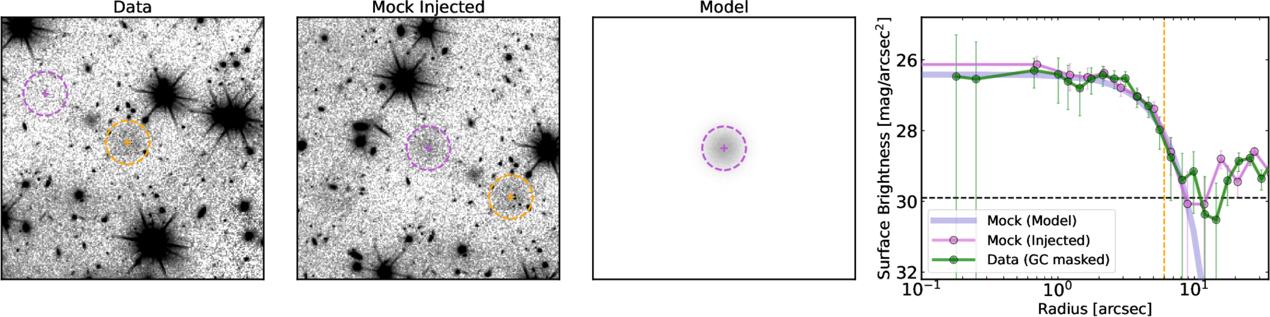
Figure 6. Injection test on the Euclid data with a mock UDG. The purple dashed circle indicates the isophote range of the injected mock UDG. The orange dashed circle indicates the isophote fitting range of CDG-2. Left: original Euclid data. Middle left: data with injected mock UDG. Middle right: mock UDG model. Right: radial profiles of CDG-2 with GCs masked, the mock UDG model, and the injected UDG. The black dashed line indicates the 1σ depth of Euclid data on 10″ × 10″ scales. The orange dashed line indicates the range of isophote fitting.
Download figure:
Standard image High-resolution image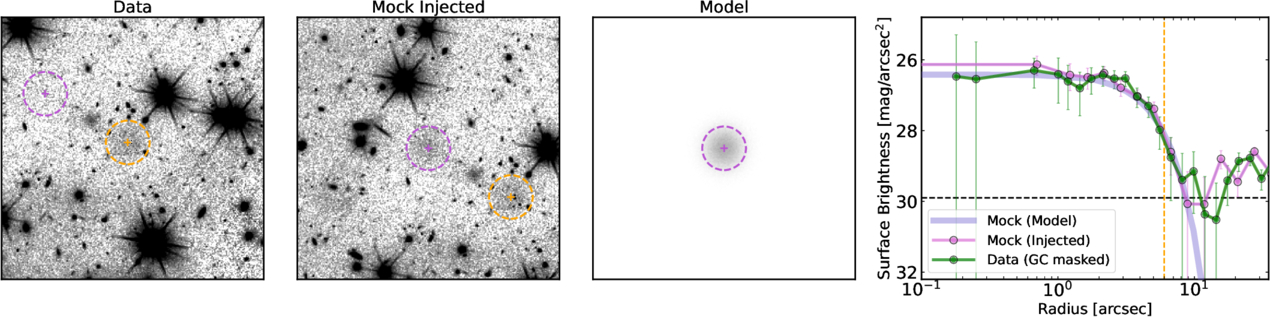
'We then performed isophote fitting on the injected mock UDG with the same procedures and setups as CDG-2. The total flux of the isophote model includes 86% of the total flux of the injected mock UDG, indicating low-level light loss in the very faint outskirts thanks to the sharp extended PSF wing of Euclid VIS (J. C. Cuillandre et al. 2024). We corrected the diffuse light flux and accordingly, the flux ratio, using this factor. We noticed that the fraction of light in the outskirts of the galaxy that needs to be corrected is dependent on the intrinsic physical parameters (M*, Reff, and nsersic) of the UDG. However, the integrated flux after correction is similar, i.e., a UDG with a shallower, extended profile yields a larger correction, while a larger UDG with a steeper outskirts has a smaller correction. Therefore, such degeneracy in the physical parameters of the UDG would not dramatically affect the total flux and the GC-to-total flux ratio after correction.