Gamma-ray bursts (GRBs) manifest as sudden, transient increases in the count rates of high-energy detectors; see, e.g., the reviews of Berger (2014), Mészáros & Řípa (2018), and Nakar (2020). These events appear as unexpected, their activity not explainable in terms of background activity or other known sources. At a fundamental level, algorithms for GRB detection have remained the same through different generations of spacecraft and experiments: As they reach the detector, high-energy photons are counted in different energy bands; an estimate of the background count rate is assessed from past observations; the observed photon counts are compared against the number of photons expected from the background, at regular intervals and over multiple, predefined timescales. The latter step is justified by a physical reason: GRBs have been observed with very different durations and lightcurves. Since the degree of similarity between the duration of a GRB and the timescale that is tested affects the power of the test, by testing multiple timescales the chance of a burst being missed due to a mismatch is reduced. The process is iterated until eventually a large enough excess in the observed count is found, relative to the counts expected from the background. The specificity of the search is regulated through a threshold parameter, usually expressed in units of standard deviations. When the threshold is reached, a quality-assurance step may take place to prevent false detection, such as accepting a trigger only if it is observed across multiple detectors. For space-borne observatories it is critical that algorithms for GRB detection run online, i.e., at the same time in which data are collected. A timely alert may in fact serve to trigger the acquisition of a recording apparatus or to initiate follow-up observations from the ground.
Over time, trigger algorithms have been developed to support an increasing number of criteria and parameters to achieve greater sensitivity to different bursts. While Compton-BATSE tested for three timescales (Kommers 1999; Paciesas et al. 1999), more than 120 and 800 different trigger criteria can be specified for Fermi-GBM (Meegan et al. 2009) and Swift-BAT (McLean et al. 2004), respectively. The Compton-BATSE’s algorithm performs a subset of the tests that are performed by Fermi-GBM, hence their performance have been compared in the literature. Paciesas et al. (2012) reports that a minimum of 83 GRBs out of the 491 bursts which triggered the Fermi-GBM algorithm during the first 2 yr of operation were detected over timescales not tested by the Compton-BATSE’s algorithm. Most of these events were identified as long GRBs and were detected over timescales greater than 1024 ms. A single GRB was detected over an energy range outside the standard BATSE energy range (50–300 keV), at timescales already covered by the BATSE algorithm. Analyses of GRBs discovered by Fermi-GBM in the third and fourth years of operation yielded similar results (Von Kienlin et al. 2014). This suggests that the range of timescales tested for a change is the most important feature of GRB detection algorithms. However, growth in algorithm complexity is not without consequences. The simultaneous operation of many trigger criteria can require most of the available CPU time (Fenimore et al. 2003); as such, trigger algorithms have been simplified during scientific operations to reduce the computational burden on on-board computers (Paciesas et al. 2012). Alternative approaches exist. For example, Scargle et al. (2013) discuss the application of a multiple change-point model, called Bayesian Blocks, to the problem of online GRB detection. Bayesian Blocks overcomes many of the limitations of conventional algorithms, such as the need to specify testing timescales. However, due to its quadratic computational cost, the technique faces even more severe performance challenges than established solutions. This picture is unfavorable to nanosatellite missions due to various constraints specific to these spacecraft, such as miniaturized computers, limited electrical power systems, and the absence of active temperature control, which result in a limitation of the available computational resources.
We investigate the application of a recently developed change-point detection technique to make a more accurate, faster, and simpler algorithm for GRB detection. Functional Online CUSUM (FOCuS) was introduced in Romano et al. (2023). The first version of the algorithm was designed for detecting anomalies in normally distributed data. In Ward et al. (2023a), FOCuS was extended to Poisson-distributed data (Poisson-FOCuS). A strategy to reduce the computational costs from linearithmic to linear was devised in Ward et al. (2023b). In essence, Poisson-FOCuS enables testing all the intervals in a count time series for transient onset, that is, testing over all timescales and offsets, at the same time in which data are collected and at a fraction of the computational cost of conventional strategies. The technique builds upon methods with a long history of applications: The mathematical backbone of FOCuS is the CUSUM test, a classic technique for anomaly detection (Page 1954; Lucas 1985), and the algorithm’s mechanics can be traced back to fundamental algorithms in computational geometry, such as Graham’s scan (Graham 1972).
Poisson-FOCuS was specifically developed to detect GRBs, in an effort to identify an algorithm for the satellites of the oncoming HERMES-Pathfinder and SpIRIT nanosatellite constellation (Fiore et al. 2020). HERMES-Pathfinder is an in-orbit demonstration using six 3U CubeSats, with the goal of demonstrating that GRBs can be detected and localized by miniaturized instruments hosted by nanosatellites. 10 HERMES-Pathfinder is funded by the Italian Space Agency and the European Commission through a H2020 grant. SpIRIT is a 6U CubeSat funded by the Australian Space Agency, managed by the University of Melbourne and hosting one HERMES-Pathfinder payload unit (Thomas et al. 2023). SpIRIT is due to launch at the end of 2023 November. HERMES-Pathfinder should reach orbit during 2024.
This paper is divided into two parts. In the first section, we introduce a framework for evaluating, comparing, and visualizing the operations of algorithms for GRB detection. We provide an account of the Poisson-FOCuS algorithm and its implementation, based on a design proposed for application on the satellites of the HERMES-Pathfinder constellation. In the second part of our study, we assess the performance of different algorithms using both real and simulated data. Using simulated data, we evaluate the detection power of an implementation of Poisson-FOCuS with automatic background assessment through simple exponential smoothing (FOCuS-AES, for Automatic Exponential Smoothing). Results are compared to those obtained with algorithms that mimic the logic of Fermi-GBM and Compton-BATSE, as well as a brute-force benchmark with oracle information on the background—that is, access to the true background count rate used in the simulations. In these tests, FOCuS-AES achieved detection performance similar to the benchmark when not limited by the automatic background assessment. On the other hand, FOCuS and the benchmark also resulted in higher false-positive rates than less sensitive algorithms. In a second experiment, we test the computational performance of Poisson-FOCuS against that of a similarly implemented benchmark emulator for the Fermi-GBM trigger logic. Poisson-FOCuS completed these tests in approximately half the time required by the benchmark. Finally, we evaluate FOCuS-AES over 3 weeks of real data from Fermi-GBM, selected at different times during the mission. All GRBs previously detected by Fermi-GBM were correctly identified, as well as a number of transients with counterparts in the untriggered GBM Short GRB candidates catalog (Bhat 2023). However, FOCuS-AES also detected a number of transients with no counterparts in GBM catalogs, likely originating from the Sun, during periods of high solar activity. All the data and code used in this research are publicly available.
Consider the problem of detecting a GRB in the following form. Over time, high-energy photons reach a count detector on board a spacecraft. Photons are counted within discrete time steps of duration τ (the bin length), resulting in a collection of t values after t time steps, or after a time t
τ from the start of the observations. We denote by xi
the ith value of the count time series, and the count time series comprising the first t values by Xt
= {x1,..,xt
}. Tests for a GRB involve comparing the observed and expected number of photons over different intervals of time. Each interval in the time series can be identified by two indices, {i, h}, representing the interval’s ending index and its length, respectively. The total number of counts in a given interval is noted with a lowercase letter,  . At the tth time step, there are a total of t(t + 1)/2 unique intervals; see, for example, the bottom panel of Figure 1. At the next time step, the number of unique intervals increases by t + 1. All these new intervals span the most recently acquired count xt+1. In our notation, they are represented by {t + 1, h}, with 0 < h ≤ t + 1.
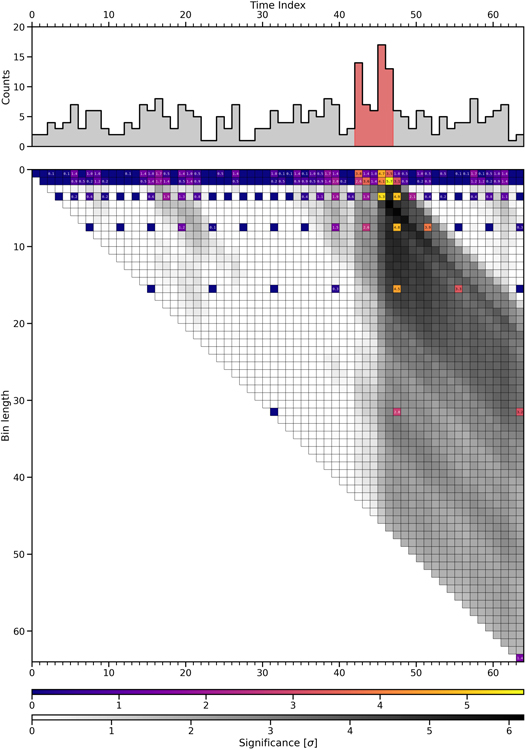
Figure 1. Operations of a conventional algorithm for detecting GRBs, testing logarithmically equispaced timescales at offsets equal to half the bin length. A time series of counts is represented in the top panel. All the counts but those in the interval {i = 47, h = 5} (or, equivalently, 41 < t ≤ 47) are sampled from a Poisson distribution with mean rate λ = 4.5 (background). Counts in the interval {i = 47, h = 5} are sampled from a Poisson distribution with mean rate λ = 9.0 (transient; red, shaded). In the bottom panel, every interval of the time series {i, h} is represented with a tile. Longer intervals are found at the bottom, early intervals are at the left. The shade of a tile represents the significance of the excess counts relative to the background mean, in units of standard deviations. Intervals tested by the algorithm are represented with colored tiles, while shades of gray are used for the remaining intervals. This figure is meant to be displayed in color.
Download figure:
Standard image High-resolution image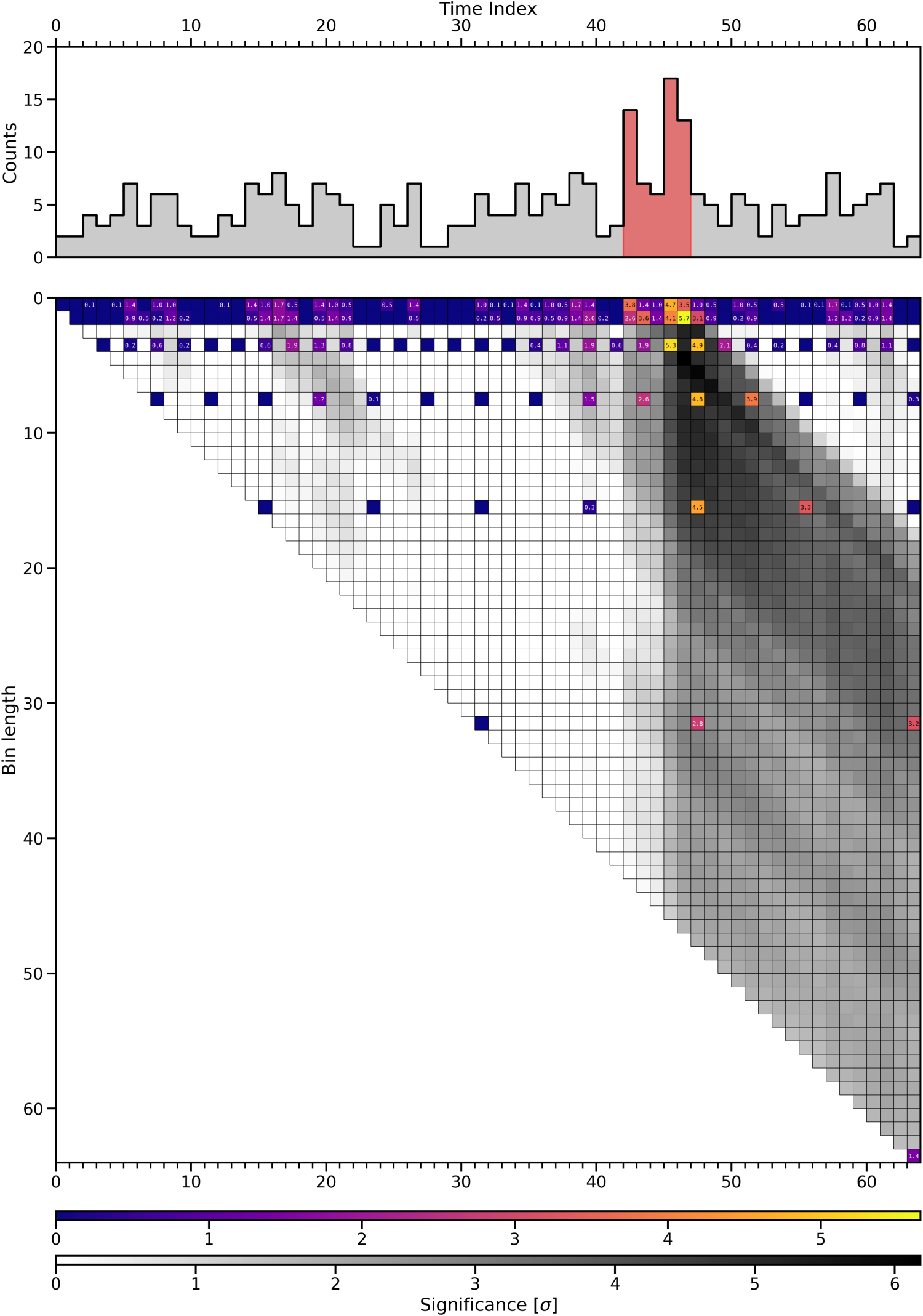
During most of the observation time, photons reaching the detector are stochastically and predictably emitted by a large number of unknown background sources. We assume that a reasonable estimate of the background count rate bi
is available each time a newly observed count value xi
is recorded. The background estimates are represented in a parallel time series, Bt
= {b1,..,bt
}. The same notation mentioned above is adopted for the background, so that the total number of photons expected from all background sources over the interval {i, h} is  .
.
Suddenly, a source in the detector’s field of view shines brightly, leading to an unexpected increase in the observed counts. A significance score Si,h is associated with each interval. The significance measures the “extraordinariness” of the number of photons collected relative to the number of photons expected from background, hence Si,h = S(xi,h , bi,h ). Since we are interested in bright transients, we consider only intervals for which xi,h > bi,h . However, it is straightforward to adapt our discussion to scenarios in which intensity deficits are pursued, e.g., when xi,h < bi,h —think, for example, of occultation phenomena.
We investigate automatic techniques to detect intervals of the count time series with excess significance greater than a predefined threshold expressed in terms of standard deviations Si,h > T. We call these techniques trigger algorithms since a positive detection may serve to trigger the operation of secondary apparatus, such as a high-resolution recording system or the observation of a small-field telescope. We restrict ourselves to strategies which can be run online, i.e., sequentially and over time series of arbitrary length. In practice, this requires that after a number of iterations t, no more than the first t elements of the count and background time series shall be accessible to the method. We assume observations to be collected for a single energy range and detector. This is reasonable when the number of detector–range combinations is small. Indeed, to widen the search to multiple energy bands and detectors, different algorithm instances can be stacked with costs only scaling linearly. Finally, we assume that algorithms have access to an estimate of the count rate expected from all background sources at each iteration. We do not require the background mean rate to be constant in time, although in practice background rates are most often assumed to change slowly relative to the transients’ duration. We will return to the subject of estimating count rate from background sources in Appendix A.
2.1. Exhaustive Search
It is trivial to design an exhaustive-search algorithm for solving the GRB detection problem: At the tth iteration step all the intervals {t, h} with duration h such that 0 < h ≤ t have their significance score St,h computed and tested against the threshold T; see Algorithm 1. Since the total number of intervals in an observation series Xt is t(t + 1)/2, the computational cost of an exhaustive-search algorithm grows as the square of the number of observations t, O(t2). For this reason, exhaustive-search algorithms are of no practical interest for real-world applications.
Many of the significance tests performed by exhaustive-search algorithms (and, by extension, conventional algorithms) can be avoided. This point is best illustrated through a simple numerical example. An exhaustive-search algorithm with a standard deviation threshold T > 0 is executed over the count observations time series X2 = {90, x2} and the background count rates B2 = {100.0, 100.0}. This implies that after the second iteration, three significance computations S1,1, S2,1, and S2,2 have been performed. If x2 > 100, then S2,2 < S2,1, hence either S2,1 > T or no trigger is possible at all, making the actual computation of S2,2 unnecessary regardless of the x2 value. Indeed, exhaustive-search algorithms make no use of the information gained during the algorithm operations. This information can be used to avoid significance computations for intervals which cannot possibly result in a trigger. Regardless of their computational performance, an exhaustive-search algorithm is a useful benchmark against which the detection performance of other techniques can be evaluated. The detection power of an exhaustive-search algorithm for GRB detection is in fact maximum, meaning that it would always be able to meet the trigger condition over the earliest intervals whose significance exceeds the algorithm threshold. An exhaustive search running over data for which the background count rate is known is biased only by the fundamental binning of the data.
Algorithm 1. A sketch of an exhaustive-search algorithm for GRB detection.
2.2. The Conventional Approach to GRB Detection
The logic of a conventional algorithm is sketched in Algorithm 2. This category includes the majority of algorithms backing space-borne GRB monitor instruments, including those discussed in Section 1. These algorithms perform a grid search over time. This means that tests of a predefined timescale are repeated at regular intervals. The search stops when an interval significant enough is eventually found. If an interval with significance Si,h > T exists, there is no guarantee that a conventional algorithm operating at threshold T will result in a trigger. For this to happen, either the burst timing should match the grid search or multiple, significant enough intervals must exist. For a bright source, this implies that the duration of the event must be similar to the interval being tested. Alternatively, the source should be sufficiently bright to be detectable over an interval shorter or longer than its actual duration. In other words, detections from conventional algorithms are biased toward events whose timings and durations match those of the grid search. The per-iteration computational costs of conventional algorithms is limited by a constant. This is trivially true, since the number of significance tests performed cannot exceed the number of tested criteria. The operations of a conventional algorithm checking logarithmically equispaced timescales at offsets equal to half acquisition length are represented in Figure 1.
Algorithm 2. Sketch of a conventional algorithm for GRB detection. The maximum significance in excess counts is computed over a grid of observation intervals with timescales  and offsets
  .
.
2.3. Computing Significances
Neglecting uncertainty in background estimation, the probability of observing more than xi,h photons when bi,h photons are expected is given by the Poisson cumulative distribution function. It is common to convert this probability value to a sigma level by calculating how many standard deviations from the mean a normal distribution would have to achieve the same tail probability. As this can be expensive to compute, the use of approximate expressions is commonplace in practice. For example, the algorithms of Swift-BAT use a recipe based on the standard score modified to support “a commandable control variable to ensure that there is minimum variance when observed counts are small” (Fenimore et al. 2003). Using standard score for computing significance when few counts are expected from background sources may lead to a higher rate of false detections, which is likely the reason why Swift-BAT uses dedicated minimum variance parameters.
An alternative approach for computing the significance of an interval involves performing statistical tests of the hypotheses:
1.
H 0, xi,h ∼ P(bi,h ), null hypothesis.
2.
H 1, xi,h ∼ P(μ bi,h ) with μ > 1.
Where P denotes the Poisson distribution and μ is the intensity parameter. Since we are presently interested in bright anomalies such as GRBs, only values of intensity μ greater than 1 are tested. The log-likelihood ratio for this test is

According to Wilk’s theorem, the log-likelihood ratio λLR is asymptotically distributed as a chi-squared distribution  , with d equal to the difference in degrees of freedom between the null and alternative hypotheses. In our problem, the only degree of freedom comes from the intensity parameter μ, so d = 1. Using the relationship between the chi-squared and normal distribution and the definition of Si,h
, we obtain the significance expression in units of standard deviations:
, with d equal to the difference in degrees of freedom between the null and alternative hypotheses. In our problem, the only degree of freedom comes from the intensity parameter μ, so d = 1. Using the relationship between the chi-squared and normal distribution and the definition of Si,h
, we obtain the significance expression in units of standard deviations:

Note that in practical applications, the most efficient way to assess the trigger condition Si,h
> T is to rescale the threshold according to  . This avoids the need for the square-root computation. In the literature, some authors refer to this test as the “deviance goodness-of-fit test” (Hilbe 2014; Feigelson et al. 2022). In Figure 2, the significance estimates obtained through Equation (1) are compared to the exact values computed according to the Poisson and the normal cumulative distributions, as well as the standard score. While Wilk’s theorem holds for large sample sizes, it is apparent that the approximation remains accurate even when testing small counts. Unlike the results obtained with the normal approximation, Wilk’s threshold upper-bounds the exact solutions, providing a more conservative estimate with a lower false-positive rate.
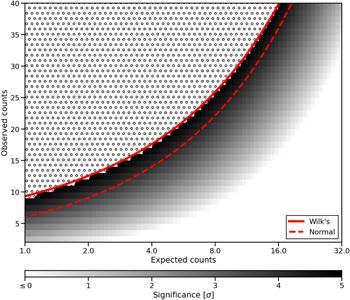
Figure 2. Threshold values according to Wilk’s theorem approximate well the true value, even when the expected background count is small. The x-axis and y-axis represent different Poisson process mean rates and observed count values, respectively. Shades of gray are used to represent the significance of the excess counts, computed according to exact Poisson tail distribution probability values and expressed in units of standard deviations. The hatched region’s significance exceeds 5σ. A solid line is used to represent the significance threshold according to Equation (1), while a dashed line represents the standard score threshold (normal approximation).
Download figure:
Standard image High-resolution image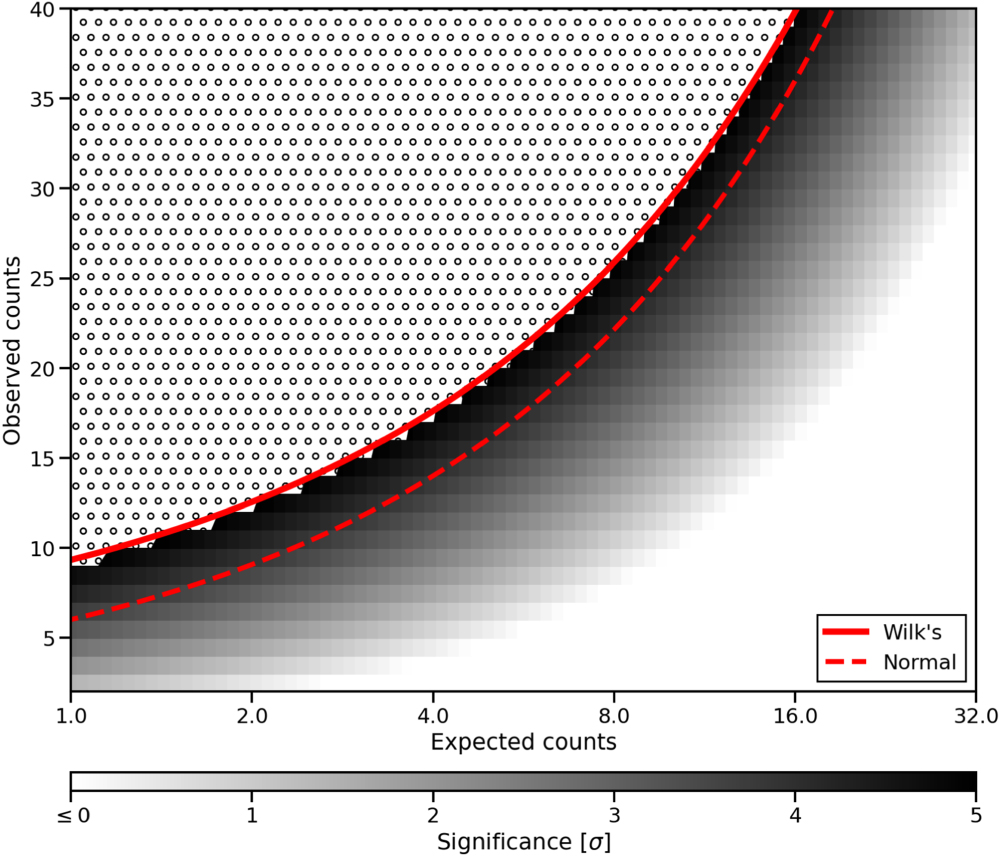
When choosing the threshold parameter one trades off potential false detections for a loss of statistical power. The best choice depends on the specific application and must take into account the cost of a false detection. For example, a false positive could result in extra telemetry or memory for storing high-resolution data. A trade-off must be considered also when choosing the bin length, τ, since power is lost to events with duration shorter than the bin length, but shortening the bin length increases the frequency of false detections. Experimentation with historic and synthetic data is crucial in determining the best combination of these parameters (McLean et al. 2004).
2.4. Poisson-FOCuS
FOCuS is a change-point and anomaly detection algorithm that builds upon the classic CUSUM technique (Page 1954; Lucas 1985), which itself can be understood as a repeated, one-sided Wald’s sequential probability ratio test (Wald 1945; Belanger 2013). It enables the detection of anomalies in time series with the sensitivity of an exhaustive-search algorithm but limited computational costs. A first version of the algorithm was presented in 2021 (Romano et al. 2023). The algorithm was later adapted to Poisson-distributed count data (Poisson-FOCuS), specifically for detecting astrophysical transients such as GRBs and targeting applications on board the spacecraft of the HERMES-Pathfinder constellation (Ward et al. 2023a). The method was then shown to be applicable to other distributions of the exponential family, and a strategy called “adaptive maxima check” was devised to reduce computational costs from linearithmic to linear (Ward et al. 2023b). The resulting technique has both maximum detection power and optimal computational cost. In this sense, we say that the algorithm is “optimal.”
Poisson-FOCuS tests for evidence of a GRB over intervals whose length is dynamically assessed by the algorithm itself, based on evidence gathered in the past. This approach contrasts with conventional strategies, which test intervals with fixed lengths; see Figure 3 and compare with Figure 1. Poisson-FOCuS maintains a hierarchical collection called the curve stack, whose elements are called curves. Each curve corresponds to an interval {i, h} in the time series. Curves are comparable: One curve is considered greater than another if its “mean” xi,h /bi,h exceeds that of the other. If a curve is smaller than an older one, it can be pruned from the collection, as a trigger from this curve would inevitably result in a trigger from another already in the curve stack. This situation is referred to as one curve “dominating” another. During each iteration, the algorithm must check the significance associated with each curve. Through adaptive maxima check, an upper-bound significance is associated to each curve, and the actual significance value is computed only if the bound exceeds the threshold. When one curve significance exceeds the threshold, the algorithm returns and outputs the corresponding interval’s start time (the change point) i − h, the trigger time i, and significance Si,h .
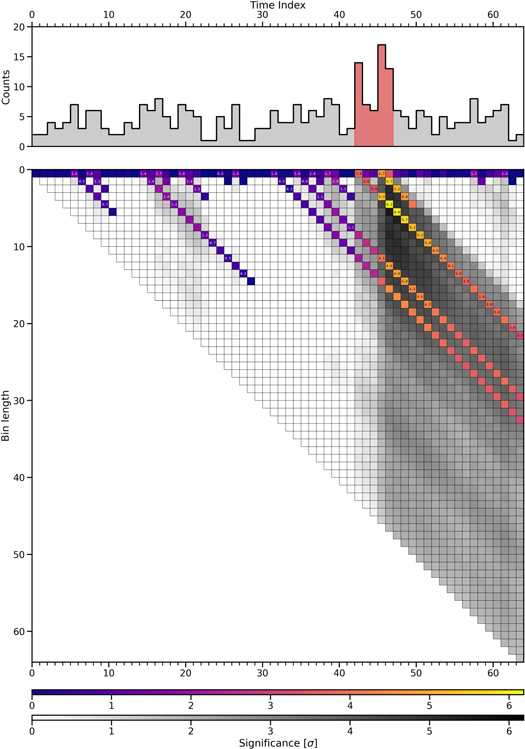
Figure 3. A schematic representation of the operations of Poisson-FOCuS over a simple data input; see also the caption to Figure 1. A colored tile in a column with index i is associated with a curve in the FOCuS’s curve stack at the ith algorithm’s iteration. Numeric values are used to display significance scores, only for those curves whose significance is actually computed, using adaptive maxima check with threshold 5.0σ. This figure is meant to be displayed in color.
Download figure:
Standard image High-resolution image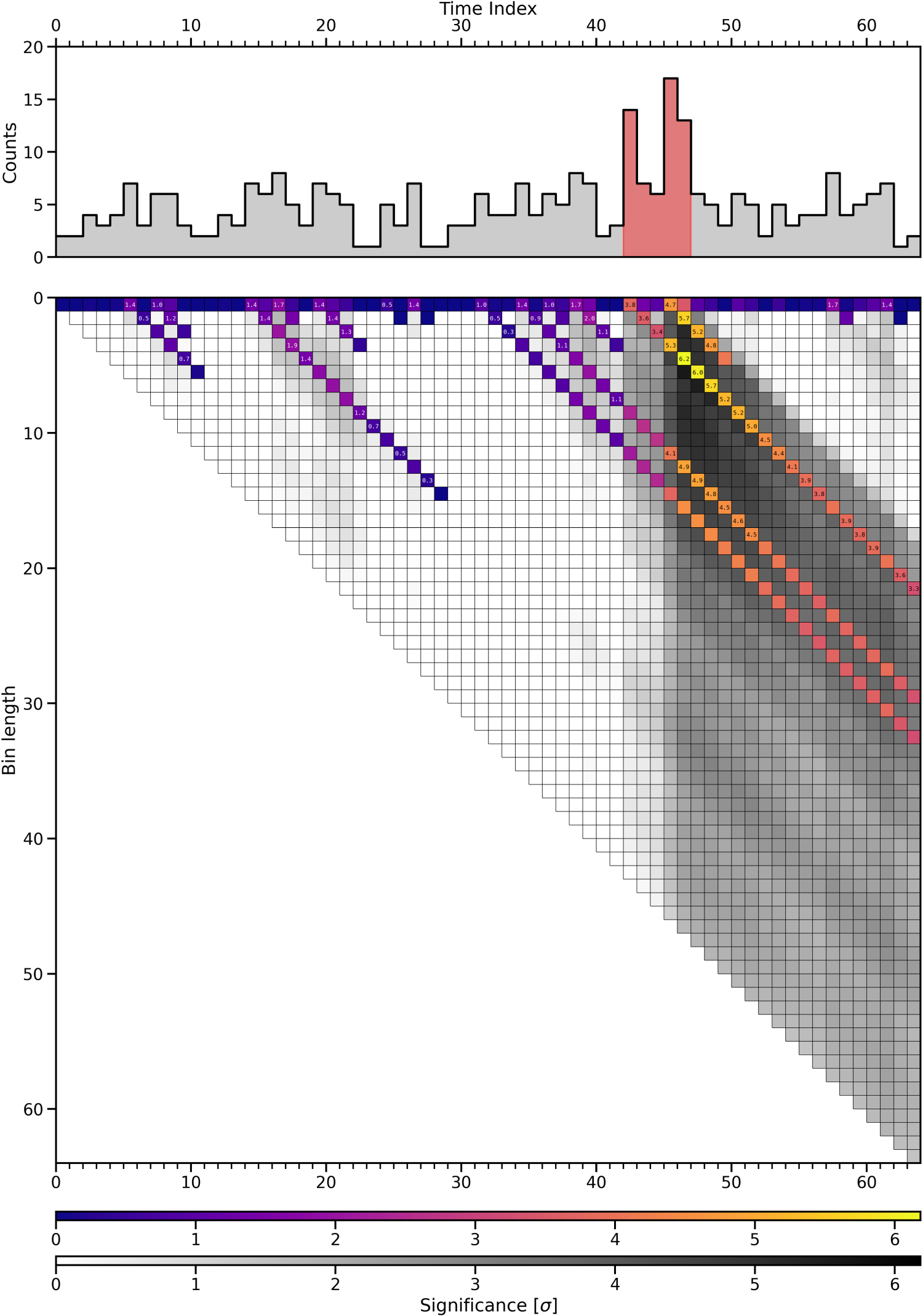
The mathematics motivating Poisson-FOCuS has been comprehensively described in Ward et al. (2023a). Presently, we will concentrate on the algorithmic aspects of Poisson-FOCuS and on how a robust and efficient implementation can be achieved. The code we provide is implemented in C89. This particular implementation was developed as a baseline for potential deployment on the satellites of the HERMES-Pathfinder constellation. The logic we designed implements all the optimization techniques we are aware of and does not assume the background to be constant. A minimal, functional Python implementation is presented in Appendix C.
The Poisson-FOCuS algorithm can be broken down into four distinct components: a constructor, an interface, the updater, and the maximizer. It relies on a stack data structure, for which we do assume a standard application programming interface exists providing access to methods for iterating, pushing and popping from the top of the stack, and for peeking the stack’s topmost element.
Curves, curve stack, accumulator. The curve stack is a stack data structure containing record elements called curves. Each curve is uniquely associated with an interval of the time series. A curve contains at least three members or fields. The count member is a nonnegative integer representing the total counts observed since the curve was first added to the stack, xi,h . The background member is a positive, real number representing the total counts expected from the background over the same interval, bi,h . The time member is a positive integer h serving as a step index “clock.” It represents the number of iterations completed since the curve was first added to the stack. One extra member can be used to store an upper bound to the curve’s significance when implementing adaptive maxima check.
Instead of updating each member of every curve in the curve stack at each iteration, Poisson-FOCuS can utilize an auxiliary curve called the accumulator. At the ith algorithm iteration, the members of the accumulator are incremented by xi , bi , and 1. When a curve is added to the stack it is added as a time-stamp copy of the accumulator. This allows, for instance, the calculation of the counts observed since the curve’s inception, xi,h , as the difference between the accumulator and the curve’s count member.
Curves are comparable; a curve q dominates (is greater than) a curve  if the mean of q exceeds the mean of
  :
:

Note that the dominate condition is formally equivalent to a sign test over a scalar product where the accumulator acts as the origin. FOCuS only tests for anomaly intervals represented by curves in the curve stack. In this sense, the curve stack serves the purpose of a dynamically updated schedule. The significance of a curve-interval is estimated according to Equation (1). Evaluating the significance of a curve, there is no need to check for xi,h /bi,h > 1 since this is an invariant property of the algorithm.
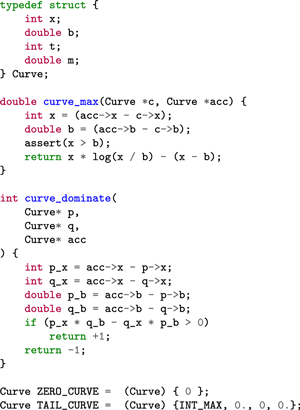
Listing 1. Poisson-FOCuS’s curves.
Constructor. The constructor is responsible for initializing the algorithm. It pushes two curves on top of the empty curve stack. These curves do not have intrinsic meaning and their use is ancillary. We call the first of these elements the tail curve. The tail curve is always found at the bottom of the curve stack and signals the end of it. We will come back to the actual expression of the tail curve when discussing FOCuS’s update step. The second curve is the accumulator. All the members of the accumulator are initialized to zero and remain so every time the curve stack only contains the tail curve and the accumulator. The constructor also initializes two variables for storing the algorithm’s results: the global maximum and the time offset. Additionally, it computes quantities that can be calculated once and for all throughout the algorithm’s operations.
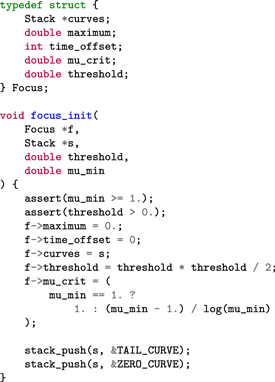
Listing 2. Poisson-FOCuS’s constructor.
Interface. The interface accepts data from the user, executes the algorithm, and returns the results. Different interfaces can be adapted to different input data. Presently, we consider two input arrays representing the observation time series Xt and the background time series Bt . In this case, the interface loops over the array indices i, at each step passing xi and bi to the updater. The loop goes on until the threshold is met or the signal ends. The minimal output is a triplet of numbers representing the trigger interval’s end time, start time, and significance. If the trigger condition is not met, a predefined signal is returned.
Note that the updater should always be provided with a background count rate, bi , greater than zero. The interface should be prepared to deal with the possibility of a bad background input and to manage the error accordingly.
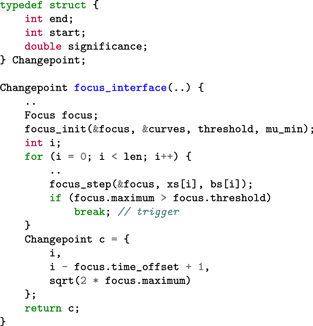
Listing 3. A sketch of an interface to Poisson-FOCuS.
Updater. Through the update step, new curves are added to the curve stack, while stale ones are removed. First, the algorithm creates a new curve using the latest count observation and background estimate. Then it evaluates if the new curves should be added to the curve stack, comparing it with the topmost element. If the new curve is not dominated by the topmost curve, it is added to the stack. Otherwise, the algorithm discards the new curve and iterates over the stack, popping one curve at a time until a curve is found that dominates the topmost element still in the stack. This operation is called pruning. Finally, the last curve is evaluated and, if its mean exceeds 1, the maximizer is invoked and the curve is pushed back on top of the stack. Else, the curve stack is emptied and the accumulator is reset to zero.
The accumulator is removed from the top of the stack at the very beginning of the update step; it is updated and its value is used through the function’s call lifetime. The accumulator is pushed back on top of the stack just before the update step returns. The form of the tail curve is chosen so that the pruning loop always stop when the tail curve is the topmost element in the curve stack. Using the accumulator, Equation (2) can be expressed as follows:

This inequality is false when a → + ∞ and b = 0. We can use this relation to find the right expression to the tail curve. In practice, depending on a curve’s representation choice, the tail curve’s count member is defined to be either a positive infinity—in the sense of floating-point representation for infinities, which is supported by most modern programming languages (Kahan 1996)—or the maximum integer value, while the background member is set to zero.
According to this recipe, the Poisson-FOCuS’s pruning loop is equal to the hull-finding step of a fundamental algorithm of computational geometry, Graham’s scan (Graham 1972); see the classic implementations by R. Sedgewick in Java or C (Sedgewick 1990, 2017). Graham’s scan is an algorithm to efficiently determine the convex hull of a set of coplanar points. The relationship between FOCuS and convex-hull algorithms has been discussed in the literature before. In Romano et al. (2023), the FOCuS algorithm pruning step has been compared to the hull-finding step of another convex-hull technique, Melkman’s algorithm. Despite involving a double loop, the computational costs of FOCuS’s update step scales linearly with the number of observations, O(t) ∝ t. The reason is essentially the same behind the linear cost of Graham’s scan's hull-finding step: While the pruning loop can test curves that were first added to the curve stack much back in time, such evaluation may only occur once, since once a curve is pruned it is never added back on the curve stack.
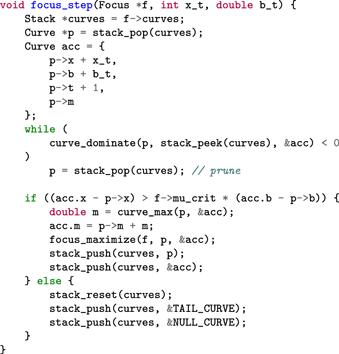
Listing 4. Poisson-FOCuS’s update step, with  cut and adaptive maxima check.
Maximizer. Once the curve stack has been updated, FOCuS still needs to evaluate the significance of the intervals associated with each curve. Since the average number of curves in the curve stack grows, on average, as the logarithm of the number of iterations (Ward et al. 2023b), maximizing each curve at each iteration would result in linearithmic amortized costs,  . A technique called “adaptive maxima check” was introduced in Ward et al. (2023b) to speed up the maximization step. This technique has been empirically observed to reduce the amortized, per-step cost of curve maximization to O(1). Through the incorporation of adaptive maxima check, the amortized cost of running Poisson-FOCuS is reduced from linearithmic to linear, O(t) ∝ t, making the algorithm computationally optimal (up to a constant).
The difference between the members of two curves does not change with an update. This fact implies that, at any given iteration, the global significance maximum is upper-bound by the cumulative sum of the differences between the curves in the stack. By keeping track of this upper bound, most significance computations can be avoided. However, implementing the adaptive maxima check comes with a memory cost, as it requires adding an extra floating-point field member to the curve’s definition for storing the maximum bound.
Implementing this technique is straightforward when utilizing an accumulator. Whenever a new curve is pushed on top of the stack, its maximum significance is evaluated and the accumulator’s maximum bound field is incremented by that value. Then the significance of curves deeper in the curve stack is evaluated, if the trigger condition is not met and the curve’s maximum bound exceeds the threshold. The iterations stop when a curve with maximum bound lower than threshold is found or the trigger condition is met. Most often, particularly for large threshold values, the loop stops at the first iteration.
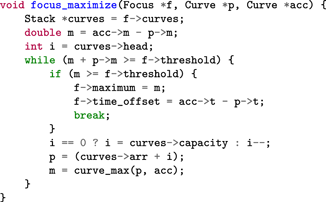
Listing 5. Poisson-FOCuS’s maximizer through adaptive maxima check.
Memory requirements and
 cut. The memory required by FOCuS grows with the number of elements in the curve stack, hence on average as
  after t iterations. To limit memory usage, the most obvious solution is to remove the oldest curve in the stack when the curve number exceeds a prefixed number. A more controllable approach requires to inhibit triggers from anomalies with mean smaller than a user-defined value
  , with
  . In practical implementation, this requires modifying the update step method to only push a new curve on the stack if its mean exceeds the critical value:

The critical mean value can be computed once and for all, at the constructor’s level.
The algorithm’s sensitivity to long, faint transients is reduced when implementing the  cut. This is often desirable in real applications, due to features of the searched transients, or limits of the background estimate, or other factors. In these cases, implementing the
  cut may result in less false positives, without losing any real events. For many applications, this is more important than the memory benefit, since the memory usage of Poisson-FOCuS is very low regardless. As with the threshold parameter, there is no one-size-fits-all recipe to select the right
  value, as this value will depend on the specific application, and experimentation with the data is recommended.
In this section, the performance of different trigger algorithms are compared over synthetic data, targeting different performance metrics such as true-positive rates and computational efficiency. The main reason for testing algorithms over simulated data is that everything about the simulation is known to the tester. For example, the true background mean rate and the actual background distribution are known, as well as the transient’s timing and intensity. Using this information, it is possible to define a benchmark with ideal detection performance, setting a reference against which the performance of real techniques are evaluated.
3.1. Detection Performance
The detection performance of different algorithms were tested and compared over two synthetic data sets. Each data set is composed of count data from 30,000 lightcurves binned at 16 ms, all with equal duration and mean background count rate. The background count rate is constant and equal to 350 s−1, a value representative of the background flux observed by the Fermi-GBM’s NaI detectors in the 50–300 keV energy band. Each lightcurve hosts a simulated GRB event with intensity spanning 30 different levels. For each intensity level, a total of 1000 lightcurves are generated. The lightcurves of the GRBs in the first data set are modeled after the Fermi-GBM observations of the short burst GRB180703949, while the template for the lightcurves in the second data set is the slow-raising, long burst GRB120707800 (see Figure 4).
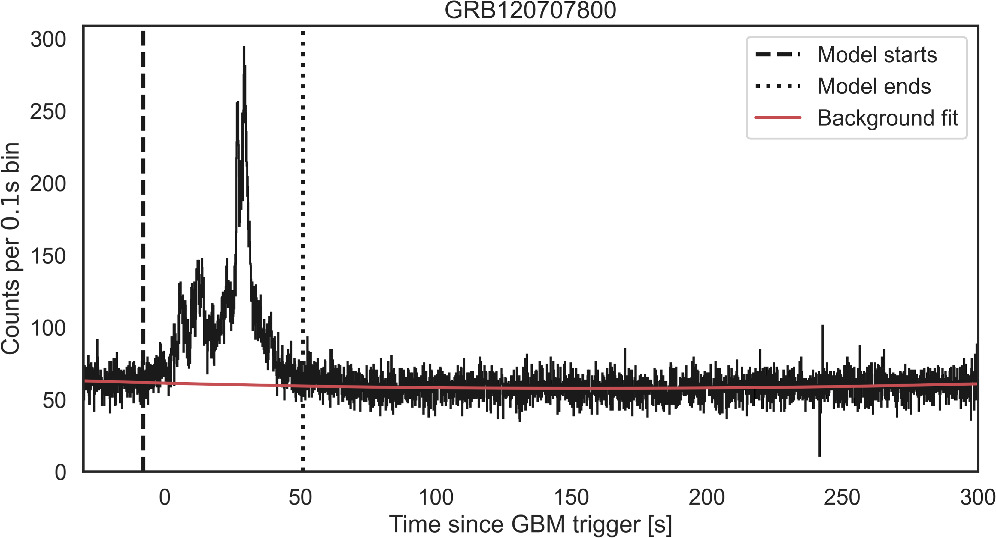
Figure 4. Histograms of Fermi-GBM photon counts for GRB120707800, in the 50–300 keV band. Data comprise observations from NaI detectors 8 and 10. Time is expressed from Fermi-GBM’s trigger time. Vertical lines represent the start and end time of the interval used as a template for the simulations. The background estimate (solid red line) was obtained fitting a polynomial to the observations outside this section.
Download figure:
Standard image High-resolution image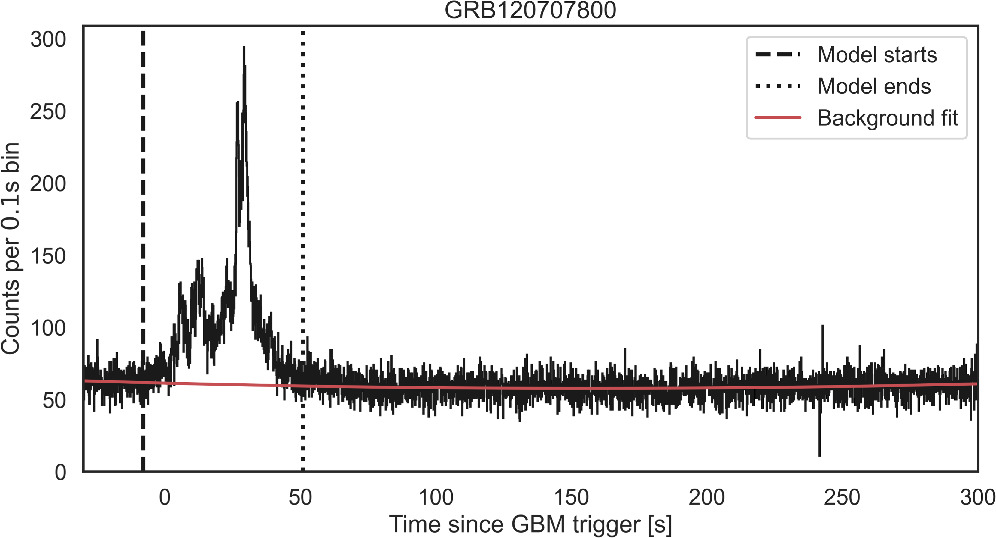
To generate these data, a software called Synthburst was specifically developed. Synthburst is a Monte Carlo tool for creating lightcurves resembling those produced in GRB observations. GRB sources are modeled after Fermi-GBM observations, and every burst of the GBM burst catalog can be used as a template. The user can customize a synthetic lightcurve through a number of parameters. These include the source’s intensity and timing, and the background’s mean count rate and time profile. In Figure 5, we show a simulated lightcurve obtained using the long burst GRB120707800 as a template; see Figure 4. Synthburst will be presented in a future publication.
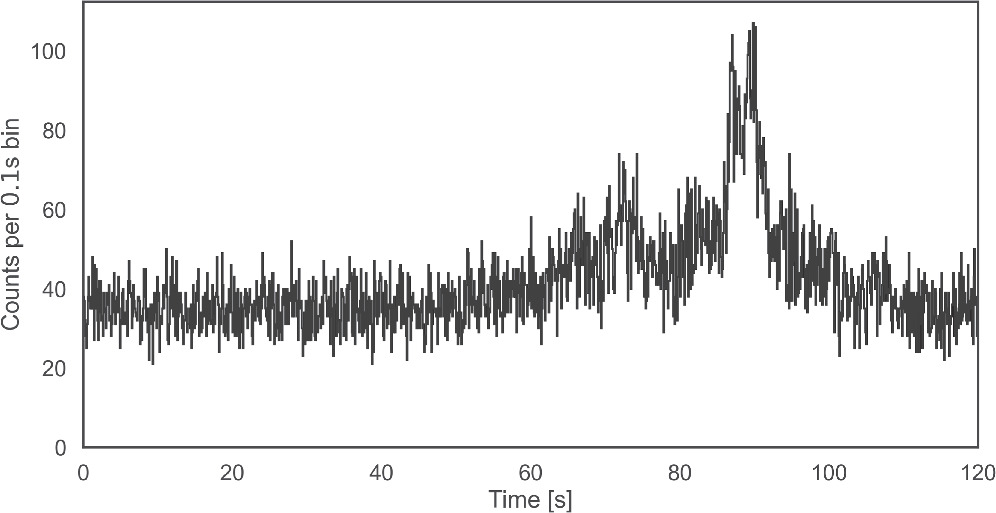
Figure 5. A synthetic lightcurve generated with Synthburst, using GRB120707800 as a template. Simulated data comprise 5000 source photons and a background count rate equal to 350 photons per second.
Download figure:
Standard image High-resolution image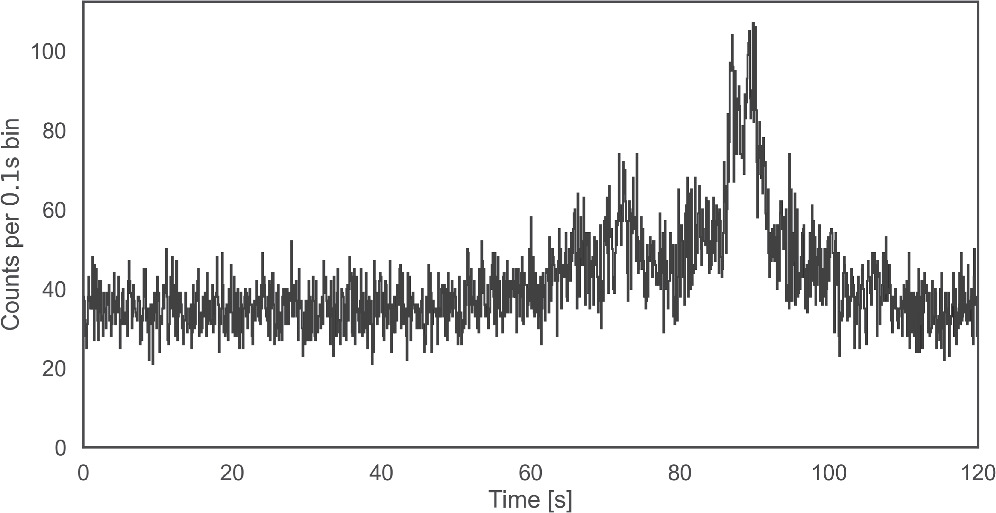
We evaluated the detection performance of five distinct algorithms. Two of these algorithms, an exhaustive-search algorithm and Poisson-FOCuS, were given information on the simulation’s true background count rate. The exhaustive-search algorithm does not approximate the interval’s significance score; rather, it computes the Poisson’s tail probability and converts it to standard deviations exactly. It serves as a benchmark for detection power. In real applications, the true background value is unknown and must be estimated, often from the same data which are tested for an anomaly. The other algorithms autonomously assess the background count rate; see Appendix A. One of these is an implementation of Poisson-FOCuS with automatic background assessment through single exponential smoothing (FOCuS-AES). The remaining two emulate the algorithms of Fermi-GBM (Paciesas et al. 2012) and BATSE (Kommers 1999; Paciesas et al. 1999). Details on these algorithms are provided in Appendix B.
Each trigger algorithm is executed over each lightcurve in the data sets, with threshold set to 5σ. Lightcurve simulations and trigger execution are performed in two steps. First, the background photons are simulated. The algorithms are launched a first time and, if a trigger occurs, the event is recorded and marked as a false positive. If no false positive is observed, source photons are generated on top of the background and the algorithms are executed a second time. If an algorithm triggers, the event is recorded and marked as a true positive. Else, it is marked as a false negative. The observed rate of true positives over the short and long GRB data sets are displayed as a function of the simulated photon number in Figures 6 and 7, respectively. A summary on the relative and absolute performance of the different algorithms is provided in Tables 1 and 2.
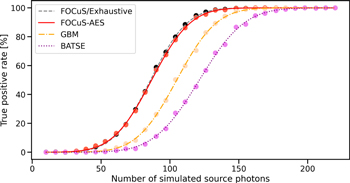
Figure 6. True-positive rates as a function of source intensity (points) and best fit to error function (lines) over the short GRB data set; see the discussions of Sections 3.1 and 3.3.
Download figure:
Standard image High-resolution image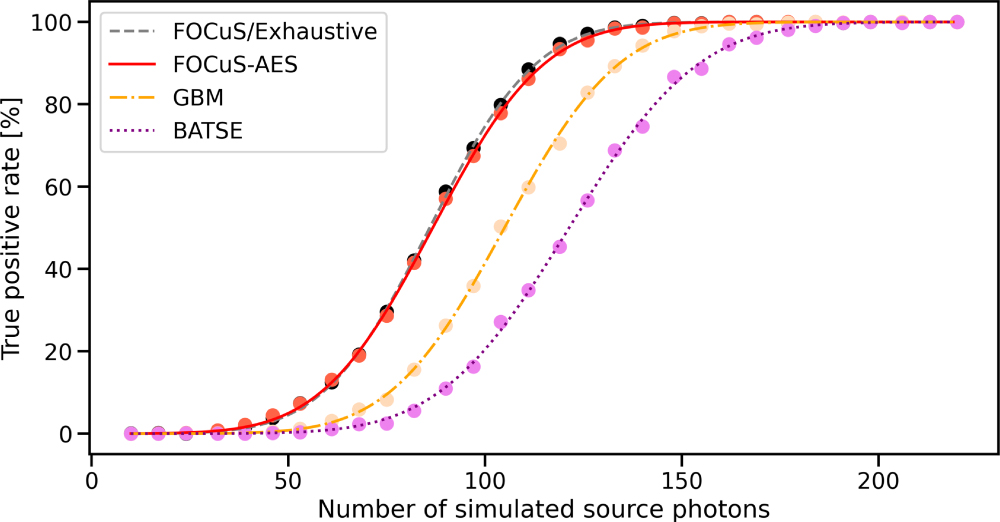
Figure 7. True-positive rates as a function of source intensity (points) and best fit to error function (lines) over the long GRB data set; see the discussions of Sections 3.1 and 3.3.
Download figure:
Standard image High-resolution image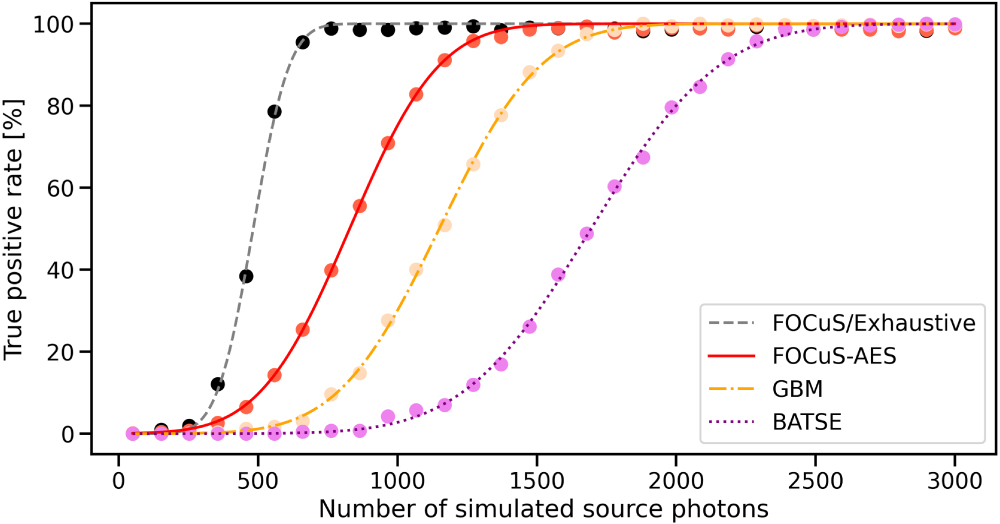
Table 1. Summary of Detection Efficiency Tests over the Short GRB Model Data Set; See Section 4 and Appendix B
| Relative Efficiency | ||||||||
|---|---|---|---|---|---|---|---|---|
| (%) | ||||||||
| tp | fp | fn | F0 | F1 | F2 | F3 | F4 | |
| Exhaustive | 19,024 | 26 | 10,950 | 50.0 | 52.0 | 51.5 | 81.5 | 95.3 |
| FOCuS | 18,877 | 16 | 11,107 | 48.0 | 50.0 | 49.5 | 80.2 | 94.8 |
| FOCuS-AES | 18,913 | 23 | 11,064 | 48.6 | 50.5 | 50.0 | 79.4 | 94.0 |
| GBM | 16,400 | 9 | 13,591 | 20.3 | 21.6 | 21.3 | 50.0 | 76.4 |
| BATSE | 14,100 | 4 | 15,896 | 8.5 | 9.2 | 9.0 | 26.3 | 50.0 |
Notes. Results from different algorithms are presented in separate rows. The first three columns indicate the total number of true positives (tp ), false positives (fp ), and false negatives (fn ). In the last five columns, the true-positive rates are expressed as percentages for five different source intensity levels (Fi ). Specifically, F0 represents the source level at which Exhaustive exhibited a 50% false-positive rate, while F1, F2, F3, and F4 correspond to the intensity levels at which FOCuS, FOCuS-AES, GBM, and BATSE achieved the same sensitivity level, respectively.
Download table as: ASCIITypeset image
Table 2. Summary of Detection Efficiency Tests for Different Algorithms over the Long GRB Model Data Set; See Table 1
| Relative Efficiency | ||||||||
|---|---|---|---|---|---|---|---|---|
| (%) | ||||||||
| tp | fp | fn | F0 | F1 | F2 | F3 | F4 | |
| Exhaustive | 25,001 | 351 | 4648 | 50.0 | 50.8 | 100.0 | 100.0 | 100.0 |
| FOCuS | 25,072 | 230 | 4698 | 49.2 | 50.0 | 100.0 | 100.0 | 100.0 |
| FOCuS-AES | 21,626 | 368 | 8006 | 8.6 | 8.7 | 50.0 | 89.8 | 10,0.0 |
| GBM | 18,668 | 89 | 11,243 | 1.0 | 1.0 | 13.1 | 50.0 | 97.1 |
| BATSE | 13,360 | 18 | 16,622 | 0.0 | 0.0 | 0.8 | 6.6 | 50.0 |
Download table as: ASCIITypeset image
3.2. Computational Efficiency
We compared the computing times of Poisson-FOCuS against a similarly implemented benchmark emulator for the Fermi-GBM on-board trigger logic. The tests were performed over Poisson-distributed count time series with constant mean rate. Multiple count time series with different length and mean rate have been generated and evaluated. The algorithms we test do not assess background count rates automatically; they are informed on the true count mean rate. The rationale behind this choice is that different algorithms for anomaly detection may employ the same technique to assess the background count rate. For both algorithms, the interval significance is defined according to Equation (1). Programs are executed without checking for the trigger condition to guarantee a complete run over the input data set.
To our knowledge, the actual implementation of the algorithm used by Fermi-GBM has not been disclosed, nor has the code from any other major experiment for GRB detection. Hence, we developed our own implementation for benchmarking purposes, focusing on optimizing performance. We implemented three key optimizations. First, the program stores photon counts cumulatively over a circular array. This allows computing the total number of photon counts  through a single difference operation I(i) − I(h). This optimization has been described in the literature before; see Fenimore et al. (2003). Second, a phase counter p is employed to determine for which criteria it is the right time to perform a test, avoiding looping over individual test criteria, at each iteration. Since the benchmark’s timescales are logarithmically equispaced, one can loop over the timescales, doubling the timescale parameter h until the modulo operator of h and p is found equal to zero or the maximum timescale is reached. Finally, the program performs a significance computation only if an interval’s observed photon count exceeds the expected count from the background. The benchmark’s test criteria timescales and offsets are the same described in Section 3.1 for the algorithm labeled “GBM.” This parameter choice was intended to emulate the operations of the Fermi-GBM algorithm over a single detector in the 50−300 keV band, as described in Paciesas et al. (2012).
The Poisson-FOCuS’s curve stack was implemented over a circular array of fixed length and can host up to 64 different curves. This choice was meant to avoid dynamic memory allocation. If a curve is pushed onto a full stack, the oldest curve in the curve stack is removed. The chance of this to happen is minimized by the use of a  parameter, which was set to 1.1. Since the Poisson-FOCuS maximization step requires a threshold value to be defined, the threshold level was set to 5σ—even if, as we already stated, the halting condition is never tested during program execution.
The implementations we test are written in C99 and compiled with GCC. Tests were performed with a 3.2 GHz Apple M1 ARM processor. Results are reported in Table 3, averaging over 20 different input data sets per entry. Across the table, the maximum observed standard deviation amounts to less than 10% of the mean. Values do not account for the time required to read the input files.
Table 3. Time Required by Poisson-FOCuS and a Benchmark Emulator for the Fermi-GBM Algorithm to Run over Poisson-distributed Count Time Series Using a Retail 3.2 GHz ARM Processor
| Poisson-FOCuS | Benchmark | |||||
|---|---|---|---|---|---|---|
| (ms) | (ms) | |||||
| N | 4.0 | 16.0 | 64.0 | 4.0 | 16.0 | 64.0 |
| 2048 | 0.04 | 0.04 | 0.04 | 0.08 | 0.08 | 0.08 |
| 4096 | 0.09 | 0.08 | 0.08 | 0.16 | 0.16 | 0.17 |
| 8192 | 0.17 | 0.16 | 0.15 | 0.32 | 0.33 | 0.34 |
| 16384 | 0.33 | 0.32 | 0.30 | 0.63 | 0.63 | 0.66 |
| 32768 | 0.67 | 0.63 | 0.59 | 1.24 | 1.25 | 1.31 |
| 65536 | 1.33 | 1.28 | 1.19 | 2.45 | 2.50 | 2.57 |
| 131072 | 2.65 | 2.51 | 2.36 | 4.86 | 4.92 | 5.09 |
| 262144 | 5.29 | 5.06 | 4.69 | 9.66 | 9.84 | 10.12 |
| 524288 | 10.59 | 10.16 | 9.45 | 19.31 | 19.71 | 20.33 |
| 1048576 | 21.21 | 20.24 | 18.84 | 38.65 | 39.19 | 40.48 |
Note. Each reported value is the average over 20 randomly generated time series. For all entries the observed standard deviation is smaller than 10%. For all entries the observed standard deviation is smaller than 10%. Column (1): geometrically increasing lengths; columns (2)–(7): the three different means.
Download table as: ASCIITypeset image
3.3. Discussion
We test whether the detection performance of FOCuS-AES is equal to that of the exhaustive-search benchmark. According to the results of Table 3, there is not significant evidence for a difference for the short GRB data set (p-value = 0.34), but there is strong evidence for a difference in the long GRB data set (p-value <10−5). On the other hand, the detection of the Poisson-FOCuS implementation with access to the true background mean is statistically similar to that of the exhaustive search over both the short (p-value = 0.21) and long (p-value = 0.78) GRB data sets—as one would expect from the theory. We conclude that the detection performance of FOCuS-AES is hindered by the background estimation process over the long GRB data set: For long, faint bursts, the background estimate may be “polluted” by the source’s photons. Nevertheless, FOCuS-AES achieved the best correct detection rates among algorithms with no access to the background’s true value. We remark that Poisson-FOCuS and the benchmark resulted in a higher false-positive rate when compared to alternatives. This discrepancy is due to the number of intervals effectively tested by the algorithms: FOCuS and the exhaustive-search benchmark effectively test all the intervals of the time series, while conventional algorithms test a subset whose extension depends on the choice of the timescales and offsets parameters.
In Section 3.2, we compared the computational performance of Poisson-FOCuS to that of a similarly implemented benchmark emulating the Fermi-GBM on-board algorithm. The time required to run Poisson-FOCuS over count series of length spanning 2048 and 1,048,576 are observed to increase linearly, as evident by comparing column-wise values in Table 3, regardless of the mean rate. Our implementation required less than 22 ms to analyze over one million data using a retail 3.2 GHz ARM processor. For comparison, the benchmark algorithm required approximately double the time in all the tests we performed. We remark that our benchmark is not the routine actually implemented on board Fermi-GBM, as this implementation remains undisclosed. Hence, the reader should avoid interpreting the results of this test as a direct comparison with the algorithm of Fermi-GBM.
We ran Poisson-FOCuS with automatic background assessment by simple exponential smoothing (FOCuS-AES) over 3 weeks of data from Fermi-GBM, chosen at different times during the mission. The algorithm’s implementation and parameters are the same as specified in Section 3.1. We implemented a halting condition similar to the one of Fermi-GBM: A trigger is issued whenever at least two detectors overcome a 5σ threshold; after a trigger, the algorithm is kept idle for 300 s, after which it is restarted. Input data were obtained binning the Fermi-GBM daily time-tagged events data products (Fermi Science Support Center 2019) at 16 ms time intervals over the 50–300 keV energy band. Only data from the GBM’s 12 NaI detectors were analyzed. This means that data from the GBM’s bismuth germanate (BGO) detectors and photons with low (<50 keV) and high (>300 keV) energy were not tested. The reason for this choice is twofold. First, these data pertains to regimes marginally relevant to GRB detection; see, for example, Table 4 and relative discussion from Von Kienlin et al. (2014). Second, the threshold profile employed by the Fermi-GBM algorithm outside the 50–300 keV domain is highly fragmented—see Table 2 of Von Kienlin et al. (2014) or Von Kienlin et al. (2020)—which complicates the setup of a meaningful comparison.
The first period we tested spans the week from 00:00:00 2017 October 2 to 23:59:59 2017 October 9 UTC time. There were two factors taken into account when choosing this time period. One factor was its association with multiple, reliable, short GRB candidates, as reported in the untriggered GBM Short GRB candidates catalog (Bhat 2023), which had gone undetected by the Fermi-GBM’s online trigger algorithm. The other factor was its coincidence with a period of moderate solar activity. For this week the Fermi-GBM’s Trigger Catalog (Fermi Science Support Center 2019) reports 11 detections. Six of these events were classified as GRBs, three as terrestrial gamma-ray flashes (TGFs), one as a local particle event, and one as an “uncertain” event. FOCuS-AES triggered eight times, correctly identifying all the GRBs and local particle events detected by the Fermi-GBM algorithm. Another event triggered FOCuS-AES at time 16:05:52 2017 October 2 UTC. This event is consistent with one of the transients listed in the untriggered GBM Short GRB candidates catalog at Fermi’s MET time 528653157. No counterpart to the uncertain event UNCERT17100325 was identified. The three TGFs detected by the Fermi-GBM’s on board algorithm also went undetected. This is understandable: TGFs are more energetic than GRBs and are detected either over the BGO detectors—which are sensitive over an energy range spanning from approximately 200 keV to 40 MeV—or the NaI detector at energy range >300 keV. The former was the case for the events of this sample, TGF171004782, TGF171008504, and TGF171008836.
The second period spans the week from 00:00:00 2019 June 1 to 23:59:59 2019 June 8 UTC time, a period of low solar activity in which the Fermi-GBM on-board algorithm triggered nine times. Seven of these events were classified as GRBs, one as a local particle event, and one as a TGF. FOCuS-AES detected 10 events. All the GRBs, as well as the local particle events detected by Fermi-GBM, were identified. No counterpart was found to TGF190604577; again, this is understandable, since we did not test the data over which TGFs are detected. The remaining two events detected with FOCuS-AES are compatible with events in the untriggered GBM Short GRB candidates catalog at MET times 581055891 and 581117737.
The last week occurred during a period of high solar activity, from 00:00:00 2014 January 1 to 23:59:59 2014 January 8 UTC time. For this week, the Fermi-GBM Trigger Catalog reports 29 detections: six GRBs, two local particle events, one TGF, one uncertain event, and 19 solar flares. In our test, FOCuS-AES got 36 positive detections. All GRBs discovered by Fermi-GBM were correctly identified. We did not find counterparts for six solar flares, two local particles, one TGF, and one uncertain event. All these events were either low-energy or detected over Fermi-GBM’s BGO detectors. FOCuS-AES detected 16 events with no counterparts in the Fermi-GBM Trigger Catalog nor the untriggered GBM Short GRB candidates catalog; see Table 4. It is not immediately apparent that any of these occurrences are false positives. Indeed, each of these events corresponds to short transients that are readily identifiable, with high temporal coincidence, over multiple detectors and different energy ranges. However, due to the frequency and clustering of these events, we expect most of them to be of solar origin.
Table 4. Trigger Events with No Counterparts in the Fermi-GBM Trigger Catalog (Fermi Science Support Center 2019) and the Untriggered GBM Short GRB Candidates Catalog (Bhat 2023); See the Discussion of Section 4
| Trigger Time | |||
|---|---|---|---|
| MET | UTC | τ | Detectors |
| (ms) | |||
| 410299390.55 | 2014-01-01 20:03:07 | 48 | 6, 8 |
| 410299746.18 | 2014-01-01 20:09:03 | 48 | 6, b |
| 410304166.77 | 2014-01-01 21:22:43 | 48 | 7, 8 |
| 410323479.59 | 2014-01-02 02:44:36 | 32 | 6, 7 |
| 410357487.64 | 2014-01-02 12:11:24 | 3168 | 1, 2 |
| 410555917.41 | 2014-01-04 19:18:34 | 64 | 5, 8 |
| 410556407.32 | 2014-01-04 19:26:44 | 80 | 8, a |
| 410556762.28 | 2014-01-04 19:32:39 | 48 | 7, 9 |
| 410557112.25 | 2014-01-04 19:38:29 | 64 | 7, 9 |
| 410563178.79 | 2014-01-04 21:19:35 | 80 | 7, 5 |
| 410568048.55 | 2014-01-04 22:40:45 | 32 | 2, 5 |
| 410568417.21 | 2014-01-04 22:46:54 | 64 | 8, b |
| 410667708.04 | 2014-01-06 02:21:45 | 64 | 4, 6, 7, 8 |
| 410812804.74 | 2014-01-07 18:40:01 | 48 | 1, 4, 9 |
| 410813905.69 | 2014-01-07 18:58:22 | 96 | 6, 8, 9 |
| 410819366.44 | 2014-01-07 20:29:23 | 96 | 6, 7, 8 |
Notes. The first two columns report the trigger times, in Fermi MET and UTC time standards. The third column holds the transient’s rise timescale τ in units of milliseconds. Finally, the last column reports the detectors where the transients were detected. We note the Fermi-GBM’s NaI detectors numbers 10 and 11 with the letters a and b, respectively.
Download table as: ASCIITypeset image
This paper addressed the following:
1.
We discussed a framework to evaluate and visualize the operations of different algorithms for detecting GRBs.
2.
We presented an implementation of Poisson-FOCuS that was designed and proposed for application on the satellites of the HERMES-Pathfinder constellation.
3.
We tested the detection performance of different algorithms using simulated data. We found that realistic implementations of Poisson-FOCuS have higher detection power than conventional strategies, reaching the performance of an ideal, exhaustive-search benchmark when not hindered by automatic background assessment.
4.
We tested the computational efficiency of Poisson-FOCuS against that of a similarly implemented benchmark emulator for the Fermi-GBM on-board trigger logic. In these tests, Poisson-FOCuS proved twice faster than the benchmark.
5.
We validated Poisson-FOCuS with automatic background assessment over 3 weeks of data from Fermi-GBM.
These findings highlight the potential of Poisson-FOCuS as a tool for detecting GRBs and other astrophysical transients, especially in resource-constrained environments such as nanosatellites. However, the effectiveness of a trigger algorithm is limited by the accuracy of background estimates. In the future, machine learning may provide a reliable solution to this challenge. Poisson-FOCuS achieves high detection power by effectively testing all intervals within a count time series for anomalies. This approach also leads to a higher rate of false positives. When selecting an algorithm, it is important to consider this trade-off. Clever instrument design can mitigate this issue, providing ways to assure the quality of a trigger. While Poisson-FOCuS was designed for the time domain, offline change-point models for detecting variability over both times and energies exist in the literature (Wong et al. 2016). It is possible that a FOCuS-like algorithm could be devised for the multidimensional setting, making similar techniques suitable also for online applications. Such an effort is beyond the scope of this work, but presents a promising direction for future research.
We acknowledge support from the European Union Horizon 2020 Research and Innovation Framework Programme under grant agreement HERMES-Scientific Pathfinder No. 821896, and Horizon 2020 INFRAIA Programme under grant Agreement No. 871158 AHEAD2020; from ASI-INAF Accordo Attuativo HERMES Technologic Pathfinder grant No. 2018-10-H.1-2020; from INAF RSN-5 mini-grant No. 1.05.12.04.05, “Development of novel algorithms for detecting high-energy transient events in astronomical time series”; and EPSRC grant No. EP/N031938/1. This research has made use of data provided by the High Energy Astrophysics Science Archive Research Center (HEASARC), which is a service of the Astrophysics Science Division at NASA/GSFC. We thank the anonymous reviewers for the precious insights and feedback, and the copyeditors for the meticulous work on the form and the typesetting of this document. G.D. thanks Riccardo Campana for his mentoring.
Software: Astropy (Astropy Collaboration et al. 2013, 2018, 2022), Numpy (Harris et al. 2020), Pandas (The pandas development team, 2020), Matplotlib (Hunter 2007), Scipy (Virtanen et al. 2020), LMFIT (Newville et al. 2014), Joblib (Joblib Development Team 2020).
The code used in this research has been made public at https://github.com/peppedilillo/grb-trigger-algorithms and a static version in Zenodo (Dilillo & Ward 2023). All the data used in this research are available at doi: 10.5281/zenodo.10034655.
In this section, we discuss the problem of assessing an estimate of the background count rate. With count detectors on board spacecraft, this task is complicated by two factors: (i) the fact that the background mean count rate changes over time, although with characteristic timescales generally larger than the duration of most GRBs; and (ii) the need to evaluate the background estimate from the same data that are tested for anomalies.
Background time-dependence. The background count rate of a space-borne count detector is influenced by multiple phenomena such as the solar activity, the rate of incident primary and secondary cosmic-ray particles, the X-ray and gamma-ray diffuse photon background, trapped radiation, nuclear activation and the instrument’s intrinsic noise (Campana et al. 2013). The interaction between these phenomena is complex and can result in background counts that fluctuate considerably over time. In low-Earth orbits, periodic fluctuations exist on timescales equal to the orbit duration (approximately 90 minutes at 500 km altitude) and the duration of a day due to features of the orbital geomagnetic environment and the spacecraft’s motion. The magnitude and velocity of the fluctuations depend on the orbital inclination parameter. Spacecraft in near-equatorial orbits span a limited range of geomagnetic latitudes and only graze the outermost regions of the South Atlantic Anomaly (SAA), resulting in small and regular background modulations due to the detector’s attitude and the residual variation of the geomagnetic field (Campana et al. 2013). In contrast, the background count rate of a spacecraft crossing the SAA in depth may change significantly, even on short timescales.
Moving-average techniques. The most common technique employed by GRB monitor experiments to estimate the background count rate is the simple moving average. With a simple moving average, past data are summarized by the unweighted mean of n past data points:

Which may be efficiently computed through the recursion

Simple moving averages are suitable for assessing background estimates if n is larger than the GRB characteristic rise time and the background count rates change over timescales larger than n. The evaluation can be delayed to reduce ‘pollution’ from eventual source photons, hence a higher rate of false negatives. For example, this is the approach of Fermi-GBM, which estimates the background count rate over a period nominally set to 17 s, excluding the most recent 4 s of observations from the computation (Meegan et al. 2009). Computing a simple moving average requires maintaining one (two, if the evaluation is delayed) queue buffers of recent counts observations. Exponential smoothing is an alternative to moving-average techniques; see Hyndman & Athanasopoulos (2018) for an overview. In single exponential smoothing, exponentially decreasing weights are assigned to past observations. At time index t, the single exponential smoothing estimate is

where 0 < α ≤ 1 is the smoothing constant parameter. The choice of the α parameter depends on the features of the data and is generally achieved optimizing for the mean squared error over a grid of parameters over a test data set. When α is close to 0 more weight is given to older observations, resulting in slower dampening and smoother St curves. On the other hand, an α value near unity will result in quicker dampening and more jagged St curves. Computing St requires the setting of an initial value S0. Common initialization techniques include setting S0 to x0, to an a priori estimate of the process target, or to the average of a number of initial observations. Similarly to simple moving averages, exponential smoothing estimates can be delayed to prevent contamination from source photons. Simple exponential smoothing requires no (one with delayed evaluation) count queue buffer to be maintained. Single exponential smoothing techniques can be modified to include a second constant accounting for trends in the data. The resulting technique is called double exponential smoothing and requires computing the recursions

where 0 < α ≤ 1 and 0 < β ≤ 1. The first smoothing equation adjusts st for the weighted trend estimate observed during the last iteration dt−1. Common initialization techniques for the trend parameter include setting b0 to x2 − x1 or an average of the differences between initial subsequent pairs of observations. At step index t, the m-step ahead forecast is given by

Since trends are indeed present in background data from count rate detectors, the application of double exponential smoothing to the problem of detecting GRBs looks promising. However, we were unable to achieve satisfying results using this technique. We found that algorithms using double exponential smoothing were more prone to false detection and harder to optimize than counterparts based on simple moving averages and single exponential smoothing. This instability is due to background estimates “lagging” behind the true value. This issue is not unique to double exponential smoothing and is encountered with the other techniques discussed thus far. Yet accounting for trends appears to further exacerbate this problem. For simple moving averages, the lagging behavior of the background estimate could be addressed by “bracketing” the interval tested for GRB onset between two regions where the background count rate is actually estimated. This solution has been pursued with the long-rate trigger algorithms of Swift-BAT (Fenimore et al. 2003). This approach poses at least two problems. The first is that bracketing the test interval results in a delayed detection by a time duration equal to the length of the fore bracket. The second problem is that the background estimate would become destabilized when it is most needed, i.e., when the anomaly enters the test interval, passing through the fore bracket.
Physical models with excellent performance in modeling the background have been described in the literature (Biltzinger et al. 2020). It is uncertain whether these techniques are applicable to online search, especially under constraints of limited computational resources. Machine-learning models have been proven effective in modeling background count rates from space-borne detectors (Crupi et al. 2023) and can be implemented on devices with modest computational capability after training (David et al. 2021). However, such models still require training on large data sets, a resource that is not available before the deployment of a mission.
In this section, we give details on the implementation of the algorithms tested in Section 3.1.
Exhaustive search. An exhaustive-search algorithm (labeled “Exhaustive“); see Section 2.1. This algorithm was given access to true background count rate and computes significance scores exactly. Unconcerned with computational efficiency, it was designed to provide a standard reference for the detection power.
Poisson-FOCuS. An implementation of Poisson-FOCuS, as described in length in Section 2.4, with access to true background count rate (labeled “FOCuS”) and no  cut (i.e.,
  ).
).
FOCuS-AES. An implementation of Poisson-FOCuS with  cut and automatic background assessment (labeled FOCuS-AES). Background mean rate is estimated through single exponential smoothing with smoothing parameter α = 0.002 s, excluding the most recent 4.0 s of observation. The background estimate is updated at each algorithm iteration. The exponential smoothing parameter α is initialized to the mean of the count observed in the first 16.992 s of observations. Intervals with duration longer than 4.0 s are not tested for triggers. This precaution avoids testing data which have been used to assess background. The
  parameter is set to 1.1.
GBM. An algorithm designed to emulate the Fermi-GBM’s on-board trigger over the 50–300 keV band (labeled “GBM”); see Paciesas et al. (2012). Background is automatically assessed through a simple moving average with length 16.992 s, at each iteration and excluding the most recent 4.0 s of observations. The algorithm checks nine logarithmically equispaced timescales equivalent to 0.016, 0.032, 0.064, 0.128, 0.256, 0.512, 1.024, 2.048, and 4.096 s. For all but the 0.016 and 0.032 s timescales, checks are scheduled with phase offset equal to half the accumulation length, e.g., a timescale with characteristic length 1.024s is checked four times in 2.048 s. The significance scores are defined according to Equation (1). Two reasons drove this choice. First, to our knowledge, the exact formula implemented by the Fermi flight software to compute significance scores has not been described in the literature. Second, this choice improves comparability with Poisson-FOCuS. In this regard, it is worth noting that Poisson-FOCuS can be modified to compute significances according to arbitrary recipes.
BATSE. An algorithm emulating the Compton-BATSE’s on-board logic (labeled “BATSE”). The algorithm checks three timescales equivalent to 0.064, 0.256, and 1.024 s. Differently from GBM, only nonoverlapping intervals are tested. For example, the 1.024 s timescale is tested two times in 2.048 s. As with the GBM emulator, the background is automatically assessed through a simple moving average with length 16.992 s at each iteration and excluding the most recent 4.0 s of observations. Significance is computed according to Equation (1).
A minimal, functional implementation of Poisson-FOCuS in Python 3.8 is presented in Listing 6. This implementation does not perform any optimization, namely accumulator, µmin cut,and maxima adaptive check.
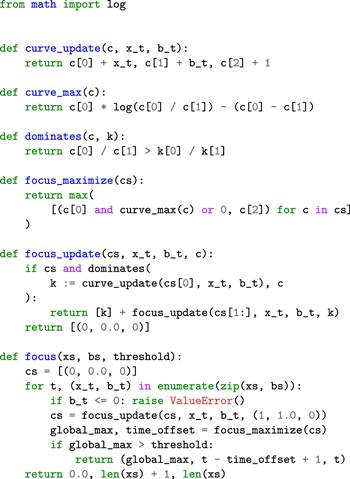
Listing 6. A minimal, functional implementation of Poisson-FOCuS with no optimizations, in Python 3.8.k.