

Humanity is crossing multiple planetary boundaries, with climate change being a particularly urgent threat (Pörtner et al 2023, Richardson et al 2023, Foster and Rahmstorf 2026). Technological innovation plays a crucial role in mitigating and adapting to climate change. Advances in renewable energy generation and storage, such as more efficient solar panels, wind turbines, and high-capacity batteries, are essential to displace fossil fuels and decarbonize electricity systems (Clarke et al 2022). Similarly, innovations in sustainable agriculture, including precision farming, drought-resistant crops, and alternative proteins, can help reduce greenhouse gas emissions while enhancing resilience to climate impacts (Skea et al 2019). At the same time, given the rapidly dwindling carbon budget, addressing climate change also requires far reaching socio-economic transformations (IPCC 2022) and large-scale changes in consumption patterns and lifestyles that reduce energy and material use while maintaining or improving well-being (Creutzig et al 2022, Dablander et al 2025).
The belief that technology will largely solve climate change and its consequences, what we refer to here as techno-optimism, can lead to an over-reliance on technological solutions at the expense of the far reaching socio-economic transformations needed to address climate change (Hernandez et al 2024). For example, current climate change mitigation scenarios rely heavily on the rollout of speculative negative emissions technologies in the future (Arvesen et al 2011, Keyß er and Lenzen 2021, Malm and Carton 2024). This reliance has wide-ranging societal implications: it hampers the development of alternative decarbonization pathways that focus on the behavioral, political, and structural changes needed to advance sustainability transformations (Stephenson and Allwood 2023, Hernandez et al 2024) and deflects attention from the urgent need for immediate emissions reductions (Anderson and Peters 2016, Hickel et al 2021, Hernandez et al 2024, Carton and Malm 2025). In other words, techno-optimism allows for the eternal delay of transformative change due to a belief in future innovations that render such transformations unnecessary (Malm and Carton 2024), and has therefore been identified as a discourse of climate change delay (Lamb et al 2020, Stoddard et al 2021, Nielsen 2023). Techno-optimism as a strategy of climate change denial and delay has been documented in the context of climate policy for aviation (Peeters et al 2016) and ExxonMobil’s climate change communication (Supran and Oreskes 2021).
Techno-optimism also influences individual climate action. It has been shown that techno-optimistic attitudes can undermine the perceived potential of non-technical solutions and willingness to engage in climate action. For example, learning about carbon dioxide removal strategies was found to indirectly reduce support for mitigation policies by reducing the perceived threat of climate change (Campbell-Arvai et al 2017). Similarly, framing geoengineering as a solution to climate change was associated with lower worry about climate change and climate mitigation policy support (Raimi et al 2019). There is also some indication that techno-optimism may undermine engagement in civic action: scientists who believe activism is compatible with science are less likely to be techno-optimists (Finnerty et al 2024). Concerning lifestyle changes, techno-optimism has also been shown to weaken individuals’ feelings of moral obligation to engage in household conservation behavior and decrease individuals’ environmental problem awareness (Soland 2013). Overall, these findings are in line with the risk compensation hypothesis, whereby learning about new technological climate solutions can reduce climate risk perceptions and engagement with personal mitigation efforts (see Campbell-Arvai et al 2017).
Little is known about scientists’ techno-optimistic beliefs and how they relate to their engagement in climate action, including both civic action and lifestyle changes. How techno-optimism influences scientists’ climate actions is of specific interest given their role as knowledge producers, in which they can shape wider societal and policy debates about what kinds of mitigation pathways are possible and necessary to meet internationally agreed-upon climate goals. Scientists—as some of the most trusted actors in society (IPSOS 2024)—may also influence others through their public credibility and perceived consistency, although this role-model pathway is likely secondary to their influence through research and policy advice. For example, scientists with lower carbon footprints are likely more effective at increasing individuals’ intentions to conserve energy than those with higher carbon footprints (Attari et al 2019). Here, we provide the largest analysis of techno-optimism of scientists to date, analyzing data from  scientists in 115 countries (see Dablander et al 2024). We provide differences in techno-optimism across scientific fields and analyze a wide range of climate actions, from civic actions such as signing petitions and engaging in civil disobedience to high-impact lifestyle changes such as reducing flying and following a mostly vegetarian or vegan diet.
2.1. Data and materials
We constructed a population of global scientists by identifying authors on Scopus (Elsevier 2024) who published a peer-reviewed article in the top journals of their field between 2020 and 2022. We invited a total of 249 876 authors to participate in our survey, resulting in responses of  scientists across 115 countries. For a complete description of the sample and the data collection methodology, see Dablander et al (2024). We removed scientists who did not indicate their position or field, resulting in 21 removals (0.2%) and a final sample size of
 . We imputed missing values for the analysis-relevant variables as described in Dablander et al (2024). Less than 1% of values were imputed.
We measured techno-optimism with the item Advances in technology will largely solve the problems caused by climate change with a 5-point Likert response scale with labels Strongly disagree, Disagree, Neither agree nor disagree, Agree, Strongly agree. We refer to scientists who strongly agree or agree as techno-optimistic, and those who strongly disagree or disagree as non-techno-optimistic. We show how agreement with this statement differs across how strongly a scientist’s research is related to climate change, measured using the item To what extent is your research related to climate change? with a 5-point Likert response scale with labels Not at all, Very little, A moderate amount, Quite a bit, A great deal. We also show how it is distributed across scientific fields and political orientation, measured using the item Where would you place yourself on this scale representing political views from left to right? with a 7-point Likert response scale with labels 1 (Left), 2, 3, 4, 5, 6, 7 (Right). We then analyze how agreement with techno-optimism is related to fifteen different climate actions. For a complete list of formulations of the relevant items we analyzed in this study, see table S1. For descriptive statistics on background variables, see tables S2 and S3.
2.2. Causal relationships
We follow the principle that statistical analyses should clearly specify the target of inference—the quantity one seeks to estimate—rather than leave this implicit (McElreath 2020, Lundberg et al 2021, Gelman et al 2026). Our aim is to identify the causal effect of techno-optimism on scientists’ engagement in different climate actions. We state our aim and identifying assumptions transparently, while acknowledging that the present design does not warrant unqualified causal conclusions (see Grosz et al 2020).
In order to interpret cross-sectional regression coefficients as estimates of causal effects, we require additional assumptions that go beyond the data (Pearl et al 2016, Peters et al 2017). Specifically, we require two assumptions. First, we need to assume that there is no unobserved confounding. Second, we need to assume correct temporal ordering, such that techno-optimism precedes the relevant climate actions rather than being (partly) caused by them. Given these assumptions, we are able to construct a regression model that adjusts for confounders and thereby allows us to obtain an unbiased estimate of the causal effect of interest. We used directed acyclic graphs (DAGs) to identify plausible measured confounders and adjust for them in our statistical models. This reduces the risk that observed associations reflect measured common causes of techno-optimism and climate engagement.
Like in any causal analysis based on observational cross-sectional data, we cannot rule out unobserved confounding or reverse causality. Therefore, the causal estimates we obtain with our analysis are the best we can obtain given our design and measured variables. These estimates can be improved by other designs that, for example, measure additional plausible confounders, or use repeated measures designs that do not require one to assume the causal direction. We have also conducted a sensitivity analysis to assess the robustness of our estimates to potential unobserved confounding.
Figure 1 shows a DAG including a number of variables relevant to this study. We posit that one’s position, tenure status, research field, political orientation, age, and sex influence both techno-optimism and climate action. For example, a male, elderly, right-leaning full professor in economics likely has higher techno-optimistic beliefs than a young, female, left-leaning PhD student in physics, and is at the same time less likely to follow a plant-based diet than the latter. Some of these variables influence the extent to which one’s research is related to climate change and one’s political orientation, which in turn both influence techno-optimism and climate action. To estimate the causal effect of techno-optimism on climate action, we need to adjust for these confounders (see e.g. Peters et al 2017). We do not adjust for variables such as worry, which we also measured, in the main analysis as worry is likely a consequence of techno-optimistic beliefs rather than a cause (see Cologna et al 2024). However, we adjusted for worry as a robustness check.
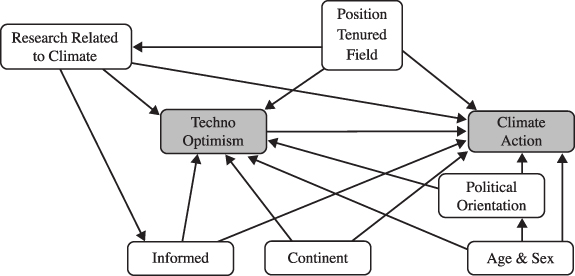
Figure 1. The theoretically derived causal graph informing the main regression analysis reported in section 3.2. The primary aim is to estimate the causal effect of techno-optimism on climate action. Causal relations involving the remaining variables inform the regression model estimating this causal effect.
Download figure:
Standard image High-resolution image
There are two potential issues with this approach. First, the causal structure might be incorrect and techno-optimism might actually cause, for example, in which research field one works or what position one has. If this were the case, adjusting for these variables would block a causal pathway from techno-optimism to climate action. However, this would only underestimate the causal effect. Therefore, our choice to adjust for these variables is conservative. Second, there might be unobserved confounders. For example, the belief that we collectively can address climate change—efficacy beliefs—may reduce techno-optimism while at the same time increase climate action. This will bias the estimated causal effect downward, that is, we might overestimate the negative effect of techno-optimism on climate action, depending on the size of the effect of efficacy on techno-optimism and climate action respectively. We want to note that all causal inference from observational data suffers from the threat of unobserved confounding. Our goal is to do the best causal analysis possible based on the observational data we have, and to be transparent about all assumptions and analysis steps (see Grosz et al 2020). We also report on a sensitivity analysis to assess the robustness of our results to unobserved confounding below.
2.3. Statistical inference
We used the R package brms (Bürkner 2017) to estimate Bayesian regression models with weakly informative default priors (Gelman et al 2008). To assess how techno-optimism differs across scientific fields, political orientation, and the extent to which one’s research is related to climate change, we used an ordinal regression model that included scientific field, political orientation, research orientation, sex, age, position, continent, and whether the researcher is tenured as predictor variables. We adjusted for these background variables to obtain clean contrasts based on scientific fields, political orientation, and research orientation that cannot be explained away by the background variables.
To assess whether techno-optimism is associated with the engagement in various climate actions, we also used ordinal regression models and based our adjustment strategy on the DAG depicted in figure 1. For each climate action, we ran individual ordinal regression models predicting whether scientists have engaged or not in the specific climate action (table S1), using techno-optimism, how informed scientists believe themselves to be about climate change, and the same background variables as above as predictors. We used the R package marginaleffects (Heiss 2022, Arel-Bundock et al 2024) to calculate average marginal effects evaluated across the empirical distribution of all predictor variables. For all analyses, we ran 12 chains with 500 burn-in samples and 1500 final samples each. Convergence was established using the R-hat statistic (Gelman and Rubin 1992).
We first describe how techno-optimism varies across scientists’ connection to climate research, scientific field, and political orientation in section 3.1. We then describe how techno-optimism influences engagement in climate actions in section 3.2. The results for both analyses are based on the regression models described in section 2.3.
3.1. Techno-optimism
There is broad variation in the extent to which scientists believe that technology will largely solve the problems caused by climate change (figure 2(a)). 13% of scientists strongly disagreed (95% CI: [12, 13]) and 31% of scientists disagreed (95% CI: [30, 32]), while 21% agreed (95% CI: [20, 22]) and 6% strongly agreed (95% CI: [6, 7]). 29% neither agreed nor disagreed (95% CI: [28, 30]). Interestingly, the percentage of techno-optimists (i.e. those who (strongly) agree with the statement) among scientists does not vary by the extent to which their research is related to climate change (figure 2(b)). For example, 28% of scientists whose research is not at all related to climate change (strongly) agreed that technology will largely solve the problem (95% CI: [26, 30]). Similarly, 29% of scientists whose research is a great deal related to climate change said the same (95% CI: [27, 30]).
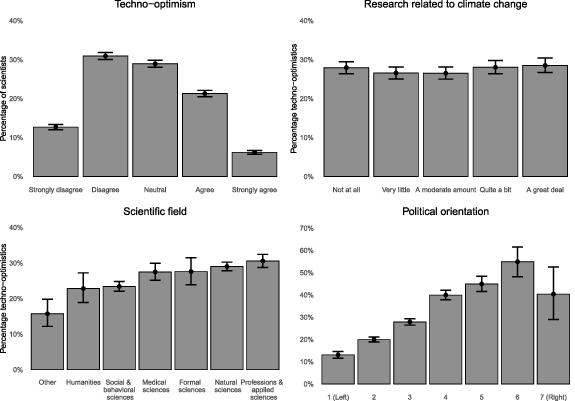
Figure 2. Percentage of scientists who (strongly) disagree, (strongly) agree (i.e., techno-optimists), or are neutral about whether technology will largely solve the problems caused by climate change (a). Percentage of techno-optimists across the extent to which research is related to climate change adjusted for background variables (b). Percentage of techno-optimists across scientific fields (c). Percentage of techno-optimists across political orientation adjusted for background variables (d). Percentages are model-implied and adjusted for background variables (see Methods). Points and error bars indicate posterior means and 95% credible intervals.
Download figure:
Standard image High-resolution image
Techno-optimism varies across scientific fields (figure 2(c)). The percentage of techno-optimists is highest in the professions and applied sciences (31%, [29, 32]), followed by the natural sciences (29%, [28, 30]), formal sciences (28%, [24, 32]), medical sciences (28%, [25, 30]), the social and behavioral sciences (23%, [22, 25]), and the humanities (23%, [19, 27]). Scientists from other fields showed the lowest percentage of techno-optimism (16%, [12, 20]). Techno-optimism also varies strongly with political orientation. Only 13% of researchers who identified as the most left-leaning were techno-optimists (95% CI: [12, 15]), compared to 55% among those who indicated a ‘6’ on the political orientation item (95% CI: [48, 62]), which ranged from 1 (Left) to 7 (Right). 40% of scientists who identified as the most right-leaning were techno-optimists (95% CI: [29, 53]).
The percentage of techno-optimistic scientists decreased with increasing levels of worry (figure S1). The percentage of techno-optimistic scientists was 51% (95% CI: [40, 63]) among scientists who were not at all worried about climate change, while it was only 23% (95% CI [22, 24]) among scientists who were a great deal worried about climate change.
3.2. Techno-optimism and climate action
We found that scientists who (strongly) agreed ( ) that technology will largely solve the problems caused by climate change reported engaging in less civic actions than those who (strongly) disagreed (
 ; figure 3). For example, techno-optimistic scientists reported signing less petitions (41% vs 52%), engaging in less protest (17% vs 28%), and engaging in less advocacy (25% vs 33%). The 95% credible intervals always remained within 2.5 percentage points of the central estimate. Averaging across all civic actions, the percentage of techno-optimistic scientists engaging in a civic action was 7 percentage points smaller than the percentage of non-techno-optimistic scientists. In terms of relative differences, climate engagement of the former was 23% lower, on average, than the engagement of the latter (figure S2).
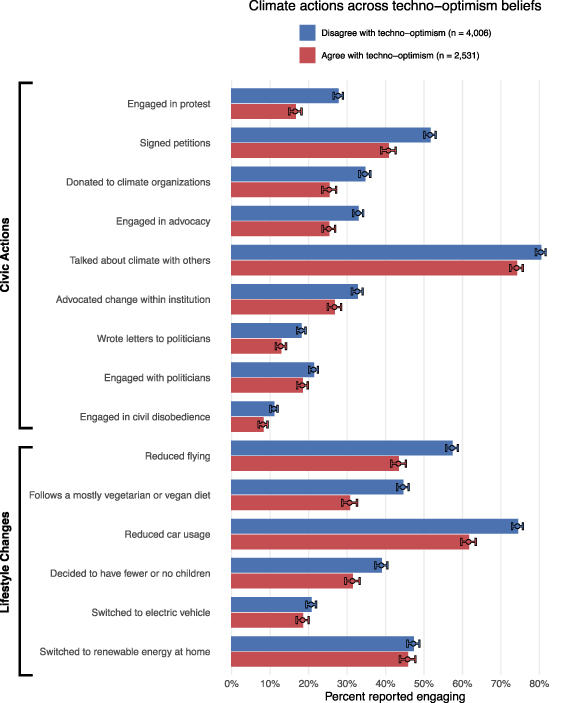
Figure 3. Percentage of scientists who reported having engaged in a particular behavior for scientists who (strongly) agree with techno-optimism (red) and scientists who (strongly) disagree with techno-optimism (blue). Points and error bars indicate posterior means and 95% credible intervals (see Methods). The actions are ordered according to absolute difference in proportions between (strongly) disagree and (strongly) agree for civic actions and lifestyle changes, respectively. Percentages are model-implied and adjusted for background variables (see Methods).
Download figure:
Standard image High-resolution image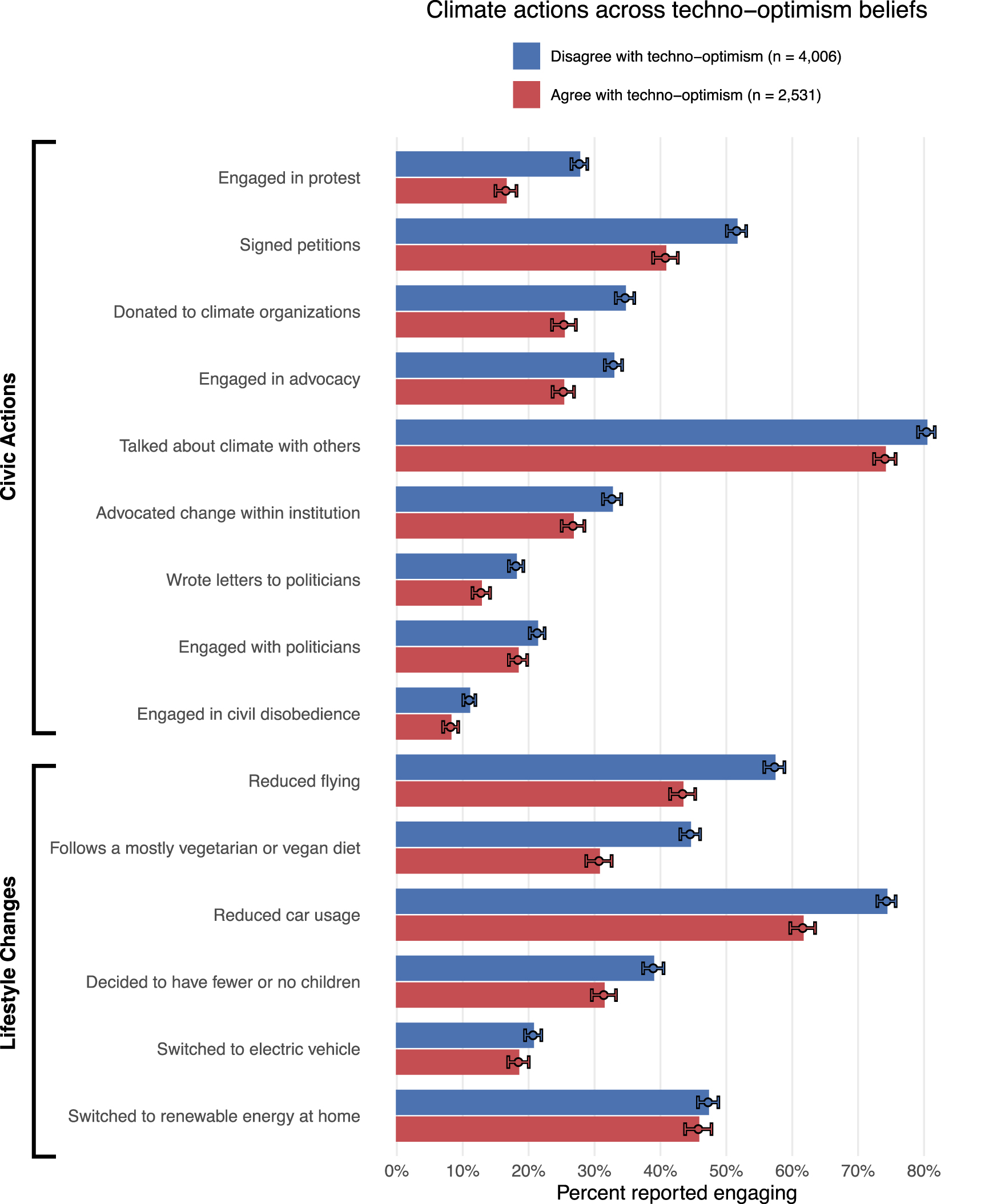
Scientists who (strongly) agreed that technology will largely solve the problems caused by climate change also reported engaging in fewer lifestyle changes than those who (strongly) disagreed. For example, techno-optimistic scientists were less likely to report reducing their flying (43% vs 57%), reducing their car usage (62% vs 74%), or following a mostly vegan or vegetarian diet (31% vs  ). Differences for technology-related lifestyle actions, such as switching to electric vehicles (18% vs
 ) and renewable energy at home (
 vs
 ), were negligible. The 95% credible intervals always remained within 2.5 percentage points of the central estimate. Averaging across all lifestyle actions, the percentage of techno-optimistic scientists engaging in lifestyle changes was 9 percentage points smaller than the percentage of non-techno-optimistic scientists. In terms of relative differences, climate engagement of the former was 18% lower, on average, than the engagement of the latter (figure S2). The previous comparison contrasts scientists who agreed with those who disagreed with techno-optimism. We can also assess how much a one-unit increase in the techno-optimism item (going from strongly disagree to disagree, from disagree to neutral, etc) decreases climate engagement (figure S3). Averaging across all civic actions, a one-unit increase in techno-optimism decreases engagement by 3.2 percentage points. Averaging across all lifestyle actions, a one unit-increase in techno-optimism decreases engagement by 3 percentage points.
In terms of professional actions, techno-optimistic scientists were also less likely to include climate change in their teaching (48% vs  ), but showed negligible differences in having shifted their research to topics related to climate change (50% vs
 ).
We used sensitivity analyses to assess the robustness of our results against potential unobserved confounding. If an omitted confounder were, conditional on all other covariates, as strongly associated with techno-optimism as political orientation and as strongly associated with the specific climate action as techno-optimism itself, the estimated effects would be reduced by 69%. If both associations were half as strong, the estimated effects would be reduced by only 17%. (figure S4).
While such a sensitivity analysis is useful, it is difficult to determine what assumed confounding strength is empirically sensible. Adjusting for a variable that is observed and that may be a (conceptually strong) confounder is another avenue to assess robustness. We therefore conducted an analyses that additionally adjust for worry (supplementary material), which we view as a likely mediator but which may also be viewed as a potential confounder. Additionally adjusting for worry results in an average effect reduction of only 16% for civic actions and 12% for lifestyle changes.
Addressing climate change requires technological innovations, far-reaching socio-economic transformations, and large-scale changes to consumption patterns and lifestyles. Techno-optimism, the belief that technology will largely solve climate change and its consequences, acknowledges the reality of climate change but contributes to delaying critical structural and behavioral transformations (Lamb et al 2020, Stoddard et al 2021, Malm and Carton 2024, Carton and Malm 2025). In this study, we provided the largest investigation to date of techno-optimistic beliefs by scientists, who as knowledge producers and highly trusted societal actors are critical in informing public debate and can act as role models for the individual and collective changes needed to address climate change.
We found that techno-optimism is unequally distributed across research fields, with professions and applied sciences exhibiting the highest percentage of techno-optimistic scientists and the humanities the lowest. This finding is aligned with the notion that scientists working in applied or technical domains are more likely to perceive technological innovation as an effective and sufficient solution, whereas scholars in the humanities and social sciences tend to emphasize social, cultural, and political dimensions of transformation (Stirling 2019, Newell 2022). The percentage of techno-optimists did not vary by how strongly the scientists’ research was related to climate change, suggesting that climate scientists are not less prone to techno-optimism than other scientists. This indicates that techno-optimism is not merely a function of domain expertise but may instead reflect broader ideological or epistemic orientations toward progress and innovation.
We also found that scientists on the political right exhibited stronger beliefs that technology will solve the problems of climate change. This aligns with prior work showing that techno-optimistic beliefs often correlate with market-oriented worldviews and resistance to regulatory or demand-side interventions (Campbell and Kay 2014, Hornsey 2020, 2021). Such beliefs reflect a broader ‘ecomodernist’ perspective that frames environmental problems as primarily technical challenges to be overcome through human ingenuity, innovation, and economic growth rather than through limits, redistribution, or behavioral change (Hällmark 2023). This shows that techno-optimistic beliefs are not only expectations about the potential of technology but may also be expressions of an underlying ideology that legitimizes incremental, growth-oriented approaches to climate mitigation while deflecting attention from deeper structural change needed to address climate change (Lamb et al 2020). Future research may therefore investigate how such techno-optimistic beliefs shape policy debates involving scientists (see Suter et al 2025).
Techno-optimism was associated with lower engagement in civic actions and lifestyle changes. Regarding civic actions, the largest differences appeared for signing petitions and participating in protests, but the pattern extended across all forms of civic engagement. This is consistent with prior research showing that scientists who view activism as being compatible with their role as a scientist are less likely to be techno-optimists (Finnerty et al 2024). The civic actions included in our study all require some degree of political mobilization, yet differ in their intensity and visibility. The consistent pattern among techno-optimists suggests that this belief may dampen willingness to engage collectively to influence policy or institutions. One plausible mechanism is that techno-optimism shifts perceived responsibility away from civic or political arenas toward technological and expert domains (Soland 2013), reinforcing the view that progress depends primarily on innovation rather than public mobilization or structural change (Markusson et al 2018, Lamb et al 2020). In this sense, techno-optimism may narrow the repertoire of engagement among scientists, emphasizing research and technological advancement over advocacy or participation in social movements. Techno-optimism might also reduce worry, which could in turn reduce engagement. Future research may wish to further disentangle the mechanisms through which techno-optimism reduces civic climate action.
Techno-optimistic scientists also reported fewer lifestyle changes. The differences were particularly pronounced in the following high-impact lifestyle actions: reducing flying, shifting to plant-rich diets, and reducing car usage. These are precisely the types of actions that involve high behavioral costs or confrontation with social norms (Wyss et al 2022). Our findings suggest that believing technology will solve the problems of climate change can function as a psychological and moral justification to avoid such lifestyle changes, consistent with earlier work showing that techno-optimism is used discursively to rationalize high-carbon practices (Cass et al 2023). There were negligible differences in switching to electric vehicles and to renewable energy at home, both of which are high-impact, infrequent behaviors requiring some financial investment, and can affirm an individual’s technological efficacy. This pattern supports the view that techno-optimism may promote forms of environmental action compatible with existing consumption patterns, while discouraging more habitual or sufficiency-oriented changes (Burger et al 2022).
As in any empirical work, our conclusions are subject to a number of limitations. First, our study is observational, so we cannot draw causal conclusions without additional assumptions. We used modern tools from causal inference to deal with this situation, reasoning with DAGs and adjusting for potential confounders, but as in any observational and cross-sectional study, unobserved confounding and reverse causality cannot be ruled out. A sensitivity analysis showed that the size of the unobserved confounding needs to be substantial, however, to markedly reduce the estimated causal effects. We therefore believe that our results are quite robust to unobserved confounding.
The threat from reverse causality is more difficult to assess, as our cross-sectional data do not allow us to quantify the potential bias arising from an incorrect temporal ordering in the same way as we can for unobserved confounding. Considering first the hypothesized direction from techno-optimism to reduced climate action, there is experimental evidence consistent with such a pathway. Presenting technological interventions as major climate solutions can reduce perceived climate threat and support for emissions mitigation (see Campbell-Arvai et al 2017, Raimi et al 2019), which may extend to the kinds of personal and civic climate actions studied in this paper. The reverse pathway—from lower climate engagement to greater techno-optimism—is also plausible, but the available evidence for it is weaker. A large body of literature on cognitive dissonance shows that environmentally harmful behavior can be accompanied by rationalizations that reduce the discomfort associated with failing to act in accordance with one’s values. Many documented rationalizations are behavior-specific, however, rather than using general beliefs such as that technology will solve climate change. For example, air travel may be justified by professional or family obligations (McDonald et al 2015, Kreil 2021), while meat consumption is commonly justified as being natural, normal, necessary, or enjoyable (Piazza et al 2015). More importantly for the present study, a closely related construct, technological optimism, has recently been identified as a mechanism of moral disengagement in qualitative analyses of interviews and social media comments (Tolmatcheff et al 2025). However, even if some people do adopt techno-optimistic beliefs as a rationalization, this alone would not establish reverse causality. A person may already hold techno-optimistic beliefs and invoke them to justify their behavior; reverse causality would instead require that lower climate engagement subsequently produces or strengthens techno-optimistic beliefs. To our knowledge, there is currently no direct evidence for this temporal pathway. Reverse causality nevertheless remains possible and cannot be ruled out by the present design. Future longitudinal or experimental research is needed to establish the relative importance of the two causal directions between techno-optimistic beliefs and climate action.
Second, what we termed ‘techno-optimism’ throughout this paper is measured using a single item, which does not cover all dimensions of what one might understand under techno-optimism. Future research might want to use a more elaborate scale of techno-optimism (see Cologna et al 2024). Relatedly, different conceptualizations of closely related constructs exist, including techno-solutionism (Finnerty et al 2024) and techno-fix attitudes, which may be differently related to climate change beliefs and engagement. For example, Cologna et al (2024) found that what they called techno-optimism (measured with items such as ‘technology makes our lives easier and more comfortable’ and ‘technology means progress’) was positively associated with pro-environmental behavior. Third, our measure of political orientation is coarse. A single left–right self-placement item is unlikely to capture the different meanings of ‘left’ and ‘right’ in our large international sample nor distinguish economic, social, and cultural dimensions of political ideology. At the same time, the use of such a broad measure likely makes our results conservative, as heterogeneity in the meaning of left–right orientation across countries introduces noise, making strong and consistent effects harder to detect. Fourth, some climate action items relate to reducing a climate-harmful behavior, such as reducing air travel or car use. However, even if scientists report having reduced such behaviors (see also Dablander et al 2024), they may still engage in more climate-harmful behavior than their peers (see Whitmarsh et al 2020). Future research can improve on this by directly measuring the number of times the harmful behavior is performed. Lastly, while our analyses were not pre-registered and should be viewed as exploratory, the consistent results and large international sample provide strong evidence for a link between techno-optimism and engagement in climate action.
Scientists play a critical role in addressing climate change both as knowledge producers and role models. By showing how techno-optimistic beliefs are related to scientists’ engagement in climate actions, we hope that our study can contribute to a critical discussion about how scientists’ own beliefs and worldviews shape their understanding of, and engagement in, climate action. Recognizing these underlying orientations can help foster greater reflexivity within the scientific community and promote a more inclusive dialogue about the changes needed to address climate change.
JMBH was supported by the Netherlands Organisation for Scientific Research (NWO) under VENI Grant No. 221G.110. JMBH has been supported by the gravitation project ‘New Science of Mental Disorders’ (www.nsmd.eu), supported by the Dutch Research Council and the Dutch Ministry of Education, Culture and Science (NWO gravitation Grant No. 024.004.016).
The data that support the findings of this study are openly available at the following URL/DOI: https://github.com/fdabl/Scientists-Techno-Optimism.
Supplementary information available at https://doi.org/10.1088/1748-9326/aea4c7/data1.
All the data and code needed to reproduce the analyses reported in this paper can be found at https://github.com/fdabl/Scientists-Techno-Optimism.
The authors declare no competing interests.