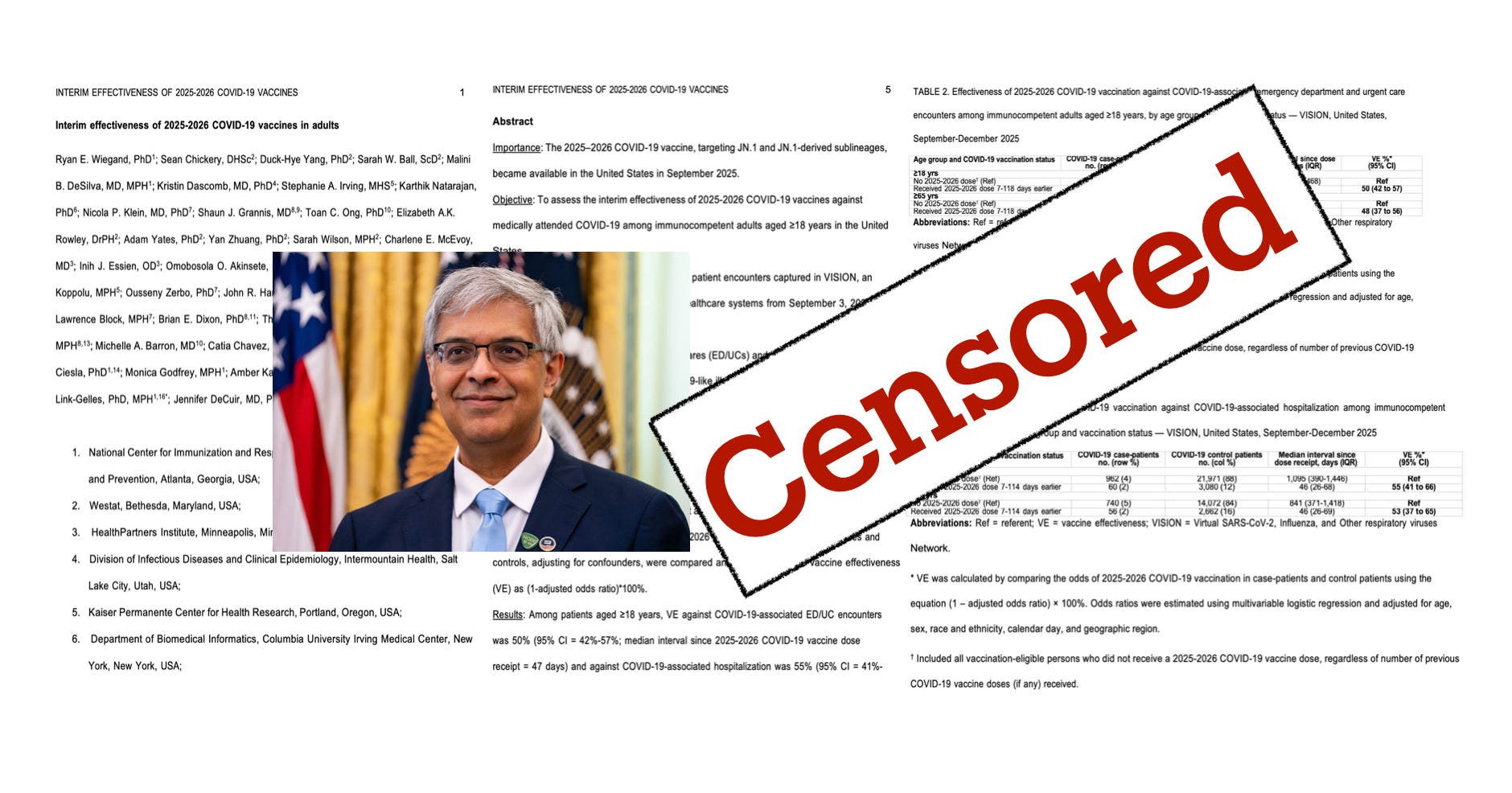
Earlier this month, The Washington Post broke the news that Dr. Jay Bhattacharya, the CDC’s temporary top official, prevented a Covid-19 vaccine effectiveness paper from appearing in the agency’s flagship scientific journal, Morbidity and Mortality Weekly Report (MMWR). The manuscript was a typical one for the VISION network, a research collaborative between the CDC, Westat, and multiple US health systems. Since 2019, the VISION network has studied vaccine effectiveness for influenza, RSV, and Covid-19 using real-world data. Its investigations have routinely been published and widely read over the years.
The censored paper presents data on the effectiveness of Covid-19 vaccines during the 2025–2026 season. The results suggest that, in the first few months after vaccination (September–December 2025), this year’s vaccines were 53–55% effective against hospitalizations among the study’s population of adults without immune compromise.
But Jay Bhattacharya believes that the public should not see this work—or at least that the CDC should not publish solid science carried out, in part, by its own experts.
That’s why we have to read it now. The blocked document (scrubbed of metadata) was obtained by Inside Medicine from a source who wished to be described as “someone close to the study.”
Here it is, available to the public for the first time:
“I’m strongly opposed to this kind of censorship,” Dr. Michelle Barron, one of the manuscript’s authors, told Inside Medicine. Dr. Barron, an infectious diseases physician at the University of Colorado, believes the move is an attack against transparency and the usual open scientific process. “It should be out in the world at large for the scientific community to judge it for what it is,” she said.
Dr. Bhattacharya defended his move by noting that technically the MMWR is not peer-reviewed. However, the journal is carefully edited and reviewed by experienced agency scientists with relevant expertise. A recent editor-in-chief, for example, was previously a deputy editor at The Journal of the American Medical Association, one of the world’s most prestigious medical journals.1
Why is MMWR not peer-reviewed? According to Dr. Sonja Rasmussen, a former editor-in-chief of MMWR, the journal doesn’t use traditional peer review for two main reasons. “Having the review be internal allows for it to be rapid when necessary,” she told Inside Medicine. Nowhere was this advantage clearer than in the early days of the Covid-19 pandemic. Beyond that, the journal is “considered the ‘voice of CDC,’ so it needs to be consistent with CDC recommendations,” Dr. Rasmussen added.
So, while MMWR manuscripts don’t follow the same external peer review process as other important scientific journals, that doesn’t mean they lack adequate rigor. In fact, VISION network manuscripts using the same methods as the paper censored by Dr. Bhattacharya have been published in top-tier, peer-reviewed, non-CDC journals, including The New England Journal of Medicine, the most influential American medical journal. Indeed, this paper has already been submitted to another major medical journal for publication. (To my knowledge, Bhattacharya has not stifled this effort.)
At issue is the “test-negative design” that the study used to measure vaccine effectiveness. To hear Dr. Bhattacharya’s take, this all boils down to the methodology of that design. But these methods are well-established, if imperfect. (It’s worth noting that Dr. Bhattacharya is a health economist, not a vaccine effectiveness methods expert.)
That said, there are pros and cons of test-negative designs. This is uncontroversial, even among CDC statistics veterans. But the limitations of the approach are always acknowledged in these papers, including the one in question. This is precisely why other study designs should be used in conjunction with investigations like this one. When several types of observational studies agree, it lowers the chance that confounding variables might have altered the outcomes overall. Still, even with multiple study designs in play, each giving a slightly different angle on vaccine effectiveness, it’s possible that only a randomized, placebo-controlled trial would reveal different answers. The question is whether it’s ethically possible to conduct such a study. (We’ll discuss this another time soon.)
If test-negative design studies are a part of the overall landscape for evaluating vaccines, why would Jay Bhattacharya censor a paper like this now? It’s telling that Bhattacharya censored the piece at a very late stage—right before publication—rather than asking CDC scientists to explore alternative options for their future work. (It’s ironic, by the way; he was so anti-censorship back when he was a private citizen that the Supreme Court said that he’d failed to even show that he’d been censored, let alone rule on his complaint about the Biden administration’s alleged actions.)
Our source of the document believes that HHS—that is, Secretary Robert F. Kennedy Jr. and his underlings like Bhattacharya—might be hoping to further weaken CDC recommendations for seasonal Covid-19 vaccines this year. It’s possible that the CDC may even weaken its recommendations for high-risk patients above age 65, he believes.
In other words, the science in this paper is pretty standard. “There was nothing new or profound here,” the source of the manuscript told Inside Medicine. He noted that many similar papers have been published by MMWR and other major external journals before. “This was purely a political decision,” he believes.
That’s in contrast to the motivations of the VISION network, according to Dr. Barron. “I think everybody’s involvement in this network is from a purely scientific and medical standpoint,” she said. One of the network’s goals, she says, is to study vaccines in specific populations, including groups where data have often been lacking, including pregnancy, and high-risk populations. “We want data so that we know when something’s working, and when something is not working. What are the risks? What are the benefits?”
That’s all for now. Thank you for reading! If you have information about any of the unfolding stories we are following, please email me or find me on Signal at InsideMedicine.88.