About Infinigen
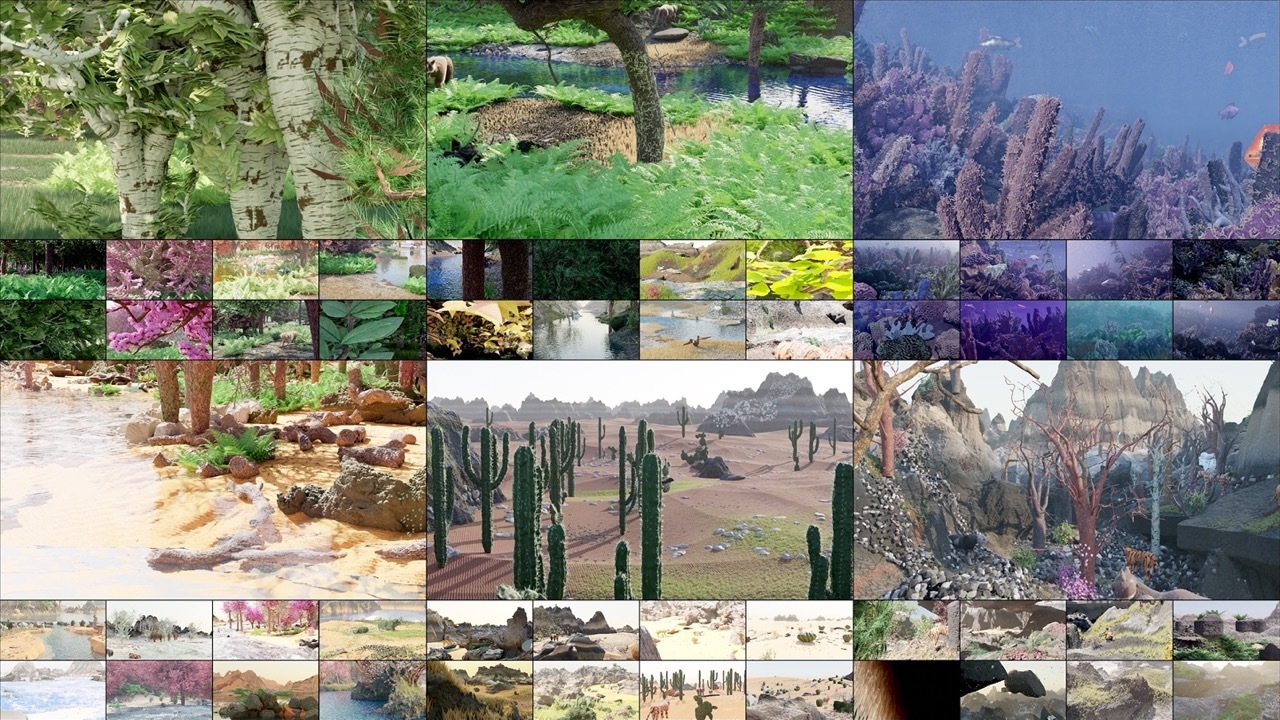
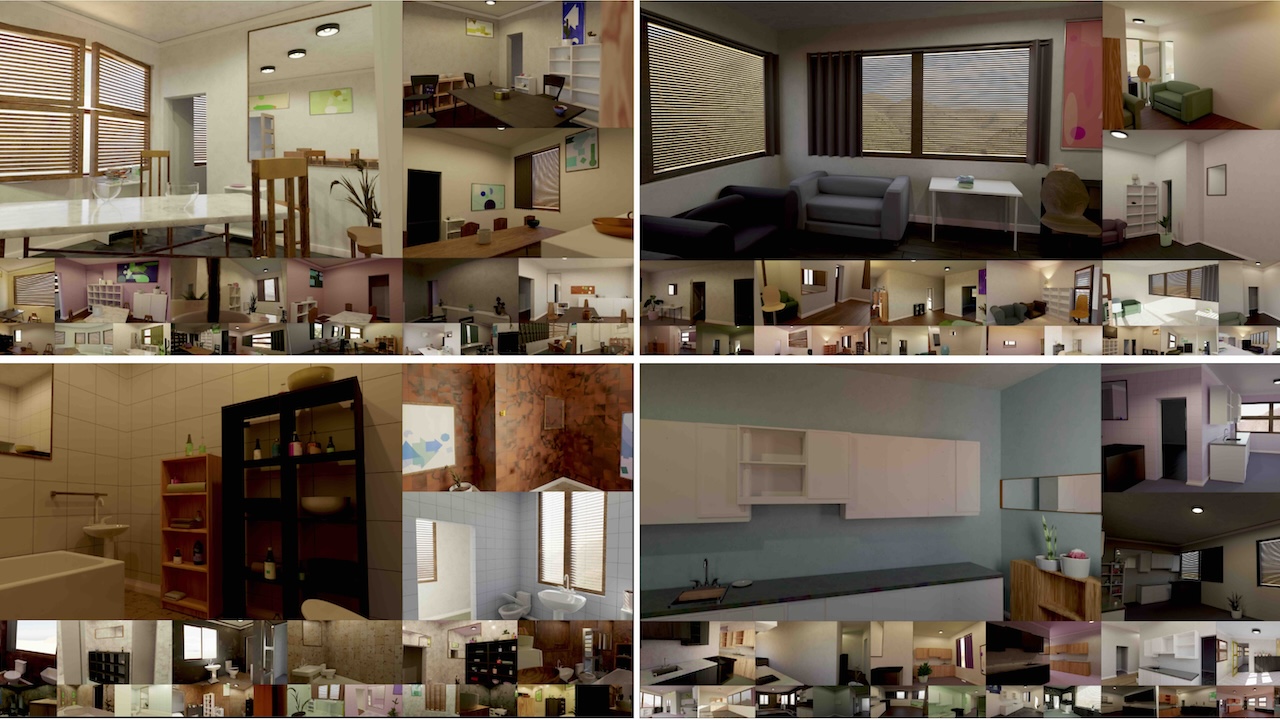
Infinigen is a procedural generator of 3D scenes, developed by Princeton Vision & Learning Lab. Infinigen is optimized for computer vision research and generates diverse high-quality 3D training data. Infinigen is based on Blender and is free and open-source (BSD 3-Clause License). Infinigen is being actively developed to expand its capabilities and coverage. Everyone is welcome to contribute.
Research Papers
Alexander Raistrick*, Lahav Lipson*, Zeyu Ma* Lingjie Mei, Mingzhe Wang, Yiming Zuo, Karhan Kayan, Hongyu Wen, Beining HanYihan Wang,Alejandro Newell, Hei Law, Ankit Goyal, Kaiyu Yang, Jia Deng
( *equal contribution, alphabetical order )
@inproceedings{infinigen2023infinite,
  title={Infinite Photorealistic Worlds Using Procedural Generation},
  author={Raistrick, Alexander and Lipson, Lahav and Ma, Zeyu and Mei, Lingjie and Wang, Mingzhe and Zuo, Yiming and Kayan, Karhan and Wen, Hongyu and Han, Beining and Wang, Yihan and Newell, Alejandro and Law, Hei and Goyal, Ankit and Yang, Kaiyu and Deng, Jia},
  booktitle={Proceedings of the IEEE/CVF Conference on Computer Vision and Pattern Recognition},
  pages={12630--12641},
  year={2023}
}
Alexander Raistrick*, Lingjie Mei*, Karhan Kayan*, David Yan,Yiming Zuo, Beining Han, Hongyu Wen, Meenal Parakh, Stamatis Alexandropoulos, Lahav Lipson, Zeyu Ma, Jia Deng
( *equal contribution, random order )
Conference on Computer Vision and Pattern Recognition (CVPR) 2024
@inproceedings{infinigen2024indoors,
    author={Raistrick, Alexander and Mei, Lingjie and Kayan, Karhan and Yan, David and Zuo, Yiming and Han, Beining and Wen, Hongyu and Parakh, Meenal and Alexandropoulos, Stamatis and Lipson, Lahav and Ma, Zeyu and Deng, Jia},
    title={Infinigen Indoors: Photorealistic Indoor Scenes using Procedural Generation},
    booktitle={Proceedings of the IEEE/CVF Conference on Computer Vision and Pattern Recognition (CVPR)},
    month={June},
    year={2024},
    pages={21783-21794}
}
Abhishek Joshi, Beining Han, Jack Nugent, Max Gonzalez Saez-Diez, Yiming Zuo, Jonathan Liu, Hongyu Wen, Stamatis Alexandropoulos, Karhan Kayan, Anna Calveri, Tao Sun, Gaowen Liu, Yi Shao, Alexander Raistrick*, Jia Deng
Conference on Computer Vision and Pattern Recognition (CVPR) 2024
@misc{joshi2025infinigenarticulated,
      title={Procedural Generation of Articulated Simulation-Ready Assets},
      author={Abhishek Joshi and Beining Han and Jack Nugent and Max Gonzalez Saez-Diez and Yiming Zuo and Jonathan Liu and Hongyu Wen and Stamatis Alexandropoulos and Karhan Kayan and Anna Calveri and Tao Sun and Gaowen Liu and Yi Shao and Alexander Raistrick and Jia Deng},
      year={2025},
      eprint={2505.10755},
      archivePrefix={arXiv},
      primaryClass={cs.RO},
      url={https://arxiv.org/abs/2505.10755},
}
Key Features & Capabilities
Procedural
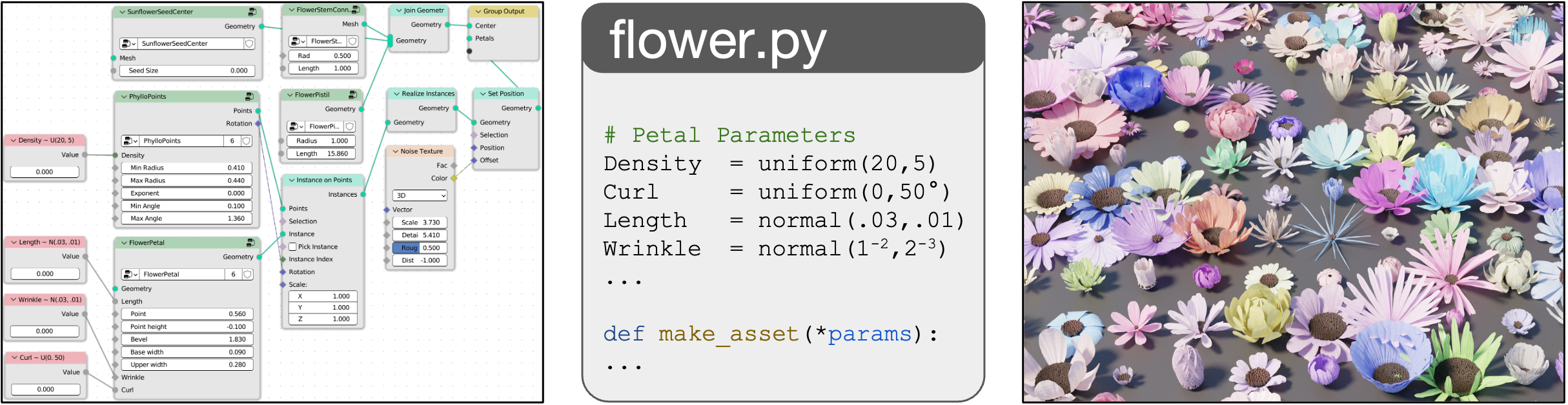
Infinigen is a procedural generator that creates everything entirely from randomized mathematical rules, including all shapes and materials, from macro structures to micro details. Infinigen can create unlimited variations. Users have full control the generation of assets by overriding default parameters of randomization.
Diverse
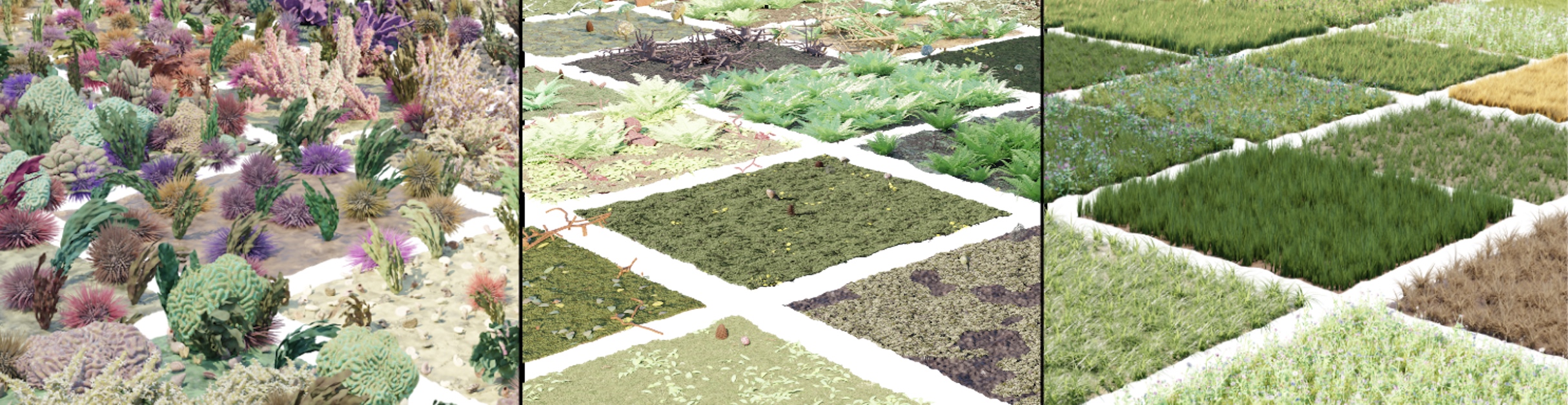
Infinigen provides generators for diverse objects and scenes in the natural world including plants, animals, terrains, and natural phenomena such as fire, cloud, rain, and snow. The current focus on nature is motivated by the observation that mammalian vision evolved in the natural world. However, Infinigen is expected to expand over time to cover built environments and artificial objects.
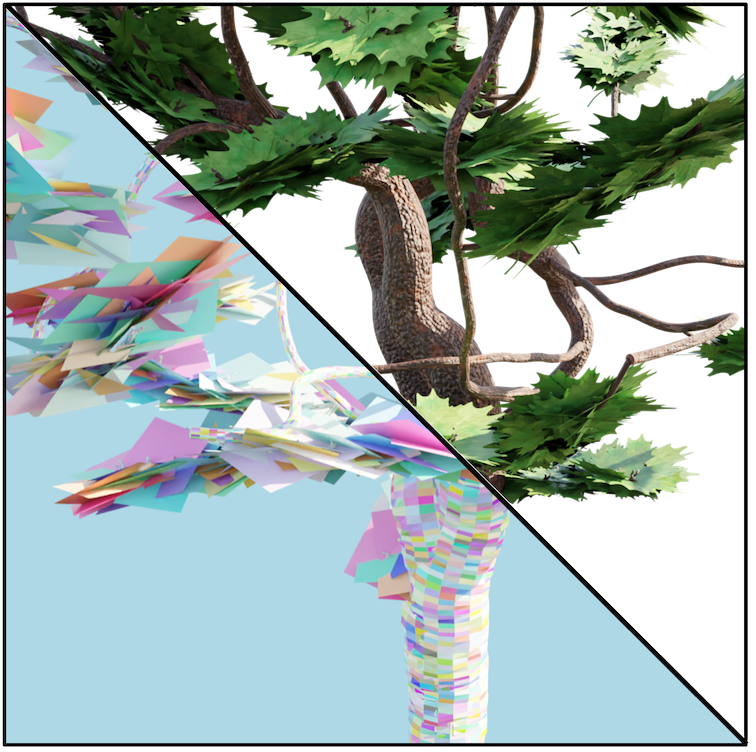
Fake Geometry
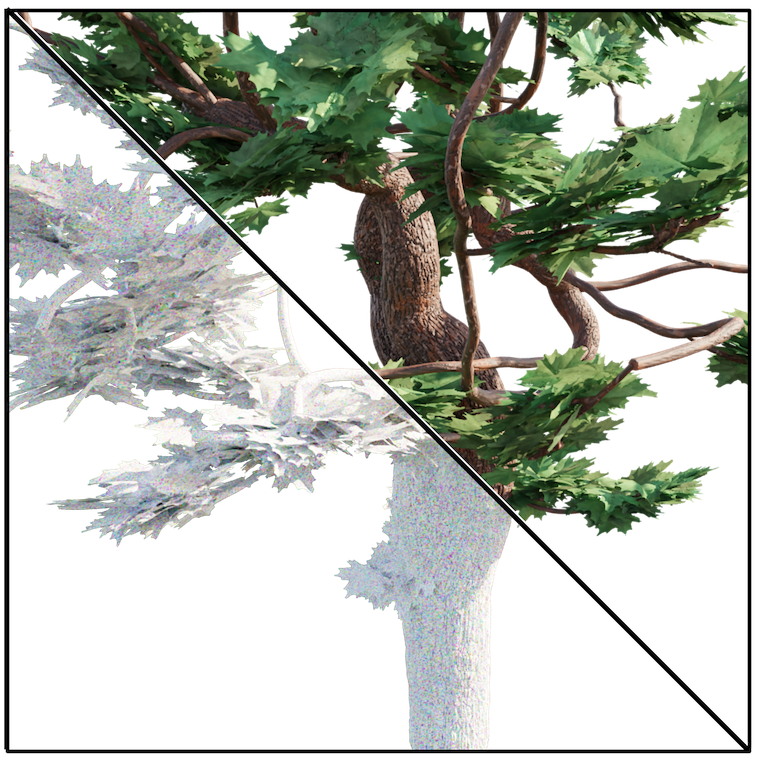
Real Geometry
Real Geometry
Infinigen is optimized for computer vision research, particularly 3D vision. Infinigen does not use bump/normal-maps, full-transparency, or other techniques which fake geometric detail. All fine details of geometry from Infinigen are real, ensuring accurate 3D ground truth.
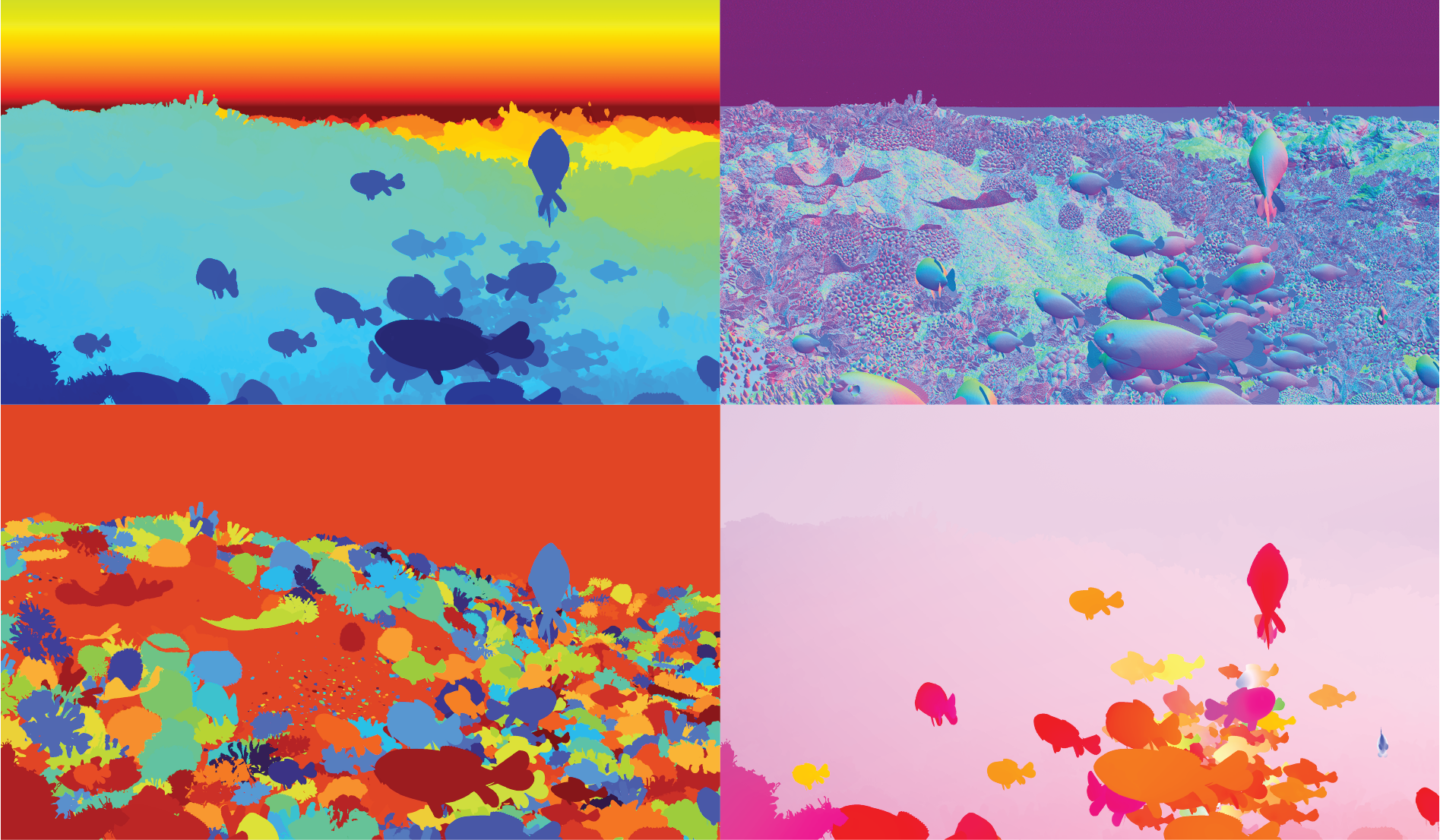
Automatic Annotations
Infinigen can automatically generate high-quality annotations for a variety of computer vision tasks, including optical flow, 3D scene flow, depth, surface normals, panoptic segmentation, occlusion boundaries. Because users have full access to the rendering process, the annotations are easily customizable.