Tansi/Hello — thank you for being here!
I have 8,479 readers. 543 paying. That is amazing, but there’s still a big gap. And it’s the weight I carry every day.
These stories exist because I refuse to let them disappear. I have spent 15 years on the ground; I have built the trust and repertoire that barely exists anywhere else. Which is why you won’t find this kind of coverage, the way I do it, anywhere else.
I need you in this with me now more than any other time.
That’s what reconciliation looks like from where I’m standing.
Come step into the fire with me.
Become a paid subscriber, hiy hiy:
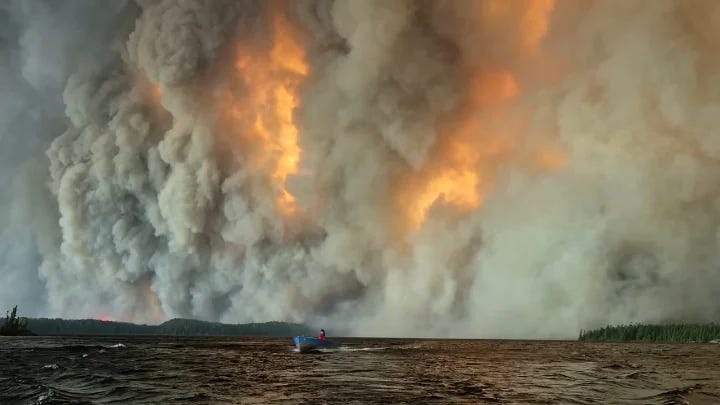
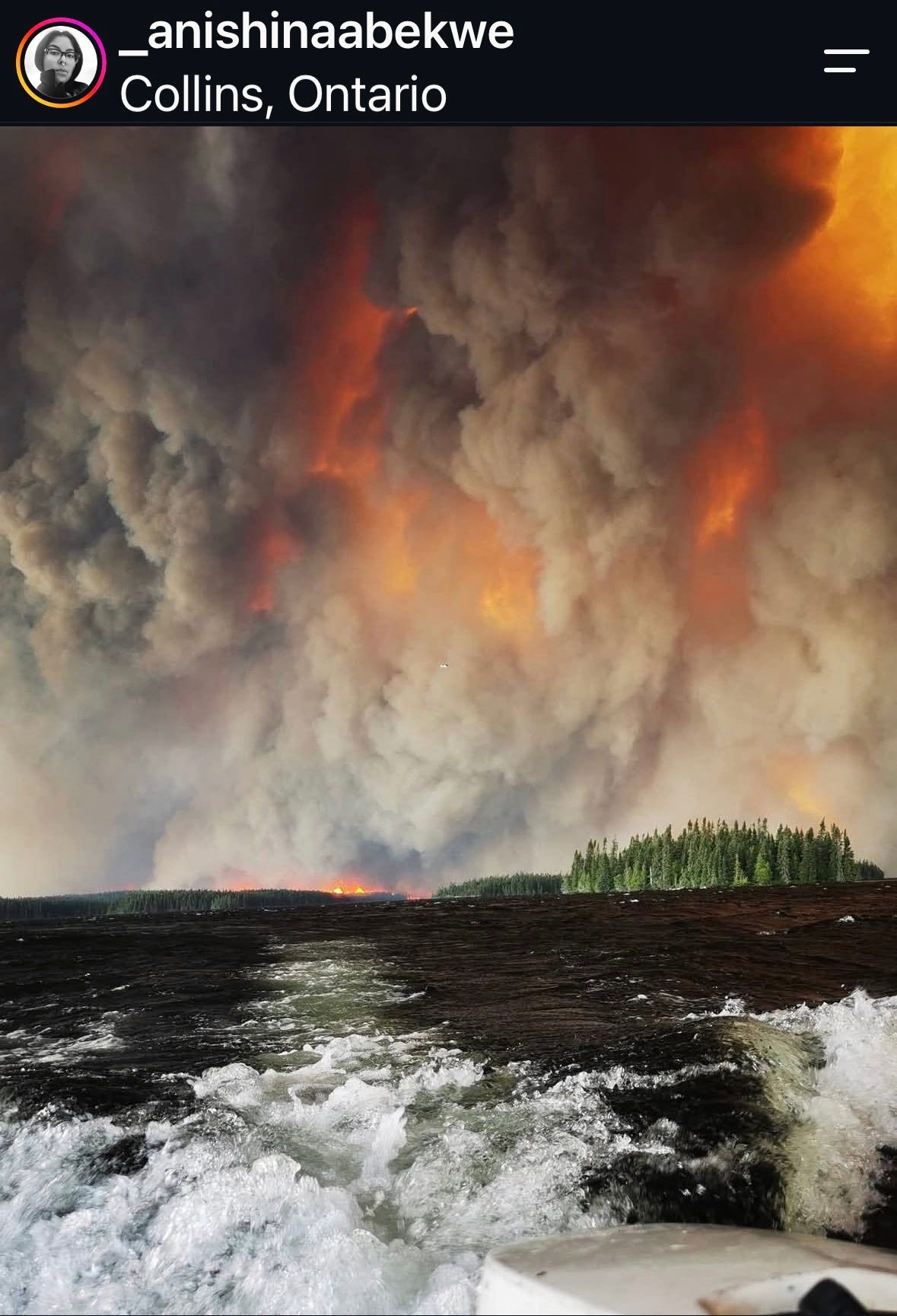
I was scrolling Instagram on Tuesday when the images started stacking up — apocalyptic, biblical almost. Massive walls of fire. Smoke clouds swallowing the horizon in every direction. Photos taken from the backs of boats, by people fleeing for their lives across dark water lit orange from behind.
Northern Ontario. And of course — of course — it was an Indigenous community. Right now, 128 wildfires are burning across the region.
My heart cracked a little more when I saw what Nadya Kwandibens posted Tuesday night. She wasn’t there. She was watching her own hometown burn from afar, same as the rest of us scrolling — except this was Collins, Ontario, where her family is from, and she wrote that it was gone. She was waiting to hear where to direct help, with donations already being routed to a hotel in Thunder Bay. Nadya is Anishinaabe, from Animakee Wa Zhing #37 First Nation. She has family ties to Namaygoosisagagun First Nation — the community also known as Collins. Nadya’s spent over two decades behind the camera as the founder of Red Works Photography, building a body of work that pushes back against colonial narratives and shows Indigenous life and strength on its own terms. This time, it wasn’t someone else’s disaster she was documenting from a distance. It was her own family’s front door, and she couldn’t even get there.
You feel so helpless watching this from afar. But here’s the thing that guts me more than the helplessness: this has become the norm. Every summer, for years running now, it’s Indigenous communities standing on the frontlines of a crisis none of us created alone but that we are absolutely paying for first.
Indigenous peoples make up roughly five percent of this country’s population and account for more than 42 percent of all wildfire evacuation events in Canada. About 80 percent of majority-Indigenous communities sit in fire-prone boreal regions — because that’s where colonial reserve policy put them, on land nobody else wanted, land that now happens to be burning hotter and more often than almost anywhere else in the country. An estimated 60 percent of reserves sit directly in the wildland-urban interface, the exact zone fire agencies treat as highest-risk — and lowest-priority, when the water bombers and crews get allocated. When the smoke clears, it’s Indigenous evacuees who make up the overwhelming majority of people pushed into unfamiliar cities, cut off from land-based food, medicine, and each other. Some of these communities have now been forced out five, six, seven times in a couple of decades. Almost all of them are First Nations.
As Collins burned, the danger wasn’t only on the water. That same day, a CN Rail worker captured terrifying video from inside a train as wildfire closed in on the tracks near the community, flames visible just feet from the rail line. “We’re encased in flames,” the worker said, watching a wall of fire engulf the treeline outside the window. CN confirmed everyone aboard made it out safely.
And Collins isn’t an isolated tragedy. It’s the latest entry in a list that keeps growing. In 2016, “The Beast” tore through Fort McMurray, forcing nearly 90,000 people out in the largest single-day evacuation in Canadian history and destroying 2,400 homes and buildings. In 2021, Lytton, B.C. — a day after setting the national heat record at 49.6°C — was wiped off the map entirely, the first Canadian town swallowed whole by wildfire. In 2024, fire tore through Jasper, forcing 25,000 to flee and destroying a third of the townsite’s structures. In 2023, more than 1,000 people had to be evacuated by boat and plane from Fort Chipewyan, Alberta — home to the Athabasca Chipewyan First Nation, Mikisew Cree First Nation and the Fort Chipewyan Métis Nation — as wildfire closed in on a community already living downstream from the oil sands and grappling with a tailings pond leak into their water. That same fire season, four First Nations served by the Kee Tas Kee Now Tribal Council in northern Alberta were forced out. Federal data show 70,824 First Nations people have been evacuated because of wildfire in the past decade alone, and in 2023 alone, 25,000 people from 79 First Nations were displaced — more than 11,400 of them gone from home for longer than three months. Some Indigenous leaders have stopped calling themselves wildfire evacuees at all. They call themselves climate refugees.
Every one of these disasters got called unprecedented. None of them were isolated. This isn’t a fluke of geography. It’s the predictable result of where people were pushed, and who gets left to face the consequences of a warming world first.
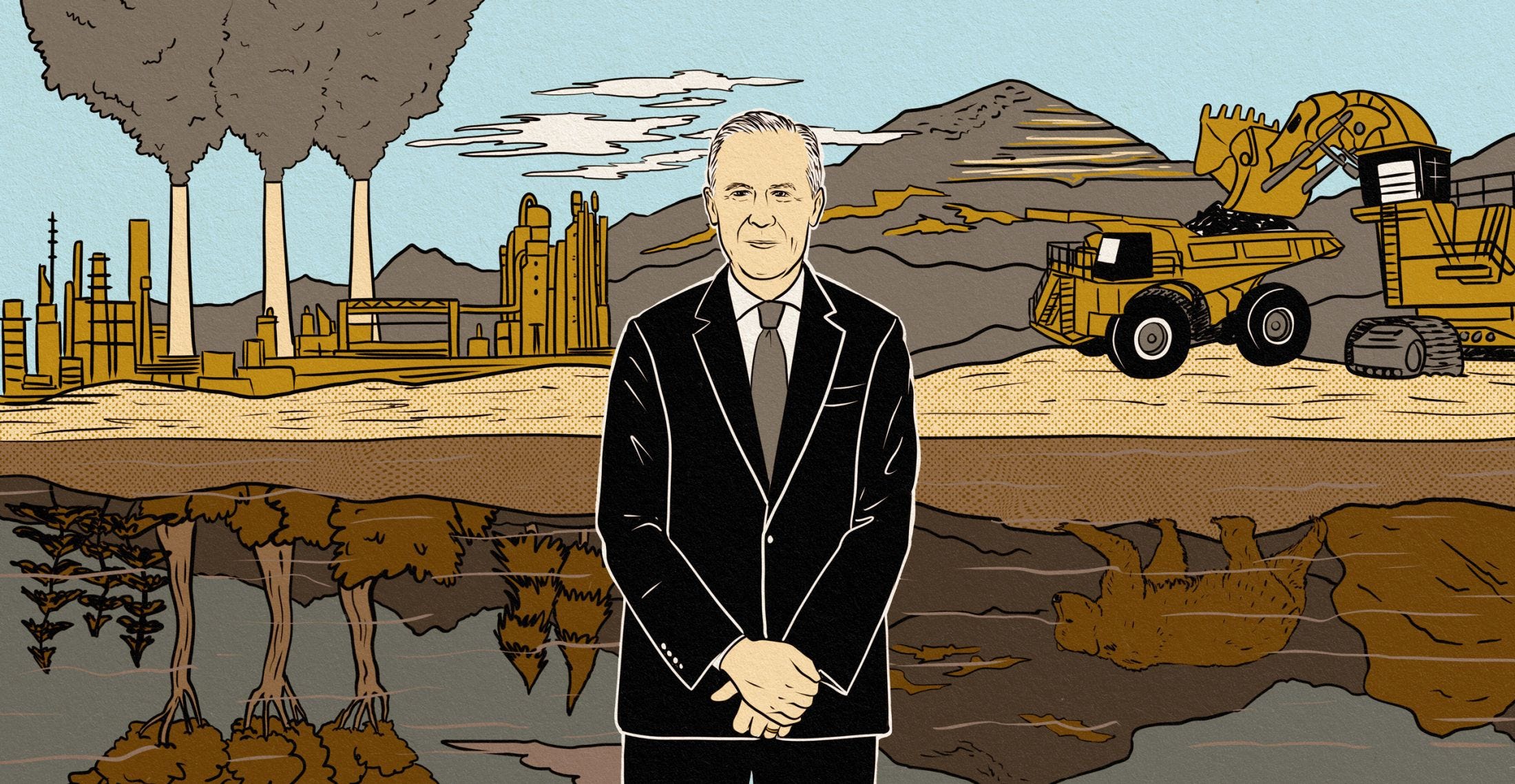
While Collins burned, Prime Minister Mark Carney has been quietly walking back the country’s climate commitments. He’s already conceded that emissions will run higher in the coming years than what was projected under the previous government’s plan, framing it as part of a pivot toward energy production and national unity rather than a broken promise. Canada is already off track to hit its 2026 interim target, and independent analysts say the 2030 goal — a legally binding 40 percent cut from 2005 levels — is now essentially out of reach.
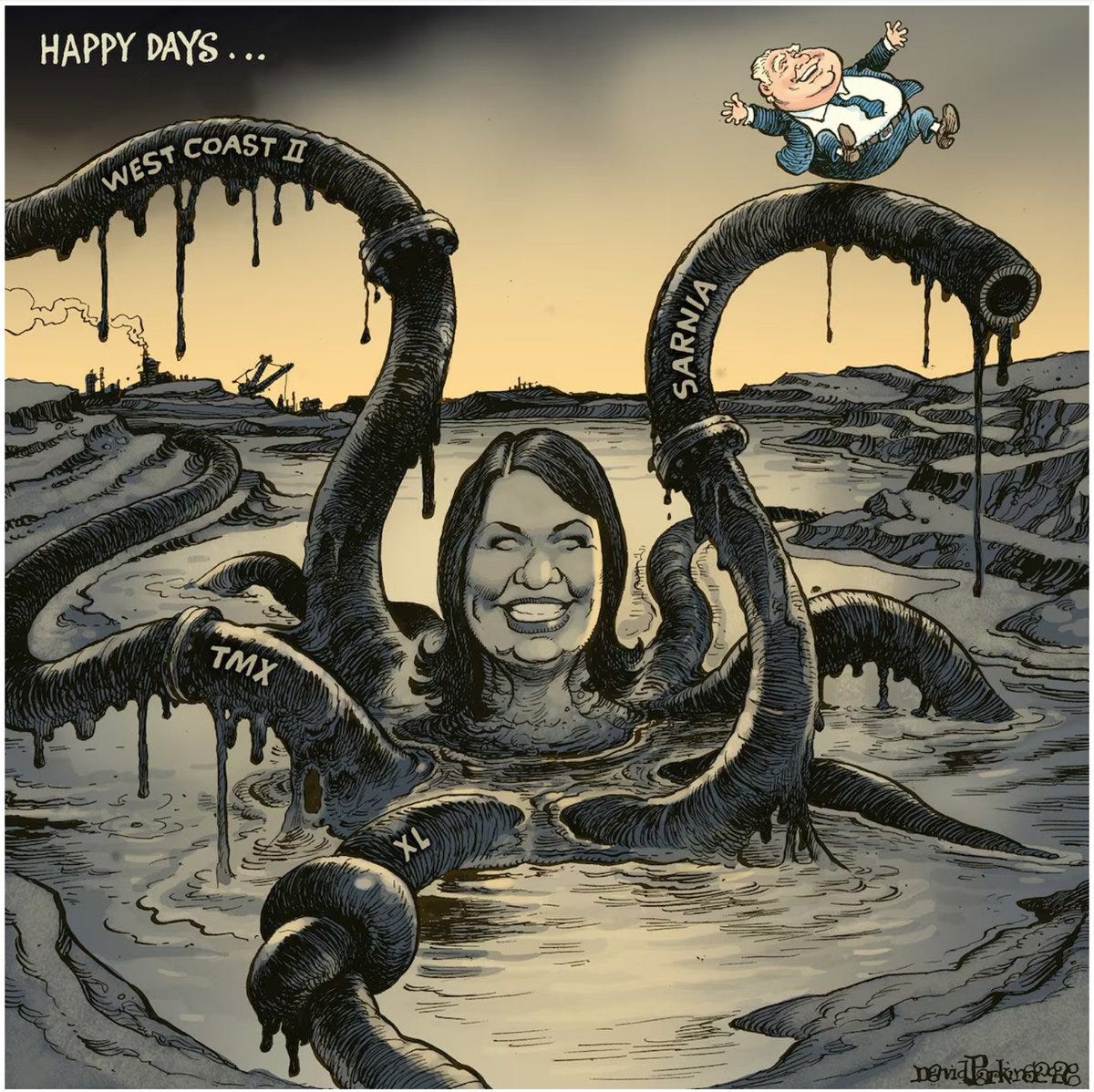
Alberta, my home province, is not slowing down to notice. We are being boxed in from every direction — by the fires closing highways and by an oil and gas expansion that keeps feeding the fires. In the span of about two weeks, three separate pipeline pushes moved forward, and every one of them tells the same story.
First, the West Coast Pipeline — a proposed 1,200-kilometre, $35-to-44-billion line from Bruderheim to B.C.’s south coast, submitted to Ottawa’s Major Projects Office on July 2. Premier Danielle Smith called it “transformational wealth.” What she didn’t dwell on: the ownership structure has Ottawa and Alberta’s governments holding the majority interest through Crown entities, with a private company holding a minority stake. That means it’s largely taxpayers — us — bankrolling a pipeline built to pump more of the exact emissions that are cooking the ground out from under communities like Collins. We are quite literally being asked to fund our own demise.
Second, days later, Alberta and Ontario unveiled the Northern Shield Energy Corridor — a proposed 3,300-kilometre pipeline running from Alberta all the way to Sarnia, Ontario. Anishinabek Nation Grand Council Chief Linda Debassige, who represents 39 First Nations across Ontario, said her nation was blindsided — no consultation before the announcement, just an email. Chiefs in B.C. said the same thing about the West Coast route through their territory. This is the pattern: governments draw the lines on the map first, then call the email that follows “engagement.”
Third, quietly moving forward without a press conference at all, is the Prairie Connector — South Bow’s project to revive the ghost of Keystone XL, running crude south from Hardisty, Alberta to the U.S. border and down into Wyoming and the Gulf Coast. It already has 20-year shipping commitments locked in.
Three pipelines. Three directions. One purpose: get more oil and gas out of the ground, faster, while the ground itself is on fire.
Ontario is under a heat warning right now too. Just another symptom of a country that is warming at roughly twice the global average — a fact confirmed years ago by Environment and Climate Change Canada’s own scientists, who found Canada’s land mass has warmed 1.6 to 2.4°C since 1948, with the North warming nearly three times faster still. It isn’t a mystery why. As snow and sea ice disappear, darker ground and water absorb more heat instead of reflecting it, which melts more snow and ice, which absorbs more heat — a feedback loop layered directly on top of rising global CO2 from burning oil, gas and coal. Canada’s own federal scientists say this warming is a direct response to global emissions from human activity. And oil and gas remains this country’s single largest source of emissions, up 11 percent since 2005 even as other sectors have cut theirs in half. Every barrel these new pipelines are built to move adds to the exact warming that’s turning our boreal forests into tinder.
And still, the posture from government is measured calm. Carney insists this isn’t a retreat from climate targets, that it’s about “investing to get results.” Business as usual, dressed up as pragmatism.
When the pillaging is done and the extraction machine has taken what it wants, the consequences land here — on reserves, in boats, in the smoke. We are being backed into a corner, watching the water rise and the fires close in, and hardly anyone outside our communities even blinks.
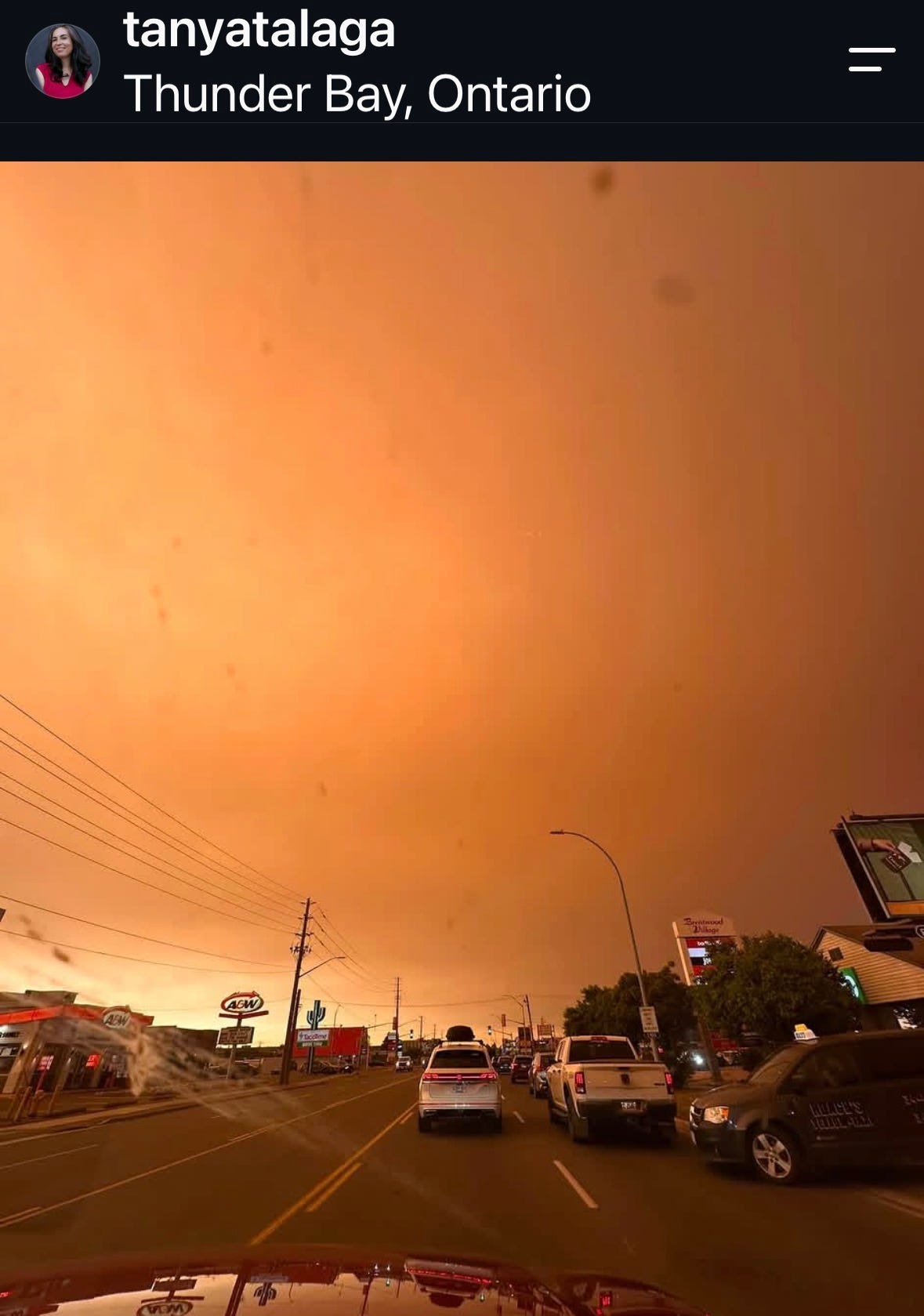
Collins First Nation, according to Kiiwetinoong MPP Sol Mamakwa, has been destroyed by this fire. The community’s own leadership is still waiting on an aerial assessment to know for certain what’s left. Journalist, author and filmmaker Tanya Talaga is in Thunder Bay right now, and she wrote in a post this week about a city under siege by its own sky — the air burnt orange and black, ash falling like snow, headlights needed on Arthur Street at 6:30 p.m. even though the sun shouldn’t have set for hours yet. That’s what smoke this thick does. It steals the daylight straight out of the middle of the day.
I keep thinking about the Seventh Fire prophecy, the one that says a new generation will rise when the world is sick, when the rivers are poisoned, when the animals disappear and the people forget who they are — and that this generation will be given a choice between two roads, one green and inviting, one black and charred. Have we already passed the point where the road is a choice, and not just where we’ve been placed? Will humanity heed the groaning of Mother Earth, or will greed keep choosing the same road while calling it a different name?
I don’t know the answer. But I fear Collins won’t be the last community this summer forced to choose between staying and drowning in smoke, or fleeing by boat with nothing but a pack sack.
Brandi Morin is a multi-award-winning Cree/Iroquois/French journalist from Treaty 6 territory in Alberta. She is the founder of Indigenous Insider on Substack and the author of the national bestselling memoir Our Voice of Fire.
Sources:
- [CBC News – Evacuation orders northwestern Ontario](https://www.cbc.ca/news/canada/thunder-bay/evacuation-orders-northwestern-ontario-9.7269201)
- [Your Thunder Bay – 128 active wildfires](https://yourthunderbay.ca/live-128-active-wildfires-rage-across-nwo-five-communities-evacuated/)
- [CBC News – Collins self-evacuation, Chief Helen Paavola statement](https://www.cbc.ca/news/canada/thunder-bay/northwestern-ontario-wildfire-evacuations-update-9.7270565)
- [Global News – Collins destroyed, MPP Sol Mamakwa](https://globalnews.ca/news/11964781/northern-ontario-wildfires/)
- [APTN News – Firsthand Collins evacuee account](https://www.aptnnews.ca/national-news/namaygoosisagagun-first-nation-in-northern-ontario-surrounded-by-wildfire-as-members-flea-in-boats/)
- [Wikipedia – 2016 Fort McMurray wildfire](https://en.wikipedia.org/wiki/2016_Fort_McMurray_wildfire)
- [Globe and Mail – Wildfire survivors: Fort McMurray, Lytton, Jasper](https://www.theglobeandmail.com/canada/article-wildfire-survivors-lessons-recovery-jasper-lytton-fort-mcmurray/)
- [Wikipedia – 2024 Canadian wildfires](https://en.wikipedia.org/wiki/2024_Canadian_wildfires)
- [Global News – “Emissions will be higher”](https://globalnews.ca/news/11944679/carney-energy-strategy-emissions-video/)
- [Radio-Canada – Carney and 2030 climate targets](https://ici.radio-canada.ca/rci/en/news/2184706/carney-climate-targets)
- [Climate Action Tracker – Canada](https://climateactiontracker.org/countries/canada/)
- [BNN Bloomberg – “Investing to get results”](https://www.bnnbloomberg.ca/business/politics/2026/05/14/pm-carney-unveils-electricity-plan-to-double-grid-lower-costs/)
- [Alberta.ca – West Coast Oil Pipeline](https://www.alberta.ca/west-coast-oil-pipeline)
- [CBC News – Alberta pipeline proposal to Major Projects Office](https://www.cbc.ca/news/canada/calgary/alberta-pipeline-proposal-ottawa-major-projects-9.7254251)
- [Trans Mountain – Statement on West Coast Oil Pipeline](https://www.transmountain.com/news/trans-mountain-statement-regarding-the-proposed-west-coast-oil-pipeline-project)
- [CBC News – Northern Shield Energy Corridor, no consultation](https://www.cbc.ca/news/indigenous/ontario-alberta-bc-chiefs-pipelines-reaction-9.7266055)
- [CBC News (Sudbury) – Alberta-Ontario pipeline criticism](https://www.cbc.ca/news/canada/sudbury/alberta-ontario-pipeline-proposal-9.7263248)
- [The Logic – Prairie Connector revives Keystone XL dream](https://thelogic.co/news/prairie-connector-pipeline-leap-kxl-dream/)
- [StockTitan – South Bow Prairie Connector open season](https://www.stocktitan.net/news/SOBO/south-bow-announces-successful-open-b9ck4a38dzok.html)
- [Canada.ca – Key issues: climate change](https://www.canada.ca/en/environment-climate-change/corporate/transparency/briefing/key-issues-climate-change.html)
- [Canada.ca – Canada’s climate warming twice as fast (2019)](https://www.canada.ca/en/environment-climate-change/news/2019/04/canadas-climate-is-warming-twice-as-fast-as-global-average.html)
- [NRCan – Geoscience: Climate change](https://natural-resources.canada.ca/science-data/science-research/geoscience-climate-change)
- [CBC News – Carney and climate targets, oil and gas emissions up 11%](https://www.cbc.ca/news/politics/carney-climate-targets-1.7604950)
- [Wikipedia – Seven fires prophecy](https://en.wikipedia.org/wiki/Seven_fires_prophecy)
- [Cree Literacy Network – Seventh Fire: Anishinaabe Prophecy](https://creeliteracy.org/2026/03/03/seventh-fire-anishinaabe-prophecy/)