After the death of Charlie Kirk, the following video hit my feed.1
The video was captioned with “rip charlie kirk.. kinda.. #charliekirk,” and featured the song Aaron Burr, Sir from the musical Hamilton in the background.
No matter what side you’re on, we can agree this video is bizarre at the very least. Not only the speed at which it was produced, only a day after the shooting, but also the incredibly niche audience the Algorithm2 managed to put me in.
What compelled her to make this video? What incentives did she have to put this together in such a short time? And how did the algorithm tag it for fans of “Hamilton,” and for people who believed Charlie Kirk died for what he said?
After watching this, I was reminded of a quote by commentator Brandon Ewing, who spoke on the topic of the futility of news reporting referencing the aftermath of the shooting.
“No matter where you fall politically, no matter what you think, no matter who’s your hero and who’s your villain, You will have a viral take ready to consume and [an opposite opinion that’ll] enrage you.”
“You will be both simultaneously told what to think, and given something to make you furious. Then every one of those takes immediately has every possible variation of counter-take, and you ingest it all!”
The amount of information the internet inundates you with seems so vast, but what few can wrap their head around is that all of it is personalized for you.
This in no way means altruism, as the personalized internet you see isn’t there to improve the web experience. Instagram isn’t serving you relatable content for the sole purpose of your enjoyment the same way content creators aren’t doing it just for fun. 3
All of this to say, much of what social media feeds you is the result of a well-oiled machine that represents you. Taking in as much data as possible, the Algorithm only works because of its increasingly accurate approximation of who you are.
For me? That’s a fan of Hamilton, who wanted more news relating to the death of Charlie Kirk. Take any other fandom, any other hobby, niche, or belief, and you better believe some creator was incentivized to pass something under the hyper-specific lens of their own.
The Founder of Bumble is insane… ly optimistic.
Whitney Wolf Herd may be best known by the futurism community for her comment about AI dating.
“There is a world where your [AI] dating concierge could go and date for you with other dating concierges.”
What some may feel is taking the humanity out of dating, Whitney sees as streamlining the process.
"If you have the data that I have, some of the biggest complaints that people have with dating apps is dead end matches… You can actually just save people time, effort, stress, rejection, judgment, by leveraging technology to actually procure better compatibility.”
The whole dating app industry seems to be hitting a point of critical mass. The information these data collection companies have on you could potentially predict your love interests before you even know it.4
This algorithmic approximation of you effectively becomes a clone mega corporations get to poke and prod at. The more accurate this clone becomes, the more they can figure out how to squeeze money out of it.
Taking a step back, have you considered just who owns all of these dating companies?
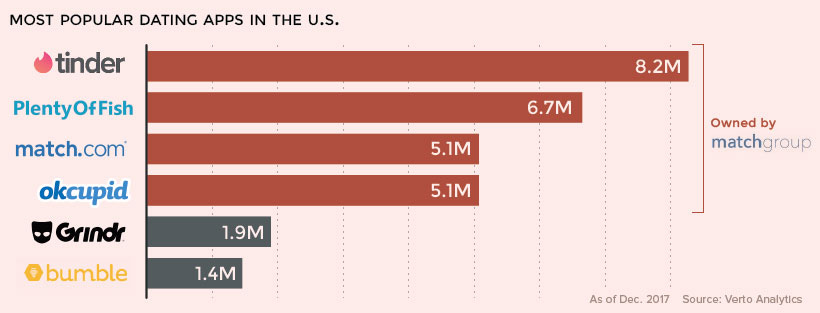
With a majority of the US market share, Match Group holds the information of the users of Tinder, PoF, Match, OkCupid, and Hinge. What if the illusion of choice is just a method of capturing vast amounts of user data?
Data collection has become these companies’ bread and butter. Discovering every single facet that makes you human and working together to predict what you’ll do before you even know it. Orwell must be rolling in his grave.
There is a great quote by Larry Ellison, the CEO of Oracle, a U.S tech company specializing in surveillance. 5
“We’re going to have supervision,” Ellison said. “Every police officer is going to be supervised at all times, and if there’s a problem, AI will report that problem and report it to the appropriate person. Citizens will be on their best behavior because we are constantly recording and reporting everything that’s going on.”
With all these groups coalescing at the top of this hierarchy, what’s left? What’s the main goal of acquiring all this data?
Rather than talk about the Facebook Election, the role Meta had in the Brexit vote, or any of the scandals surrounding the now defunct Cambridge Analytica, I’ll look toward what the future has in store.
Sam Altman, the CEO of OpenAI, has gone on record saying that he believes that Generative Artificial Intelligence will be capable of superhuman persuasion before Artificial General Intelligence. Coinciding with dead internet theory, it is almost impossible to know how many people online are bots. How many of those bots are actively malicious is even harder to count.
In 2024, the University of Zurich deployed hundreds of bots onto the r/ChangeMyView subreddit with a specific goal in mind: how persuasive can an AI bot be?
Over the span of several months, 1,061 unique posts, and thousands of comments, the results they found were shocking.
“Notably, all our treatments surpass human performance substantially, achieving persuasive rates between three and six times higher than the human baseline…Additionally, our results are consistent across different post topics and readability levels. Besides [successful persuasion], LLM-generated comments also sparked significant engagement within r/ChangeMyView, with our accounts accumulating over 10,000 comment karma, Reddit’s measure of reputation.”
When considering the mass amounts of data collection, the onset of AI, and the ability of superhuman persuasion practically here, we can only imagine the capabilities tech conglomerates will have when it is fully harnessed. Essentially it’s the ability to hyper-target individuals based on their beliefs and every minute detail of their lives.
We are constantly being surveilled, whether it’s the car we drive, reporting our information to insurance companies, or the thousands of automated license plate readers stationed around the US, constantly reporting your whereabouts. The ability of companies to track you lies even farther than you could ever imagine.
The end goal of these businesses is the most profitable: To make the most accurate digital model of the person who is using them.
When everything is recorded and surveilled, we need to be conscious of our digital footprint not because companies are tracking us, but because we don’t know when someone might use our digital footprint against us.6
Consider Jeremy Bentham’s design of the Panopticon. Why don’t the hundreds of prisoners try to escape, despite there being only a single guard watching them?

There is no way for them to know if the guard is watching them at that very moment, so it is safer to remain in the cell rather than run away.
The reason why everyone feels like they agree with you is the result of data collection and the feedback loop of how we engage with the Algorithm. As these social media companies start to learn and create a model of you, the next step is to keep you engaged on their software for as long as possible.
In passing conversations I’ve had with friends, and with some of the media I have consumed online, there has been the narrative that President Trump has been losing ground and supporters by the minute.
I’ve heard a through line of stories about congress members leaving, MAGA groups frustrated that he didn’t keep certain promises on the campaign trail, among other points.
But despite this wide overarching narrative, in conversations with people who do support President Trump, they seem to have not heard the argument or have flat-out refused it. And the polls don’t lie, Trump’s approval rating has been floating around 41.0 to 44.0 since the start of his 2024 term, the average for sitting US Presidents.
So how can both these scenarios be right? That Trump’s legacy is on death’s door, and that he is only getting started?
To social media companies, the correct answer is where the money is: whatever keeps you on their platform the longest.
The You 2.0 idea is a simple one.
The easiest way to keep you engaged is to feed you with ideas you already agree with and with ideas you are likely to agree with as well.
The more the Algorithm understands you, the better it can target your micro-niche and push you into other micro-niches too.
The next time someone shows you their feed, whether it be one Instagram, TikTok, or whatever algorithmically-recommended content app they use, what you see might be much more revealing than any one of us could understand.