Summary: Runway orientation depends on the prevailing winds in the area. The orientation is selected such that planes can takeoff or land under a selected crosswind limit (20 kts), at least 95% of the time. Various other factors must be considered when ultimately selecting the final layout.
Note: Some of the graphics are best viewed by clicking on the images to expand, on a desktop.
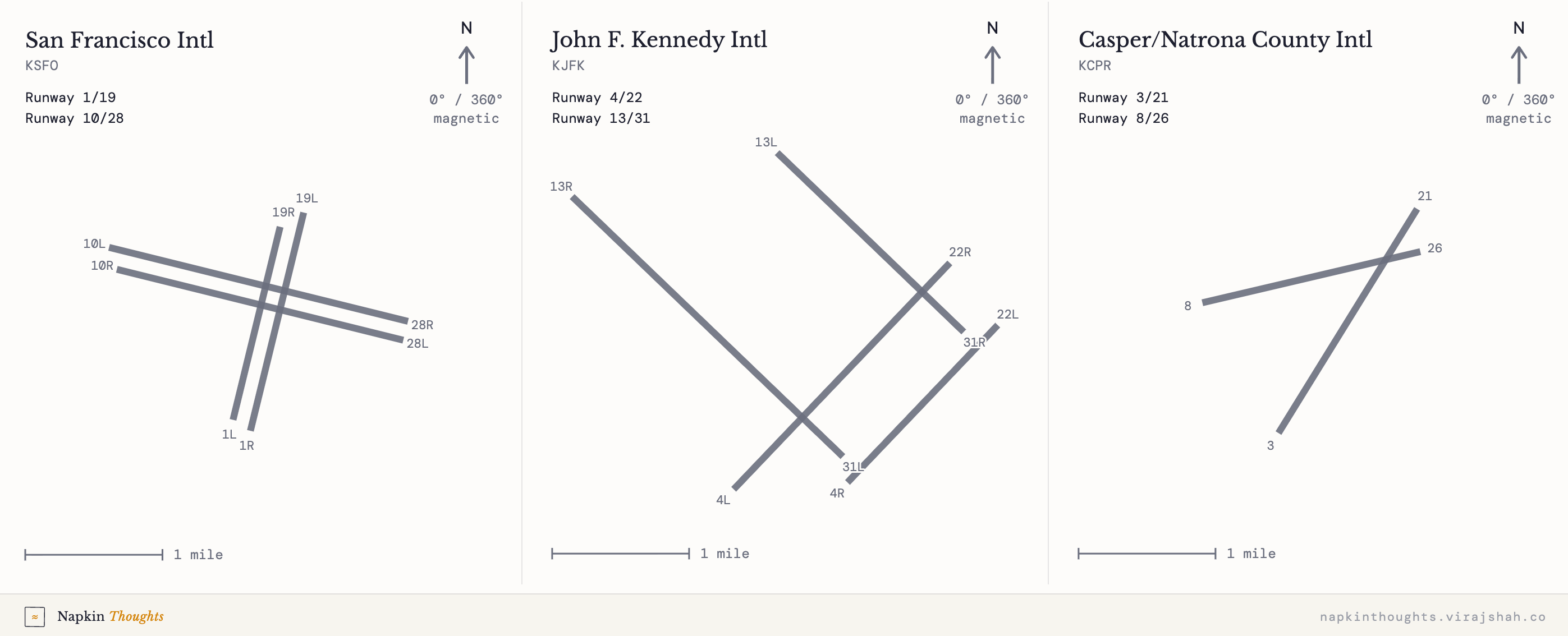
When you takeoff or land at an airport, the runways are oriented in specific directions (e.g., North-South, East-West, 45°-225°). We’ll look at three airports JFK (NY), SFO (SF), and CPR (WY) in the US. A runway is generally aligned with the prevailing winds in the area. What does that mean, and how is it determined? To understand this, let’s cover some terms first.
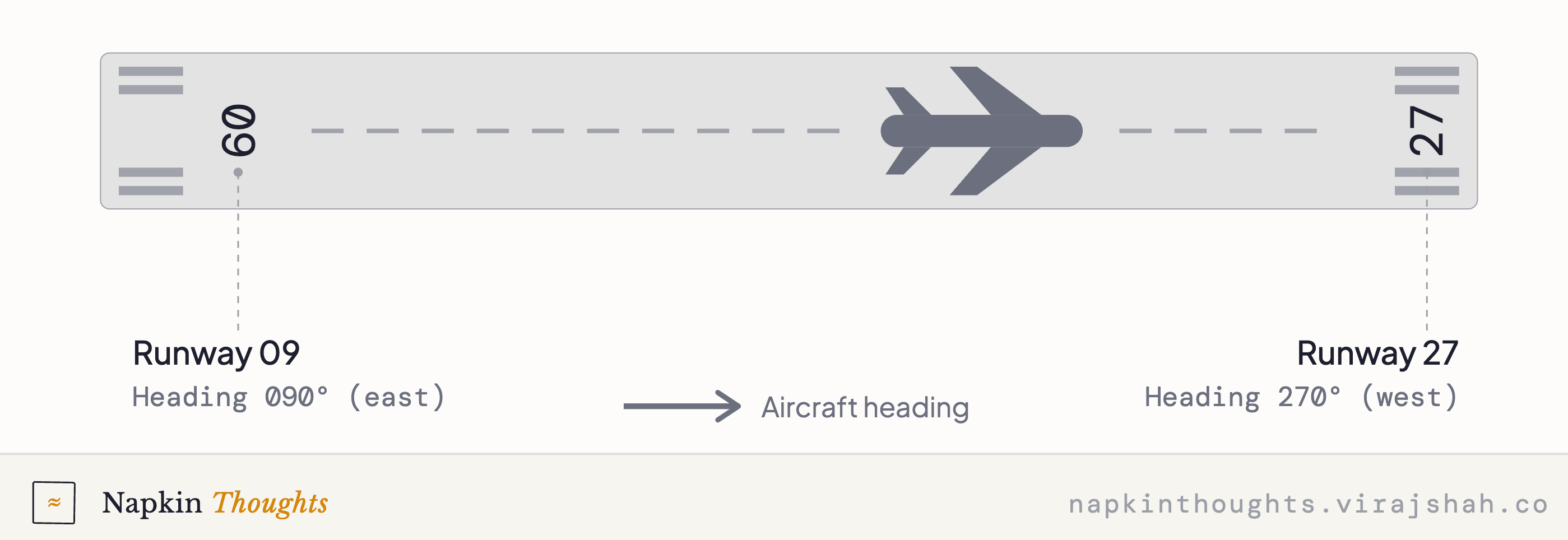
In the example below, the runway is identified as “Runway 09/27”. These numbers represent the magnetic heading – the direction you’d see if you were holding a compass. 09 represents 90° (east), and 27 represents 270° (west). The numbers are always 18 apart or 180° since a runway is a straight line. The aircraft below is taking off (or landing) on runway 09, at a heading of 90°.
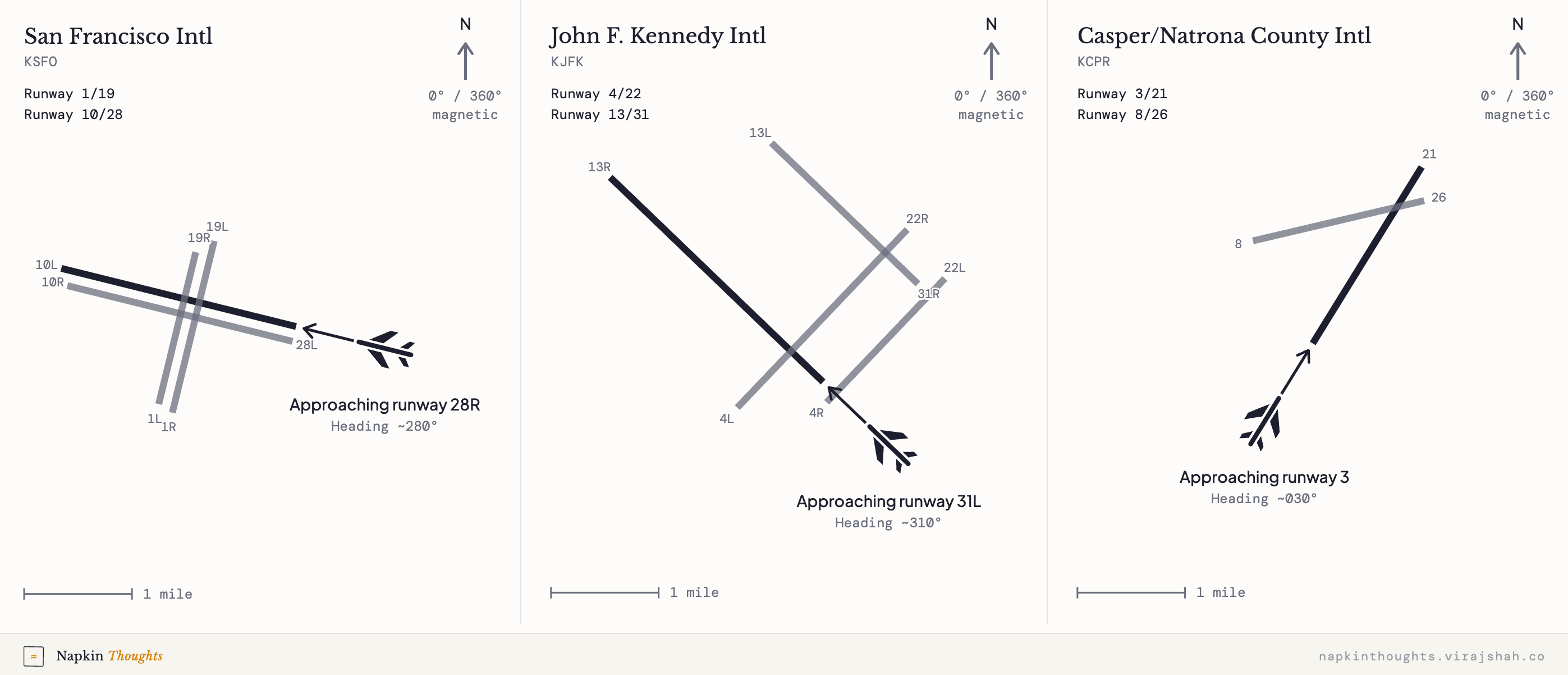
The following shows three examples of planes approaching the runways at each of the airports we’ll look at. L and R represent left and right for parallel runways.
Winds are critically important in all phases of flight, but especially during takeoffs and landings. You can have a tailwind, which comes from behind the aircraft’s direction of travel or a headwind which opposes the direction of travel.
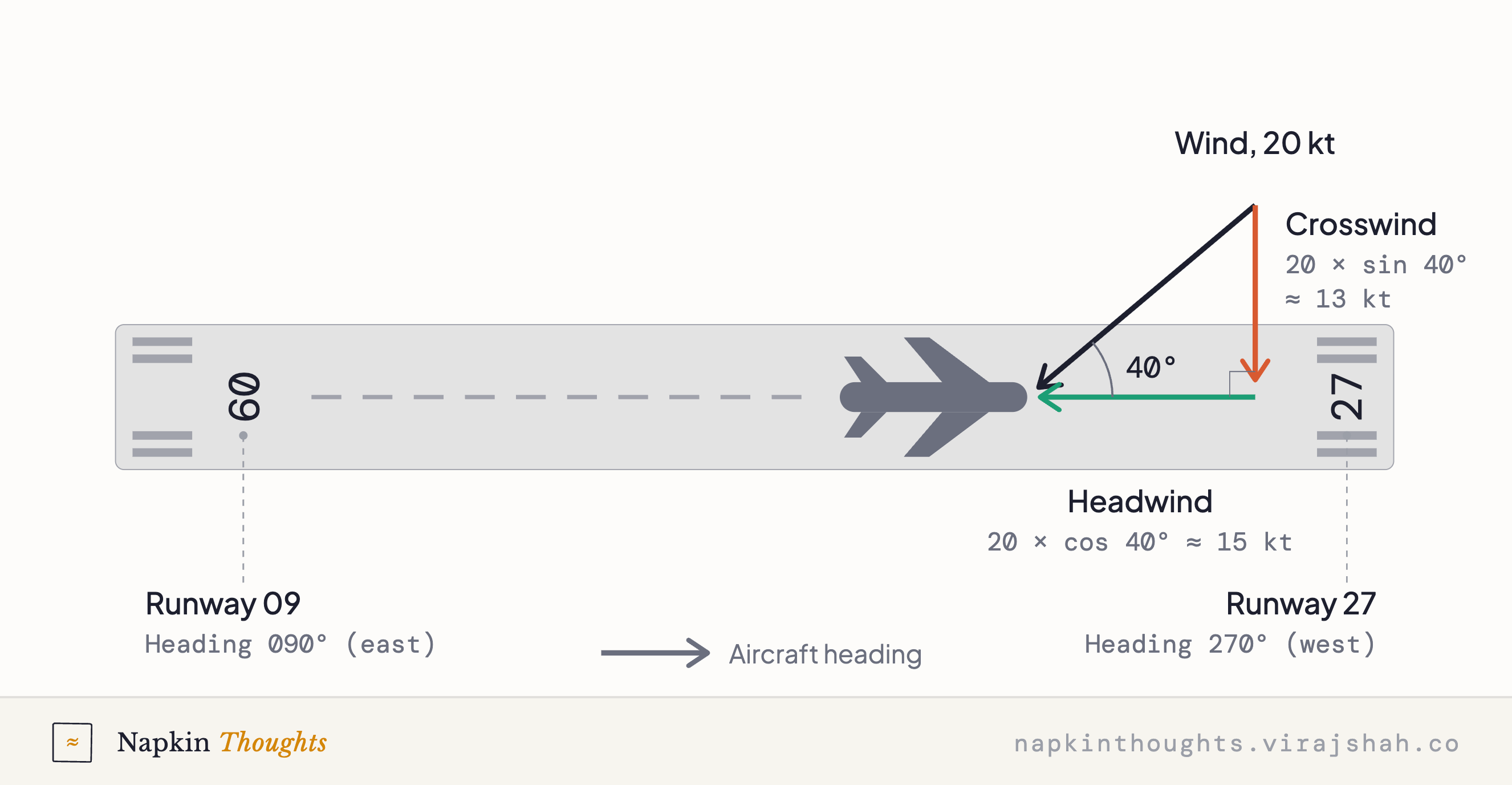
Any wind that comes at angle, from behind or in front, that isn’t directly aligned with the plane’s heading, has a crosswind component. The crosswind is the portion of the wind that comes at a right angle to the plane’s heading. In the example below, a headwind of 20 (knot) kts can be broken into a direct headwind of 15 kts and a crosswind component of 13 kts.
When taking off or landing, you want to do so in a direct headwind – wind directly opposing your direction of travel. In our case, if our plane is landing on runway 09, the best case is to have the winds coming from 90° (or blowing towards 270°, east to west).
During takeoff, a direct headwind provides more airflow over the wings. This means that the aircraft can obtain lift at a shorter ground speed and with less runway. During landing, a direct headwind allows an aircraft to land at a slower touchdown speed while maintaining greater control over the aircraft with less runway. A direct tailwind for takeoff or landing increases the takeoff roll, landing distance, runway length required, and overall decreases the safety margin.
Of course, we can’t control the winds. And generally, when landing, we land into a headwind that isn’t direct.1 In other words, the wind has some crosswind component. If we are landing on runway 09, with 20 kt winds coming from 50° (or 40° relative to the runway (90 - 50), as in the example above), we’d have a 13 kt crosswind.
Any crosswind component makes landings more difficult and thus more dangerous. And aviation is defined by safety. Crosswinds affect a plane’s stability, handling, and trajectory, leaving the aircraft susceptible to hard landings, wing tip strikes, and runway excursions (i.e., sliding off the runway).
Airplanes have crosswind limits largely defined by controllability requirements. Larger airplanes have larger crosswind (component) limits – a Boeing 757 has a crosswind limit of 40 knots, while a Cessna 172 has a limit of about 15 knots. It’s harder to push around a sumo wrestler than a toddler.
The punchline – runway orientations are defined by crosswind limits. Ideally, a runway is oriented to minimize the crosswind components of the dominant winds in the area, for as much time as possible. According to the Federal Aviation Administration’s (FAA) Advisory Circular (FAA AC 150/5300-13), that time, also known as wind coverage, is 95%.
The best runway orientation is one in which the crosswinds are below a certain limit, at least 95% of the time. That limit is 20 kts for airports that service large airliners like the ones we most associate with travel – well below the 30 to 40 kt safety limit for those aircraft itself.
Now that we know why runways are oriented the way they are, let’s look at how we’d determine that orientation for three airports: SFO, JFK, and CPR.
The first thing we need is wind data – how often is the wind coming from a direction and how fast is it? Many airports, especially the major ones, have long standing wind data dating back to the 1940’s. We’ll look at the last 10 years’ (10/2016 to 10/2026).2 We can find this here, and compile the data into wind roses. Wind roses bin the frequency the wind is blowing from a specific direction in each “petal”. The longer the petal, the more frequently the wind comes from that direction. And within each petal, there is a color-coded breakdown of the wind speeds. See the example below for the three airports.3
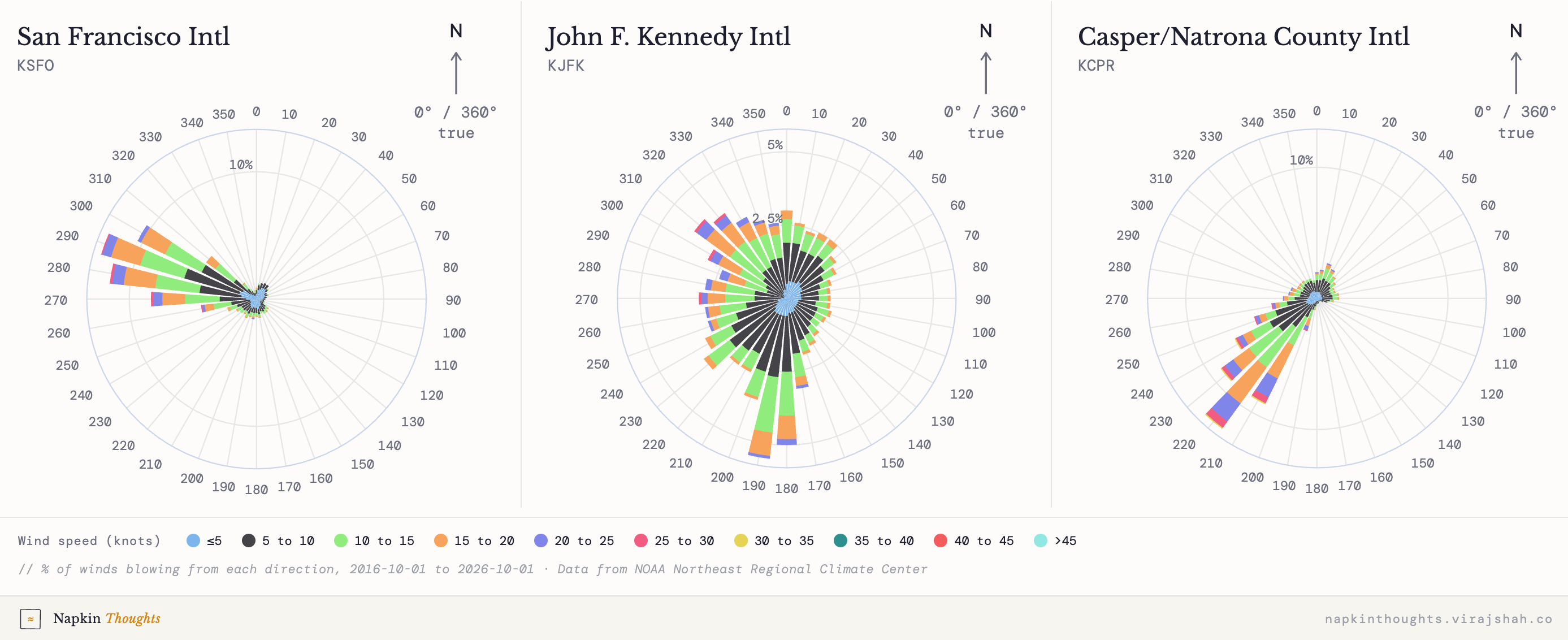
You’ll notice SFO and CPR have strongly preferential winds, coming from 270° - 300° and 210° - 240°, respectively. JFK is more evenly distributed but has some preference near the south around 180° - 190°. We might expect one of the runways, at these airports to be roughly aligned with this wind direction to minimize crosswinds.
Let’s lay the runways over the wind roses. The wind data is based on true north while the runway headings are relative to magnetic north. The difference is the magnetic declination (or variation).4 I’ve rotated the runways by the magnetic declination at each location, so everything is relative to true north.
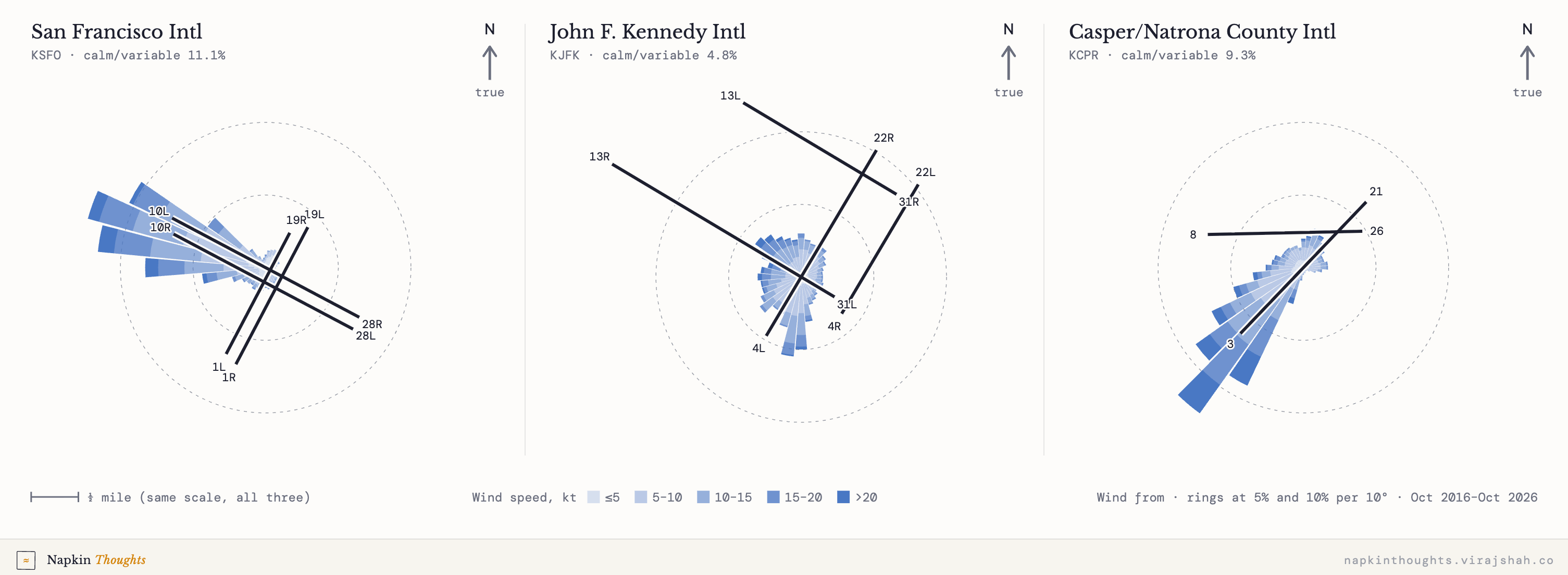
These are approximate overlaps to get a feel for what’s going on. For SFO and CPR that is somewhat clear. Runway 10/28 at SFO and runway 3/21 at CPR, both roughly align with the most common wind direction, which would minimize crosswinds. Since the winds are distributed a little more evenly at JFK, this is a little less obvious.
But we’ve only been looking at wind direction and frequency. To find the best runway, we must also look at wind speed.5 Remember, we want a runway orientation where the crosswinds are below our limit (20 kts), at least 95% of the time (a.k.a. wind coverage).
We incorporate the wind speed by modeling every single runway orientation possible, in 1° increments (180 possibilities), and calculate the crosswinds. Using the same historical wind data above, we calculate the angle of the wind relative to the runway, to find the crosswind component. Then we tally whether that is above or below our design limit of 20 kts. We plot the wind coverage for the three airports.6
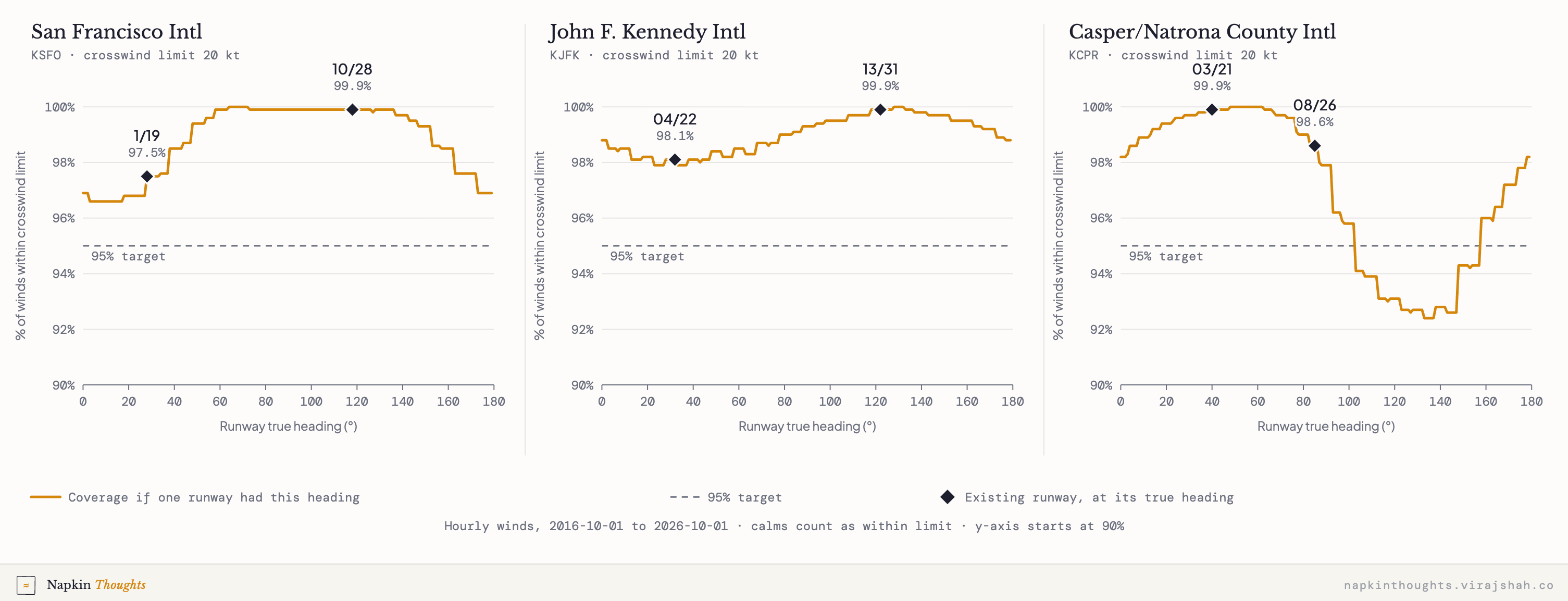
For JFK and SFO, we see greater than 95% wind coverage for all possible runways. CPR has certain runway orientations that have crosswinds greater than 20 kts for more than 5% of the time. This is only if we consider one runway. If there are two runway orientations like at all three of these airports, we find that there is 100% wind coverage. That means, based on the historical wind data over the last 10 years, planes would be able to land 100% of the time with crosswinds less than 20 kts at these airports, with two runways.
It’s hard to see the optimization when some of these curves are above 95% wind coverage for all orientations. What if we were designing these runways for smaller planes, that might have smaller crosswind limits?
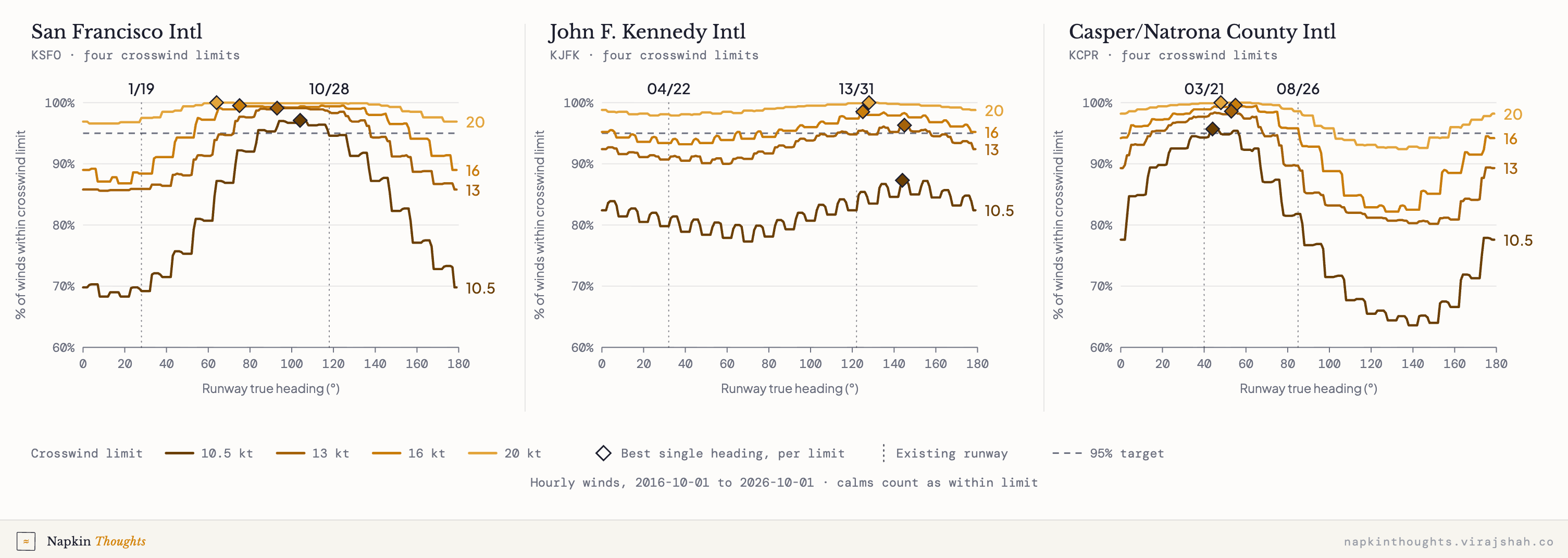
Here we’ve plotted the wind coverage for different crosswind thresholds. As your crosswind threshold decreases, the more sensitive the runway alignment is to the wind direction. And since SFO, for example, has preferential winds coming from the northwest (~280° - 300°), we see that as the crosswind threshold decreases, the optimal runway alignment moves closer and closer to runway 10/28. The same is evident for CPR and runway 3/21.
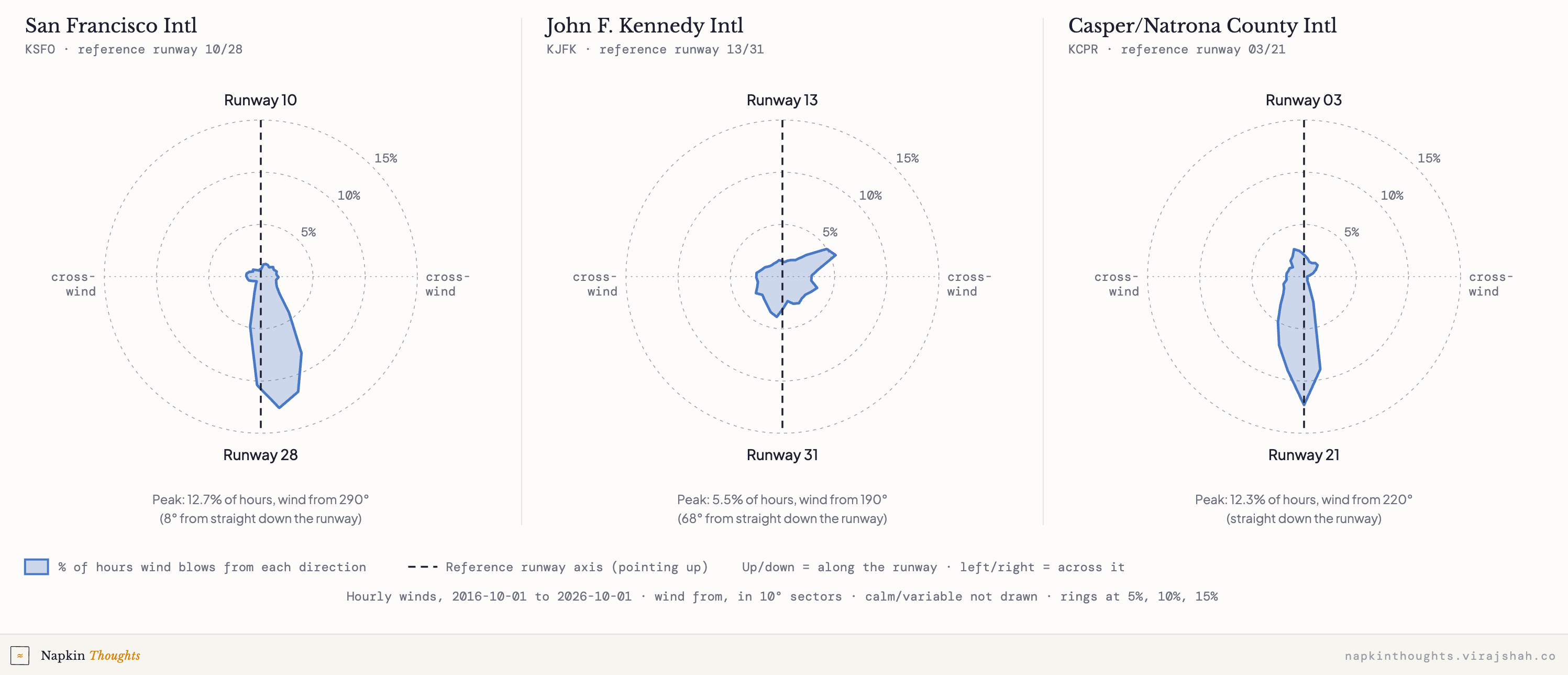
We can also plot the winds relative to the runway axis at each airport. For SFO and CPR, which have strong winds coming from one direction, most of the winds roughly align with one of the runways (i.e., have a small crosswind component). The runway at JFK experiences more wind from all directions than the other two airports, but the magnitude of the crosswinds is still below the design limit (<20 kts), over 95% of the time.
We looked at crosswind limits and wind coverage but in reality, there are many other considerations in runway design:
Gusting winds – temporary gusts of winds which are recorded, were not included in the analysis and could change the orientation
Obstacle clearance – manmade or natural obstacles can affect the climb gradient possible
Seasonal and temporal variation – if you segment the wind data by time of day, hour of operation, or winter versus summer, you might conclude that other orientations might give you better wind coverage during those segments
Noise, future airport expansion, airspace restrictions, changes in prevailing winds over longer periods of time, etc.