Executive summary
Congress has long tasked the Department of Labor (DOL) with protecting US workers by ensuring that the employment of foreign workers does not adversely affect the wages and conditions for similar US workers. DOL has historically carried out this role by setting wage requirements based on employers’ own evaluations of their minimum job requirements.
That approach is not the only way to set prevailing wages. In a 2026 Notice of Proposed Rulemaking (NPRM), DOL announced it was considering a new approach termed “Experience Benchmarking” that would make direct comparisons between foreign workers and similarly credentialed US workers. Experience Benchmarking would set the prevailing wage for a foreign worker as the median wage paid to US workers in the same geographic area with the same occupation, education, and age.
The guide details why Experience Benchmarking is feasible, lawful, and the prevailing wage approach most consistent with controlling statutory authorities.
Key insights
- Congress requires that prevailing wages “shall” be commensurate with education and experience. However, the current system for identifying prevailing wages is not based on any data reflecting such characteristics. Experience Benchmarking resolves this defect.
- Experience Benchmarking implements Congress’s overriding intent that the employment of foreign workers does not adversely affect the wages and working conditions of similarly employed US workers. It also reflects Congress’s worker-focused conception of a job, recognizing that jobs cannot be considered equivalent if they are held by workers with different qualifications and experience.
- Experience Benchmarking would require employers to know the credentials of the foreign professional being sponsored before filing the necessary H-1B Labor Condition Application (including a prevailing wage attestation) or the necessary Prevailing Wage Determination request for a Permanent Labor Certification. This is not a practical hurdle for employers, who in most cases already know the credentials of foreign workers they seek to sponsor before making such filings. In FY2024, 91% of initial cap-subject H-1B petitions had LCAs filed after registration began, at which point employers are already required by the government to provide information about the specific individual.
Special thanks to Jason Levy for his technical and legal review and valuable contributions to an earlier version of this paper. Jason Levy was Attorney-Advisor and Senior Attorney for the DHS Office of General Counsel’s Immigration Law Division, where he worked on employment-based immigration regulations and policies for 15 years, before returning to private practice as Counsel with Grossman Young & Hammond in 2025. His government service included substantial work on H-1B regulations and collaboration between DHS and DOL on LCA, PERM, and H-2 regulations.
An earlier version of this paper was submitted as a public comment to DOL here.
I. A primer on prevailing wages
In the high-skilled immigration system, prevailing wage requirements establish required wages that employers must pay to foreign professionals and are a guardrail against undercutting US workers by hiring similarly qualified foreign workers for less. Under the governing Immigration and Nationality Act (INA), the most common route through the US high-skilled immigration system consists of two stages: a foreign professional is first sponsored by a US employer for H-1B status, and then later sponsored for green card status (lawful permanent residence) — by that employer or a subsequent one — once the employer obtains a permanent employment labor certification through the so-called PERM process.1 Both H-1B and PERM require the employer to document prevailing wages before proceeding with sponsorship:
- In the H-1B program, before filing an H-1B petition with the US Department of Homeland Security (DHS), the employer must file a Labor Condition Application (LCA), certified by the US Department of Labor (DOL). The LCA comprises four employer attestations, including prevailing wages. The wage attestation requires the employer to both document the prevailing wages in the geographical area of employment for the job offered and confirm it will pay the foreign professional the greater of the “actual wages” (what the employer pays similarly employed US workers) and the prevailing wages.
- In the PERM program, before filing an Immigrant Petition with DHS, the employer must file a PERM request (an Application for Permanent Employment Certification) for certification by DOL, which includes a predicate prevailing wage determination issued by DOL. To secure the prevailing wage determination, the sponsoring employer must file an Application for Prevailing Wage Determination with DOL, detailing the job title, duties, and minimum required education and experience.
The “bones” of the INA that govern DOL’s immigration-related wage authorities and implementation practices were enacted in 1952. While there have been several overhauls and major revisions in the intervening 75 years, many artifacts of today’s high-skilled immigration system still harken back to the INA’s original construct and the role of federal agencies within it.
Starting at least as far back as the 1950s, DOL focused its immigration wage protection efforts on the minimum requirements for jobs being filled by immigrants. This was sensible — comparing a minimally qualified and available US worker to the employer’s requirements for a job being filled by a foreign worker is foundational to the INA’s 1952 construct for the permanent employment certification process,2 which was later made more explicit by statutory amendments.3 Yet in 1952, and for roughly 50 years onward, Congress did not provide any direction, much less mandates, about how to calculate prevailing wages; did not attach any labor market protections related to wages or otherwise for what was then codified as the “H-1” visa program for professionals; and did not even include the term “prevailing wages” in the INA statute itself.4
Instead, for decades the Department of Labor was relied upon to issue and revise agency-level policy guidance on required wages, implementing the statutory requirement that immigrants not be admitted as new lawful permanent residents (LPRs) if their US employment would negatively impact the wages and working conditions of similarly employed Americans.5 In 1977, DOL promulgated its first regulation — not just sub-regulatory policy guidance — instituting an agency definition and methodology for the prevailing wage determinations underlying permanent employment certification required for most employment-based LPRs. DOL’s regulation established that the prevailing wage owed to a foreign worker being sponsored for green card status was “the average rate of wages” paid to those workers “filling jobs requiring a substantially similar level of skills.”6
A. Limitations of current prevailing wage calculation methods
Based on decades of practice, DOL concluded that the most efficient and cost-effective way to develop consistently accurate prevailing wage rates for both the H-1B and permanent employment certification programs is to ”use the wage component of the BLS Occupational Employment Statistics (OES) program.”7 for both the H-1B and permanent employment certification programs. As detailed below, today almost all H-1B LCAs8 are filed based on a “prevailing wage obtained independently from the Occupational Employment [and Wage] Statistics program,”9 after self-identifying prevailing wages through the Foreign Labor Application Gateway (FLAG),10 a public portal that provides searchable access to the government’s general wage statistics. In the PERM program, all employers must file for and receive a formal DOL-issued prevailing wage determination11 before filing the PERM application12 with DOL. This is the case even though DOL’s prevailing wage determinations are also almost always based on the same OEWS general wage statistics H-1B employers use.
However, relying on OEWS general wage statistics is blind benchmarking of prevailing wages. This approach is “blind” in two senses:
- It is blind to the foreign worker’s actual qualifications. Moreover, because the prevailing wages are based on the employers’ self-reported job requirements, the employer could game the system by strategically getting lower prevailing wage requirements than the market rate commanded by Americans with similar qualifications to the specific foreign worker being sponsored.
- It sets prevailing wage levels using a dataset that is blind to what Americans actually earn at different levels of experience and education. These limitations are inherited from DOL’s reliance on the Occupational Employment and Wage Statistics (OEWS) data, which lacks information on earnings by education and experience.13
Using OEWS general wage data effectively hinges on DOL defining standards for typical job requirements for every occupational classification and then instructing employers on evaluating their own job requirements, and DOL then picking fixed thresholds in the OEWS wage distribution to associate with different skill levels. Among other defects, this uniform percentiles approach has been complicated by efforts to standardize how employers report minimum education and experience requirements, which lets employers misclassify, underclassify, or inconsistently classify skill levels and their prevailing wages.
To address this, DOL issued a series of General Administration Letters providing guidance to employers hiring foreign workers.14 The most recent instructions on how to identify skill level based on education and experience were articulated in DOL’s November 2009, 36-page Prevailing Wage Determination Policy Guidance.15 Many occupations for which employers are hiring high-skilled professionals today, like AI engineering, did not exist in 2009, and standards for minimum education and experience requirements have likewise changed. Moreover, the worksheets provided in DOL’s guidance,16 laying out how to select OEWS wage levels, are likely to result in underclassification or gamesmanship to find occupation classifications with lower associated wages, whether purposefully or as an unwitting result of following DOL’s worksheet guidance.
But even more fundamentally, the OEWS just does not collect any evidence from employers about the education and experience of their hires. As critics have rightly insisted, “the published descriptions for these skill levels … are entirely fictions that have no statistical relationship to the actual data”17 on worker qualifications, disconnecting the current system of prevailing wages from the actual job market.
This disconnect between skill leveling for prevailing wages and the actual education and experience held by either American or foreign-born workers has led some to conclude — mistakenly — that it would be appropriate to require that all foreign professionals working in the US be paid the occupational median. Senators Grassley (R-IA) and Durbin (D-IL) introduced a bill in the 110th Congress to require that all H-1B workers receive at least “the median average wage for all workers in the occupational classification in the area of employment” and have introduced legislation with this same bedrock provision in each Congress since including a bill in the 119th Congress.18 However, paying all high-skilled professionals the occupational median wage is an alternative still disconnected from the labor market because employers do not, and should not, pay the same wage to all hires in an occupation without regard to the position’s requirements and the worker’s education and experience. Moreover, since a mandate to pay even early career professionals the occupational median would not apply to American workers, it would suggest employers treat foreign-born professionals more favorably than similarly situated Americans — an untenable result.
Under the Trump administration, the stakes on getting prevailing wages right have been raised. On the assumption that the entry of H-1B professionals may be a detriment to the US, the administration has tasked DOL with reevaluating prevailing wages.19 In the ensuing rulemaking,20 DOL proposed continuing its systematic use of OEWS data by mechanically raising the required wage for an employer who wants to hire an H-1B professional or sponsor a foreign professional for green card status through PERM, despite DOL’s concession that “…the OEWS survey captures no information about differences within the [occupational] groupings based on skills, training, experience or responsibility levels of the workers whose wages are being reported…”21
B. Experience Benchmarking: an evidence-based alternative
In the 2026 NPRM, DOL presented Experience Benchmarking as an alternative to using fixed percentiles of surveyed OEWS wages to determine prevailing wage levels. DOL took only three pages of the 48-page NPRM to explain its conception of Experience Benchmarking, so many technical questions still need to be resolved. Presuming methodological and other questions can be addressed, experience-benchmarked prevailing wages should be considered a solution waiting in the wings to better ensure that employers hiring foreign professionals through both the H-1B and PERM programs don’t undercut Americans.
As described in the NPRM,22 Experience Benchmarking would compare the wages of any foreign-born professional being hired through the H-1B and PERM programs to the wages paid to the median US worker with the same credentials in the same occupation and job location. More specifically, Experience Benchmarking would compute a multitude of prevailing wage levels, calibrated to each combination of education and experience in an occupation and geography to directly compare the wages due the foreign worker with those paid to similarly employed US workers. The approach relies on the foreign worker’s actual education and experience (based on age)23 instead of the employer-identified minimum job requirements. Although it would be a new construct and require a short-term period of adjustment, Experience Benchmarking would make prevailing wage compliance much more straightforward for both the regulated community and government regulators by indexing on the actual credentials of the foreign professional being hired and similarly employed Americans.
While the methodological details would need to be further explored, Experience Benchmarking as described in the NPRM would supplement the OEWS survey, which lacks data on the education or experience of workers, with data from the Census Bureau’s American Community Survey (ACS) to identify the returns to education and experience24 and produce “experience-benchmarked” wage estimates. Enhanced accuracy follows because, unlike the uniform percentiles approach, the foundation of Experience Benchmarking would be actual data on the education and experience of both the sponsored foreign professional and similarly employed Americans.
The NPRM explains that, if employing Experience Benchmarking, DOL’s Office of Foreign Labor Certification (OFLC) would rely on public-use ACS microdata to fit Mincer wage equations for each occupation.25 The equations would then be used in conjunction with OEWS data to generate figures for the median wages for US workers in each occupation and geography for every combination of education and experience.
For the H-1B LCA, Experience Benchmarking would produce a prevailing wage due to the sponsored foreign worker that reflects what the median US worker with the same education, experience, and occupation in the same geographic location earns. The experience-benchmarked result for PERM would be a prevailing wage that reflects what the median US worker actually earns with the identified minimum education and experience requirements for the offered future job and an integrity check for those PERM beneficiaries already working in the US by identifying the wage paid the median US worker with the same credentials as the foreign worker in their current employment (without regard to the employer’s minimum requirements).
The Department of Labor itself highlights the reasons why Experience Benchmarking would better ensure the integrity of the high-skilled immigration system: it “essentially ends the practice of wage arbitrage,” better selects for top ability, and “reduces the ability of employers to under-classify workers using strategic job descriptions.”26 These are reasons enough to pursue new methods grounded in experience benchmarking to calculate the prevailing wages for the high-skilled immigration system.
Adopting Experience Benchmarking would be a departure both from how employers hiring high-skilled foreign-born professionals have interacted with the immigration system and how the US Department of Labor has calculated prevailing wages. That raises two questions: whether employers could feasibly utilize an experience-benchmarked prevailing wage construct, and whether DOL would be authorized under existing law to identify prevailing wages based on Experience Benchmarking.
II. Experience Benchmarking is practical for employers
Whether Experience Benchmarking is feasible for employers and their lawyers is of particular concern in the H-1B petitioning process, which requires obtaining a prevailing wage in various stages and circumstances, including:
- Initial petitions, filed to allow a foreign professional to first obtain H-1B status;
- Continuation petitions to extend the status of a foreign professional already in H-1B status remaining with the same employer;
- Change of employer petitions for individuals already in H-1B status who are moving to a new sponsoring employer and often also extending their period of stay; and
- Amended petitions, on behalf of foreign professionals in H-1B status where a material change has occurred with their employment most often a change of job location (also accounted for as continuation petitions).
For each filing, an LCA reflecting the prevailing wage must be filed with the H-1B petition. Employers navigating the prevailing wage and recruitment steps and timing for PERM always know the specific credentials of the sponsored foreign worker; Experience Benchmarking would retain both the same level of certainty and the same procedural challenges.27
The reality is that in the H-1B program, most employers know the beneficiary at the LCA stage, making Experience Benchmarking realistic. For PERM, employers have long been required to have an identified beneficiary when filing the required Form ETA-9141 Application for Prevailing Wage Determination as a predicate for the PERM submission.
As detailed below, an employer knowing the beneficiary before filing the LCA is generally common in today’s H-1B program, and also in sharp contrast to DOL’s institutional experience with other prevailing wage programs it manages in the immigration process — for example, in the H-2B visa program for non-agricultural workers, employers are not required to and typically do not know who the specific workers will be at the time of confirming a prevailing wage. Moreover, DOL’s institutional experience recognizes that the INA does not exclude obtaining an LCA for a future, unknown hire nor mandate that each LCA describe only one H-1B worker,28 both of which would still be permitted with Experience Benchmarking. Employers could use knowledge of typical worker credentials to file LCAs, relying on experience-benchmarked prevailing wages in advance of identifying a specific worker in the limited situations where that might be desirable, as described below.
Experience-benchmarked prevailing wages would be practical for the regulated community in the high-skilled immigration system because employers already nearly always know the beneficiary and their credentials when identifying prevailing wages for H-1B, and always know them for PERM. This is the case for all types of US employers, in any sector, of any size, and in any geography — and whether they are in an industry subject to H-1B numerical caps, or in higher-ed, government research, or nonprofit research organizations exempt from H-1B numerical caps, which may hire very different types of foreign professionals.
A. Initial H-1B petitions
The process for initial H-1B petitions, whether cap-subject or cap-exempt, would accommodate Experience Benchmarking’s worker-credential comparison requirement.
Initial cap-exempt H-1B employers — universities and their affiliates, nonprofit research organizations, and government research entities — can pursue H-1B status at any time of the year and, with no government-imposed timing constraints, would thus have no difficulty preparing an LCA immediately preceding their petition once they have identified the beneficiary.
For initial cap-subject H-1B petitions, employers are already required by the government to identify a specific beneficiary (by name, birthdate, country of nationality, and passport number) in order to register a petition for possible selection that would allow petition filing. Since the March 2020 registration for fiscal year (FY) 2021, cap-subject employers have been encouraged not to engage in petition preparation, including the LCA, until a registered petition is selected. Thus, it is expected that cap-subject employers know the individual beneficiary at the time they attest to prevailing wages and file the LCA, which now occurs in the normal course after registration.29 By binding regulation, DHS affords employers a 90-day period following H-1B registration lottery selection to file an H-1B petition, more than enough time to secure a certified LCA from DOL and assemble supporting documentation to make the filing.
In FY2024, over 91.1% of cap-subject initial H-1B petitions were accompanied by LCAs filed after the registration period started.30 In other words, employers and their lawyers would not be disadvantaged by Experience Benchmarking’s requirement that prevailing wages be obtained and attested to on LCAs after the beneficiary has been identified, because that identification already happens naturally through H-1B registration.
Even LCAs filed before registration typically represent a specific individual on whose behalf a petition will be registered and who has a bona fide job offer in place with their credentials known to the employer at the time the prevailing wage is identified and LCA filed. Moreover, these 8.9% of early LCA filings are highly concentrated among relatively few employers. The top 10 employers account for 70% of all early LCA filings and include large tech companies (like Amazon, Google, Apple, and Intel) and large consulting firms (like EY and McKinsey).31 These sophisticated and large employers are best positioned to adapt. Further, given the volume of cap-subject filings by employers filing early LCAs, it is most likely that they are filing before registration as a matter of operational readiness.
Accordingly, adopting an Experience Benchmarking requirement leading employers to provide beneficiary credentials information in the LCA would not be burdensome for cap-subject employers, because they are already collecting that information in anticipation of the H-1B registration process.
B. H-1B extensions or changes of employer
The process for filing either continuation petitions for an extension of stay with the same employer or a change of employer would also accommodate Experience Benchmarking with little burden.
When an H-1B extension is filed without a change of employer, the individual H-1B beneficiary is always known by the employer because, by definition, they are already employed as an H-1B nonimmigrant. In most situations, employers or their lawyers diligently track when extensions need to be filed; they could readily begin the extension process a little earlier to accommodate the filing of an individual LCA under an Experience Benchmarking paradigm if the organization previously used multiple-slot LCAs (i.e., LCAs filed for multiple workers) in seeking H-1B extensions.
Both cap-subject or cap-exempt employers typically file initial H-1B and extension petitions in certain occupations typical for their organization, with correspondingly consistent education and experience credential requirements. Should they prefer multiple-slot LCAs for extensions, they could assemble records detailing the particular combinations of Standard Occupational Classification (SOC) codes,32 education, and experience of their H-1B staff. In fact, employers that employ numerous H-1B workers might already have the data needed to confirm the relevant characteristics of both US and foreign high-skilled workers.
USCIS data shows that, in recent years, about 23% of annual continuation in employment petitions are for H-1B workers changing employers.33 For these change of employer petitions, employers often need to file the petition as soon as a job offer is accepted due to pressure to make the so-called “H-1B portability” filing quickly to avoid delaying job-start dates.34 The predicate work to prepare an LCA delays the ability to promptly file the new H-1B petition, even though the Department typically certifies LCAs within a week.35 To save time, Experience Benchmarking would allow employers to prepare multiple-slot LCAs for common combinations of education and experience in the common SOC codes for which they typically hire laterally through H-1B filings (e.g., Master’s plus 1 year of experience, Master’s plus 2, PhD plus 0, and so on).
In sum, developing a systematic approach to Experience Benchmarking may cost employers additional time — internally or with outside counsel — whether they are cap-subject and cap-exempt, and whether they file single-slot or multiple-slot LCAs in anticipation of such H-1B portability filings, but this would be an achievable undertaking.
C. LCAs for amended H-1B petitions
When an H-1B worker begins working in a new location36 (outside the Metropolitan Statistical Area covered by the LCA(s) filed with the underlying H-1B petition) or undergoes a material change in the assigned job duties, hours, or salary, the sponsoring employer must file an amended H-1B petition before the H-1B employee switches job locations or undergoes the other material change. Outsourcing employers and staffing firms frequently file amended H-1B petitions, because their business model relies on short-term assignments, itinerant consultants, and a changing roster of third-party client job sites at which professional services are provided. It may be that outsourcing and staffing firms regularly rely on multiple-slot LCAs in anticipation of a high volume of future H-1B filings requiring new prevailing wages and associated LCAs. If so, an experience-benchmarked prevailing wage system may prove somewhat more burdensome for outsourcers and staffing firms than other organizations whose employee work locations are mostly static, because an LCA under Experience Benchmarking can only reflect the prevailing wages for the particular education and experience credentials of the relevant H-1B professional who is switching job sites.
Given the historical volume of H-1B workers for large outsourcers, especially at H-1B-dependent firms, Experience Benchmarking may require that such employers develop new systems to track the education and experience of their staff. But the need to routinely file new LCAs to cover new service contract locations for potential amended H-1B petition filings would be nothing new to these employers. So while Experience Benchmarking may be more time-intensive for outsourcing employers and staffing firms, the differences would be manageable, and they could readily adapt their practices to create new efficiencies in response.
D. Revised information collection in the H-1B and PERM programs
Providing the level of detail necessary to ensure prevailing wages reflect a data-based comparison to the experience and education of comparable Americans won’t be unduly burdensome given the information collection already mandated, including as recently revised. Employers in both the H-1B and PERM programs would be able to adjust to provide credentials-based information.
When proposing the new H-1B weighted lottery on September 24, 2025, USCIS announced it intended to revise the Form I-129 form to collect information about the minimum requirements for the job.37 On February 27, 2026, when the new weighted lottery regulation went into effect, USCIS announced the revised I-129 would indeed proceed — with new questions on the Data Collection Supplement form, in Section 1:38
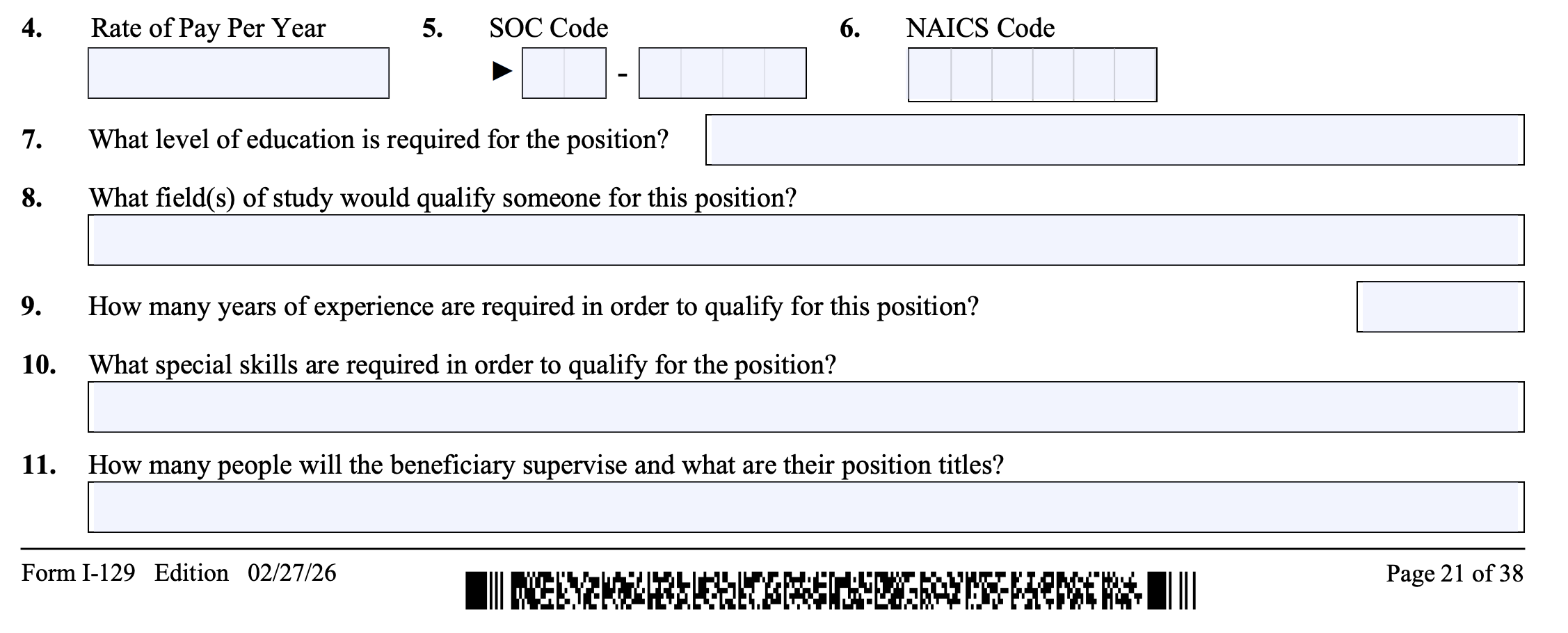
- What level of education is required for the position?
- What field(s) of study would qualify someone for this position?
- How many years of experience are required in order to qualify for this position?
- What special skills are required in order to qualify for the position?
- How many people will the beneficiary supervise and what are their position titles?
DOL would need to revise its LCA form (ETA-9035) and Prevailing Wage Determination form (ETA-9141) in similar fashion to collect the information needed to implement Experience Benchmarking, which would harmonize the information collections between DHS and DOL. For the LCA form, a new information collection for the ETA-9035 would need to identify the specific educational and experience credentials of the nonimmigrant(s) to be hired under the LCA. While most LCAs are filed based on a prevailing wage obtained by the employer (or their lawyer) through a direct query in the FLAG system’s OFLC Wage Search for OEWS figures, the ETA-9141 Application for Prevailing Wage Determination would need similar revisions for employers to obtain a formal prevailing wage determination from DOL for H-1B purposes, and for all employers filing for PERM. A new information collection for the ETA-9141 would include questions relating to the sponsored worker’s education and experience; for PERM, ETA-9141 would also need to collect information for purposes of the PERM prevailing wages through questions that ask whether the sponsored worker is currently an H-1B nonimmigrant, and if so, the LCA Case Number and prevailing wage rate that is listed on the certified LCA for their current H-1B status.
Even though these updated information collections would be aligned with the recent changes at USCIS, revisions to information collected on DOL forms would be a notable shift for the regulated community, because of the entrenched expectations and standardized practices around prevailing wages in accordance with DOL guidance that has been on the books since 2009.39 The new information collection would require DOL to seek meaningful input from stakeholders and provide public-facing training or FAQ materials.
E. ACWIA industries
Under the American Competitiveness and Workforce Improvement Act of 1998 (ACWIA), Congress established that prevailing wages for higher education institutions, their affiliated or related nonprofit entities, nonprofit research organizations, and government research entities “shall only take into account employees at such institutions in the area of employment.”40 Accordingly, for Experience Benchmarking to work, DOL would need separate Mincer equations41 for the ACWIA industries, with calculations for every education-experience combination, in every occupation and geographic area covered by the OEWS. This is because hiring practices, compensation, and job requirements in universities and in nonprofit research and government research enterprises are quite distinct from those at for-profit companies or nonprofits not focused on research and development. For example, the wage of a faculty member hired as an Assistant Professor in Chemistry, which requires a PhD in Chemistry and limited prior experience, cannot, under the operative statute, be compared to a PhD Chemist with limited experience working at a major pharmaceutical firm, despite having the same education and experience combination.
Department policy has long applied “all industry” standards — rather than ACWIA-specific ones — when identifying the minimum education requirements for occupations in its Occupational Information Network (O*NET), which describes minimum education requirements for each of five Job Zones. Because most ACWIA hiring of high-skilled immigrants occurs in Job Zone 5, Experience Benchmarking would need to separately address the minimum education for ACWIA industries in that zone, and perhaps others. In the H-1B program, experience-benchmarked prevailing wages would thus eliminate the need for outdated prevailing wage policy guidance42 that sets educational minimums for professional jobs for purposes of prevailing wages, because the actual credentials of the sponsored foreign national and similarly employed Americans would instead control the prevailing wage determination. Further, in both the H-1B and PERM programs, the ACWIA-specific Mincers would provide adjustments applicable specifically to professionals at higher education institutions and affiliates, nonprofit research organizations, and government research organizations, as required by the governing statute.
In summary, experience-benchmarked prevailing wages will be feasible for employers to adopt for several reasons: most already nearly always know the beneficiary and their credentials, the burden of adapting is manageable for the remaining employers who do not already know the individual beneficiary when they prefer to file the LCA, the necessary information collection by government agencies is workable, and the methodology can be applied separately for ACWIA industries.
III. Experience Benchmarking is the prevailing wage approach most consistent with governing statutes
DOL has long used uniform percentiles from general wage statistics to set prevailing wages, taking into account the employer’s minimum requirements for the US job being filled by a foreign national.43 While this is an acceptable interpretation of the INA, today’s legal standard for the scope of executive branch authority is whether the approach adopted by a department or agency is the best interpretation of the law Congress enacted.44 Substituting in Experience Benchmarking for prevailing wages is not only consistent with INA,45 but more consistent than a uniform percentiles approach at achieving the statute’s overarching purpose of ensuring that employment of foreign workers “will not adversely affect wages and conditions for similar US workers.”46 More specifically, Experience Benchmarking better ensures that wages are commensurate with education and experience; accounts for worker credentials rather than job descriptions; operates on the best information available under H-1B statute; and protects US workers under PERM.
A. Commensurate with education and experience
Section 212(p)(4) of the INA mandates prevailing wages provided by the government for both the H-1B and PERM programs “shall” be “commensurate” with “experience, education, and level of supervision.” But because the OEWS does not ask employers direct questions about whether salaries paid to employees are based on education, experience, or assigned job duties, historically, DOL has only been able to comply with this requirement47 through inferences.
Today, the Department must rely on guesswork in at least two fundamental ways to validate that prevailing wages reflect education, experience and supervision.
First, DOL’s historical uniform percentiles approach presumes that skill levels are evenly and similarly distributed across every occupation. This is not the case. For example, the skill distribution for medical scientists (more senior-heavy) differs significantly from that of computer programmers (more junior-heavy). In turn, deploying the uniform percentiles approach to, for example, mechanically raise required wages when hiring foreign professionals in more junior-heavy occupations ignores this variance. Moreover, it can inadvertently disadvantage the ability to hire foreign professionals in critical and emerging fields, which are skewed to extensively hire advanced-degree professionals with deep expertise relatively early in their careers, at very high compensation levels.
Further, without Experience Benchmarking, DOL must presume that an employer’s self-assessment of the job requirements sufficiently follows DOL’s Prevailing Wage Determination Policy Guidance, which was last updated in 2009.48 Relying on this outdated guidance rests on three improbable assumptions: that DOL accurately and reliably determined the “usual” requirements of every job, correctly inferred the appropriate wage level from a comparison of minimum requirements to usual requirements, and that that guesswork has not needed modification in over 15 years.
DOL’s existing frameworks do not entail an evidence-based consideration of education, experience, or supervision, making it unlikely that DOL’s frameworks produce wage determinations that are “commensurate” with education, experience, and supervision. In contrast, experience-benchmarked prevailing wages explicitly factor in this data, making them more accurate and better-positioned to protect US wages as intended by the statutory directive.
Experience Benchmarking’s advantage extends to other related statutory requirements. Section 212(p)(4) of the INA establishes DOL’s obligation to “provide at least 4 levels of wages” tied to experience and education for both H-1B petitions and PERM applications. Under Experience Benchmarking, the prevailing wage is the median wage paid to Americans with the same experience and education, in the same occupation and area as the foreign worker. Although the 2026 NPRM stipulates that under Experience Benchmarking, the binding prevailing wage will be identified as the new OEWS Level 1 output,49 each occupation and area will, as a factual matter, have substantially more than four levels of wages, because there will be a unique level for every combination of education and experience. The Experience Benchmarking approach thus satisfies, and indeed exceeds, the statutory minimum of four wage levels.
Importantly, Section 212(p)(4) also provides a method for DOL to deliver four levels by first identifying the lowest and highest levels, after which the Department “may” derive intermediate levels by “dividing by 3, the difference between the 2 levels offered, adding the quotient thus obtained to the first level and subtracting that quotient from the second level.” This provision only applies to existing government surveys and, in any event, is permissive, not mandatory; the statute states DOL “may” use this formula but not that it “shall” or “must.” There is no statutory requirement that the Department continue to rely on this particular arithmetic formula when underlying data supports a more granular and evidence-based approach to constructing wage levels.
B. Worker credentials rather than job descriptions
Section 212(n)(1)(A) of the INA, enacted in 1990, establishes that prevailing wages for H-1B nonimmigrants are “for the occupational classification.” Section 212(p)(1), enacted in 1998, extends that to prevailing wages for both PERM applications and H-1B workers. But “occupational classification” simply refers to the occupational code (i.e., the Standard Occupational Classification or SOC), and this anodyne requirement does not get us very far on its own. It may be interpreted to mean wages of minimally qualified workers in a given occupation, as it has been, or it could just as easily mean wages applicable to the particular worker who would fill a position in that occupational classification. Both readings are plausible, but it makes more sense to compare the prospective wages that are being offered to a foreign worker filling a position in a particular occupational classification with the wages that would be paid to a similar US worker, rather than to someone who is far less or far more qualified.
In any event, Congress has resolved that question. Congress amended section 212(p) of the INA in 2004, adding a new paragraph (p)(4) that further clarifies the meaning of prevailing wages applicable to occupational classification for both H-1B and PERM purposes.50 In this later-enacted statute, Congress established specific terms to govern the more general ones codified in section 212(n)(1)(A)(i)(II) in 1990.51 This new provision explicitly connects the prevailing wages to attributes of individual workers by requiring that prevailing wages “shall” be commensurate with experience, education, and supervision — elements that can be reflected in workers’ credentials. Indeed, how much supervision an individual is capable of providing or requires is often reflected in an individual’s education and experience.
With the 2004 amendment, Congress clearly indicated that the better interpretation of the prevailing wage statutory construct is one that ensures that a foreign national is not paid more or less to fill a position in an occupational classification than a US worker with equivalent education and experience. It is unlikely that congressional aims would favor a policy that benefits a foreigner over a similarly qualified US worker. Nor is it likely that Congress would prefer today’s approach — determining wages supplemented by a dated worksheet-based point system derived from agency guidance52 as an artificial proxy for education and experience — over an approach grounded in the actual education and experience associated with an occupational classification and area of employment.
Prevailing wages based on worker credentials are supported by the INA’s two primary prevailing wage statutes:
- Section 212(n)(1) requires employers to pay whichever is greater of: (I) “the actual wage level paid by the employer to all other individuals with similar experience and qualifications for the specific employment in question,” or (II) “the prevailing wage level for the occupational classification in the area of employment.” Critically, the phrase “prevailing wage level for the occupational classification” does not dictate whether such prevailing wage levels must, should, should not, or must not account for individual characteristics.53 The fact that the longstanding interpretation of the term, focused on the employer’s minimum job requirements, fails to account for individual worker qualifications cannot be viewed as an a priori restriction on doing so. It is merely one interpretation, and not even the best one, nor the most consistent with the overall statutory construct now governing prevailing wage determinations, particularly section 212(p)(4).54
In the actual market, worker credentials are integral and even a primary driver of wages: employers pay differently depending on the qualifications of the worker, even when recruiting for a single job — a more qualified candidate will often get a better offer than a less qualified one applying for the same job. A prevailing wage that ignores the qualifications of the workers transacting in that market would not be a “prevailing” rate at all.
- Section 212(p)(4) reinforces the legal footing for instituting experience benchmark-derived prevailing wages by requiring that any governmental survey used to determine the prevailing wage for either H-1B or PERM provide wage levels “commensurate with experience, education, and the level of supervision.” Experience Benchmarking implements this requirement explicitly: it produces a wage floor calibrated to each combination of these three attributes. Differences in levels of supervision would be reflected in the different wages in the ACS data for workers actually employed in the occupation with comparable credentials. Moreover, in many occupations supervisory responsibilities are often tied to a distinct occupation under the Standard Occupational Classification system, thus many common promotion paths will involve a change in SOC code to reflect a change in supervision level.
Even before the 2004 amendments, in 1998, Congress provided a most straightforward confirmation that the statute establishes that job equivalence relies on worker traits.55 While not a prevailing wage provision, INA sec. 212(n)(4)(B) explicitly confirms that the definition of a “job” in the H-1B program is tied to worker credentials, as part of the statute’s non-displacement obligations protecting US workers. Under that section, “[a] job shall not be considered to be essentially equivalent of another job unless it involves essentially the same responsibilities, was held by a United States worker with substantially equivalent qualifications and experience, and is located in the same area of employment.” In other words, two positions with identical titles and duties are not the same job under statute if they are held by workers with substantially different qualifications and experience. This affirms that Congress understands job identity to be constituted by and dependent on worker characteristics. Separating the specific job holder from the necessarily broader occupational classification56 cannot produce a better reflection of the wage that is appropriate to the respective individual position.57 Although section 212(n)(1) and (p) refer to an “occupational classification” rather than a “job,” it would be exceedingly strange for Congress to divorce the prevailing wage assigned to a specific “job” within a given occupational classification from the job holder.
In short, the congressional mandate on prevailing wages is best interpreted as an invitation to classify occupations based on the attributes of individual workers, rather than mere job descriptions.
C. Best information available under the H-1B statute
As a key part of the statutory scheme, Congress required that H-1B employers’ obligations to attest to actual wages paid their US workers and the prevailing wages for similar US workers be “based on the best available information available as of the time of filing the [labor condition] application.”58
Experience Benchmarking is an evidence-based method to ensure employers meet this requirement. As described above, Experience Benchmarking uses ACS data and Mincer equations to generate unique Wage Levels for every combination of education and experience, explicitly factoring in worker (1) education, (2) experience, and (3) the level of supervision, as required by section 212(p)(4). Variation in the level of supervision within an occupation is one of several factors — including unobservable skills, industry productivity, and the specific duties of a position — that contribute to wage variation among workers with comparable credentials, reflected in the ACS data. And, Experience Benchmarking captures some explicit differences in supervision by relying on SOC codes, which can track supervisory level.
Experience-benchmarked prevailing wages therefore better satisfy the statutory standard of producing the “best information available” on prevailing wages paid to similar US workers, using concrete data to compare a foreign worker’s credentials to those of a similarly qualified US worker.
D. Protecting US workers under the PERM statute
The PERM statute differs from the H-1B statute in a way that shapes how experience-benchmarked prevailing wages must operate. The principal labor certification statute for for most employment-based immigrants being sponsored for LPR status, section 212(a)(5)(A) of the INA,59 has two primary requirements:
- 212(a)(5)(A)(i)(I) mandates that certain employment-based immigrants are inadmissible unless the Secretary of Labor has determined and certified that “there are not sufficient workers who are able, willing, qualified…and available.”
This subparagraph requires a comparison to “qualified” US workers, a term that has long been read as meaning minimally qualified.60 It does not explicitly reference the term “minimally qualified,” but the agency’s interpretation of the term “qualified” to mean a worker minimally qualified for the job is validated by the inclusion of an exception: a different standard (comparing the foreign worker to “equally qualified” rather than merely “qualified” workers) is relevant in the case of “special handling” (i.e., where a foreign worker will be a member of the teaching profession — currently interpreted to include only instructors and university faculty with teaching responsibilities — or has exceptional ability in the science or arts).61 The mandate that there must not be a sufficient number of available minimally qualified workers, based on the employer’s minimum job requirements, has no analog in the H-1B statutes.
- 212(a)(5)(A)(i)(II) mandates that the employment of these foreign workers will not adversely affect the wages and working conditions of workers in the United States similarly employed. This requirement is analogous (although not identical in wording) to a similar requirement for the H-1B category.
DOL’s 2026 NPRM provision on Experience Benchmarking in PERM
In its 2026 NPRM, DOL described the approach to Experience Benchmarking they were considering for PERM:
If this approach were adopted for PERM, the prevailing wage associated…would be the higher of: (1) the Level I OEWS Level corresponding to the minimum education and experience requirements of the position, and (2) if the alien worker is an H-1B, H-1B1, or E-3 worker, the prevailing wage identified on the Labor Condition Application certified by DOL and listed on the DHS/USCIS I-129 Petition for Nonimmigrant Worker approved for that alien worker.62
DOL’s description imagines a single prevailing wage for both the labor market test and the prevailing wage determination for PERM, which is dependent on two considerations. The single prevailing wage would primarily be based on minimum job requirements, but with an added integrity measure for PERMs filed on behalf of workers who already have H-1Bs (or H-1B1s or E-3s). For PERMs filed on behalf of an H-1B, H-1B1, or E-3 worker, the prevailing wage would generally be the prevailing wage from the respectiveLCA, which, after implementation of the rule, would be experience-benchmarked to the credentials of the worker. In other cases, the prevailing wage would be based on the minimum requirements of the job only, not on worker credentials.
This approach would satisfy both statutory PERM requirements through a two-pronged analysis generating a single prevailing wage. The first prong is grounded in 212(a)(5)(A)(i)(I)’s focus on the availability of US workers, while the second prong is grounded in the statutory requirement that permanent residence of a foreign worker will not adversely affect the wages of similarly employed workers in the United States pursuant to 212(a)(5)(A)(i)(II).
For the first prong, consistent with section 212(a)(5)(A)(i)(I)’s inquiry into whether minimally qualified US workers are available (rather than workers who are equally qualified to a foreign worker), the experience-benchmarked prevailing wage rate for the regular permanent labor certification process (without special handling) would identify the median wage paid to US workers with education and experience satisfying the employer-identified minimum requirements for the occupation in the geographic area of employment. These requirements would be identified in the employer’s job offer and job duties on the employer’s prevailing wage application, Form ETA-9141,63 corresponding to the position referenced in the employer’s labor certification application on Form ETA-9089.64
The second prong adds an integrity measure, grounded in the statutory requirement that LPR status for a foreign worker will not adversely affect the wages of similarly employed workers in the United States pursuant to 212(a)(5)(A)(i)(II). More specifically, this approach aims to avoid the possibility that the Department of Labor might certify a prevailing wage for a permanent labor certification that is lower than the prevailing wage the same noncitizen professional already earns in the US labor market.
Because a majority of PERM applications are filed and approved for individuals in H-1B status, this integrity measure would meaningfully and reasonably implement the Department’s explicit authority from Congress to determine that the noncitizen beneficiary’s indefinite employment in the US “will not adversely affect the wages and working conditions of workers in the United States similarly employed.”65
DOL’s options for implementing PERM Experience Benchmarking
DOL’s 2026 proposal of a two-pronged, single prevailing wage structure is one lawful approach, but it is not the only one.
For example, another approach consistent with the statutory requirements could satisfy each of the two provisions separately. This approach would rely on the understanding that each of the two statutory PERM mandates defines its own occupational classification warranting a separate prevailing wage determination by DOL: one that would control for purposes of the labor market test, and one that would drive the non-adverse effect determination that is a separate predicate to DOL’s PERM certification. One prevailing wage would protect US workers satisfying the employer’s minimum credential requirements for the labor market test, and a second for the non-adverse effect test would protect the similarly employed US workers with credentials similar to the foreign worker.
Subparagraph (I) of INA’s section 212(a)(5)(A)(i) asks whether minimally qualified US workers are available for the job the employer has defined. That inquiry is based on the occupational classification defined by the employer’s minimum requirements. Subparagraph (II) asks a different question entirely: whether the foreign worker’s employment will depress the wages of US workers “similarly employed.” Nothing in that language references minimum job requirements or employer-defined job qualifications, nor does it directly link to the specific terms of a job offer. The occupational classification in question here is instead one based on “similarly employed” workers, for which the natural comparison group for a worker is the other workers with similar credentials, because that is who actually defines the labor market.
In other words, another viable way to address each of the 212(a)(5) subparagraphs is to do so separately, with one prevailing wage for the occupational classification defined by minimum job requirements for the labor market test and another for the occupational classification defined by the worker for the non-adverse effect test. 212(a)(5)(A)(i)(I) would be satisfied by identifying a prevailing wage for the labor market test that corresponds to the median wage paid to US workers with the education and experience just satisfying the minimum requirements. 212(a)(5)(A)(i)(I) would be satisfied with a separate Experience Benchmarked minimum wage requirement based on the individual foreign worker’s characteristics, meeting the requirement that employment of a foreign worker will not adversely affect the wages of similarly situated US workers. The labor market would be tested with a prevailing wage that represents the median wage for US workers merely qualified for the job, but further, regardless of the labor market test outcome, DOL would not issue a certification if the petitioning employer is not paying the sponsored foreign national the median wage of similarly employed US workers in the same occupation and area with the same education and experience as the noncitizen. Under this interpretation, 212(a)(5)(A)(i)(I) governs who counts as an available US worker under subparagraph (I) but it does not dictate what wage protects US workers from adverse effect under subparagraph (II).
There are practical reasons to prefer this direct approach over that proposed in the 2026 NPRM. First, there is a significant limitation to the second prong of the NPRM’s approach, which imports the prevailing wage certified on the controlling LCA for those workers in H-1B status. But that linkage is coherent only so long as H-1B prevailing wages are themselves experience-benchmarked (and the worker is an H-1B). That may not be the case if DOL does not finalize Experience Benchmarking for H-1Bs or even if they do, in the case of H-1Bs with LCAs certified before Experience Benchmarking is implemented.
Second, and more importantly, this direct approach allows DOL to apply the worker-credential benchmark to all PERM beneficiaries rather than to only those already working in the United States on an H-1B, since subparagraph (II) draws no distinction based on the beneficiary’s current location or status.66 This approach would create a transparent and easily understandable standard that would be consistent across both H-1Bs and PERMs: that an employer cannot sponsor a foreign worker unless they offer at least the median pay of a US worker in the same area and occupation with the same credentials. Doing so would be more consistent with the overriding intent of Congress — and specifically with subparagraph (II) — to protect US workers’ wages, since it guarantees no PERMs are approved for foreign workers paid less than similarly situated US workers with the same occupation, geographic area, education, and experience.
Regardless of how DOL would implement it, Experience Benchmarking is authorized by the PERM statute, and is more faithful to it than a uniform percentiles approach that is less accurate and cannot as reliably protect similar US workers’ wages from being adversely affected.
Conclusion
Experience-benchmarked prevailing wages for both H-1B LCAs and PERM are practical in the real-world and permitted under the statute. Indeed, Experience Benchmarking is more consistent with the statute than DOL’s uniform percentiles approach.
The best interpretation of the statute is the one that aligns with the best read of all relevant legislative text, especially where it also is most consistent with the INA’s overarching purpose: to ensure that the employment of foreign workers does not adversely affect the wages and working conditions of similarly employed US workers. Deploying Experience Benchmarking improves the integrity of the US high-skilled immigration system because it allows prevailing wages for the H-1B and permanent labor certification programs to be more accurate and less gameable, reflecting data-based consideration of the education and experience of both the foreign workers being hired and the median US worker in the same occupation and location.
An Experience Benchmarking approach should be actively considered because it can be operationalized by both the regulated employers that use the H-1B and PERM programs and their lawyers, and is the best interpretation of the legal authorities Congress delegated to DOL in the relevant provisions of the Immigration and Nationality Act, upholding the commitment to not undercut American workers.
Amy Nice is a distinguished immigration counsel at the Institute for Progress and distinguished immigration scholar at Cornell Law.