How Comics Are Made
by Glenn Fleishman, designed by Mark Kaufman
How Comics Are Made
A Visual History from the Drawing Board to the Printed Page
Purchase a signed copy from the author (with an optional inscription), or order from a bookstore.
2026 Eisner Award–nominated celebration of the newspaper comic as an art form and object of industrial production, from the 1890s to the 2020s.
My book How Comics Are Made celebrates the evolution of the comic strip: from the Yellow Kid and early syndication through the very latest webcomics. This covers the whole ball of wax of how artists, knowing their newsprint medium, drew their comics and marked drawings up for color reproduction; how printers put that work through the most arcane and impossible-to-believe operations to get them onto paper; and how modern cartoonists produce cartoons for print and online or web-only.
“…no one, before now, has written a history of the comic strip as a technological artifact — not, at least, in such depth, and on such a sound foundation of research.”
— Michael Chabon, author, The Amazing Adventures of Kavalier & Clay (and author of the foreword to this book)
What other people are saying about How Comics Are Made:
Order Your Copy
Get a signed copy directly from the author, or pick a bookstore.
The 288-page book is laden with original cartoon artwork, photographs, scanned newspaper reproductions, and illustrations, some of which have never appeared in print anywhere, while some historic comics appear for the first time ever in any medium in this book.
The gallery below shows you a sampling of pages from the book.
How Comics Are Made relies on my personal collection of printing artifacts backstopped with the help of artists, estates, and institutions that thankfully retained original work and newspaper and printed versions. Key among them is the Billy Ireland Cartoon Library & Museum at the Ohio State University in Columbus, Ohio. You can watch a video I made for a 2022–2023 exhibit at Billy Ireland showing one aspect of the artist-to-newspaper process (it appeared in a 2023–2024 exhibition, too). The Charles M. Schulz Museum and Research Center also provided extensive assistance and material.
As part of the book, I interviewed dozens of cartoonists about the aesthetic and functional choices they made and make to ensure their work remains true to their vision through print and online production, particularly around color. I asked how those who started in the 70s and 80s worked through the great metal and analog to offset and digital switch. For instance, Lynn Johnston (For Better or For Worse) told me she was concerned enough at the start of her career to get the Sunday color just right that she flew to Buffalo, New York, to get a hands-on look at the operations of American Color, the largest firm handling and printing color comics in the country. I spoke as well to comics historians, production artists, colorists, and other people across the industry.
In addition to Johnston, among 40 interviewees are Tom Batiuk (Funky Winkerbean, Crankshaft), John “Derf” Backderf (The City, My Friend Dahmer), Paige Braddock (Jane’s World, Charles M. Schulz Creative Associates Chief Creative Officer), Georgia Dunn (Breaking Cat News), Lex Fajardo (Charles M. Schulz Creative Associates Editorial Director, Kid Beowulf), Bill Griffith (Zippy), Guy Gilchrist (formerly Nancy, Muppets, and many others), Jim Keefe (King Features colorist, Sally Forth artist), Garry Trudeau (Doonesbury), comics historian Brian Walker (writer on Beetle Bailey and Hi & Lois, author of The Comics: The Complete Collection), Bill Watterson (Calvin and Hobbes), and Shena Wolf (cartoonist’s agent; formerly Andrews McMeel Universal).
What’s this all about?
The book covers the entire history of newspaper comics from a unique angle—how they were made and printed. You can find many other books that I can recommend that look at comics through the lens of artist, biography, genre, and subject matter, as well as hundreds of lovingly, painstakingly restored collections, such as the complete Peanuts and Little Nemo Sunday strips.
How Comics Are Made turns to the stories of creation: What did artists’ originals look like and how were they transformed for print? In the days before digital reproduction, how did a cartoonist tell a printer they wanted a 30% green? How, in fact, did the Yellow Kid get his tint? Does a cartoonist have to conceive of a comic differently now when aiming for multiple print and digital appearances in different formats? The answers are surprising, revealing, and beautiful.
Other digital creative efforts get their day in the sun. While the methods are different, I look into how webcomics artists have created their work for online-only or online-first reading for the last 25-plus years and how that’s changed archiving, reading habits, and perception.
You can find this book in your local bookstore or through online retailers!
Who am I to do this?

I’m Glenn Fleishman, a print historian, letterpress printer, technology journalist, podcaster, and graphic designer. I developed a specialty in the history of cartoon print production starting several years ago and wanted to expand and share what I knew because it’s so danged cool. Some of my recent projects include producing the Tiny Type Museum & Time Capsule, a deep collection of type and printing artifacts, and editing and project managing the nearly 1,400–page book set, Shift Happens. Find Glenn on Bluesky. Read Glenn’s full bio…

Mark Kaufman, cartoonist, illustrator, award-winning designer of the award-winning The Nib, and a generally creative and expressive guy, was the helmsperson on the voyage—the Starbuck to my Ahab? Let’s hope not, but at least the Q to my Bond. Mark designed and laid out the book and drew cartoon illustrations that open many chapters. Find Mark on Bluesky. Read Mark’s full bio…
Acting as a check on Glenn’s flights of fancy and bringing a gimlet eye as editor is Harry McCracken, the perfect mix of technology expert and comics aficionado and researcher. Harry held a variety of editorial positions at PC World over 13 years, and has spent the last 10 years as technology editor of Fast Company. But Harry is also a deeply nerdy comics and animation fan with a deep appreciation and knowledge of the classics—particularly forgotten comics. Read Harry’s full bio…
What you’ll find in the book
- How artists incorporated feedback from newspaper printing into their aesthetic and drawing choices
- Bill Watterson’s choices when it came to coloring Sunday strips
- Laying down tones and patterns: artists’ stipples and dots, Ben Day screens, Zipatone, and digital coloring
- The transition from relief (raised metal or letterpress) printing to offset (flat or planographic)
- Why John Ehrlichman “apologized” to Garry Trudeau in 1973 for messing up a week of Doonesbury comics already in the hands of newspapers (watch video)
- The shift from a limited set of colors for Sunday strips to “full” color
- How artists show Black faces in a medium favoring empty circles: cross-hatching, tints, tradition, and more, with a guest appearance from Langston Hughes
- The elaborate process of syndication before photostats, photocopiers, and scanners
- Flong! What it was and how important it was
- How much variation occurred for the same comic strip in color across many newspapers
- Etching comic strips in acid for reproduction
- Drawing and production methods of artists making webcomics
- How color comics get printed
- Rare original and printing artifacts showing cartoons that never appeared in print
The book is roughly divided by time and transitions, from the start of consistently appearing daily and weekly comics in newspapers:
- The Early Days: From the Yellow Kid in the 1890s to the 1910s
- The Reign of Metal: When it became affordable to make hundreds or thousands of copies of daily strips to send around the country (or world), from the 1920s to 1950s
- Picture This: The start of the transition from metal to photographic means reproduction from the 1960s to 1970s.
- Flatland: Newspapers’ switch from relief to flat printing and the shift to purely photographic transformations from the 1980s to 1990s
- Pixel Perfect: The transition from photographic to digital, from scanning to digital creation, from the 2000s through the present day, including the rise of webcomics.
Each section features interviews with artists, reproductions of original cartoon art, printing and coloring artifacts, and the way cartoons appeared in print—or on screen.
The book specs
How Comics Are Made is a 288-page hardcover book measuring 8½ inches tall × 10½ inches wide (22 × 27 cm). This format was designed to fit strip and Sunday comics. The book features a glossy book jacket, printed case cover, and printed endpapers.
- Title: How Comics Are Made: A Visual History from the Drawing Board to the Printed Page
- ISBN: 9-781524-898779
- Publisher: Andrews McMeel Publishing
- Pages: 288
- Publication date: June 3, 2025*
- Index: Yes, indeed—14 pages of detailed entries!
*2nd printing; 1st printing, October 2024, as How Comics Were Made (Aperiodical LLC)
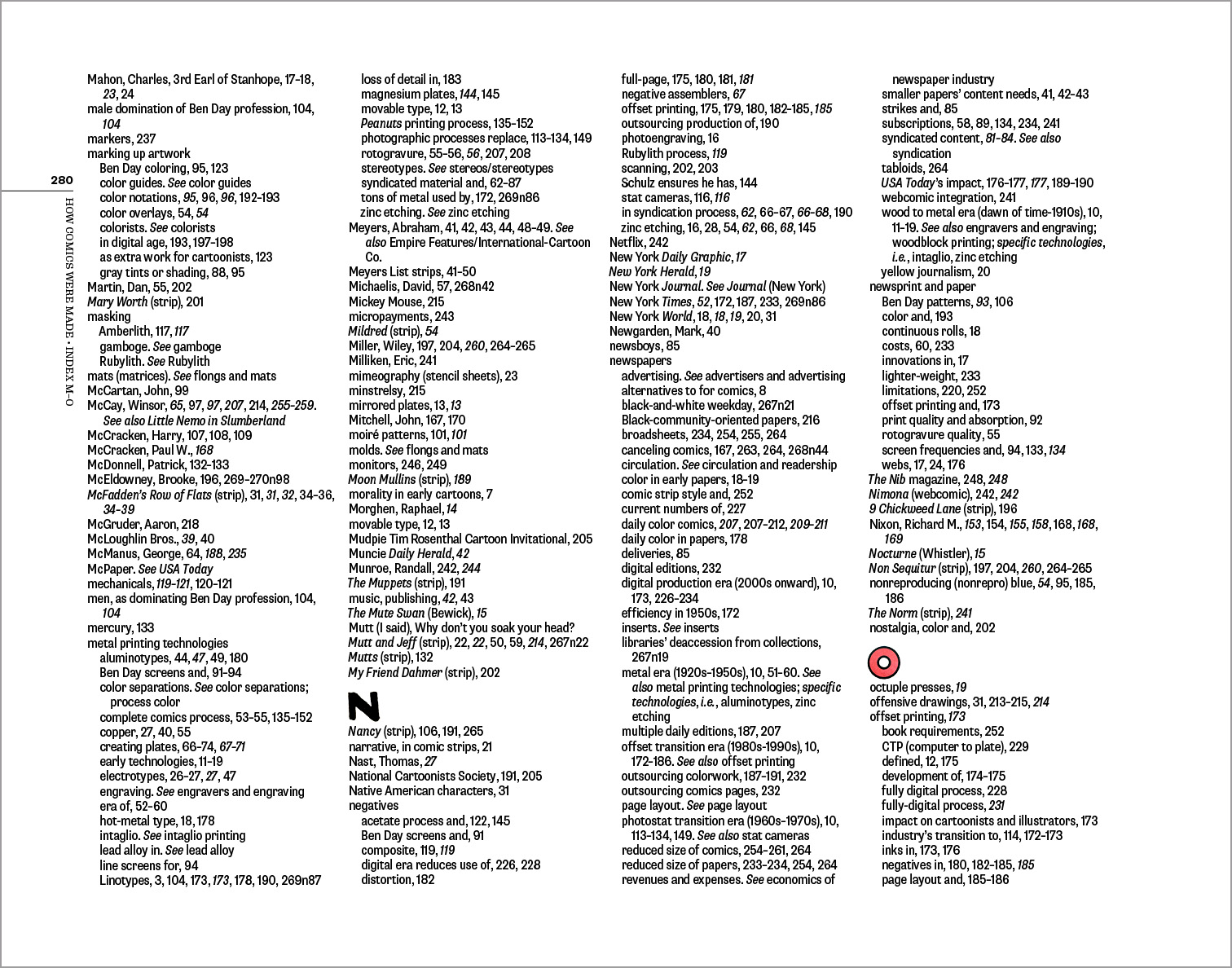
An index page shows the depth of detail provided.
Table of Contents
Part 1
- Wood to Metal: Early Era to 1910s
- Making Multiples
- CMYellowKid
- It’s No Joke
Part 2
- The Reign of Metal: 1920s–1950s
- Syndication in Metal
- Always Rely on the Ben Day Artist
- Peanuts Tours the Des Moines Printing Plant
Part 3
- Picture This: 1960s–1970s
- Dawn of the Dots
- From Good Grief to Metal Relief
- The Week in Doonesbury That Wasn’t
Part 4
- Flatland, the Offset Transition: 1980s–1990s
- Printing Sundays in Color
- Painting Daily Comics
- People of Color in Black and White
Part 5
- Pixel Perfect: 2000s Onward
- Traditional Media in Modern Times
- Webcomics and Beyond
Back Matter
- Edge Cases
- End Notes & Bibliography
- Permissions
- Index
- Acknowledgments