Bulk Exchange is a Solana-native perpetuals venue with an on-chain custody layer and a separate network for matching, risk, and settlement. It is newer than the largest perps venues, so its liquidity, security history, and operating record deserve extra scrutiny.
Bulk describes a deterministic order book, portfolio margin, and a validator network called BULKBFT. This is not spot swapping. Perps use leverage, funding, and liquidation rules.
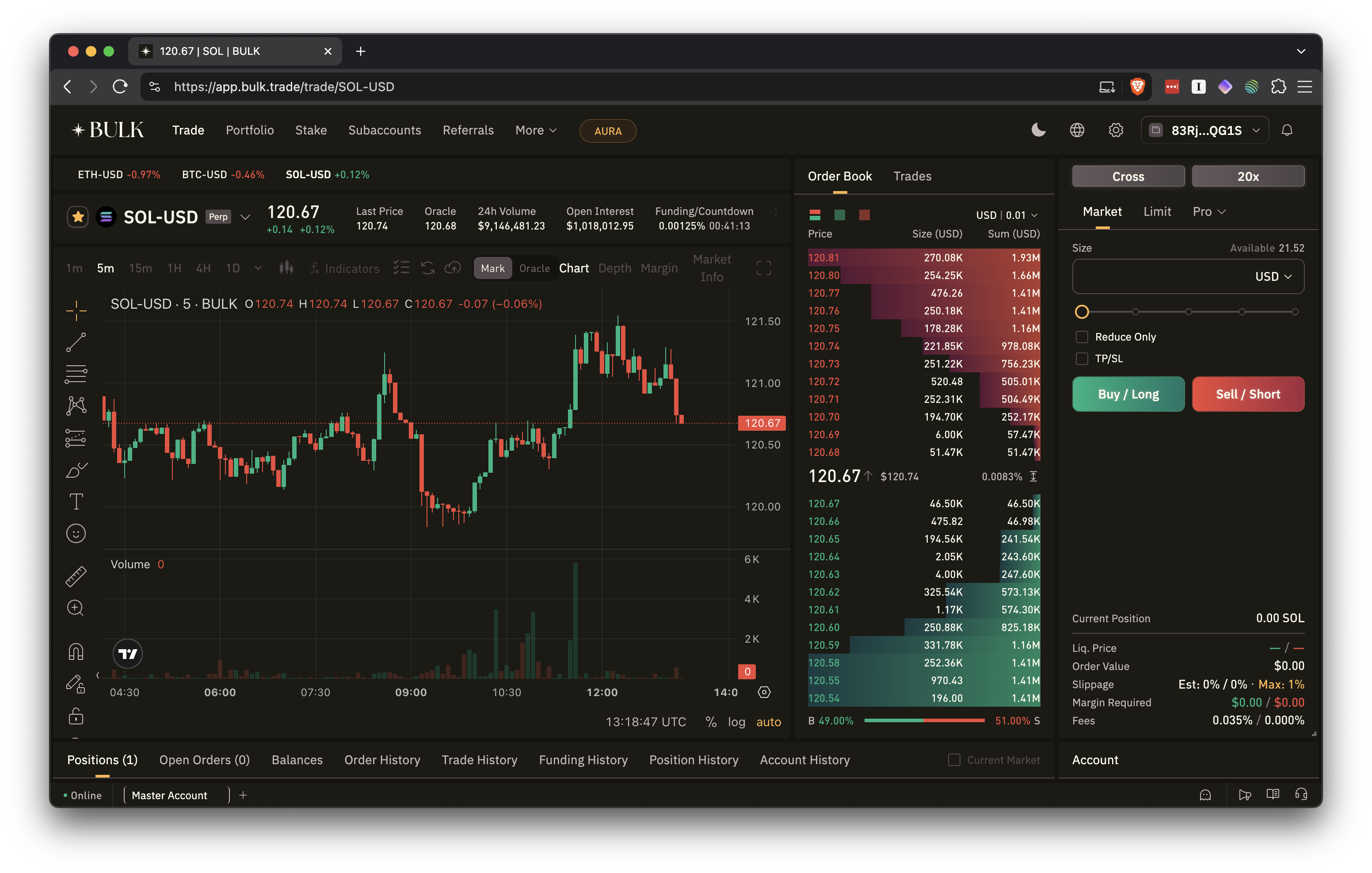
The SOL-USD screen shows the order book, funding countdown, leverage control, and liquidation fields a trader should review before placing an order. These interface values are a point-in-time screenshot, not a current fee or market-data claim.
Where Bulk Exchange fits among Solana perps platforms
Perpetuals trading is inherently higher-risk than spot swapping: leverage amplifies both gains and losses, and positions can be liquidated if the market moves against you and your margin falls below the required maintenance level. Bulk Exchange fits into the broader category of Solana perps platforms alongside more established names like Jupiter Perps and Pacifica, competing on execution speed and fee structure — see our Perpetuals category page and best Solana perps platforms roundup for how the category as a whole breaks down.
Bulk Exchange’s fee structure
Bulk’s official fee documentation currently describes Phase 1, called Genesis Liquidity. It lists a 0 bps base maker fee and tiered taker fees, with the base rate starting at 3.5 bps.
The same documentation says fees use a rolling 14-day volume tier. Maker rebates are calculated separately by market. Check the live schedule before trading because the phase and rates can change.
AURA, Ranked Aura, and the Challenger Series
Bulk’s official Challenger Series documentation now separates existing AURA from Ranked Aura. Trading activity on BULK earns the Ranked Aura used for the seasonal ladder. Ranks can move every week through promotion and demotion, with playoffs for traders who reach the Challenger tier.
AURA earned through pre-deposits or BulkSOL activity is unaffected, but it does not count toward Challenger rank. Referral rewards are described separately in Bulk’s referral documentation. Do not assume that a referral, holding, or integration action improves your rank unless the official rules say it does.
Bulk’s docs also leave room for limited-time gauntlets, with their own rules and additional Aura, plus incentives in lower ranks. The official page says top-ranked traders may get the chance to compete for cash prizes, but it does not publish prize amounts, timing, eligibility details, or a guaranteed payout. A ranked trading league creates a new reason to trade, but it does not make leveraged trading safer or confirm a future token payout.

The BULK app shows seven league tiers, from Unranked to Challenger. The screenshot confirms the tier names and league concept; it does not show promotion thresholds, prize amounts, or season dates.
BulkSOL is Bulk’s liquid-staked SOL product. Treat its yield, fee sharing, supported uses, and AURA eligibility as separate questions. Verify each one in the live product and official terms.
The access model is clearer than the scoring model. Bulk’s official referral documentation says pre-launch deposits determined legacy access-code tiers. New users start with zero codes and unlock one code for each $1 million in mainnet trading volume.
Codes reset weekly and unused codes do not roll over. The exact reward amount, rank thresholds, season dates, and gauntlet rules still need to be checked against the official points documentation.
For live volume, open interest, and liquidation data rather than a point-in-time snapshot, check the independent YetiScan BULK terminal before treating a headline or screenshot as evidence. It tracks the exchange in real time and is not operated by the Bulk team.
The current multi-protocol BulkSOL strategy
A recent third-party strategy write-up describes a route that puts the same SOL through several products: SOL into BulkSOL, BulkSOL into an Exponent principal- or yield-token market, and then PT-BulkSOL or BulkSOL into Loopscale as collateral where the live market supports it. The strategy keeps a separate USDC sleeve for genuine Bulk trading and may borrow some SOL back against collateral. This is a reported strategy, not official proof that every step qualifies for AURA or that every market is currently open.
The useful idea is composability, not “four guaranteed airdrops.” Exponent currently describes principal/yield tokens and maturity-based yield markets, but market availability, pricing, maturity, collateral eligibility, and borrow terms can change. Check Exponent, Titan, Loopscale, and the relevant BulkSOL market directly before moving assets; do not assume that an integration earns points merely because an article describes it. HittinCorners may receive a benefit if you use the Titan or Loopscale links.
The risk stack grows with every layer: SOL/BulkSOL price and depeg risk, smart-contract and integration risk, fixed-maturity risk in PT/YT markets, borrow costs, and liquidation risk if collateral is used to borrow. Holding BulkSOL or trading only with capital you already intended to use can be the more defensible choice than recursively borrowing to increase an unconfirmed reward exposure. For a step-by-step points decision process, see our Bulk AURA farming guide.
Weighing Bulk Exchange against established perps venues
- Pro: offers an additional venue and fee/execution option within the Solana perps category, which can matter for traders comparing execution across platforms.
- Con: we can’t independently verify its audit status, liquidity depth, or track record through a full market cycle — this is an inference gap, not a confirmed fact either way.
- Con: as a newer platform, counterparty liquidity is likely thinner than on established venues, which can mean worse execution and wider funding-rate swings.
Bulk Exchange’s limited, unverified track record
Bulk Exchange is a newer, smaller protocol relative to the most established Solana perps venues. We don’t have enough independently verified history to make strong claims about its audit status, liquidity depth, or track record through a full market cycle — treat any specific claims about TVL, volume, or security you see elsewhere with the same skepticism you’d apply to any less-established derivatives platform, and verify current status directly with the protocol before committing meaningful capital.
Perpetuals trading carries substantially more risk than spot swapping or lending, independent of which specific platform you use — leverage means losses (and liquidations) happen faster than in unleveraged positions. For a newer platform specifically, add smart-contract risk and liquidity-depth risk (thinner counterparty liquidity can mean worse execution and wider funding-rate swings) on top of the general risks of leveraged trading. Start small, understand the liquidation mechanics before opening a position, and don’t treat any perps platform — established or new — as a source of “safe” yield.
Getting in: verify the current access route
Bulk Exchange mainnet is invite-only. A new user needs a one-time access code and a referral link.
The official referral documentation says codes reset weekly and unused codes do not roll over. Do not rely on a copied code list. Check the current access route at yetiscan.com/codes, then confirm the destination domain before connecting a wallet.
If Bulk fits your needs, open BULK. HittinCorners may receive a protocol benefit from this link. Confirm the market and app status before trading.
How Bulk Exchange stacks up head-to-head
See how Bulk Exchange compares directly against Hyperliquid, Aster, Variational, edgeX, Lighter, Hibachi, Ondo Perps, and StandX — every real, verified match-up we’ve written against it so far.
Why this Bulk Exchange review is deliberately cautious
Current information comes from Bulk Exchange’s public-facing materials and general perps-DEX mechanics. Its audit status, liquidity depth, and full-market-cycle track record remain unresolved. Check current status, documentation, and audit claims directly with the protocol before committing meaningful capital.