Productivity can be defined as the difference between the value of what goes in and what comes out. The value can be whatever unit of thing you’re looking at.
If what goes in decreases and what comes out increases then that’s productivity growth.
Historically any growth that humans have observed has come through technological innovations. We can go back 10,000 years ago when agriculture began. Earth isn’t a place where the food just pops up out of nowhere that we can consume and get energy to reproduce and live a good life. Earth is a very harsh place and it tries to kill you constantly.
The people who came up with agriculture were the first bunch of scientists and engineers who systemized the production of food. That’s what enabled the access to a consistent supply of energy for everyone.
It was because of the contribution of scientific and technological breakthroughs that today
lets you have a fridge that keeps your food from going stale
lets u sleep in a hot weather with help of air conditioning
let’s you talk to your friends in a different place while scrolling through memes
let’s you travel thousands of kilometers in just a few hours.
But all that breakthrough and innovation took a lot of knowledge and energy. Humans had to discover new information all the time to solve problems for other humans, and once new knowledge is discovered, humans had to deploy armies to make sure that new products are created that make our lifes easier.
You see, the main component of this innovation cycle is the effort put by humans to discover new knowledge and then the effort put by humans to implement the newly derived knowledge.
But with AI, now we’re able to supply the effort of both kinds to solve problems for humans, and this is just the beginning. With the current capability of AI, it needs to be understood where productivity comes from.
With AI, it’s not very hard to understand why productivity grows over the long term, but what about the short term? Most people don’t understand the exponential nature of growth that AI is enabling.
If we talk in terms of human capital, an individual who has researched over an area for 10 years will have far more knowledge of that field than someone with just 1 year of experience and it’s extremely hard to replicate such knowledge inside the brains of other 100 researchers who are just entering the field.
It’s hard to transmit knowledge amongst humans with help of traditional methods of learning.
With AI it’s almost instantaneous, even in it’s current form. Even if this machine stays at it’s current state for the next 5 years ( which it’ll not, it’ll only get better ), the human’s effort vs output with AI curve kinda looks like this:
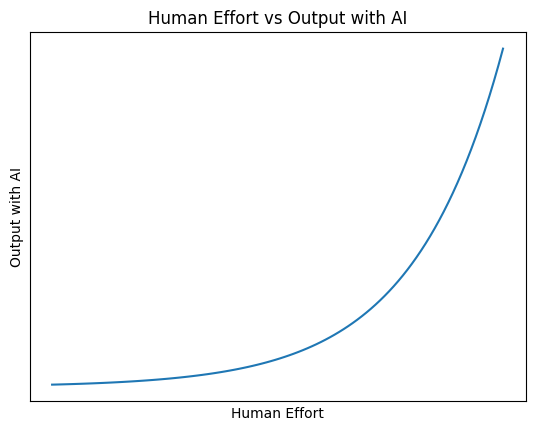
What this graph tries to convey is as more humans increase their use of AI in producing goods and services, the output initially isn’t much but as the processes gets turned into systems, where more and more things get automated, the overall output graph of production of value should get steeper and steeper.
So, the world will change very fast once we reach that threshold of enough systems in place where there will still be human effort put in but the distribution of human effort vs output with AI has a very very steep curve.