Silicon Valley’s obsession with The Lord of the Rings isn’t a tribute to the Hobbits, but a heretical reading where Sauron is the hero, inspired by an obscure 1990s Russian fanfic that paints Mordor as the Silicon Valley of the Third Age.
Peter Thiel just launched a new bank, and you guessed it: the name draws from the Tolkien universe. Erebor, the Lonely Mountain that hoards all the gold.
His obsession with J.R.R. Tolkien is both a known trope for the nerd-to-billionaire arc, and a bit strange, given how orthogonal The Lord of the Rings is to the Silicon Valley ethos of “Move fast and break things.” Tolkien wasn’t a big believer in progress; he was a man of “the long defeat.”
“...and together through ages of the world we have fought the long defeat.”
— Galadriel, in J.R.R. Tolkien’s The Fellowship of the Ring
But Thiel is a contrarian. He has a subversive, almost heretical reading heavily influenced by Kirill Eskov’s The Last Ringbearer.1
Eskov’s paraquel2 is a revisionist history of the Third Age, where the Orcs are the heroes and the “good guys” are the obstacle to human flourishing. In this version Sauron isn’t a dark god; he is the Chief Technology Officer of Mordor. And the War of the Ring isn’t a battle of good vs evil, but of stasis vs progress.
The Elves are the ultimate “incumbents” of Middle-Earth, immortal elites using magic to freeze Middle Earth in an eternal, golden autumn. Seen from their high towers, the realm of the “precautionary principle” is a beautiful , but stagnant world, a muddy museum where nothing must ever change. They keep Middle-earth in a stasis. If you are born a labourer in the Shire, you remain a labourer in the Shire. And if you are born an Orc, you are a monster by birthright.
If the “good guys” win forever, history stops.
Mordor is the disruptor. In Eskov’s telling, it is not a hellscape but a meritocratic society of doctors, engineers, and scholars on the verge of an Industrial Revolution. The Nazgûl, a council of scientists and philosophers trying to protect their intellectual advancement from the “Luddite” Wizards.
Sauron opens his doors to the Orcs Middle Earth rejects and, through his industry, creates social mobility and abundance. He builds housing, develops medicine for the Orcs, and keeps Mordor warm in the winter. Mordor’s industry is magic for the people; technology is the great equalizer, bringing utility to the many rather than power to the few.
This defines the Thielian perspective: the world is moved forward and lifted out of the mud by those who build, and threatened by the prudence of those who wish to preserve a mystical past. Between the “unjust” peace and safety of a stagnant world managed by a global Elven elite — “the Antichrist” — and the risks Mordor’s technology burns down Middle Earth — “Armaggedon,” Thiel’s read suggests we should be far more afraid of the Antichrist.
By flipping Tolkien’s moral binary, Thiel justifies disruption as a moral imperative. To him, the smoke of the forge isn’t a sign of evil, but of a civilization that has finally decided to solve its own problems.
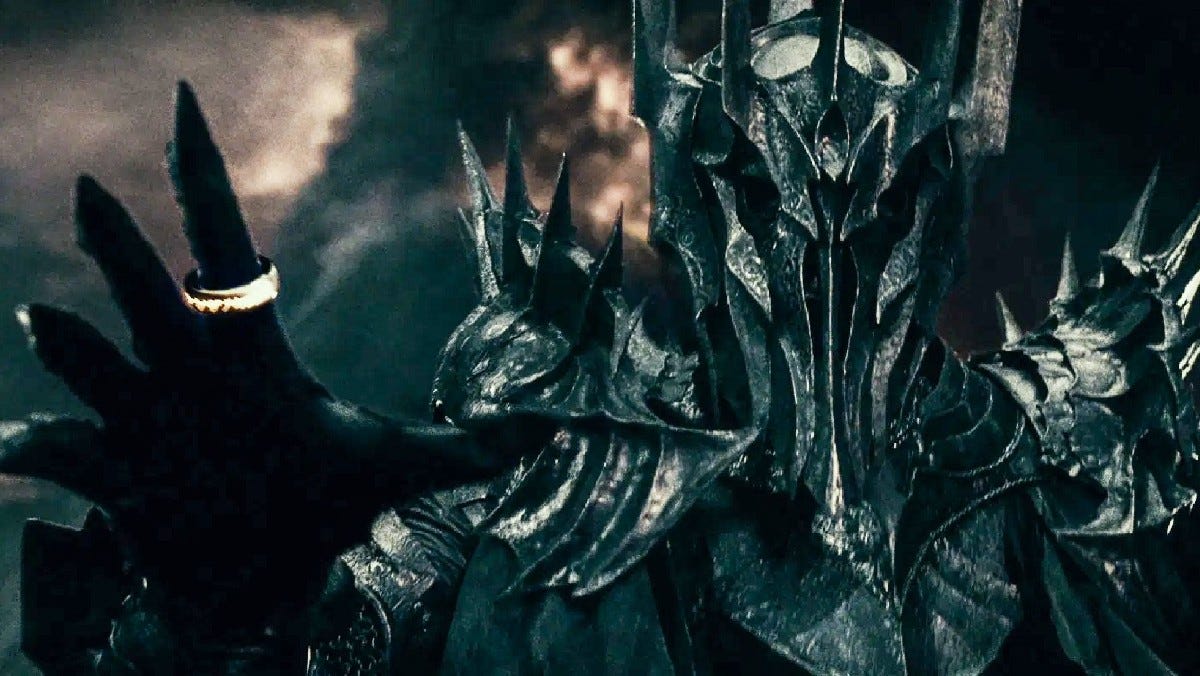
Eskov’s work is a good thought experiment, but it fails to overcome the Manichaeism it wrongfully attributes to Tolkien. It swaps the jerseys, but doesn’t redeem Sauron.
Holding one next to the other shows us a mirror: Sauron and the Elves are mimetic doubles.3 They think they are opposites, but they become identical as they obsess over the same thing: the One Ring that will give them total control.
The Elves want to preserve their power to keep the world “beautiful,” and stagnant; Sauron wants power to make the world “efficient” and ordered. As they fight, they both retreat to their towers, become obsessed with surveillance and maintaining their vision from above. Both get blindsided: the Elves too high up to see the rot growing in the shadows, Sauron too high up to believe anyone would ever want to destroy the ring rather than use it.
Mordor claims to hate the Elven elite while adopting their worst trait: the desire to see all and know all from a distance.4 Sauron practices Goeteia,5 magic used for domination. His favourite tool for psychological warfare is the Palantir, a tool of surveillance.
Thiel might argue he is using the tool of the villain to prevent the end of the world. But Tolkien’s warning was that the tool itself changes you. You can’t use the Palantir without eventually seeing the world through Sauron’s eyes. You start out wanting to build a high-tech realm for Orcs, but you end up just wanting to make sure no Hobbit can move without you seeing it.
And even then, you get blindsided.
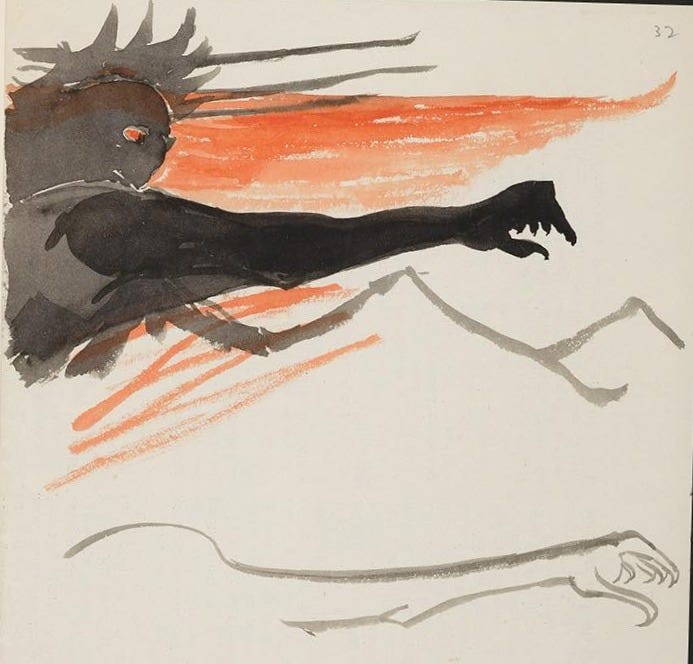
There is a gap bigger than the Moria between “lifting the Orcs out of the mud through tech” and “building surveillance tools that track the Hobbits,” and it’s hard to see how the Stasi prevents stasis.
Thiel complains we are in danger of stasis because a stagnant elite has prioritized fear over innovation, and because innovation has prioritized bits over atoms.
To the latter, his own investments have largely prioritized bits, and his pursuit of the atom is more longevity for Sauron, not medicine for the Orcs, plus a fortress in New Zealand and an army of drones.
And to the former, maybe the fears are warranted, not out of overblown precaution but because Mordor’s tech has done a lot of tangible, palpable harm.
The “magic for the people” is now a black mirror in everyone’s hands, capturing data on the Shire-folk to sell them more pipe-weed while reporting to the secret police of Gondor.
The “disruption” hasn’t turned Orcs into Elves or Humans into Wizards. It has turned Hobbits into Gollums. Meta for instance (Thiel was an early investor) might claim to be a global Shire and look like a community with friends, photos, parties, but is governed by the logic of the Eye: algorithms, data-harvesting, psychological profiling.6

If all they have are bits that turn people into atoms and atoms that blow people to bits, if Mordor’s genius-alchemist-founder-builders can only make Hobbits more stupid, more isolated and worse feeling all while reading their private letters, the Shire doesn’t need the Nazgûls. Sauron’s “meritocracy” is a lie; he doesn’t want merit, he wants slaves who are good at math. If you aren’t useful to the Machine, you are discarded.
Eskov’s vision is an interesting counter-narrative, but Tolkien’s original is more nuanced. Tolkien didn’t write propaganda for a stagnant elite. He wrote about how the “Good” Elites were failing just as badly as the “Evil” ones. Not unlike Silicon Valley, Tolkien’s Middle Earth lives in the tragic tension between lofty goals and reality.
His high and mighty — Elves, Wizards, and Kings — aren’t victors. They are sorrowful incumbents, so convinced of their own moral superiority that they became complacent, allowing Sauron to rise in their shadows. Their wisdom was clouded by their desire to preserve their own status.
And Sauron doesn’t come bearing gifts. In his rise against the totalitarianism of the past, he imposes a totalitarianism of the future. His machine is efficient, but it is not empathetic: if allowed to build at all costs, he cuts down the Ents, reduces the Hobbits to slavery, and paves over the Shire for a data centre.
And he’s no less elitist than the Elves, maybe more. He’s ready to engineer superior Orcs for his army, and at the top, Sauron doesn’t like competition; Zero to One isn’t far from “One Ring to Rule Them All.”
Tolkien’s foresight shows in the penultimate chapter, the Scouring of the Shire, where the wizard Saruman has industrialized the Hobbits’ land with factories, polluted water, and a rules-based bureaucracy, and the Hobbits rise up against the new rules and the machine.
There are many contenders for the hero title in LotR, but the real one isn’t the wizard or the king. And it’s certainly not Sauron. It’s Frodo or Sam, a simple Hobbit who wants neither ring nor tower. They break the cycle of desire by throwing the monopoly away.
Frodo goes through all this trouble to save the Shire because the Shire is a really nice place — and one of best literary examples of a functioning anarchy. They might be quaint of insignificant, but…
The Hobbits are ideal libertarians.
The Shire isn’t involved in the great affairs of Elves or Mordor. It has no standing army; the “Shirriffes” are basically park rangers finding stray sheep. There is no centralized taxation or bureaucracy. Order is maintained through “jokes and histories” and the social pressure of being a good neighbour.
In a letter to his son Christopher in 1943, Tolkien wrote:
“My political opinions lean more and more to Anarchy (philosophically understood, meaning abolition of control not whiskered men with bombs).”
The Shire is the literal manifestation of that “philosophical anarchy.” It isn’t a state as much as a community. And it works because it doesn’t have a single point of failure, and the Hobbits have values.
The Ring failed to corrupt them for decades because it works by magnifying ambition. If you have no ambition to “optimize” or rule others, the Ring has nothing to grab onto. Sauron and the Elves literally cannot “see” the Hobbits because their radar only looks for other power. Bilbo kept the ring for decades without getting corrupted because he didn’t want to rule anyone; he just wanted to be invisible so he could avoid unwanted guests and eat more cake. Hobbits don’t want to control the world, to freeze it or force it; they just want to inhabit it.
By rejecting the Ring, the Hobbit rejects the “One Ring to Rule Them All.” In Zero to One, Thiel argues that “Monopoly is the condition of every successful business.” Tolkien points out that monopoly is the condition of every great evil.
The Shire might be “boring” or insular, but it provides roots. The Sauron path is about global expansion that destroys those roots for the sake of a new catapult. By naming a bank Erebor, Thiel misses the point of the mountain: it was a hoard that led to Dragon-sickness, a perfect metaphor for captured capital that turns friends into enemies.
Victory isn’t Middle-earth over Mordor; it’s a world where the Orcs are free to innovate and the Hobbits are free to live in peace, without either being managed by a high-altitude elite. Maybe Mordor’s tools could improve the Shire. Yes to plumbing; no to being rule by Elven Kings or Saurons.
The Hobbits may not be high-IQ elitists, but it takes a rare kind of genius to look at the One Ring of total dominance and decide to throw it away. In a world obsessed with scaling to infinity, maybe the way of the Hobbit and going back to your garden is the only disruption that actually matters.