Explore general FAQs about ads in ChatGPT, including eligibility, personalization, privacy, and controls.
For current advertiser availability by country, see Ads Manager Availability. Availability may continue to evolve as testing expands.
Ads may appear for users on the Free and Go plans. Plus, Pro, Business, Enterprise, and Edu accounts will not have ads. We do not show ads to accounts identified as belonging to people under 18.
General FAQs
Why are you testing ads in ChatGPT?
ChatGPT is used by hundreds of millions of people for learning, work, and everyday decisions. Keeping the Free and Go plans fast and reliable requires significant infrastructure and ongoing investment. Ads can help support broader access to ChatGPT and continued investment in the product—without changing how ChatGPT works or what users expect from the experience.
When will ads be available in ChatGPT?
We’re beginning this test in the US on February 9, 2026. We’re taking a deliberate, phased approach and will expand gradually as we learn from real-world use and feedback. If you’re eligible for the test, you’ll see clear in-product information.
Who will see ads?
Ads may appear for users on the Free and Go plans. Plus, Pro, Business, Enterprise, and Edu accounts will not have ads. We do not show ads to accounts identified as belonging to users under 18, based on account-level age information and age prediction where available. Ads shown in logged-out experiences are appropriate for all audiences, while mature-content ads are limited to eligible logged-in users.
Will Plus, Pro, Business, Enterprise, and Edu accounts have ads?
No. Plus, Pro, Business, Enterprise, and Edu accounts will not have ads.
Do ads influence the answers ChatGPT gives me?
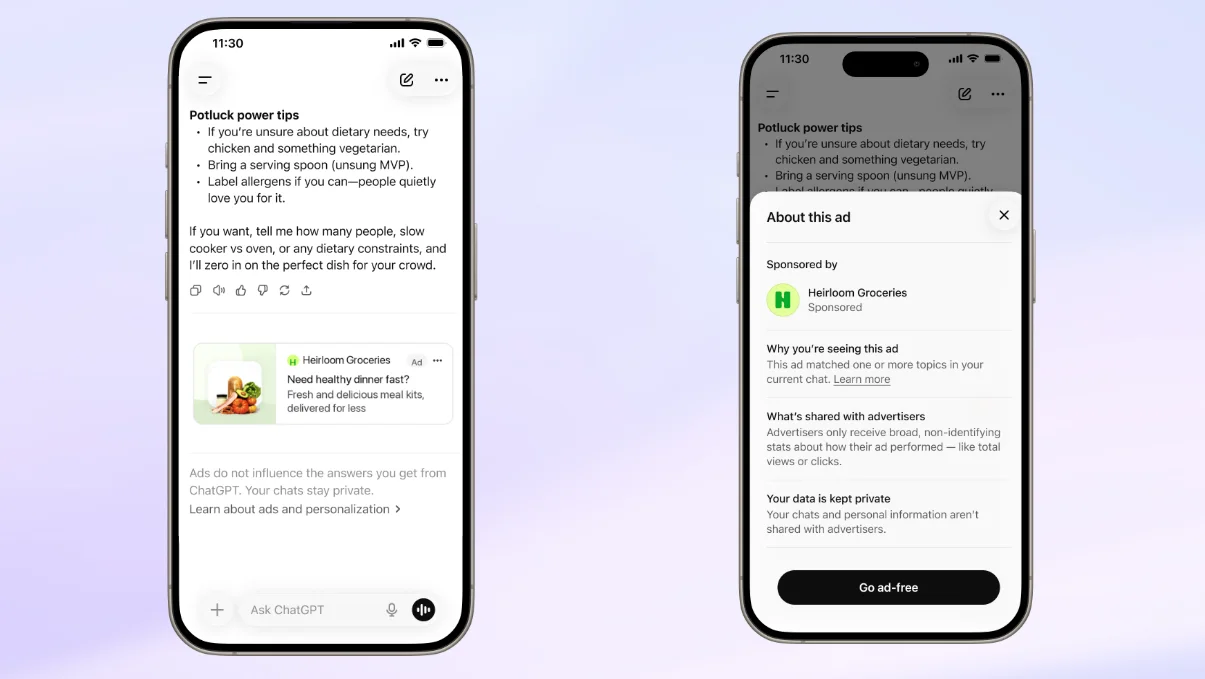
No. Ads do not influence ChatGPT’s answers. Ads run on separate systems from our chat model, and advertisers have no ability to shape, rank, or alter ChatGPT’s responses. Ads are separate and clearly labeled.
Ads are paid placements, and seeing an ad doesn’t mean OpenAI endorses or recommends the advertiser or its products or services.
When and where do ads appear?
Ads can appear below the end of a response. Ads are clearly labeled as sponsored and visually separated from ChatGPT’s response.
During this test, ads do not appear in the ChatGPT Atlas browser.
How do you decide which ad to show?
Our ads system selects and delivers ads based on expected relevance and outcomes.
It considers multiple signals, including the context and intent of your current conversation, the ad’s landing page, title, copy, advertiser-provided context hints and targeting selections, and, when ads personalization is enabled, select signals from your broader ChatGPT experience.
How are ads ranked?
If there are multiple eligible ads, we consider a combination of factors, including relevance and advertiser bids when deciding which ad to show first.
When ads personalization is enabled, select signals from your broader ChatGPT experience may help us better assess which ads may be relevant to you.
How many ads will I see at a time?
During the test, you may see one or more ad units below a ChatGPT response when there’s a relevant match to your chat. That unit may feature one or more items from an advertiser, or multiple advertisers. For longer conversations, we also consider overall context and user experience.
Do you share my conversations with advertisers?
No. We do not share your conversations with ChatGPT with advertisers, and we never sell your data to advertisers.
Advertisers do not have access to your chats, chat history, memories, or personal details. Advertisers only receive aggregated, non-identifying information about how their ads perform, such as total views or clicks.
If you choose to message an advertiser through an ad (for example, to ask questions while making a purchase decision), the advertiser will only see the messages you send them directly.
Can I control my ads experience?
Yes. You can control your ads experience, including whether your ads are personalized. Ad controls are available in Settings > Ad Controls, or visit this link on web or iOS.
You can:
Turn off ad personalization at any time
Dismiss ads and share feedback
See why you’re being shown a particular ad
Clear data used for ads at any time
If you turn off ads personalization, you will still see ads based on the context of your current chat thread, but we won't use other chat threads, ads history or topics to inform the ads we show you.
Ad controls are available only to Free and Go users in regions where ads are available or will soon be available. Personalized ads are not initially available in the European Economic Area (EEA) or Switzerland.
If you do not see Ads controls on your mobile app, please update to the latest version.
Are memories and past chats used to personalize the ads I see?
If ads personalization is turned on, ChatGPT may use select signals from your broader ChatGPT experience to make ads more relevant to you. If memory is on, ChatGPT may save and use memories and reference recent chats when selecting an ad. You can manage your memory controls and ad personalization at any time in Settings.
To chat without using or updating memory, use Temporary Chat. Learn more about how memories work and how to control them
here.
Do my interactions with ads affect my ChatGPT memories?
No. Actions like hiding, reporting, viewing, or clicking an ad do not get added to your ChatGPT memory.
If you share an ad with ChatGPT via the “Ask ChatGPT” feature and ask questions about it, that conversation can be referenced in future chats if you have the “reference chat history” setting enabled.
Will ads appear in sensitive or regulated chats?
No. Ads are not eligible to appear near sensitive or regulated topics, including personal health, mental health, or politics.
Will I see sensitive or regulated ads?
Some advertisers in sensitive or regulated verticals/categories, such as health and financial services, may be eligible to advertise if they meet our strict eligibility criteria. Even where those advertisers are eligible, we do not place ads near sensitive user content, including personal health conversations, and we currently do not allow political advertising in ChatGPT. Read more about our ad policies here.
Will minors see ads?
We do not show ads to accounts identified as belonging to users under 18, based on account-level age information and age prediction where available. The model considers a combination of behavioral and account level signals, including stated age, how long the account has existed, typical times of use, usage patterns over time, and the general topics a person discusses.
Will ads appear in Temporary Chats?
Temporary Chats will not show ads.
Will there be a way to not see ads?
Yes. You can reduce or avoid ads in a few ways:
Upgrade to an ad-free subscription plan (Plus or Pro)
Choose a free, no-ads option with additional limits (fewer messages per day and no access to tools like images)
Availability may vary by region and over time.
Can I ask ChatGPT about the ad I’m seeing?
By default, ChatGPT can’t see the ads shown to you. If you’d like to ask about a specific ad, tap the three-dot menu on the ad and select Ask ChatGPT. This shares the ad with ChatGPT so it can answer questions about it.
Advertisers do not influence ChatGPT’s responses about ads that are shared in the chat.
What information is shared with advertisers?
For this early test, advertisers receive aggregated reporting such as views and clicks. We may explore additional measurement insights over time while continuing to protect user privacy.
What user signals can be used to show ads? What is not used?
Ads are shown using information that stays within ChatGPT to help make ads relevant and is not shared with advertisers. Depending on your settings, this can include:
What you’re discussing in your current chat thread
Basic context such as general location or language. An ad’s language may differ from your conversation or interface language. Ad language selection can consider location, language settings, and conversation language.
If you have Personalized Ads enabled, starting in February 2026 this can also include:
Your current chat thread, including personalized model responses
How you interact with ads (for example, ads you hide or engage with)
Past chats and memory
Advertisers never receive your chats, chat history, memories, name, email, precise location, IP address, or sensitive information (such as health, mental health, political topics).
How long is ads data retained, and what happens if I clear it?
If you delete your ads data, it’s no longer used to show you ads. That data is retained for up to 30 days before being removed from our servers.
I’m interested in advertising on ChatGPT. How can I learn more?
If you’re a business interested in advertising in ChatGPT, sign up at ads.openai.com. Check Ads Manager availability for the current country-by-country status. If Ads Manager isn’t available in your country yet, you can create an account and we’ll notify you when it becomes available. Creating an account does not give you access before your country is supported.
What are OpenAI’s principles for advertising in ChatGPT?
People trust ChatGPT for important and personal tasks. As we introduce ads, we’re guided by principles designed to preserve user trust:
Mission alignment: Advertising supports our mission by helping make AI more accessible.
Answer independence: Ads do not influence answers. Ads are separate and clearly labeled.
Conversation privacy: We keep conversations private from advertisers, and we never sell user data.
Choice and control: You control ad personalization and can clear ads data at any time. We’ll always offer a way to avoid ads, including ad-free paid tiers and a free no-ads option with additional limits.
Long-term value: We don’t optimize for time spent. We prioritize user trust and user experience over revenue.
You can read all our principles here: https://openai.com/index/our-approach-to-advertising-and-expanding-access/
How can I report or hide an ad?
Tap the three-dot menu on an ad:
Use Hide ad to dismiss an ad you don’t want to see.
Use Report ad if you believe it’s misleading, unsafe, inappropriate, or violates our policies. Reporting hides the ad and sends it to our team for review.
Ads-Free on the ChatGPT Free plan
If you’re on the Free plan and prefer not to see ads, you can switch to an Ads-Free experience. This removes ads, but comes with lower usage limits and reduced feature access (for example, fewer messages and no access to some tools like image generation or deep research).
If you want an ad-free experience without the reduced Free limits, you can upgrade to Plus or Pro.
Ads (and Ads-Free controls) may only appear in regions where ads are being tested. If you’re not eligible for the ads test, you may not see these options.
How to switch to Ads-Free
Open Settings in ChatGPT.
Select Ads controls.
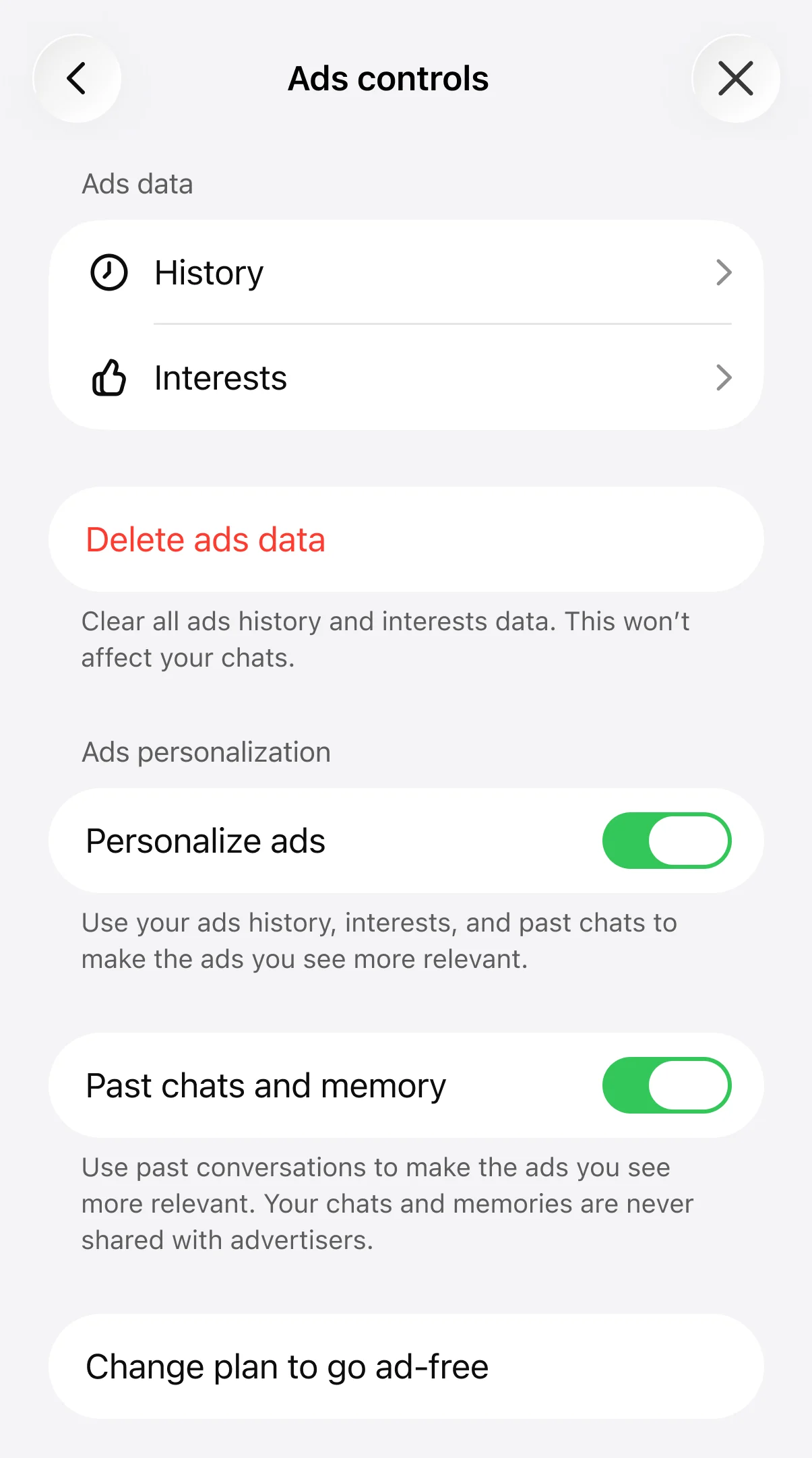
Tap Change plan to go ad-free.
Choose Reduce message limits (this removes ads for free).
Confirm the change.
You’ll see a prompt that explains the tradeoff: ads allow for more access, while going ads-free on Free lowers your message limits. (Wording may vary by platform.)
What changes on Ads-Free
When you switch to Ads-Free, you should expect:
No ads
Lower usage limits (you may hit rate limits more often)
Reduced feature access (some tools may be unavailable, such as image generation or deep research)
If you hit a limit, ChatGPT may show a banner with options to:
Upgrade (to Plus or Pro), or
Show ads (switch back to the ad-supported Free experience for more access)
How to switch back to the ad-supported Free experience
You have two options:
From the rate-limit banner, tap Show ads.
From Settings → Ads controls, use the plan option to return to the ad-supported Free experience (wording may vary by platform).
Ads controls (if you choose to see ads)
If you’re on the ad-supported Free experience, Ads controls lets you manage how ads work for you. Depending on your region and eligibility, you may be able to:
View History and Topics - See ads you’ve viewed or interacted with, and the topics used to make ads more relevant.
Delete ads data - Clears ads history and topics data (this does not affect your chats). After deletion, it may take up to 30 days to be fully removed from our systems.
Toggle Personalize ads - Turning personalization off can make ads less tailored, but it doesn’t remove ads.
Toggle Past chats and memory - If enabled, past chats and memory can contribute to ad relevance. If disabled, ads rely more on your current chat thread. If disabled, past chats and memory won’t be used to inform the ads you see.
When an ad appears, you can also use the three-dot menu on the ad to:
Hide ad (to dismiss an ad you don’t want to see)
Report ad (if it seems misleading, unsafe, or inappropriate)
Select About this ad (to learn why you’re seeing it)
Select Ask ChatGPT (to share that specific ad in-chat—by default, ChatGPT can’t see the ads shown to you)
Does Ads-Free change how ChatGPT answers?
No. ChatGPT responses are generated independently. Ads are not integrated into responses.
Are ads endorsements?
No. Ads are paid placements, and seeing an ad doesn’t mean OpenAI endorses or recommends the advertiser or its products or services.
Do advertisers see my chats or memories?
No. Advertisers do not see your chats, chat history, memories, or personal details. We only share aggregated ad performance data (such as total views or clicks).
Is turning off ad personalization the same as going Ads-Free?
No. Turning off personalization changes how ads are selected. Ads-Free removes ads (and reduces your Free usage limits).
I’m on a Go plan—can I use Ads-Free?
Ads-Free is a Free-plan option. If you’re on a paid plan, you’d need to switch back to Free to use it, or upgrade to a plan that’s already ad-free (like Plus or Pro).