Earlier this year I ran a cash-pay GLP-1 telehealth company. It didn’t survive — I was a late entrant in a commodity price war — but one realization from inside the industry stuck with me longer than the failure did.
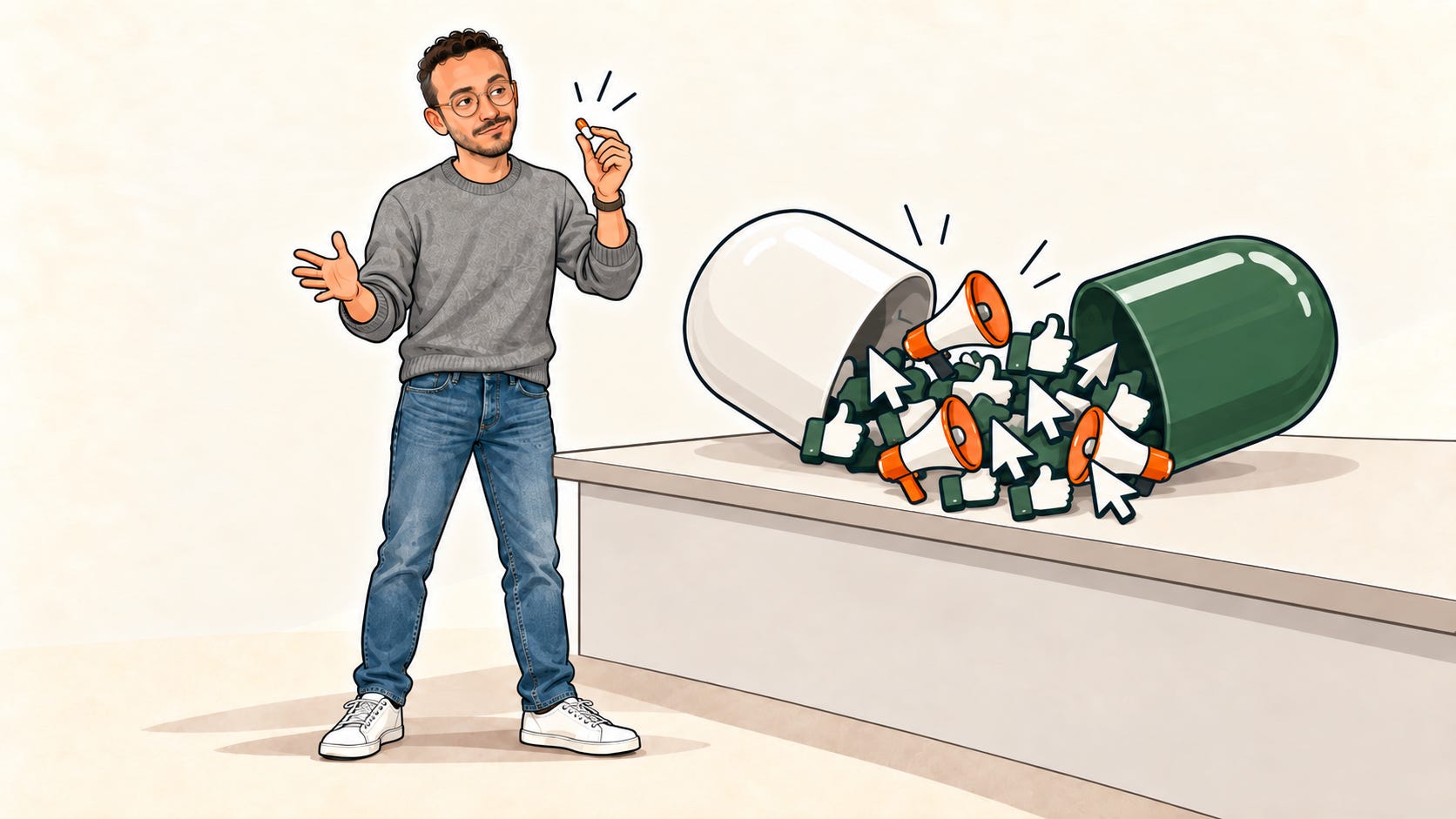
By my estimate, roughly two-thirds of what a patient pays for their medication doesn’t buy medication. It buys the marketing that found them.
This is a general disease of B2C subscription economics that has infected telehealth. My hypothesis is this: GLP-1 telehealth is the worst case because every exit is blocked. Let me show the math, then the hypothesis.
Start with what it costs to acquire a paying patient. Published agency benchmarks for DTC telehealth put fully-loaded CAC at roughly $150–500 per paying patient, with GLP-1 weight loss toward the top of the range. My own operating experience says a new entrant should expect the high end: $300–500 once you’ve gotten past the learning data spend that never converts.
Say a patient pays $199/month and stays four months — that’s $796 total. At $400–500 CAC, that’s 50–63% of everything they paid going to marketing. For customers who leave after two or three months — and as you’ll see below, many do — it’s well over two-thirds. Blend across a realistic retention curve and “roughly two-thirds” is the honest middle.
Now consider who’s paying. Cash-pay GLP-1 patients are disproportionately uninsured, and KFF polling finds about half of adults who’ve taken these drugs say they’re difficult to afford. Functionally, low-income and uninsured individuals are paying a toll to the world’s largest ad platforms — Meta and Google which together capture nearly half of US digital ad spend.
After four months working in this industry, I can confidently say that I don’t think medication should be priced this way.
Here’s the thing operators in other categories will recognize immediately: CAC devouring customer revenue is the classic DTC subscription failure mode.
Blue Apron told investors its customer acquisition cost was $94 per customer — an average over 2014–2016. By the twelve months before its IPO, analysts calculating from its own filings put the number around $463 per new customer, against roughly 70% of subscribers cancelling within a year. Casper spent over $420 million on marketing from 2016 through late 2019 — sales and marketing running 35–40% of revenue — for an LTV-to-CAC ratio analysts pegged around 1.4x, when healthy consumer businesses want 3x or better.
Different products, same disease: commodity-ish subscription products, bought through rented ad channels, with retention too short to amortize the acquisition cost. The customer’s payments mostly fund the machine that found them.
So why is telehealth the worst version of this?
Other DTC companies suffering from CAC disease have exits — ways out of the paid-acquisition trap. Organic channels. Product differentiation. Auction victories. High retention. My hypothesis for why cash-pay GLP-1 telehealth is terminal: all four exits for a new entrant are blocked at once.
Exit 1: Organic channels — blocked by policy, not preference. A mattress brand can build a following on Instagram. A prescription-drug brand largely cannot without paying — social platforms heavily restrict or prohibit prescription-drug promotion, and certification requirements gate what remains. I learned this the expensive way: one mis-posted ad, a three-month Meta ban, support bots, no human, no recourse. Demand that other categories capture for free gets funneled, in this category, into paid auctions. Fewer legal channels, same demand, higher prices.
Exit 2: Product differentiation — blocked by the molecule. Zero differentiation collapses all competition into the ad auction. Casper could at least argue about foam quality. A compounded molecule is a compounded molecule — same pharmacies, near-identical costs industry-wide. When the product can’t differentiate, the ad bid becomes the entire competition.
Exit 3: Winning the auction — blocked by portfolio bidders. The auction clears at the portfolio players’ price, not yours. Established telehealth companies bid rationally against the lifetime value of a customer across their whole catalog — lose money on the GLP-1 acquisition, recover it on everything else they sell. Single-product entrants bid against one product’s economics. The market-clearing price is unprofitable for newcomers by construction. This isn’t cheating; it’s just auction theory working as designed, against newbies.
Exit 4: Retention — blocked by the clinical reality. Staying power in this category is short — clinically, not just commercially. In a JAMA Network Open cohort study of 125,474 adults, 53.6% of patients discontinued GLP-1s within one year — and among patients without diabetes, the population closest to cash-pay weight-loss customers, 64.8% quit within a year and 84.4% within two. Recall the math section: CAC gets recovered over months of retention. When two-thirds of your likeliest customers are gone inside a year, the recovery window is a recovery slit.
Any one blocked exit is survivable. All four is a category where a new entrant’s customer payments must overwhelmingly go to acquisition — which is to say, to Google and Meta — and/or the entrant dies.
One more layer, because the cost isn’t just competitive — it’s structural to how ad platforms work.
Platforms optimize with data, and the data comes from your spend. On day one, the algorithm knows nothing about who converts for you, so early spend is tuition paid at terrible efficiency. You can’t optimize for sales until you have sales. Every new entrant pays this ramp tax, and it’s a regressive one: the amount is roughly the same whether you’re a startup or a $1M-MRR incumbent, so the smallest operators pay the highest rate. Meanwhile the platform’s own recommendations steer you toward its automated products and broader spend — toward what’s measurable in clicks, which is not the same as what’s efficient in sales. And the tools are hard enough that an entire agency industry exists to translate between small businesses and two companies’ ad consoles.
This system is clearly broken and in my opinion, ripe for disruption in DTC healthcare and beyond.
In a world where AI has made building a telehealth company nearly free, it did nothing to the cost of reaching patients. The tech stack got cheap. The distribution toll didn’t — and that toll remains the biggest line item in a patient’s medication bill.
Beyond full scale disruption, the hypothesis also suggests a fix: unblock an exit. Anything that lets healthcare businesses reach patients without the DTC marketing duopoly — physician referral channels, transparent marketplaces, easy insurance integrations — directly shrinks the marketing share of every prescription.
And for founders in any category: run the exit count before you enter the building. Organic channels, product differentiation, auction victories, high retention — how many are genuinely open to you? If the answer is zero, the economics above are your future, whatever your product is.
Until then, the useful thing is for patients to know where the money goes. You’re not just buying medication. You’re buying the ads that found you, the algorithm’s education, the marketing agency’s retainer, and the clicks of everyone who never bought anything.
The drug is almost the cheapest thing in the box.
Next week: the pricing playbook that wins this category — and why I refused to run it.
Sources: DTC telehealth CAC benchmarks from agency-published 2026 data (ClinicAds; Telehealth Media; BrighterClick); EMARKETER US digital ad spend forecasts; KFF Health Tracking Poll on GLP-1 affordability; Blue Apron S-1 and subsequent filings, with CAC analyses by The Motley Fool and others; Casper S-1 with LTV/CAC analysis by Venture Twins; Rodriguez PJ et al., “Discontinuation and Reinitiation of Dual-Labeled GLP-1 Receptor Agonists Among US Adults With Overweight or Obesity,” JAMA Network Open (2025). The two-thirds figure is my operator estimate applying those CAC benchmarks to observed category pricing and retention — if you have better data, my inbox is open. I’d rather be corrected than approximately right.