If you’re reading this, you’re probably aware of the rollercoaster that has been the Helpful Content Update (HCU). And you’re probably also aware that the most recent core update finally saw some small glimmers of hope for a few small publishers. What is left of our team is genuinely incredibly happy for those sites that saw a lift because we know the struggle. In an industry that has been battered and bruised, we have to stick together.
Unfortunately, like many passionate publishers, we’ve been left behind. And before you close this letter and chalk it up as another sob story that echoes what you’ve already heard a million times, I want to take a different approach today.
I’d like to look at a few reasons I believe we and many publishers like us have not recovered, and why I believe that it’s a step backward for search quality.
Here’s what I want to look at:
- Framing the Discussion – What You See When You Search for Reviews
- Review aggregating sites say everything is bad…always.
- Does anyone have a favorite toaster review team? – Brand Awareness
- If Returning Visitors is a ranking factor, we’re doomed
- Can you trust a review from a brand within the space?
- Big publishers must be experts…in everything?
- The problems with “affiliate sites”
- Our olive branch to Google
- So, what’s next for Healthy Framework?
It wasn’t always this bleak…
Okay, to truly understand our perspective, we need to give you a quick tl;dr of who we are.
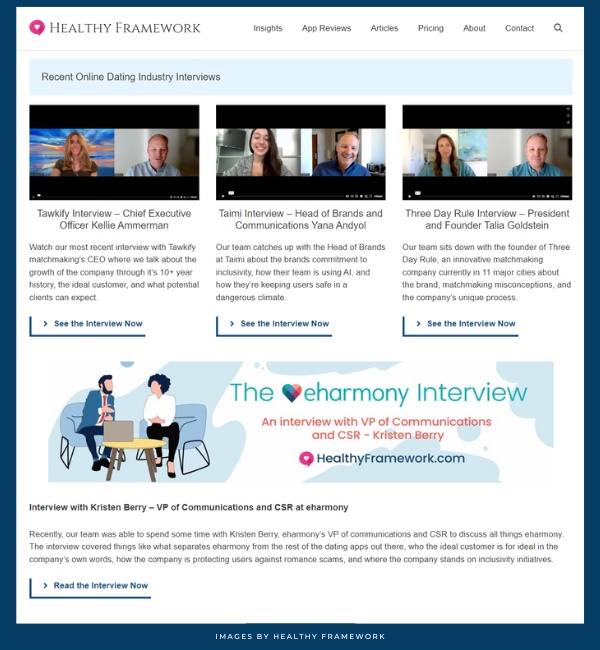
Our story is a tale as old as time last September. Like many publishers, the team at Healthy Framework is passionate about what we write about, which for us is online dating. We’ve been writing, reviewing, interviewing, and studying the industry for a little over seven years now. As cheesy as it might sound, our goal is to genuinely help people find a little joy in their search for love.
Rewind back to May of 2022 (shortly before the very first HCU update) and we were on top of the world. Dare I say we were ‘helpful’?
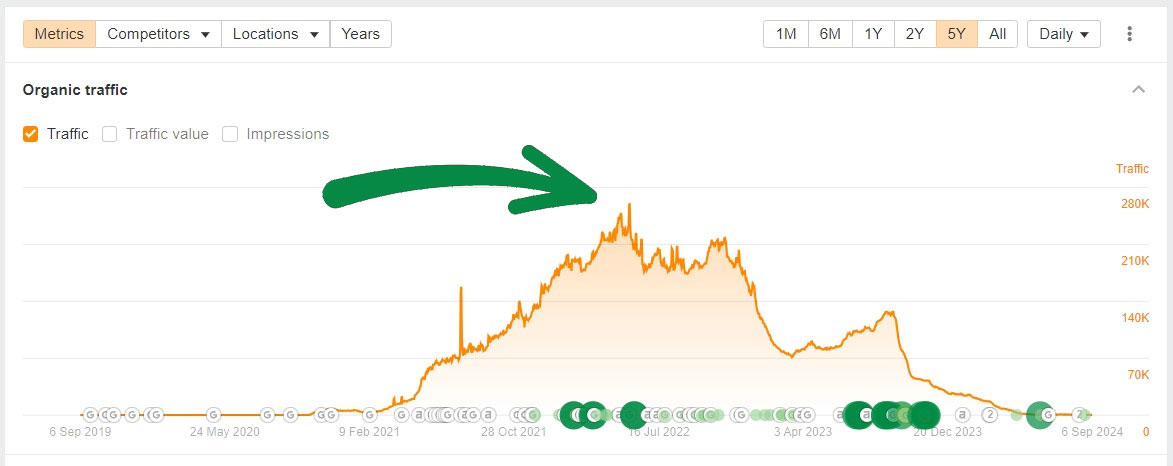
When the first HCU update rolled out that month, we took a hit. And ever since then it’s been a slow death by a million cuts that finally culminate in us basically going to zero with the September 2023 HCU update.
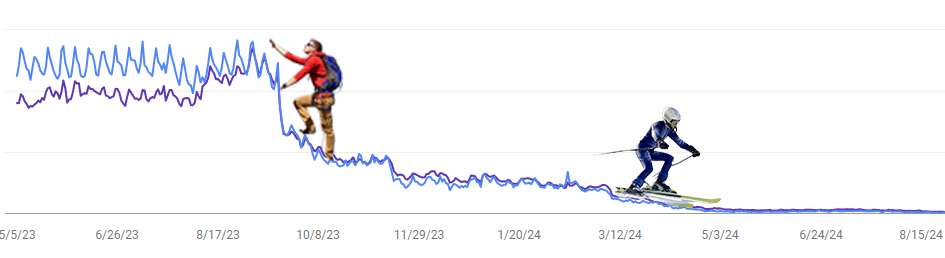
Healthy Framework lost 98% of our revenue. We’ve had to let most of our team go, make significant life changes to try and make the scraps we still get stretch, and I’ll spare you a trip through my emotional health over the last year.
There’s so much more to the story, but that’s enough for us to get into our discussion. All you need to know to read on is that Healthy Framework is a website that writes about and reviews dating apps and that we were crushed by the HCU and have not recovered.
Framing the Discussion – What You See When You Search for Reviews
We’ll be using the world of dating apps for our examples today (because it’s what we know best), but I do believe these themes extend to any small publisher in the review space.
When you search for any dating app review, the top results are almost always the same:
- Forbes
- Trustpilot
- Consumer Affairs
- Quora
- Brands within the space
- The occasional sprinkle of PCMag
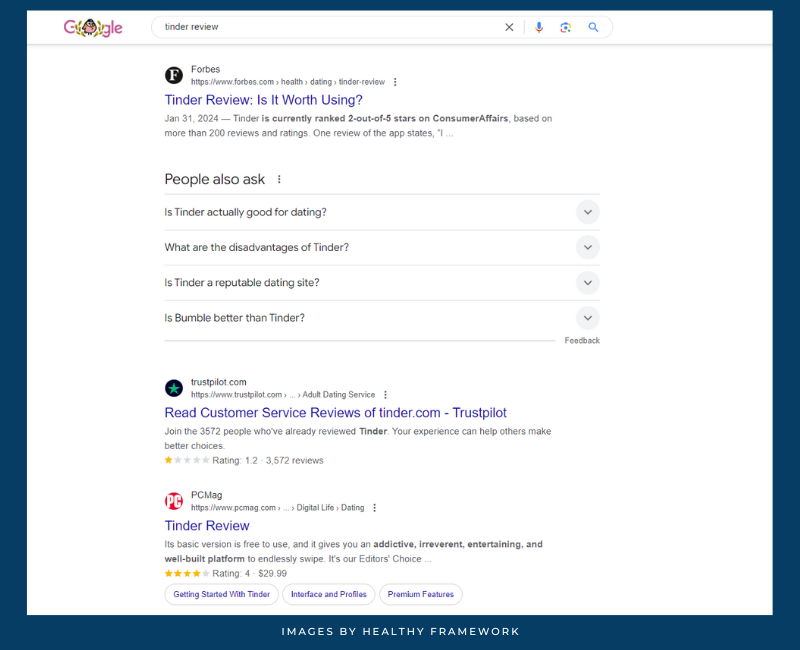
What I’d like to do now is take a look at a few reasons I believe these are showing and why I think they aren’t the best results to serve the needs of the searcher. I’d also like to look at how I don’t know if we’ll ever get some love from Google again.
As a disclaimer, these are just my thoughts and theories so take them as you will.
Review aggregating sites say everything is bad…always.
Sites like Trustpilot and Consumer Affairs must be the best thing to return for reviews because they’re reviews from real people, right? That’s why Google always shows them at the top, right?
Here’s the problem. The only people who take the time to write a review on these sites are those who had a terrible experience. So, if you look up pretty much any company on these sites, it will tell you they’re awful.
Trustpilot
Here’s the Trustpilot scores for 10 of the largest dating apps out there.
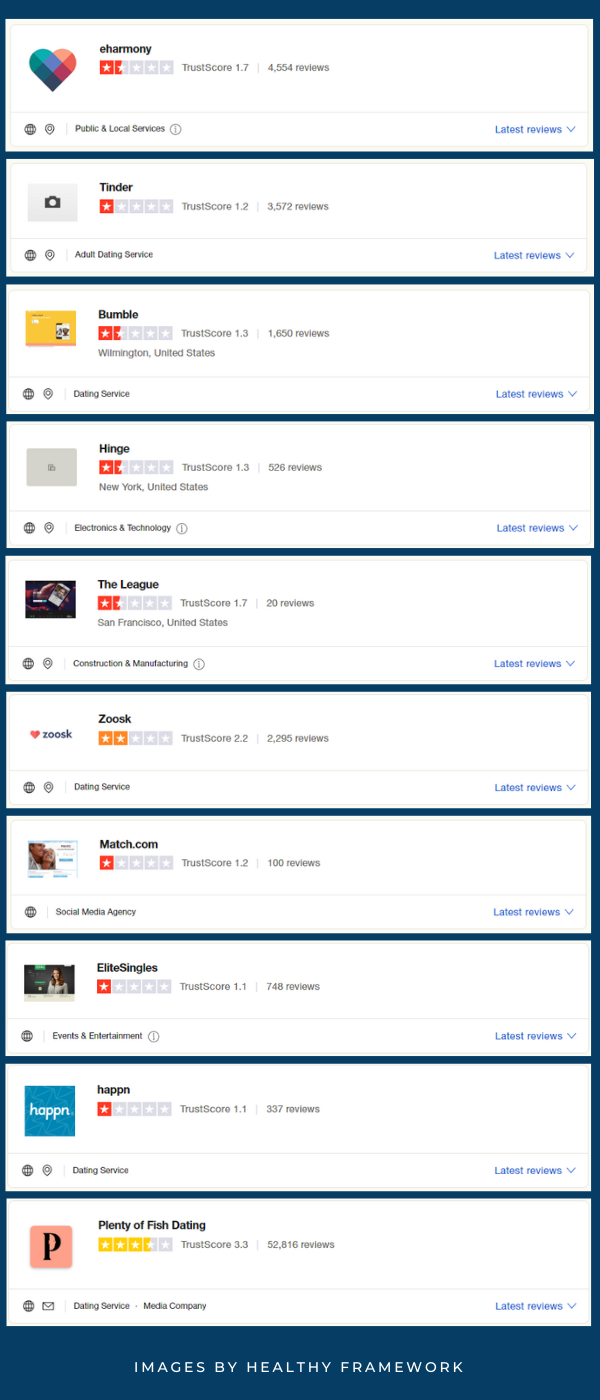
The average score is literally a 1.61 out of 5.0. If Trustpilot is to be trusted, then everything is terrible.
And you might be saying, “Well Plenty of Fish at least has a 3.3! They must be amazing!” If you’ve ever used the site, you know that this number is more than likely manipulated. Why can we say that confidently? Because Plenty of Fish was purchased a few years back and turned into a shell or doorway site to send you to other dating apps.
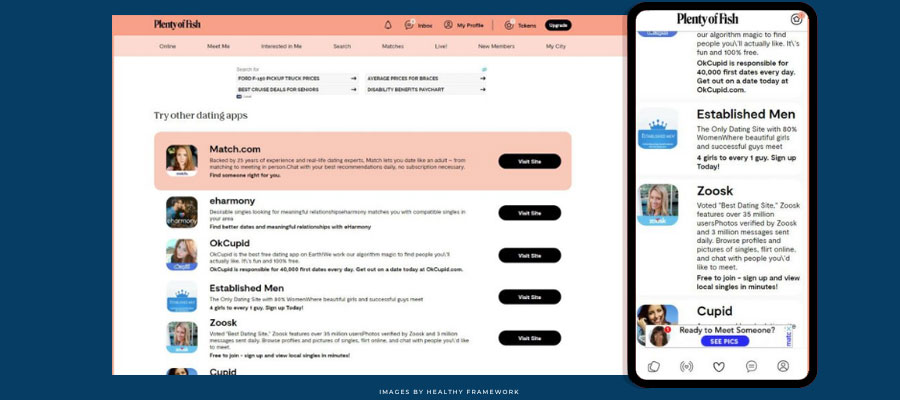
The highest rated dating app of this group on Trustpilot is nothing more than the shell of an app gutted by affiliates.
Here’s something you may or may not know. POF is notorious for sexual harassment in the form of dick pics. Instead of fixing the problem, the team at POF decided to make a joke out of it and build their own virtual gallery of dick picks.
We don’t know everything about everything, but we do know dating apps. While at first glance it might make you laugh, an app that glamorizes sexual harassment probably shouldn’t be the number one option getting recommended. People need to be aware of these things when making a selection.
Consumer Affairs
What about Consumer Affairs? I see a similar trend…

Yet again, if the aggregate review sites are to be trusted—everything is terrible.
And just for some added giggles, when you search for “consumer affairs Zoosk”, this is what you see.

Oh, okay.
Does anyone have a favorite toaster review team? – Brand Awareness
Recently, Tom Capper, a Senior Search Scientist at Moz shared an incredible article analyzing the winners and losers of the past few HCU updates. While I’m nowhere near as smart as Tom (so please forgive me if I butcher this), but as I understand it the takeaway is that having a strong awareness of your brand was a key trait amongst sites that recovered.

Makes sense. If people know about you, you can probably be trusted? However, here’s the challenge for small publishers.
Let’s say you’re in the market for a toaster. You want to hear from people who live, breathe, and sleep toasters, right? Who is your go-to brand name for toaster reviews? If you’re drawing a blank, so are we.
You can be the greatest toaster review team, refrigerator expert, or dating app review team—and literally no one will know your name. Here’s why:
- You don’t buy a new toaster or join a new dating app every month. Why on earth would you have a favorite review team in these spaces?
- If a review team is doing their job well, you won’t have a need for them ever again (or at least for a very long time). If you actually recommend a durable and effective toaster to me, you probably won’t see me for 6-10 years (yes, I looked up the average lifespan of a toaster).
- You’re not going to tell your friends about the amazing review you read that recommended your new toaster. You’re going to tell them about your toaster.
Toasters is just one example of many. We’ll talk about this more in a moment. But as another example, why does a site like The New York Times rank #1 for ‘best air purifier’ when a site like HouseFresh exists?

So….what are we and other small publishers like us supposed to do?
The internet has been riddled with people lately saying “go build a brand” and you’ll recover. What are small publishers like us who are passionate about something people only think about once in a blue moon supposed to do to “build a brand”?
And does it even make sense to expect this of small publishers? Even if a niche site were to do everything right in building a brand they would still never be a household name. So, what’s the point then if not solely for the purpose of ranking in google? Review sites focusing more on brand than content does not serve the best interest of the user.
What this leaves is only three groups that can serve reviews—brands who actually sell products in the space, big publishers like Forbes, and aggregate review sites. We’ve already discussed the last one, but we’ll get to the other two in just a minute. There’s something else I want to cover first.
If Returning Visitors is a ranking factor, we’re doomed
“If a review team is doing their job well, you won’t have a need for them ever again (or at least for a very long time).”
There has been some chatter that having people “search for your site by name” and your “Returning Visitor Percentage” are possible indicators of the quality of your site. If this is the case, Healthy Framework and other small publishers who do reviews are probably doomed.
Here’s a graph of our Returning Visitor Percentage below. (No, this is not just a picture of a right angle). I would share the actual figures but I literally have no idea how to do anything within GA4. Basically, most people get what they need from us, and we don’t see them again, at least for a very long time.
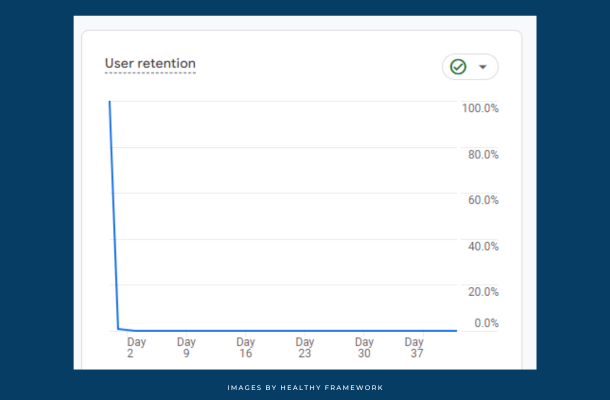
Yes, I can see that this could happen because our content is awful and people hate us. However, I’d submit that, isn’t it possible this is because of the nature of our industry and that we’re doing our job well?
If you come to us looking for a dating app recommendation and we give you a great one…or if you come looking for some guidance on how to address an issue you’re dealing with and we give you sound counsel…why would you need to come back?
This is why even during our golden age, 96% of our traffic was from organic search.
I’d file this under the same logic that once you give someone a sufficient answer with AI Overviews, they’re not going to be very inclined to click a link to…see the answer again? I’ll leave that discussion for another day.
The bottom line here is that if this is a ranking factor and part of who did and did not recover, the only incentive for us is to do worse at what we do so you have to come back for more help.
Can you trust a review from a brand within the space?
With that said, I want to go a little deeper into the idea that the best source of information for queries are actual brands. In a lot of search instances, 100%. However, when it comes to reviews—it seems wrong.
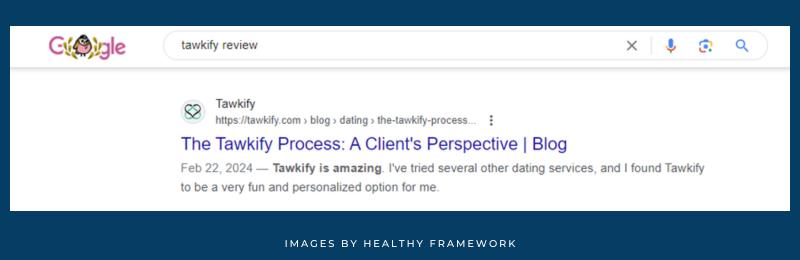
There are two instances to look at here. First, brands writing reviews about their competitors. Here’s an example in our space. Check out these articles written by matchmaker Tawkify.

What do you think the odds are these reviews are unbiased? Let’s look.
First, we’d argue that these reviews are incredibly low-effort and are nothing more than a collection of random facts by someone who clearly has not been within 10 miles of any of these services. However, what is interesting are “The Takeaway” sections. What are they recommending to users?
Let’s start with the Kelleher Matchmaking Review. Here’s the takeaway they put at the end of the review:

Well, it looks like they recommend themselves. Let’s look at a few more of the reviews and see what they have in the takeaways:
Selective Search Review Takeaway – “That’s where Tawkify enters the picture. We offer affordable matchmaking packages starting at $4,900 and take pride in the high-quality matches we provide, all hand-selected from our database of over 1 million relationship-ready singles.”
Hmmm, looks like they recommend themselves again. Let’s try a few more…
Three Day Rule Review Takeaway – “But no matter where you live, Tawkify matchmakers are here to help you find your person. We have a network of more than 1 million relationship-ready singles, packages affordable for just about any budget, and dedicated matchmakers who can guide you toward long-lasting, meaningful partnerships.”
Okay, saw that one coming. Let’s try one more…
Luma Matchmaking Review Takeaway – “For an intentional, empathetic, and refreshing approach to matchmaking, turn to Tawkify, where you can expect to make meaningful connections with like-minded singles—with the goal of finding a compatible partnership. Let us know when you’re ready to find your person.”
You get the point. Again, we’re not trying to bash Tawkify here, but it begs the question if getting reviews from brands within a space is really a great idea?
Secondly, (and we’ll let you explore this one yourself), how do you think the quality of this search result is for people looking for an honest take?
Big publishers must be experts…in everything?
We won’t spend a lot of time here today, because frankly, unless you’re living under a rock, this will be beating a dead horse. That said, I do want to offer a potential suggestion after we frame the discussion.
Search ‘any major dating app + review’ in Google and the number one result is almost always the same site—Forbes.
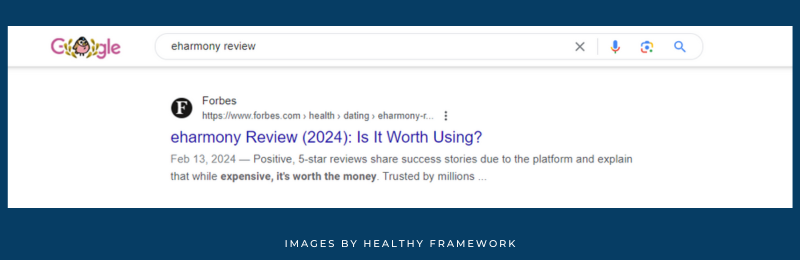
If you look at their dating app reviews, at first glance, they look pretty good. Decent design, decent format, and even some quotes from psychologists. However, read the actual review and you’ll realize it’s nothing more than regurgitated basic information that can be pulled from other regurgitated reviews on the web. No screenshots, no deep insight, no hidden gems of helpful information—nothing.
While I’ve made it this far not tooting our own horn, I have to do it briefly here. If you look at our eharmony review, you’ll see our team actually tested the app multiple, multiple times (like we do with all of our reviews), conducted our own interview with the VP of Communications from eharmony, poured through the terms of service to look for hidden language, shared countless screenshots to help you see if it’s a good fit for you, compared the app with industry trends and norms…And all of this? “Not helpful.”
I think Forbes and other big publishers have the resources to hire good enough writers who can spin other people’s work and put it into a template that at least looks good. Does that really help readers?
And to beat the dead horse one more time…I find it hard to believe that Forbes is an expert in air purifiers, alarm clocks, backpacks, BBQ equipment, bed skirts, Bluetooth trackers, cat water fountains, clothes, coffee makers, cooling towels, couches, credit cards, dating apps, diamond rings, diapers, dog food, earbuds, finance, fitness equipment, getting Oasis tickets, hair products, headphones, hot tubs, hotels, ice cream makers, insurance, laptops, mattresses, pans, pillows, prescription glasses, shoes, snow tires, steam mops, toasters, TVs, vacuums, watches, weed whackers, and sooooooooo much more—all at the same time.
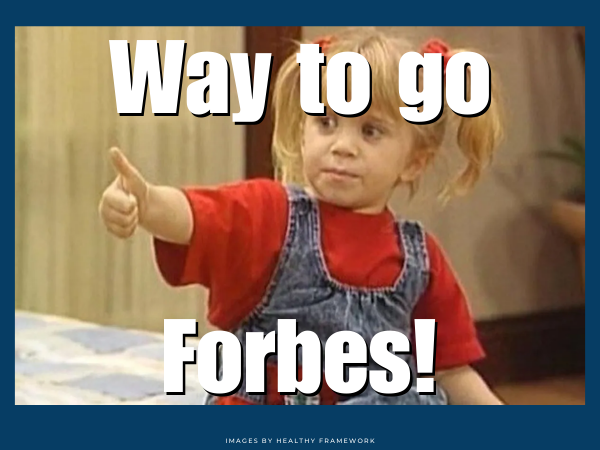
Forbes and sites just like them use their authority from other topics to write about literally anything they want and they automatically rank first. Sorry Mr. Horse.
An idea…
Here’s something that could work. Why not make sites have to register their areas of expertise? Anyone can still rank for anything, but some favoritism (or Twizzlers, or whatever they’re called) in the rankings can be shown to sites who declare they’re experts in a topic. Maybe you list off your one main area of expertise and two sub-areas? Forbes can take finance, business, and credit cards if they want.
Forbes can still write about toasters all they want and they can still rank if no one else is writing about them or there is no great content out there. However, if they want to be viewed as authoritative in the topic, they have to start a fresh domain just like the rest of us and can’t just piggyback off of prior successes.
Instead of forbes.com/toasters automatically winning…make them compete (fairly) with forbestoasters.com.
The problems with “affiliate sites”
This wouldn’t be a complete discussion without talking about the problems that can happen with sites like ours. There are temptations to do things that are unethical, and they could be challenging for Google to detect.
Ranking whoever pays you the most
There’s a temptation to just put whoever pays you the most at the top of your rankings and recommendations. For transparency, that’s something we refuse to do at Healthy Framework, but “proving” that to an algorithm is hard.
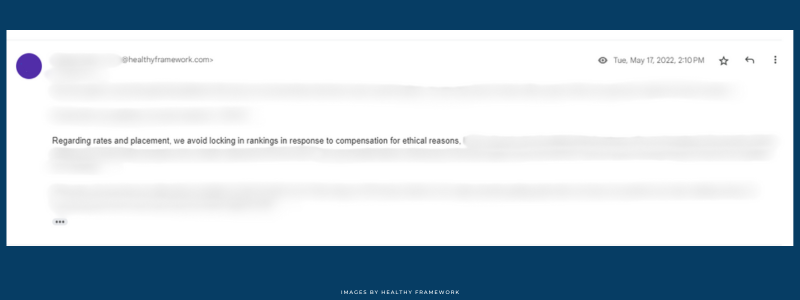
If you’re advising Google, you could make the argument that all you have to do is look at the website and if they recommend the same few options over and over again, they must be compromised, right? While this would catch some people abusing the system, what happens in an industry where there are only a few viable options?
For example, what if someone is searching for a great farmer dating app? There is not a single niche dating app solely focused on farmers that is worth its weight in grain. They’re all great in theory, but terrible in execution. I would not send my worst enemy to them.
So, what do you recommend to someone searching for a good farmer dating app (yes, this gets searched a lot)? Well, the right answer is you recommend the best option, which is a good mainstream dating app that has adequate search filters, a large enough membership base for rural members, and opportunities to match based on your outdoor-driven lifestyle. You recommend an app that has a lot of farmers on it, plenty of options in farm-heavy areas, and is user-friendly for people who might not be great with technology.
The problem? Well, that mainstream dating app you recommended for farmers might also be the best choice for several other niche groups. If you make the same recommendation (because it’s truly the best for them), you end up looking like you’re bought and paid for.
So, as a site owner, what are you supposed to do? Offer terrible options? Offer the “same” option because it’s best and risk getting flagged as spam? Or don’t offer any options, don’t write the page, and then farmers looking for love end up wasting money at worthless, unsafe sites.
Affiliates first or second?
Continuing on, let’s say you recommend that mainstream dating app to farmers because it’s the right answer. A while later you find that the mainstream app will pay you some money if you refer people to them. Because you’re not a moron, you accept the free money and get paid for a recommendation you’re already making.
Based on this, you start going down the list of options you’re already recommending and start getting more of these affiliate deals. Your list of recommendations are now “riddled with affiliate deals”. But as long as this is not impacting your recommendations, is this really a problem? Part of me wonders if the algorithm thinks it is.
The challenge for Google is that some people approach this differently. They find out who they can get affiliate deals through first, and then write their recommendations and reviews accordingly.
Again, though, is it fair for us to get punished because of what other people are doing? Are we just collateral damage because we bear some of the same traits at quick glance as “spam affiliate sites”?
Our olive branch to Google
Before we wrap up, I do want to toss an olive branch to Google. I get it. It has to be a monumentally hard task protecting the quality of the internet from thousands of people trying to game the system. Crafting a one-size-fits-all approach will never be perfect, and there will always be people who get left in the dust. I get it.
However, you have to do better. I understand we’re a nobody to you. But as people like us who are passionate about less-popular topics run out of money, we’ll vanish. And at some point, I feel you’re going to realize that what you’re serving for reviews is not great. At that point, your experts will be gone and you’ll have no choice but to keep serving the same regurgitated garbage.
So, what’s next for Healthy Framework?
Based off the last update, our days are numbered. We’ll keep “trying” (whatever that even means anymore) to “fix” things. But unless something major happens, we’ll be gone soon.
If you want to help us, consider sharing this story. The best we can hope for is awareness that the problem this last update was supposed to fix is not fixed.
If you’re interested in talking to our team, please send us an email at [email protected].