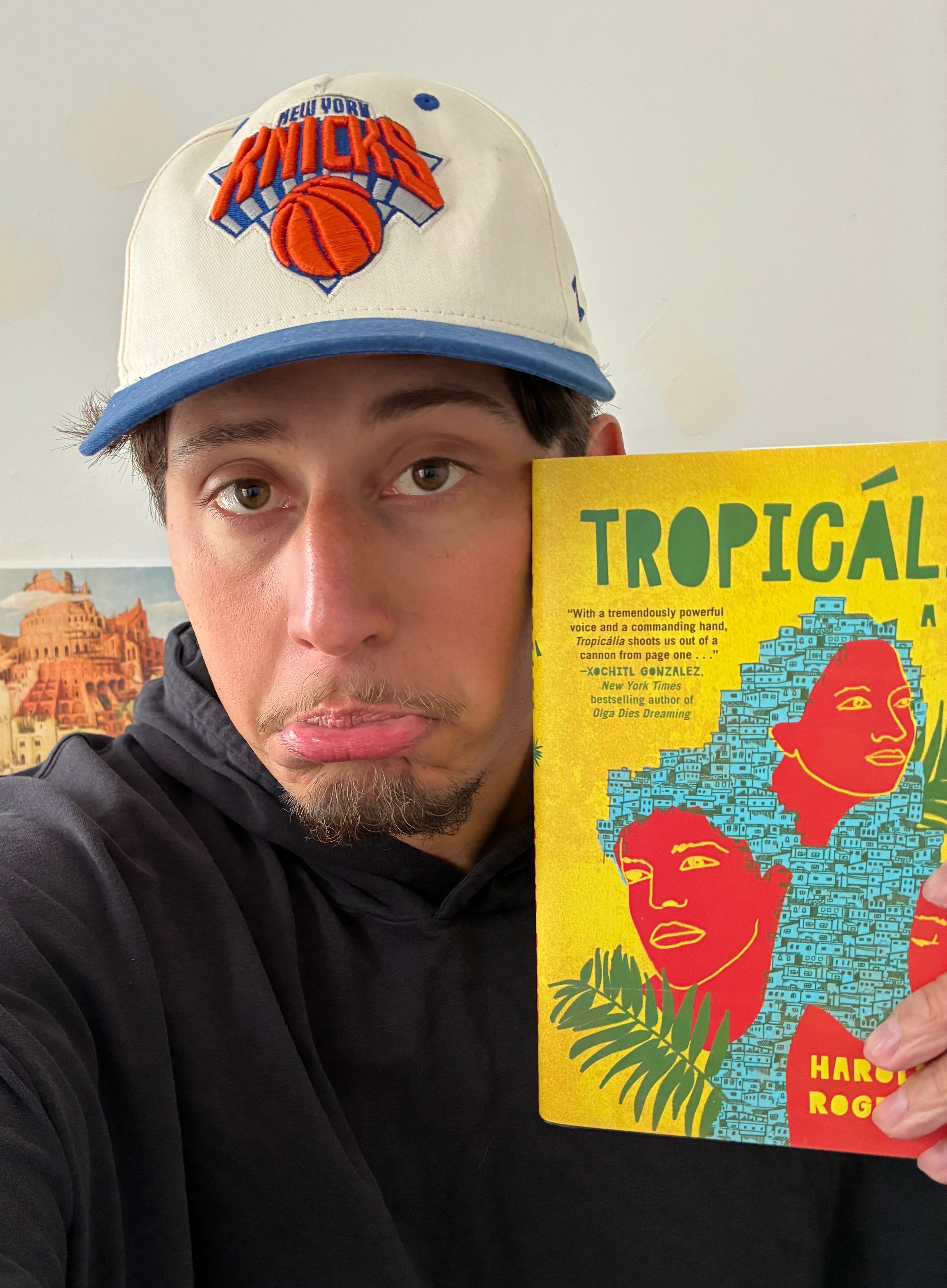
MY DEBUT NOVEL TROPICÁLIA (2023) SOLD 763 COPIES, —
. . . remarkable, juxtaposed with years of silent toil where literally NOBODY read any of my writing ; less remarkable, in the context of a for-profit publishing industry :
I received a $125,000 advance from Atria.
When I tell people my novel was a FLOP, they mewl sympathetically with unanimous succor : “don’t say that! No it wasn’t!” — bruh, I know my novel doesn’t SUCK, but there’s one goal in big publishing :
TO MAKE MONEY !
For Simon & Schuster, my book was an unequivocal FAILURE.
They were not interested in publishing me again.
MY GOALS FOR TROPICÁLIA WERE SIMPLE & REALISTIC, —
. . . in my journal, I outlined my 3 wishes (excerpt 1/18/23) :
“I know this novel is a generational monument; ideally, I would : 1) Win the pulitzer prize ; 2) get a glowing review by James Wood ; 3) make the NYT bestseller list. . . if only one or two of these happen, I’ll be OK, but I think it’s realistic I hit all three. . .”
I was 25 years old.
. . . the most bewildering thing about publishing a novel : U cultivate a long-term private DREAM, nurture the most ecstatic expectations, become convinced of its utmost importance: — who doesn’t think, If they would just gimme a chance my book would be a fucking HIT, — suddenly, it’s in the cold world of the market : to live or die by luck & merit ;
I will never forget my release day: July 18, 2023 ; I was teaching at the gym all morning, checking my phone every hour on the hour from 6AM to 12PM, expecting a rave NY Times review: eventually the doldrums hit: my only pub-day review was a 3.75/5 on theglossbookclub.com ;
Gaby picked me up on her lunch break; it was raining. She walked and I sulked over to the now defunct Barnes & Nobles on Warren Street. Tropicália was on the front shelves: ECSTASY.
. . . not even three years later : U can’t find my book in any store.
THERE’S A PAUCITY OF GOOD, DETAILED INFORMATION, —
. . . nobody cites their numbers, most people are mum on the whole process : here’s how I sold Tropicália : at Miami University, I was a philosophy major, but my senior year 2018-19, I did an independent study on contemporary fiction with the writer Margaret Luongo ;
I wrote a 100 page draft of what was then luso-ridiculously called Eu Agora Sou Feliz ; (— I didn’t know anything about MFA programs; I took a workshop Senior year with Daisy Hernandez, who had given me a C minus in a Freshman workshop the most knuckledragging football players were A-plusing;
she was impressed with a story I wrote (under the influence of George Saunders & Nana Adjei-Brenyah) called Fast Times at the Perpetual Daytona 500 and suggested I should apply: I was shocked) ;
I applied only to Columbia University. Ben Marcus called me on my birthday, March 14, 2019, to tell me I was accepted. I didn’t answer; I was cutting weight for a fight. . . After I won my fight, I listened to his voicemail for the first time: it was one of the giddiest moments of my life; I email-hammered them until I got full-funding, and I went to NYC.
. . . to say I enjoyed my experience as an MFA student at Columbia would be a LIE; but another LIE would be to tell U the experience wasn’t beneficial to me as a writer. I had three especially influential workshops: with Lauren Grodstein, Rivka Galchen, & Binnie Kirshenbaum,
there will always be absolute DOLTS in Ur workshop: if U listen to them, U R a FOOL and were never gonna be a writer anyway ; to imagine the workshop is a place where Ur brilliant prose gets whittled into marketable dreck is an absolute delusion: most people are already writing staid dreck.
What’s vital, especially, if U go in, like me, with only about 5 years of serious writing experience: is being READ ! — Never in my life had I gotten honest feedback about my stories. . .
During the MFA, I avoided camaraderie & socializing like the plague: I focused solely on Tropicália: I didn’t write a word of anything else.
I sent my third full draft to Rivka Galchen in January 2021; she was abundantly complimentary and told me to send the book to her agent: Bill Clegg. Now, this is where my dreams of grandeur truly began. I thought I was gonna be Zadie Smith. I was sure Clegg was gonna hit me back ASAP, and I would soon be signing a million dollar deal with Knopf.
Days, weeks, months: No response from Clegg. Embarrassingly, I sent him a follow-up query with “blurbs” : including what Binnie wrote on her last workshop letter, and an amended text from Sean Thor Conroe (“Bruh, Tropicália is FIRE AF”). . .
Eventually, I gave up and started sending wider queries. I didn’t realize my query fucking SUCKED. I had NO CLUE how to sell my book. Moronically expecting agents to have the same taste as me, my “comps” were Krasznahorkai & Clarice Lispector ; this was LITERALLY the first line of my query :
“What does this ‘I’ mean? What is this self contiguous with?”
(A rule to take home : U MUST NOT USE “CONTIGUOUS” IN A QUERY.)
Look, I know U, like ME, are invested in the PURITY of Ur artistic vision, but no agent wants to work with a naive writer: my query evinced an embarrassing naivety. BOOKS have always been a BUSINESS. Some of the greatest writers of all time have been adroit hustlers: Shakespeare, Charlotte Bronte, Whitman ;
— and if U R Emily Dickinson and can’t/won’t hustle Urself, U need someone propagating behind the scenes, or Ur work will NEVER BE READ!
I sent out 75 awful hubristic queries with weak, unpolished pages attached; I did not receive ONE SINGLE RESPONSE. . . I rewrote the book twice. . . I saw this awful writer I knew had an agent; her agent seemed imbecilic, but I sent a query, just trying to get someone to bite: finally, I got a request for a full manuscript; she passed.
In late September 2021, I reached out to Rivka again for more help; she was surprised Clegg had ghosted me. She told me: send the book to Clive Clamhands, Clegg’s assiduous, cheerful former underling. He emailed me back on October 9th;
I was so nervous to read another rejection, I put it off for three days: finally, out on the sidewalk smoking a spliff, I opened it :
“I just spent all day reading your novel and absolutely loved it. The voices that you’re able to inhabit feel so real to me, and the writing is just off the charts. I haven’t read a novel that got my blood flowing the way this one did in a while. I laughed, I cried, I held my breath in fear of the inevitable. I feel like Lucia at the poetry reading! I didn’t know I was being razed down by boredom until this novel got in front of me and delivered something intense, funny, vibrant, and alive.”
Oh Reader! to describe to U my erection! . . . but I scrolled down a little further,
“Here’s the thing. I do think there’s a good amount of work to do. There’s so much good stuff here, but I don’t know that’s it’s clicking together as well as it could. . .”
CAN SOMEONE JUST PLEASE GIMME A FUCKING BOOK DEAL ALREADY!
CLAMHANDS DIDN’T SIGN ME RIGHT AWAY, —
. . . we hopped on the phone for a vibe-check; sometimes, especially when U have no experience with the publishing industry, it can be frustrating talking to agents (and even editors) b/c the thought creeps into Ur head: these people don’t care about Literature the way I do. . .
Guess what, they don’t! And they shouldn’t! If Ur agent can disquisition on Joyce, fire them! Their job is to make Ur book viable in the marketplace. . .
Clamhands gave me wonderful notes & bullshitless criticism in early December: it was clear he knew the VISION and was interested in making the book the best version of what I wanted for it. By the end of January 2022, I had a new, much stronger rewrite.
After a few more edits, by early March, Tropicália was ready to submit. At this point, I had ZERO publications; I had ZERO social media. Clamhands asked me for a picture to use in the submission:
Gaby came over; I was in my best outfit: yellow hoodie, jeans, crispy Air Forces; she was in sweats. I said she “looked comfortable” and didn’t notice her haircut. I said I needed a photo. We fought, awfully, all the way over to St. Patrick’s cathedral and she took my author photo with her iPhone.
. . . we submitted to 25 of the top editors in NYC. I was overjoyed, seeing my remarkable future spill out in front of me. The bidding war! The bidding war! Early in the first week, Clamhands told me there was a lot of enthusiasm. . . but soon, silence. The first rejections started to come in. . .
On Thursday, March 17th, two weeks after we submitted, Clamhands called and gave me the skinny: “it doesn’t look good.” I was depressed. Would I have to write another book? Moping home from work Friday morning, I sat down in some random plaza and called my mom. I cried like a little baby on the phone, telling her I didn’t think I was gonna sell my book.
But that afternoon, Clamhands texted me: Lindsay Sagnette from Atria was interested, and she wanted to interview me on Monday. . . Monday, I put on my best outfit: yellow hoodie (so she would recognize me from the photo) and hopped on Zoom. . .
It was obvious to me Lindsay had only read the first chapter, but her assistant Jade Hui was over-the-moon. She had never acquired a book before. Would I be OK with their joint acquiring the book and Jade taking the lead? . . . I would check with my other offers, but I think I would be OK with that.
The interview went well; it was a long week, but on Friday, March 25, 2022, at 12:25PM, Clamhands texted me,
“Hey Harold, great news, I got a strong offer of $100k for North American rights. . . Congratulations! I’ve gone back with $150k for the same rights, and we’ll see if they can improve.”
Only ONE agent & ONE editor wanted me. But I sold the book: now I was gonna prove all the haters wrong, I was gonna be a star. . .
BIG PUBLISHERS BUY LOTTERY TICKETS, —
. . . why would the FIRST ever publication by an unknown writer get a $125,000 advance? especially the type of book with a lot of blackballing hubbub: written by a young, White male writer (albeit Latino), unabashedly literary, where the main character is a problematic young male. Guess what, the market SPOKE!
. . . for the record, as of today, I’ve sold 763 hardcovers; 127 paperbacks; 273 digital copies; 212 audiobooks: for a total of 1375 books. But the hardcover number is really the only one that matters for the second deal.
They toss U an advance which to U seems astronomical, but for them is a drop in the bucket because they’re playing home runs or strikeouts; if Ur book is a home run, AWESOME: they get the better end of that deal; if Ur book is a strikeout, don’t let the door hit U on the ass on the way out. Ur cooked.
In 2666, Benno von Archimboldi’s publisher believed in his first book Rivers of Europe, and so he is committed to putting out whatever he writes, no matter what,
“Mr. Bubis didn’t like Bifurcaria Bifurcata, to the extent that he didn’t even finish reading it, although of course he decided to publish it. . . Soon after he send the contract to Archimboldi, he received a letter from the writer stating in no uncertain terms his dissatisfaction with the advance. . . he said he expected an advance at least as big as the advance for Rivers of Europe.
Really, he’s right, thought Mr. Bubis: just because a novel bores me doesn’t mean it’s bad, it just means I won’t be able to sell it and it will take up precious space in my warehouse. The next day he sent Archimboldi a slightly larger sum than the latter had received for Rivers of Europe.”
The LOTTERY TICKET MODEL is horrible for writers either way: because either U get dropped, or U experience the nightmare scenario of Ur first book becoming an unabashed smash.
Do U ever wonder why the most successful young American writers hardly write? Because having a MASSIVE first book is CRIPPLING!
I’m not gonna sit here and litany the young writers with big hits who don’t write anything, but U know it’s true, and it’s not a phenomenon U see in Europe or Latin America: where the novelists tend to write, and long-gestation is a product of ambition, not dillydallying. . .
. . . Tropicália was one of the millions of anonymous novels published every year; but the failure felt starker because I had a big machine behind me: my book was on the front table in airports all over the country for Latin American Heritage month, — an airport book that sold less than 1,000 hardcovers! — I did a live TV interview with Mary Calvi for the CBS New York book club, etc.
Now there are thousands of copies of Tropicália headed to the glue factory, or whatever they do with all these unsold books.
American publishing is NOT interested in writers’ long term success; the LOTTERY TICKET MODEL is deleterious to writers, and it will likely only get worse.
I’M LUCKY MY BOOK WAS A FLOP, —
. . . I got a second chance in big publishing because my editor Ben Brooks was a fan of my first book, and he is actually INTERESTED in my writing; there is no better scenario than an editor who understands Ur vision and wants to proliferate it ;
sometimes I get furious about the industry; here’s my journal entry (from 12/23/25) after I got my copy-edits back and was in the midst of several meetings with the FSG lawyer,
“Publishing is the worst business on the planet! It is filled with slowpokes, ninnies, and MORONS!”
Which I honestly stand by, but right now I’m in the best situation possible; Ben let me go hog-wild with HUMPTY DUMPTY, even greenlighting my idea to not get any blurbs for the book,
— BLURBS! the most ass-slapping nonsense of a dying industry; but my personal frustration was borne out of my experience, where a very prominent blurb-writer sent me one, calling my book “Tropopicália” and saying it really brings “São Paulo to live” , —
. . . and : I started writing on Substack, which I never would’ve done if my book was a smash hit. Substack is the only thing that has kept Tropicália alive.
Ben reads the stack and suggested I pitch a book of essays based on it. I wrote a proposal and got it sold. I got 40k for HUMPTY DUMPTY and 12.5k for the essays called ABOLISHING TIME.
If those books flop, I’m likely out of big publishing for good; — or I will turn my attention to a series of boxing smut novels. But we’ll cross that bridge when we come to it.
My debut novel FLOPPING was the best thing that ever happened to me.
Now, I have an editor invested in my long-term success, and I’m writing as much as I can. . .