For this project, I am looking to 3d print 5x20mm barrel fuses with conductive filament, the kind you find in small electronics and older automotive applications. I will use a bench top power supply, fuse holder, thermometer, multi-meter, and conductive filament to test a handful of potential designs. The goal is to generate enough heat via resistance to melt the PLA and break the connection. Is it wise to melt plastic into your electronics? Probably not. Will that stop us? No.
Wouldn't it be handy to just print a fuse? I think so. Is conductive PLA the material to do it with? Probably not, but let's try anyway.
For this project, I am looking to create 5x20mm barrel fuses, the kind you find in small electronics and older automotive applications. I will use conductive filament from Protopasta, fuse holder from Digikey, bench top power supply, thermometer, and multi-meter to test a handful of potential designs.
The goal is to generate enough heat via resistance to melt the PLA and break the connection. Is it wise to melt plastic into your electronics? Probably not. Will that stop us? No.
In my previous experimentation (failed and successful) with the conductive PLA, I found that this material makes for a better resistor than anything, so let's crank up the power supply and see what happens.
Check the logs for updates and follow along.
Final update:
The fuses could hypothetically function as a fuse, but the practical limits of the voltage needed makes it unfeasible. So was this a failure? Well sure, but we also learned along the way, and it ends up the conductive filament makes for a great resistor.
There are a number of small diy projects that need resistors, and if you kept this on the shelf you wouldn't need to keep a stock of them and could just print on the fly as needed. LEDs, buzzers, small speakers, and so many other projects could use 3d printed resistors. Is it practical? that's up to you, but it does make for some interesting options.
Video available at https://www.tiktok.com/t/ZTH3RtNxVDanW-ZAYRm/
fuseholder.stlBench test stand for the Digikey 486-1988-ND Fuse Holder Standard Tesselated Geometry - 244.61 kB - 10/16/2025 at 01:39 |
Download | |
5x20fuse-1x1square.stl5x20mm fuse with 1x1x8mm square center Standard Tesselated Geometry - 24.89 kB - 10/16/2025 at 02:39 |
Download | |
5x20fuse-2x2square.stl5x20mm fuse with 2x2x8mm square center Standard Tesselated Geometry - 24.50 kB - 10/16/2025 at 02:39 |
Download | |
5x20fuse-3x3square.stl5x20mm fuse with 3x3 square center Standard Tesselated Geometry - 24.89 kB - 10/16/2025 at 02:39 |
Download | |
5x20fuse-sidehole.stl5x20mm fuse with 3mm hole perpendicular through center Standard Tesselated Geometry - 44.71 kB - 10/16/2025 at 02:39 |
Download |
- 1 × Conductive Filament Protopasta https://proto-pasta.com/products/conductive-pla?_pos=1&_fid=7dc416278&_ss=c
- 1 × Fuse Holder Digikey 486-1988-ND https://www.digikey.com/en/products/detail/schurter-inc/0031-5001/640403
- 1 × 3D Printed Stand Bench test stand for the fuse holder, see files.
- 1 × M3 Bolt A short M3 bolt to attach fuse holder to stand.
-
Bench Test
JohnsonFarms.us • 11/11/2025 at 23:13 • 0 commentsSo with the rig all setup I got to testing...and as suspected after the resistance test, they make a better resistor than a fuse.
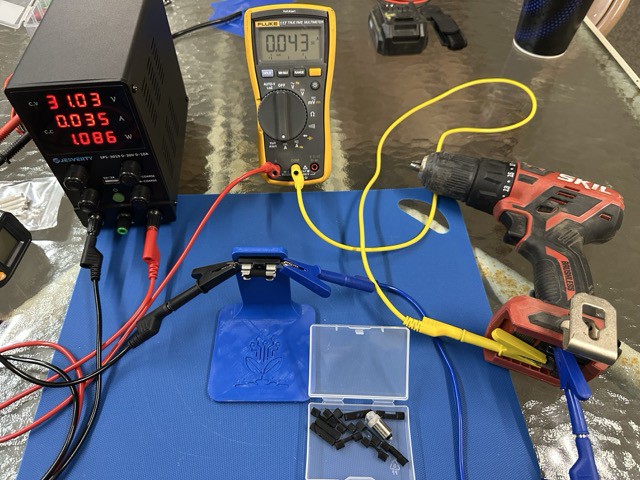
The hollow fuse allowed the most amperage through, but even at over 30 volts I barely got the led on the drill to turn on, let alone make the drill turn.
Just for fun I tried hooking this up in line with my battery on my pickup while starting using some jumper cables, and still not enough to make a meaningful impact on the fuse, or start the pickup.
I tested the resistance again after leaving it hooked as a ground short on the pickup battery, and while the fuse was not warm (but not cold either), the resistance had increased to just over 600 ohms. It seems that with enough voltage or duration, the fuse heats, and resistance increases with it. With a doubling of resistance within a temperature range I could not even feel, I can only imagine how high the resistance might get if truly heating up.
Now the more interesting piece of this is that the conductive PLA does make for a decent resistor, and if you got your design dialed in well, you could be pretty consistent in the resistance. I could see easily printing resistors for LEDs, buzzers, and a number of other small projects.
Video available at https://www.tiktok.com/t/ZTH3RtNxVDanW-ZAYRm/
-
Resistive Test Results
JohnsonFarms.us • 10/16/2025 at 03:57 • 0 commentsSo the first round of fuses are printed and a quick round of resistance measured with each.
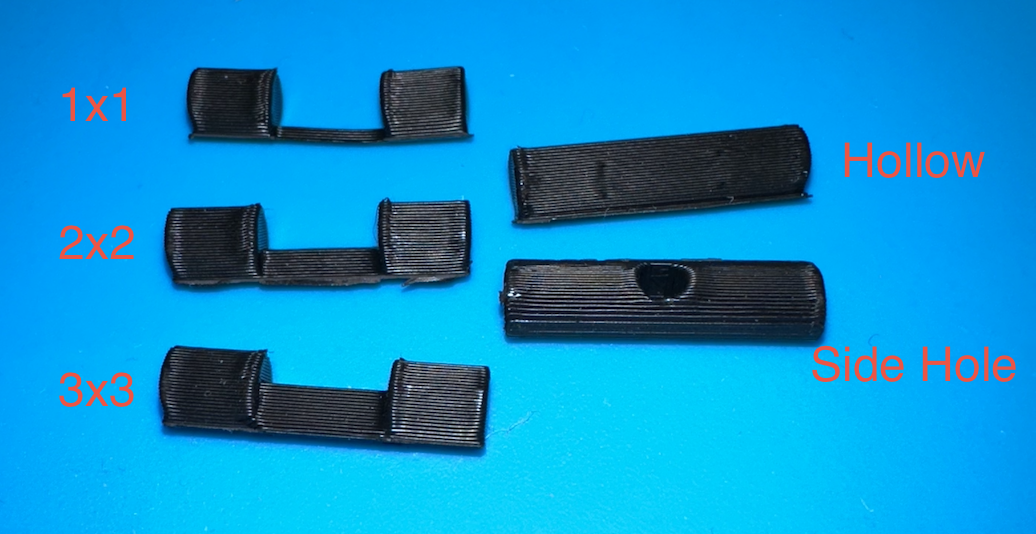
The printing was successful, but done "with brim" to help keep them in place. That said, I am not sure that was necessary, it had been a while since I had used the conductive PLA and I forgot how great the bed adhesion is, it sticks well, really well. So the next round will probably be without brim since the thinner fuses are difficult to separate from the brim without breaking, that and they get a weird flat spot from the brim.
Another note on printing, the fuses need printed horizontal, the conductivity between layers is not as good as within layers, so unless greater resistance is needed stick with horizontal.
For the test each fuse was pulled in and out of the holder 3 times and also wiggled/rotated while it was in it. The results are the average and/or most consistent reading.
All of the following are the 5x20mm barrel fuses, with a descriptor and ohm of the "fuse" portion.
- 1x1x8mm square: 1250 ohms
- 2x2x8mm square: 500 ohms
- 3x3x8mm square: 350 ohms
- 3x8mm hollow: 300 ohms
- 3mm perpendicular hole: 300 ohms
Obviously these are quite high for a fuse, but we are already down this rabbit hole so lets keep going.
Discussions
Become a Hackaday.io Member
Create an account to leave a comment. Already have an account? Log In.

crun wrote 10/20/2025 at 05:00
The side hole version could be constructively packed with potassium chlorate or nitrate powder to more reliably clear the circuit. (Potassium permanganate would also offer a handy wireless indicator function).
21st century man might choose sodium bicarbonate.