Update 01-29-2026: This project is still active! See https://ei2030.github.io/FemtoTX/ for details. https://github.com/EI2030/Low-power-E-Paper-OS Building a consensus on a postage stamp-sized ATX standard with: 1. Solar Power & Battery Management https://www.tindie.com/products/jaspersikken/solar-harvesting-into-lithium-ion-capacitor/ 2. MCU & Memory PCB Design: https://www.sparkfun.com/products/15444 "And runs at less than 1mA" https://www.tsmc.com/english/dedicatedFoundry/technology/logic/l_22nm https://www.cmc.ca/globalfoundries-22fdx-fdsoi-22-nm/ 3. Linux/RTOS software development-- https://github.com/hatonthecat/linux_distro_tests https://github.com/kragen/dernocua/blob/master/text/energy-autonomous-computing.md 4. E-paper/Reflective Display driver (larger screens sought!) https://www.youtube.com/watch?v=BD4At2-e87E SHARP Memory in Pixel 4.4"
1-29-2026 This project is seeking linux & hardware developers: https://ei2030.github.io/FemtoTX/#about
7-28-2025 The OLPC that wasn't:
6-2-2025 https://ei2030.github.io/FemtoTX/ for project updates and landing page
4-22-2025 Update
https://nlnet.nl/news/2025/20250422-announcement-grants-CommonsFund.html
"42 Free and Open Source Projects Receive Funding to Reclaim the Public Nature of the Internet
It is wonderful to see the growing number of people working on digital commons, inventing and improving technologies to the benefit of all humanity. 42 of such projects have been selected for funding in the October call of the NGI Zero Commons Fund. In terms of applications, it was the largest call round in NGI Zero's life time. And we'd like to take this space to thank all applicants for their contributions to an internet for people rather than for profit.
From solar powered motherboards to a new high performance filesystem
The selected projects all contribute, one way or another, to the mission of the Commons Fund: reclaiming the public nature of the internet. For example, there are people working on interesting open hardware projects such as the tablet MNT Reform Touch and the Solar FemtoTX motherboard — a collaborative effort to create an ultra-low power motherboard that can run on solar power. LLM2FPGA aims to enable running open source LLMs locally on programmable chips ("FPGAs") using a fully open-source toolchain. bcachefs readies itself as the next generation filesystem for Linux, improving performance, scalability and reliability when compared to legacy filesystems."
7-12-2024
Brainstorming Draft Specs to develop "FemtoTX" and "AttoTX" form factor
https://en.wikipedia.org/wiki/Small_Form_Factor_Special_Interest_Group
"FemtoTX" (fTX) could be used for tablets and laptops, whereas "AttoTX" aTX) could be for cell phones, and at least small enough to be in a keycard or usb drive. Though there could be an overlap so that attoTX can also fit on a femtoTX mounting holes (similar to mini-ITX fitting on 4 of 9 Micro holes.
| micro | μ | 10−6 | 0.000001 | 1873 |
| nano | n | 10−9 | 0.000000001 | 1960 |
| pico | p | 10−12 | 0.000000000001 | |
| femto | f | 10−15 | 0.000000000000001 | 1964 |
| atto | a | 10−18 | 0.000000000000000001 |
from:
https://en.wikipedia.org/wiki/Metric_prefix#List_of_SI_prefixes (chosen for easy reference/continuity, rather than arbitrarily small form factor concept)
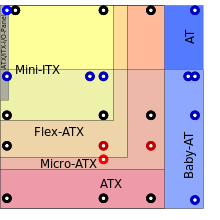
"The Mobile-ITX form factor was announced by VIA Technologies at Computex in June, 2007. The motherboard size of first prototypes was 75 × 45 mm (3.0 × 1.8 in).[2] The design was intended for ultra-mobile computing such as a smartphone or UMPC."
https://en.wikipedia.org/wiki/Mobile-ITX
| Embedded |
|
|---|
60mm is 2.3622" and that might be too large for a mobile phone at least for a square dimension. 40x40mm = 1.57x1.57" and might be simpler for a smaller form factor, but perhaps too small for femtoTX and too large for attoTX.
The Sparkfun Nano, for example (see pictures) is 49mmx21mmx7mm (1.92"x0.82"x0.27"):
https://www.distrelec.biz/en/redboard-artemis-nano-development-board-76v-sparkfun-electronics-dev-15443/p/30160886 Narrow and thin enough to fit in a phone and long enough for additional headers. A boxier one would not as flexible with most cell phones (as 1.9 wide would leave little space for the side of the cell phone. Two mounting holes could be used, however, and doubling the width to 50x50mm or 49x49mm might be ideal for femtoTX,...
eDRAM and Pentium class.PNGhttps://www.techrxiv.org/doi/full/10.36227/techrxiv.174060159.95599671/v1 "A Heuristic Method for Designing Solar Circuits" Portable Network Graphics (PNG) - 114.94 kB - 04/18/2026 at 02:50 |
Preview | |
1nm chip.pnghttps://inavoyage.blogspot.com/2026/01/the-nm10-chipset-backporting-to-pentium.html 1mm^2 chip (2-3nm) Portable Network Graphics (PNG) - 260.11 kB - 04/18/2026 at 01:13 |
Preview | |
|
Copilot_20250902_125257.pngPortable Network Graphics (PNG) - 2.62 MB - 09/03/2025 at 00:40 |
Preview | |
|
_1bf6751e-251c-4474-ba9f-65cec0070e23.jpgJPEG Image - 129.92 kB - 09/03/2025 at 00:40 |
Preview | |
|
_dbefa4a0-6d8d-47ed-aafb-32a3618c5625.jpgJPEG Image - 202.11 kB - 09/03/2025 at 00:40 |
Preview | |
-
computer rendered concept designs
Giovanni • 09/04/2025 at 16:22 • 0 comments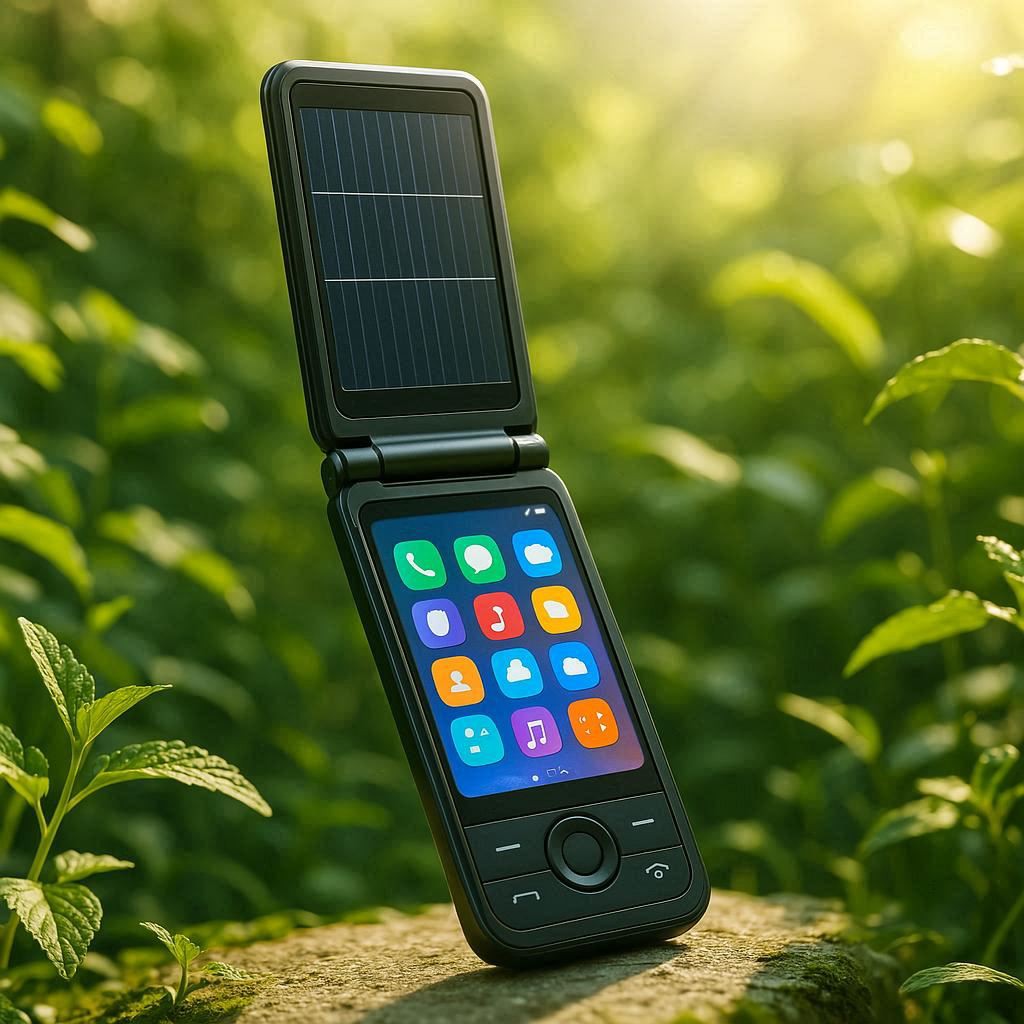
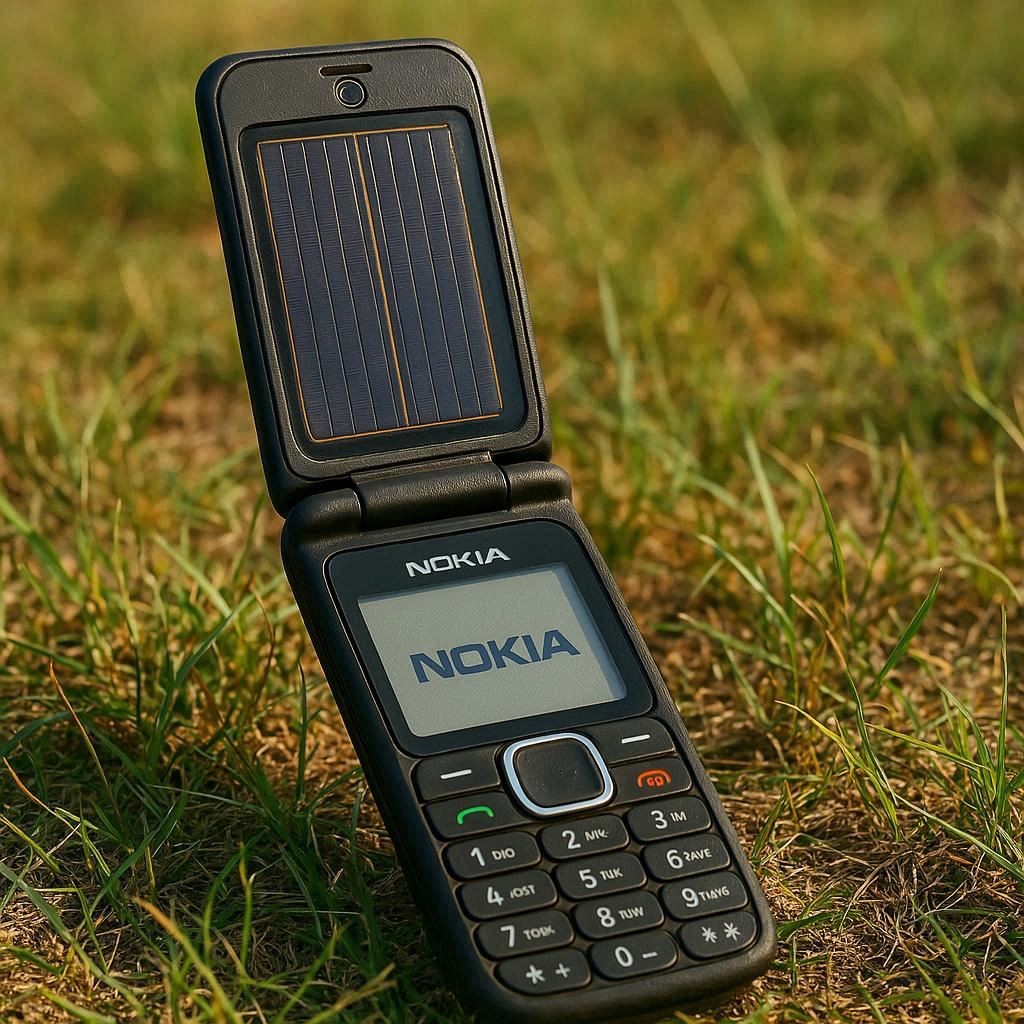
some new concepts (only the last photo seems practical)
-
06-02-2025 Update
Giovanni • 06/02/2025 at 13:08 • 0 commentsVedula has completed synthesis of a ZAP processor (ARMv5T) on an Artix A7!:
Vedula's notes:
"Please see Save/ dir for Synthesis report.
Added a separate Readme for convenience."
syn_timing.rpt
| Design : zap_top
| Device : 7a75t-csg324
| Speed File : -3 PRODUCTION 1.23 2018-06-13
| Design State : SynthesizedXC7A75T-1CSG324C
-
Thought Experiment
Giovanni • 09/21/2024 at 19:34 • 0 commentshttps://github.com/hatonthecat/Solar-Kernel?tab=readme-ov-file#copenhagen
The theory, analogy, and metaphor is- solar powered computers are possible, but most have just not realized there was a calculation to be made. (From Copenhagen, 2002, BBC4)
![]()
-
Lithium Ion Hybrid Capacitor Circuit & LED Test
Giovanni • 08/28/2024 at 14:51 • 0 commentsI successfully tested the Ymin 10mAh, 20 Farad lithium capacitor- it runs continuously and it hasn't been recharged since I received it. Next step is testing a variable resistor, a potentiometer which is pictured in the 1st and 3rd videos to toggle the dimness. I also tested positively a 12V car W5W "dome" LED light that I bought from eBay in 2017 - a 10 pack for $0.99- unsure what kind of voltage it uses (when connected to this breadboard), but similar ones use around 0.2Watts. Green LEDS (not the tinted aspect) use the least power, though using green for everything isn't always preferred.
-
Testing a 20F, 10mAh Lithium Ion Hybrid Capacitor
Giovanni • 08/26/2024 at 04:06 • 0 commentsBeing so risk-averse when it comes to testing circuits, electricity is easier written about than tested. That said, I try to make time for actually devising miniscule experiments that test at least one or two things. I am also a very slow learner- I tend to accumulate a ton of idle knowledge and rarely organize the information towards something I actually can see a use for testing (and towards developing a more complex test or build!). The terms "move fast and break things" and "fail fast" doesn't interest me, or at least when it comes to testing circuits, as opposed to carpentry or metalworking (which I never do). Not only that, but "move fast and break things" is counterproductive for circuits at best and dangerous at worst. For this video, I was only able to test one thing- voltage. Granted, I also had an unused multimeter that I only tested once in 2021, and had been wanting to get some use out of it. Not to mention the breadboard and solar power managers that I have laying around in a box. But one step at a time- While the breadboard is pictured, it is not tested in this video. That will come next, once I figure out how to wire the minimum circuit necessary to light the red LED.
A positive result was that the voltage test resulted in a reading of 3.60V, of which the LIC is rated 3.8V. Not sure if that is less than par, or it is just less than 100% charged. Or something like that. The margin of error is somewhere between 0.5-1%, not enough to result in an incorrect reading of 5% margin error:
|Automatic ranging TRMS 6000 count
AC voltage: 6V/60V/600V (±1.2% + 5d), 750V (±1.5% + 5d)
DC voltage 600mV/6V/60V/600V(±0.5% + 5d), 1000V (±1.0% + 5d)
AC current 6mA/60mA (±1.0% + 10d), 600mA (±1.5% + 10d), 20A (±2.5% + 10d)
DC current 60μA/6mA/60mA (±0.8% + 10d), 600mA (±1.2% + 10d), 20A (±2.0% + 10d)
Capacitance: 6nF/60nF/600nF/6μF/60μF/600μF (±3.0% + 5d), 6mF/100mF (±5.0% + 10d)
Resistance: 600Ω(±0.8% + 10d), 6kΩ/60kΩ/600kΩ/6MΩ(±0.8% + 3d), 600MΩ(±1.2% + 10d)
Frequency: 100Hz/1000Hz/10kHz/ 100kHz/1MHz/10MHz (±1.0% + 3d)
Duty ratio: 1%~99% ± (1.0% +2d)
Temperature: -20℃-100℃ -4℉- 1832℉ (± 1.0% + 3)
Diode test, Continuity test, Good Sensitivity of NCV sensor
Full range overloaded protection, Data hold, Live test
Auto Shutdown: 15 minutes
Backlight and flashlight|
https://www.lcsc.com/product-detail/Lithium-Ion-Capacitors_Ymin-SLA3R8L2060813_C970391.html
Multimeter User UA19B guide: https://drive.google.com/file/d/1uLc5ZH09o1W1XA3oQ490vOcm_m7ylSJ0/view
https://www.amazon.com/gp/product/B08BRG4XN2/ref=ppx_yo_dt_b_search_asin_title?ie=UTF8&psc=1
There are some great tutorials on breadboards:
If I haven't posted a project log in a while, it's probably because I'd like to have something more substantial to showcase in a video than a single test. But I'm ok with that too.
Note: the 9V multimeter battery is being replaced very soon! It will be interesting to discover whether the low battery level was causing a 5-6% measurement error rate, which would suggest it is actually 3.8V...
----
An English version of the data sheet can be viewed here:
https://en.sekorm.com/doc/2768518.html
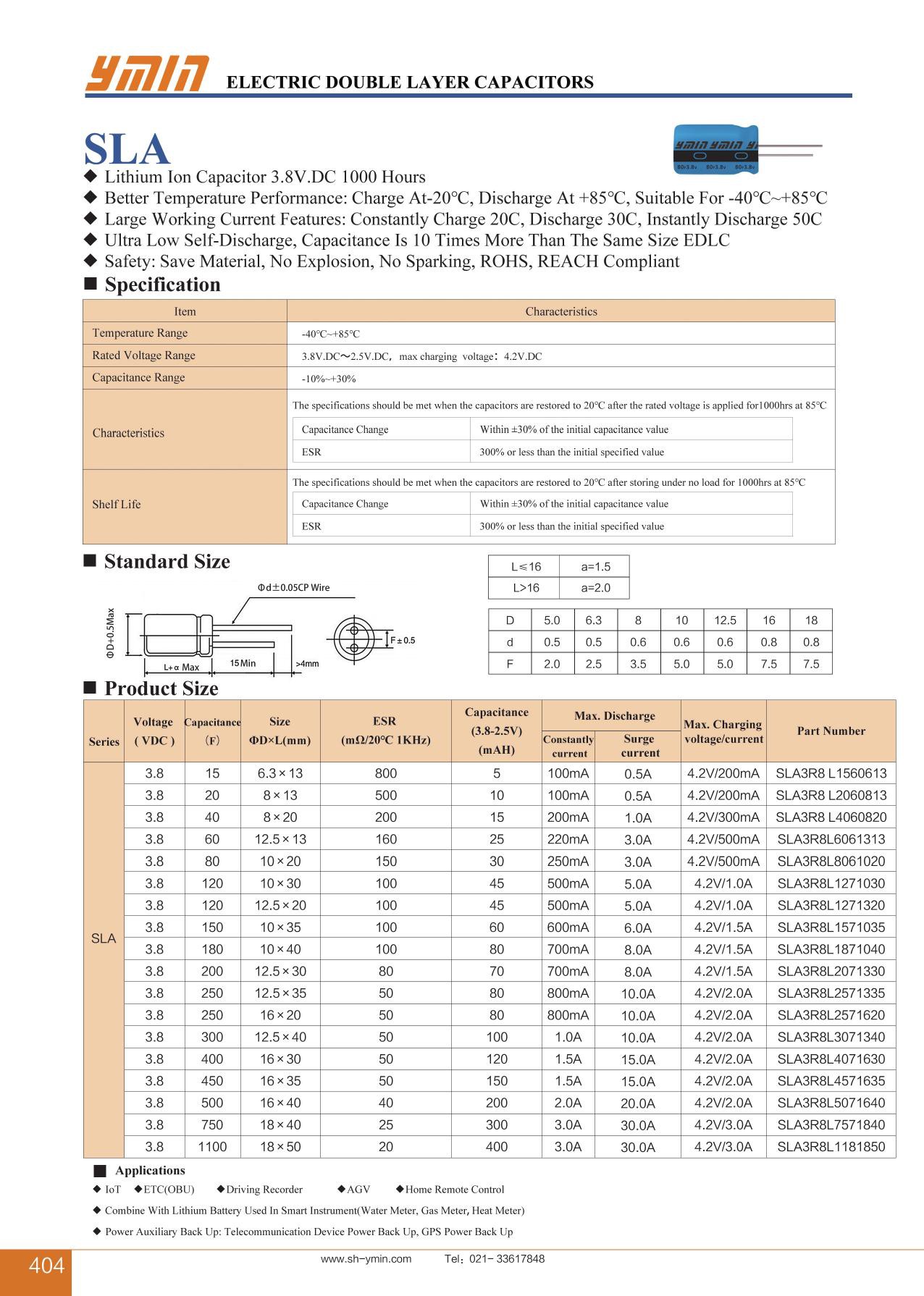
"The SLA3R8L2060813 from Shanghai Yongming Electronic is a Supercapacitor with Capacitance 20000 mF, Voltage Rating 3.8 V, Equivalent Series Resistance 500 mOhms, Temperature Operating Range -40 to 85 Degree C. Tags: Through Hole. More details for SLA3R8L2060813 can be seen below.
Product Specifications
Product Details
- Part Number SLA3R8L2060813
- Manufacturer Shanghai Yongming Electronic
- Description 20000 mF,...
-
Steve Jobs' 1984 Macintosh, & Why Designing a Solar Powered Laptop integrates New Tech the same way.
Giovanni • 10/02/2023 at 19:54 • 0 comments -
Review of project status (and some history of telecommunications)
Giovanni • 10/01/2023 at 02:48 • 0 comments -
Adapted Pi-Top for solar panel by replacing display cable outlet for DC cable
Giovanni • 03/20/2021 at 13:17 • 0 commentsWas able to fit a 5" screen in Pi-Top v3, thus considering use as a cyberdeck instead of main panel.
-
Solar powering Ambiq Micro Apollo3
Giovanni • 03/17/2021 at 16:14 • 0 comments -
Powering the 5mW Artemis Nano fully on a 10.5 Phillips LED
Giovanni • 03/09/2021 at 05:04 • 0 commentsGot my Artemis Nano to power on completely with a 10.5W LED, far less than the 45W Cowboy Studio CFL I was using with the 2V, 160mAh panel in my previous log . Since the bluetooth LED is is blinking, it must be using around 5mW, which is probably not very efficient, although it is the only way I can connect [using an Adafruit Universal USB / DC / Solar Lithium Ion/Polymer charger w/ TI BQ24074) the 5W panel to the USB-C input of the Artemis Nano at the moment. Some efficiency loss is likely, since it travels through the 500mA boost converter.
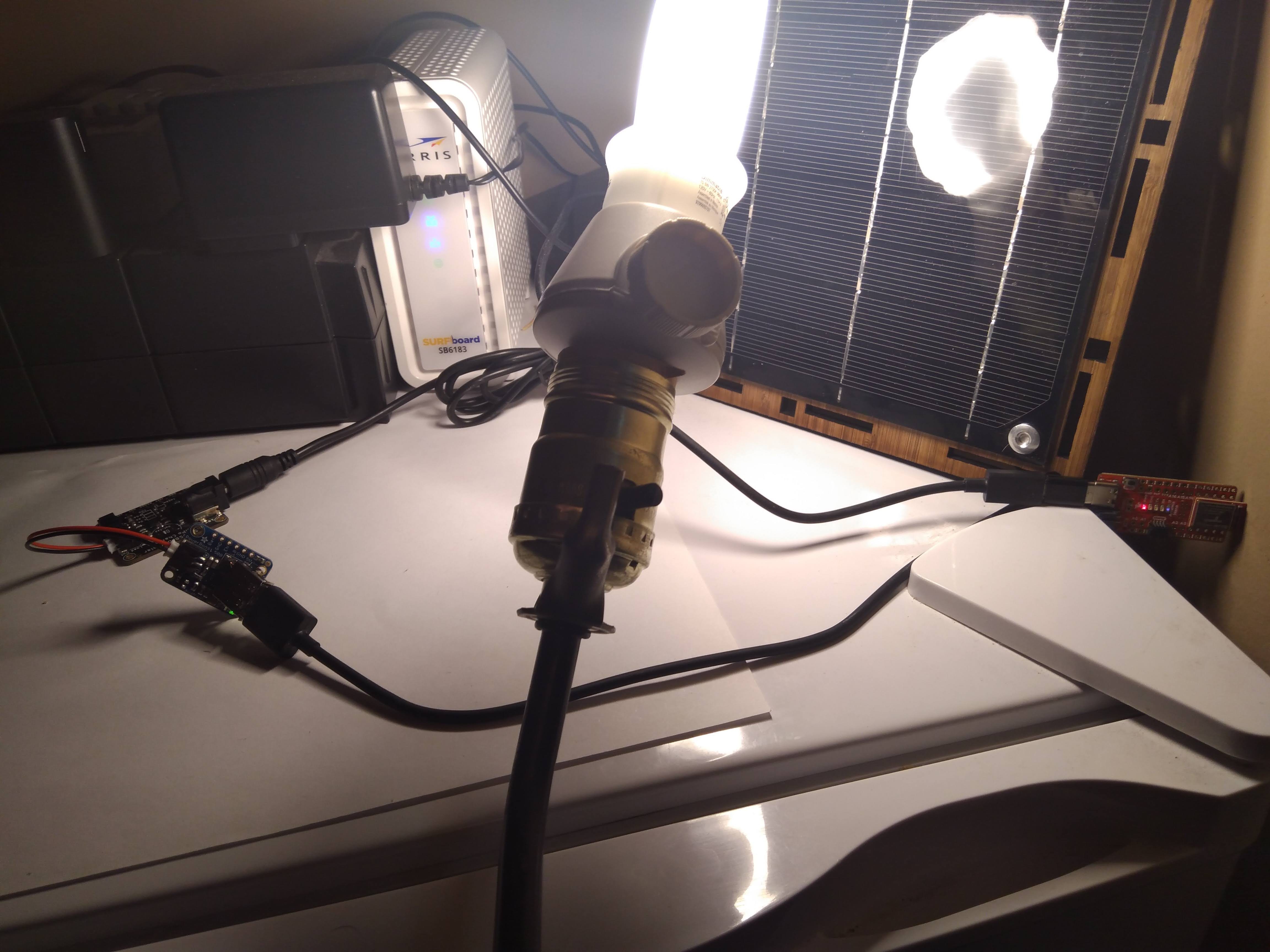
Later I put the lampshade back on the Philips and was able to get a red LEDd, but it took a while for current to flow through the entire circuit. With some efficiency improvements (i.e soldering the 500mV boost and panel placement), it is very likely that the Artemis Nano can be powered in a more ambient condition (i.e not a bulb directly on the panel as in the above photo.)
I’ll also try my Powerfilm Dev-in-Basic w/ BQ25570 development kit sometime.

-
1
Step 1
These are not build instructions but build concepts.
Goal #1: Power a Sparkfun Artemis board on 4 Powerfilm LL200-2.4-75or 3-37 (x2 or x4):
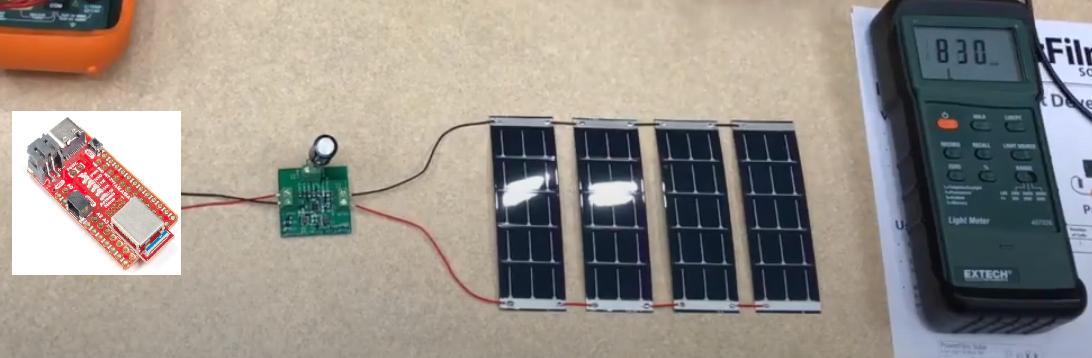
by using:
1. Sparkfun Artemis board https://www.sparkfun.com/products/15443
and
https://www.powerfilmsolar.com/products/development-kits/solar-development-kit (DEV-BASIC)
uses BQ25570 and includes (2) LL200-3-37 Indoor Solar Panel with 6” leads
uses AEM10941 harvester:
- AEM-PF-EVK Dev Kit PCBA (and includes (2) LL200-2.4-37 Indoor Solar Panel with leads)
- a battery can be used in place of the supercapacitor. This image was used to demonstrate the panels can be wired in parallel. Earlier in the video they use a 40mah battery, which could be used here, or a larger one (100mah), for example.
Additional panels can be purchases separately from Digikey & Mouser. Other BQ25570 chargers include Mikroe-2814:
and off-brand BQ25570: https://www.ebay.com/itm/184366178954
A Tindie seller for AES10941 https://www.tindie.com/products/jaspersikken/solar-harvesting-into-li-ion-battery/
Demo:
By accomplishing this goal, it can be demonstrated that not just a bluetooth sensor, but a microcontroller capable of running GUI-based applications on a number of solar panels inside continuously, without relying on sleep programming. The goal of this is to be a computer that one can access and see a stream of emails incoming, and not it have to shut off for long boot up times.
Jasper Sikken, who sells an AEM10941 harvester on Tindie, has said on his project page (Thank you!): https://hackaday.io/project/159139-tiny-solar-energy-module-tsem :
"Jasper Sikken wrote 4 hours ago
You seem to understand my calculations to estimate the amount of daily harvested energy. The AEM10941 input voltage range is max 5V. You need to make sure that the open circuit voltage does not exceed 5V. That often means you need to select 4V or less NOMINAL voltage. Either you put 1 or more 4V solar panels in parallel or put a few lower voltage cells in series. Note that a partial shade on a series string causes the whole string to malfunction. Also note that AEM10941 efficiency drops with solar panel voltage below 1V. So a tradeoff is to select about 2.0V nominal voltage and if you want more power you add more in parallel"
Additional Powerfilm Dev-Kit Review:
-
2
Step 2. Add a display
Power an e-ink or reflective display and the Artemis board connected to the Artemis board's SPI pins using 4-6 panels.
Discussions
Become a Hackaday.io Member
Create an account to leave a comment. Already have an account? Log In.


Giovanni wrote 05/03/2025 at 13:29
Thanks! The Metashunt looks like a great offline solution- and not needing a bulky multimeter. Andreas Eriksen has tested an Artemis board with a Nordic Power Profile Kit- it connects to an app, but provides very detailed current logging. I haven't used current testers them beyond a brief multimeter test, but they certainly have their own advantages.
https://hackaday.io/project/184340-potatop/log/215909-snake

e64 wrote 07/01/2024 at 18:55
please add more ram 512K is ok for start.
and meybe a meshtastic.org / reticulum.network Lora network for emergency communications
Giovanni wrote 07/01/2024 at 20:55
https://www.top-electronics.com/en/apollo3-blue-plus-soc-96-mhz-768kb-bga
https://www.top-electronics.com/en/apollo4-blue-plus-192-mhz-2-75mb-bga
https://www.top-electronics.com/en/apollo510-soc-250mhz-3-75mb-wlcsp
Cool project! When optimizing FemtoTX for low power, my project (and now product) might be helpful to you: https://hackaday.io/project/193628-metashunt-high-dynamic-range-current-measurement
If you're interested, let me know - I'd be happy to share a discount code to support the project!