UPDATE:
Check out the latest updates:
***April 2021
*** Nov. 2020
Class of 2020 had finished. I learned a lot by teaching the class on Sunday since March and digesting complex ideas into drawings. Hope you enjoyed it as much as I did. All the recordings can be found here.
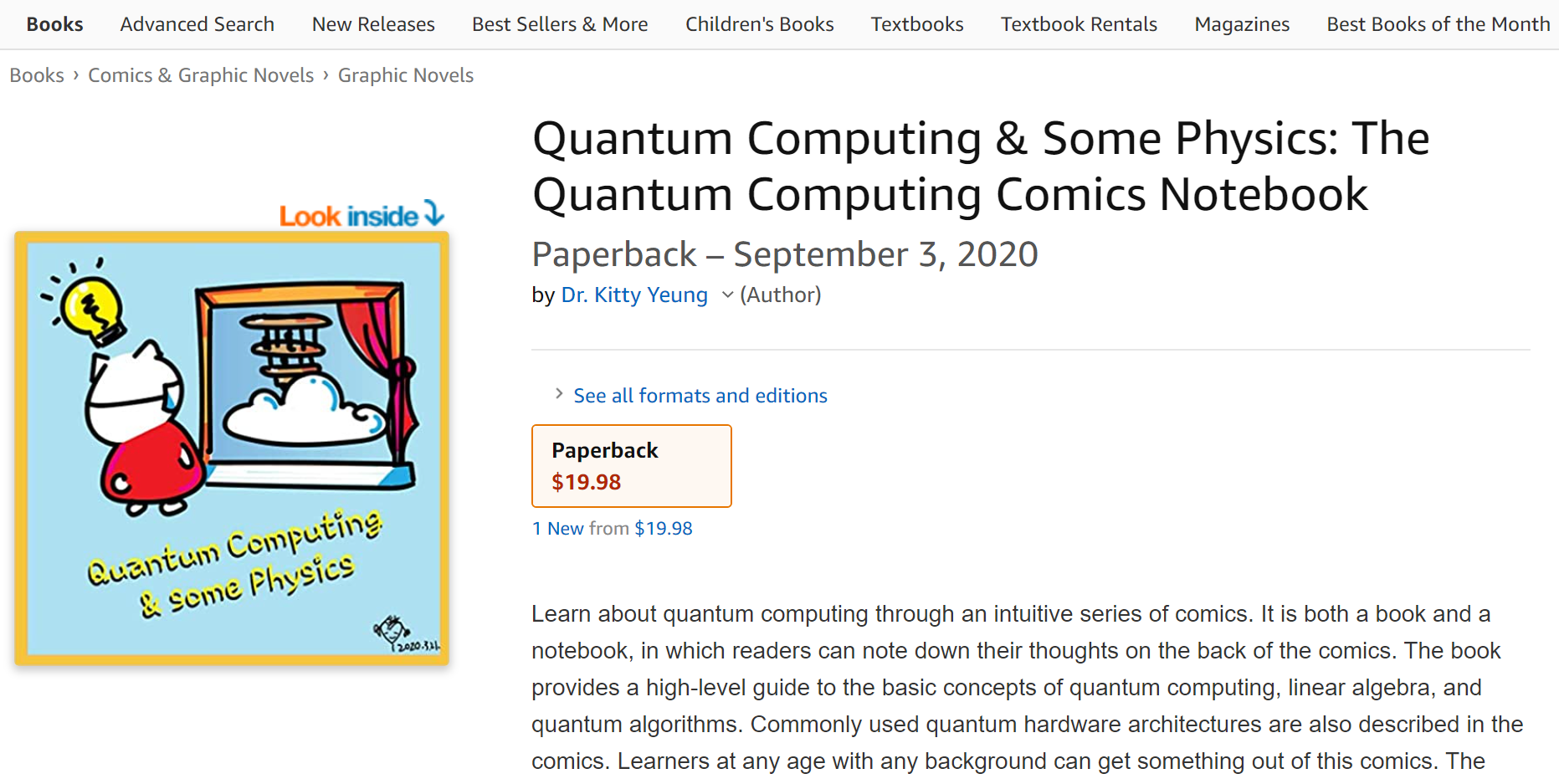
We also have a cartoon "textbook" which can be found in 13 markets on Amazon. Search for ASIN : B08HGLPZXP Quantum Computing & Some Physics
See you in future classes!
***
We discussed a new topic for 30 mins every week. The topic is based on my comics of the week below in the log. You can also follow progress of the drawings on my website, LinkedIn, Twitter, Instagram and YouTube. Hackaday is adding the classes gradually to their channel here: Intro to Quantum Computing playlist
You can send questions and requests in the comments section below. I'll address them in the comics, in the comments or during the class. Past recordings are in the description of the slides under the "Files" areas.
***
Quantum computing has been a hot topic since the past couple of years, especially with recent progress made in industry. However, there hasn't been enough materials to lead hobbyists into the subject, as most books and papers are written for professional academics and media articles are technically shallow. These hobbyists include scientists, engineers, developers and hackers who are highly technical but may not have a background in quantum computing. Even with a PhD in Applied Physics who studied quantum properties of materials, I did not know how quantum computers worked. As I started learning the subject, I realize that one does not need a degree in physics to understand quantum computing. All they need is some necessary math and physics foundations. This subject can be taught in a straightforward way at the right level. Once people know what goes into quantum computing, they will be able to dig deeper and demystify the subject.
As I've been teaching our employees at Microsoft, I've built up a series of systematic materials from basic concepts to algorithms to hardware systems, and a tutorial on Q# (Q-sharp) - a domain-specific programming language used for expressing quantum algorithms. Typically we took a few months to go through all the basic concepts. Every class was followed by a few Q# exercises. But it is do-able for a 2-hour workshop, such as the one at Hackaday Supercon. On November 15, 2019, I gave a workshop on a hands-on introduction to Quantum Computing at Supercon. Here are the slides for everyone. It might felt like a lot to people who encountered the concepts for the first time. But if they go back to the slides now, they'll be able to recall and digest at their own pace. The workshop was also on high demand. We didn't have enough space for more people. So anyone who missed it can take a look at the slides which hopefully can give them directions to study further.
Please feel free to post any questions and discussions in this project page. And any mistakes to correct in the slides. I'll try to answer them here. Enjoy!
***
About the instructor:
Dr. Kitty Yeung, Sr. Quantum Architect at Microsoft Quantum Systems; Producer of MS Learn quantum modules and the Quantum Learning website with customized learning materials; Creator of comic series Quantum Computing through Comics; Lecturer at HackadayU and Microsoft Reactor on Introduction to Quantum Computing; Founder & Designer of sustainable and STEAM fashion brand, Art by Physicist; Creative Technologist & Lead of the Fashion Hack at Microsoft; Public Speaker on quantum computing and fashion tech. Harvard University 15′ Applied Physics; University of Cambridge 10′ Natural Sciences – Physical.
Slides Nov 1.pdfSession 25: Quantum Error Correction by Dr. Michael Beverland Recording: https://youtu.be/5zFpLLaVmAs Adobe Portable Document Format - 1.89 MB - 11/01/2020 at 20:51 |
Preview | |
qcvv_Chris.pdfSession 24: Quantum Tomography by Prof. Chris Ferrie Recording: https://youtu.be/utH6YcaoGTE Adobe Portable Document Format - 887.31 kB - 10/19/2020 at 15:17 |
Preview | |
Slides Oct 18.pdfSession 24: Quantum Tomography by Prof. Chris Ferrie Recording: https://youtu.be/utH6YcaoGTE Adobe Portable Document Format - 1.02 MB - 10/19/2020 at 15:18 |
Preview | |
qml_maria.pdfSession 23: Quantum Machine Learning by Dr. Maria Schuld Recording: https://youtu.be/DGNc0gmtumE Adobe Portable Document Format - 3.57 MB - 10/13/2020 at 09:47 |
Preview | |
Slides Oct 11.pdfSession 23: Quantum Machine Learning by Dr. Maria Schuld Recording: https://youtu.be/DGNc0gmtumE Adobe Portable Document Format - 778.06 kB - 10/11/2020 at 19:44 |
Preview | |
-
Comics: Quantum Computing & some Physics
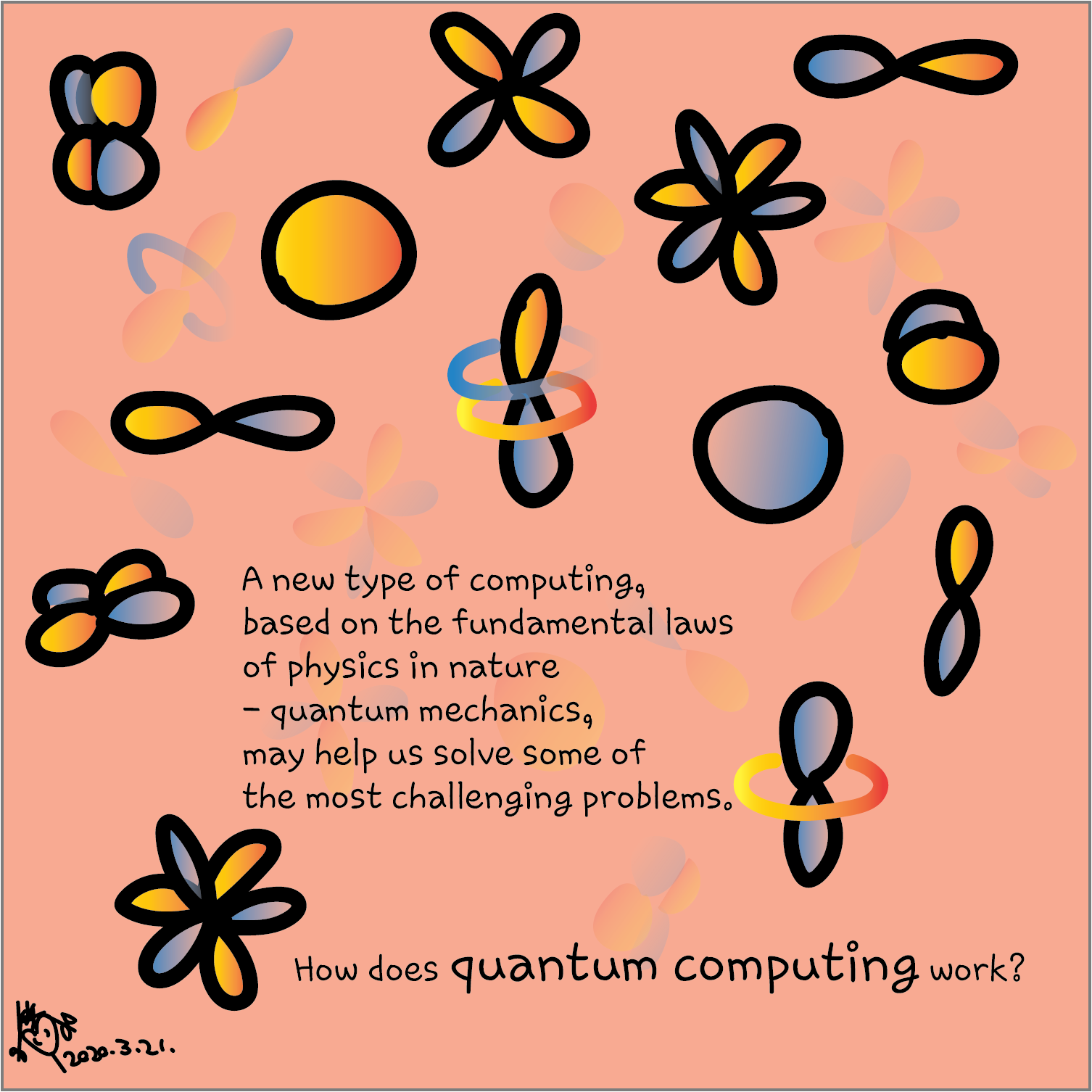
artbyphysicistkitty • 03/22/2020 at 13:06 • 0 commentsIn the mist of the COVID-19 pandemic, I am bummed that I don't have a 3D printer and my sewing machine is still to be shipped from SF to my new home in Germany, with no supplies to join the PPE making :( But to contribute, in addition to donating to non-profits, I want to provide some support to people staying at home, with what I can do the best.
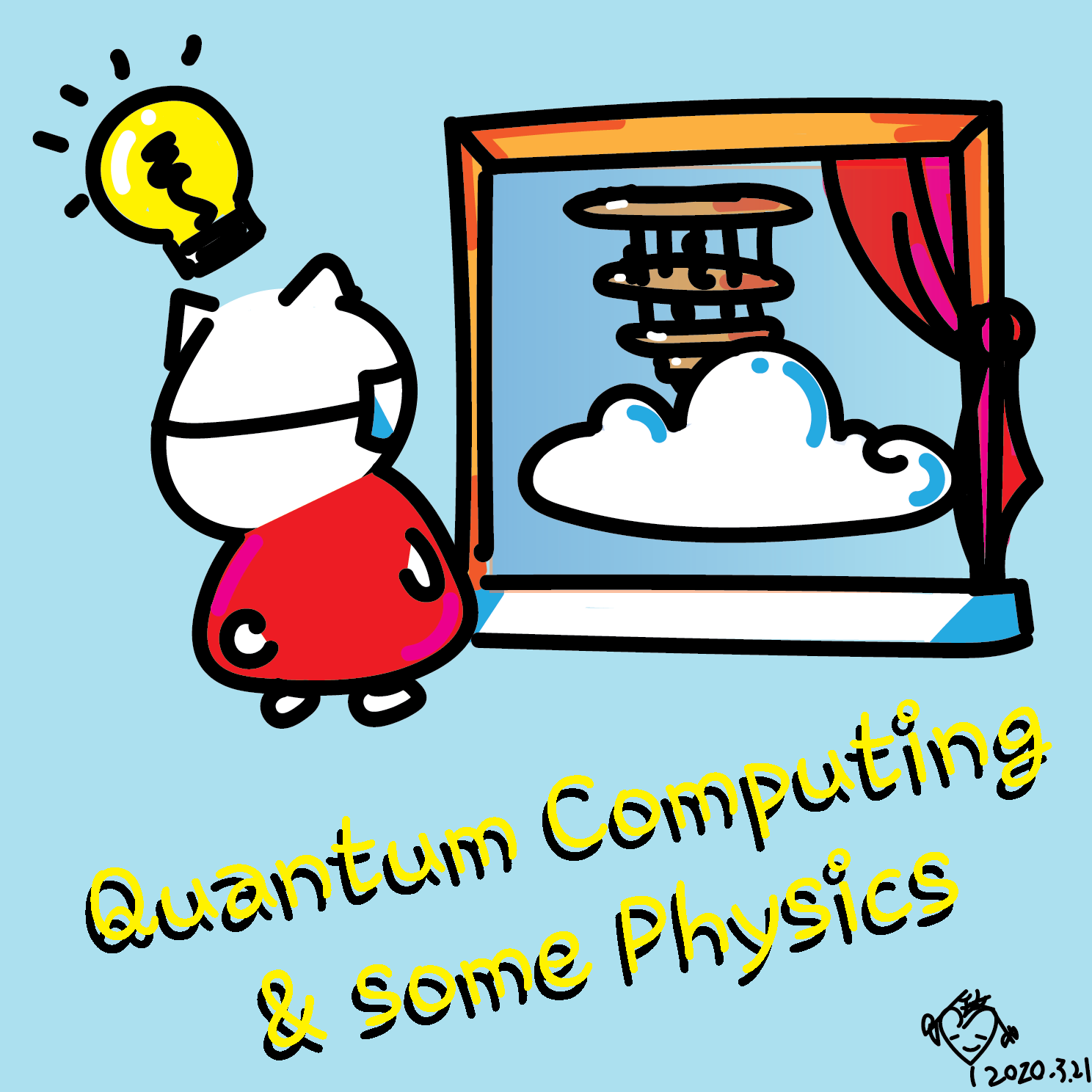
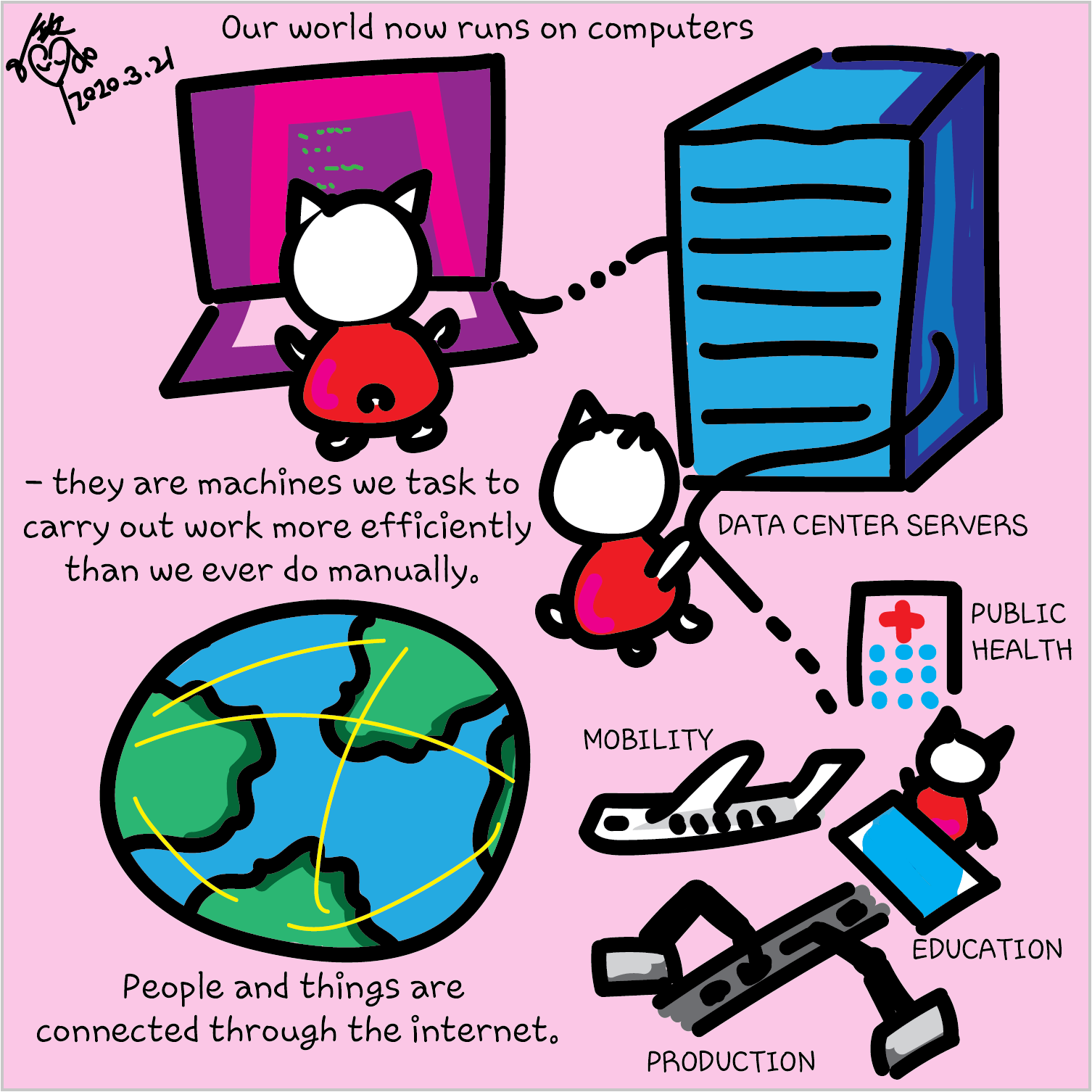
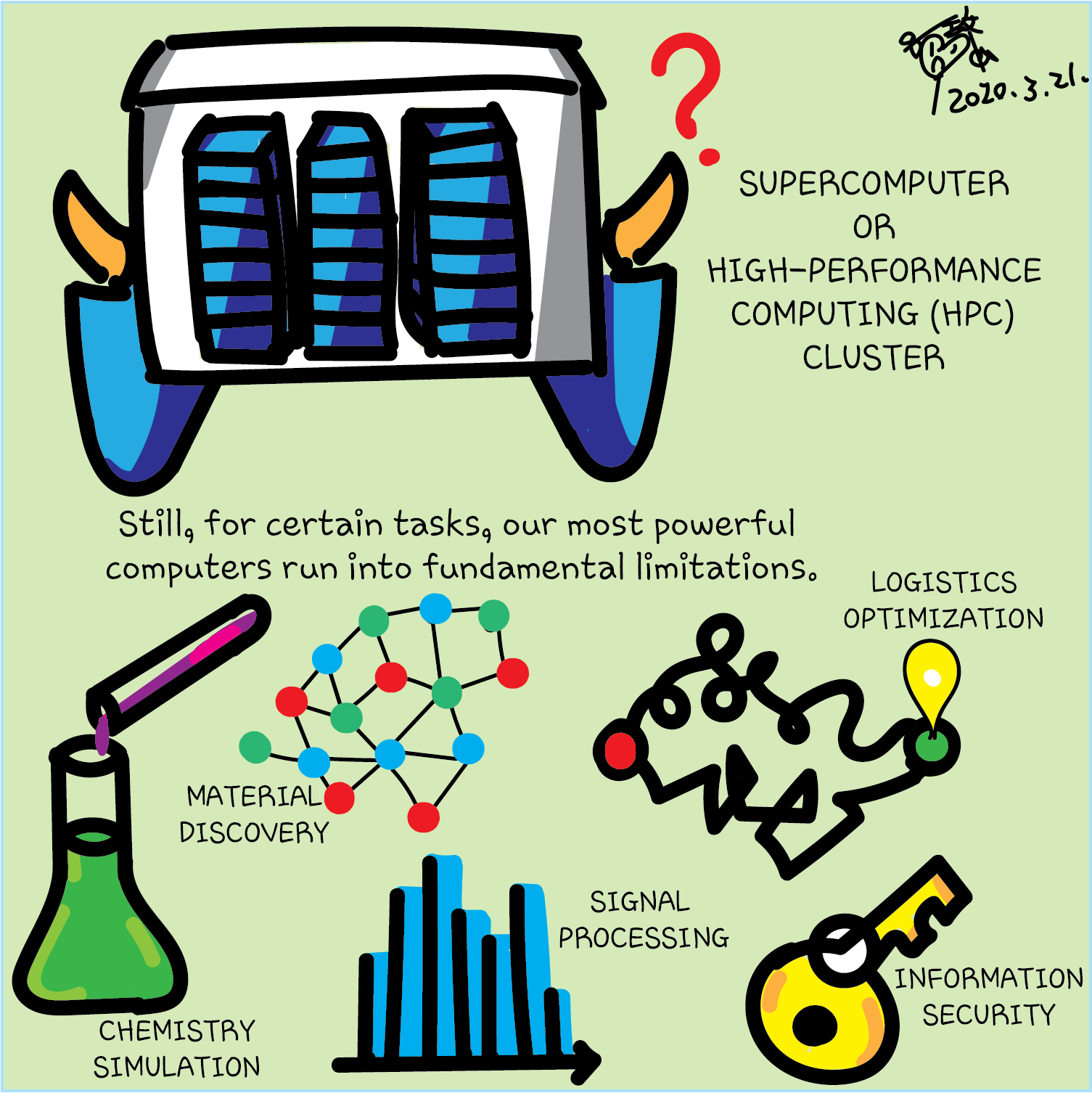
Every Sunday and Wednesday, I'll post a comic about quantum computing and some physics concepts. Watch out here for updates. I'll also post on Twitter, LinkedIn, Instagram and possibly other media. I hope this can be of help for people spending time to learn new things. It will certainly be an exciting challenge for me as well. Feel free to share the contents and discuss in the comments. Also let me know any questions and topics you'd like me to draw.
-
Pages 5 & 6
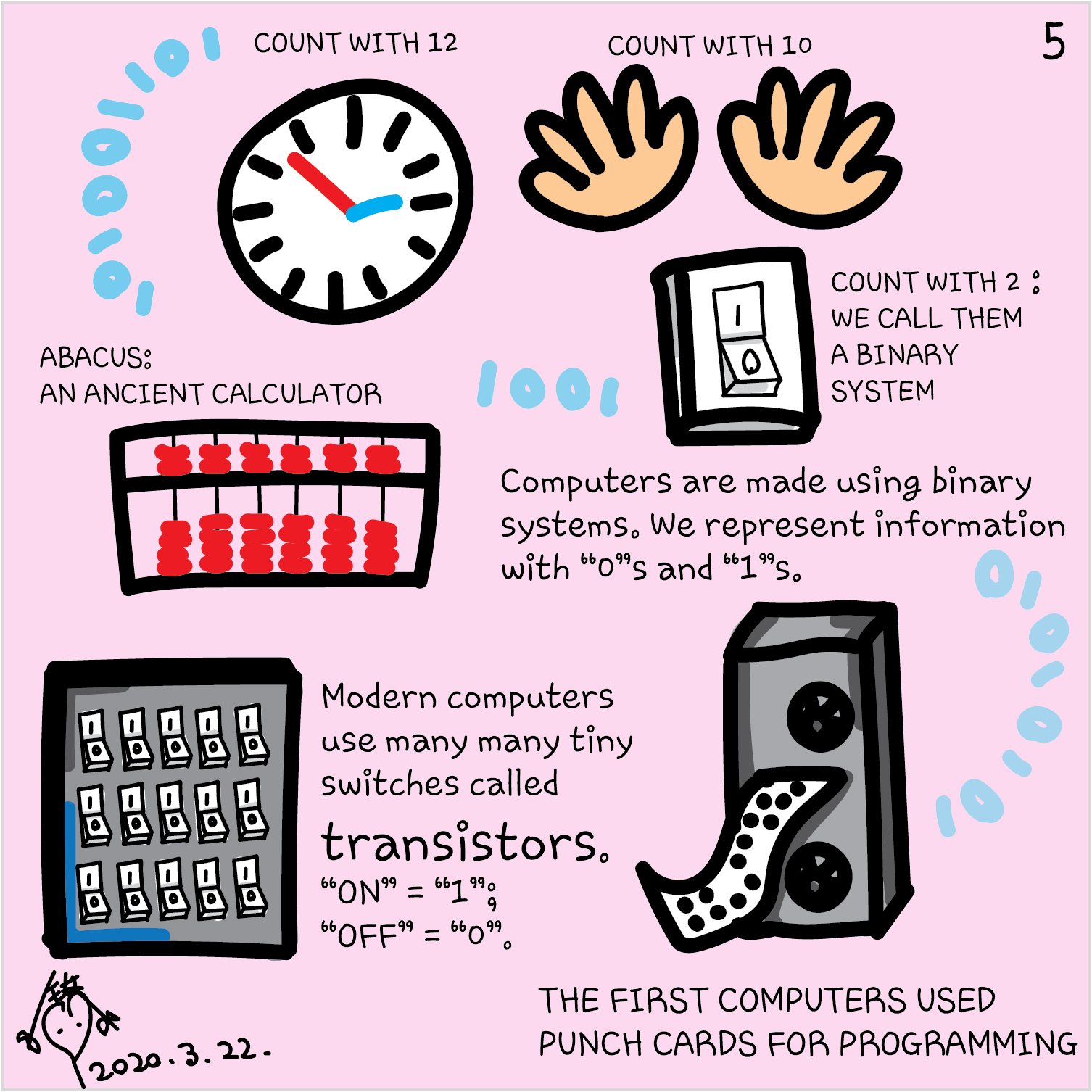
artbyphysicistkitty • 03/25/2020 at 21:21 • 0 commentsFirst Wednesday update. More to come to explain these various concepts.
For interested readers, Wikipedia articles on binary systems, early computers and Ada Lovelace are very good backgrounds.

-
Pages 7 & 8
artbyphysicistkitty • 03/29/2020 at 14:20 • 0 comments(First Sunday update) The contrast between "amplitude" Vs "probability" is very important, which helps build intuition to interpret measurements - will be explained later.


-
Pages 9 & 10
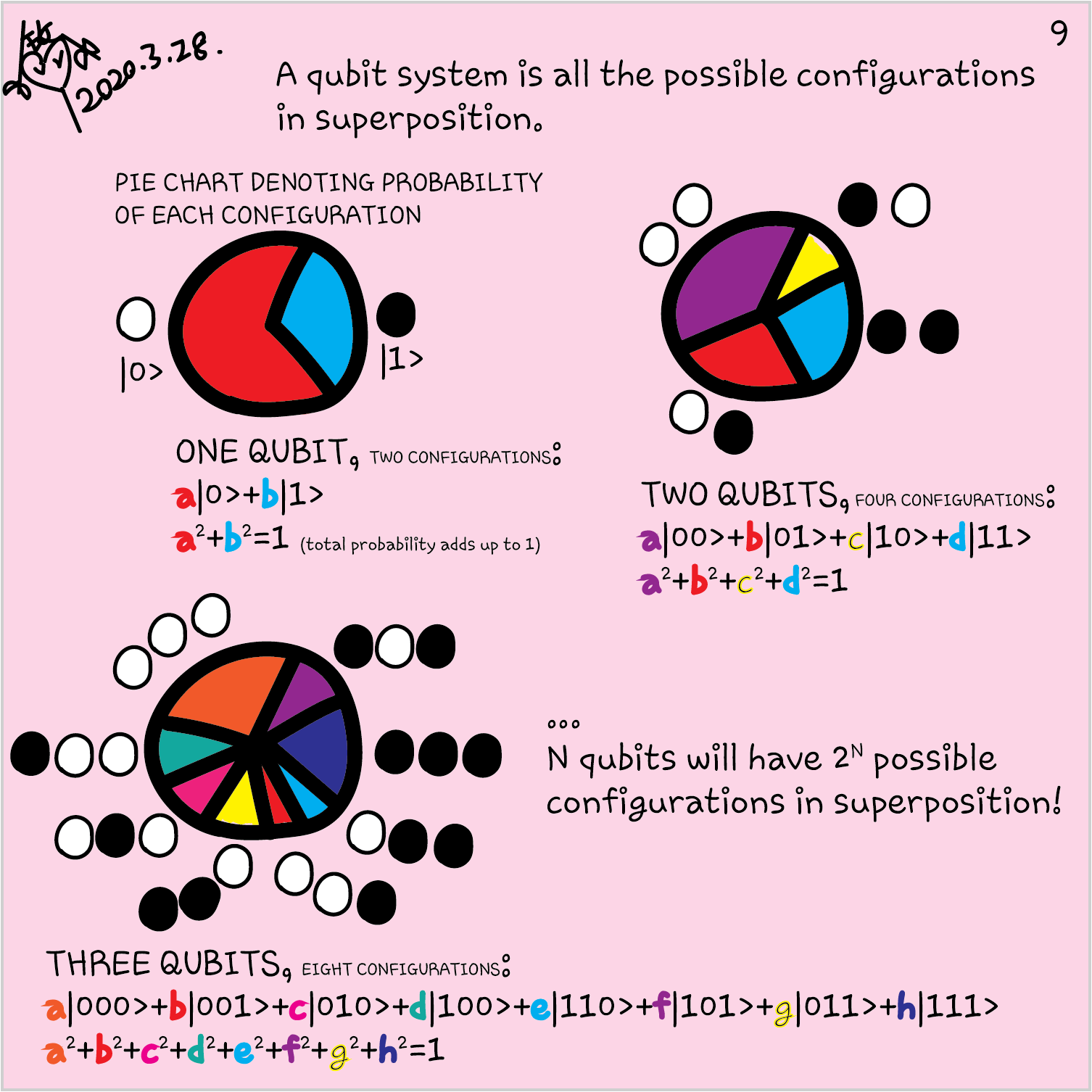
artbyphysicistkitty • 04/01/2020 at 14:28 • 1 commentEmphasizing a bit more on amplitude. What's coming up is very exciting.

-
Pages 11 & 12
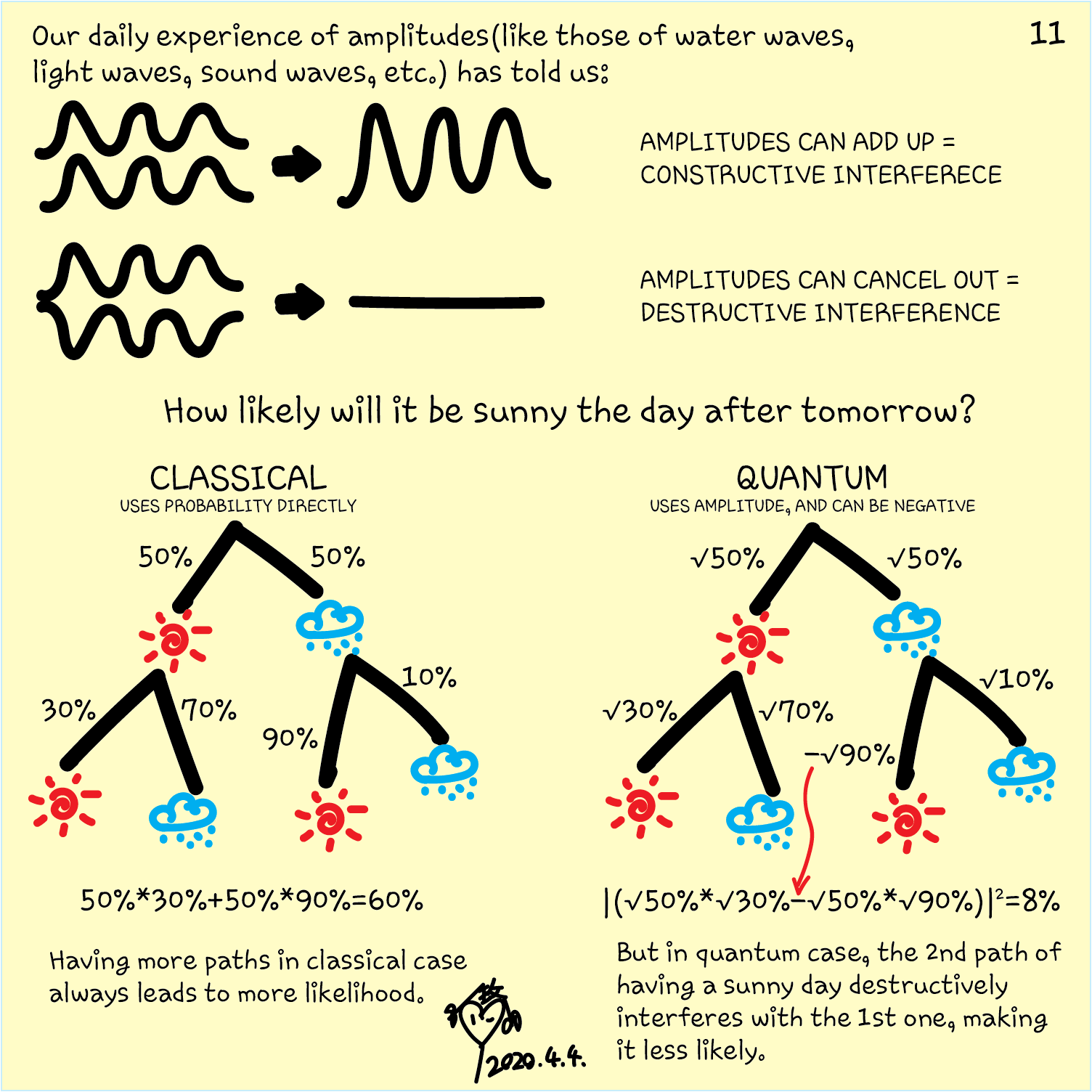
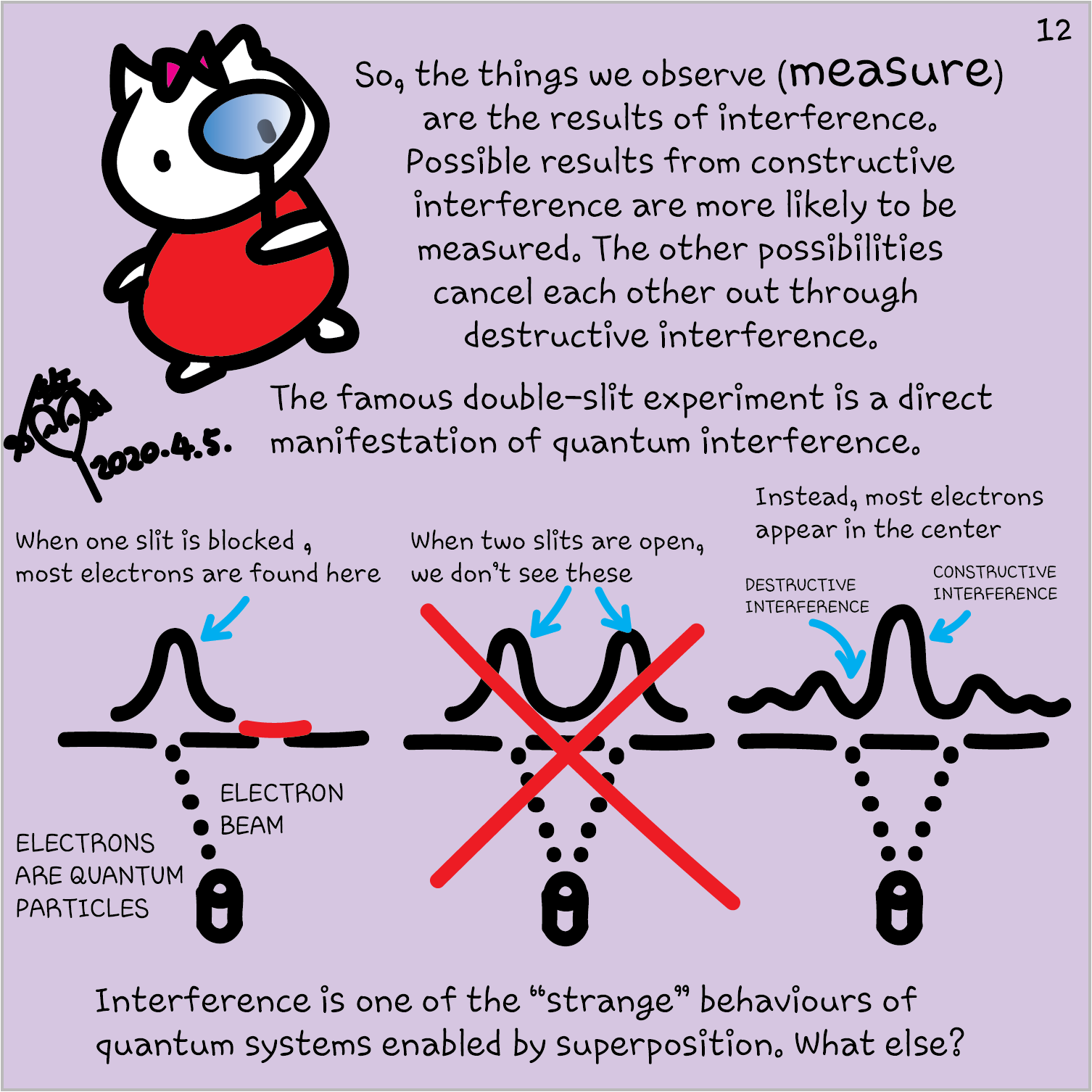
artbyphysicistkitty • 04/05/2020 at 13:23 • 0 commentsQuantum mechanics explained with interference. With all the possibilities in our world, we are just observing the events that are the most likely, resulted from interference!
I should probably make some additional pages on complex numbers. But will prioritize the next few topics that are more urgent.
-
Page 13 & 14
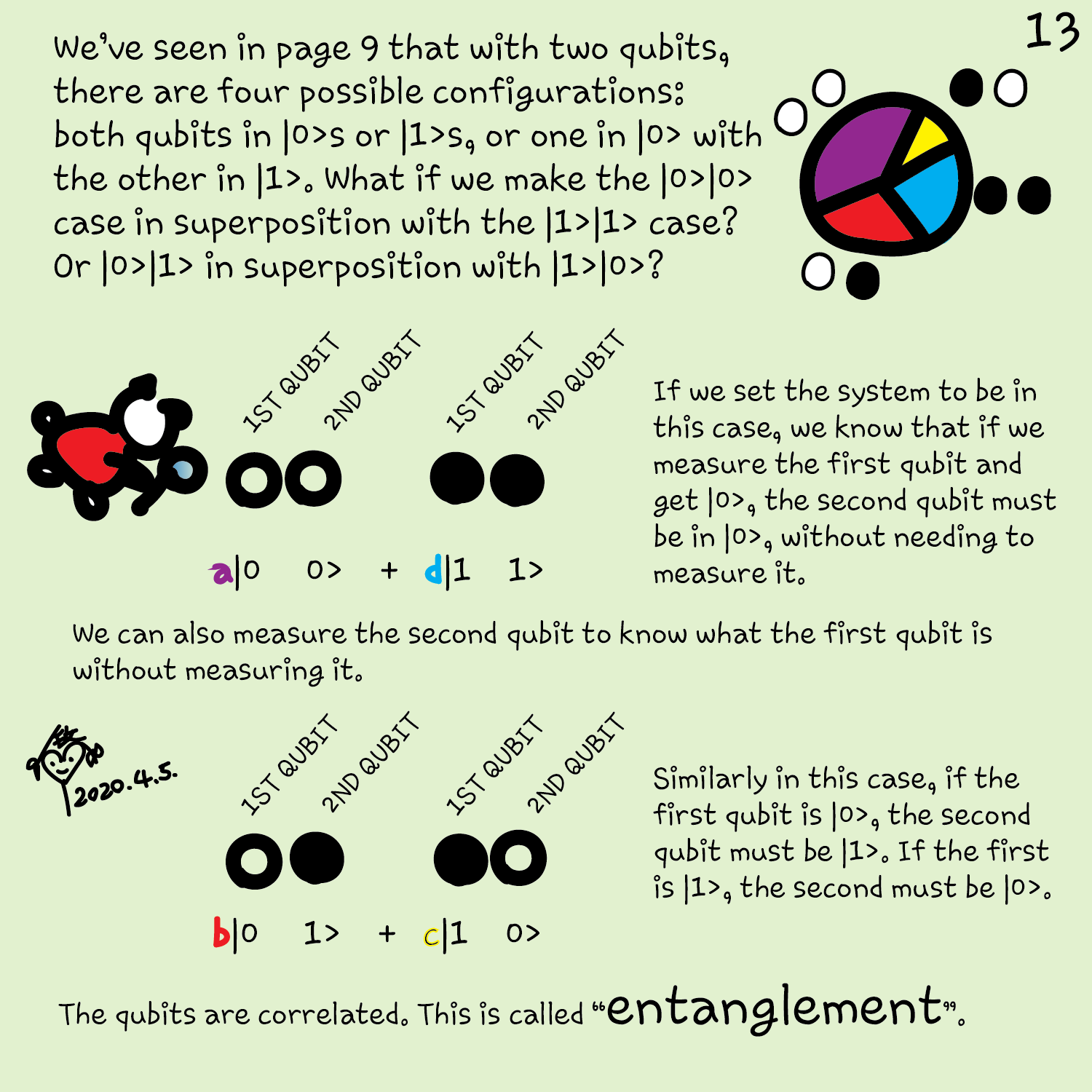
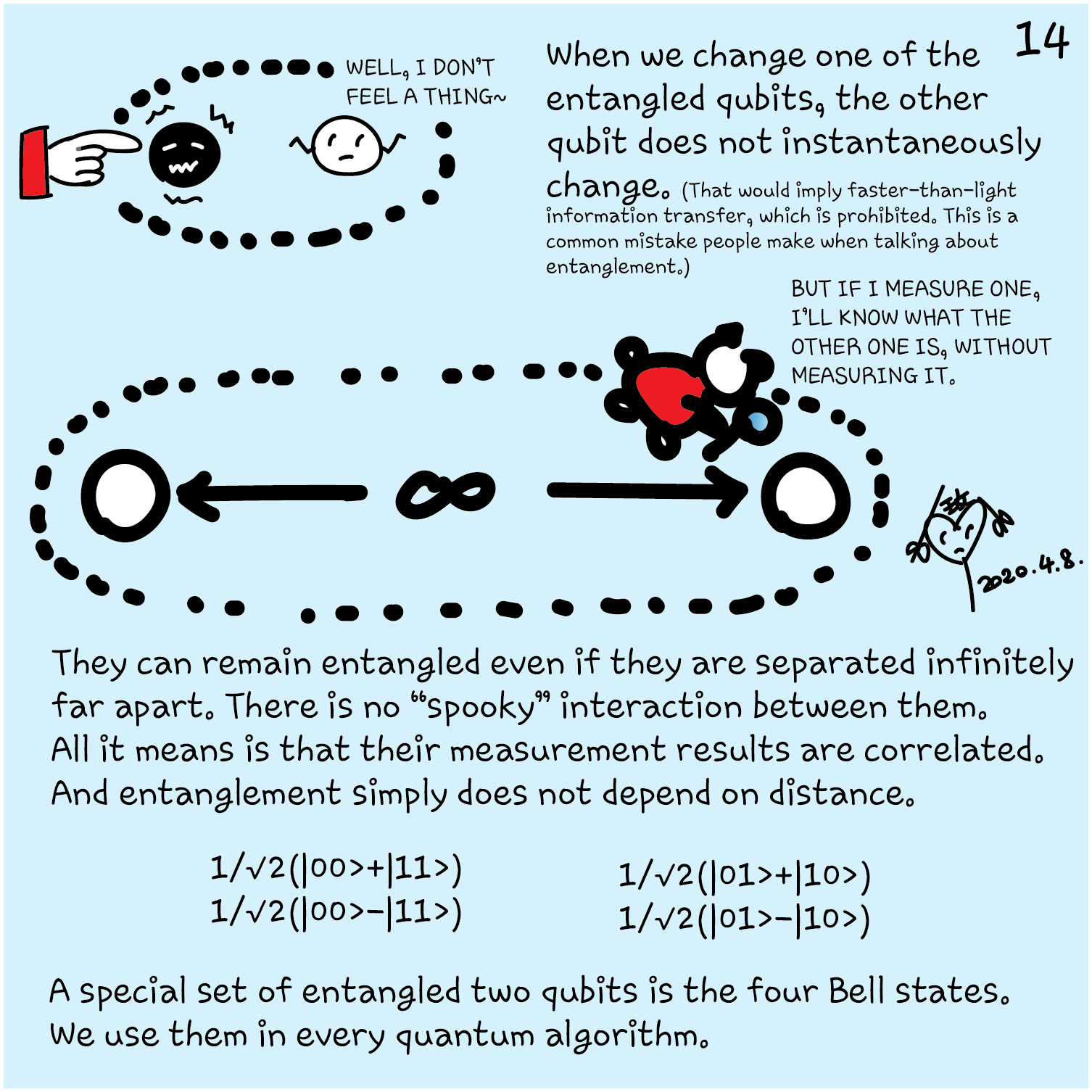
artbyphysicistkitty • 04/08/2020 at 14:30 • 0 commentsSince there's been so much confusion on this entanglement, I'll show what it is NOT.
-
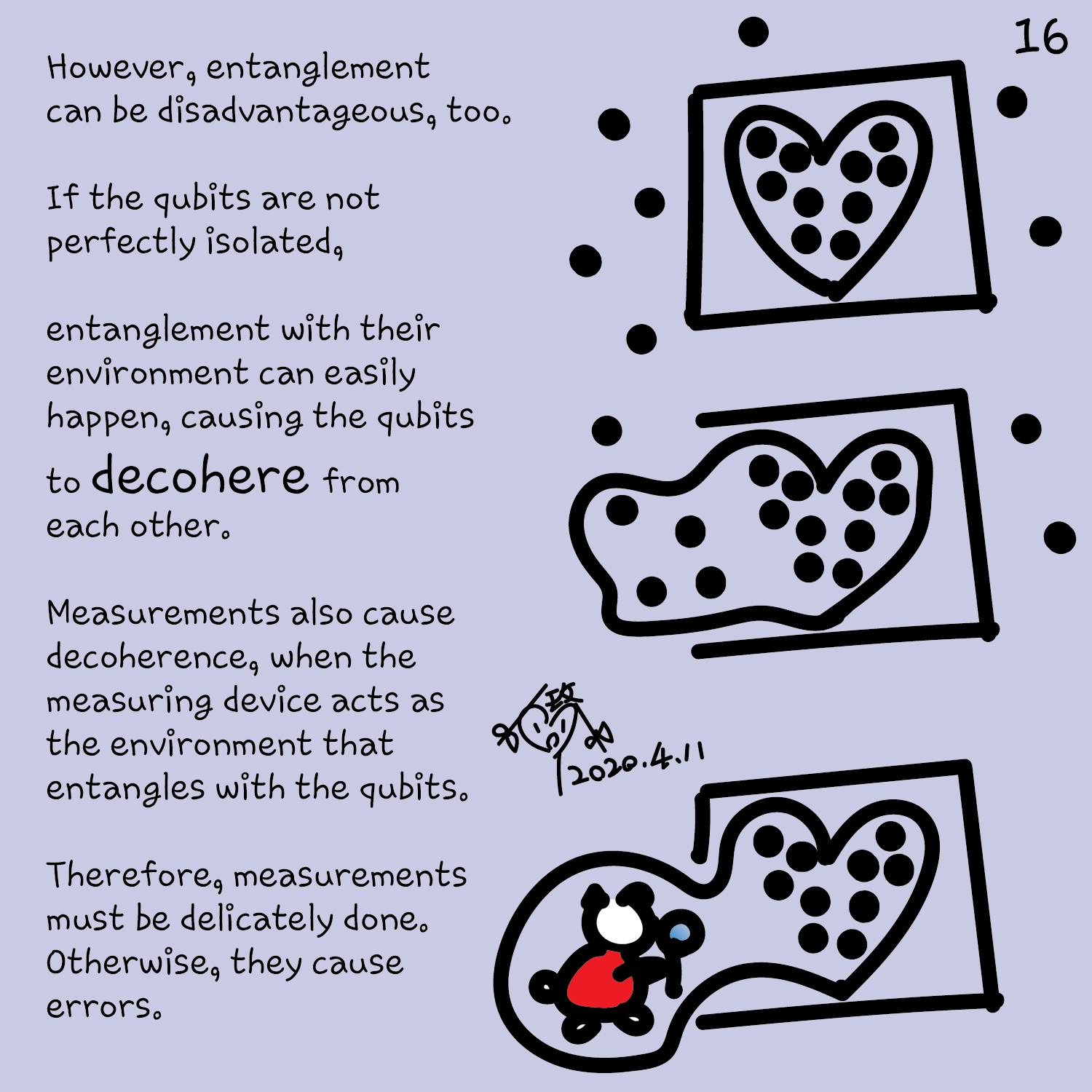
Pages 15 & 16
artbyphysicistkitty • 04/12/2020 at 14:10 • 0 commentsWe won't delve into decoherence any time soon. If you are interested to learn more about it, just take a search online.
We will next lean how to control and manipulate qubits.
-
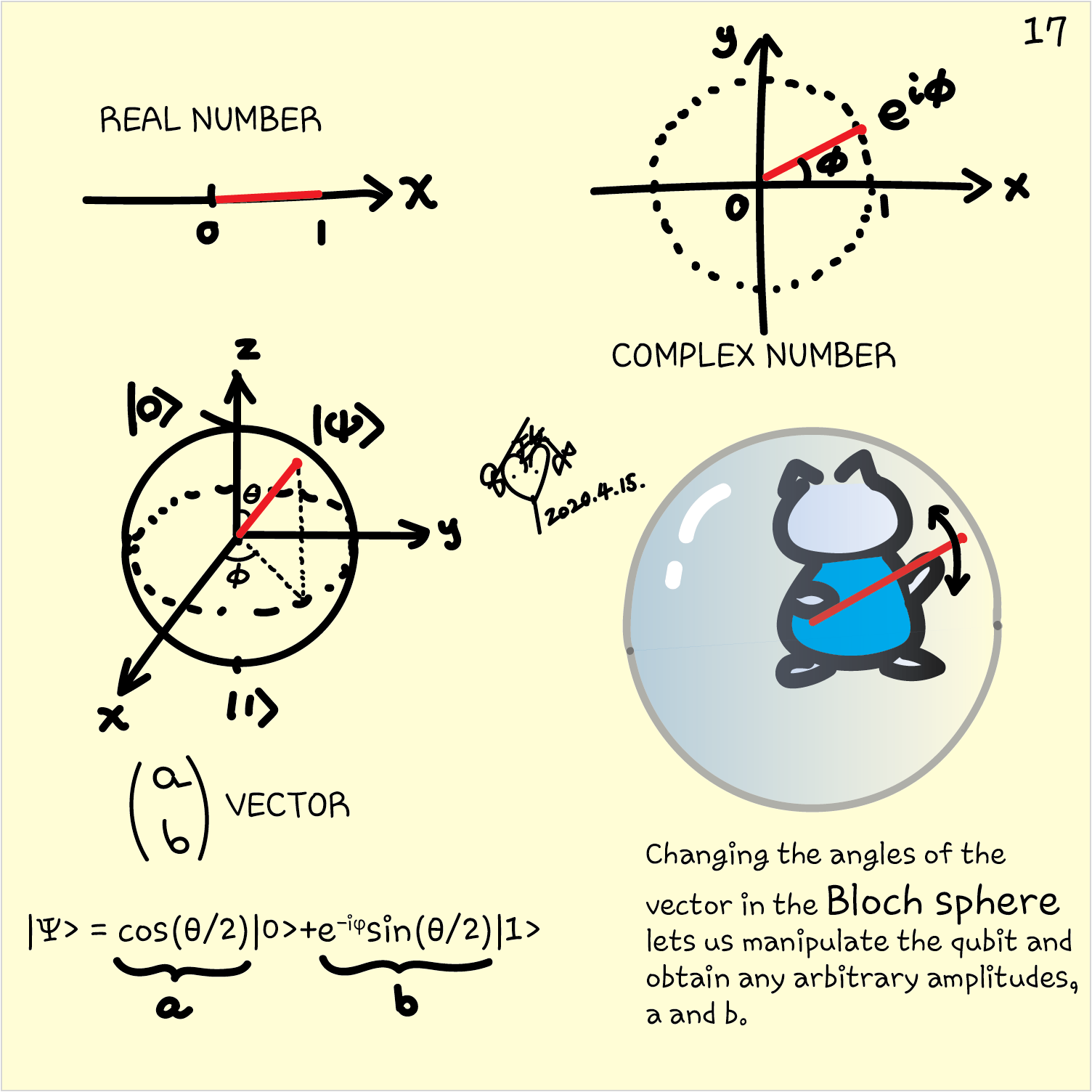
Pages 17 & 18
artbyphysicistkitty • 04/15/2020 at 14:14 • 0 commentsThis week, we will start talking about how to manipulate qubits to build quantum algorithms.

-
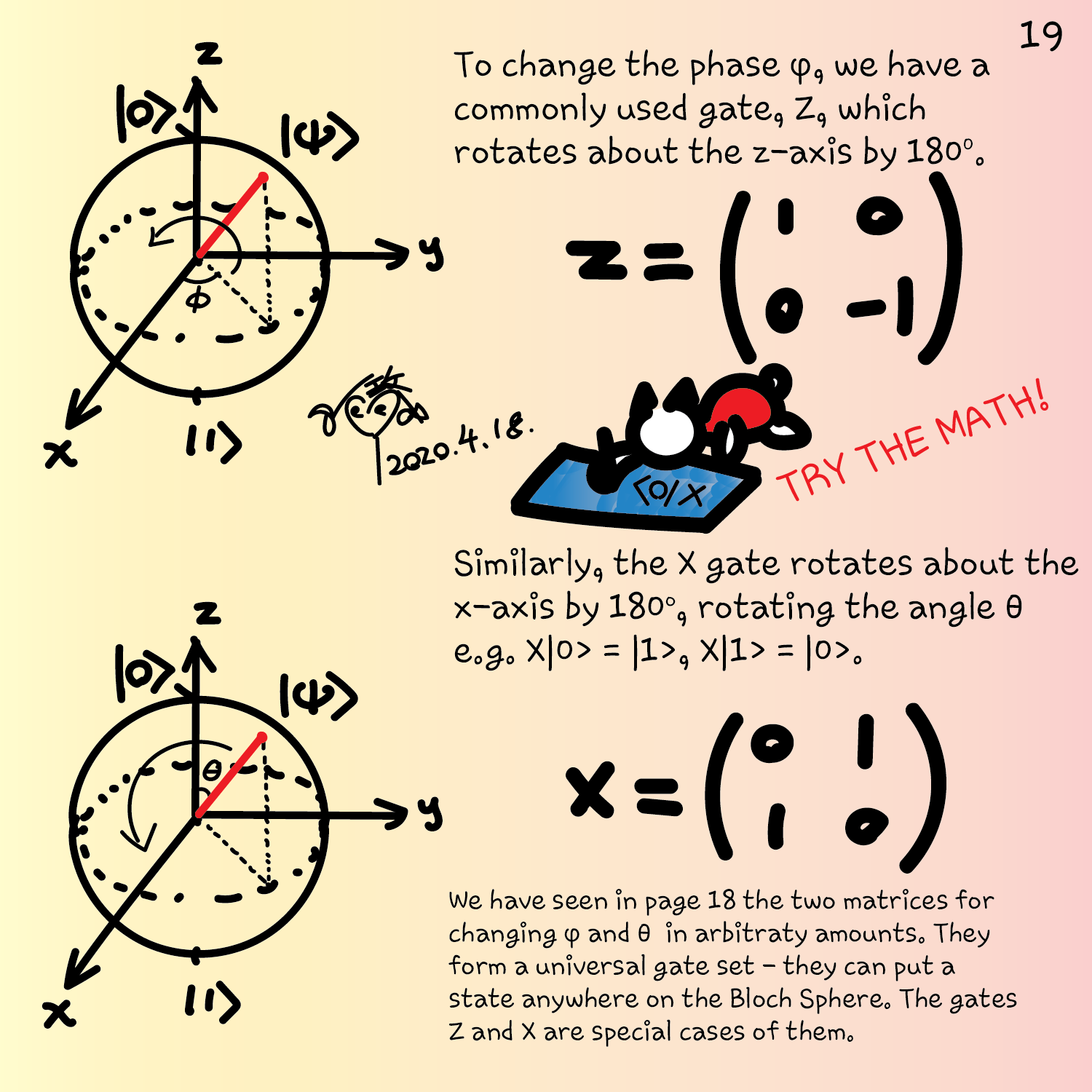
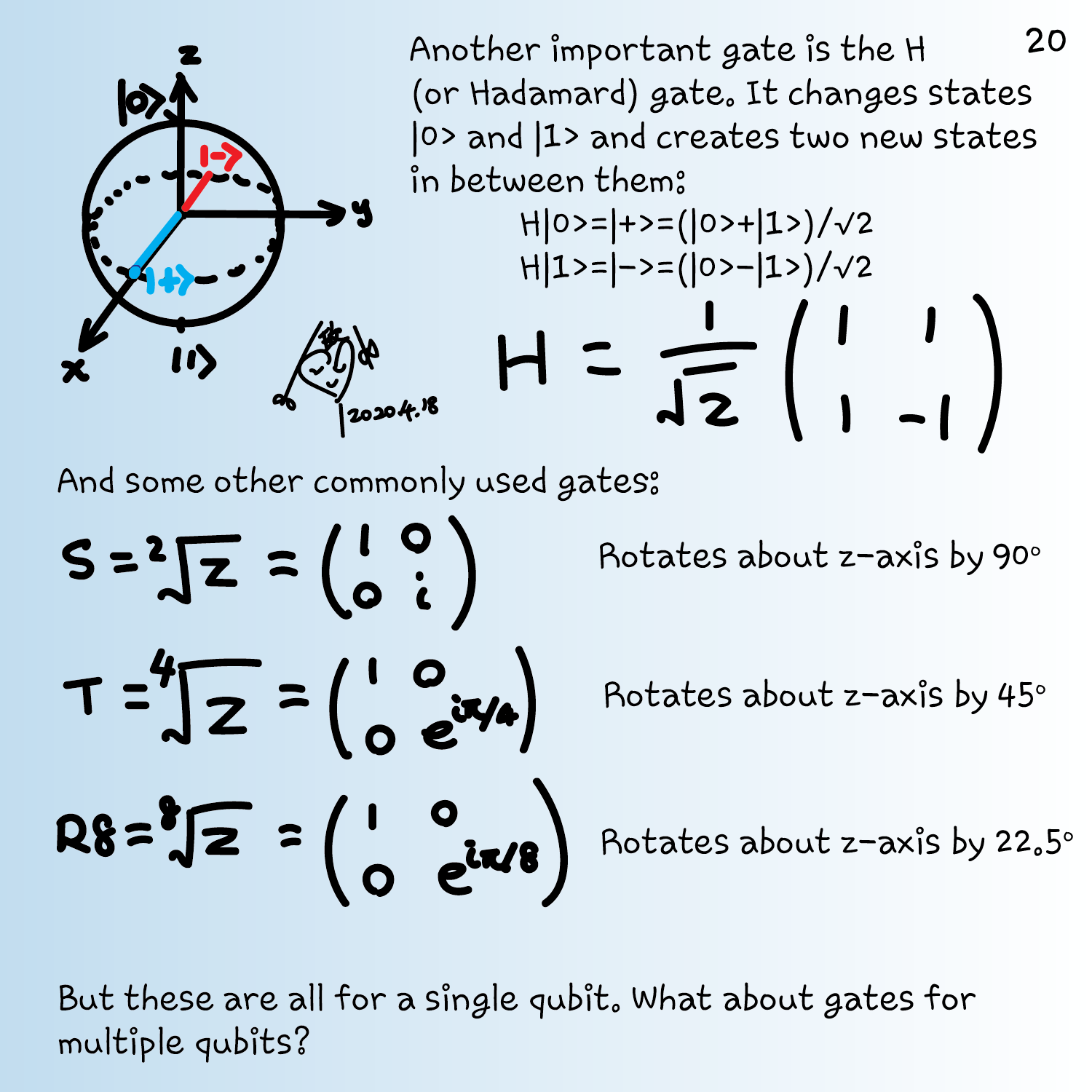
Pages 19 & 20
artbyphysicistkitty • 04/19/2020 at 14:09 • 0 commentsWhile an infinite number of gates can be used to change a state (and move it around on the Bloch Sphere), some gates are special cases that are commonly used in algorithms.
-
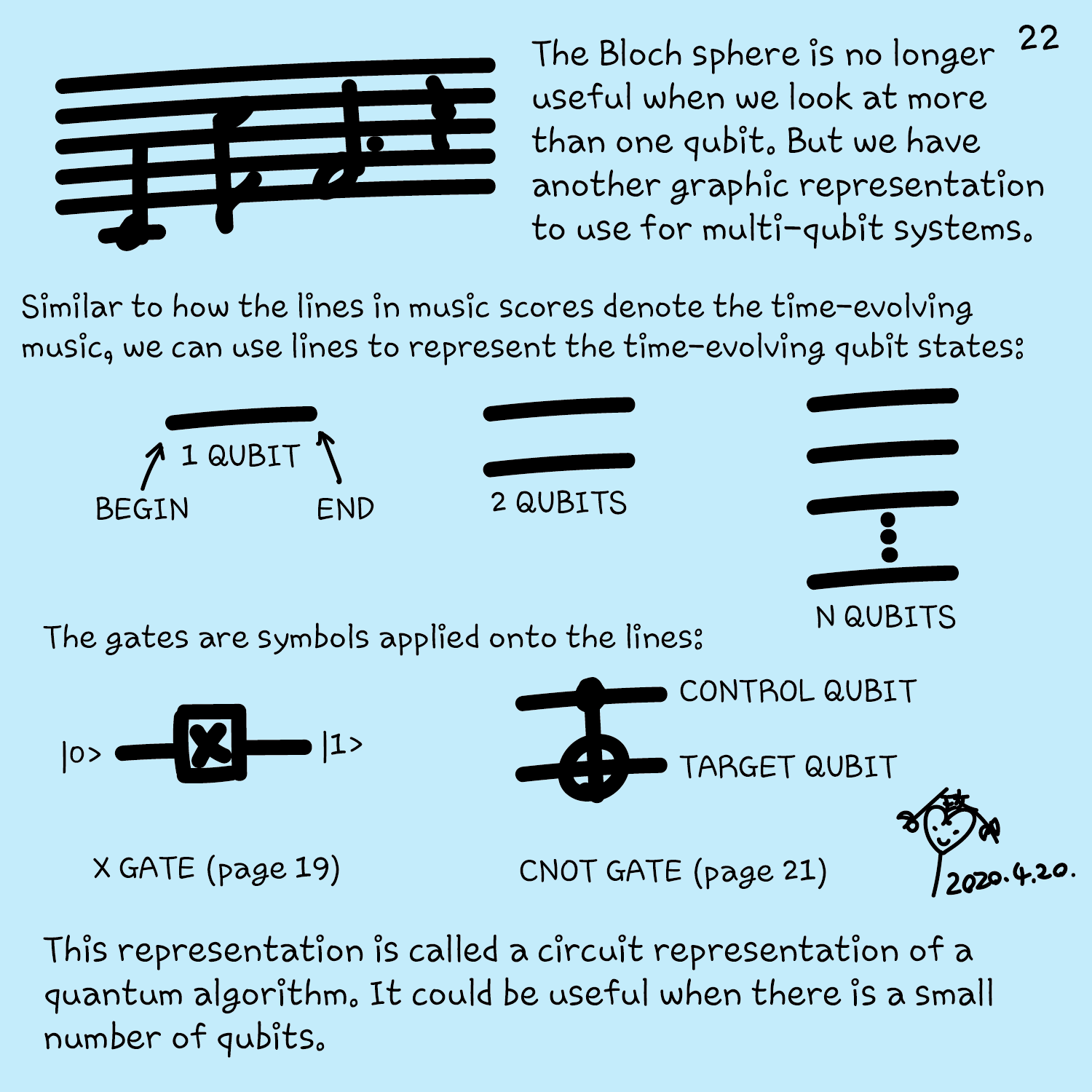
Pages 21 & 22
artbyphysicistkitty • 04/22/2020 at 14:16 • 0 commentsA couple build-ups for what's to come: using the gates to construct algorithms, and using Q# quantum programming language for large numbers of qubits (when the circuit representation doesn't scale).

-
1
Hackaday classes every weekend
Sunday weekly class at 11:30am PDT. Join Microsoft Teams Meeting.
For phone options:
+1 323-849-4874 United States, Los Angeles (Toll)
Conference ID: 636 979 670#
We will discuss a new topic for 30 mins every week. The topic will be based on my comics of the week.
-
3
New quantum developments that may interest you
Discussions
Become a Hackaday.io Member
Create an account to leave a comment. Already have an account? Log In.

Hanaki Onu wrote 02/19/2024 at 14:06
Is there a specific website that lets you use this data - other than Hackaday? I was thinking that scratch would, but it does not. also, I love how easy she makes it to understand.

Davide wrote 09/08/2020 at 12:36
Hi Kitty, I was reviewing class #5/ comic #23 (teleportation) and I can’t figure out why, when Alice entangles her new qubit |A'> to the previously entangled pair |A> |B>, she firstly applied the CNOT gate then secondly the Hadamard gate: that is the reverse order of gates to obtain entanglement, isn’t it? May you please elaborate on this step a bit more?
artbyphysicistkitty wrote 09/08/2020 at 17:00
Great question, Davide. The best way to see it would be to go through the math at each step. What happens if you reverse CNOT and H? Would it work for some states? |A'> in general is a superposition state of |0> and |1>. What happens if you apply a H gate? Another place to look is jumping to Session 13: Teleportation + codingRecording: https://youtu.be/nPJeI-J5934 and try coding the circuit with Q#.
Barry Burd wrote 07/02/2020 at 20:26
My question is about the Basic Gates kata, Task 2.3. Two-qubit gate - 3. I can do it by thinking intuitively about what gates do, but I don't want to rely on intuitions. I'm looking for a way to do it using only matrices (maybe by writing down the matrix for the multi-qubit transformation that I want to achieve, and factoring that matrix into the matrices for basic gates). Is there a way to do something like this?
artbyphysicistkitty wrote 07/03/2020 at 10:11
Hi Barry, for sure, you can express all quantum gates as matrices and qubits as vectors. For this question, you can write down the CNOT matrices and control and target qubits.
Barry Burd wrote 07/04/2020 at 01:59
I have no doubt that I can express a sequence of basic gate operations with matrices. My question is, are there mathematical tools to find a sequence of operations to go from an arbitrary start state to a desired target state. The basic gates H, CNOT, and Phase45 are universal -- so is there a method to determine which of them to apply?
artbyphysicistkitty wrote 07/05/2020 at 14:18
Interesting thought. We can use the arbitrary general matrices that are described by each qubit's angles and then calculate what the angles are. Then we will find out which universal gates they are. We can calculate manually or express in a generic tool like Mathematica or MatLab. 2x2 matrix would be easy but as the matrices grow bigger, it can get messy.
Ramkumar wrote 06/20/2020 at 08:50
artbyphysicistkitty wrote 06/20/2020 at 14:24
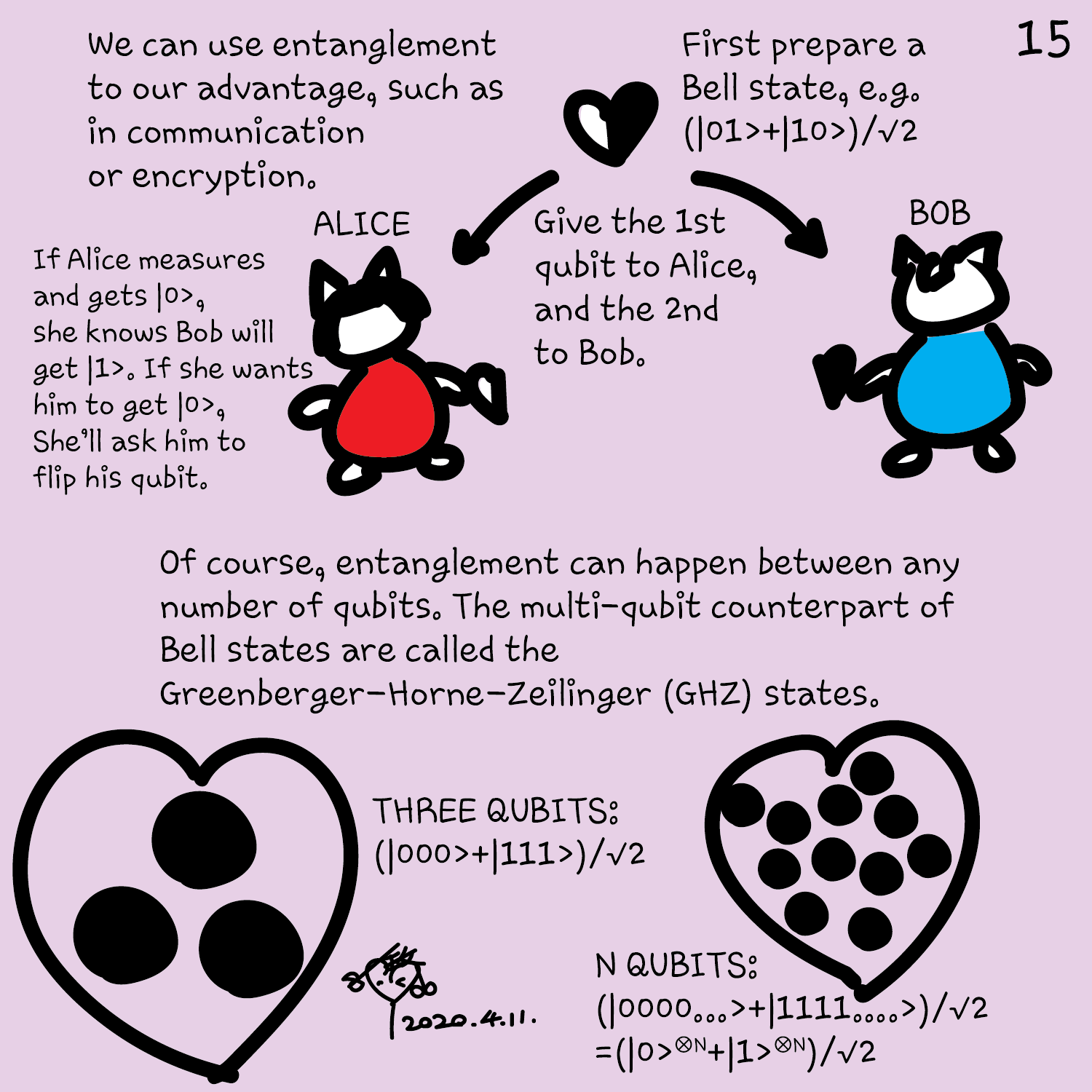
Hi, thanks for asking. We can entangle them in many different ways. ( 1 ∕√2 | 000> + 1 /√2 | 111> ) is a maximally entangled state. The amplitude in front of each term can also be different. The example you gave does not have the three qubits entangled though. When we measure the third qubit (or any qubit), we still won't know what the other two qubits are. It is not different from writing 1 ∕√2 | 01>(|0>+|1>) then we can see the first two qubits are not correlated with the last qubit. Whereas in the case of ( 1 ∕√2 | 000> + 1 /√2 | 111> ) we cannot write them as separate qubits.

olivialsn wrote 06/09/2020 at 06:03
there is superposition like 1/2(|00⟩+𝑖|01⟩−|10⟩−𝑖|11⟩), how to understand when there is imaginary part? for |01⟩, i^2 = -1, does it have a negative probability to appear? or we only consider the real part, so the probability of |01⟩ and |11⟩ is 0?
artbyphysicistkitty wrote 06/11/2020 at 12:59
Great that you are asking about this! Thank you. I have not mentioned this part in order to reduce the math for beginners. We cannot have negative probability. In fact, it should be the modulus | i |^2 that we calculate for probability, so the amplitude can be any number. If you express an imaginary number with magnitude and phase, you will see that it is the magnitude (always positive) squared that gives the probability. I can show this detail in one of the next classes. Glad we are ready.
Barry Burd wrote 06/08/2020 at 20:58
Can anyone help me with setting up the katas on my local computer? I'm working on Windows but I can also try using a Mac. I was able to open a notebook but I kept getting messages that the server couldn't obtain a lock (apparently from dotnet). Then I saw a note about uninstalling microsoft.quantum iqsharp and installing a particular version. When I try to reinstall iqsharp, I get an error message Failure to install and it gives four possible reasons.
Frankly, I'm lost because I'm not an experienced dotnet or jupyter user. If anyone has time for a brief online help session, that would be great.
John Cronin wrote 05/24/2020 at 10:53
Kitty,
your presentation at the Makers' Faire was excellent. And actually your second about fashion was interesting.
I have a question, what is your recommendation for a beginning quantum mechanics text and a good math review text. I feel comfortable with restarting my undergrad calculus.
Thank you
artbyphysicistkitty wrote 05/24/2020 at 11:23
Hi John, thank you for attending both sessions.
For quantum mechanics, a widely used one is Introduction to Quantum Mechanics by David Griffith.
A book on quantum computing that everyone uses is: Nelson and Chaung, Quantum Computation and Quantum Information – 10 th Anniversary Edition (you can find free PDFs to download). It's not the most easy to read though. I heard this one is pretty good: Quantum Computing: An Applied Approach, and Quantum Computing for Software Engineers.
If you are interested in hardware (not specifically for quantum computers), I loved Introduction to Solid State Physics by Charles Kittel.
For math...maybe the standard high-school and undergrad textbooks from China? See if they have translations into English. I haven't used textbooks for math for a while. My undergrad was in England and can't remember what we used there. The lecture notes were pretty good. Are you in the UK?
John Cronin wrote 05/25/2020 at 12:41
Thanks for the book recommendations.
I live in Delaware, recently retired from pharma industry, PhD in analytical chemistry. Now I can pursue my intellectual hobbies. I needed a refresher in linear algebra and matrices.
I looked at the chem quantum stuff. It is above my knowledge but it is the same old boring stuff with H atoms. As an analyst I am more interested in finding signals in the noise.
Thank you for your help


mraarone wrote 04/26/2020 at 21:55
I was looking for a good book as a handbook for my Quantum Theory studies to review and discuss Lie groups, Clifford Algebras, SU(2), tensors, spintors, and just a bunch of fundamentals that are spotty in my past. I found this book where the author shares it freely on the Internet (I'm buying it from Amazon because I'm a nice guy).
If you're interested, the book is called "Quantum Theory, Groups and Representations: An Introduction" by Peter Woit.
He makes it publicly available a la his professor's site at Columbia:
http://www.math.columbia.edu/~woit/QM/fall-course.pdf
Maybe more technical than most would want, but for those looking to read deeper with a companion handbook for the formalism behind the physical application, this seems to cover a lot that I have been looking for in a bunch of other books.
Enjoy!
Aaron

Robert E. Griffith wrote 04/15/2020 at 13:07
Hey Kitty, I was reviewing past slides and I have a question about number 11 (about the weather). I dont understand why there is a nagative amplituded in the quatum calculation. Is it a real example in that for these number this must be the correct calculation or is the negative case one of several possibilities. I wonder if the point of this slide is that there are solutions represented by both negative and positive terms and this just illustrates one example of what the solution could be.
artbyphysicistkitty wrote 04/15/2020 at 13:26
Yes, the negative sign was put there on purpose to show what happens if the amplitude can be negative, since in the quantum case the amplitude can be positive or negative.
artbyphysicistkitty wrote 04/13/2020 at 10:46
Thanks Barry and Robert.
There is a set of gates that can be combined to produce any arbitrary amplitude of a qubit. With three qubits, you will apply those gates to them individually so you get the a,b,c,d,e,f,g,h, you want. A way to visualize a qubit is the Bloch sphere - a 3D representation of a qubit vector. You can write any arbitrary gates into a gate (matrix) to move the vector along the Bloch sphere. This will exactly be the topic for the coming week. Watch out for my comics on Wednesday and Sunday.
Robert E. Griffith wrote 04/12/2020 at 21:50
(this is in response to the question Barry asked at the end of class and in the chat application)
Barry, I wonder if your question can be broken down into two parts. 1) given a 3qbit system with state amplitudes (a,b,c,d,e,f,g,h), what at the 3 qbit states that produce it and 2) how do you manipulate a qbit to have a particular state other that 0,1 and root(2)?
Robert E. Griffith wrote 04/07/2020 at 20:00
Hi Marcelo, in the Files section above you will find the first two video classes and their accompaning slides. Note that the video URLs do not come in as links for me so I had copy and paste them. The third meeting will be next Sunday.
Does this project spark your interest?
Become a member to follow this project and never miss any updates
Hi, I'm currently in class 3 where you explain quantum entanglement. Say, there are 3 quantum particles in entanglement. Is this ( 1 ∕√2 | 000> + 1 /√2 | 111> ) the only possible configuration. I guess they can be entangled in any possible ways.
If yes, consider the state ( 1 ∕√2 | 010> + 1 ∕√2 | 011> ). Here if we observe the first two particles, the third particle's state cannot be determined. On the other hand, it is enough to observe only third particle. Is this valid entanglement?