Anona Labs Headquarters, San Francisco. Monday, 8:23 AM
Angela Reyes was staring at a spreadsheet that made no sense.
As CFO of Anona Labs, she had seen plenty of numbers that told uncomfortable stories. But this one was particularly frustrating because the story it told was about money they were leaving on the table.
She pulled up the product margin report for the third time that morning. Their flagship product i.e. the Conversation Intelligence Platform was performing well. $28M ARR, growing 40% year over year. The sales team was hitting quota. Derek was happy. The board was happy.
But buried in the data was a different story.
Anona Labs didn’t just sell one product. Over the past three years, they had built out a portfolio of six distinct AI services: the core Conversation Intelligence platform, a Predictive Escalation Engine, a Quality Assurance Automation suite, a Compliance Monitoring tool, a Customer Sentiment Analytics product, and a recently launched Agent Coaching AI.
The core platform accounted for 82% of revenue. The other five products? Combined, they represented just 18%.
That wasn’t the problem.
The problem was the margin column.
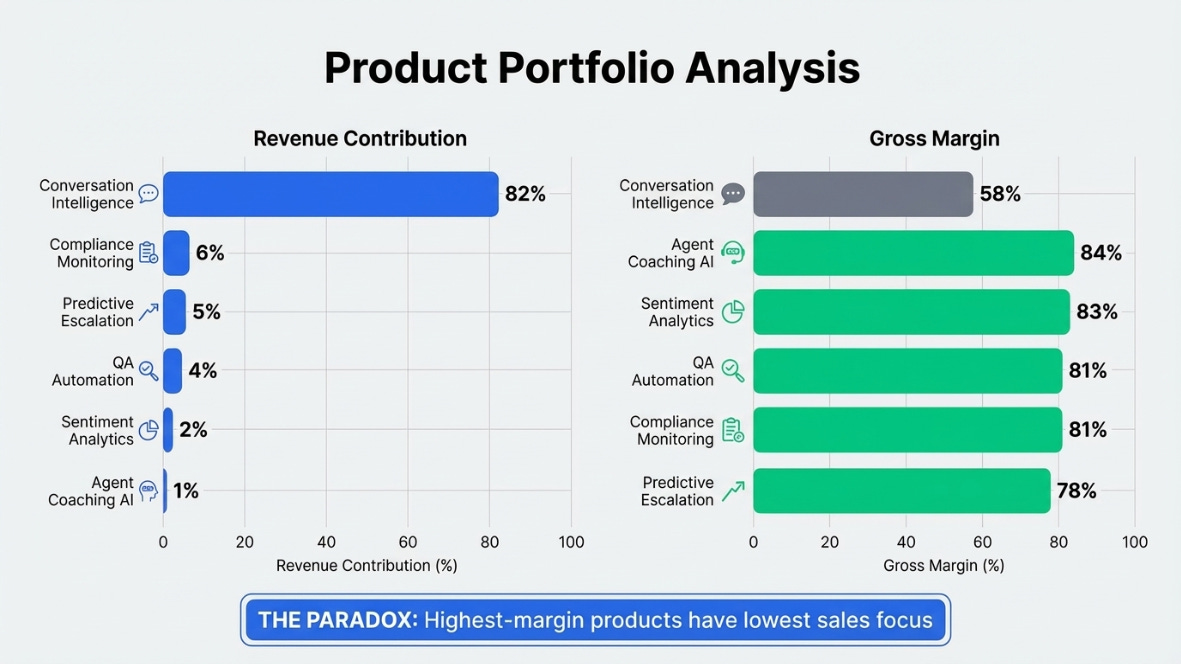
The core platform had a gross margin of 58% which was solid for enterprise SaaS. But the Predictive Escalation Engine? 78% margin. The QA Automation suite? 81%. The Agent Coaching AI they had launched six months ago? 84%.
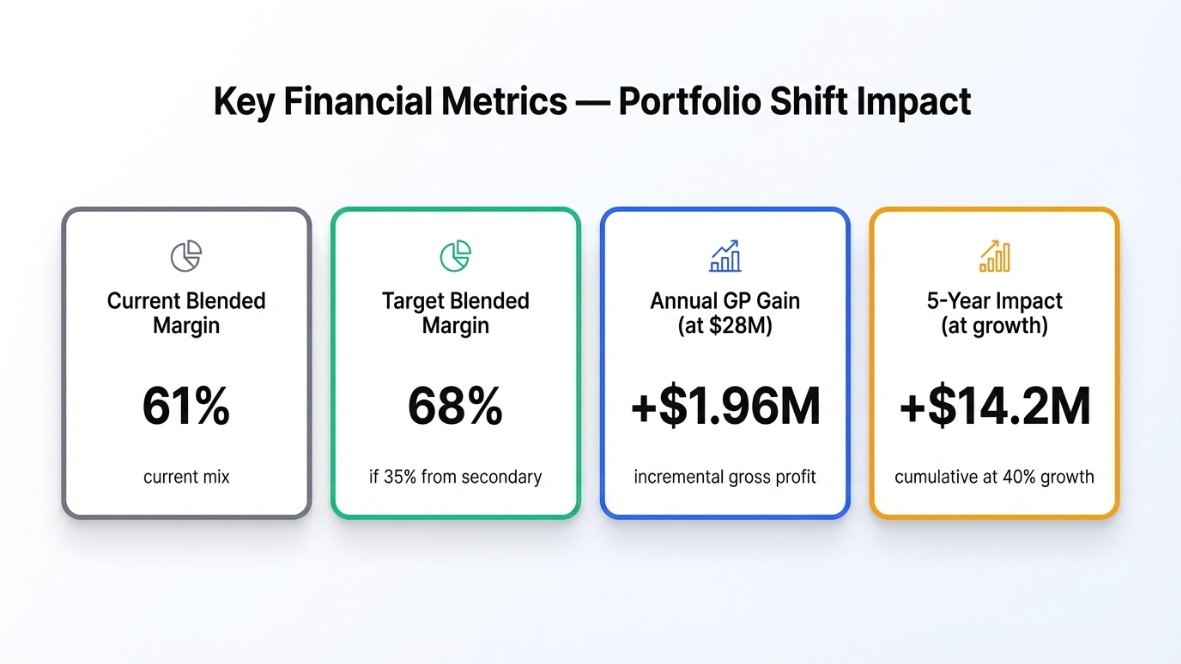
Angela did the math she had done a dozen times before. If they could shift just 15% of their revenue mix toward these high-margin products, their blended gross margin would jump from 61% to 68%. On $28M ARR, that was nearly $2M in additional gross profit dropping straight to the bottom line.
She picked up her phone and texted Maya Chen.
“My office. Bring coffee please. We have a portfolio problem.”
Angela’s Office: Monday, 9:15 AM
Maya settled into the chair across from Angela, two cups of coffee between them. The framed quote on the wall “In God we trust. All others bring data.” seemed particularly relevant this morning.
“Walk me through the product economics again,” Angela said. “I want to make sure I understand why our highest-margin products are our lowest sellers.”
Maya pulled up her laptop. She had been tracking this issue for months, quietly building models while waiting for someone else to notice.
“It’s actually not a mystery,” Maya said. “It’s a sales behavior problem. And it’s completely predictable.”
She turned the screen toward Angela.
“Here’s the portfolio breakdown. Six products. The core Conversation Intelligence platform is what we’re known for. It’s what customers ask for by name. It’s what Derek’s team knows how to sell. It has the most case studies, the most references, the most marketing support.”
“And the highest quota credit,” Angela added.
“Exactly. A rep sells $100K of core platform, they get $100K toward quota. They sell $100K of the QA Automation suite? Same thing $100K toward quota. But here’s the difference.”
“The core platform has a six-month average sales cycle. Complex implementation, multiple stakeholders, long procurement process. The QA Automation suite? Three-month cycle. Half the time, half the effort.”
“So why wouldn’t reps sell the easier product?”
“Because it’s not easier to find. The core platform is what brings customers to us. It’s what the marketing generates leads for. It’s what the SDRs are trained to qualify. A rep can sit at their desk and have qualified core platform opportunities dropped in their lap. But finding a QA Automation buyer? That requires the rep to do discovery. To understand the customer’s tech stack. To identify pain points that the customer might not even know they have.”
Maya paused.
“And here’s the real issue. A rep who spends two hours doing deep discovery on a QA Automation opportunity could have spent those same two hours closing a core platform deal that was already 80% of the way there. The rational economic choice: given our current incentive structure is to ignore the high-margin products entirely.”
Angela leaned back in her chair.
“So we’ve accidentally built a system that rewards reps for ignoring our most profitable products.”
“Not accidentally,” Maya said. “Predictably. This is what happens when you design compensation around revenue instead of margin. Every company with a multi-product portfolio eventually hits this wall.”
“Sales reps are not irrational. They are hyper-rational. They will optimize for whatever you measure and reward. If you reward revenue, you get revenue. If you want margin, you have to pay for margin.”
Conference Room Horizon: Monday, 2:00 PM
Derek Okonkwo walked into the meeting with the energy of someone who had just closed a deal. Which he had. A $380K renewal with a healthcare customer that morning.
“What’s the emergency?” he asked, dropping into a chair. “I’ve got a pipeline review in an hour and our forecasting tool is broken. We need to get it fixed ASAP.”
Angela, Maya, and Marcus Thompson were already seated. Anoop Kumar was dialed in from New York, his camera showing the corner of a hotel room.
“The emergency,” Angela said ignoring Derek’s comment about Forecasting tool, “is that we’re leaving $2 million a year in gross profit on the table because our sales team doesn’t sell our high-margin products.”
Derek’s expression shifted. “Define ‘doesn’t sell.’”
Maya pulled up the data.
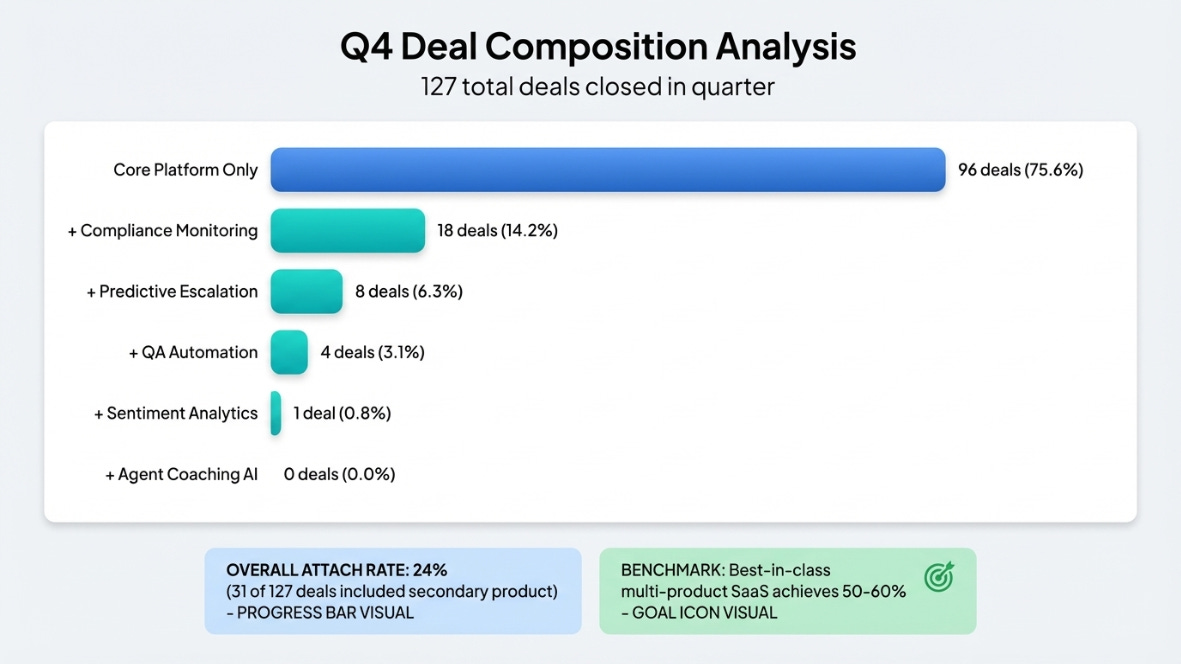
“In Q4 last year, your team closed 127 deals. Of those, 31 included at least one secondary product. That’s a 24% attach rate. And look at which products got attached.”
Derek crossed his arms. “Agent Coaching is a new product. The team doesn’t know it well enough yet.”
“Agreed,” Maya said. “But that’s the point. The team doesn’t know it because there’s no incentive to learn it. No training investment makes sense when the payoff is the same as just selling more of what they already know.”
Anoop’s voice came through the speaker. “Derek, I’m not attacking your team. But I want to reframe the question. This isn’t just about margin. It’s about customer outcomes.”
He paused to let that land.
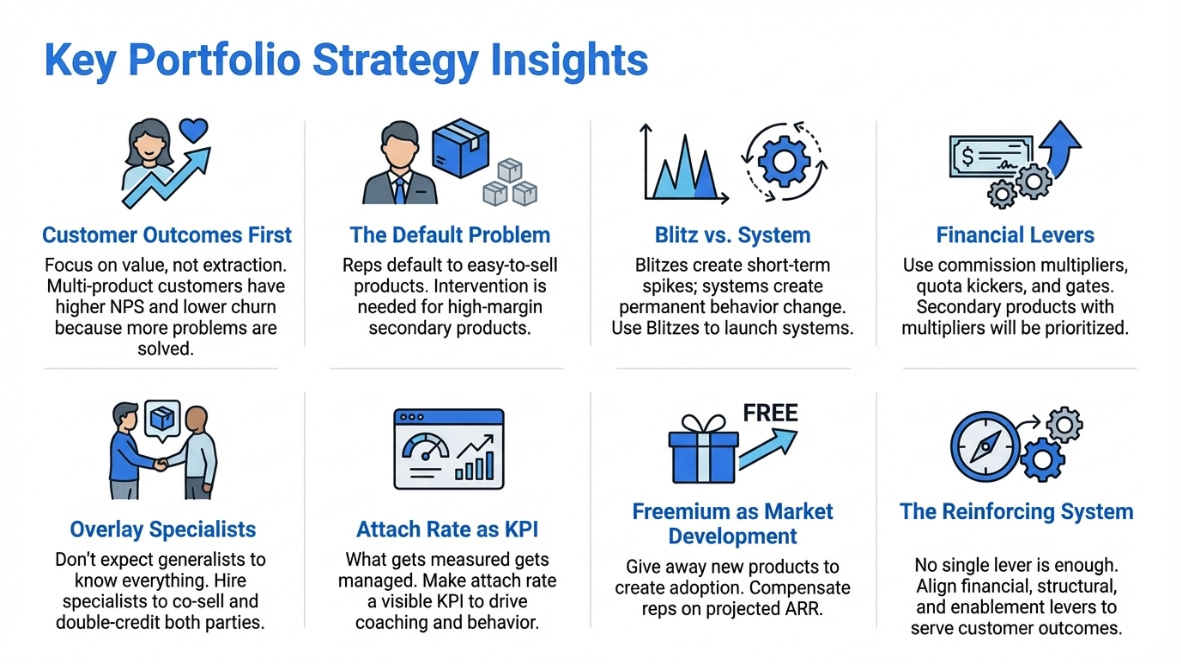
“I pulled our NPS data last week. Customers who use three or more of our products have an NPS of 72. Customers who only use the core platform? 41. Our multi-product customers have 3x lower churn. They expand faster. They refer more. And here’s the thing. They’re not happier because they’re paying us more money. They’re happier because we’re actually solving their problems.”
Angela nodded. “The QA Automation product reduces their support ticket volume by 30%. The Predictive Escalation engine catches problems before they become customer complaints. These aren’t upsells for upsell’s sake. They’re genuine solutions.”
“Exactly,” Anoop said. “So when I say we’re leaving $2 million on the table, I’m also saying we’re leaving customer value on the table. We have products that would genuinely help our customers, and we’re not even telling them about it. That’s not good sales strategy. That’s a disservice to the people who trust us.”
Derek was quiet for a moment.
“You want me to be honest?”
“Always.” said Anoop.
“It would take a complete redesign of how we incentivize, enable, and organize the sales team. A Blitz Day or a SPIFF isn’t going to move the needle. Not at the scale you’re talking about. You’re asking for a fundamental behavior change across 40 salespeople who have spent two years optimizing for a different game.”
Angela nodded. “So let’s design the new game.”
The Blitz Debate: Monday, 2:30 PM
“Why not start with a Blitz?” Marcus asked. “We’ve done them before. Pick a day, focus the whole team on one product, run a contest. It generates energy.”
Derek shook his head. “Blitzes are sugar highs. We did one last year for the Sentiment Analytics product. We made 200 calls in a day. Booked maybe 15 meetings. Closed 2 deals over the next quarter. And then everyone went back to what they were doing before.”
“The problem with a Blitz,” Maya added, “is that it treats the symptom, not the disease. The disease is that our incentive structure, our organizational design, and our enablement programs all point in the same direction: sell the core platform, ignore everything else. A single day of focused activity doesn’t change that.”
“So what does?” Anoop asked.
Maya spoke up. “Can I add something? I’ve been looking at our churned customer data. The number one reason customers leave isn’t price. It isn’t competition. It’s unresolved problems. They come to us for conversation intelligence, but their real pain is broader. Quality issues, compliance gaps, agent performance. We solve one piece and leave the rest on the table.”
She pulled up another chart on her laptop.
“Customers who bought only the core platform have a 14% annual churn rate. Customers with two products? 8%. Three or more? Under 4%. We’re not just leaving margin on the table. We’re leaving customers vulnerable to problems we could solve. And then we’re surprised when they leave.”
Angela stood up and walked to the whiteboard.
“Let me frame this differently. There are three categories of levers we can pull. Financial levers: how we pay people. Structural levers: how we organize people. And enablement levers: how we equip people. A sustainable solution requires pulling levers in all three categories.”
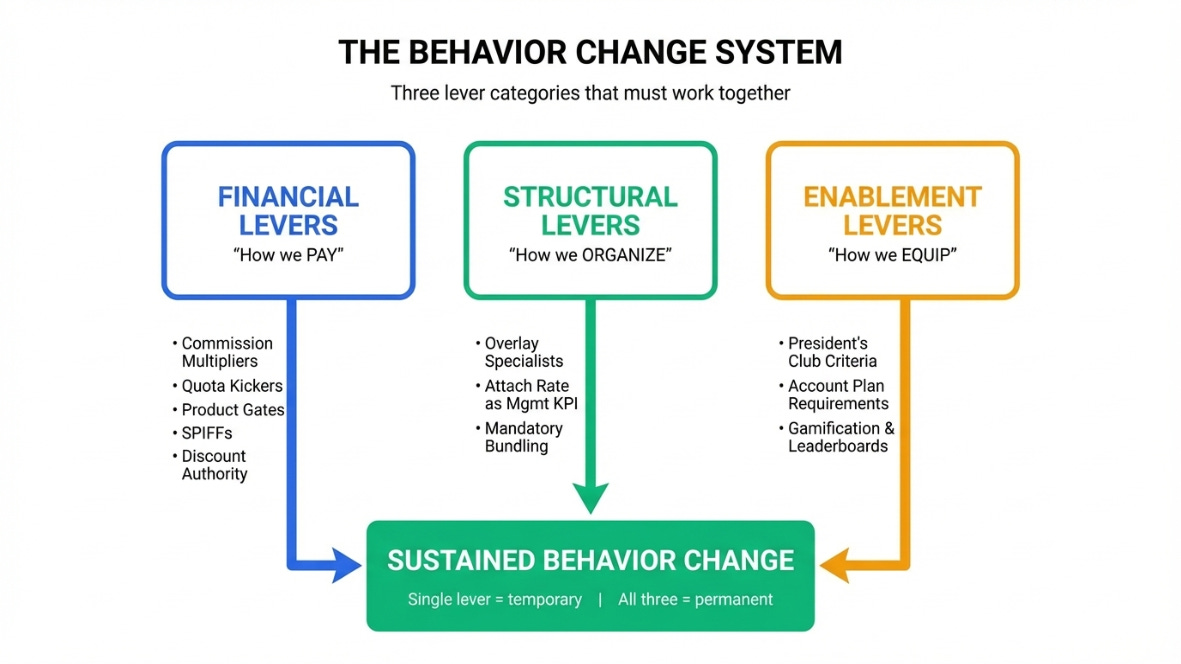
“Derek, Maya, Marcus. I want us to design a comprehensive system. Not a campaign. A system that makes selling high-margin products the rational economic choice for every rep, every quarter, permanently.” Angela said.
Anoop’s voice cut in. “And let’s be clear about why. These aren’t high-margin products because we’re overcharging. They’re high-margin because they’re efficient to deliver and they solve real problems. When a rep sells QA Automation, they’re not padding our bottom line. They’re helping a customer catch defects before their own customers complain. The margin is a byproduct of genuine value creation.”
Financial Levers: Monday, 3:00 PM
Maya took the marker from Angela.
“Let’s start with money. There are five financial levers we can consider.”
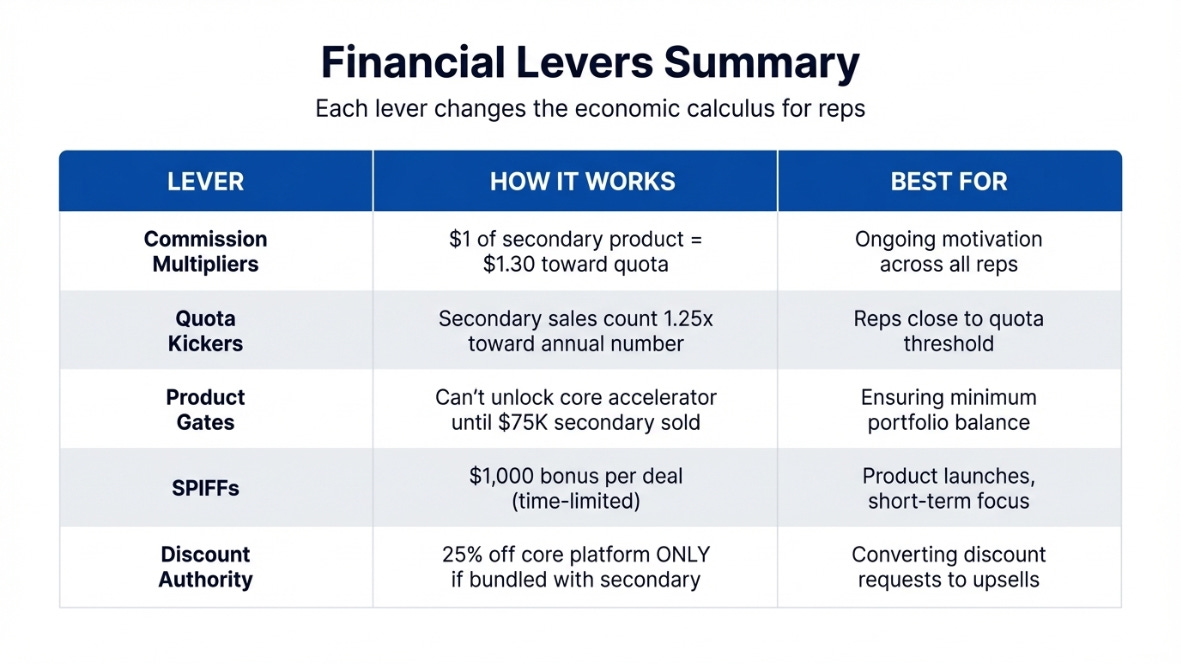
1. Commission Multipliers (Accelerators)
“The simplest lever. We apply a multiplier to revenue from high-margin products. A rep sells $100K of core platform, they get credit for $100K. They sell $100K of QA Automation, they get credit for $130K or $150K, depending on how aggressive we want to be.”
Derek leaned forward. “That changes the math. If I’m a rep deciding between two opportunities, and one counts 1.5x toward my number? That one wins.”
2. Quota Retirement Kickers
“Similar concept, but focused on quota attainment instead of commission dollars. Every dollar of high-margin product counts 1.25x or 1.5x toward retiring the rep’s annual number. This is powerful because hitting quota unlocks accelerators on everything else.”
3. Product-Specific Gates
“This one is more aggressive. We structure the comp plan so that reps can’t unlock their full accelerator tier unless they hit a minimum threshold on high-margin products. For example: you don’t get your core platform accelerator until you’ve sold at least $75K of secondary products.”
Derek frowned. “That could backfire. If a rep is crushing it on core platform but hasn’t hit the gate, they might feel like we’re punishing success.”
“It’s a risk,” Maya agreed. “Gates work best when the threshold is achievable. Something like 15-20% of total quota. High enough to matter, low enough that most reps can hit it without heroic effort. And you have to communicate the why clearly. This isn’t punishment. It’s alignment.”
4. SPIFFs
“Short-term, direct bonuses. $500 per deal closed this quarter. $1,000 for hitting a specific milestone. These are good for generating short-term focus. Better than a Blitz because they run for a quarter instead of a day. But they’re not a permanent solution.”
5. Discount Authority
“This one is subtle but powerful. We give reps aggressive discounting capability on the core platform but only if it’s bundled with a high-margin product. Want to give a customer 25% off the core platform? Fine. But only if they’re also buying QA Automation at standard pricing.”
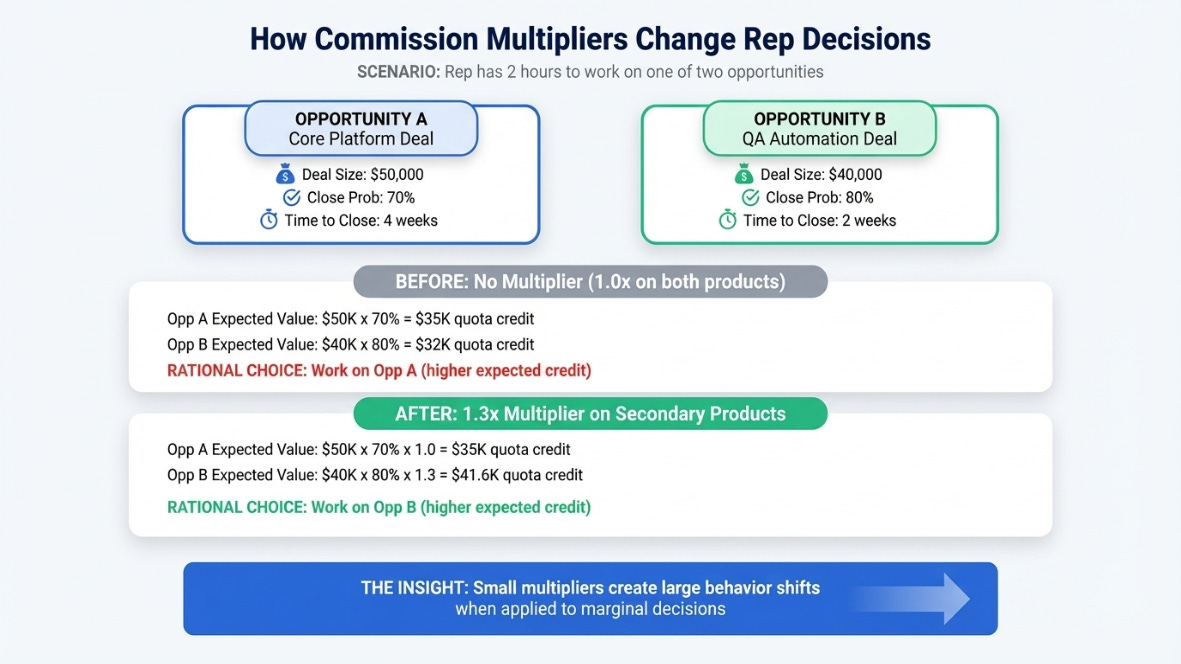
“SPIFFs and Blitzes create motion. Multipliers and gates create sustained behavior change. But neither matters if you’re not solving real customer problems. Incentives should accelerate value creation, not manufacture it.”
Structural Levers: Monday, 3:45 PM
Angela took the marker back.
“Financial incentives matter, but they’re not enough. The structure of your organization also shapes behavior. Let’s talk about three structural levers.”
1. Overlay Specialists
“This is the biggest lever we haven’t pulled yet,” Angela said. “Right now, we expect every rep to sell every product. That’s six products, six different value propositions, six different buyer personas. It’s unrealistic.”
“The alternative?” Derek asked.
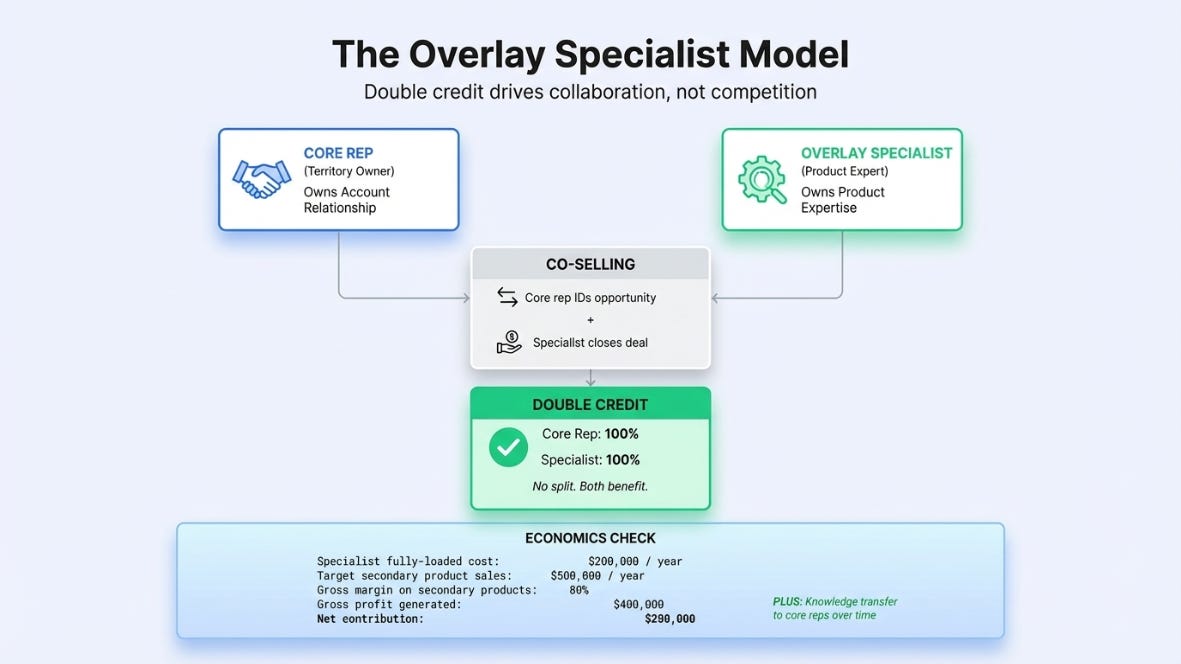
“Overlay specialists. We hire or promote. Two or three people whose only job is selling the high-margin secondary products. They don’t carry their own quota on the core platform. They don’t have their own territories. Instead, they ‘overlay’ the core sales team. A core rep identifies an opportunity, brings in the specialist, and they close together.”
“And compensation?”
“Double credit. The core rep gets full credit for the deal. The specialist also gets credit. Both benefit from the same sale.” said Angela
Derek looked skeptical. “That’s expensive. We’re paying twice for the same revenue.”
“We’re paying for margin,” Angela said. “The incremental cost of the specialist, let’s say $200K fully loaded is easily covered if they help close an additional $400K in high-margin products. At 80% margin, that’s $320K in gross profit versus $200K in cost. The math works.”
2. Attach Rate as a Management KPI
“Right now, no one is measured on attach rate. Not the reps, not the managers, not the directors. If we make attach rate a visible KPI and bonus managers on it they will coach their teams accordingly.”
3. Mandatory Bundling
“This is the most aggressive structural lever,” Angela said. “Instead of selling products separately, we create bundles that include both the core platform and a secondary product. The customer can’t buy just the core platform. They buy the ‘Complete Customer Intelligence Suite’ that includes the core plus QA Automation.”
Process & Enablement Levers: Monday, 4:30 PM
Marcus stood up. “Can I take this section? Product and enablement are my world.”
Angela handed him the marker.
“Financial and structural levers create the incentive to sell high-margin products. But reps also need the capability to sell them. That’s where process and enablement come in.”
1. President’s Club Criteria
“President’s Club is the ultimate sales recognition,” Marcus said. “The trip, the title, the prestige. Right now, eligibility is based purely on total attainment. Blow past your number, you’re in.”
“What if we changed the criteria? What if, regardless of how much you sell, you’re not eligible for President’s Club unless you’ve closed at least five deals or $100K of secondary products? Suddenly, even your top performers have to care about portfolio selling.”
Derek winced. “That’s going to be controversial.”
“It’s meant to be. President’s Club is about signaling what the company values. If we value portfolio selling, the criteria should reflect that. The message is: we don’t just want revenue machines. We want strategic sellers.”
2. Strategic Account Plans
“For every key account, we require a written account plan that gets approved by leadership. New rule: the plan isn’t approved unless it includes a discovery or POC plan for at least one secondary product.”
3. Gamification and Leaderboards
“Simple but effective. We create a public leaderboard specifically for secondary product sales. Updated weekly. Visible to everyone. Salespeople are competitive. Seeing your name at the bottom of the ‘Agent Coaching AI’ leaderboard when you’re at the top of the overall leaderboard is embarrassing. It creates social pressure.”
The Trojan Horse: Monday, 5:00 PM
Anoop’s voice cut through the discussion.
“I want to propose something more aggressive. For the Agent Coaching AI specifically.”
Everyone turned toward the screen.
“We launched this product six months ago. Zero deals closed. The problem isn’t that it’s a bad product. Priya’s team built something genuinely valuable. The problem is that customers don’t know they need it yet. We’re trying to sell a painkiller to people who don’t know they’re in pain.”
“So what do you propose?” Angela asked.
“Give it away.”
Silence.
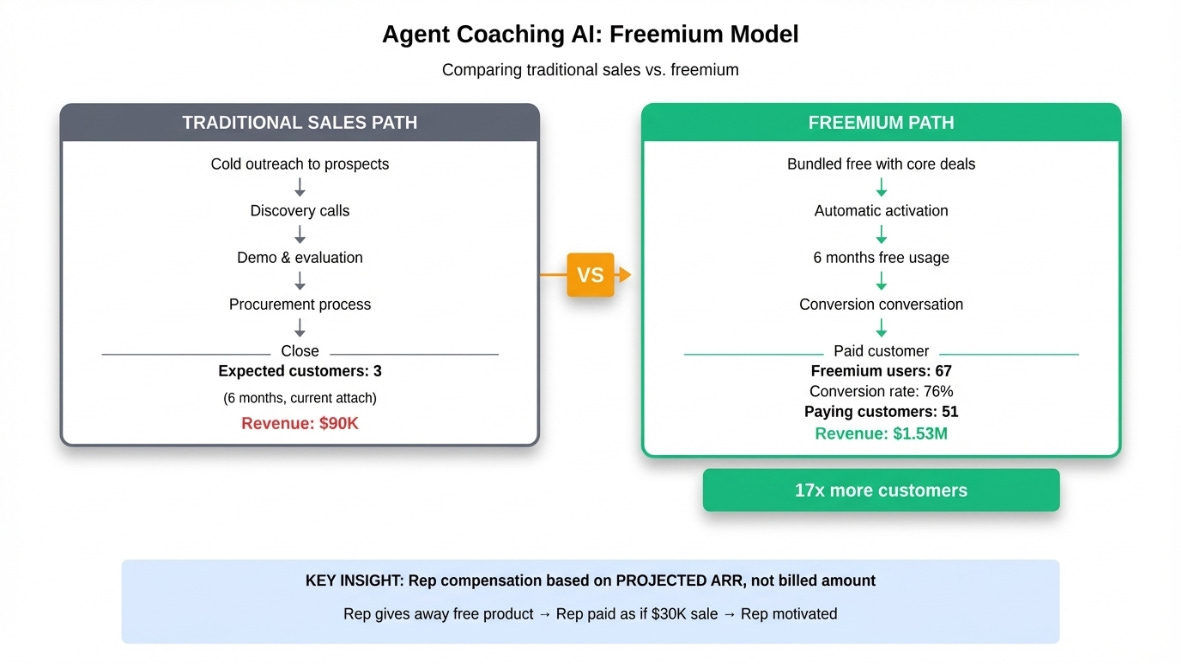
“Not forever. For six months. A Freemium to Premium model. Any customer who buys the core platform gets Agent Coaching AI included at no additional charge for the first six months. The hook is in. They start using it. They see value. When the six months are up, they’re paying customers.”
Derek looked uncomfortable. “That’s a lot of free product.”
“Is it? Let’s do the math. If we give away Agent Coaching to 50 customers over six months, and 40% convert to paid at the end. That’s 20 paying customers. At $30K ACV each, that’s $600K in new ARR at 84% margin. What would we have closed through traditional sales? Based on our current performance, maybe 2-3 deals. $60K-90K.”
“The freemium model generates 7x the pipeline.”
“But the reps,” Derek said. “They’re not going to want to give away something for free. There’s no commission on free.”
“There is if we create one,” Maya said. “We compensate the rep on the projected ARR of the Agent Coaching deal, not the actual billed amount. If a rep gives away Agent Coaching for free but gets the customer to commit to the product, they get paid as if it were a $30K sale. We’re signaling that we value adoption over immediate cash.”
“Sometimes the fastest path to revenue is through free. The freemium model isn’t charity. It’s market development. Pay your reps to build the market, not just harvest it.”
The Integrated System: Monday, 5:30 PM
Angela stood back from the whiteboard, which was now covered in boxes, arrows, and dollar signs.
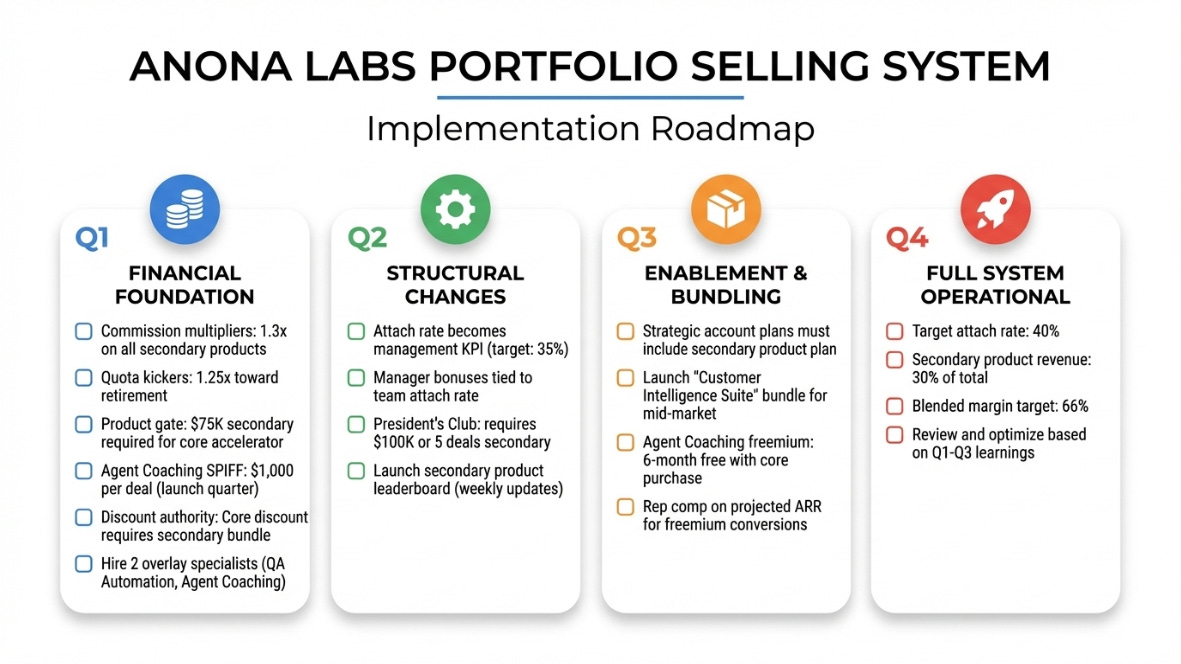
“Let me summarize what we’ve designed. This isn’t a campaign. It’s a system.”
She turned to the room.
“Does this seem like overkill? Because it’s not. Changing sales behavior is one of the hardest things a company can do. You’re asking people to work differently than they’ve worked for years. A single lever won’t do it. A campaign won’t do it. You need a reinforcing system where every signal: financial, structural, cultural points in the same direction.”
Derek exhaled. “It’s a lot to roll out.”
“We phase it,” Angela said. “Quarter one: financial changes and overlay specialist hires. Quarter two: management KPIs and President’s Club criteria. Quarter three: bundling and account plan requirements. By Q4, the full system is live.”
“And we measure everything,” Maya added. “Attach rate, secondary product revenue, conversion rates from freemium to paid, specialist-assisted close rates. If something isn’t working, we adjust. But we don’t bail on the system just because the first month is bumpy.”
The Announcement: Two Weeks Later
Derek stood in front of his sales team. 40 people in a San Francisco conference room, another 15 dialed in from New York.
“I’m going to talk about money,” he said. “Specifically, your money. And how you’re going to make more of it.”
The room got quiet.
“We’re making changes to the comp plan. Not because you’re doing anything wrong. You’re not. You’re crushing it. But the company has decided that portfolio selling, not just core platform selling is a strategic priority. And when the company decides something is a priority, the comp plan needs to reflect that.”
“Starting Q2, every dollar you sell of our secondary products: QA Automation, Predictive Escalation, Sentiment Analytics, Compliance Monitoring, and Agent Coaching counts 1.3x toward your quota. Sell $100K, get $130K of credit. That’s not a SPIFF. That’s not a one-quarter special. That’s the new normal.”
Murmurs around the room.
“Additionally, you won’t unlock your accelerators on core platform until you’ve sold at least $75K of secondary products. I know that sounds like a gate. Because it is. But here’s the thing: $75K is less than 10% of most of your quotas. It’s achievable. And once you hit it, your accelerators on everything kick in.”
“We’re also bringing on two specialists: Overlay Specialists, we’re calling them who will help you close secondary product deals. When they help you close a deal, you both get credit. No split. Double credit.”
A hand went up. “What if I don’t want to sell secondary products? What if I just want to sell core platform?”
“You can. No one’s forcing you to change. But you’ll be leaving money on the table. The reps who figure out how to attach secondary products are going to out-earn the reps who don’t. That’s by design.”
A younger rep in the back Sarah, one of the SDRs who had recently been promoted raised her hand.
“Can I ask something? Is this just about us hitting margin targets? Because I’ve been on calls where customers are struggling with QA issues, and I didn’t even know we had a product for that. I just... I just….I feel like we could actually help them if we knew our own portfolio better.”
Derek paused. This was exactly the point Anoop had made.
“Sarah, that’s exactly right. And I’m going to be honest. I wish I had framed it that way from the start. This isn’t about squeezing more money out of customers. It’s about actually solving their problems. Our customers come to us with pain. We solve one piece and call it a win. Meanwhile, they’re still struggling with quality issues, compliance gaps, agent coaching. All things we could help with.”
He clicked to a new slide showing customer data.
“Look at the numbers. Multi-product customers have 3x lower churn. Their NPS is 30 points higher. They expand faster. They refer more. That’s not because we’re good at upselling. It’s because we’re actually solving their problems. The incentive changes we’re making? They’re designed to align your compensation with customer outcomes. When customers win, you win.”
Another hand. “What about President’s Club?”
“New criteria. Starting this year, you’re not eligible unless you’ve closed at least five secondary product deals or $100K in secondary revenue. Even if you’re at 150% of total quota. The message is: we want strategic sellers, not just volume sellers.”
Six Months Later: Quarterly Business Review
Angela stood at the front of the boardroom, presenting the Q3 results.
“I want to show you one chart,” she said.
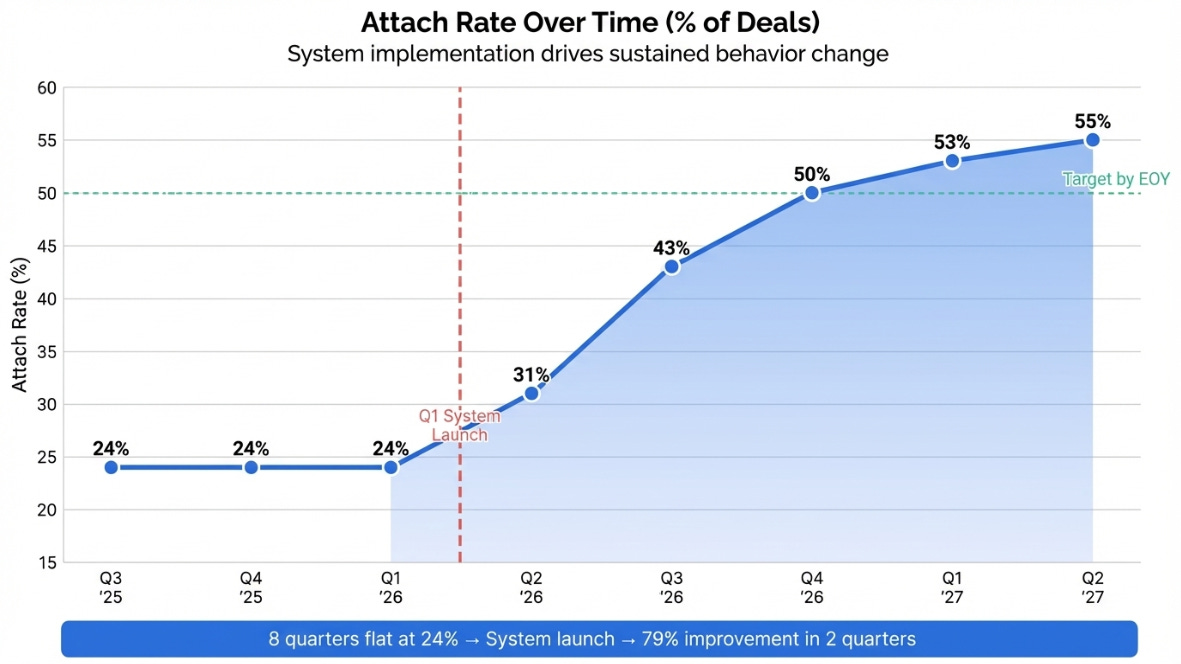
“Q1: 24%. Q2: 31%. Q3: 43%. We’re on track to hit 50% by end of year.
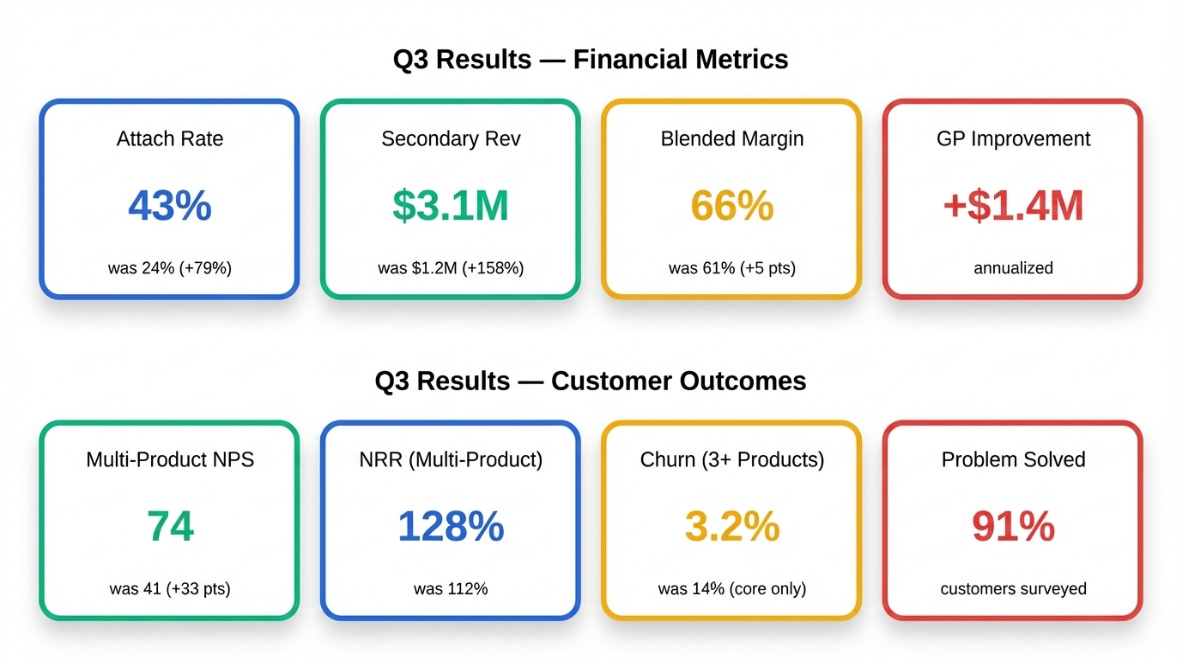
“Secondary product revenue: Q1 was $1.2M. Q3 is $3.1M. That’s 2.5x growth in two quarters, while core platform revenue grew at our normal 40% rate.”
“Blended gross margin: was 61%, now 66%. That’s $1.4M in incremental gross profit on an annualized basis. And we’re just getting started.”
Anoop leaned forward. “What about the Agent Coaching freemium experiment?”
Angela smiled. “I was hoping you’d ask.”
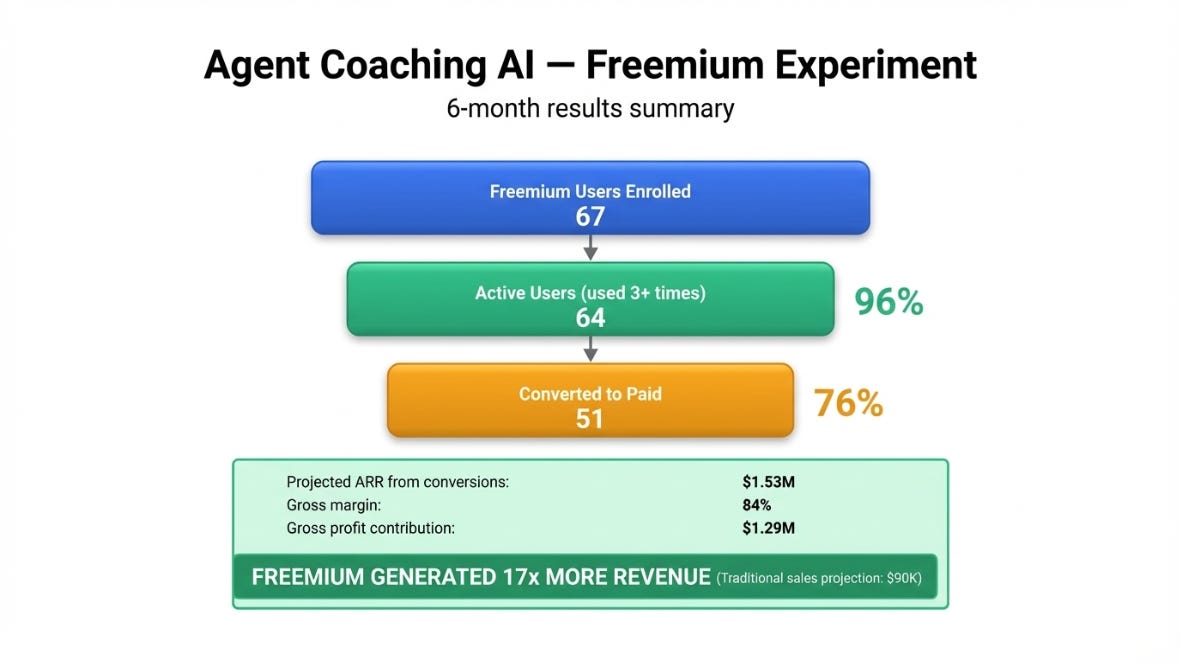
“We gave Agent Coaching away to 67 customers over the six-month freemium period. Of those, 51 are now paying customers. That’s a 76% conversion rate. Significantly higher than Anoop’s conservative 40% estimate.”
“Projected ARR from those conversions: $1.53M. At 84% margin, that’s $1.29M in gross profit from a product that had zero revenue twelve months ago.”
A board member leaned forward. “These financial results are impressive. But what about customer impact?”
Angela smiled. She had been waiting for this question.
“That’s the part I’m most proud of. Net Revenue Retention for multi-product customers is now 128% up from 112% a year ago. Churn on customers with three or more products dropped to 3.2%. And our NPS for multi-product customers hit 74 this quarter.”
She paused.
“But here’s the number that matters most to me. We surveyed customers who adopted secondary products this year. 91% said the additional products solved a problem they were already struggling with. They weren’t buying because we pushed. They were buying because we finally showed them something they needed.”
Anoop nodded. “That’s the whole point. We built these products because customers have these problems. We just weren’t connecting the dots for them. Now we are.”
The Real Lesson: Angela’s Office, After the QBR
Maya found Angela in her office after the board meeting.
“Congratulations,” Maya said. “The numbers are impressive.”
Angela shrugged. “The numbers are the result. The lesson is something else.”
“What’s that?”
Angela gestured to the quote on her wall.
“We didn’t change the sales team. We changed the system they operate in. Same people. Same products. Different incentives, different structure, different enablement. And suddenly, behavior changes.”
“Sales reps aren’t irrational. They’re hyper-rational. They will always, always optimize for what you measure and reward. For two years, we measured and rewarded revenue. We got revenue. Now we measure and reward margin, portfolio selling, strategic accounts. And we’re getting those things.”
Maya nodded. “So the lesson is: don’t blame the salespeople. Blame the system.”
“The lesson is: if you want different results, design a different system. Campaigns are temporary. Systems are permanent. And permanent behavior change only comes from permanent systems.”
She paused.
“The Blitz was useful as a learning moment, a kickoff, a cultural signal. But the Blitz didn’t change behavior. The comp plan changed behavior. The specialists changed behavior. The management KPIs changed behavior. The President’s Club criteria changed behavior.”
“Everything else was noise. The system was the signal.”
Maya was quiet for a moment. Then she said: “There’s one more thing. Sarah. The junior rep who asked if this was just about margin targets. She closed more secondary product deals than anyone in Q3. I asked her why.”
“What did she say?”
“She said she stopped thinking about it as selling and started thinking about it as solving. Once she understood what each product actually did for customers, the conversations changed. She wasn’t pitching features. She was connecting problems to solutions.”
Angela nodded. “That’s the real lesson. The financial incentives got people to pay attention. But the customer outcomes are what made it stick. Reps who see their customers succeed, who get thank-you notes because they solved a real problem, they don’t need to be incentivized anymore. They’re believers.”
She looked back at the quote on her wall.
“We designed a system that aligned sales behavior with company economics. But it only worked because company economics were already aligned with customer outcomes. That’s the foundation everything else is built on.”
“The best incentive systems don’t just align sales behavior with company goals. They align company goals with customer outcomes. When you’re genuinely solving customer problems, the economics take care of themselves.”
Note: The characters and company in this story are fictional. The incentive design concepts: commission multipliers, overlay specialists, attach rates, SPIFFs, and freemium-to-premium models are real B2B strategies used across SaaS and enterprise sales organizations.