As human beings, we are hard-wired to stay included in the group. Our very survival as a species relies on this biological urge. As a group, we are protected. So while the literal threat of lions is long gone, our brains haven’t recalibrated. Any threat to our inclusion in the group, however subtle and innocuous, will activate our nervous system and send us into fight, flight or fawn.
In my 20 years in leadership, I’ve come to realize that our composure under this threat response is extremely fragile. Becoming anti-fragile in this domain takes tons of uncomfortable practice. Something many of us, sheltered behind our keyboards, aren’t willing to do. It is, in essence, the modern day equivalent of standing up to lions.
It may surprise you how little it takes for people to get dysregulated from a perceived threat. For them to stay quiet in a meeting room in order to preserve the peace, to say they agree with a decision when they really don’t, or to quickly become defensive when challenged on their views. It can be triggered by a subtle glance, tone of voice, or accidental exclusion from an email thread. It happens to all of us, all of the time. No human being is immune to this.
These responses don’t occur in isolation. We can be primed to be more sensitive to these social cues depending on what is going on in our lives outside the office, as well as by how our emotional needs were met as children. This isn’t a bug. This is a feature of our social brains and it serves a very useful function. Without it we would all be out to serve our own interests and desires, and be completely unconcerned with the consequences our actions have on others.
But having this feature does not mean it should dominate how we behave in every situation. In the modern workplace, a dissenting opinion is rarely a threat to our survival. It is possible to modulate our response to perceived threat, to consciously choose not to identify with the emotions coursing through our veins. By doing so, we can remain open and connected, and capable of contributing our absolute best.
Because the activation triggers are very sensitive, it is up to the leader to deliberately design the conditions for productive dissent. The leader needs to be fully aware that this feature is enabled by default in every member of the team, including themselves, and that in order to bring out the best possible performance of the team, healthy dissent has to be cultivated carefully, strategically, methodically.
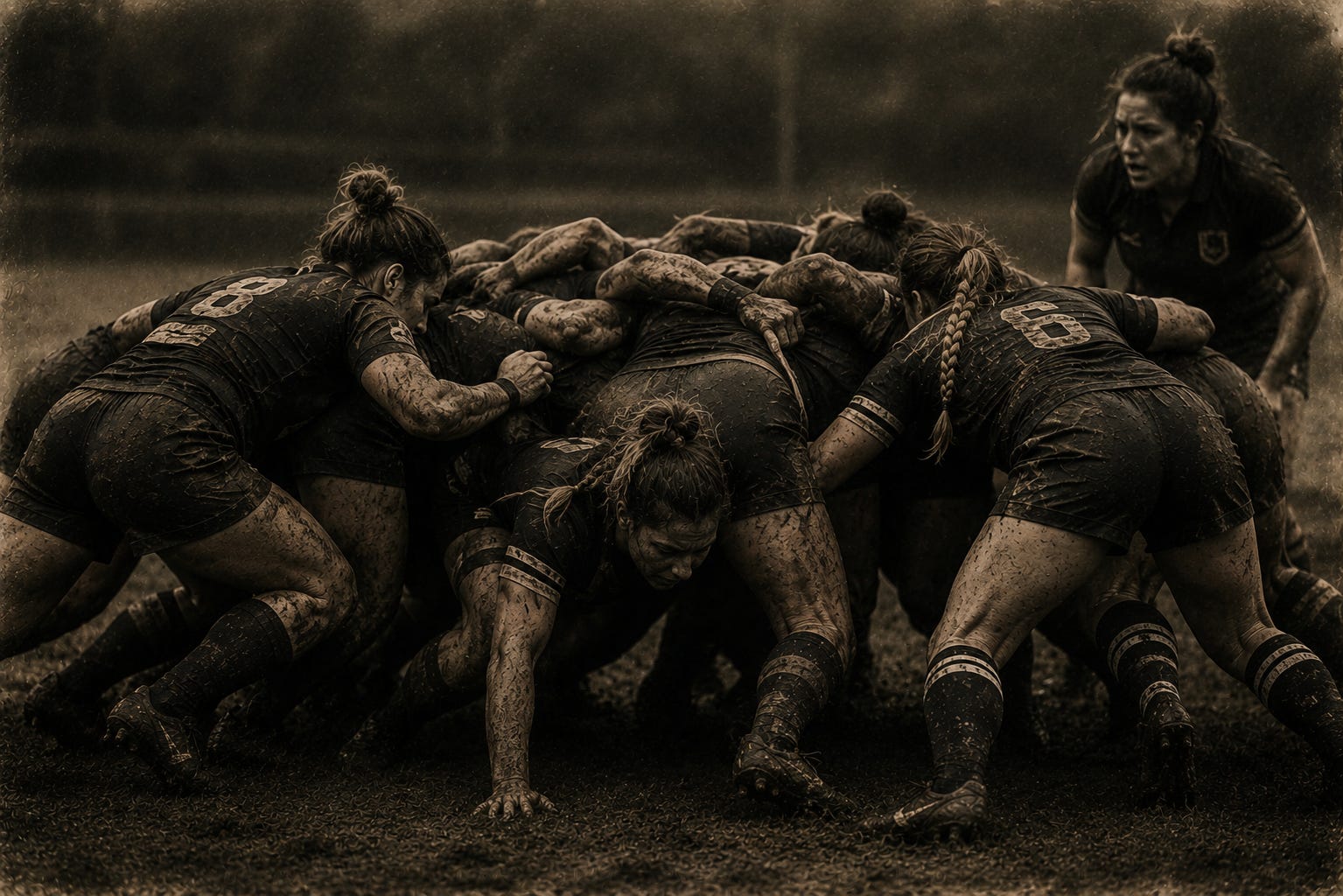
Dissent is a gift, and like coaxing a seedling from the earth, a leader can use a few practices to help it emerge. But these practices must be applied in the right order to be effective.
To bring out productive dissent in a team, a helpful model to apply is the PCP Model. The PCP Model (perspective, context, permission) is a behavioural influence framework popularized by Chase Hughes, a behavioral profiling specialist with a background in military operations and specialized tactical psychology. It explains how human decisions unfold sequentially. First you change people’s perspective. The change in perspective shifts the context. When the context change has been internalized, it gives people permission to take action.
Many leaders fail at creating the conditions for healthy dissent because they jump straight to step three of the model, often pleading: “please speak up and voice your honest opinions”. While well-intentioned, this is one of the subtle psychological triggers that activate our threat responses. It makes people anxious. And in this anxious state, the natural human reaction is to fawn, resulting in false harmony and fake agreement.
Instead, the first step is to methodically dismantle the fear of social isolation and retaliation.
It’s often said that a great leader is a “repeater-in-chief”. And there is a good reason for this. People naturally suffer from cognitive drift. Under stress or routine, our perception of reality defaults back to personal survival and siloed thinking. We do this to preserve energy. By constantly repeating “why we’re here” and “what we are trying to do”, a leader anchors the team’s perception of reality, aligning individual actions into a cohesive system rather than a series of disconnected tasks.
Beyond broadcasting the strategic fundamentals, leaders must also actively dedicate space to uncover each member’s current perspective and view of reality. This not only makes it easier to synthesize perspectives into a shared worldview, it also builds trust by making people feel genuinely seen and heard.
Once the team’s perspective is aligned, the unspoken rules of the environment have to be re-written. Perspective dictates what things mean, but context dictates what behaviours are normal and expected. By deliberately altering the context, the leader can remove the social friction of speaking up. This means the path of least resistance and energy conservation is no longer to stay silent, but to voice a critique. Silence should feel unnatural.
There a three key ways to do this:
Run a pre-mortem: instead of open-ended questions, force the entire room into a failed future: “assume this project has completely failed in six months. Write down exactly what killed it.”
Dismantle the hierarchy: the mere presence of a leader in the room carries psychological weight. You can alter this context by passing the facilitation role to a junior colleague or by requiring everyone to submit critiques anonymously via sticky notes. And most importantly, the leader must always speak last. When you speak first, you inadvertently anchor the room; when you speak last, you allow alternative perspectives to emerge unfettered.
Assign the role: formally appoint a “devil’s advocate” or “red team” for the meeting and rotate this duty regularly. When dissent is a formal job assignment, interpersonal friction dissipates. The team member is no longer attacking a colleague’s idea; they’re simply executing their systemic role.
The final step is to give the team a green light to dissent. Many leaders mistake this as a passive policy. But permission is an active extraction. Since people are hard-wired to preserve peace and seek consensus, the leader has to use their authority to explicitly mandate the dissent the meeting was designed for.
There are a few key ways to do this:
Replace passive prompts with direct commands. Instead of “what are your thoughts?” say: “let’s come up with three ways this will blow up in our faces” or “let’s find the flaws in this data”.
Reward dissent: the exact moment the first person voices a dissenting opinion, the entire room will look at the leader for their reaction. This is the moment to give positive praise and acknowledgement for contributing their contrarian point of view. By rewarding the pioneer with praise, you give permission to the rest of the group to follow suit with zero risk.
Refuse quick and easy agreement: if the team aligns too quickly with no one offering a challenge or alternative path, reject their decision. Force them to articulate at least one fully formed alternative path before making a final decision.
By systematically pulling the levers of perspective, context and permission, a leader can transform dissent from a scary professional risk into a celebrated systemic requirement. You stop having to beg people to speak up and instead build a structure that naturally extracts your team’s best thinking.
Refusing quick and easy agreement is the hardest practice on the list, because it means slowing the room down at the exact moment everyone wants to converge. Most leaders won’t do this consistently and most teams won’t ask them to.
Afoot makes that moment structural. It captures what a team decided and reflects it back for confirmation, which turns agreement into something a team has to actually give rather than something the meeting assumes.