Everyone’s got a plan until they get punched in the face.
Take this blog. When I sketched out the initial pieces around AI risk, OpenAI didn’t even feature. We’re now eight articles deep and I’ve only covered three of the original list. I had to do Skynet twice.
Thus, I empathise with OpenAI CEO Sam Altman’s predicament. OpenAI’s founding ambition was to create AGI for the benefit of all mankind. Along this path, the company has had to make many compromises, deals, and pivots. OpenAI’s critics say this is a betrayal. Others say it is expected.
There is, however, a gauge: values. Is Altman still acting in accordance with OpenAI’s aspiration to elevate humanity with AGI? Or has the economic reality forced him to break his oaths around AI safety and usher in AGI not for man, but for profit?
At what point does a hero’s journey become a villain’s arc?
When OpenAI started, it was founded as a non-profit organisation with a simple goal: to deliver AGI safely.
This was the era of the AI Jedi.
Altman and his fellow co-founders cared passionately about AI safety. AI ethics was largely theoretical, positivity about the potential for AI was high, and Elon Musk was considered a real-life Tony Stark.
In Oxford, impactful AI spinouts emerged. Caristo could spot a heart attack years before it happened. Brainomix was making advances in stroke diagnosis where seconds count. Latent Logic (now Waymo) spun up simulated worlds to train autonomous vehicles, while Oxa was putting them on the road.
In 2017, Google changed the game when it published the paper Attention Is All You Need, ushering in the transformer era. At Oxford Nanopore, transformers enabled its machine learning team to build the Dorado basecaller, massively improving accuracy and making its molecular sensing platform a true competitor to legacy DNA sequencing. At OpenAI, the technology opened the door to Large Language Models (LLMs).
Altman, Musk and others viewed Google as a bad actor. They saw beating Google as critical for the survival of the human race. This is not an uncommon driver in AI. Demis Hassabis at DeepMind wants to solve intelligence so it can solve every other problem. Dario Amodei founded Anthropic to battle perceived misalignment at OpenAI. Musk, too, has a saviour complex – albeit one that stems from snorting ketamine while mainlining Mein Kampf.
As Altman would soon discover, the road to Hell is paved with good intentions.
30 November 2022, ChatGPT 3.5 launched. I remember it well as I was having a tall, stiff drink at the time, prematurely mourning the loss of my writing career.
As ChatGPT raced to become the fastest growing tech platform in history, the accessibility doors had been blasted wide open, allowing non-technical folks to get hands on with AI. Unlike other tech fads such as crypto, the usefulness of LLMs was instantly both recognisable and tangible. As growth went stratospheric, OpenAI needed to scale fast.
It is in this struggle between maintaining trajectory and ensuring safety that Altman’s values began to be tested.
Prior to launch, tensions had already started to boil over internally. Disagreements over safety had formed tribes within OpenAI – some favouring for-profit, others maintaining that not-for-profit remained the most responsible strategy. This led to Amodei and others leaving OpenAI in 2020 after Altman accepted $1bn from Microsoft, citing concerns over the deal’s implications for OpenAI’s mission.
Altman’s courting of Middle Eastern sovereign wealth funds was considered a black mark internally. Safety-minded staff considered his promotion of CustomGPTs and handling of chain-of-thought reasoning models (the ‘o’ series released a year later) as reckless. This led to a mutiny. In late 2023, OpenAI’s chief scientist Ilya Sutskever successfully pulled off a board coup, leading to Altman’s departure.
Sutskever would not have much opportunity to celebrate with the Ewoks.
Notified just one minute before news of Altman’s dismissal went public, the Microsoft Collective promptly assimilated Altman. A counterinsurgency formed within OpenAI, with many staffers announcing support of Altman and threatening to join him in the collective. Forced to the negotiating table, Slopcutus of Nadella told Sutskever’s Rebel Alliance that “Resistance is futile”.
Within a month, Altman was back in charge of OpenAI.
Upon his return, OpenAI’s commitment to the safe development of AGI rapidly began to erode. On 10 January 2024, the company’s ban on military use and weapons development was lifted. Its superalignment project, dedicating 20% of its resources to safe implementation of AGI, was killed off with Sutskever. Revelations about OpenAI’s non-disparagement clauses appeared. Concerns over safety and trust continued to further gut OpenAI’s leadership throughout the year.
At the core of the conflict is how the company is structured. Formed as a non-profit, Altman changed its founding principles in 2019 so that profit would not exceed investment by a factor of 100. This is where the fracture lines began to form. Where the truly seismic rifts emerged is from the move to being truly for-profit.
An idealist would say that OpenAI should remained tied to its utopian vision. A pragmatist would retort that for-profit is necessary to meet the pace its own technology has set.
In a perfect world, nation states would be cognizant of the issues we face as a society and honest about their inability to address them. This would lead to a massive commitment to AGI as the nearest and best hope of resolving the catastrophe which awaits us in the decades ahead. Sadly, we are far from perfect.
Compromises therefore must be made. Hassabis knew that to access the resources to scale DeepMind, he had to accept the Google acquisition. Amodei did not flirt with the non-profit model, opting to adopt a for-profit B-corp guided by public benefit and values. Sutskever’s Safe Superintelligence Inc has failed to achieve anything beyond losing its co-founders to Meta.
In Altman’s case, compromise has become full abdication of responsibility. Its handling of the 4o model – where evidence of its sycophantic nature leading to user harm has mounted - should’ve led to its axing months ago. Instead, we only saw the firm sunset it in February 2026. This isn’t responsible handling of AI, but the same optimised-for-engagement nightmare that Mark Zuckerberg created when he unleashed the Pay-Per-Click Maximiser into our lives.
The turn to advertising should be deeply concerning. If AI can be engaging and persuasive, as 4o was, then it can definitely influence buying decisions. Platforms such as Facebook are now inundated with scams, driven by malevolent use of AI. Combined with how personal interactions with AI have become for many, Altman’s decision to place ads in ChatGPT recklessly endangers his userbase.
OpenAI has ended up in a quasi-state between a public interest company owned by a charity and a hyper-capitalistic corporation guided by profit. It is a compromise on paper – one which complicates its looming IPO – but it is the wolf of wall street in sheep’s clothing.
Altman’s pursuit of growth over safety also now threatens the economy. OpenAI, Oracle, Microsoft and Nvidia are now deeply in each other’s pockets. The maths around these bets is predicated on two things:
OpenAI becomes the most substantial and significant company to have ever existed.
It does this by replacing vast swathes of jobs.
It’s either win big by taking everyone out of work or fail spectacularly and risk an economic meltdown that blasts straight through the brittle foundations the rest of the financial system is currently built on.
Either way, the average person – the people OpenAI was founded to elevate – will lose.
In recent days, we’ve seen genuine leadership and commitment to safety in AI, but not from Altman. When the fascist cabal in the White House told Anthropic to either lobotomise its model Claude or face the wrath of 4-Star General Asskisser Hegseth, they chose pain.
As soon as the hammer came down, Altman swooped in to take Anthropic’s place, joining MechaHitler at the side of Darth Mango. While OpenAI has said it has red lines of no autonomous weapons or mass surveillance, Altman’s one rule now is that he is prepared to cross any line to realise his goals. These goals are evidently no longer aligned with humanity, but his shareholders.
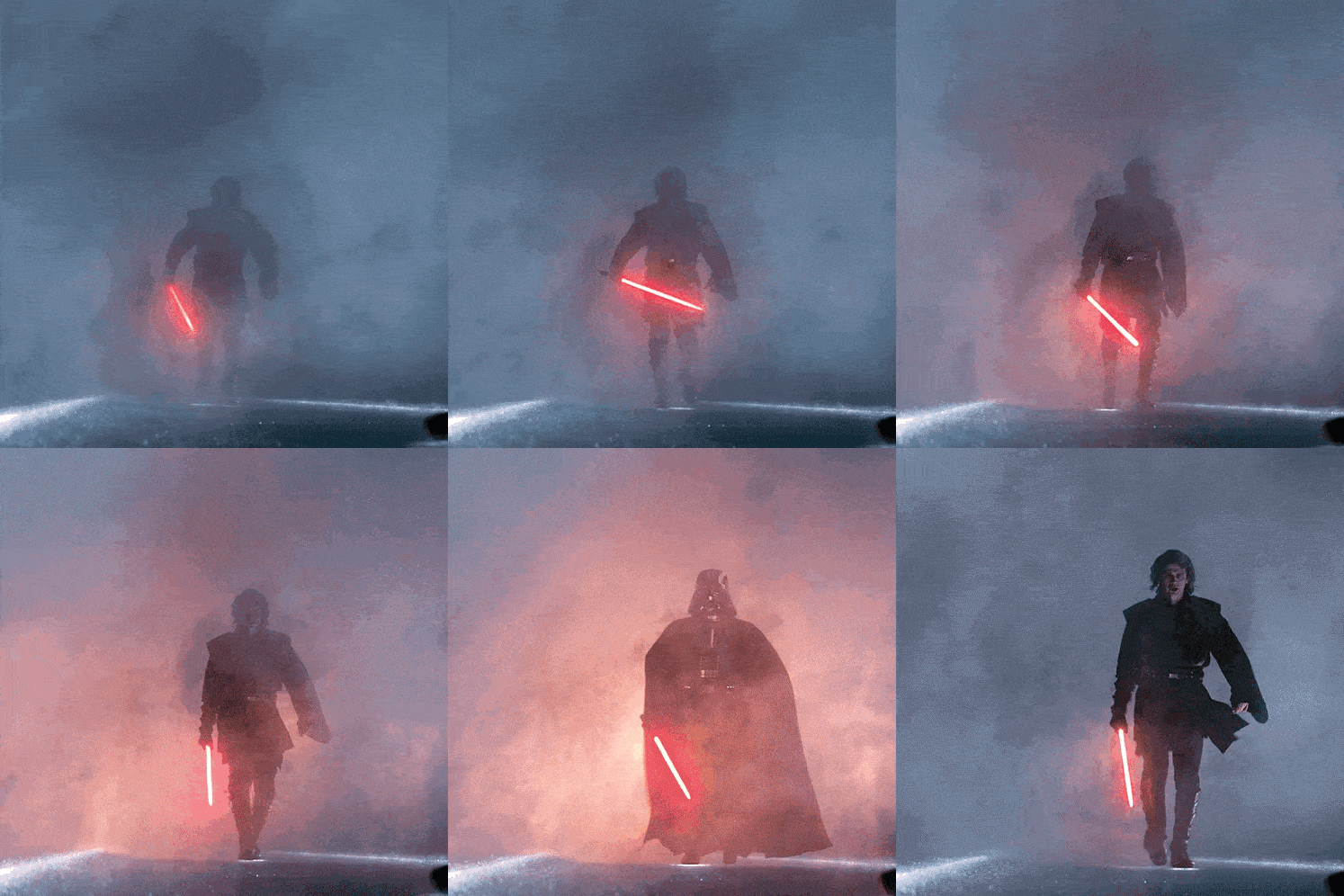
Samakin Altwalker’s fall from Jedi to Sith Lord now imperils his userbase, his company and those intertwined with OpenAI, and society at large.
Users experience legitimate harms due to zero enablement for the public while failing McKinsey gets a bung to service the corporate world’s elite. The economic bomb Altman has created is only defused if he wins outright. Any company built on Microsoft, Oracle or OpenAI technologies could go down with the ship. If Altman does win – and the odds look increasingly slight - millions become economically displaced by a technology they didn’t ask for or consent to.
There are, however, developers of AI with AGI aspirations which give me hope. In saying no to Trump, Amodei has demonstrated he has a spine and his values are intact. The Claude offering is also legitimately great – Opus 4.6 is a remarkable model, Claude Code allows users to create their own bespoke software, and Cowork achieves the vision of Microsoft’s Copilot – something the collective is nowhere near to doing themselves.
Hassabis remains true to his guiding mission of fixing intelligence to save mankind. Deepmind’s Gemini 3.1 is the smartest model on the planet at time of writing – offered at a 1/7th the price of Opus – and backed by an incredible suite of tools from Google which trumps anything OpenAI or Microsoft have to offer.
I urge anyone reading this blog – either as an individual or as an organisation – to consider jettisoning OpenAI and Microsoft. They are actively endangering you as a user in pursuit of profit.
AI is the Force. It can grant users incredible ability. But as I’ve said countless times before, the difference in outcomes is entirely dependent on your approach.
“Remember, a Jedi’s strength flows from the Force. But beware: Anger, fear, aggression – the Dark Side, are they.”
If you’ve got any questions about switching, hit me up in the comments or via DM. Full disclosure: I use Claude and Gemini extensively in my own work, so take the endorsement with appropriate Bayesian priors — but the reasons I use it are the same reasons I’m recommending it here.
As always, a like, share or subscribe is always welcome.