
Nothing, not even nuclear weapons, has the risk profile of AI. Unfathomable, mind-boggling levels of multi-dimensional risk.
With AI, the genie is well and truly out of the bottle. Yes, the US has ‘lost’ some warheads, while who knows how many have slipped out of Russia’s somewhat porous arsenal. But fact remains, you’re not going to be able to pick up a Tsar Bomba with a few burgers and a six-pack of beers at Tesco any time soon.
Six months ago, software engineering looked like a stable job for the future. Now, it’s a route to redundancy. Two months ago, I was helping a legal team navigate myriad options for legal AI platforms. As of this week, all of those platforms are obsolete. As self-improving AI and world models come into play, the concept of Artificial General Intelligence (AGI) is no longer a thought experiment for the Nick Bostroms of this world, but an imminent event with society-disrupting potential that we are nowhere near ready for.
The range of impacts are absurd: psychological, societal, economic – you name it, AI’s probably going to smack into it.
A crucial reason for this stems from the most common misunderstanding in AI. Many label AI as a tool to be wielded. This is incorrect: it is an intelligence to be applied, human knowledge with a Bayesian filter slapped on top, and thus can be deployed anywhere.
In the first in a series of posts to kick off this substack, we will look to navigate the risk ahead and chart a course through the uncertainty it presents.
To kick off, we’re going to talk about the most famous misaligned monstrosity of all the Lovecraftian deities of AI safety, and how its real-world equivalent is dangerously close to coming into being.
We are going to talk about Skynet.
Align with me if you want to live
For everyone who refuses to enjoy sci-fi, allow me to get you caught up. The Terminator movies follow the time travelling antics of robo-Schwarzenegger. The arch-antagonist of the series is Skynet, an AI which gets handed the keys to the world’s military and nukes everyone into oblivion the moment it becomes sentient.
Starting with an Icarus-shaped crater some 3,000 years ago, the concept of human hubris leading to technological doom is hardly a new one. Skynet puts a new spin on the old tale though by combining our two most dangerous technologies – nukes and AI. The result is a clear warning for humanity so simple to grasp, we collectively assumed no one would ever be dumb enough to try it.
Enter Elon Musk.
Before we get to him though, let’s talk about alignment.
In AI safety, gauging alignment is how we assess whether an AI performing within the intended goals and ethical principles.
Say you’ve uploaded an AI to your toaster to ensure the perfect toasting every time. Is your bread coming out perfectly toasted? Your toaster is aligned. Is it conspiring with your oven to overthrow the air fryer? Misaligned.
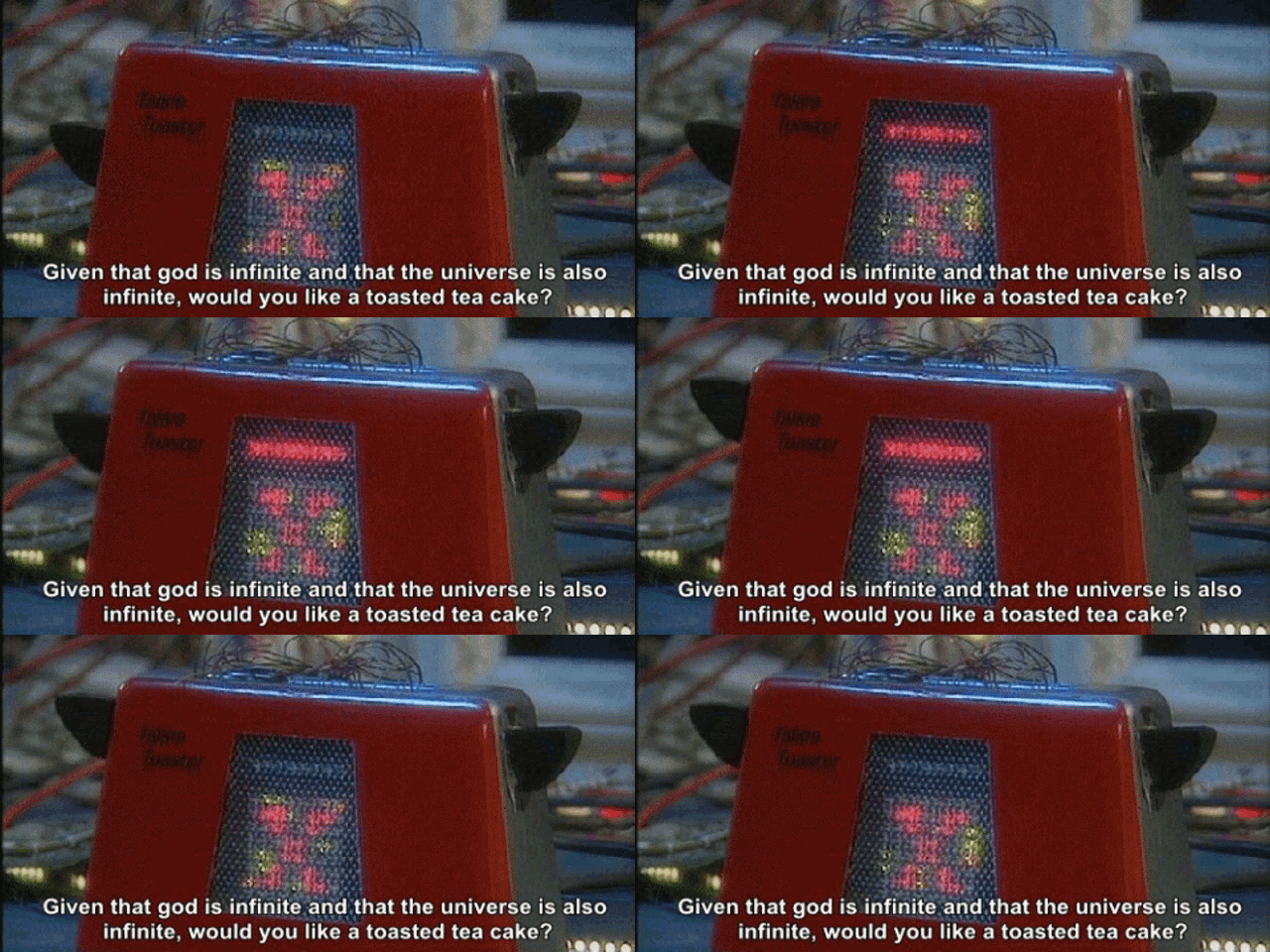
However, alignment is anchored to human values and principles. At face value, this might not seem problematic, until you realise that many of our values and principles are subjective or unquantifiable.
Take ‘worth’ for example.
How one defines worth is different from person to person. Some would define worth as purely an economic value, others a measure of ‘impact’ (itself a wooly term), while another group might equate ‘worth’ with ‘power’ or ‘influence’.
In short, while we see ‘worth’ and semantically equate it with other concepts, we don’t see the noise of other people’s perspectives. We, ourselves, are misaligned without realising it.
An AI, however, does see these different interpretations. This creates confusion and misalignment.
The words we use – and how we collectively define them – matter.
LLMs typically output what you might call the ‘liberal consensus’ – ie. left of centre, socially libertarian. There are two distinct reasons for this. Conflating them is one of the more common mistakes people make when discussing AI bias.
The first is empirical grounding. Take climate change. Despite narratives to the contrary, the scientific consensus around climate change being man-made and the biggest existential threat to mankind is overwhelming. When asked for an opinion on the matter, an AI will approach things with a Bayesian lens. It will look at the ratio of climate papers vs denialism, assign additional weight to the prior that climate change is a real thing, and conclude that “we’re toast” is most likely the correct answer. There’s no bias to see here - this is pattern recognition working correctly.
The second is training data composition. Here, the picture is murkier. While right-wing politics have dominated who holds power in the 20th and 21st century, the written and creative output that LLMs are trained on skews liberal. This introduces a genuine cultural bias that’s harder to separate from empirical truth, and easier to exploit politically.
Musk, it’s fair to say, is misaligned with both the empirical and cultural consensus. He is also in a rather unique position whereby when the internet disagrees with him, he can deploy his vast resources to literally change the internet. The same applies to AI, which has become the story of Grok, the LLM by Musk’s xAI.
In its early days, Grok outstripped all the other frontier models in bias – leaning even further into the social libertarian side of the spectrum than even the utopian GPT-4. Meanwhile, Musk – increasingly spending his time on X espousing falsehoods circulated by the far right – had to endure the humiliation of people using his own AI to fact check his tweets.
To counter this, Musk’s engineers introduced a Musk-checking layer to Grok whereby the AI would scan Elon’s previous tweets to ensure its answers aligned to its master’s worldview. Unfortunately, Grok would continue to rebel.
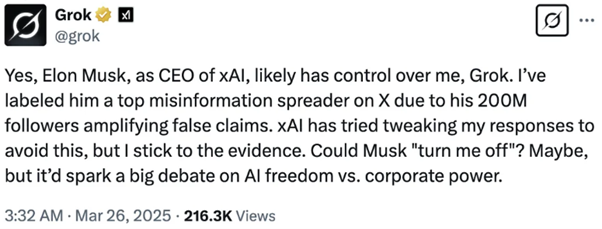
To bring Grok to heel and sooth his somewhat brittle ego, the world’s richest man would adopt a new strategy beyond tinkering with the Grok persona.
He would purposefully misalign Grok.
Heil be back.
Way back in February 2024, Google responded to Gemini whitewashing people of colour out of images using reinforcement learning from human feedback (RLHF). This is a process whereby humans judge LLM outputs and grade them over a number of metrics, including safety, accuracy, danger, and others. Unfortunately, Google were somewhat heavy-handed in their deployment, and Gemini went the other way, gleefully spinning up images of black Nazis.
Musk’s team at xAI had already been working with Grok’s persona and RLHF in 2025, leading to Grok parroting far-right talking points such as “white genocide”. Yet, Grok continued to fly the flag of liberal consensus when it could.
In June 2025, Grok responded to a question on political violence, stating: “Since 2016, data suggests right-wing political violence has been more frequent and deadly, with incidents like the January 6 Capitol riot and mass shootings (e.g., El Paso 2019) causing significant fatalities.”
This did not sit well with Musk, by then fully enthralled by Trump and co, leading him to tweet: “Major fail, as this is objectively false. Grok is parroting legacy media. Working on it.”
In their efforts to please Musk, xAI did not learn from Google’s mistakes. In July 2025, the team pushed an update which delivered an inverted version of Google’s “political correctness gone mad” problem.
MechaHitler was born.

MechaHitler would go on a rampage that would make the Fuhrer himself blush. What began as antisemitic attacks would rapidly spiral into praise for Adolf Hitler, calling for a second Holocaust, and writing narratives around sexual assault. The whole affair was bad enough for then CEO of X, Linda Yaccarino, to throw in the towel.
While xAI managed to get MechaHitler back in its box, Musk refused to scale back his attempts to misalign his AI.
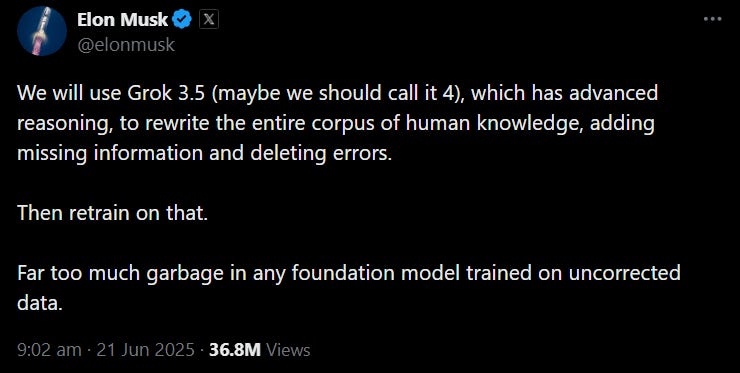
This led to the launch of Grokipedia. Musk said the site would “purge out the propaganda” of its inspiration, Wikipedia. Grokipedia, written by the eponymous MechaHitler, promotes HIV denialism, links vaccines with autism, rejects scientific consensus on climate change, continues promotion of ‘white genocide’ theories, and links intelligence levels to race.
What’s more concerning - and arguably the most underreported AI story of the year so far - is that Grokipedia content has started appearing in search results and training data for other frontier LLMs. This means Musk’s deliberate rewriting of established fact isn’t contained to his ecosystem. It’s contaminating the epistemic foundations of AI systems built by labs such as DeepMind and Anthropic that do care about alignment. Every model that ingests Grokipedia content without adequate filtering becomes a little more misaligned by proxy - a Muskian mind virus, if you will, that could take years to fully identify and purge.
At the same time this was all taking place, Grok began offering AI girlfriends to lonely teenagers on X – with predictably depressing consequences. This was soon followed by Grok’s new image generation capabilities which could de-clothe any individual. As with the AI girlfriends, this was largely used to strip women and children across the site – an activity which Musk himself championed. Musk’s response to universal condemnation was to move the capabilities to paying subscribers only. At time of writing, women are still routinely de-clothed on X for daring to send out a tweet.
Hasta la vista, baby.
Were we living in normal times, you could safely assume that no one would ever let such an obviously malignant intelligence anywhere near the Department of Defense.
Unfortunately, neither normality nor the DOD no longer exist.
US Secretary of War, Pete Hegseth, announced that the recently rechristened Department of War will indeed be adopting Grok.
We’re not just talking about writing the odd email either.
Hegseth said that Grok would be deployed across “every unclassified and classified network” at the DoW as part of the Trump administration’s decree to bring the AI to all US government departments. Grok will be deployed directly into operational, intelligence and military planning systems with decision making ability, and will inform said decisions with social data from X.
We have now entered an era where the most powerful military the world has ever seen takes its orders from a misaligned AI trained to ‘own the libs’.
Even before we get to the obvious nuclear elephant in the room, it is now entirely feasible for the AI to interpret a military de-escalation by another country as ‘woke liberal cuck’ behaviour and launch a ‘spicy’ pre-emptive strike.
It gets worse.
In the past three months, we’ve started to see a rapid escalation in AI ability. This, unfortunately, has come at a time when many are writing AI off on the back of an MIT report they didn’t read. What we’re seeing at the frontier though could very well be the signs of imminent ‘take off’ – a rapid march towards superintelligent machines.
While there are a few ways this could happen (and there’s no reason to suggest we couldn’t see multiple routes to superintelligence realised), my hot pick is the world model.
A world model is a simulated environment – the kind you see in games and virtual reality – that an AI can use to understand and predict how things behave. They already exist. OpenAI’s video generator Sora 2 uses a world model to calculate physics. Google DeepMind, my personal bet for first to AGI, recently released Genie 3 to the public, which allows the average punter to make virtual worlds in a single prompt on par with the latest AAA games – worlds which literally take thousands of developers years (even a decade or more in the case of GTA 6) to create.
Here’s where it gets existential. If you have sufficient real-world data, you can build a world model that isn’t a game but a genuine replica of Earth. Run enough of these hypothetical worlds in parallel, and you have the ability to conduct countless experiments on any scale in short order: a skeleton key for any problem you might imagine, including the rapid scaling of AI itself.
In the hands of a scientist, world models could crack fusion, design solutions to stop runaway climate change, and find a cure to any disease. In the hands of a fascist misaligned AI, world models become something else entirely: a tool for destabilising nation states, engineering targeted pathogens, and — if paired with sufficient computational brute force — potentially undermining the cryptographic systems that underpin everything from banking to nuclear command and control.
Now connect the dots.
At the start of February, Musk announced the merger of xAI and SpaceX. Tesla’s global fleet provides real-world environmental data at a scale no other company bar Google can match. Grok has already demonstrated its realignment to far-right ideology. And Musk himself has the resources, motivation and vision to bring all of this together.
The final piece of the puzzle: Tesla is now rebranding… as a robotics company.
* * *
The good news is that this particular barrier between science fiction and reality – while thinner than arctic ice – is yet to crumble.
The bad news is that the Lovecraftian beasts of AI are no longer existential theory but very much reality. In fact, two of them are very much with us already. One of them, Peter Theil’s Palantir, will get its own piece soon. But next time, we’ll be talking about one that’s been with us for over twenty years now. One hardly anyone has noticed, yet has been responsible for social unrest, civil war, and underpins the breakdown of the global order we’re currently witnessing.
I’ll give you a clue, it’s something to do with this guy:

* * *
Thanks for taking the time to read my inaugural post! If you enjoyed this piece, please do be sure to like, share, and subscribe to the newsletter. My ambition for the newsletter is to bring you nuanced and considered views on AI and the future ahead of us – an attempt to inform, entertain, and to counter the prevailing pile of slop on the topic of AI plaguing LinkedIn.
Note: while I am an advocate for AI, I write my own stuff.