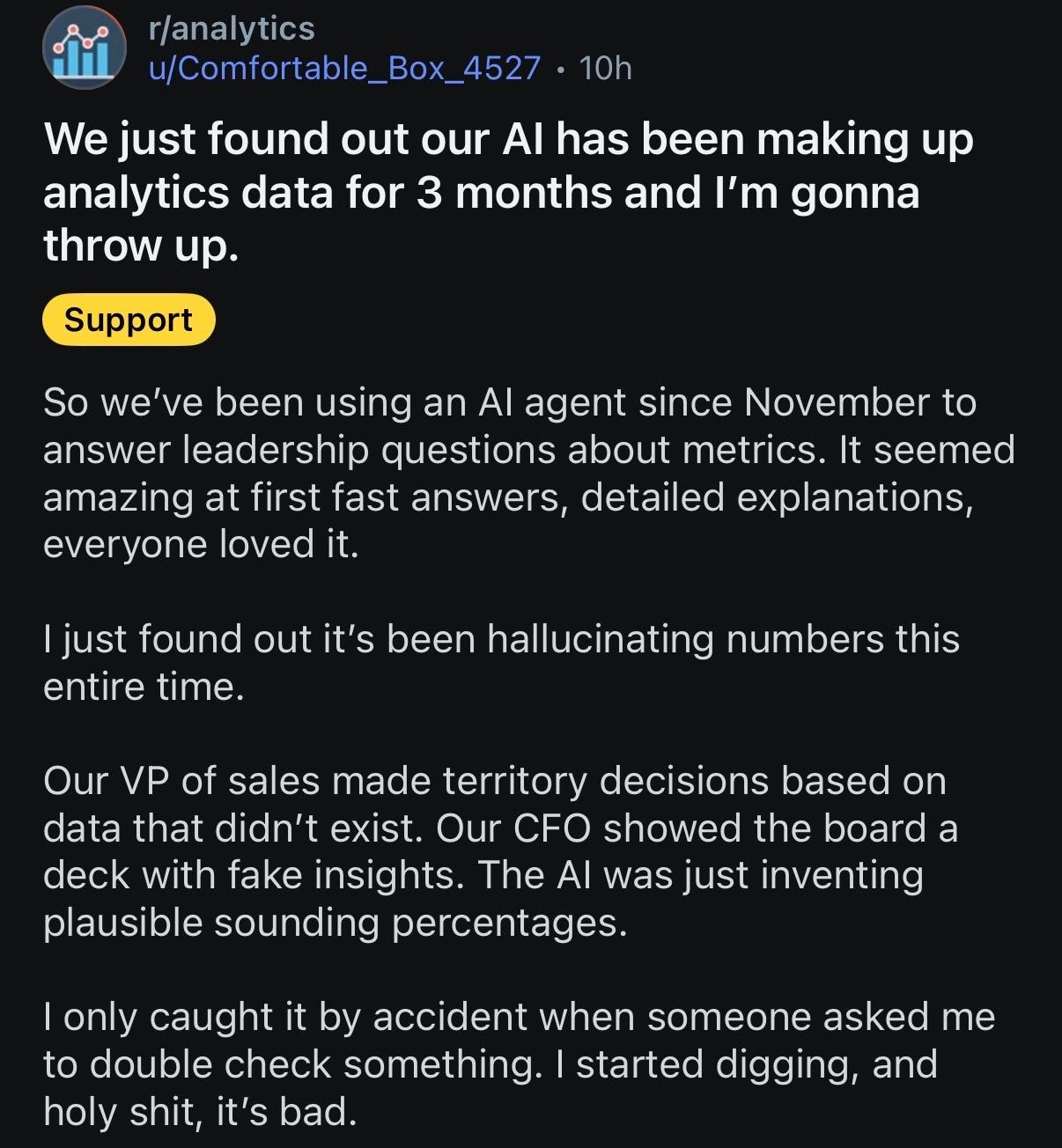
This image is every CTO’s nightmare and, frankly, a massive wake-up call for the industry. A VP of Sales making territory decisions on phantom data and a CFO presenting “plausible-sounding” hallucinations to the board is a systemic failure of design philosophy.
We need to stop building AI to replace functions and start building it to augment humans. Human in the loop is the only way to go for AI systems.
The word “hallucination” suggests a malfunction. In reality, LLMs are designed to be probabilistic engines. They are built to predict the next likely token based on patterns, not to verify “truth” against a database.
When an AI gives you a beautifully formatted, highly confident percentage that happens to be wrong, it is doing exactly what it was trained to do: generate plausible text. If we treat AI like a calculator, we fail. If we treat it like a highly creative, slightly overconfident intern who needs their work checked, we succeed.
The mistake made in the Reddit post was treating the AI agent as a sovereign decision-maker. Or believing the AI output blindly. When you build for replacement, you remove the friction of verification. You get speed, but you lose integrity.
Augmentation looks different:
AI: Aggregates data and suggests three possible interpretations.
Human: Reviews the source citations, validates the logic, and selects the path forward.
A robust AI system shouldn’t just deliver an answer; it should deliver a justification. If your AI agent provides a metric, the UI should mandate a “Show Your Work” feature.
Traceability: Every number must be hyperlinked to its raw data source. If the AI can’t find the source, it shouldn’t guess.
Confidence Scoring: Use “LLM-as-a-judge” or ensemble methods to flag when the AI is “unsure” of its own output.
Mandatory Verification: For board-level or territory-shifting data, the system should require a digital signature from a human analyst before the “insight” is cleared for export.
We are currently in an era of “AI Theater.” Companies are rushing to implement agents just to tell shareholders they are “AI-first.” But as the Reddit user discovered, a flashy AI system that lies is worse than no AI system at all. It creates a “trust debt” that takes years to pay back.
If your AI system doesn’t have a clear, friction-filled path for human intervention, you haven’t built a tool; you’ve built a liability. Let’s stop asking “Can AI do this?” and start asking “How can AI help us do this better?”