The previous blog established the “crisis” using Marx’s lens, the next logical step is to explore the “synthesis”, how we move past the conflict between the digital proletariat and the AI lords.
Today we expand on those themes, focusing on the unique nature of software and the physical constraints of hardware.
In my previous post, we looked at how AI giants are performing a “Primitive Accumulation” of our digital lives, fencing off the open internet to build proprietary models. If we follow Marx’s trajectory, this leads to a “Metabolic Rift” where the digital soil is depleted, and creators are alienated from their own data.
But there is a flaw in the historical analogy that offers us an exit: Land is finite. Software is not. While the physical Enclosure Acts of the 18th century took away a limited resource (acreage), the digital enclosure is trying to fence off something that can, in theory, be infinitely replicated. This is where Open Source AI becomes the “Negation of the Negation”, a way to restore the commons without falling into the traps of the past.
Marx’s critique of capitalism was rooted in the limitation of the Earth. If a Lord fences off a forest, the peasant cannot simply “download” a copy of that forest.
In the AI era, we have a unique advantage:
The Zero Marginal Cost of Reproduction: Once an AI model is trained and its “weights” (the learned intelligence) are released as Open Source, the “fence” vanishes.
Consumption by Everyone: My use of an open-source model does not prevent you from using it. We are no longer fighting over the same patch of grass; we are sharing a sun that shines on everyone simultaneously.
By open-sourcing model weights, we effectively “de-commodify” the intelligence that was gathered from our collective data. It is the ultimate act of digital restitution.
However, we must be intellectually honest. While software is infinite, the Means of Production for AI are not. We are seeing a shift from the enclosure of data to the enclosure of compute.
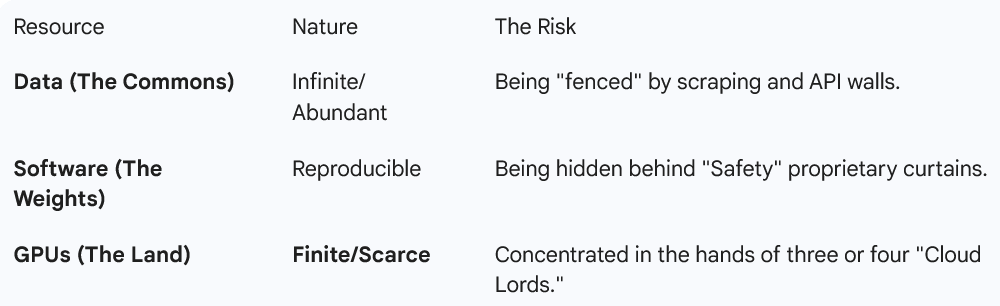
Even if a model is Open Source, the “Metabolic Rift” persists if only the ultra-wealthy can afford the electricity and silicon to run or fine-tune it. This is the GPU Scarcity. If Open Source is to save us, it must focus not just on open code, but on efficiency, making models small enough to run on “the people’s hardware” (consumer laptops and local servers).
If I was running AI policy in India, these are the two things I would be concentrating on:
Data collection efforts.
Funding R & D for coming up with more efficient models.
Open Source AI offers a “Third Way” that sidesteps the failures of the 20th century’s dominant systems:
In a purely capitalist AI 1.0, 4-5 companies control the “Base Models” of human thought. They decide what is “safe,” what is “true,” and they charge a rent (subscription) to access the intelligence we originally provided. Open source breaks this monopoly by distributing the capability to everyone.
Traditional state-led communism often failed because it centralized power in a different way, through a state bureaucracy that controlled the “Commons.” Centralized AI, even if “publicly owned,” risks becoming a tool for state-mandated thought.
Open Source is Decentralized. It doesn’t belong to a CEO, but it also doesn’t belong to a Politburo. It belongs to the protocol. It is the “Negation of the Negation”: a restoration of individual property (your own local model) on the basis of communal possession (the open-source repository).
The “Metabolic Rift” occurs when AI eats the internet and gives nothing back, causing “Model Collapse” as the digital soil becomes sterile.
Open source heals this by:
Transparency: We can see what data was used, ensuring “nutrients” are acknowledged.
Local Cycles: Instead of shipping all our data to a central “city” (the Silicon Valley clouds), we process data locally. The insights and value stay with the creator, much like the medieval peasant returning nutrients to their own local plot.
The enclosure is not inevitable. While the “Cloud Lords” try to fence off the GPU clusters and the data lakes, the Open Source movement is building a “Digital Commons” that is more resilient than the physical ones Marx studied.
By making AI small, local, and open, we ensure that the “Original Sin” of data scraping leads not to a new era of digital serfdom, but to a collective leap in human capability.