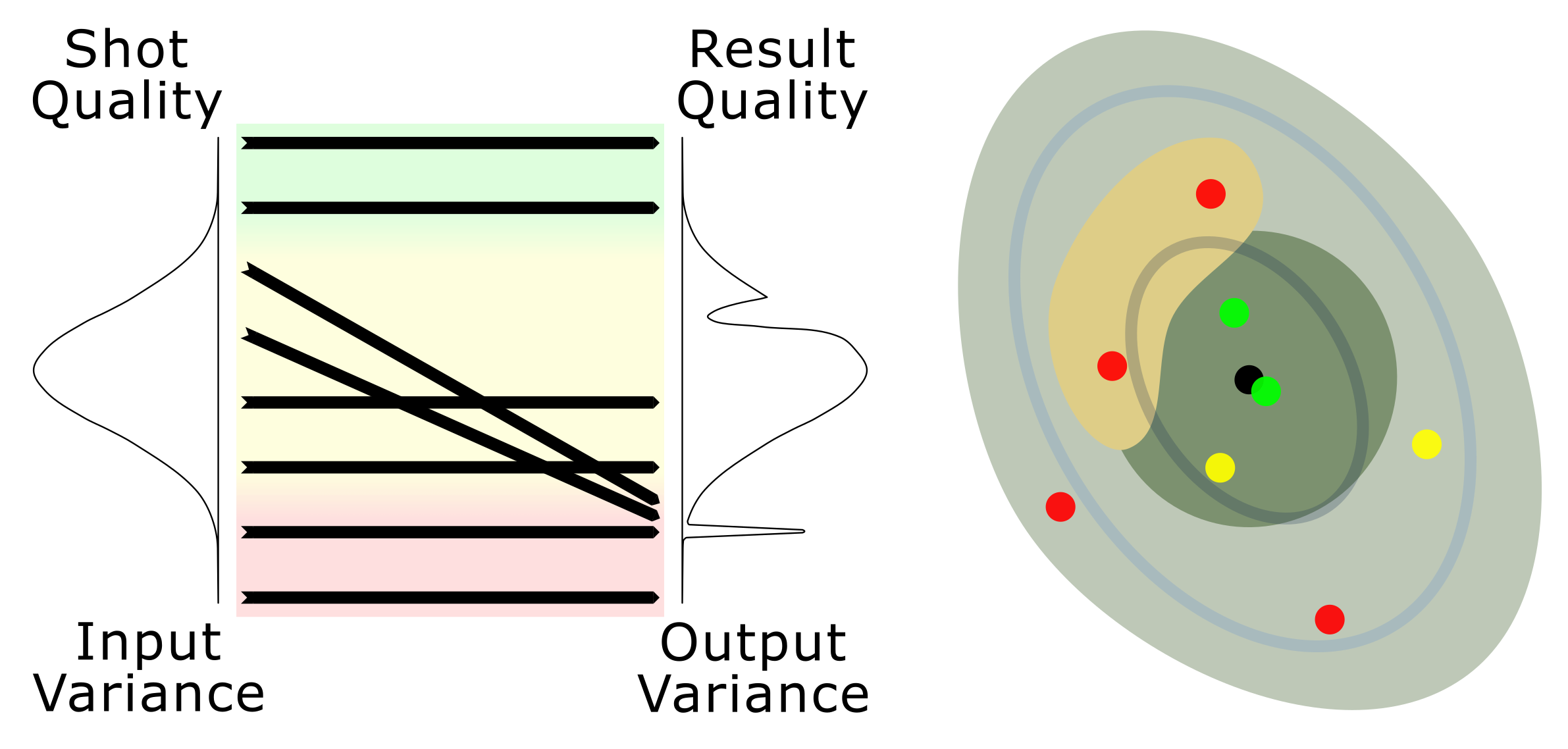
Well, we’re finally here: the discussion of variance in golf I’ve been working on for months. The good news is that the work is done. But the topic is long and dense, so I’ll be breaking it up into three parts to make it a bit easier to digest.
At the outset, though, I think it’s important to remember that I’m trying to build up to something throughout the multi-part series:
Part one is about how hole design transforms uniform dispersion patterns into different probabilistic outputs.
Part two will be about visualizing variance: how we can show strategic tradeoffs by illustrating risk-adjusted strokes-to-hole.
Part three will be about what we mean by “good shots” and “bad shots,” and will illustrate why the two different frameworks divide the golf community.
When we think about variance on the golf course, we really need to look at both shot quality and result quality, since one doesn’t always guarantee the other. Each player comes to the course with their own dispersion pattern.1 A good shot for the player is an accurate shot on the target the player intends. More often than not, an accurate shot has a good result, but occasionally, even a well struck shot ends up in a bad spot. Thus, a discussion of variance needs to take both outcomes into account.
To illustrate the relationship between shots and results, we start with a simple example: a flat green with no features. Then we put a golf shot dispersion on top with a few example shots:
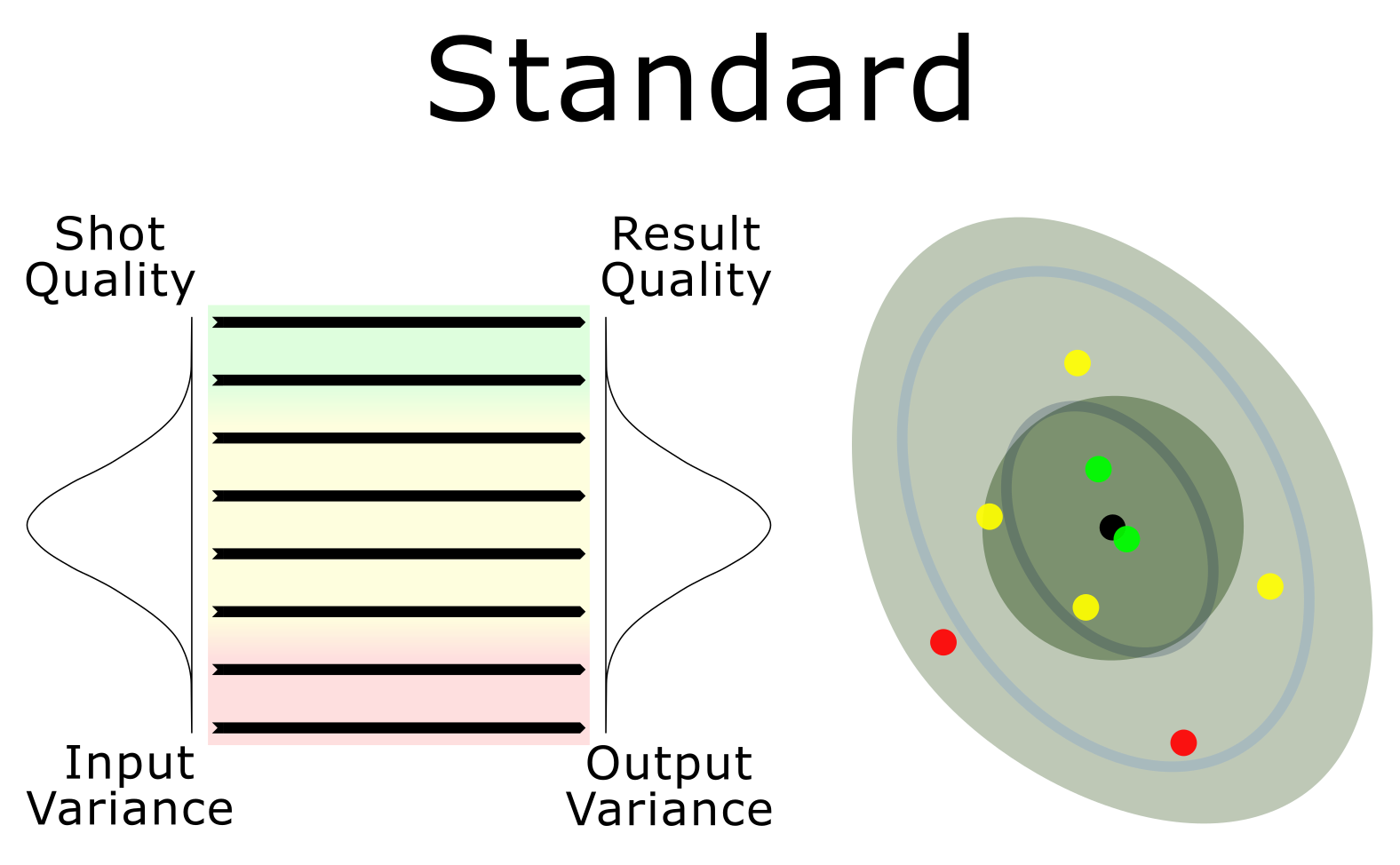
Most shots are pretty average.2 A few will land very close to the target, and others will miss by a significant distance. If our course has no features for the ball to interact with, the quality of the shot should correlate to the quality of the result. In the illustration above, a few shots are a tap-in away; many are makable, but likely two-putts; and some are far enough away that we should expect more than two putts to finish the hole. Here, we assume a normal distribution for both the shot and the result, which leads to the shot quality directly correlating with result quality.3
This is the simplest version of golf, and it is mostly skill based. The tighter the dispersion pattern, the better the results in the long run.
To make the game more interesting, we add a bunker:
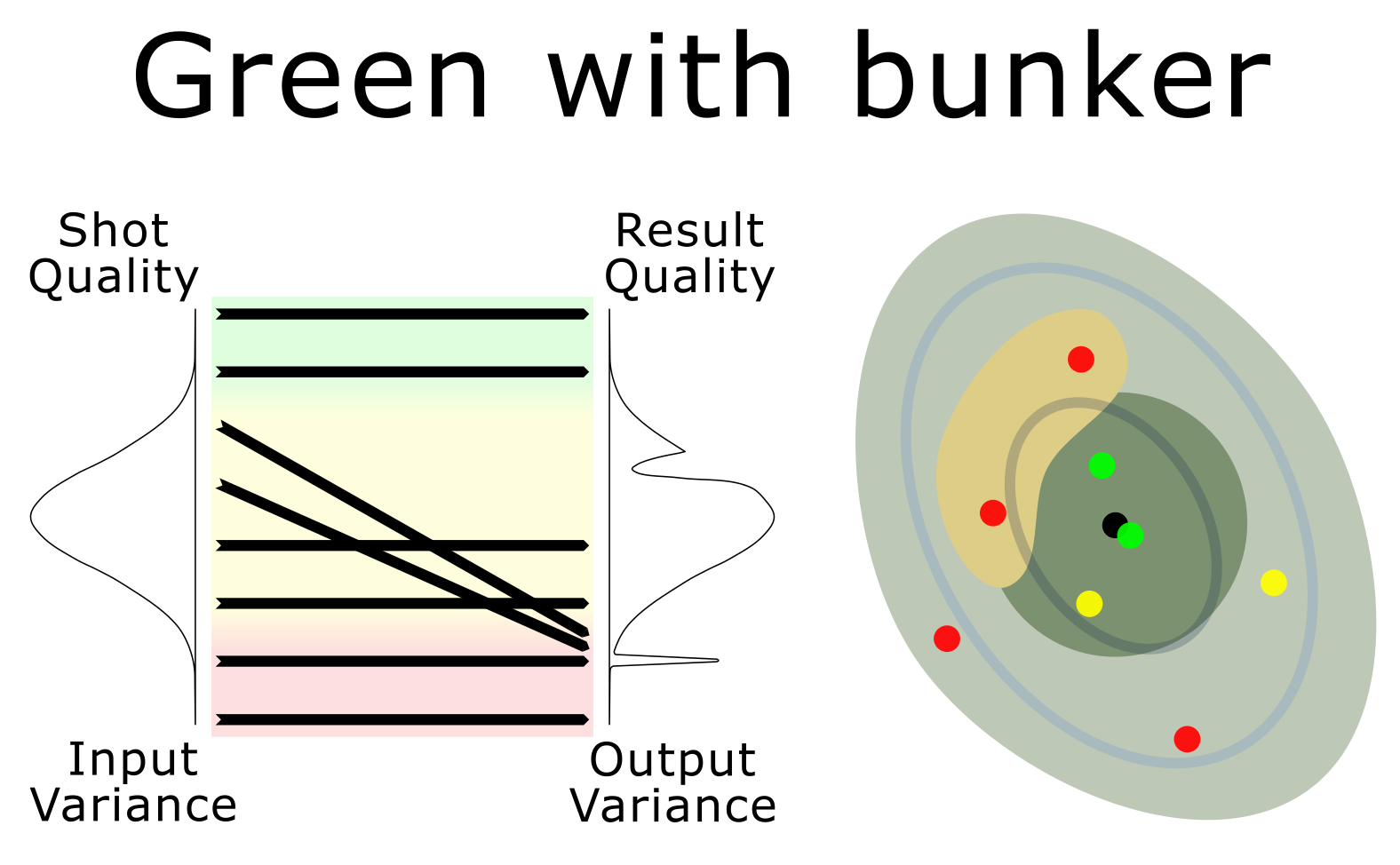
Now when we aim at the hole our shot quality is disconnected from our result quality. Suddenly a shot of decent quality, that just happens to miss toward the bunker, has a very bad result. What we have, in effect, is a math function that transforms one distribution into a different distribution.
Here we make the step to strategy. If we move our target away from the hole, we can maintain the general relationship between the shot quality distribution and the result quality distribution:
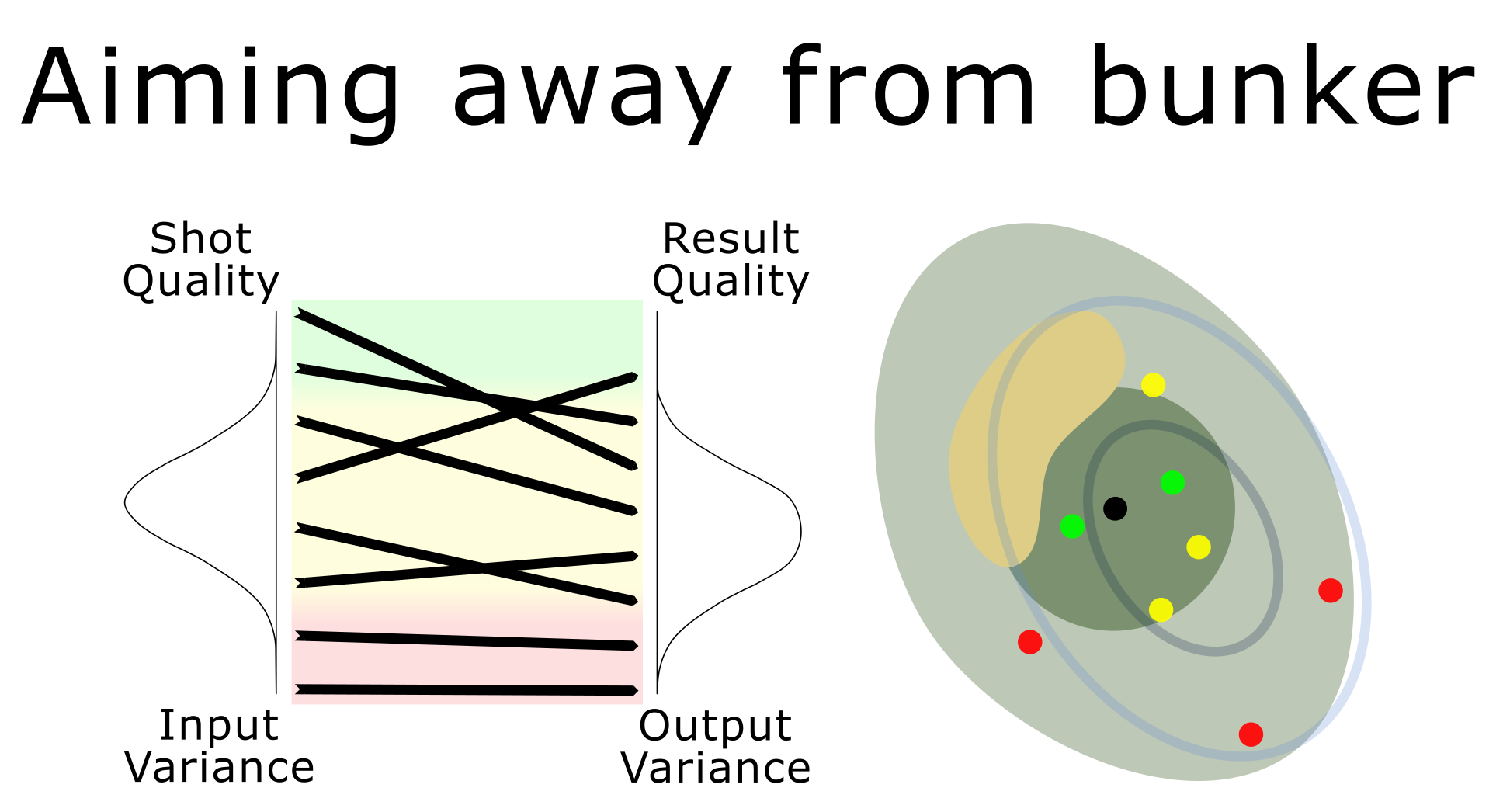
I believe this is what we mean by “strategic golf”: it is when a player optimizes their target to create the best result quality distribution, given the inherent variance of their shot quality. Importantly here though, we must note that some of the highest quality shots (shots that finish near the aiming target) get bad results. And interestingly, some mediocre shots end up with the best results. Strategy in games, however, is less about the skill of the player, and more about the player’s ability to optimize.
There is a downside for the player, though, even using this strategy. The resulting distribution, overall, will still be a bit worse than our green-only scenario, because we’ve forced more shots away from the hole, and average scores should go up. This will have a smaller impact on better players, though, because their smaller dispersion patterns mean they’ll be able to aim closer to the hole using this strategy than someone with a wide dispersion pattern.
Suppose, however, that our course architect wants to really incentivize the strategy of playing away from the hole. Well, she can add a kicker slope opposite the bunker that funnels balls back toward the hole:
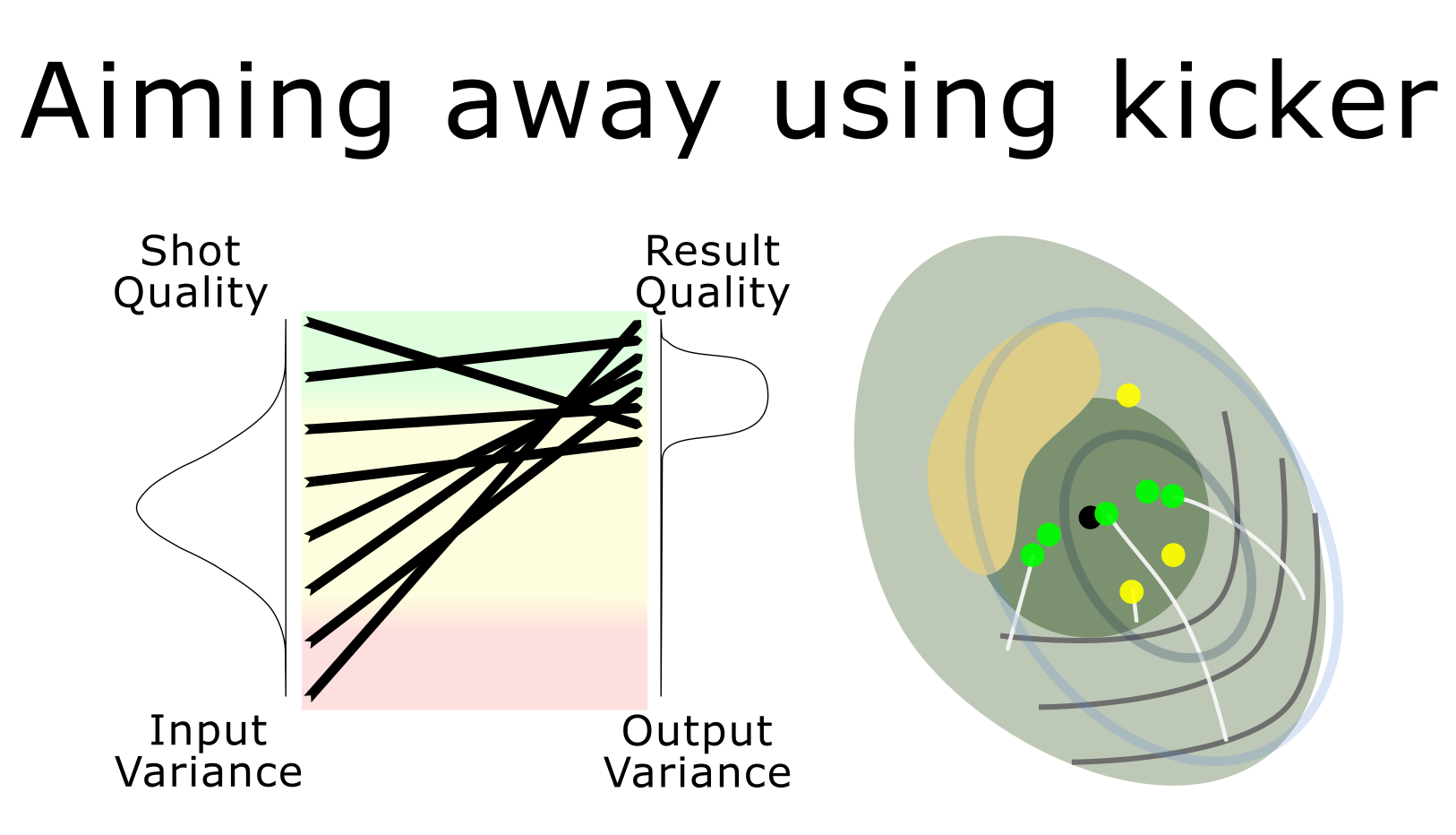
In this example, we turn our dispersion upside down. Some of the “worst” shots end up with the best results. Yes, by shifting the target away from the bunker, the player is still rewarded overall, but the reward seems almost entirely disconnected from how good the actual shot was. And yes, some of the better shots end up close to the hole, but the worst shots are inversely rewarded and end up right next to it.
Here, some will almost certainly object: “this hole is unfair, that kicker slope rewards bad shots.” That’s true! In fact, that’s the whole point. This example shows how golf architecture can offer incentives beyond just trying to produce the tightest dispersion pattern possible.
This type of strategic element trades skill with the club for skill with thoughtful strategy. Sure, aiming at the flag here is a genuinely bad decision, but given this layout, even figuring out the optimal target becomes incredibly complicated. Sometimes optimal play means hitting the ball to strange places, and learning that is a skill we must train as well.
If the reader will indulge me here, I’d like to move away from the realm of data and into philosophy. Variance in games, from my perspective, is interesting because it is about control. Too much control makes the game boring. Too little control makes the game frustrating.
Imagine the most basic miniature golf hole: it’s mostly uninteresting because there is little skill and strategy required. Now imagine a long par three with an island green, but the green is only one yard across! There isn’t a player in the world who could consistently finish that hole in regulation. Landing a long shot on a one-yard green is complete luck. When we have either too much or too little control, the game just becomes pointless.
In most cases – when shot quality and result quality correlate – we can think of the player’s dispersion pattern as the player’s skill. Higher skill means a tighter dispersion pattern. We can also usually consider the variance in a shot’s result as the level of challenge. When the shot quality correlates with result quality, it’s a standard shot. When the result quality skews negative, bad results become disproportionately common, which means the shot is challenging. When result quality skews positively, the shot is easy.
We can show this with two templates: the Volcano and the Punchbowl. These two templates are effectively the opposite of each other.
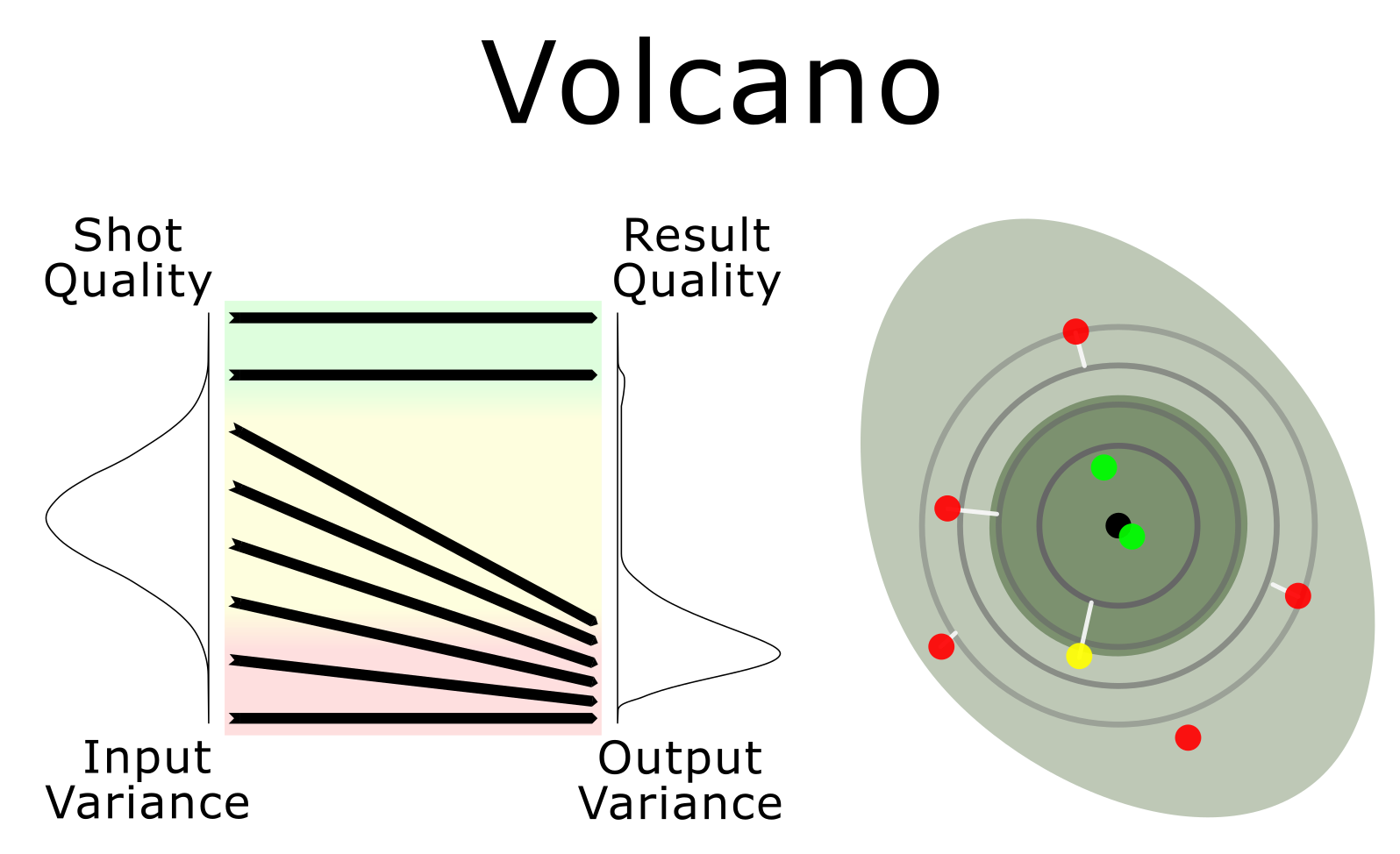
A Volcano hole template actually does look like a volcano. The green is on the top of a steep hill, and any shot that misses will roll down, leaving a disproportionately bad result. The template turns anything that isn’t a clear success into a real failure.
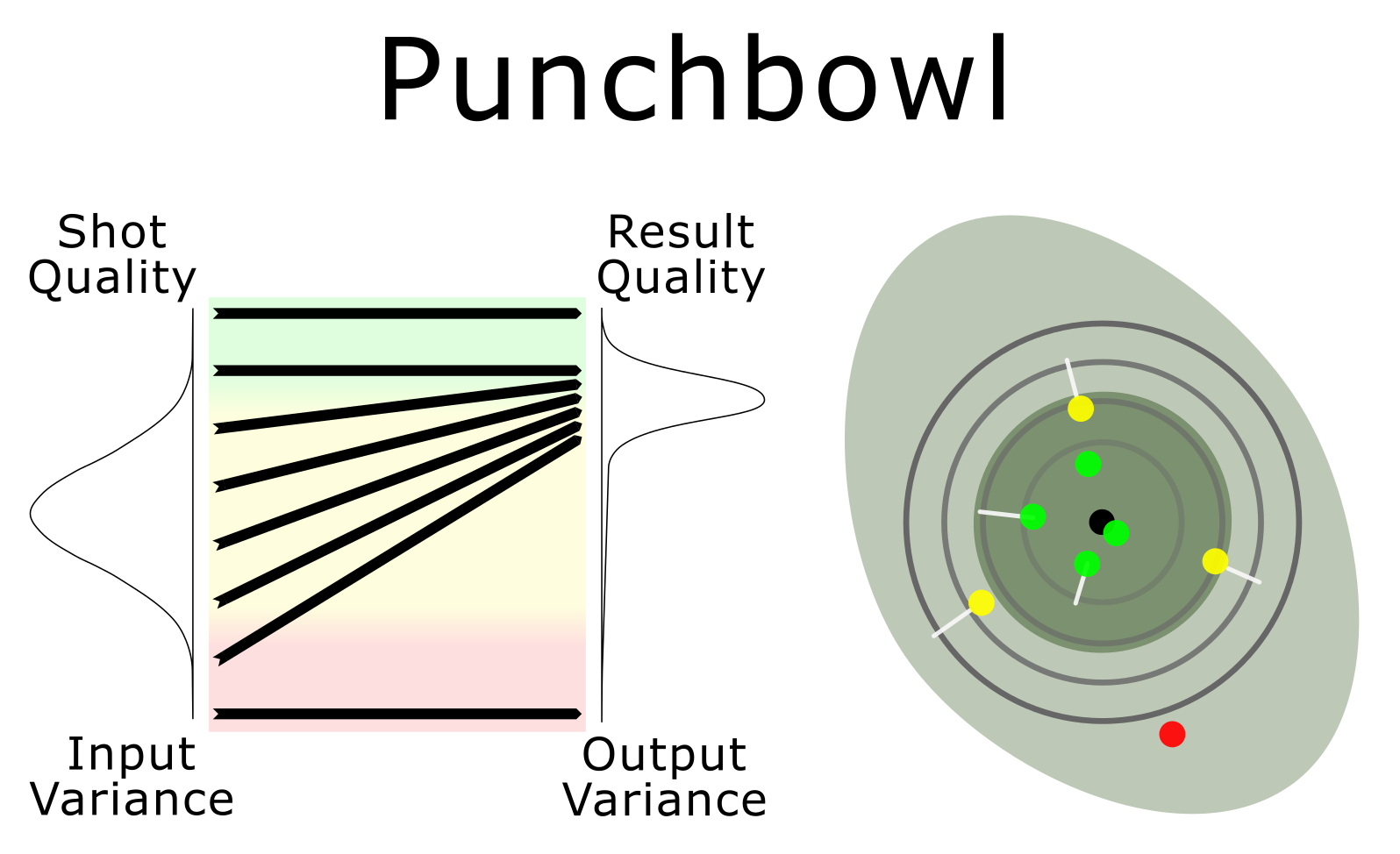
The Punchbowl template is the opposite. The green sits in a bowl where anything that misses the green ends up rolling onto the green anyway. The template turns anything that isn’t a total failure into a clear success.
When a Punchbowl template is too easy, it becomes just as pointless as a too-hard Volcano template. However, an interesting design quirk is that an architect can adjust the difficulty of these templates simply by changing the size of each player’s dispersion patterns. This happens by starting players closer or farther away from the hole.
On a very difficult Volcano template, suppose we expect most of our players to hit a long-iron. If we instead start our player farther forward, they will probably play something closer to a wedge. This will shrink their dispersion pattern significantly. Ideally, this leaves our player with a challenge that is much more manageable:
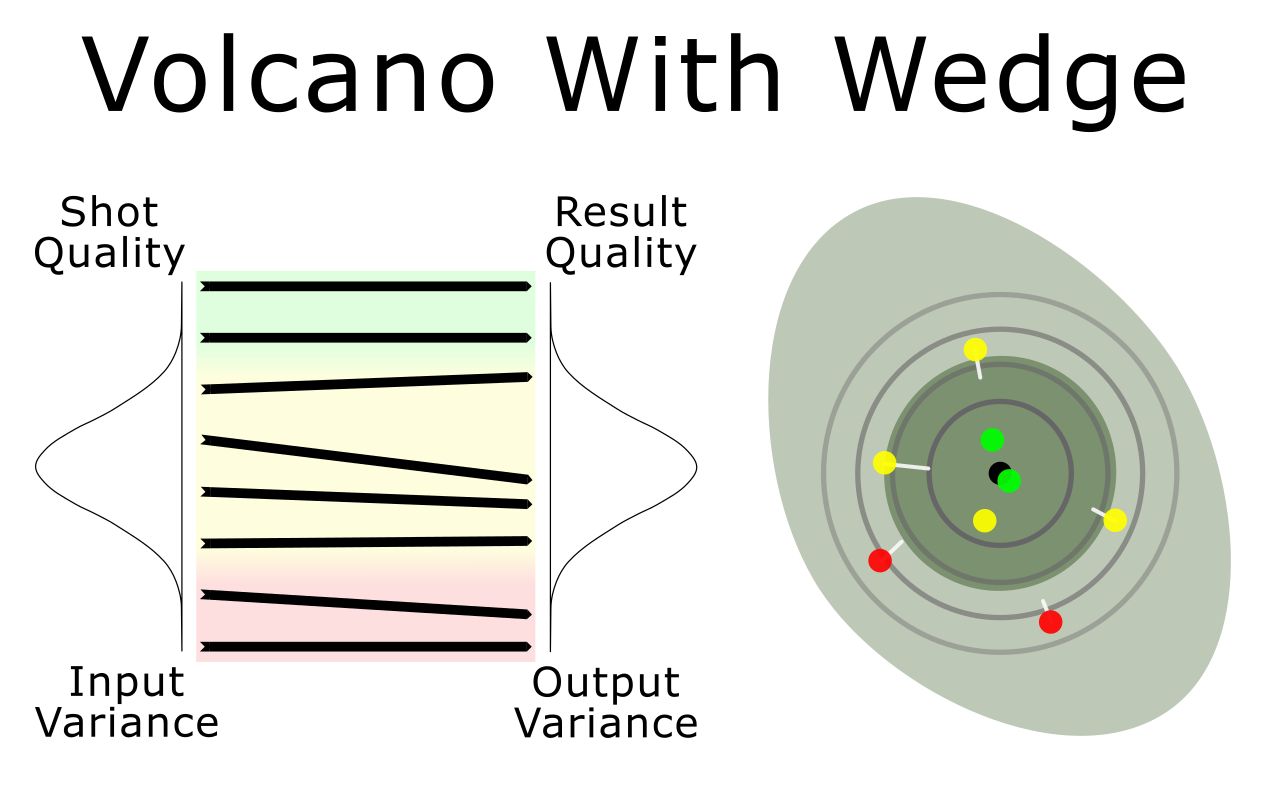
We can do the same thing on the Punchbowl template by moving players back when the hole is too easy. If we give our player a longer shot to hit, perhaps using their driver, we can grow their dispersion pattern to the point where the hole is quite challenging:
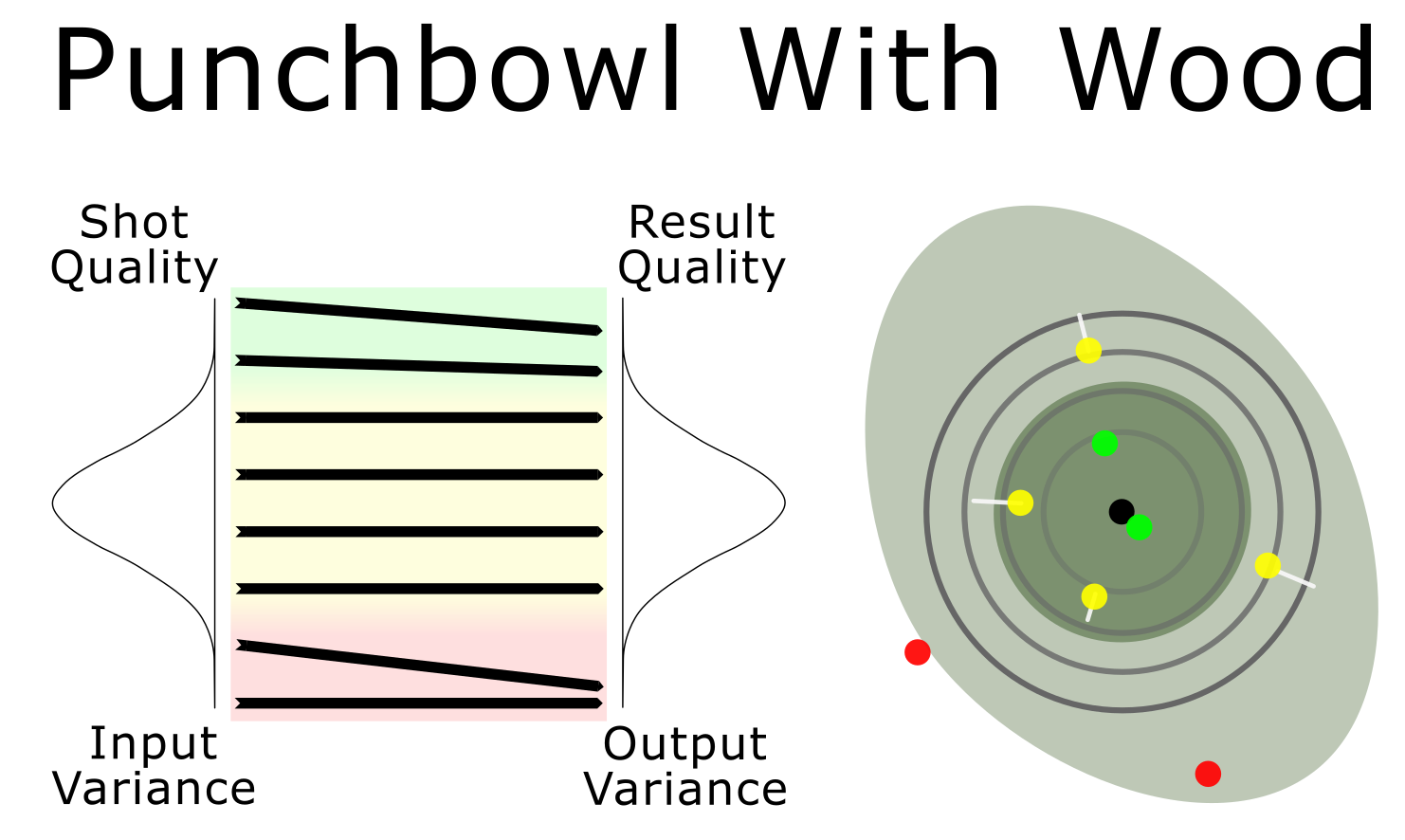
This balance shows how architects can optimize features given the distances the player will approach from. And, we see this in existing design patterns. Volcano holes are almost always short par threes and we typically see punchbowls on holes designed with a longer approach in mind.
Differentiating between the input variance (shot quality) and the output variance (result variance) of each shot has nuance, and it is an important part of the discussion to come. So, I’ll leave it here for now. I’ve oversimplified quite a bit, so do let me know if you have any questions, and I will try to publish part two soon.
There may be variance in golf design, but there is no variance in me thanking you for reading and asking you to like and share these articles with folks you think might like niche golf topics.