If you’ve trained long enough you know there are times when progress seems to come to a grinding halt.
You’re putting in the effort, showing up consistently, but the results just aren’t reflecting your hard work anymore… at least not like they used to!
It’s a frustrating and demotivating phase that most of us encounter at some point along our path. This is especially true when working on bodyweight and skills training, where progress isn’t as obvious as seeing more weight on a barbell or a few seconds off your 5K run time.
However, hitting a plateau doesn’t necessarily mean that all hope is lost.
In fact, your training plateau can be an opportunity for a profound shift in perspective and strategy.
In this article, we’ll explore effective ways to reignite the flame of improvement and, perhaps more importantly how to redefine the concept of progress in a way that aligns with lifelong training.
Reframing Your Training Plateau
Kristina, one of our certified GMB Trainers, relates that even when you have extensive experience you can break out of your rut. You just need to take a step back and honestly view what you’re doing.
She describes something we see all the time, especially with clients who are already “strong” or have extensive training backgrounds.
We can focus so much on PROGRESSION and hitting milestones that we leave gaps in our development. These, often quite small, gaps can come back to bite us later when we need a bit more strength, mobility, and/or motor control to really nail down a movement skill. And as we get more experienced, these small discrepancies add up.
But even beginners face the plateau… as soon as beginners’ luck (aka “n00b gainz”) runs out.
That’s all right though.
This is a natural part of the process for almost everyone, so rest assured that we’ve all been there, and you can definitely get past it. Here’s how 🙂
How to Get Back to Making Gains
Reigniting progress requires a blend of introspection, adaptability, and strategic planning.
Here are three practical steps you can take to break through and resume your journey towards improvement. They aren’t easy, it can take some deep introspective work to let go of some of your favorite habits and find your way out of stagnancy.
1. Prioritize and Balance Your Training Needs
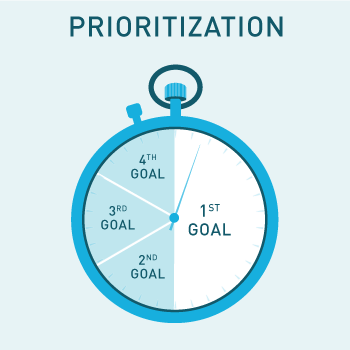 Recognize that you can’t do it all, especially when you’ve spread yourself thin. Prioritize your goals and choose what matters most. It’s okay to let certain pursuits simmer on the back burner while you concentrate on what really fires you up.
This doesn’t mean “just do one thing over and over” and get rid of everything else!
For example, you realize that you only have so much energy and recovery ability and need to pare down your exercise program. And you really want to improve your ability to squat easily and freely. But you also have “non-negotiable” things like hikes with your family every weekend and several times a week of co-ed soccer with your friends.
And this makes sense to me, enjoying physical activities with friends and family takes precedence over exercising in my opinion. Isn’t that why we’re exercising in the first place?
Your baseline level should then be those activities, and your benchmark for progress is how you feel moving into and out of your squat. Now reduce all the rest of your training by about half, there’s research saying maintenance happens at around a third of your previous volume but let’s keep things simple and just say 50%. Then monitor how your squat feels with the reduced training. If it stays about the same, you now know where you’re at and can make an informed choice about adding a bit more work and see how that shakes out.
2. Experiment and Optimize Your Exercise Selection
 Now that you’ve established a true baseline of how your body reacts to a particular amount/volume of activity, you can play with different approaches.
You can see in the research that there is a wide range of responses to training stimuli. Some people are more geared towards strength/speed and some to more endurance. So-called low responders to exercise show improvement when you switch the modality from strength training to aerobic and vice versa.
Drilling down further some people do better with exercise at a higher intensity but with a lower amount of total work, and some do better with lower levels of intensity but a bit higher amount of work. Even further, there are often differences in upper body vs. lower body.
In my case, I’ve found I don’t have to do a lot to keep my strength up but I have to put in a fair amount of work to maintain my endurance.
Seems like a lot to keep track of and figure out, but if you’ve been training long enough and are introspective, you’ll discover quite a lot about yourself.
3. Find Your Patterns (both Helpful and Unhelpful)
 And lastly, finding your personal patterns requires regularly evaluating your energy levels, motivation, and performance.
Listen to your body and mind, and adjust your efforts accordingly. If you’re consistently worn out, it might be a sign to dial back; if you’re well-rested but not progressing, consider adding more volume or intensity.
This is the heart of auto-regulation, not just taking a day off when you aren’t feeling the best, but actually taking the time and attention to learn about yourself and how you’re responding to your exercise program, and frankly everything else going on in your life.
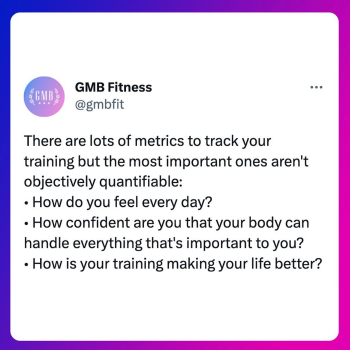
Whether you use an app or a good old-fashioned notebook, you absolutely should be tracking your training. And not just sets/reps/weights, but more importantly your personal assessments and evaluation of how each session went, and how you feel about it.
This can help you suss out your patterns, perhaps even as you are writing down your notes. Keep an open mind and be willing to pivot based on the outcomes. Once you’ve spotted a pattern that needs addressing, the AAA loop gives you a structured way to work on it.
How to Reframe What Training Progress Means for You
It’s important to acknowledge the factors that contribute to the perception of halted progress. These reasons can vary widely from person to person and situation to situation, but a couple of common culprits include:
- Diminished Motivation and Enthusiasm
- Dissatisfaction with Performance
 One of the most significant indicators of a progress plateau is a growing dread of training, be it a workout routine, a skill-building practice, or any other personal goal. When the excitement wanes, it becomes harder to maintain consistent effort and dedication.
Burning out could be a sign of overtraining but it could also just be telling you that your efforts and feelings about training aren’t jiving with what you really want from it. Do you really want to do more push-ups and pull-ups or do you want what that ability can give you?
When these symptoms happen, take a good hard look at your training and honestly assess whether it’s in alignment with what you really value.
Another signal is a dissatisfaction with your performance.
You feel like you’re putting a lot of effort and time yet you’re not achieving the progression of skill or strength that you once had. This can be frustrating and demoralizing, leading to a sense of stagnation.
It’s rough because at some point in our training, when we’ve done it long enough, the “gains” are going to be slower than we like. And doing more could help but other stuff has to taper down or you’re toast. I’ve found this out the hard way for myself at least.
Use this time to shift your perspective on progress. Rather than narrowly defining it as continuous, linear improvement, let’s reframe progress as a multi-dimensional concept.
Consider the following perspective shifts.
Frustration as a Sign of Growth, But Only So Much
We have to recognize that frustration is a natural part of growth. It’s often a signal that you’re doing something that will make you better. If our training doesn’t have any level of discomfort then there’s likely no adaptive stimulus occurring and we won’t improve. But if there’s too much, it likely means the intensity or amount of work is too extensive for us to recover and we won’t improve that way either.
Finding the sweet spot of just enough and not too much can take a bit of trial and error – and a lot of self-honesty – but it’s absolutely essential for lifelong training and continual improvements.
We can’t force continual progress , if we do it just sets the stage for breaking down and burning out. Progress happens organically from a well thought out plan that accounts for the realities of life and all its ups and downs. Adapting and responding appropriately in the moment, for years and years, is what takes you to where you want to be.
Transition to a Lifelong Mindset
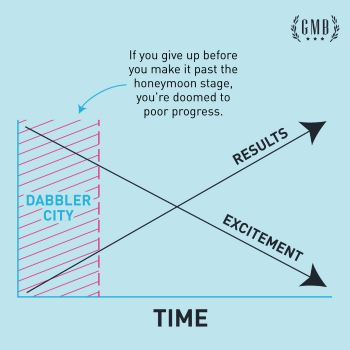 Instead of looking at your training as a series of goals requiring immediate feedback, adopt a lifelong perspective. Consider your endeavors as integral parts of your daily routine, just like brushing your teeth. This shift in mindset helps you weather the lulls in progress and treats them as natural ebbs and flows.
On a personal note, I was working on some movements yesterday that I had first learned about 4 years ago. I knew they were feeling better but it only really hit me when I checked video from the first few practices.
Focusing on your quality of movement and the ease in how you perform. These tend to be better gauges of progress for movement skill training than tallying up repetitions and time. And reviewing video is a great way to analyze this perspective because often the improvements are so gradual and embodied that we don’t realize they are happening.
Like losing and gaining a few grams of weight over several months. You can’t see it on the scale daily but the improvements add up.
Don’t let the absence of “quick gains” deter you.
Trust the process, stay committed, and understand that growth takes time, especially during plateaus.
Progressive Training Over a Lifetime
Our Elements program incorporates the components of self assessment and regulation in a systematic curriculum to help you progress in your lifetime of training.