Conversations linking to GitHub, newest first. Times are UTC.
Mentions by source
Oct 23, 21:00Oct 24, 21:00
Oct 24, 00:00Oct 25, 00:00
Oct 23, 23:00Oct 24, 23:00
Oct 23, 23:00Oct 24, 23:00
Oct 24, 00:00Oct 25, 00:00
Oct 23, 21:00Oct 24, 21:00
Oct 23, 23:00Oct 24, 23:00
Oct 23, 22:00Oct 24, 22:00
Oct 14, 21:00Oct 15, 21:00
Delayed · data through Oct 15, 21:00 UTC
Oct 24, 00:00Oct 25, 00:00
Oct 24, 00:00Oct 25, 00:00
Oct 23, 23:00Oct 24, 23:00
Oct 24, 00:00Oct 25, 00:00
Oct 24, 00:00Oct 25, 00:00
Oct 24, 00:00Oct 25, 00:00
Oct 24, 00:00Oct 25, 00:00
Latest posts
From FF14? In world of warcraft there were model viewers for that sort of thing... Hmm. Yup. Found one. nohbdy/ffxivmodelviewer Then I believe you need steamcommunity.com
Show HN: Agentsh – A Decentralized, Scalable Multiagent Harness Discussion
Download the full resolution image at this link
#Linux 7.4 flushes idle workqueues 10-100x faster on big machines, but unbound queues get 15-20% slower when all are busy. Author's microbenchmarks on a 192-CPU box. The commit says where it loses. github.com/torvalds/linux/commit/f1639cde5f5c
AI-friendly file. repomix.com brain.md (JavaScript, 577 stars): A persistent, file-based memory layer for coding agents - give Claude Code, Codex & others a project brain (durable decisions, requirements, constraints) via a zero-dependency CLI. mindmuxai/brain.md
How I Found a High-Severity Rounding Vulnerability in Morpho Midnight (Tenor Labs) Introduction Smart contract security is often about finding the invisible edge cases. While participating in a recent bug bounty for Tenor Labs (a protocol built on top of Morpho Midnight), I discovered a high-severity rounding vulnerability in their migration callbacks. If exploited, this flaw allows an attacker to artificially inflate a user's Loan-to-Value (LTV) ratio to infinity, triggering an immediate liquidation of the user's pre-existing collateral. In this article, I’ll break down the vulnerability, explain the math behind the exploit, and provide the Foundry Proof of Concept (PoC) that proves it works. The Architecture: Tenor Labs & Morpho Midnight Tenor Labs is a suite of non-custodial smart contracts that extends the Morpho Midnight protocol. One of its core features is the ability for borrowers to seamlessly migrate their debt and collateral between different markets (e.g., moving a position from Market A to Market B). This is handled by BorrowMidnightRenewalCallback.sol and the CollateralTransferLib. When a position is migrated, the protocol calculates how much collateral needs to move from the source market to the target market. It does this pro-rata, based on the amount of debt being repaid. The Vulnerability: mulDivDown Rounding to Zero The core of the bug lies in the transferCollaterals function within CollateralTransferLib.sol. The code uses mulDivDown to calculate the collateral to transfer: if (sourceDebtBefore != repaidUnits) { collateralToTransfer = collateralToTransfer.mulDivDown(repaidUnits, sourceDebtBefore); } mulDivDown performs multiplication followed by division, always rounding down. Here is the fatal flaw: In DeFi, debt accrues interest. If a borrower has 1000e18 in collateral and 1000e18 in debt, after one block, their debt might be 1000e18 + 1 wei due to interest. If an attacker performs a "dust fill" on the migration offer (repaying exactly 1 wei), the math looks like this: 1000e18 * 1 / (1000e18 + 1) = 0.999... Because mulDivDown rounds down to the nearest integer, the collateralToTransfer becomes 0. The Exploit Scenario The developers actually left a comment in the code acknowledging this rounding behavior, noting that it "temporarily increases the target position's LTV until the position is fully migrated." However, this assumption is fatally flawed. An attacker can weaponize this "temporary" state: 1. The Setup: A borrower creates a SELL offer to migrate a large position from Market A to Market B. The borrower also has some pre-existing collateral on Market B. 2. The Dust Fill: An attacker (or a malicious bot) intentionally fills a tiny fraction of that offer (e.g., 1 wei). 3. The Rounding: The contract repays 1 wei of debt on Market A, but transfers 0 collateral to Market B. 4. The Kill: Market B now records a new debt for the borrower, but 0 new collateral backed it. The LTV on Market B is instantly pushed to infinity. 5. The Liquidation: The attacker immediately liquidates the borrower on Market B, stealing the liquidation penalty and the borrower's pre-existing collateral. The Proof of Concept (Foundry) To prove this, I wrote a Foundry test that replicates the math. I mocked the Midnight interface and set up a scenario where a user has 1000e18 collateral but 1000e18 + 1 debt (simulating accrued interest). // SPDX-License-Identifier: MIT pragma solidity 0.8.34; import {Test, console} from "forge-std/Test.sol"; import {CollateralTransferLib} from "../src/libraries/CollateralTransferLib.sol"; import {Market, CollateralParams, IMidnight} from "@midnight/interfaces/IMidnight.sol"; contract DustFillExploit is Test { // ... Mocks setup ... function testDustFillRoundsCollateralToZero() public { // 1. Borrower has 1000e18 collateral on Market A midnight.setCollateral(sourceMarketId, borrower, 0, 1000e18); // 2. Debt is 1000e18 + 1 (due to accrued interest) uint128 sourceDebtBefore = 1000e18 + 1; // 3. Attacker does a dust fill of 1 wei uint256 repaidUnits = 1; // 4. Call the vulnerable library function directly (address[] memory tokens, uint256[] memory amounts) = CollateralTransferLib.transferCollaterals( IMidnight(address(midnight)), sourceMarket, targetMarket, borrower, sourceMarketId, sourceDebtBefore, repaidUnits ); console.log("Collateral transferred to target:", amounts[0]); // 5. The transferred collateral will be 0, proving the vulnerability assertEq(amounts[0], 0, "Vulnerability proven: collateral rounded to zero!"); } } Output: [PASS] testDustFillRoundsCollateralToZero() (gas: 65335) Logs: Collateral transferred to target: 0 How to Fix It To mitigate this vulnerability, the transferCollaterals function should enforce a minimum transfer amount. If the pro-rata calculation rounds down to zero, the transaction should revert to prevent unbacked debt from being created. if (sourceDebtBefore != repaidUnits) { collateralToTransfer = collateralToTransfer.mulDivDown(repaidUnits, sourceDebtBefore); // Add this check: if (collateralToTransfer == 0 && repaidUnits > 0) { revert CallbackLib.ZeroAmount(); } } Conclusion This bug is a perfect example of why rounding directions and edge cases matter so much in DeFi. A simple mulDivDown combined with accrued interest created a path to drain user funds. If you are a developer, always assume debt and balances will have dust amounts, and protect your math accordingly. If you are a researcher, always read the developer comments—they often point you directly to the attack surface! You can check out more of my security research and PoCs on my GitHub Portfolio.
Laravel TokenGuard Auth Bypass (CVE-2026-114509): What Site Owners Must Do Now > Act today if this applies to you > > CVE-2026-114509 is a critical (CVSS 9.2) flaw in Laravel’s built-in token API guard. If your app authenticates API requests with the "token" driver and stores users in MySQL or MariaDB, an attacker with no account can sign in as an existing user, without that user’s token. Update laravel/framework to 12.68.0 or 13.29.0 or later. Apps that use only Sanctum, Passport or session logins are not affected by this flaw. - 9.2 - CVSS v4 base score, rated critical (9.8 under CVSS 3.1) - 0 - accounts, passwords or tokens the attacker needs - 12.68 · 13.29 - the fixed laravel/framework releases - 0 - official workarounds: updating is the fix Laravel published the advisory on 19 October 2026. It affects a feature many teams forget they still have: the simple token guard that older Laravel apps used for their API before Sanctum existed. If your site or product was started a few years ago and has a mobile app, an integration or a partner API, it is worth five minutes to check. This guide explains, for site owners, whether you are exposed and what to ask your developer to do. What the vulnerability does Laravel’s TokenGuard checks an API token by looking up the user whose stored token matches the one sent with the request. Before the fix, it only checked that the value was not empty. It did not check that it was text. An attacker can send a specially crafted value that is not text in a JSON request. On MySQL and MariaDB, the database then compares the stored tokens in a way that can match an existing user, so the request is treated as that user. The attacker does not need an account, a password or a real token, and no one has to click anything. The result is account takeover on every route protected by that guard: reading the user’s data, changing it, or acting as them through your API. If the matched user is an administrator, the impact is the whole application. Are you affected? A four-question check You are exposed only if all four answers are yes: QuestionHow to checkIf the answer is noIs laravel/framework older than 12.68.0 (or 13.x older than 13.29.0)?composer show --locked laravel/framework, or php artisan --versionYou already have the fixDoes config/auth.php define a guard with 'driver' => 'token'?Search config/auth.php for 'token'This flaw does not apply (Sanctum and Passport use their own guards)Do any routes use that guard?Look for auth:api or auth:<guard name> in routes/, or run php artisan route:listThe guard is unused; still update and remove itAre users stored in MySQL or MariaDB?DB_CONNECTION in .envThe advisory names only MySQL and MariaDB; update anyway Your developer can run these checks in a couple of minutes: # 1. Which Laravel version is installed? composer show --locked laravel/framework | grep versions # 2. Is the built-in token guard configured? grep -n "'driver' *=> *'token'" config/auth.php # 3. Which routes use it? (usually the "api" guard) grep -rn "auth:api" routes/ app/ php artisan route:list --middleware=auth:api # 4. Which database holds your users? grep -n "^DB_CONNECTION" .env > Common in older apps > > Laravel 7 and earlier shipped an "api" guard with the token driver in config/auth.php by default. Many apps upgraded since then kept that guard even after moving to Sanctum, sometimes on a forgotten mobile or partner endpoint. Check it rather than assume. Which versions are fixed Laravel versionStatusWhat to do13.xFixed in 13.29.0Update to 13.29.0 or later12.xFixed in 12.68.0Update to 12.68.0 or later11.xNo fixed release named in the advisoryPlan the move to 12 or 13; apply the stopgap below meanwhile10.x and olderNo fix; out of security supportUpgrade; apply the stopgap below meanwhile Some write-ups say Laravel 11.56.1 contains the same type check, citing the proof-of-concept authors. The official advisory does not list an 11.x fix, so do not rely on it: treat 11.x as unpatched until Laravel says otherwise, and check Laravel’s support policy for which versions still receive security fixes. How to fix it composer update laravel/framework --with-all-dependencies composer show --locked laravel/framework | grep versions # expect 12.68.0+ or 13.29.0+ php artisan optimize:clear # Restart PHP-FPM, queue workers and Octane (commands depend on your server) If you cannot update today: a temporary stopgap The fix itself is small: TokenGuard now rejects any token that is not a non-empty string (see the current source). Until you can update, a middleware that does the same check before the guard runs closes the hole. Add it in front of your token-guarded routes and remove it after updating. <?php // app/Http/Middleware/RejectNonStringApiToken.php // Temporary: blocks CVE-2026-114509 until laravel/framework is updated. namespace App\Http\Middleware; use Closure; use Illuminate\Http\Request; class RejectNonStringApiToken { public function handle(Request $request, Closure $next) { // Use your guard's input_key if you changed it from the default. $token = $request->input('api_token'); if ($token !== null && ! is_string($token)) { abort(401); } return $next($request); } } Register it so it runs before auth:api on the affected routes. It is a stopgap only: the framework update is the real fix, and Laravel 10 and 11 apps still need an upgrade plan. Is it being exploited? As of 24 October 2026 there are no confirmed reports of attacks, and the flaw is not in CISA’s Known Exploited Vulnerabilities catalog. Security Online reports that a proof of concept has been published on GitHub, although the advisory itself links none. With a working example circulating, assume automated scanning will follow and patch exposed APIs first. If you also run PHP 8.2 to 8.5, check that the server has this month’s PHP security release as well: our [PHP2Shell guide](/blog/php-security-release-october-2026-cve-2026-109618-cve-2026-109619/) covers the separate runtime fixes released on 21 October. Questions to ask your developer or agency Send this list today - Which laravel/framework version does each of our apps run, including staging and old microservices? - Does any app still have a guard with the token driver in config/auth.php, and which routes use it? - When will we be on 12.68.0 or 13.29.0, and were workers and Octane restarted after the update? - Have we rotated API tokens and reviewed API logs since 19 October? - If we are on Laravel 10 or 11, what is the upgrade plan and date? Laravel security Need your Laravel apps checked and patched? We can audit every Laravel app you run for this flaw, apply the update or the stopgap without downtime, and plan the upgrade off unsupported versions. [Book a free 30-minute call](/contact-us/?topic=Laravel%20security%20update#book) Sources - GHSA-f9x3-7vq9-cph6: Token-based API guard Auth Bypass (Laravel, 19 October 2026) - GitLab Advisory Database: CVE-2026-114509 (affected ranges, CVSS 3.1, CWE) - Illuminate\Auth\TokenGuard source (laravel/framework 13.x) - Laravel authentication bypass PoC released (Security Online) --- Originally published at phpscientist.com.
🚨 A crafted OpenAPI document can turn generated TypeScript clients into a code execution path; CVE-2026-108551 PoC: Zombie-Kaiser/CVE-2026-108551-POC The flaw affects openapi-typescript-codegen and stems from unsafe interpolation inside Handlebars templates. An attacker who controls an OpenAPI document can inject JavaScript through values such as path keys, parameter names, server URLs, or version fields. CVSS: 9.3 Critical Affected: openapi-typescript-codegen ≤ 0.31.0 Impact: Arbitrary JavaScript execution when generated clients are imported or affected service methods are called The PoC demonstrates how malicious OpenAPI input can survive client generation and execute once the generated code is used.
Stop Configuring Agent Frameworks — Start Using AI Assistants Today Today's GitHub Trending chart reveals a shift that's been building for months: developers are tired of Agent frameworks that take days to configure. They want assistants that work out of the box. Let's look at the evidence. The "Out-of-the-Box" Signal makecindy/cindy gained 471 stars today with a simple promise: "The open-source AI agent that works out of the box." Its bilingual slogan — "想到,就能做到" — captures what users actually want: think it, done. No environment setup. No dependency hell. No reading 500 lines of source code. Just install and use. The "Copy-Paste Tutorial" Signal luongnv89/claude-howto gained 442 stars today with another clear promise: "A visual, example-driven guide with copy-paste templates that bring immediate value." This repo's popularity tells us something important: people don't want API documentation. They want step-by-step guides with screenshots and configs they can paste and run. The Shift: Framework → Assistant For the past two years, the open-source AI community has been building frameworks. Configure this, wire up that, write a custom adapter for the other thing. The result? Most developers spend more time setting up the framework than actually using AI. The trend is now clear: assistants > frameworks. Users want something they can install today and get value from today. !Astron Assistant Creation Interface AstronClaw + Loomy: Built for the Assistant Era This is where AstronClaw (cloud AI) and Loomy (desktop AI) come in. Instead of building another framework, the Astron team built actual assistants — one for the cloud, one for the desktop — with a tutorial that follows the exact pattern that claude-howto proved works: - Visual: Every step has screenshots - Example-driven: Real scenarios, not abstract concepts - Copy-paste ready: Configs you can paste and run immediately - Progressive: From basic setup to advanced automation Pair It With RPA for Real Automation Want your desktop AI assistant to actually do things — browser automation, file operations, desktop workflows? Pair it with astron-rpa, an Agent-ready RPA suite that turns your assistant from a chatbot into an automation engine. !Astron RPA Desktop Automation The Bottom Line The community has voted with their stars: the future of AI is not frameworks, it's assistants. Stop configuring. Start using. 🔗 Tutorial: iflytek/astronclaw-tutorial 🔗 RPA: iflytek/astron-rpa
Today's GitHub Trending signal: Agent era is shifting from "frameworks" to "assistants." makecindy/cindy (+471 stars) and luongnv89/claude-howto (+442 stars) prove users want install-and-go, not config hell. AstronClaw (cloud AI) & Loomy (desktop AI) do exactly that. Tutorial: github.com/ifl
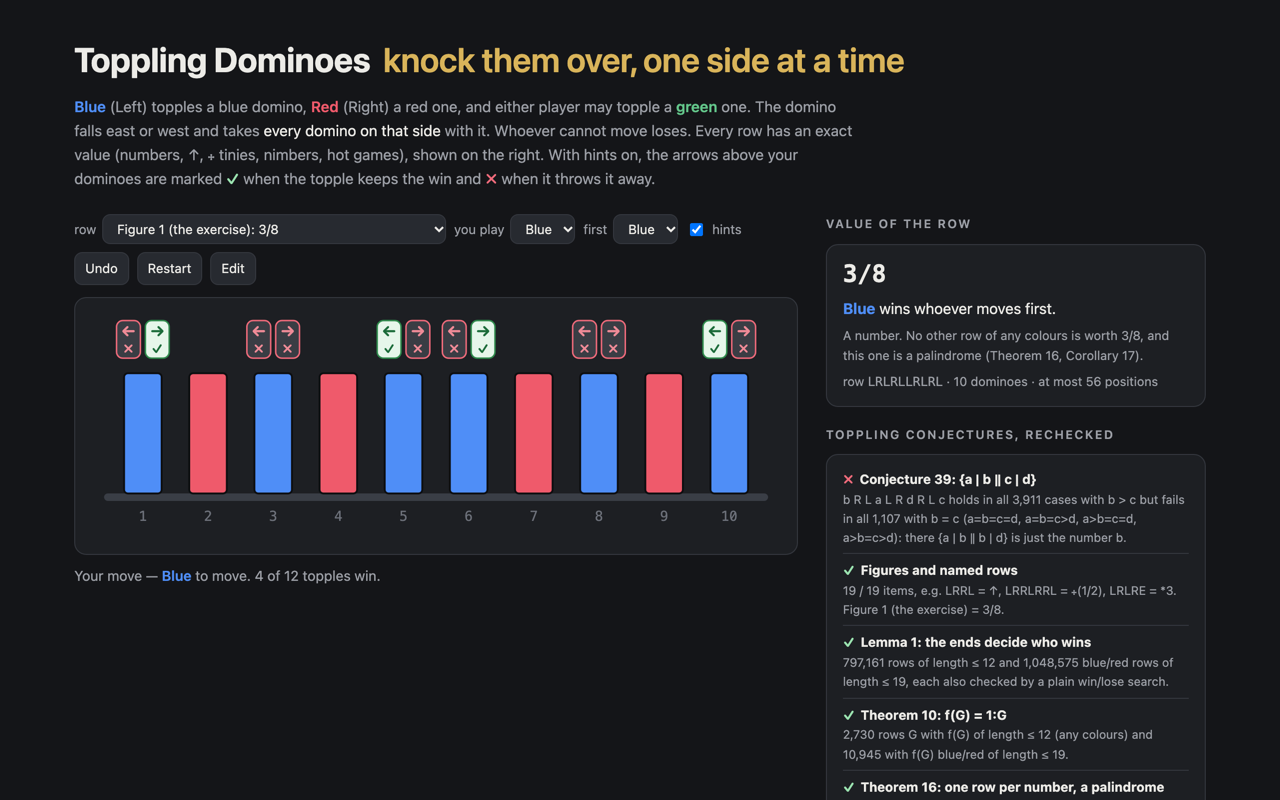
Toppling Dominoes(ドミノ倒しゲーム)— 論文「Toppling Conjectures」の定理と予想を全列挙で検算したら、予想 39 だけは b = c のとき成り立たなかった > Toppling Dominoes(トップリング・ドミノ)をブラウザに実装した。一列に並んだ青(Left)・赤(Right)・緑(どちらでも)のドミノから、手番の人が自分の色のドミノを 1 枚選んで東か西へ倒す。倒したドミノと、その側にあるドミノは全部なくなる。動けなくなった方の負け。すべての列に組合せゲーム理論の正確な値(数・↑・⧾ タイニー・ニム数・熱いゲーム)を付け、倒し方ごとに勝ち筋か負け筋かを ✓/✗ で表示する。検算の対象は Fink・Nowakowski・Siegel・Wolfe の論文 "Toppling Conjectures"(Games of No Chance 4, 2015)で、定理と予想を、3 色で長さ 12 以下の全 797,161 列と、青赤だけで長さ 19 以下の全 1,048,575 列で総当たりした。数はどれも 1 列でしか作れず、その列は回文になる(定理 16)。⧿x は R L x L R で作れて、それ以外の列では作れない(予想 22。論文は長さ 15 まで確認、ここでは青赤の列で 19 まで)。*m の作り方はちょうど m 通り(定理 29)。このあたりは全部成り立った。成り立たなかったのは予想 39 で、ゲーム {a | b ‖ c | d} を作る列を b R L a L R d R L c としている。b > c なら 3,911 件すべてで正しかったが、b = c の 1,107 件はすべて外れた。b = c だと {a | b ‖ b | d} は数 b そのものになり、数を作る列は 1 本しかないからだ。図版のドミノは PDF から文字に落ちないので画像から書き写し、論文が演習問題として残した Figure 1 の値(3/8)も計算した。テスト 24 件。ソルバー内蔵パズル第 95 弾。 デモ: sen.ltd リポジトリ: sen-ltd/toppling-dominoes !Toppling Dominoes ルール - ドミノが一列に立っている。色は青(Left)、赤(Right)、緑(Either、どちらの手番でも倒せる)の 3 つ。 - 手番の人は、自分が倒せる色のドミノを 1 枚選び、東(右)か西(左)へ倒す。倒したドミノと、倒した側にあるドミノは全部連鎖して倒れ、列から消える。 - 手番で倒せるドミノがない方の負け(最後に動いた方の勝ち)。 Albert・Nowakowski・Wolfe の教科書 Lessons in Play(2007)で導入されたゲームで、組合せゲーム理論の「おなじみの値がだいたい全部出てくる」例として知られている。論文では Left = 青(白黒印刷では黒)、Right = 赤(白)、Either = 緑(灰色)。この記事では列を L R E の文字列で、西から東の順に書く。 例として、論文 p.65 の LRLR で Left(青)が打てる手は 4 つある。 | 倒すドミノ | 向き | 残る列 | |---|---|---| | 1 枚目(青) | 西 | RLR | | 1 枚目(青) | 東 | (空) | | 3 枚目(青) | 西 | R | | 3 枚目(青) | 東 | LR | 論文の A〜D と同じ 4 つが出る。この表は tools/verify.mts の項目 sec1-options で照合している。 どんな値が出てくるか 論文の Figure 2 は、おなじみの値を作る列の見本帳になっている。図はドミノの絵で、pdftotext では何も出てこない。そこで PDF を 400 dpi で画像化し、ドミノの色を目で読んで文字列に書き写した。 | 列 | 値 | 計算結果 | |---|---|---| | LLLLL | 5 | 5 | | LRL | 1/2 | 1/2 | | LRLRL | 1/4 | 1/4 | | LRLRLRL | 1/8 | 1/8 | | EEEEE | *5 | *5 | | LRRL | ↑ | ↑ | | LRRRL | ⧾(1) | ⧾(1) | | LRRRRL | ⧾(2) | ⧾(2) | | LRRLRRL | ⧾(1/2) | ⧾(1/2) | | LRLRE | *3 | *3 | | LERE(予想 33) | {1 | 0, {0 | −1}} | {1 | 0, {0 | −1}} | 11 個すべて一致した。論文には「Figure 1 の値は?」という演習問題もある。Figure 1 の列は LRLRLLRLRL で、値は 3/8。数なので、後で見る定理 16 によれば 3/8 になる列はこれ 1 本しかなく、実際に回文になっている。 緑だけの列 E…E は Nim の山と同じ(n 枚で *n)。青端と青端に挟まれた列は必ず Left の勝ち、といった勝敗の判定は、論文の補題 1 が「両端のドミノだけで決まる」と述べている。 - 空の列は 0(後手勝ち) - 両端が青なら Left の勝ち、両端が赤なら Right の勝ち - 両端の色が違う、または端に緑があれば先手の勝ち 最後の「端に緑」の行は論文に明示されていないが、緑の端を内側へ倒せば相手に何も残らないので明らか。これも全列挙で確かめた(後述)。 エンジン 局面は全部「部分文字列」 ドミノを西へ倒すと、それより西が全部消える。東へ倒すと、それより東が全部消える。つまり列 s から行ける局面は、接頭辞か接尾辞を削った s の部分文字列しかない。長さ n の列から出てくる局面は高々 n(n+1)/2 + 1 個で、Clobber(#377)のように盤を分割したり対称性でまとめたりする必要がない。値は列そのものをキーにメモ化する。 export function moves(s: string, p: Player): Move[] { const out: Move[] = []; for (let i = 0; i < s.length; i++) { if (!canTopple(s[i], p)) continue; out.push({ i, dir: 'W', to: s.slice(i + 1) }); out.push({ i, dir: 'E', to: s.slice(0, i) }); } return out; } export class Valuer { private memo = new Map<string, GameId>([['', ZERO]]); value(s: string): GameId { const hit = this.memo.get(s); if (hit !== undefined) return hit; const g = make(options(s, 'L').map((t) => this.value(t)), options(s, 'R').map((t) => this.value(t))); this.memo.set(s, g); return g; } } 標準形(前回までのエンジンを流用) make(L, R) は #375 Hackenbush で作り、#377 Clobber で拡張した標準形のエンジンをそのまま使っている。支配される選択肢を消し、可逆な選択肢を迂回して標準形にし、その標準形を一度だけ intern する。こうすると値が等しいことと id が等しいことが同じになる。数は「間で最も単純な数」として直接作り、名前は ↑・⧾(x)・*m・±x などを id の表から引く。 値を使わない勝敗探索 エンジンの検算用に、値を一切使わない勝敗探索(Searcher)も持っている。「手番の人に、相手が負ける局面へ行く手があるか」を列ごとにメモ化して調べるだけのもの。全列挙では、すべての列について「値から読んだ勝敗」「補題 1 の端による判定」「素朴な探索」の 3 つが一致するかを見ている。 序数和 1:G 論文の柱になる定理 10 は「f(G) = 1:G」という形をしている。1:G は序数和で、G に「Left だけが一手で 0 へ行ける」という土台を付けたゲームだ。土台で動くと上の G ごと消える。 export function ordinalOne(g: GameId): GameId { return make([ZERO, ...leftOptions(g).map(ordinalOne)], rightOptions(g).map(ordinalOne)); } (実装ではメモ化している。)f は「青の連(空の連も含む)すべてに青を 1 枚足す」写像で、f(RRLLRL) = LRLRLLLRLL(定義 9 の例。これも照合した)。 export const f = (s: string): string => 'L' + s.replace(/[RE]/g, (c) => c + 'L'); 全列挙の設計 論文の定理や予想は「すべての列について」の主張が多い。そこで、長さ 0 から順に、全部の列を辞書順に値付けしていく。長さ n の列の選択肢は長さ n − 1 以下の部分文字列なので、一つ前までの長さでもうメモに入っている。値ごとに「その値になった列の数」と「鏡像を同一視した列の数」を数えておき、一意性の主張は最後にまとめて判定する。 各列では次を調べる。 - 補題 1(端で勝敗が決まる)と、素朴な探索との一致 - 定理 10: 列が f の像なら、f⁻¹ を求めて値 = 1:(f⁻¹ の値) - 予想 34: 青を 1 枚挿入すると値が真に増える(x L y > x y) - 補題 14: 正の数の列には青以外のドミノが 2 枚続かない - 補題 30・31: 無限小の列の形と、ニム数への逃げ道 node tools/verify.mts sweep LRE 12 # 3 色、長さ 12 以下の全 797,161 列 node tools/verify.mts sweep LR 19 # 青赤だけ、長さ 19 以下の全 1,048,575 列 node tools/report.mts 19 12 # 表と src/findings.json を runs/ から生成 長さごとの経過は runs/sweep-*.jsonl に 1 行ずつ追記される。記事の表と数字は runs/ の JSON から機械的に埋め込んだもので、手で書き写したものはない(node tools/report.mts 19 12 で同じ表が出る)。 3 色 | 長さ | 列の数 | 新しく出た値 | 数 | 熱い | 無限小 | 時間 | |---|---|---|---|---|---|---| | 0 | 1 | 1 | 1 | 0 | 1 | 1 ms | | 1 | 3 | 3 | 2 | 0 | 1 | 0 ms | | 2 | 9 | 5 | 2 | 4 | 3 | 0 ms | | 3 | 27 | 14 | 4 | 14 | 7 | 1 ms | | 4 | 81 | 30 | 2 | 52 | 21 | 3 ms | | 5 | 243 | 88 | 6 | 164 | 61 | 7 ms | | 6 | 729 | 224 | 4 | 500 | 183 | 42 ms | | 7 | 2,187 | 683 | 6 | 1,514 | 547 | 119 ms | | 8 | 6,561 | 1,953 | 4 | 4,564 | 1,641 | 451 ms | | 9 | 19,683 | 5,953 | 10 | 13,696 | 4,921 | 2.5 s | | 10 | 59,049 | 17,733 | 4 | 41,116 | 14,763 | 14.6 s | | 11 | 177,147 | 54,014 | 12 | 123,374 | 44,287 | 143.1 s | | 12 | 531,441 | 163,216 | 6 | 370,124 | 132,861 | 649.5 s | 青赤だけ | 長さ | 列の数 | 新しく出た値 | 数 | 熱い | 無限小 | 時間 | |---|---|---|---|---|---|---| | 0 | 1 | 1 | 1 | 0 | 1 | 2 ms | | 1 | 2 | 2 | 2 | 0 | 0 | 1 ms | | 2 | 4 | 3 | 2 | 0 | 2 | 1 ms | | 3 | 8 | 6 | 4 | 4 | 0 | 1 ms | | 4 | 16 | 10 | 2 | 6 | 4 | 0 ms | | 5 | 32 | 20 | 6 | 24 | 2 | 2 ms | | 6 | 64 | 36 | 4 | 44 | 10 | 3 ms | | 7 | 128 | 72 | 6 | 100 | 12 | 6 ms | | 8 | 256 | 135 | 4 | 202 | 32 | 20 ms | | 9 | 512 | 272 | 10 | 424 | 54 | 33 ms | | 10 | 1,024 | 527 | 4 | 832 | 118 | 114 ms | | 11 | 2,048 | 1,056 | 12 | 1,708 | 224 | 289 ms | | 12 | 4,096 | 2,079 | 6 | 3,398 | 460 | 642 ms | | 13 | 8,192 | 4,158 | 8 | 6,816 | 906 | 1.4 s | | 14 | 16,384 | 8,253 | 8 | 13,648 | 1,826 | 3.5 s | | 15 | 32,768 | 16,512 | 16 | 27,328 | 3,636 | 9.2 s | | 16 | 65,536 | 32,892 | 6 | 54,626 | 7,288 | 21.0 s | | 17 | 131,072 | 65,792 | 18 | 109,324 | 14,558 | 75.6 s | | 18 | 262,144 | 131,323 | 8 | 218,604 | 29,134 | 287.8 s | | 19 | 524,288 | 262,654 | 12 | 437,268 | 58,248 | 966.6 s | 時間は 3 本の全列挙を同じマシンで並行に走らせたときのもので、目安にとどまる。最後の 1 段で、3 色は 4.5 倍、青赤だけは 3.4 倍に伸びた。3 色の長さ 13 も走らせたが、この伸び方では制限時間内に終わらないので途中で打ち切り、3 色は長さ 12 までとした。 検算 1: 数は 1 列だけ、しかも回文(定理 10・16、系 17) 論文の第一の結果は「どの 2 進有理数 x にも、値が x になる列がちょうど 1 本ある。その列は回文」というもの。証明は構成的で、次の 2 つを使う。 1. 定理 10: f(G) = 1:G 2. Berlekamp–Conway–Guy の事実 7: 正の数 x は、より単純な数 y を使って 1:y と書ける なので x > 0 の列は f(x の y に当たる列)、x < 0 の列は色を反転したもの、と再帰的に作れる。y を逆算する部分は次のとおり。 /** The number y with 1:y = x, for a dyadic x > 0 (Fact 7). */ export function ordinalOneInverse(x: number): number { if (Number.isInteger(x)) return x - 1; // 1:n = n + 1 let d = 2; while (!Number.isInteger(x * d)) d *= 2; const lo = x - 1 / d; const hi = x + 1 / d; if (lo === 0) return -Math.log2(d); // 1:(−n) = 2^−n return simplestBetween(ordinalOneInverse(lo), ordinalOneInverse(hi)); } export function numberRow(x: number): string { if (x === 0) return ''; if (x < 0) return negate(numberRow(-x)); return f(numberRow(ordinalOneInverse(x))); } numberRow(3/8) = LRLRLLRLRL(Figure 1)、numberRow(3/4) = LRLLRL、numberRow(5/8) = LRLLRLRLLRL。 全列挙では、数になった列を値ごとに集めて「1 本だけか」「回文か」「numberRow が作る列と同じか」を見た。3 色の長さ 12 以下に数は 63 個、青赤の長さ 19 以下に 139 個あり、例外はなかった。定理 10 そのもの(f(G) の値 = 1:G)は、3 色で 2,730 列、青赤で 10,945 列について確かめた(f(G) が全列挙の範囲に収まる G すべて)。 検算 2: タイニー(定理 21、予想 22) 論文の第二の結果は、x > 0 の数の列を挟んだ R L x L R が ⧿x(マイニー x = {x | 0 ‖ 0})になるというもの。色を反転すれば L R (−x) R L = ⧾x(タイニー x)。Figure 2 の右列 LRRRL = ⧾(1)、LRRLRRL = ⧾(1/2) がこの形をしている。 論文は「⧿x になる列はこれだけか」を予想 22 として残し、長さ 15 まで確認と書いている。全列挙では、⧿x・⧾x になる列を値の索引から数えた。 - 3 色・長さ 12 以下: 30 個のタイニー/マイニーすべて、その値になる列は 1 本だけ - 青赤・長さ 19 以下: 94 個すべて、青赤の列では 1 本だけ 青赤の列に限れば、論文の 15 を 19 まで延ばしたことになる。ただし緑を含む列については長さ 12 までしか見ていない。 検算 3: *m の作り方はちょうど m 通り(定理 29) ニム数は数と違って作り方が複数ある。論文の定理 29 は、青赤の列で *m になるのは (LR)^a (RL)^m (LR)^a(0 ≤ a < m)とその鏡像だけ、つまり鏡像を同一視して m 通り、というもの。 | m | 長さ 19 以下で見つかった列(鏡像込み) | 定理 29 から予想される列(長さ 19 以下) | |---|---|---| | *1 | 2 | 2 | | *2 | 4 | 4 | | *3 | 6 | 6 | | *4 | 6 | 6 | | *5 | 6 | 6 | | *6 | 4 | 4 | | *7 | 4 | 4 | | *8 | 2 | 2 | | *9 | 2 | 2 | 全部一致した。a を 1 増やすと長さが 4 増えるので、長さ 19 では m 通り全部が揃うのは小さい m だけになる。緑を許すとニム数の作り方は一気に増え、たとえば *2 は 3 色・長さ 12 以下で 9 本の列がある(EE、LRE、ELR、…)。 検算 4: 無限小の形(補題 30・31)と、再計算しなかった定理 32 論文の最後の定理 32 は「無限小の列の原子量は 0、1、−1 のどれか」。証明は補題 30・31 に乗っている。 - 補題 30: 青で始まる無限小の列は (LR)^n、(LR)^n E x、(LR)^n R x のどれか - 補題 31: 無限小の列では、先手は必ずニム数へ行ける。先手がニム数以外へ行ったら、後手はニム数で応じられる この 2 つは列と値だけで判定できるので、3 色・長さ 12 以下の無限小 199,296 列すべてで調べ、例外はなかった。 定理 32 そのものは再計算していない。原子量の再帰式(#377 Clobber で実装した Definition 3.8)は all-small なゲーム、つまり「片方だけが動ける局面がない」ゲームのためのものだ。Toppling Dominoes の無限小は L(= 1)のような数を部分局面に含むので all-small ではない。論文は「数の停止点を別の記号に置き換えて all-small に直す」と書いているが、置き換え先の記号が PDF で消えていて、手順もスケッチにとどまっている。推測で実装して「一致した」と書くことはしなかった。 検算 5: 予想 33・34・35 - 予想 33: 値 {1 | 0, {0 | −1}}(LERE)は青赤の列には出てこない。→ 青赤・長さ 19 以下で 0 本。緑を許すと長さ 12 以下で 4 本ある(LERE、EREL、LLRRE、…)。 - 予想 34: どんな列 x, y でも、間に青を 1 枚挟むと値が真に増える(x L y > x y)。→ 全列挙の全列・全挿入位置、計 12,492,971 通りで成立。 - 予想 35: 青赤の回文の値は、ほかの青赤の列には出てこない。→ 長さ 19 以下の回文 3,069 本すべてで成立。 予想 35 については、もっと強いことが観察できた。青赤の列は、鏡像を除くとほとんど値を共有しない。長さ 19 以下の全 1,048,575 列で、鏡像でない 2 本以上の列に共有されている値は 16 個しかなく、うち 6 個は定理 29 のニム数だった。ニム数以外の値は次のとおり(短い順)。 - 1*2: LLRLLRL, LLRLRLLRLLLRL (2 up to reversal) - −1*2: RLRRLRR, RLRRRLRRLRLRR (2 up to reversal) - 2*2: LLLRLLLRLL, LLLRLLRLLLRLLLLRLL (2 up to reversal) - 1*3: LLRLLRLLRL, LLRLRLLRLLRLLLRL (2 up to reversal) - {*, *2, {0 | *, *2} | *, *2, {*, *2 | 0}}: LRLRRLLRLR, LRRLRLLRRLRLLR (2 up to reversal) - −1*3: RLRRLRRLRR, RLRRRLRRLRRLRLRR (2 up to reversal) - −2*2: RRLRRRLRRR, RRLRRRRLRRRLRRLRRR (2 up to reversal) - 1*4: LLRLLRLLRLLRL, LLRLRLLRLLRLLRLLLRL (2 up to reversal) - −1*4: RLRRLRRLRRLRR, RLRRRLRRLRRLRRLRLRR (2 up to reversal) - {*, *3, {0 | *, *3} | *, *3, {*, *3 | 0}}: LRLRLRRLLRLRLR, LRRLRLRLLRRLRLRLLR (2 up to reversal) ほとんどが 1*2、2*2、1*3 のような「整数 + ニム数」で、ニム数に複数の作り方がある(定理 29)ことと関係していそうだが、そこまでは確かめていない。 LLRLLRL と LLRLRLLRLLLRL はどちらも 1*2 で、互いに鏡像ではない。緑を許すと事情はまったく違い、LE と LLR がどちらも {1 | 0} になるように、短い列からどんどん値が重なる。 本題: 予想 37〜39 と、b = c のときの反例 論文の最後に、数 a ≥ b ≥ c ≥ d を使って熱いゲームを作る列の予想が並んでいる(数 x の列も x と書く)。 - 定理 36: 数 x = {xL | xR}(標準形)は xL L R xR - 予想 37: {a | b} は a L R b - 予想 38: {a ‖ b | c} は a L R c R L b - 予想 39: {a | b ‖ c | d} は b R L a L R d R L c 全列挙の範囲に収まる (a, b, c, d) の組をすべて作り、列の値が主張どおりか、その値になる青赤の列がほかにないか(鏡像は除く)を調べた。 - 定理 36: 100 組すべて成立 - 予想 37: 1,544 組すべて成立(a = b の {a | a} = a* を含む) - 予想 38: 4,440 組すべて成立(等号を含む組も全部) - 予想 39: 5,018 組中 1,107 組で値が違った 予想 39 を等号の入り方で分けると、外れ方がはっきりする。 | 等号の入り方 | 組 | 値が主張どおり | 主張されたゲームが数 | |---|---|---|---| | a=b=c=d | 9 | 0 | 9 | | a=b=c>d | 128 | 0 | 128 | | a=b>c=d | 68 | 68 | 0 | | a=b>c>d | 647 | 647 | 0 | | a>b=c=d | 128 | 0 | 128 | | a>b=c>d | 842 | 0 | 842 | | a>b>c=d | 647 | 647 | 0 | | a>b>c>d | 2549 | 2549 | 0 | 外れたのは b = c の組だけで、b = c の組は全部外れた。b > c なら、a = b や c = d の等号があっても全部成り立っている。最後の列は「主張されたゲームを標準形にすると数になる組の数」で、外れた件数と一致する。 なぜ b = c だと成り立たないか b = c のとき、主張されたゲームは G = {a | b ‖ b | d}(a ≥ b ≥ d)。G − b = {a − b | 0 ‖ 0 | d − b} を考えると、 - Left が先に動くと {a − b | 0} へ行くしかなく、Right が 0 へ応じて Left の負け - Right が先に動くと {0 | d − b} へ行くしかなく、Left が 0 へ応じて Right の負け となって後手必勝、つまり G − b = 0。主張されたゲームは数 b そのものになる。ところが定理 16 により、b になる列は numberRow(b) の 1 本しかなく、b R L a L R d R L b は b の列を含んだうえで 6 枚以上長い、別の列だ。だから値が一致することはありえない。 具体例を挙げる。a = 2、b = c = 1、d = 0 なら予想の列は LRLLLLRRLL で、主張されたゲーム {2 | 1 ‖ 1 | 0} は 1。実際の値は LRLLLLRRLL = {{2 | {1 | 0}}, {2 | 1} | {1 | 0}, {{2 | 1} | 0}} で、Left の停止点も Right の停止点も 1 だが、1 ではない(1 との差は無限小で、Blue が先手でも後手でも勝つ。1 なら後手勝ちのはず)。d を −1 にずらして b > c にした LRLLLLRRRL は、予想どおり {{2 | 1} | {0 | −1}} = {2 | 1 ‖ 0 | −1} になる。 予想 39 は「a ≥ b ≥ c ≥ d」ではなく「a ≥ b > c ≥ d」と読むべきだった、ということになる。b > c に直した形なら、全列挙の範囲(3,911 組)では反例がなかった。ほかの予想(37・38)は等号を含めて全部成り立つので、39 だけ不等号の条件が 1 か所ゆるかったのだと思う。 テストでは、b > c の 3 例が成り立つことと、b = c の LRLLLLRRLL で「主張されたゲーム = 数 1」「列の値は数ではない」の 2 点を固定している。 予想 40: 現れないゲーム 予想 40 は「Toppling Dominoes に現れないゲームがある」。比較として Hackenbush には熱いゲームが一切出てこないことが挙げられている。誕生日 2 までに生まれるゲームは 22 個あるので、それぞれがどの列で最初に出てくるかを数えた。 3 色・長さ 12 以下で、22 個中 18 個が現れ、↓、↑、{0, * | −1}、{1 | 0, *} は現れなかった。↑ は LRRL で出てくるのに、↑* は長さ 12 までどこにも出てこない。これは予想 40 の具体的な候補になるが、もちろん長さ 12 までの観察で、証明ではない。 デモ - 上段の「row」から論文の図の列(Figure 1、↑、⧾(1/2)、*3)、予想 39 が成り立つ列と外れる列、予想 33 の LERE、鏡像でないのに値が同じ 1*2 の列などを選べる。 - 自分の色のドミノの上に ← → のボタンが出る。ヒントをオンにすると、その方向へ倒したあと自分が勝てるなら ✓、負けるなら ✗。 - 相手はコンピュータで、勝てる手があればその中から選び、なければドミノをなるべく多く残す手を選ぶ。 - 「Edit」で列を作れる。ドミノをクリックすると青 → 赤 → 緑と色が変わる。L R E の文字列で入力することもできる(24 枚まで)。 - 右側に列の値・勝敗・数/ニム数/タイニーなどの分類・標準形と、論文の検算結果の一覧を表示する。 まとめ 1. Toppling Dominoes の局面は全部部分文字列なので、列そのものをキーにしたメモ化で値が出る。標準形のエンジンは #375・#377 のものを流用した。 2. 論文 "Toppling Conjectures" の図の値(PDF の画像から書き写した 11 列)、Figure 1 の演習問題(3/8)、定理 10・16・21・29、補題 1・14・30・31、予想 22・33・34・35・37・38 は、3 色で長さ 12、青赤で長さ 19 までの全列で成り立った。予想 22 は論文の長さ 15 を、青赤の列に限って 19 まで延ばした。 3. 予想 39 は b = c の 1,107 組すべてで外れた。b = c だと主張されたゲームが数 b に潰れるので、数の一意性(定理 16)と両立しない。b > c なら 3,911 組すべてで成立した。 4. 定理 32(原子量)は、all-small でないゲームへの原子量の拡張が論文でスケッチだけなので、再計算していない。 参考文献: - A. Fink, R. J. Nowakowski, A. N. Siegel, D. Wolfe, Toppling Conjectures, Games of No Chance 4, MSRI Publications 63 (2015), 65–76 - M. H. Albert, R. J. Nowakowski, D. Wolfe, Lessons in Play, A K Peters, 2007 - E. R. Berlekamp, J. H. Conway, R. K. Guy, Winning Ways for your Mathematical Plays, 2nd ed., A K Peters, 2001 - A. N. Siegel, Combinatorial Game Theory, Graduate Studies in Mathematics 146, AMS, 2013 デモ: sen.ltd リポジトリ: sen-ltd/toppling-dominoes