
This framework aims at helping researchers and developers who want to test and play with distributed algorithms.
It provides a simple and intuitive interface to define the
behavior of individual nodes and the graph structure, and it takes care of the rest. Because of its simplicity, it is easily extendible in its capabilities. It is also suited for integration with ML and DL libraries
like scikitlearn, TensorFlow or PyTorch.
Unofficial paper: https://theelandor.github.io/prova/Matteo_Lugli_Nodes.pdf
Implemented Algorithms and Simulations
- Lamport's Mutual Exclusion;
- Ricard & Agrawala's Mutual Exclusion;
- Flooding on connected graph;
- Spanning tree "Shout";
- Spanning tree "Dft" (Depth First Traversal);
- Leader election "Bully";
- Leader election "All the Way";
- Leader election "As far as it can";
- Leader election "Controlled Distance";
Quickstart
Clone/fork the repo and install the Nodes package in developer mode:
cd Nodes
python3 -m pip install -e .
You can find several examples (client and server files) contained in the Tests directory. You can find the full documentation in the docs/ folder. To run the first example:
cd Tests\example1
python3 server.py network.txt
Below you can find another example (example3) with some comments to help you become familiar with the framework.
Server
import networkx as nx
import sys
import Nodes.utils as utils
import Nodes.initializers as initializers
import os

#create any graph you like with networkx
G = nx.erdos_renyi_graph(7, 0.5, seed=1, directed=False)

#print some metrics of interest
n = G.number_of_nodes()
m = G.number_of_edges()
print(f"Nodes: {n}")
print(f"Edges: {m}")
print(f"Expected n. of messages: {(4*m)-(2*n)+2}")

#specify the path of the client absolute path
client = os.path.abspath("./client.py")

#create the initializer object
init = initializers.Initializer(client, "localhost", 65000, G, shell=False)

#wakeup node with ID=5
init.wakeup(5)

#wait for protocol termination
init.wait_for_termination()

#wait for messages containing total messages used during the protocol.
init.wait_for_number_of_messages()
Client
Here's an example client.py file. In this case, we want to create a node running the Shout protocol, which is alredy implemented in the Protocols package. Alternatively, you can define your custom protocol directly in the client.py file for convenience.
import sys
from Nodes.Nodes.Node import Node
from Nodes.Protocols.Shout import Shout
if len(sys.argv) != 4:
    raise ValueError('Please provide HOST, initializer PORT and local PORT NUMBER.')
NODE = Node(sys.argv[1], int(sys.argv[2]), int(sys.argv[3]))

#create the protocol object
proto = Shout(NODE)

#run the protocol
proto.run()
Protocol
This is a possibile implementation of the Shout protocol, used to create a spanning tree in a undirected graph in a distributed way. As you can see, it is similar to pseudo-code. To create your custom protocol, always override these 3 methods:
-
setup(): setup procedure that each node executes at the beginning of the protocol. It is usefull to initialize variables or start parallel threads (see example5); -
handle_message(): this method should be the core of the protocol. You have to specify for each possibile combination of state and message what the node should do. Remember that you can find some useful tokens in theNodes.constpackage to avoid typos in strings. When the node has locally terminated the computation, just returnTrue. -
cleanup(): you can optionally override this method to send extra information or log variables at the end of the protocol. In this case, we send the total number of messages sent by the node during the computation.
from Nodes.Protocols.Protocol import Protocol
from Nodes.messages import Message
from Nodes.const import Command, State
from Nodes.Nodes.Node import Node

class Shout(Protocol):
    def __init__(self, node: Node):
        super().__init__(node)

    def setup(self):
        self.state = State.IDLE
        self.counter = None
        self.parent = None
        self.tree_neigs = set()

    def handle_message(self, message: Message) -> bool:
        assert message.command != Command.START_AT, "This protocol supports only 1 initiator."
        if self.state == State.IDLE:
            if message.command == Command.WAKEUP:
                self.node.log("I am the root.")
                self.counter = 0
                self.state = State.ACTIVE
                self.node.send_to_all(Message(Command.Q, self.node.id))
            if message.command == Command.Q:
                self.node.log("I am a child.")
                self.parent = message.sender
                self.tree_neigs.add(message.sender)
                self.counter = 1
                self.node.send_to(Message(Command.YES, self.node.id), self.parent)
                if self.counter == len(self.node.get_neighbors()):
                    self.state = State.DONE
                    self.node.log("Computation Done.")
                    self.node.log(str(self.tree_neigs))
                    self.node.log(str(self.parent))
                    return True
                else:
                    self.node.send_to_all_except(message.sender, Message(Command.Q, self.node.id))
                    self.state = State.ACTIVE
        elif self.state == State.ACTIVE:
            if message.command == Command.Q:
                self.node.send_to(Message(Command.NO, self.node.id), message.sender)
            if message.command == Command.YES:
                self.tree_neigs.add(message.sender)
                self.counter += 1
                if self.counter == len(self.node.get_neighbors()):
                    self.state = State.DONE
                    self.node.log("Computation Done.")
                    self.node.log(str(self.tree_neigs))
                    self.node.log(str(self.parent))
                    return True
            if message.command == Command.NO:
                self.counter += 1
                if self.counter == len(self.node.get_neighbors()):
                    self.state = State.DONE
                    self.node.log("Computation Done.")
                    self.node.log(str(self.tree_neigs))
                    self.node.log(str(self.parent))
                    return True

    def cleanup(self):
        super().cleanup()
        self.node.send_total_messages()
Example Usage
The following script runs a simulation to evaluate the number of messages exchanged in different leader election protocols by varying the number of nodes in a ring network. It initializes the network, executes each protocol, collects message counts, and stores the results in a Pandas DataFrame. Finally, it generates a comparison plot (comparison.png) using Seaborn to visualize the message complexity across protocols. To run the simulation, simply execute the script, and the results will be saved automatically. This demonstrates how the framework can be paired with python's data analysis tools in a very simple and efficient way.
import networkx as nx
import Nodes.initializers as initializers
import os
import random
import seaborn as sb
import matplotlib.pyplot as plt
import Nodes.utils as utils
import pandas as pd

n_nodes = [5*i for i in range(1,10)]
clients = [
    ("./ControlledDistance.py", "Controlled Distance"),
    ("./AllTheWay.py", "All The Way"),
    ("./AsFar.py", "As Far As It Can"),
]
df = pd.DataFrame(columns=["Protocol", "Nodes", "Messages"])
PORT = 65000
for CLIENT_PATH, PROTOCOL_NAME in clients:
    for n in n_nodes:
        node_ids = list(range(n))
        random.shuffle(node_ids)
        G = nx.cycle_graph(node_ids)
        n = G.number_of_nodes()
        m = G.number_of_edges()
        print(f"Nodes: {n}")
        print(f"Edges: {m}")
        client = os.path.abspath(CLIENT_PATH)
        init = initializers.Initializer(client, "localhost", PORT, G, shell=False)
        init.wakeup(random.choice([_ for _ in range(n)]))
        init.wait_for_termination()
        messages = init.wait_for_number_of_messages()
        df.loc[len(df)] = [PROTOCOL_NAME, n, messages]
        init.close()
print(df)
sb.set_style("whitegrid")
fig, ax = plt.subplots(figsize=(8, 4))
sb.lineplot(data=df, x="Nodes", y="Messages", hue="Protocol",marker='o', ax=ax, color="b")
plt.title("Message Comparison of Leader Election Algorithms")
plt.savefig("comparison.png", bbox_inches="tight", dpi=300)
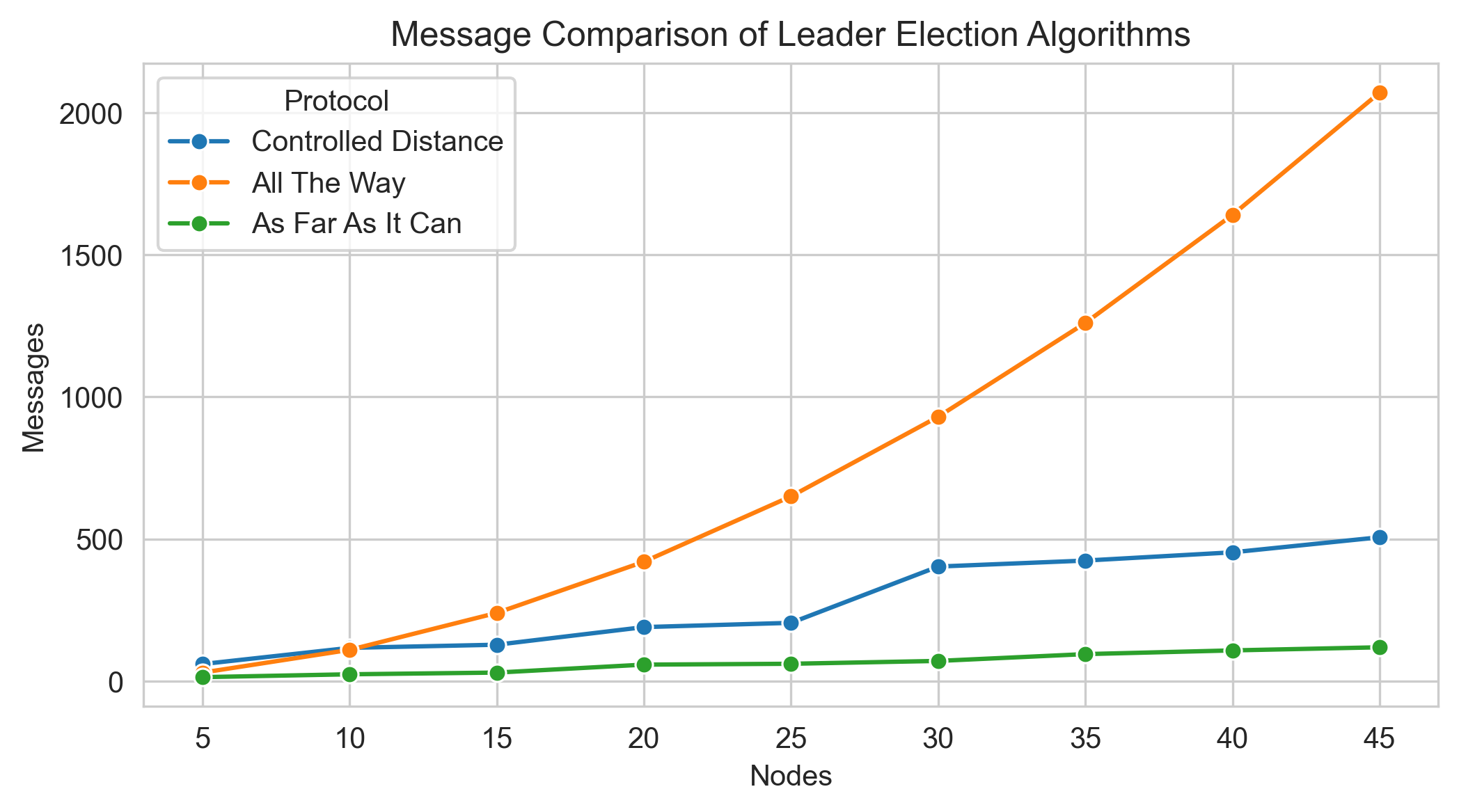
This other script will plot number of nodes vs number of messages used in a simple simulation where nodes try to access a critical section leveraging Lamport's Mutual Exclusion. The script is very concise and similar to the previous one. As expected, the number of messages scales quadratically with the number of nodes in the network.
import networkx as nx
import Nodes.initializers as initializers
import os
import pandas as pd
import seaborn as sb
import matplotlib.pyplot as plt
n_nodes = [5*i for i in range(1,11)]
CLIENT_PATH = "./client.py"
df = pd.DataFrame(columns=["Nodes", "Messages"])
PORT = 65000
for i,n in enumerate(n_nodes):
    print(f"{i}/{len(n_nodes)} simulations done.")
    G = nx.complete_graph(n)
    client = os.path.abspath(CLIENT_PATH)
    init = initializers.Initializer(client, "localhost", PORT, G, shell=False)
    init.wait_for_termination()
    messages = init.wait_for_number_of_messages()
    df.loc[len(df)] = [n, messages]
    init.close()
print(df)
sb.set_style("whitegrid")
fig, ax = plt.subplots(figsize=(8, 4))
sb.lineplot(data=df, x="Nodes", y="Messages", marker='o', ax=ax, color="b")
plt.title("Number of Messages vs Number of Nodes in LME")
plt.savefig("lamport.png", bbox_inches="tight", dpi=300)
