


Reble — pronounced re-bl (the final e is silent).
Reble is an open SQL engine for your Iceberg lakehouse. Your models are plain SQL files; Reble derives their dependencies, builds the tables into your catalog and bucket, and refreshes exactly what moved — triggered by cron, CI, Airflow, or an agent.
Every data team ends up building the same expensive hack around that job: a copy of the warehouse for testing changes. You refresh it, you queue for it, you hope it still matches prod — and you pay for it twice. The Apache Iceberg table format already has the primitive that makes it unnecessary: a branch ref is metadata-only, so a "copy" of a 5M-row table costs under 10 ms and zero bytes on any compliant catalog. What was missing is the workflow — deciding what a change touches, making its inputs reproducible, showing what it will do to production rows before anyone accepts it.
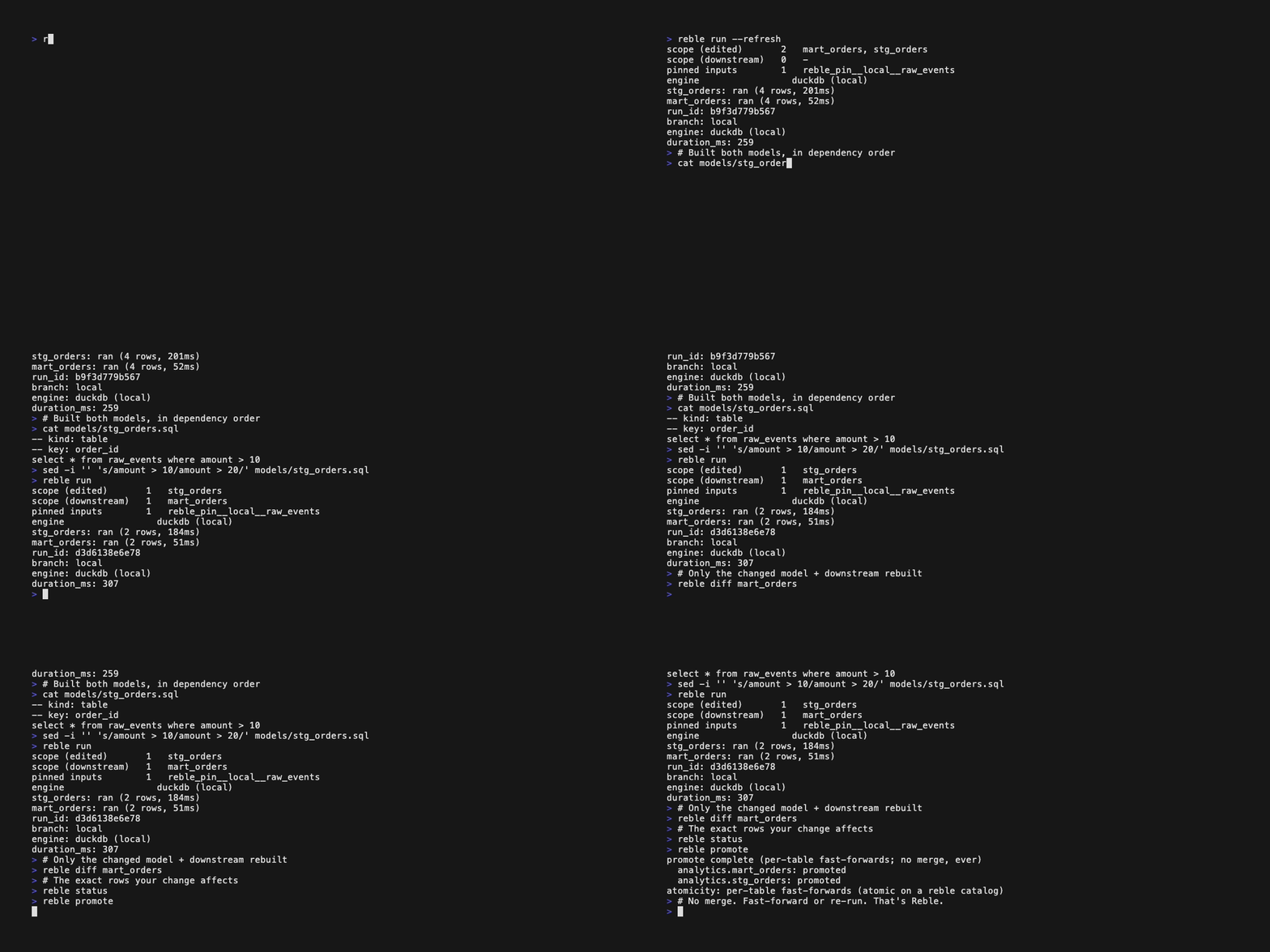
Reble is that workflow, and it isn't bolted on: scope, pin, run, diff, promote are what the engine does. When you change a model, it branches, re-runs only the blast radius — your edited models plus their downstream closure, derived from the SQL — shows you the exact rows that will change, and fast-forwards production when you accept. There is no merge step, on purpose: promote or discard, never three-way-merge data, because data merges are where correctness goes to die.
How it works
flowchart TB
    WHO["who triggers — cron · CI · Airflow · AI agents (MCP)"]
    MODELS["your models — models/*.sql, plain SQL + a 3-line header"]
    REBLE["Reble — SQLGlot lineage · scope · pin · run · diff · promote"]
    ENGINE["compute — DuckDB (default) · Spark (same interface)"]
    CAT["your Iceberg catalog — Glue · Polaris · Nessie · Hive · REST · sql"]
    STORE[("your storage — S3 · GCS · local disk")]
    WHO -->|"invokes one verb"| REBLE
    MODELS --> REBLE
    REBLE --> ENGINE
    ENGINE -->|"branch refs · tag pins · snapshots"| CAT
    CAT --> STORE
Reble owns the transformation layer — models, lineage, execution, branching — the shape dbt-core has, without the templating or YAML. It does not own scheduling: cron or Airflow decides when; Reble is the step they run. And it's built on native Iceberg branch refs — a per-table Iceberg spec feature supported by any catalog (Glue, Polaris, Nessie, Hive, or any REST-compliant catalog). It is not a catalog and requires no new infrastructure. A branch ref is metadata-only: zero bytes are copied.
Quick start
No models of your own yet? Watch the whole loop — branch, edit, diff, drift, promote — in one command against a throwaway local catalog:
git clone https://github.com/satya1395/reble && cd reble && ./demo.sh
Or with your own models:
pip install reble
reble init                # writes reble.yml; probes your catalog
git switch -c fix-orders  # or: --change-set agent-42 — git is one adapter
# ...edit two models...
reble run                 # → data branch: edited models + downstream closure
                          #   written; upstream inputs pinned via Iceberg tags
reble diff                # schema + row-level diff vs. branch base
reble status              # un-run edits, drifted pins, branch age/expiry
reble promote             # fast-forward if base is current; forced re-run with
                          #   fresh diff if main moved. No merge. Ever.
What Reble is — and isn't
- Is: a transformation engine (models + lineage + execution) that works with the Iceberg catalog you already run (Glue, Polaris, Nessie, Hive, any REST catalog). No server, no new infrastructure.
- Isn't: a scheduler (cron/Airflow's job — Reble is the step they run), a catalog, or a merge tool. There is no three-way data merge, ever — a change is either fast-forwarded or re-run.
- See how Reble compares to lakeFS, Nessie, and warehouse clones.
The loop in detail
flowchart LR
    M[("main<br/>(Iceberg tables)")]
    E["edited SQL"] -->|"scope: AST-changed ∪<br/>downstream closure"| RUN["reble run"]
    M -->|"upstream inputs pinned<br/>via Iceberg tags"| RUN
    RUN -->|"zero-copy branch refs"| B[("data branch")]
    B --> D["reble diff<br/>rows + schema"]
    D --> P{"reble promote"}
    P -->|"pinned bases still<br/>equal main"| FF["fast-forward main"]
    P -->|"drift"| RR["scoped re-run +<br/>fresh promote-time diff"]
    RR --> FF
- Scoped branching — scope = edited models ∪ downstream closure, capped
by
--depth;reble run --refreshscopes by data movement instead (nightly refreshes rebuild exactly what ingested). - Pinned inputs — upstream tables pinned with Iceberg tags
(
reble_pin__*) at run time; tags blockexpire_snapshots, so branch reads stay correct even while main moves. - Row-level diffs — computed on your compute via DuckDB, streaming
through
iceberg_scan(out-of-core; spills under a configurableengines.duckdb.memory_limit). - Promote semantics — fast-forward only when every pinned base still equals current main; otherwise a scoped re-run and a fresh, promote-time diff. The PR diff is advisory; the promote diff is authoritative.
- Atomic per-table commits — every model write and every promotion step commits a table atomically: no partial states, no half-applied changes, interrupted work resumes instead of repeating. Cross-table consistency is verified at promote time (every pin still equals main) — not reconciled afterward by a merge you have to trust.
Performance
Measured, reproducible, no clusters — full numbers and reproduction commands on the performance page:
- Branch a 5M-row table: < 10 ms. Branches are metadata-only.
- Full lifecycle on AWS (Glue + S3, 1M rows, from a laptop): scoped
run ~13 s, keyed diff ~4 s, drift check ~2 s — with streaming reads
verified engaged (
iceberg_scan, zero fallbacks). - Reads spill under a configurable
memory_limit— working set bounded by config, not by RAM.
Models are plain SQL
"Model" is just our word for one SQL file that creates one table. If
your team keeps a folder of SQLs and schedules them some way — a DAG, cron,
an internal webapp — you already have models; point Reble at the folder.
No orchestrator required, no dbt required: models/**/*.sql, one file is
one model, the file stem is the table name, and a minimal header comment
block carries the semantics:
-- model: mart_orders      (optional; defaults to file name)
-- kind: table | view
-- key: order_id           (diff key)
select ... from stg_orders join raw_customers using (customer_id)
Every run fully rebuilds its scope — replace, never append — and
reble run --force rebuilds even unchanged SQL. (There is deliberately no
incremental kind yet: it arrives when watermark / insert-overwrite
execution is real, not as a word that recomputes everything.)
Lineage is parsed with SQLGlot: a table reference that matches another model
is an edge; anything else is an upstream input, pinned with an Iceberg tag at
run time. Cosmetic edits (whitespace, comments, casing) hash identically on
the canonical AST and never trigger a run. Every branch snapshot carries
provenance (reble.model, reble.ast_hash, reble.run_id) in its summary —
"which code produced this table state" is answered from the catalog itself.
Set it up once, it runs itself
No manual runs. Put one command in cron, CI, or Airflow — the same command whether you have two models or two hundred:
# nightly: rebuild exactly what changed
0 3 * * * cd /srv/warehouse && reble run --refresh && reble gc
Safe to trigger repeatedly: a night with no new data does nothing. A crashed run resumes from where it stopped. A retried promote never double-applies.
For teams, state lives in Postgres so multiple workers share it safely
(one line in reble.yml, validated at startup — no shared filesystem
needed):
state:
  store: postgres
  uri: ${REBLE_STATE_URI}   # postgresql://user:pass@host:5432/reble
Install with pip install 'reble[postgres]'.
The verbs are idempotent and the exit codes are a contract, so any job can drive Reble: scheduled, or triggered by whatever lands your data. A double trigger is harmless — a quiet night computes an empty scope from one catalog listing.
# .github/workflows/refresh.yml — rebuild exactly what moved, nightly and
# on demand (your ingestion job can dispatch it when new data lands)
on:
  schedule: [{cron: "0 3 * * *"}]
  workflow_dispatch:
jobs:
  refresh:
    runs-on: ubuntu-latest
    steps:
      - uses: actions/checkout@v4
      - run: pip install reble
      - run: reble run --refresh     # + reble gc to drop expired branches
        env: { REBLE_CHANGE_SET: local }   # catalog/warehouse creds as secrets
PRs get the same treatment: reble status exits 3 on drift and
reble diff prints the row-level consequences — cheap checks to wire into
any CI.
Agents (MCP)
Any MCP host can drive the same verbs — the agent has no special powers:
{
  "mcpServers": {
    "reble": {
      "command": "reble-mcp",
      "env": { "REBLE_PROJECT_DIR": "/path/to/project" }
    }
  }
}
Install with pip install 'reble[mcp]'. reble_run generates and returns a
change-set id; errors carry the spec exit codes as structured error.code
(3 = drift, 4 = promote-blocked). Tool docstrings are the agent-facing spec.
Agents and CI are first-class everywhere, not just over MCP: every command
speaks a stable --json envelope with documented exit codes,
run/diff stream versioned --events (NDJSON),
and work is keyed by change-set (--change-set <id> or REBLE_CHANGE_SET)
so it never depends on git — --branch resumes an existing data branch
under a new change-set.
Documentation
- Docs site — quickstart, concepts, guides, and the CLI, config, and exit-code references.
SPEC.md— normative CLI specification (v0.2): invariants, on-disk layout,reble.ymlschema, command reference, JSON envelope, event streams, provenance, exit codes.DECISIONS.md— recorded behavior decisions.
Requirements
- Python 3.10–3.13 (3.14 not yet tested)
- An S3 bucket + an Iceberg catalog (Glue, Polaris, Nessie, Hive, or any
REST-compliant one) — on AWS,
pip install 'reble[aws]'and follow the AWS walkthrough (covers bucket creation, credentials, and every step from zero) - SQL models under
models/(path configurable vialineage.models_path)
Roadmap to 1.0
| Release | Theme | Highlights | Status |
|---|---|---|---|
| 0.4 | Runs on AWS | Glue + S3 verified end-to-end, credential auto-config, self-cleaning AWS smoke | ✅ shipped |
| 0.5 | Bigger warehouses | Spark runner (local first, then serverless); GCS + ADLS verification; partitioned tables; incremental execution (watermark / insert-overwrite) | Spark runner ✅ (0.6.0); rest ongoing |
| 0.6 | Backfills & teams | Date-range / partition-scoped backfills (branch + insert-overwrite); documented CI recipes (PR checks, promote gates); multi-writer etiquette; reble doctor |
planned |
| 0.7 | Interop | REST catalogs verified (Polaris, Nessie); Trino read adapter on demand; Iceberg views | planned |
| 0.8 | Operations | Metrics/log hooks; estimate v2; Windows support |
planned |
| 1.0 | GA | See criteria below | — |
GA criteria — 1.0 ships when, not before: the JSON envelope, event streams, and exit codes have held stable through a full minor release; the lifecycle is green in CI on Glue + one REST catalog + sql; both engines (DuckDB, Spark) are real; at least three non-trivial warehouse deployments have run promote in production; and a security pass is done.
License
Apache-2.0.