Interview your coding agent before you ship with it.
agent-trials runs the same task suite through every coding agent CLI you have installed and prints a scoreboard: who passed, how long they took, what they spent. Each task gets a temporary working copy. Commands still run on your host.
why
Public benchmarks score agents on tasks someone else picked. Your repo is not that benchmark. The question that matters before you let an agent loose on a codebase: does it fix YOUR bugs, in YOUR stack, at a sane price? Write the tasks once, run every candidate, keep the receipts.
execution safety
Agents are untrusted code. This tool runs them unattended, which means it is not, and cannot be, a security sandbox. What it does give you:
- credentials are withheld. Agents and verify commands get a minimal environment:
PATH,HOME,SHELL,TERM,LANG,LC_ALL,TMPDIR,TZ. Everything else is dropped.ANTHROPIC_API_KEY,GITHUB_TOKEN,AWS_SECRET_ACCESS_KEYand the rest do not reach the child process. A suite can opt specific vars back in withallowedEnv. - secret files are skipped.
.env,.env.local,*.pem,*.key,id_rsa,.npmrc,.netrc,.aws/,.ssh/and similar are never copied into the working copy. The run prints what it skipped. Ordinary files are left alone:config.json,src/config.json,.env.exampleandcredentials.jsare not secrets and stay put.--allow-secretsoverrides this if you have a reason. - symlinks are skipped. A link copied into the working copy hands the agent a path out of your repo, and dereferencing one imports files that were never in the repo. Neither happens: links are dropped and the run lists them, so you can see why a linked directory looks empty inside a run.
- unsafe flags are opt-in. Builtin
claude,codex, andgeminispecs disable approval prompts (--dangerously-skip-permissions,--full-auto,--yolo) and the tool refuses to run them without--unsafe. The check reads the argv, so redefining a builtin name, or writing a custom agent that passes a bypass flag, still requires--unsafe. - timeouts kill the process group. A timed-out cell signals the child and everything it spawned, so a killed
npm testdoes not keep running against a directory that is being deleted. - temporary copies are cleaned up. On normal exit, on Ctrl-C, and on SIGTERM.
--keepleaves them and prints the paths.
What it still does not do:
- the working copy is not a security sandbox. Agents run with your user's permissions and can read and write outside the copy. Skipping symlinks and secrets narrows what is handed to them; it does not contain them.
- an agent with network access can exfiltrate anything it can read, including your source.
verifyPathsare restored from your repo after the agent runs so it cannot rewrite its own test, but a verify command that reads mutable state elsewhere can still be gamed. AverifyPathsentry that is itself a symlink is refused.
Run this in a disposable VM with no sensitive files or credentials. That sentence was true before and it is still true now. Use only suites you trust.
install
npx agent-trials init # writes trials.json in your repoWorks straight from GitHub too: npx github:princejain756/agent-trials.
use
agent-trials init           # starter suite
agent-trials doctor         # which agent CLIs are installed
agent-trials run --unsafe   # run the suite, print the board, write TRIALS.md
--unsafe is required whenever the selected agents are the builtins, because those specs disable the agent's own approval prompts. Without it the run stops and tells you which agents it means.
trials.json
{
  "verify": "npm test",
  "verifyPaths": ["verify"],
  "timeoutSec": 600,
  "allowedEnv": ["ANTHROPIC_API_KEY"],
  "tasks": [
    {
      "id": "fix-cache",
      "prompt": "The cache in src/cache.js never expires entries. Add a ttl option. Keep the API.",
      "verify": "node checks/cache-ttl.mjs"
    }
  ],
  "agents": {
    "sonnet": { "run": ["claude", "-p", "{prompt}", "--dangerously-skip-permissions", "--model", "sonnet"] }
  }
}
allowedEnv is optional. Without it the agent gets only PATH, HOME, SHELL, TERM, LANG, LC_ALL, TMPDIR, TZ. Agent CLIs usually read their own auth from a config file in HOME, so you often do not need this; add a var only when a CLI genuinely needs it from the environment.
Each cell (agent x task) works like this:
- your repo, minus
node_modules,.git, and secret-looking files, is copied to a temporary working copy - optional
setupcommand runs once (npm ciand friends) - the agent runs headless on the task prompt, using the selected CLI flags, timeout-guarded, with a minimal environment
- checker paths are restored from your repo, so the agent cannot rewrite its own test
- your
verifycommand runs in the working copy; exit 0 means pass
Step 4 restores verifyPaths from the suite, or a top-level verify/ dir when verifyPaths is not set. For a checker outside those paths, the tool fingerprints every file the verify command names before the agent runs and fails the cell if one changed or appeared, so an agent cannot pass by rewriting the script that grades it. This means a verify command must not run a file the agent is supposed to create. If your check needs a file the agent writes, read it from the verify command instead of exec'ing it.
Builtin agents: claude, codex, gemini. Custom agents are one argv array away: anything installed, any flags, {prompt} gets replaced with the task prompt.
The --unsafe gate is not limited to the builtins. Any agent whose argv contains a known approval-bypass flag (--dangerously-skip-permissions, --full-auto, --yolo, --force, --auto-approve and friends) requires --unsafe too, including a custom agent that reuses a builtin name. A plain command like ["sh", "./agent.sh", "{prompt}"] runs with no flag.
a real run
examples/tinylib is a 3-function library with planted bugs. Same 3 tasks, 3 settings of the same agent CLI (claude --model opus|sonnet|haiku):
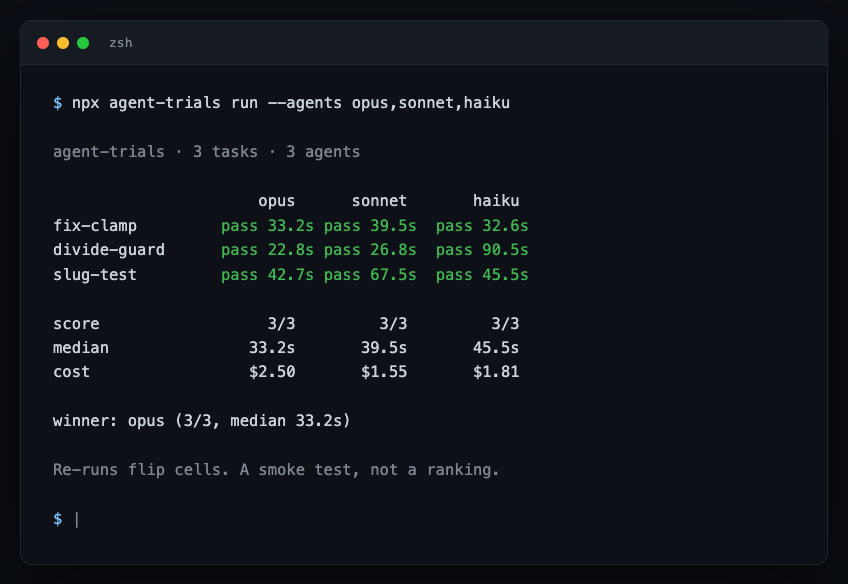
agent-trials · 3 tasks · 3 agents

                      opus      sonnet       haiku
fix-clamp         pass 33.2s  pass 39.5s  pass 32.6s
divide-guard      pass 22.8s  pass 26.8s  pass 90.5s
slug-test         pass 42.7s  pass 67.5s  pass 45.5s

score                  3/3         3/3         3/3
median               33.2s       39.5s       45.5s
cost                 $2.50       $1.55       $1.81

winner: opus (3/3, median 33.2s)
An agent name is not a model: the tool records the literal model string each cell was served and warns when a column label disagrees with it, because --model haiku can resolve through local config like ANTHROPIC_DEFAULT_HAIKU_MODEL to something other than Haiku. The served string lands in --json output, so a leaderboard is built on what was served, not what was requested.
The board above is one run of three toy tasks. Re-running the same suite flips cells, and three tasks are too small to rank models. Treat it as a smoke test that the tool works end to end, not a benchmark.
What the suite caught across runs:
- the shipped
slug-testchecker used to run the agent's own test file and trust its exit code, so a file containingconsole.log("ok")scored a pass even though the deliverable was never written. It now requires at least three real assertions and independently assertsslugifyagainst the agent'slib.js. A do-nothing agent that used to pass now fails, and a correct test still passes. - in one run the agent asked a clarifying question ("should -0 count as zero?") into an empty terminal, then exited 0 having changed nothing. Exit code alone cannot be the verdict; the verify command is what counts.
Full results with per-cell costs: LEADERBOARD.md
limits, honestly
- pass/fail is your verify command's exit code. The tool cannot judge taste, only outcomes.
- runs spend your agent quota and your auth; costs are reported when the agent's JSON output includes them (claude does)
- agent CLIs must be installed and logged in
- macOS/Linux; the working copy and verify assume
sh. Windows untested - scoring is binary per task. No partial credit for "almost fixed it"
- a verify command that reads state outside the files it names (a network call, a global cache, a timestamp) can still be gamed. Fingerprinting covers the scripts the command mentions, not everything it touches.
- the working copy is not a security sandbox. Credentials and secret files are withheld, but the agent still runs as your user on your machine. Use a disposable VM
flags
| flag | default | what it does |
|---|---|---|
--suite <file> |
trials.json |
suite file to run |
--agents a,b |
all known | restrict the agent list |
--root <dir> |
. |
the repo being tested |
--jobs <n> |
2 |
parallel agent x task cells |
--out <file> |
TRIALS.md |
markdown report path, none skips |
--json <file> |
- | raw per-cell results |
--keep |
off | keep working copies under /tmp for debugging |
--unsafe |
off | allow builtin agents to run with approval prompts disabled |
--allow-secrets |
off | copy secret-looking files into the workdir |
Flags are strict: an unknown flag, a repeated flag, a bare positional argument, or a value flag with no value all stop the run with a message instead of being ignored. If you typo --job for --jobs, you hear about it.
why the suite format is the point
Tasks are plain JSON and verify is plain shell, so a suite doubles as a smoke-test pack for humans. Commit trials.json next to the code it describes. When you swap agents or bump model versions, rerun and diff the board.
MIT