
pingtop is a fast, keyboard-first multi-host ping monitor for people who live in the terminal.
Point it at a few hosts, a whole subnet, or a host list, and get a live Textual dashboard with RTT trends, loss stats, sortable columns, and per-host drill-down details.
It is built for the moment when ping is too small, dashboards are too heavy, and you just want to see what your network is doing right now.
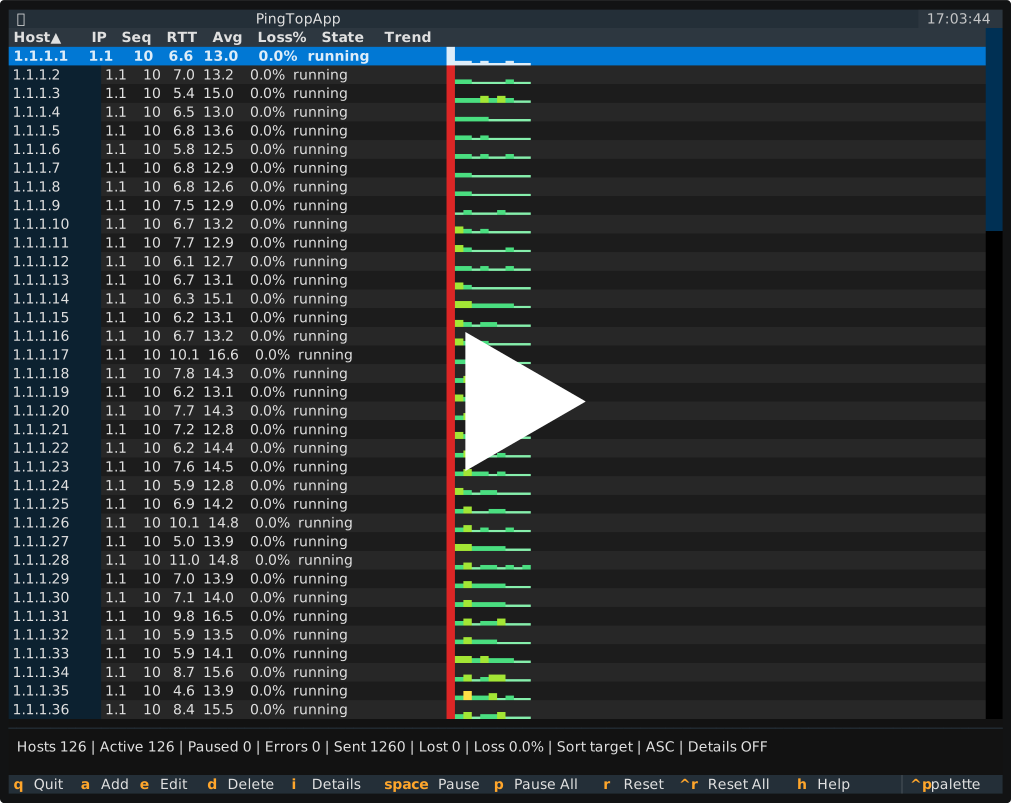
Why pingtop
- Monitor many hosts at once in a single live TUI
- Spot latency spikes instantly with inline RTT trend bars
- Sort by host, IP, RTT, avg, max, stddev, loss, state, or trend
- Inspect a selected host in a dedicated details panel
- Add, edit, delete, pause, and reset hosts without restarting the session
- Load targets from CLI args, CIDR ranges, or a hosts file
- Export the final snapshot to JSON or CSV
- Print a clean colored summary on exit
- Use raw ICMP directly instead of shelling out to
ping
Feature Highlights
Live network view
- Real-time host table with RTT, min/avg/max, stddev, loss, state, and trend columns
- Responsive layout that keeps the table useful on both wide and narrow terminals
- Stable numeric column widths, so values stay easy to scan while data updates
Designed for triage
- One-key sorting across every important signal
- A details panel with an expanded RTT graph for the selected host
- Global status strip showing active hosts, paused hosts, errors, sent packets, and total loss
Built for real sessions
- Add or fix targets in place instead of restarting
- Pause a noisy host, pause everything, or reset stats when you want a clean measurement window
- Deduplicate repeated hosts automatically when combining CLI args and
--hosts-file
Install
Requirements:
- Python 3.10+
python -m pip install pingtop
After installation, run it directly:
pingtop 1.1.1.1 8.8.8.8
Quick Start
Monitor a few public resolvers:
pingtop 1.1.1.1 8.8.8.8 9.9.9.9
Use a faster sampling interval:
pingtop 1.1.1.1 8.8.8.8 --interval 0.2 --timeout 0.5
Expand a CIDR block into usable hosts automatically:
pingtop 10.22.76.19/30
Load hosts from a file:
pingtop --hosts-file hosts.txt
hosts.txt is newline-delimited. Blank lines and lines starting with # are ignored.
Common Workflows
Monitor a host list and export the final snapshot:
pingtop --hosts-file hosts.txt --export snapshots/session.json
Write CSV explicitly:
pingtop 1.1.1.1 8.8.8.8 --export snapshots/session.csv
Enable debug logging while troubleshooting:
pingtop 10.0.0.1 10.0.0.2 --log-file pingtop.log --log-level debug
Disable the exit summary when you only want the TUI:
pingtop 1.1.1.1 --no-summary
CLI Options
Usage: pingtop [OPTIONS] [HOSTS]...

Options:
  -i, --interval FLOAT            ping interval in seconds
  -t, --timeout FLOAT             timeout in seconds
  -s, --packet-size INTEGER       ICMP payload size in bytes
  --hosts-file FILE               newline-delimited host list
  --summary / --no-summary        print a colored summary on exit
  --export FILE                   export final snapshot
  --export-format [json|csv]      override export format
  --log-file FILE                 write logs to a file
  --log-level [debug|info|warning|error|critical]
  -h, --help
Keyboard Shortcuts
Session control:
aadd a hosteedit the selected hostddelete the selected hostspacepause or resume the selected hostppause or resume all hostsrreset statistics for the selected hostctrl+rreset statistics for all hostsishow or hide the details paneltabswitch focus between the table and details panelhor?open helpqquit
Sorting:
HhostGresolved IPSsequenceRlast RTTImin RTTAavg RTTMmax RTTTstddevLlost packetsPloss percentageUstateWtrend
Press the same sort key again to reverse the order.
What You Get On Exit
By default, pingtop prints a compact colored summary with:
- overall status
- total hosts, tx, rx, and loss percentage
- lossy or down hosts
- top issues worth investigating first
If you export a snapshot, the file includes session config, aggregate stats, and per-host results.
Permissions
pingtop uses ICMP sockets directly and does not require sudo or root privileges on modern systems.
- macOS — unprivileged ICMP is supported out of the box.
- Linux — most distributions ship with a permissive
net.ipv4.ping_group_rangeby default.
If you do hit a permission error on Linux, check the current value:
cat /proc/sys/net/ipv4/ping_group_range
Then widen the allowed range so your user or group can open ICMP sockets:
sudo sysctl -w net.ipv4.ping_group_range='0 1001'
Development
You may need to set poetry config virtualenvs.in-project true for the included vscode launch.json to work.
poetry install
poetry run pytest
poetry run ruff check .
poetry run mypy src
Credits
- The raw ICMP implementation is derived from the original
pingtopproject. - The TUI is built with Textual.
If pingtop earns a place in your toolbox, star the repo.