
Know which coding agent needs you, without checking all terminal windows.



Picture a normal afternoon. Six agent sessions open: four still thinking, one that finished ten minutes ago and is waiting on your follow-up, one stopped on a decision it won't make without you. You can't tell which is which without tabbing through all six.
captain-miao is a TUI dashboard for every coding agent you have running, Claude Code, Codex and others. Each session gets a row that says what it's doing right now.
- Stop tab-hunting. Every session in one table: status, working directory, model, context usage, git branch, and a live transcript preview.
- Never leave an agent waiting. Sessions blocked on an approval or a question are flagged, and
sjumps to the next one. - Drive the whole fleet from one place. Launch, resume, fork and kill sessions from the dashboard, on this machine or on a remote server.
captain-miao.demo.mp4
npx @hyperlogue/captain-miao
Runs in the terminal you already use: Kitty, Ghostty, iTerm2, zellij or tmux. See Installation for Cargo, Nix and prebuilt binaries.
Highlights
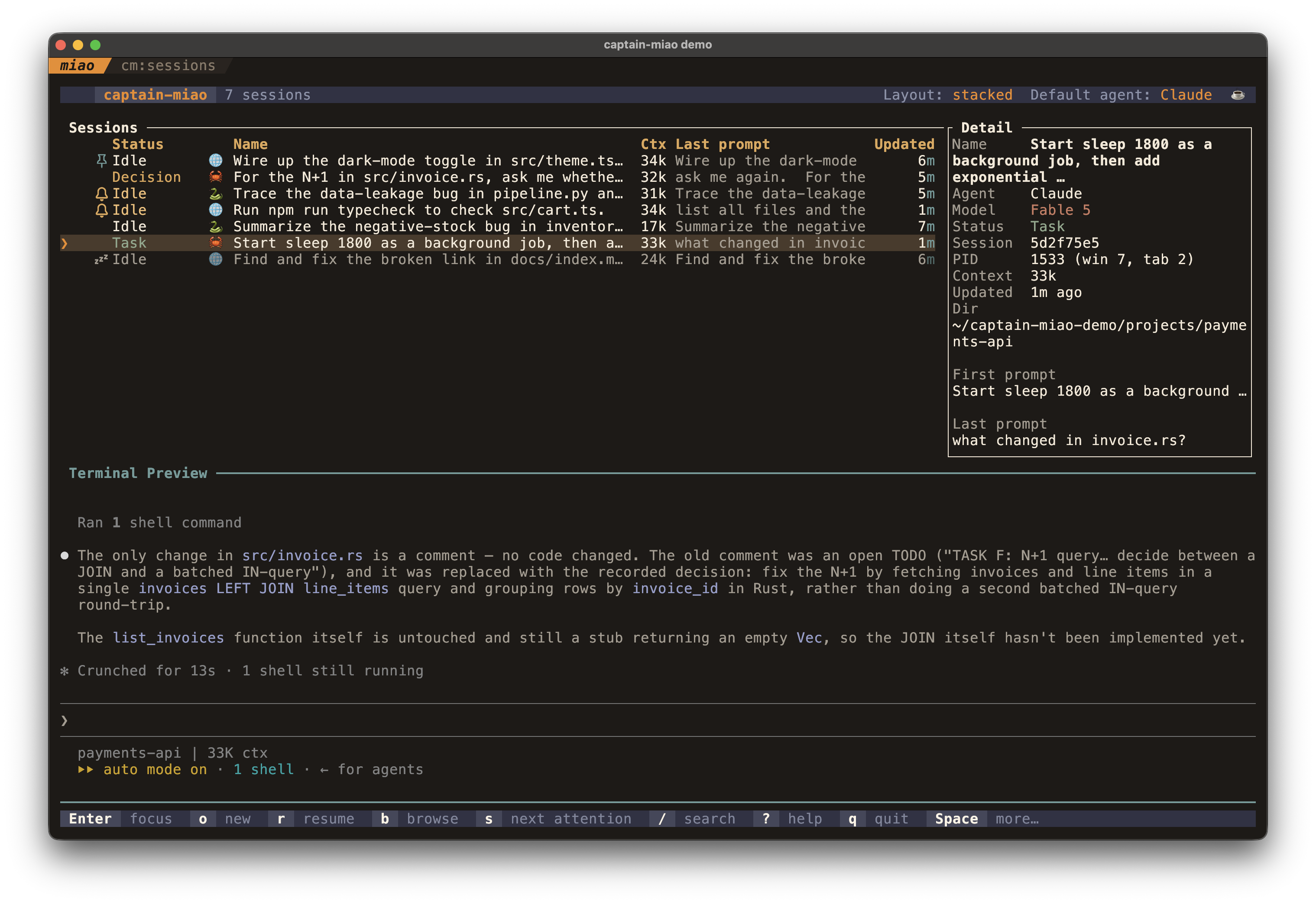
Unlike herdr or cmux, captain-miao embeds no terminal of its own. It drives the Kitty, Ghostty, iTerm2, zellij or tmux you already run (every session is a native window or pane, controlled through the terminal's own protocol), so it stays one small, focused tool and the rest of your workflow is yours to compose.
- Sessions on remote servers: federate several hosts into one dashboard, each running its sessions in its own pty pool (shpool), so a dropped connection or a slept laptop detaches windows without killing the sessions. A host can also borrow this machine's clipboard, so
Ctrl+Vin an agent running there attaches a screenshot you just took locally (details). - Support Claude Code and Codex today, behind a backend abstraction built to extend to other coding agents. Reasonix, Kimi Code, Grok Build, opencode and Pi ship too, each with known limits.
- direnv-aware: a session started in a directory with an
.envrcpicks up that environment automatically (viadirenv exec). - r3 integration: when a session's running background task is an
r3 watchwaiting for your review, it flags as Review and surfaces as needing your attention. - Keep-awake: prevents your machine from sleeping while any session is still working (
caffeinateon macOS,systemd-inhibiton Linux).
Requirements
One supported terminal to drive, and at least one agent CLI on your PATH.
Terminals
| Terminal | Notes |
|---|---|
| Kitty | Needs remote control enabled (Kitty setup). Most of features in captain-miao are designed around Kitty. |
| Ghostty ≥ 1.3 | macOS only, driven through Ghostty's AppleScript dictionary (Ghostty setup). Nothing in that API reads a window's screen, so there is no preview. |
| iTerm2 ≥ 3.0 | macOS only, driven through iTerm2's AppleScript dictionary (iTerm2 setup). Previews are plain text — iTerm2 returns no colour. |
| zellij ≥ 0.44 | Sessions live as full-size floating panes in one miao:sessions tab. |
| tmux ≥ 3.2 | One window per session. |
Every one of them runs the whole dashboard; the notes above are the deltas. One cosmetic difference isn't among them: the header's paw is a real image only under Kitty, the single backend that speaks the kitty graphics protocol (and not from inside zellij or tmux, even in a Kitty window). Everywhere else it's a 🐾 glyph and clicking it does nothing.
Agents
| Agent | Notes |
|---|---|
| Claude Code | |
| Codex | Hooks can't be injected per-invocation, so a session runs under a synthetic CODEX_HOME that symlinks your real one. No support for pasting in remote sessions, as it reads the clipboard in-process (details). |
| Reasonix | Token/model columns and worktrees don't work (known limits). |
| Kimi Code | Hooks can't be injected per-invocation, so a session runs under a synthetic KIMI_CODE_HOME. No fork and no worktrees (known limits). |
| Grok Build | Runs under a synthetic GROK_HOME that symlinks your real one. No token column (Grok doesn't persist one), and an interrupted turn keeps reading as working (known limits). |
| opencode | Has no hooks at all, so a session runs under a synthetic OPENCODE_CONFIG_DIR carrying a generated plugin. No worktrees (known limits). |
| Pi | Hooked with a generated extension passed as pi -e; nothing of yours is touched. No approval state (Pi has no per-tool gate), no resume-picker entries and no worktrees (known limits). |
Installation
From source with Cargo
cargo install --git https://github.com/hyperlogue/captain-miao
This installs the miao command (the project is captain-miao; the binary is short because you'll type it a lot).
Building needs a Rust toolchain and a C compiler (for the statically-bundled SQLite that reads Codex session titles).
From a prebuilt binary (npm)
No Rust toolchain, no build:
npx @hyperlogue/captain-miao          # run it once
npm install -g @hyperlogue/captain-miao   # or install the `miao` command
bunx @hyperlogue/captain-miao works too. The npm package is a small launcher
that execs a prebuilt native binary shipped as a per-platform optional
dependency, so your package manager downloads only the one binary matching your
machine; nothing is fetched at runtime. Prebuilt binaries cover macOS (Apple
silicon + Intel) and Linux (x86-64 + arm64), and are also attached to every
GitHub Release as
miao-v<version>-<target>.tar.gz if you'd rather download one directly.
Every prebuilt binary carries an x86-64 glibc miao-server, so it can set up a
remote host that has nothing installed on it — see Running sessions on remote
servers. A host on another architecture, or
one with no glibc, gets its server downloaded at deploy time instead. If you'd
rather not depend on that, each release also has a
miao-bundled-all-server-v<version>-<target>.tar.gz carrying every server
captain-miao publishes — larger, and never needs the network.
With Nix
A flake is provided; run it straight from GitHub:
nix run github:hyperlogue/captain-miao
Kitty setup
captain-miao drives Kitty over its remote-control protocol, so your kitty.conf must allow it. Remote control is a real privilege (a program that has it can read your terminal and run commands), so the tightest setup kitty offers pairs a password with an authorization script:
allow_remote_control password
remote_control_password "i-am-the-captain-miao" captain_miao_rc.py
listen_on unix:/tmp/mykitty
Kitty resolves that filename against your config directory, so put the script at ~/.config/kitty/captain_miao_rc.py:
# The only remote-control commands captain-miao issues.
ALLOWED_COMMANDS = frozenset({
    "ls", "get-text", "launch", "focus-window",
    "focus-tab", "close-window", "detach-window", "goto-layout",
})

def is_cmd_allowed(pcmd, window, from_socket, extra_data):
    # Reject the in-terminal escape-code channel; only the listen_on socket gets in.
    return from_socket and pcmd["cmd"] in ALLOWED_COMMANDS
Every request must now clear three checks: arrive over the socket (not the escape-code channel that a shell, even one across ssh, could otherwise use), carry the password, and name one of the commands above. i-am-the-captain-miao is captain-miao's built-in default, so this works as written; to use your own secret instead, set remote_control_password (above) and [kitty] rc_password in captain-miao's config to match. Keep the script the last item after the password; command names listed alongside it are allowed without ever calling your function.
Looser alternatives: allow_remote_control socket-only (off the escape-code channel, but no password and no allowlist) or allow_remote_control yes (no checks at all; avoid it). captain-miao verifies remote control at startup and exits with a diagnostic if it can't connect.
Keep the stack layout enabled. captain-miao's default Stacked session layout puts every session in one kitty tab and shows one at a time via kitty's stack layout. The default enabled_layouts * already includes it; if you've narrowed that list, add stack or sessions tile instead of stacking. (The alternate Per-tab layout, toggled with Space l, needs no particular layout.)
Ghostty setup
macOS only, Ghostty ≥ 1.3. captain-miao drives Ghostty through its AppleScript dictionary, which is enabled by default — there is no config file to edit. The one thing you must do is approve the Automation prompt macOS raises the first time captain-miao talks to Ghostty; if you dismissed it, re-enable it under System Settings → Privacy & Security → Automation, in the entry for whatever launched captain-miao. It verifies the channel at startup and exits with a diagnostic naming the fix if it can't get through.
The Linux build of Ghostty exposes no equivalent control channel, so captain-miao does not claim it there — run it under zellij or tmux instead.
Three things work differently here, all of them because the dictionary has no way to express them:
- No preview. Nothing in Ghostty's automation API reads a window's screen or scrollback, so the preview pane says so instead of showing output. Everything else on the row — status, context usage, working directory — comes from the agent's own files and is unaffected.
- No move-to-tab.
tis hidden, as it is on zellij. - New sessions bring Ghostty to the front. Ghostty activates itself whenever a script creates a window or tab (ghostty#11457), with no way to opt out, so a spawn takes focus even when captain-miao asks it not to.
Sessions always get their own tab: Ghostty has neither a stack layout nor floating panes, so Space l has nothing to toggle and is hidden, exactly as on tmux.
Ending a session doesn't interrupt you. Ghostty confirms before closing a surface whose command is still running (confirm-close-surface, on by default), and it asks on that tab — so a close arriving while the process was alive switched you away from the dashboard to answer a dialog. D and a restart signal the session and let it exit first; a Ghostty surface whose command has exited closes itself, so by then there is nothing left to confirm. The exception is a pooled session's attach window: the process in it is a local ssh that captain-miao holds no pid for, so closing that one still asks. Set confirm-close-surface = false if you would rather never be asked.
Start sessions from the dashboard here — o for the current directory, O to choose one. A hand-typed miao claude . in a Ghostty window is refused, because Ghostty exports no per-surface id to the process running in it: such a session would appear in the dashboard but could not be focused with Enter or closed with D, and refusing at the prompt beats discovering that on the row an hour later. A dashboard-started session has no such gap — its window comes from the spawn itself. The refusal is narrow: under tmux or zellij inside Ghostty the pane names itself, so hand launches work there exactly as they always have.
Only partly confirmed against a live Ghostty. Spawning and dashboard-window discovery have been driven by hand against Ghostty 1.3.1; the rest of the backend is unit-tested only, because CI can't supply a Mac with a GUI session and a hand-clicked Automation grant. Report anything that looks wrong rather than assuming it's expected.
iTerm2 setup
macOS only, iTerm2 ≥ 3.0. captain-miao drives iTerm2 through its AppleScript dictionary, which is on by default — there is nothing to enable. As with Ghostty, approve the Automation prompt macOS raises the first time captain-miao talks to iTerm2; if you dismissed it, re-enable it under System Settings → Privacy & Security → Automation, in the entry for whatever launched captain-miao. The channel is verified at startup, with a diagnostic naming the fix if it can't get through.
Unlike Ghostty, iTerm2 tells a process which session it is in, so nothing here is second-class: hand-typed launches bind to their window, Enter focuses, D closes, and miao focus works. Three smaller differences:
- Previews are plain. iTerm2 returns a session's visible screen without colour, so the preview shows the right text in the wrong palette. It also has no scrollback in the API, so the preview never reaches back further than the window itself.
- No move-to-tab.
tis hidden, as it is on zellij and Ghostty. - Sessions always get their own tab, so
Space lhas nothing to toggle and is hidden, exactly as on tmux.
One iTerm2 bug is worth knowing about: after any window or tab is created with a command that exits immediately, iTerm2 stops answering "create tab" altogether — later spawns hang even when their command is long-lived, until iTerm2 is restarted. captain-miao bounds the wait and says so rather than hanging, and the sessions it starts hold themselves open on failure, so this is hard to reach in normal use.
Only partly confirmed against a live iTerm2. Spawn, snapshot, focus, capture and close have each been driven by hand against iTerm2 3.6.11; a full session lifecycle (resume, restart, kill, detach) has not, and CI can't drive one. Report anything that looks wrong rather than assuming it's expected.
Usage
Run the dashboard inside a supported terminal (Kitty, Ghostty, iTerm2, zellij or tmux):
From the dashboard, o / O start new sessions and r resumes existing ones. You can also drive captain-miao from the shell:
| Command | What it does |
|---|---|
miao |
Run the TUI dashboard (the default). |
miao claude [dir] [args…] |
Launch Claude Code in dir (default .) with tracking hooks. Args starting with - (e.g. --resume) are forwarded straight to claude. |
miao codex [dir] [args…] |
Launch Codex in dir with tracking hooks; extra args are forwarded to codex. |
miao reasonix [dir] [args…] |
Launch Reasonix in dir with tracking hooks; extra args are forwarded to reasonix. See known limits. |
miao kimi [dir] [args…] |
Launch Kimi Code in dir with tracking hooks; extra args are forwarded to kimi. See known limits. |
miao grok [dir] [args…] |
Launch Grok Build in dir with tracking hooks; extra args are forwarded to grok. See known limits. |
miao opencode [dir] [args…] |
Launch opencode in dir with a tracking plugin; extra args are forwarded to opencode. See known limits. |
miao pi [dir] [args…] |
Launch Pi in dir with tracking hooks; extra args are forwarded to pi. See known limits. |
miao focus [--window-id <id>] |
Focus the running dashboard window; with --window-id, also ring the session running in that Kitty window. |
miao hook <event> |
Internal: forwards an agent hook event to the launcher. You won't run this yourself; it's wired up automatically. |
Sessions launched via claude / codex / reasonix / kimi / grok / opencode / pi are wrapped by a launcher process that injects the tracking hooks, so they show up in the dashboard automatically. Hooks are injected per-session and torn down on exit; nothing is written to your global ~/.claude/settings.json. The one place a launch is refused is a bare Ghostty window — see Ghostty setup.
Per-agent limits
Claude Code and Codex are the proven backends. The five below all ship and track status, but none has been run against a released build — report anything that looks wrong. A row stuck at Starting usually means the agent rejected our hook config.
Reasonix support
Status, launch, resume and fork work.
- No token or model columns — Reasonix persists usage per day, not per session.
- No worktrees, no background-task tiers.
- Run
reasonix setupoutside captain-miao once first, or it lands in the synthetic config home and is lost.
Kimi Code support
Status, launch, resume and the title, token and model columns work. Esc mid-turn settles the row immediately, because Kimi reports an interrupt as a real hook. Written from Kimi's docs alone, so the least verified here.
- No fork (
fhides itself) — Kimi documents no flag to branch a resume, so the key would silently resume in place. - No worktrees, no background-task tiers.
Grok Build support
Status, launch, resume, fork and worktrees all work.
- An interrupted turn keeps reading as working until you send the next prompt — Grok fires no hook for one. The limit most likely to bite day to day.
- No token column — Grok deliberately doesn't persist its token ledgers.
- No background-task tiers, and the worktree name isn't shown (Grok keeps worktrees in its own registry, not beside the repo).
- Authenticate with
grokoutside captain-miao once first.
opencode support
Status, launch, resume, fork and the title, tool, token and model columns all work. opencode has no shell-command hooks, so captain-miao generates a JavaScript plugin for it.
- No worktrees, no background-task tiers — a settled turn reads as
Idlewhatever else is still running. - Your own plugins keep loading:
plugins/is rebuilt to symlink each of them beside our generatedcaptain-miao.js. - The plugin stays out of
permission.ask, so nothing it does can delay a decision you're being asked to make.
Pi support
Status, launch, resume, fork and the token, model and title columns all work.
- No "waiting for approval" state — Pi has no per-tool gate, so there is no prompt to reflect. An absence in Pi, not a gap here.
- No resume-picker entries — Pi's sessions are trees rather than logs.
pi -ropens Pi's own picker meanwhile. - No worktrees, no background-task tiers.
- A row stuck at
Startingis usually Pi's project-trust prompt — answer it in the session window.
Key bindings
Press ? in the dashboard for the complete list. The six you'll reach for most:
| Key | Action |
|---|---|
j/k, ↑/↓, Ctrl-n/p |
Navigate sessions |
Enter |
Focus the selected session's window, or attach one to a detached session (asking first if another client holds it) |
o / O |
New session (same cwd / prompt for cwd) |
r / f |
Resume picker (one host; Ctrl-h switches) / fork the selected session |
x / D |
Kill the selected session / detach from it, leaving it running |
s |
Jump to the next session needing attention |
Remaining key bindings
| Key | Action |
|---|---|
gg / G |
Jump to top / bottom |
1..9 / Ctrl-1..9 |
Select Nth session / select and focus its window |
p / i |
Pin / toggle needs-input on the selected session |
y |
Copy the selected session id to the clipboard |
t / w |
Move window to tab (Kitty and tmux) / switch to or open the cwd's work tab |
h/l, ←/→ |
Scroll the preview horizontally |
Ctrl-u / Ctrl-d |
Scroll the preview up / down |
R |
Refresh the preview now |
Space v / Space d |
Toggle the preview / detail panel |
Space i |
Edit the selected directory's icon + color |
Space e / Space E |
Restart the selected / all idle sessions |
Space z |
Toggle keep-awake (inhibit OS sleep while sessions work) |
Space a / Space H |
Set the default backend / default host for new sessions |
Space l |
Switch session layout (stacked in one tab / one tab per session; not offered on tmux, Ghostty or iTerm2, which have only the one) |
Space h / Space s |
Hosts panel (add, edit, port forwards, suspend with c, upgrade the host's server with u, connection log with l) / attach to a session, kicking the client holding it |
Space A |
Attach a window to every detached session that's free to take (rows another client holds are skipped, not stolen) |
Space m |
Message log — the footer's status messages, newest last (j/k, g/G to scroll; in memory only, last 200) |
? |
Show the full key list (help overlay) |
/ |
Search |
q / Ctrl-c |
Quit |
Pressing Space (the leader) shows a which-key strip of the available follow-up keys in the footer.
In the cwd picker, Ctrl-t switches the backend for that one launch, Ctrl-h the host, and Ctrl-d drops the highlighted recent directory.
Custom keybindings. Every Normal-mode command above is remappable via a [keybinds] table in ~/.config/captain-miao/config.toml. Map a command id to a key (or list of keys); an empty list unbinds it:
[keybinds]
kill = "X"                      # move kill from x to X
jump_attention = ["s", "n"]     # bind two keys to one command
restart = "space r"             # remap a leader sequence
toggle_detail = []              # unbind a command
Keys parse forms like "ctrl+u", "O" (= "shift+o"), "space e", "enter", "f5", and arrow names. Ctrl-c, g g, and the 1..9 / Ctrl-1..9 selectors are fixed.
Command ids are the string in each Command::id(); the authoritative list lives in the DEFAULTS table in src/app/keymap.rs, and they match the actions in the key-bindings table above.
Configuration
captain-miao reads an optional TOML file at ~/.config/captain-miao/config.toml (or $XDG_CONFIG_HOME/captain-miao/config.toml). Every key is optional and falls back to the default shown below; an unparseable file falls back to defaults rather than crashing. The complete set of options:
[terminal]
backend = "kitty"            # "kitty" | "ghostty" | "iterm" | "zellij" | "tmux"; unset
                             # auto-detects (zellij, then tmux, then iTerm2/Ghostty,
                             # else Kitty)
sessions_layout = "stacked"  # "stacked" | "per-tab" (the runtime Space l toggle overrides this;
                             # tmux, Ghostty and iTerm2 are always per-tab)

[kitty]
rc_password = "i-am-the-captain-miao"   # the built-in default, and a published constant; set your own (see Kitty setup)

[launcher]
default_agent = "claude"     # backend for new sessions: "claude" | "codex" | "reasonix" |
                             # "kimi" | "grok" | "opencode" | "pi"; a name this build can't
                             # drive falls back to Claude (Space a overrides)
approval_grace_secs = 2      # grace window after a permission dialog before a transcript change reads as "dismissed"
max_recent_cwds = 50         # entries kept in the workdir picker's recent list
resume_list_limit = 50       # max sessions listed in the resume picker (most recent first)
new_tab_title = "{agent}: {basename}"     # new-session tab title; placeholders: {agent} {basename} {cwd}
resume_tab_title = "{agent}: {basename}"  # resumed-session tab title
pooled = false               # run this machine's sessions in a local pty pool, so they
                             # survive closing the window; needs miao-server on PATH

[remote]
on_window_close = "close"    # "close" | "detach": what closing a pooled session's window
                             # does to the session. Only a window *you* close counts — an
                             # attach that ends because its link died (a laptop resuming to
                             # a dropped ssh) always detaches, and the session keeps running.

[thresholds]
context_warning_tokens = 175000    # context usage turns to the warning color here
context_critical_tokens = 400000   # …and to the critical color here
preview_stale_secs = 20            # show "updated Ns ago" once the preview is older than this (0 = always)

[polling]
fs_reload_debounce_ms = 100        # debounce for filesystem-watch reloads
preview_debounce_ms = 200          # debounce before re-fetching the preview
event_poll_ms = 100                # input poll interval (floored at 10)
preview_auto_refresh_secs = 10     # auto-refresh the preview while focused + busy + unscrolled (0 disables)

[ui.panels]
preview_auto_min_height = 16       # min body height before the preview auto-shows
detail_auto_min_width = 70         # min body width before the detail panel auto-shows
detail_default_width = 36          # detail panel column width
narrow_max_width = 90              # at/below this body width the layout stacks vertically

[ui.table]
name_truncate = 35                 # max characters of a session name before truncation

[colors.ui]
title_fg = "cyan"
header_fg = "cyan"
attention_fg = "yellow"
error_fg = "red"
highlight_bg = "dark_gray"
selection_fg = "blue"
selection_symbol = "❯ "         # display width = cursor gutter width; keep the
                                # trailing cell unless the glyph paints within one

[colors.picker]
highlight_bg = "dark_gray"
chevron_fg = "blue"

[debug]
enabled = false                    # verbose logging; also enabled by CAPTAIN_MIAO_DEBUG=1
log_file = "debug.log"
keybind_log_file = "keybinds.log"

[keybinds]
# Remap any Normal-mode command: command-id = "key" or ["key", "alt"]; [] unbinds.
# command-ids are the Command::id() strings in src/app/keymap.rs (DEFAULTS table).
# e.g. kill = "X"  /  jump_attention = ["s", "n"]  /  restart = "space r"
Colors accept named values (cyan, dark_gray, …) or #rrggbb hex. The command ids for [keybinds] are the ones in the key-bindings table above (kill, jump_attention, restart, toggle_preview, …).
Running sessions on remote servers
Add hosts with Space h. Each runs a miao-server daemon holding its sessions
in a pty pool, and the dashboard attaches local windows to them over ssh — so a
dropped connection or a slept laptop detaches windows without touching the
sessions, and reconnecting brings them back. Full design notes:
docs/remote-sessions.md.
The panel is where each host reports in: connection state and the reason when it
failed, session counts, daemon version, latency, and CPU + memory. l opens its
full connection log, c suspends it, u upgrades its server.
- Detached rows — running there, no window here — are dimmed and marked 🙈
when free or 👀 when another client is holding one.
Enterattaches,Space Aattaches every free one,Space ssteals a held one. - Closing a session's window ends it, the same as
x; seton_window_close = "detach"under[remote]for the opposite. A window lost to a dropped link detaches instead, so a flaky network never costs you a session. Optionstakes verbatim ssh arguments, mainly port forwards (-L 8080:localhost:3000), which come up and go away with the connection. Everything else belongs in~/.ssh/config.- Terminfo — a host with no entry for your
TERMis offered yours, so sessions there stop falling back toxterm-256color. It asks first. - The daemon is either your own on
PATHor one the dashboard deploys.cargo xtask distbundles servers into the binary (--listshows the variants); carrying none for a host, it offers to download the published one.miao --versionreports what a binary carries. - Run
loginctl enable-linger "$USER"on any Linux host running the daemon, or systemd-logind takes its sockets away at your last logout.
Pasting a screenshot into a remote session
A host's Clipboard field (Space h, e, then Space on it) offers that host
this machine's clipboard, so Ctrl+V in an agent running there attaches a
screenshot you just took here. It works by shadowing xclip/wl-paste on the
agent's PATH with a shim that asks back over an owner-only unix socket,
ssh-forwarded while the host is connected. A row that has it on shows 📋.
Only images are ever served. Text is not filtered out — it is never requested, so a remote can't read your password manager through this. It is off by default and per-host, because while a host is connected anything running as you there (including the agent, which runs arbitrary code by design) can read your clipboard when it holds an image.
Sharp edges worth knowing:
- Codex has no
Ctrl+Vhere: it reads the clipboard in-process, so no shim can serve it. Runclipboard-pastein the session instead — it writes the image beside the agent and prints the path to hand it. - Only Claude Code is confirmed to work through the shim, and only Codex is
confirmed not to. Reasonix, Kimi Code, Grok Build, opencode and Pi are all
shimmed identically but none has been tested: each works if it shells out to
xclip/wl-pasteand silently does nothing if it reads the clipboard in-process the way Codex does.clipboard-pasteworks on all of them regardless, so treat it as the reliable route until one is confirmed. - A macOS host gets nothing: the agent's clipboard path there is
osascript, which never reaches a shim.clipboard-pasteis the whole story on such a host. - On a Linux dashboard only what the clipboard actually offers can be served, so a browser-copied JPEG answers "no image" — there is no converter on that side. macOS re-encodes, so anything on the pasteboard works.
- Only sessions started after you enable it are shimmed; restart a session to pick it up.
- Two dashboards on different machines against one host collide: the later one wins the forward and the earlier one's paste stops working until it reconnects.
How it works
captain-miao is built around a strict unidirectional data flow:
- The launcher wraps each agent process and is the single source of truth for that session's state. It receives hook events over a Unix socket and writes a JSON state file.
- Hooks are thin forwarders: they parse the agent's hook payload from stdin and send it to the launcher socket.
- The dashboard is a pure viewer. It watches the session state directory and per-backend transcript dirs with
notify(FSEvents on macOS, inotify on Linux) and re-reads files when they change. It performs no IPC of its own.
State lives under ~/.local/state/captain-miao/ and runtime sockets under $XDG_RUNTIME_DIR/captain-miao/, both owner-only: session state files record your prompt text, so they are written 0600 under a 0700 directory. For a deeper tour of the architecture, module layout, hook wiring, and data files, see AGENTS.md.
License
MIT. See LICENSE.