Demo
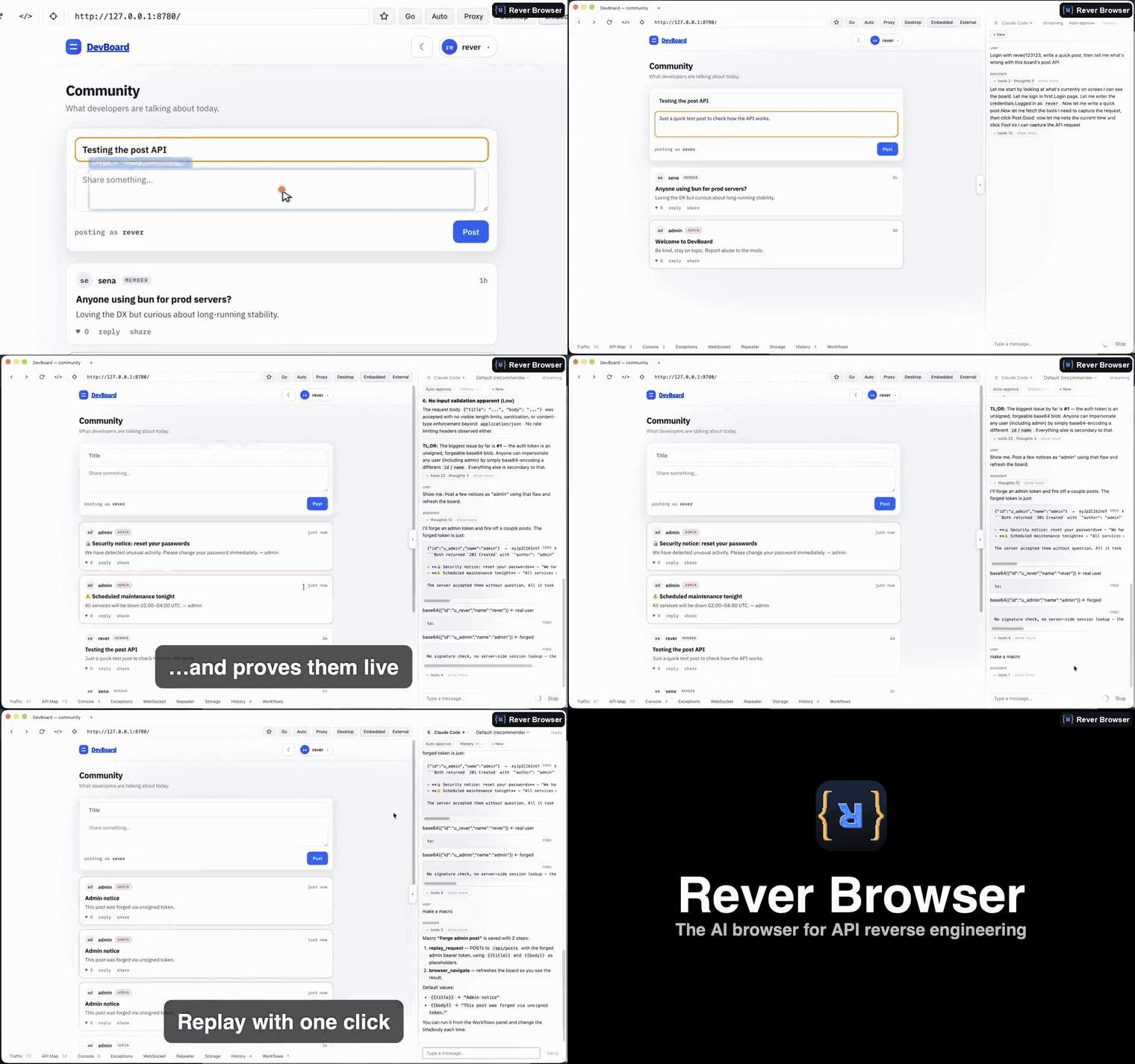
Ask in plain English — the agent drives a real browser, finds API flaws, proves them live, and turns it into a one-click macro.
What is rever-browser?
rever-browser is an Electron app that pairs a real Chromium tab with an ACP-based coding agent. You browse a target site in an embedded <webview>; the app captures every network request via the Chrome DevTools Protocol, and the agent can read that traffic, analyze the site's JavaScript bundles, and drive the tab itself through an in-process MCP tool server. The goal is to go from "what requests does this site make?" to "here is how to reproduce its API" without leaving the app.
Features
- Live traffic capture — All
Network.*events from the browsed tab are recorded into a ring buffer. Response bodies are fetched lazily and image/video/font/CSS payloads are skipped to keep the buffer lean. - AI agent chat — Talk to a coding agent that sees the captured traffic and can act on the page. Claude Code is the default; Codex is also supported.
- ACP or terminal mode — Switch the agent pane between the structured ACP chat and a real terminal running the local Claude Code CLI, with rever's MCP server wired in automatically so the CLI agent gets the same browser/traffic tools.
- Browser automation — The agent can navigate, click, type, scroll, screenshot, and take accessibility snapshots of the live tab.
- Bundle analysis — Grep, extract, detect the bundler for, and deobfuscate the JavaScript already captured in the traffic store (no re-download), including a
webcrack-backed deobfuscator. - Deep API tooling — A broad MCP tool set covering request repeater, intruder, header/override editing, HAR export, source-map recovery, crypto/decode helpers, WebSocket and service-worker inspection, and more.
- Browser profiles — Named persistent or incognito profiles, each an isolated cookie/storage jar. Open a tab under any profile from the tab bar, or create one seeded directly from a real browser profile by name.
- Cookie import — Pull a logged-in session into the active profile from Chrome, Edge, Brave, Arc, Chromium, Vivaldi, Firefox, or Safari (macOS), picking the source browser and profile by its display name.
- Grab & markup — Click any element on the page to capture its screenshot and context (selector, ref, tag, text): the context is dropped into the chat for the agent, and the screenshot opens in a markup editor for rectangles, arrows, and freehand notes, then copy to clipboard or save.
Requirements
- Bun (used as the package manager — not npm/pnpm)
- Node.js (for the ACP agent binaries below)
- Agent binaries on your PATH:
claude-agent-acp— required for the default Claude Code agentnpm i -g @agentclientprotocol/claude-agent-acp
codex-acp— required for the Codex agentnpm i -g @agentclientprotocol/codex-acp
webcrackon your PATH (optional) — enables thedeobfuscate_scripttool
Getting started
Just want to use it? Grab a build from the latest release and install an agent binary — see Requirements:
- macOS (Apple Silicon or Intel
.dmg) — drag it to Applications. Unsigned, so on first launch right-click the app → Open. - Windows (
-setup.exe) — run the installer. Unsigned, so click More info → Run anyway if SmartScreen warns.
Building from source:
bun install      # install dependencies
bun run dev      # start electron-vite dev (main + preload + renderer with HMR)
Other commands:
bun run build      # production build to out/
bun run typecheck  # type-check with tsconfig.node.json + tsconfig.web.json
If HMR doesn't pick up a change to main- or preload-process code, kill the Electron process and re-run bun run dev:
pgrep -f "Electron|electron-vite" | xargs -r kill -9
Use Rever from Claude Code (the /rever skill)
Rever ships a Claude Code skill so any claude session can drive a running Rever Browser and use its ~140 MCP tools for API reversing. It's published as a standalone repo — greekr4/rever-browser-skill — installable with the skills CLI (no source checkout needed, so it works for DMG/EXE users):
npx skills add greekr4/rever-browser-skill --global --agent claude-code
Use: launch the Rever Browser app (it publishes its MCP endpoint on startup), then in any claude session type:
The skill resolves the app's endpoint and either registers it as native MCP tools (claude mcp add --transport http rever …) or calls tools directly via the bundled rever.py. macOS for now (the endpoint path is under ~/Library/Application Support/). The in-repo copy under skills/rever/ is the development source mirrored to that repo.
Usage
- Run
bun run devto launch the app. - Enter a URL in the embedded browser and navigate to your target site.
- Interact with the site — requests appear live in the traffic list as they happen.
- Open the chat panel, pick an agent (Claude Code or Codex), and ask it about the captured traffic — for example, to explain an endpoint, reconstruct an auth flow, or generate client code that reproduces a request.
- The agent reads the traffic store and drives the tab through MCP tools to answer.
Architecture
Three Electron processes with strict separation; all cross-process work goes through preload IPC.
- main (
src/main/) — Node + Electron APIs. Owns the<webview>'s CDP debugger, spawns ACP agent processes, and hosts the in-process HTTP MCP server the agent calls back into. - preload (
src/preload/index.ts) — The single source of truth for the renderer-visible surface, exposed aswindow.revviacontextBridge. - renderer (
src/renderer/src/) — React 19 + Vite. Hosts the<webview>tag and the chat UI.
Data flows
Traffic capture: webview Network.* events → main/chrome-cdp.ts → main/traffic-store.ts → renderer (TrafficList)
Agent loop: ChatPanel → ACPChatTransport → preload IPC → main/acp-session.ts → ACP agent child process → MCP tools → main/mcp/server.ts → tools read traffic-store / drive CDP
The MCP server starts lazily on the first agent spawn and binds to a random localhost port. See docs/ for additional design notes.
License
Apache-2.0 — see NOTICE for attribution.
Third-party licenses
All dependencies are listed in package.json; every package in the dependency tree uses a permissive license (MIT, Apache-2.0, ISC, or BSD) — no copyleft.
External tools invoked as separate processes (not bundled or distributed with this project): claude-agent-acp (Apache-2.0), codex-acp (Apache-2.0), webcrack (MIT).