Takes a book in English, finds the words that are "rare" (by the measure IDF >= 15 or -ln(frequency) > 14) and lists the definition in a dictionary and the places it occurs in the original text. The final output is a static HTML file. You can view a live demo for a subset of words from a book here: https://deedy.github.io/vocabuliwala/
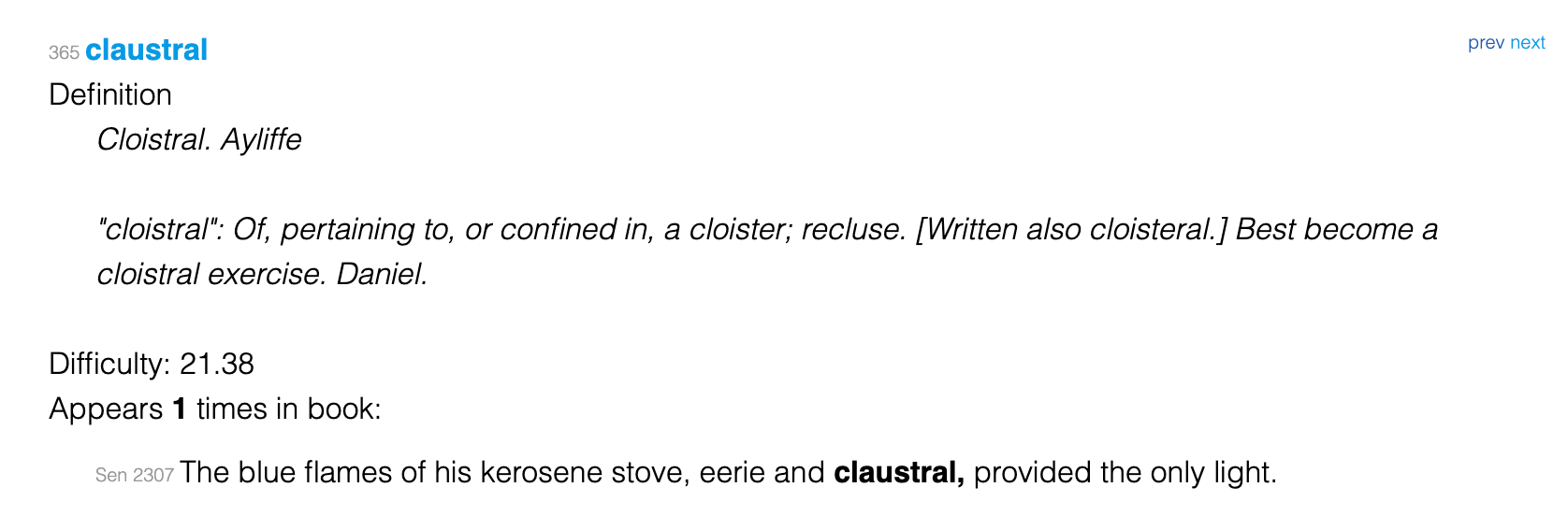
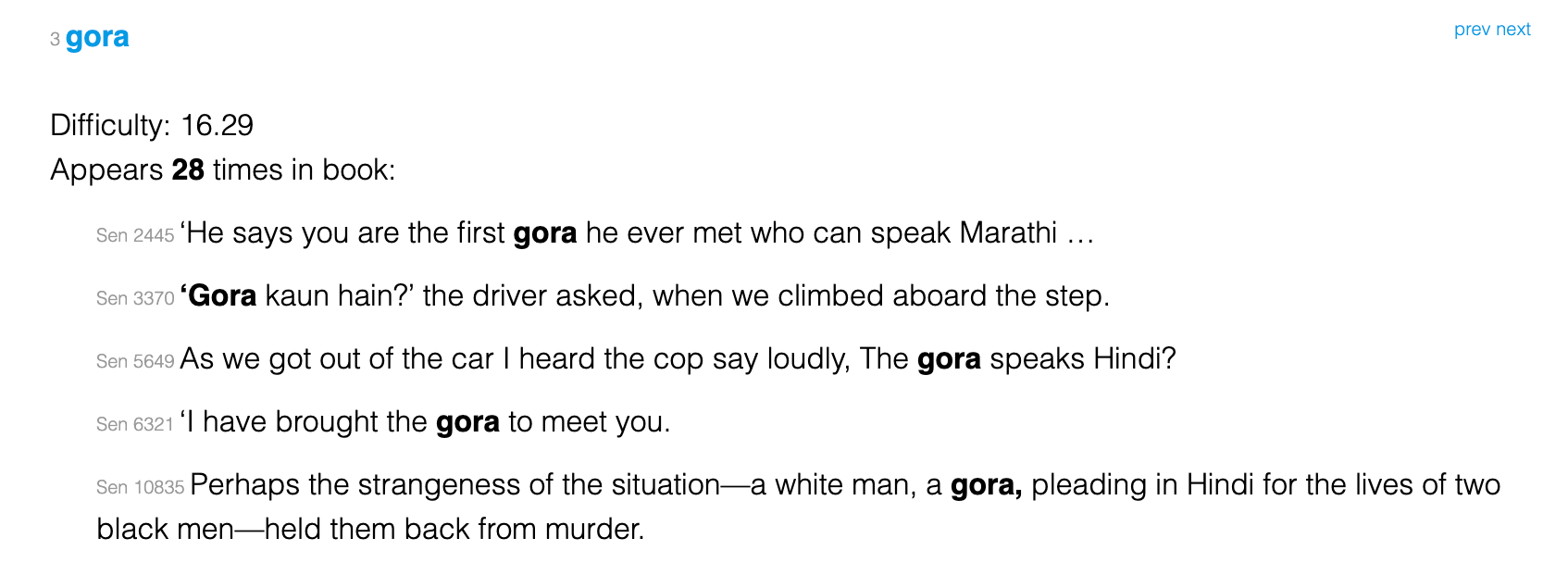
Some examples output demonstrating some of the key features of Vocabuliwala:
- Dictionary lookup
- Secondary dictionary lookup: looking up dictionary meanings which themselves need explanation
- Difficulty rating
- Show appearances in the input book
Who is this for?
- A casual reader of a book
- A teacher trying to teach a book
- Students trying to learn vocabulary for a standardized test
Usage Instructions
This is definitely not easy to use for non-technical people (and even technical people). It was a quick and dirty project.
- Clone the repo and fire up
jupyter/ipython notebookin the directory and open upVocabulary Extractor.ipynb. - Create a directory and put your book txt in it (e.g.
book/book.txt) - Change the name of the
BOOKvariable up top tobook/book.txt - Manually run all the parts of the notebook. You may need to download the Python deps. It takes ~20-30s for a large book and isn't fully optimized.
- The output in
htmlwith 3 sort orders - by order of most rare, by order of most used in the book, and by order of appearance in the book - will be saved as statichtmlfiles inbook/such asbook/book_vocab_sortby_most_common_first.html.
Features
- Tokenizes the text and words with NLTK to deal with punctuation
- Removes proper nouns and character names
- Has a lot of custom-built lemmatization (WordNetLemmatizer proved insufficient) to get the root word in order to correctly evaluate rarity AND look up the correct root word in the dictionary
- Can easily sort the result by order it appears in the book or overall frequency of the word in the book.
- Often dictionary definitions have words that are also hard, so we do a secondary extraction of word meanings in the dictionary definition to make it easy to understand.
Numbers
- Merriam Webster dictionary has 100k words (102,217)
- Word frequency list (en_full) has 1.5m words (1560428) with a total count of ~710m (709588976)
- Word frequency list (enwiki) has 1.8m words (1857808) (min count 3) with a totl count of 1.9B (1926212329)
- Anecdotally, around 10-15% of unique words of a book will be a vocab word if 15 threshold, 5-10% if 16 threshold.
- Anecdotally, around 70% of vocab words have definitions but this number will vary widely.
TODO
- Make it a runnable script instead of a notebook and add options for IDF threshold, etc.
- Doesn't do much for words transliterated from other languages - marks them as vocab words with no dictionary definition.
- Lemmatize before doing secondary lookup of dictionary definition words e.g. "tergiversates"
- Make sure non dict words are written to the vocab
- Aggregate words which lemmatize to the same word
- Make plugin definition collapsible