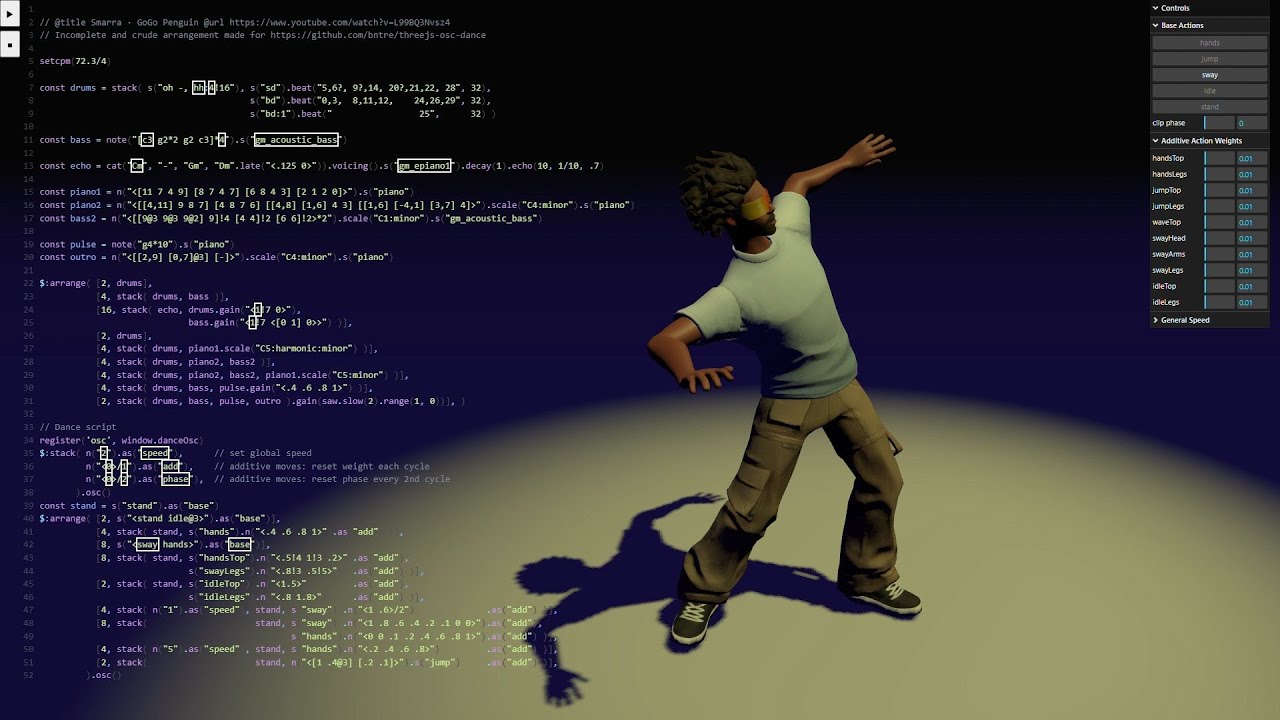
This is a web-based proof-of-concept for controlling character dance animations using OSC-like messages.
It is designed with livecoding workflows in mind.
Try it live: https://bntre.github.io/threejs-osc-dance/
Demo video: https://www.youtube.com/watch?v=24Vd_2r3LPM
Core idea
The main idea of this project is to control character dancing by mixing small animation fragments in real time.
Character animations are split into short, named segments and converted into seamless loops.
Dancing is controlled via Strudel (https://strudel.cc).
Animation retargeting to a custom Ready Player Me avatar is supported.
Moves and scene setup
Character setup and animation configuration are defined in a separate .js file (see setup_michelle.js).
There are two types of moves:
-
Base moves
- Can be triggered at any moment
- Smoothly crossfaded from the previous base move
- Define the main body motion
-
Additive moves
- All additive animations are played continuously
- Each move has a controllable weight
- Additive moves are blended on top of the current base move
Moves can also be split by animation tracks, allowing partial-body control (e.g. HEAD, ARMS, LEGS).
This makes it possible to combine different motions across body parts in a modular way.
Moves are created using the utility function subclipLoop that:
- resamples animation clips to a specified FPS
- applies crossfading at the clip edges, resulting in seamless looping motion segments
Live control from Strudel
Moves and global parameters are controlled using Strudel calls:
-
s("sway").as("base")- start a base move -
s("hands").n("<.4 .6 .8 1>").as("add")- control additive move weights (using a mask, e.g. "hands*") -
n("2").as("speed")- change global animation speed -
n("0").as("phase")- change phase of all additive moves (primarily used for reset) -
setcpm(80)- tempo control also affects animation playback
See demo dance script as example: strudel_smarra.js#L32
Control modes / branches
The project has two main branches with different control setups.
1. main branch
- The Strudel REPL is embedded directly into the Three.js scene page
@strudel/repldoes not provide native OSC support, so a custom OSC handler is implemented and handled directly inside the Three.js scene- This mode is fully self-contained in the browser.
2. separate branch
- The Three.js scene runs on a standalone page (without Strudel)
- An external https://strudel.cc page can be used for control
- Native OSC support from Strudel is used
- A WebSocket broadcast server (Node.js or Python) is required to forward OSC messages to the Three.js page
In both control modes, OSC messages handled by the animation scene are not using the binary OSC format defined by the official protocol
(see: https://en.wikipedia.org/wiki/Open_Sound_Control). Instead, messages are currently exchanged as JSON-based structures that resemble OSC semantics but are not yet encoded or decoded into binary OSC packets.
This approach simplifies experimentation and browser-side handling and may be replaced by full binary OSC support in the future.
Links and credits
Three.js examples
The Three.js code is based on the following official examples:
-
Additive animation blending
https://threejs.org/examples/#webgl_animation_skinning_additive_blending -
Ready Player Me retargeting
https://threejs.org/examples/#webgpu_animation_retargeting_readyplayer
Animations
-
Mixamo - Samba Dance
https://www.mixamo.com/#/?type=Motion&query=Samba+Dance+Olodum+Variation+TwoThe Samba Dance animation is loaded at runtime from the Three.js examples package and is not included in this repository.
Character
- A custom Ready Player Me avatar is used (custom-made, referenced via URL)
Music
-
"Smarra" by GoGo Penguin
Original: https://www.youtube.com/watch?v=L99BQ3Nvsz4A rough and incomplete arrangement is used for the dance demonstration.
Related work
- LocoMotion by David Ogborn https://github.com/dktr0/LocoMotion
- See also https://en.wikipedia.org/wiki/Computer-generated_choreography
Status
This project is experimental and intended for exploration, prototyping, and livecoding experiments.