DwarfStar
Specialized local inference for models that do not fit in memory.
A transparent research and co-development fork of antirez/ds4, focused on Metal, adaptive SSD streaming, common 16–64 GB Apple Silicon systems, and measured experimentation.




Quick start · Benchmarks · Models · DSBox · Upstream diff · Documentation
Important
This is andreaborio/ds4, a fork of
antirez/ds4. It does not aim to replace
upstream. The goal is to co-develop DwarfStar: explore complementary hardware
and model paths here, then propose every general, reproducible improvement back
to upstream when it clears the correctness and performance bar.
DwarfStar is a small, self-contained inference engine optimized around a narrow set of very large models. It includes native model loading, prompt rendering, tool calling, RAM/on-disk KV state, an HTTP server, a coding agent, GGUF tooling, and correctness and speed tests. It is intentionally not a generic GGUF runner; arbitrary GGUF files are not expected to work.
Why this fork exists
Upstream DwarfStar provides the core engine and leads the high-memory and distributed paths. This fork asks a complementary question:
How far can the same specialized design be pushed on the 16–64 GB Macs many developers already own, when the SSD becomes an active model-memory tier?
The current work concentrates on:
- adaptive Metal residency and routed-expert cache policies across memory tiers;
- SSD streaming that accounts for page cache, wired memory, swap, I/O, and throughput together;
- safer model-backed experiments near macOS memory limits;
- measured GLM 5.2 work and Qwen3.6-35B-A3B bring-up;
- GGUF calibration, incremental quantization, and expert-analysis tooling;
- keeping useful changes small enough to validate and send upstream.
This is primarily a learning and systems-research project. The fork lets work continue while upstream changes are under review; it is not a parallel rewrite or a competing inference ecosystem.
Co-development with upstream
The boundary is explicit and reviewable:
| Change type | Where it belongs |
|---|---|
| General, reproducible, backend-safe improvement | Open a PR against antirez/ds4 |
| Model- or hardware-specific experiment | Keep it isolated while evidence is incomplete; open an upstream PR too whenever it applies to an upstream-supported path |
| Change that regresses an existing path | Do not promote it; isolate or revise it first |
| Change already solved upstream | Take the upstream implementation and remove the fork delta |
This is mandatory, not aspirational: every fork change applicable to an upstream-supported path will be opened upstream once its scope, correctness, and performance evidence are ready. Fork development can continue while that review is in progress.
Current upstream work includes #434
(quality-score build fix), #520
(GLM streamed-prefill correctness), and
#528 (GLM indexed-prefill prepare).
The DeepSeek regression found on the GLM line is tracked in
#532. See
FORK_NOTES.md for the status of each fork change and
MERGE_LOG.md for sync history. The same policy is part of
CONTRIBUTING.md. The current main delta is always
inspectable in GitHub's
upstream/fork comparison.
Quick start
Requirements: Apple Silicon, Xcode Command Line Tools, and enough SSD space for the selected model. A 64 GB Mac is the practical reference tier for DeepSeek Flash streaming; the 16 GB path is an experimental low-memory tier, not a speed guarantee.
xcode-select --install
git clone https://github.com/andreaborio/ds4.git
cd ds4

./download_model.sh q2-imatrix
make
./ds4 --build-info
./ds4 -m ./ds4flash.gguf --nothink
On macOS, AUTO residency keeps the model resident when it safely fits. Otherwise it selects SSD streaming and derives an expert-cache budget from the model geometry and live host memory. Force the SSD path only when you need a controlled run:
./ds4 -m ./ds4flash.gguf --ssd-streaming --ctx 32768 --nothink
Start the local API with:
./ds4-server -m ./ds4flash.gguf --ctx 32768
How SSD streaming uses memory
flowchart LR
    GGUF["Model GGUF on SSD"] --> AUTO["AUTO memory planner"]
    AUTO -->|"safe fit"| RES["Resident model"]
    AUTO -->|"model exceeds budget"| STREAM["SSD-streamed model"]
    STREAM --> FIXED["Mapped fixed / non-routed state"]
    STREAM --> CACHE["Adaptive routed-expert cache"]
    GGUF -->|"cache miss"| CACHE
    FIXED --> METAL["Metal graph"]
    CACHE --> METAL
    METAL --> TOKEN["Next token"]
The fixed model state, KV cache, graph scratch, and macOS file-backed cache all need headroom. The routed-expert cache is the variable tier; making it larger can help only until it starts displacing the pages and allocations the rest of the runtime needs.
Model status
| Model | Location | Status | Current focus |
|---|---|---|---|
| DeepSeek V4 Flash | main |
Primary supported path | Metal, adaptive SSD streaming, 16–64 GB measurements |
| DeepSeek V4 PRO | main |
Supported upstream path | High-memory and distributed inference |
| GLM 5.2 | codex/glm52-upstream-clean-bench |
Experimental branch | Correct streamed prefill and Metal performance on 64 GB |
Qwen3.6-35B-A3B (qwen35moe) |
main |
Supported opt-in Metal path, model-backed measured | Metal AUTO mapping, live-pressure fallback, strict SSD cache, resident prefill, and parallel resident decode |
DeepSeek expert-major v2 format
DS4 includes the experimental, self-describing ds4.expert_major.v2 layout for
DeepSeek V4. It stores each layer as adjacent gate/up/down expert records without
requantizing and without keeping a second routed-weight copy. Canonical GGUFs
remain byte-for-byte compatible with every existing backend; native v2 files
currently require a complete local Apple Metal model and fail early elsewhere.
Conversion, full byte-level verification, compatibility limits, and the
model-backed promotion gate are in
docs/deepseek-expert-major-v2.md. Until a
dated canonical/native benchmark gate is complete, the canonical DeepSeek GGUF
remains the release reference. The first M5 Pro SSD tranche is recorded in
docs/benchmarks/2026-07-17-deepseek-native-expert-major.md.
The distinctly named experimental artifact is
DeepSeek-V4-Flash-DS4-ExpertMajor-v2-GGUF,
with full conversion provenance and compatibility limits in its model card.
Qwen3.6 Metal AUTO path
The main branch is qualified and measured with one normalized text-only
artifact. The recommended release download is the single-layout
Qwen3.6-35B-A3B-DS4-ExpertMajor-v1-Q4_K_S.gguf from
andreaborio/Qwen3.6-35B-A3B-DS4-ExpertMajor-v1-GGUF.
It stores routed weights once in DS4's expert-major order and activates
automatically; no sidecar variables are needed. The canonical
Qwen3.6-35B-A3B-ds4-Q4_K_S.gguf remains supported during migration.
The release artifact is 20,808,970,240 bytes (only 406,816 bytes larger than
the canonical input) with SHA-256
fb2b344d49f0c3dfd854cfc11d92ffc873cc93a1d30bf4664e5aea6f1bfef839.
This is not generic Qwen or arbitrary community-GGUF support. The literal environment guard is the experimental opt-in; Metal, power 100, and AUTO residency are the Apple defaults, but are shown below for reproducibility:
DS4_QWEN_EXPERIMENTAL_METAL=1 ./ds4 \
  -m /absolute/path/to/Qwen3.6-35B-A3B-DS4-ExpertMajor-v1-Q4_K_S.gguf \
  --metal --power 100 --ctx 8192 --nothink
ds4.expert_major.v1 is an explicit DS4 GGUF extension. Other loaders must
reject this artifact unless they implement the layout; use the canonical file
for llama.cpp, MLX, or other runtimes. Format details, conversion commands,
compatibility boundaries, and measured parity are in
docs/qwen-expert-major-store.md.
Qwen AUTO selects the full-model mapped Metal mode only when both the fixed Metal
working-set budget and a point-in-time host-memory pressure check pass. Under
pressure it falls back to SSD and lazily grows the routed-expert cache to the
largest complete routing tier admitted by the current conservative snapshot.
Above 16 GiB the planner independently reserves the 2.50 GiB static page set,
context/runtime memory, and system headroom. On a 16 GiB Mac, AUTO keeps the
complete static charge but lets those unpinned, pageable GGUF pages share system
headroom. It selects the largest complete 320-expert cache cycle admitted by
the remaining live and platform budgets rather than imposing a fixed low-RAM
floor. Bounded file-backed inactive pages receive full credit only while macOS
reports normal pressure; unknown or elevated pressure retains half-credit and
fails closed near the boundary. --resident fails unless both admission checks
pass; because pressure can change after the
snapshot, this is a conservative admission policy rather than a future-memory
guarantee. --ssd-streaming remains the reproducible forced-streaming override.
In SSD mode Qwen grows its Metal expert cache in 321-expert slabs (about
0.529 GiB) instead of taking the generic 4 GiB first slab.
Here resident means that DS4 maps the complete tensor payload, disables its
explicit SSD expert cache, and executes full-tensor Metal kernels. Metal's
residency request is a budgeting hint: it neither pre-faults every GGUF page nor
proves that every page remains physically resident as later pressure changes.
That stronger physical-residency claim requires separate runtime measurement.
All neural math in the supported Qwen path is on Metal. The CPU still performs
tokenization, sampling, route readback, cache bookkeeping, and streamed GGUF
I/O; a CPU+GPU split of layers or experts is not implemented in this path.
The hard SSD cache floor is 321 complete routed experts (about 0.53 GiB); 640
(about 1.06 GiB) is a useful controlled small-cache tier. Startup and the
per-layer path fail closed if the effective locked cache falls below the floor.
The runtime has completed model-backed resident and SSD generation on an M5 Pro
with 64 GiB, plus bounded SSD generation on a physical M1 Pro with 16 GiB. On
production main bd62a0b, AUTO started with 321 cached experts for prefill and
grew toward 2,241 for decode. One cold request completed at 10.56/8.24
prefill/generation t/s; four subsequent distinct short prompts had medians of
15.04/9.77 t/s, with normal memory pressure and no new swapouts. This recheck
used the canonical migration GGUF; the native ExpertMajor v1 artifact was not
copied to the 16 GiB host because only 3.6 GB of disk space was free. The older
4.06/7.03 result remains a conservative 321-expert compatibility floor, not the
current production speed. See
tests/qwen/README.md for the exact artifact contract,
reproducible evidence, and current limitations.
Metal on Apple Silicon is the current proving ground for fork-specific optimization. The inherited CUDA/DGX Spark and ROCm/Strix Halo DeepSeek paths remain supported targets, but a Metal result is not advertised as a Blackwell or Strix Halo result until it is re-measured on that backend.
Measured results
Best retained local results so far. These rows are not cross-model rankings: each model uses a different artifact, context, and runtime path.
| Model | Best measured setup | Prefill | Generation / decode | Status |
|---|---|---|---|---|
| Qwen3.6-35B-A3B Q4_K_S, 20.81 GB | M5 Pro 64 GB, Metal resident | 258.08 t/s | 57.81 t/s | Controlled DS4 prefill A/B, +23.3% over the previous dispatch; greedy output identical |
| Qwen3.6-35B-A3B Q4_K_S, 20.81 GB | M5 Pro 64 GB, page-touched resident CLI | 218.30 t/s | 63.94 t/s | Best retained real CLI generation number; same rendered prompt and visible continuation as the llama.cpp reference |
| Qwen3.6-35B-A3B Q4_K_S, 20.81 GB | M1 Pro 16 GB, Metal AUTO to SSD, canonical migration GGUF | 15.04 t/s | 9.77 t/s | Warm median over four distinct short prompts after one cold run; normal pressure, no new swapouts |
| DeepSeek V4 Flash IQ2XXS, 86.72 GB | M5 Pro 64 GB, Metal SSD streaming | 20.75 t/s | 12.58 t/s | Direct upstream/fork A/B showed parity, not a fork speedup |
| GLM 5.2 ds4-native GGUF, 244.14 GiB | M5 Pro 64 GB, Metal SSD streaming | 9.15 t/s | 0.91 t/s | Indexed-prefill prepare A/B; big prefill win, no decode win |
DeepSeek hardware reference bests from the standard speed-bench sweep:
| Host | Model | Prefill | Generation |
|---|---|---|---|
| MacBook Pro M5 Max, 128 GB | Flash q2, 11,707-token context | 463.44 t/s | 25.90 t/s |
| Mac Studio M3 Ultra, 512 GB | Flash q2, 11,709-token context | 468.03 t/s | 27.39 t/s |
| Mac Studio M3 Ultra, 512 GB | PRO q2, 32,768-token context | 138.82 t/s | 9.56 t/s |
| DGX Spark GB10, 128 GB | Flash q2, 7,047-token context | 343.81 t/s | 13.75 t/s |
Full commands, samples, and caveats are in
docs/benchmarks/2026-07-15-qwen-ds4-vs-llamacpp.md,
docs/benchmarks/2026-07-14-m5-pro.md,
SSD_STREAMING_VERIFICATION.md, and
docs/ENGINE_REFERENCE.md.
Memory safety is part of performance
More expert-cache RAM is not automatically faster. On memory-constrained Macs, an oversized cache can evict the file-backed pages SSD streaming needs and make decode slower even when Activity Monitor appears to show free memory. AUTO therefore treats the routed-expert cache as variable and preserves headroom for fixed weights, KV, scratch, Metal allocations, and the macOS page cache.
During development, a model-backed test bypassed SSD streaming and attempted to make an 80.76 GiB GGUF resident with a 100,000-token context on a 64 GiB Mac. Global wired memory reached roughly 61.36 GiB before a watchdog kernel panic. Crashing the host is not an acceptable test outcome.
Current main includes hardware-aware AUTO residency, fail-closed cache
admission, bounded benchmark guards, and GPU cleanup before model mappings are
released (1523b26). A stricter guard that rejects resident mappings larger
than 90% of physical RAM is tested and published on
fix/refuse-oversized-resident-maps at 06fd005, but is not yet on main.
Until it is merged, it must not be described as a mainline guarantee.
Prefer a desktop interface?
DSBox is the companion desktop interface, inspired by Unsloth Studio: discover compatible models, manage ds4, chat locally, connect coding agents, and observe memory, swap, disk, and token throughput without hand-assembling every command. DSBox is a separate project and still a work in progress.
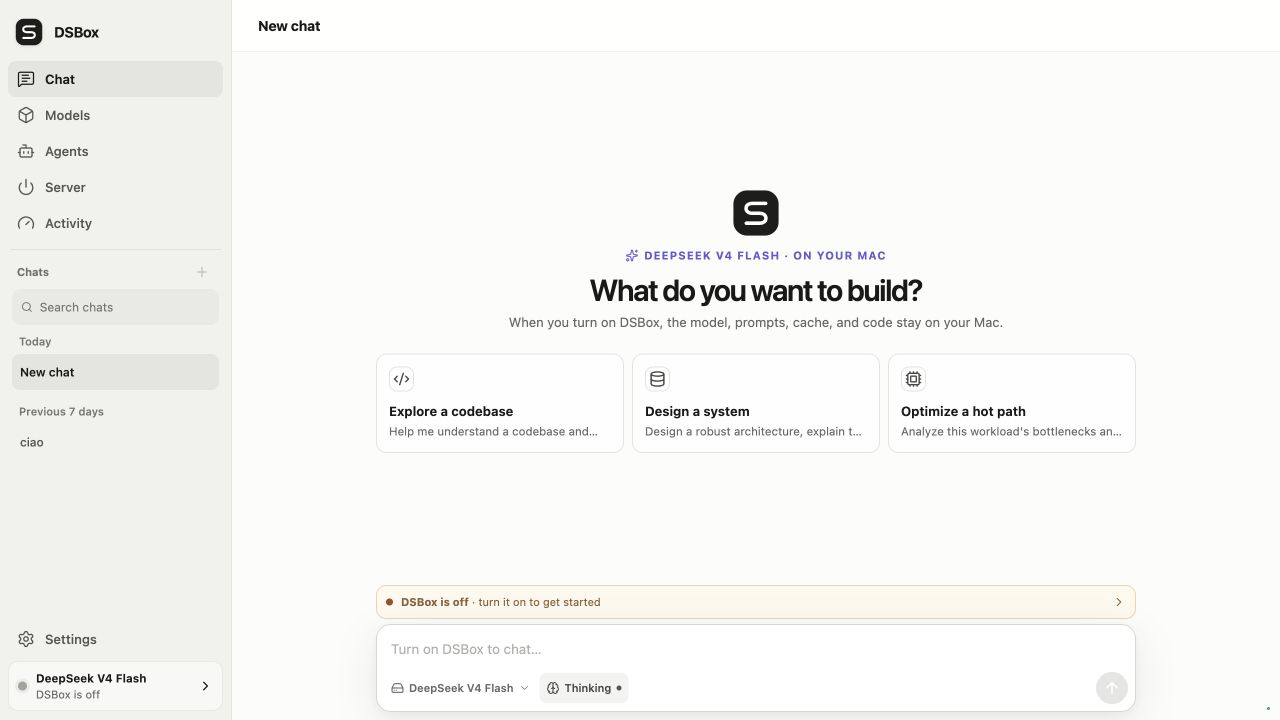
DSBox is an optional companion UI, maintained in a separate repository.
Documentation
docs/ENGINE_REFERENCE.md: complete model, runtime, server, agent, KV-cache, distributed, backend, and debugging guide.tests/qwen/README.md: experimental Qwen artifact contract, oracle procedure, Metal + SSD commands, measurements, and limits.docs/qwen-expert-major-store.md: DS4-native GGUF layout, transactional converter, compatibility, and parity evidence.docs/expert-major-v2-roadmap.md: generic expert-major manifest and separate DeepSeek/GLM qualification plan.CONTRIBUTING.md: upstream-first contribution policy and correctness/performance gates.FORK_NOTES.md: fork delta and upstreamability ledger.MERGE_LOG.md: upstream synchronization history.GOLD_METAL_SSD.md: Metal build identity, AUTO residency, and benchmark promotion gates.SSD_STREAMING_VERIFICATION.md: independent SSD-streaming verification campaign.ONEDGE_IMATRIX.md: live, privacy-preserving imatrix collection.STREAMING_MIXED_PRECISION.md: mixed-precision expert streaming design and validation.EXPERT_PRUNE.md: expert profiling and prune-mask research.gguf-tools/README.md: GGUF, imatrix, quantization, and quality tooling.
Detailed fork additions and research notes
Fork feature details
The sections below preserve the longer design notes for the fork's research
features. They are not an exhaustive commit count: adaptive residency, cache
hardening, benchmark guardrails, telemetry, and safe Metal teardown have also
evolved since the original five-feature summary was written. The authoritative
per-change ledger is FORK_NOTES.md; upstream syncs are recorded
in MERGE_LOG.md.
The GLM 5.2 SSD-streaming line (not mainline)
The fork also carries a GLM 5.2 line on
codex/glm52-upstream-clean-bench:
upstream's glm5.2 branch (bd89932) plus eleven commits — the streaming prefill
correctness fixes proposed as
antirez/ds4#520 (real-size prompts were
failing under --ssd-streaming; independently validated by a third party on an M4 Max
128 GB), the indexed-prefill layer-prepare overlap proposed as
antirez/ds4#528 (measured prefill ×1.6-2.0
across a 2048-8192 sweep in the PR, ×2.4-2.5 re-measured on short prompts, decode
unchanged, greedy output byte-identical), the ds4-native GLM 5.2 GGUF layout support the
line runs on, a copy of the RAM guard (upstreamed separately, see
FORK_NOTES.md), and a set of default-off streaming experiments
(router-ahead prefetch, expert prune/profile hooks, virtual resident decode layers).
The short-prompt speedup, the regression below and the MTP gate were re-verified
independently with paired A/B runs
(SSD_STREAMING_VERIFICATION.md); the sweep figures
are from #528's benchmark.
Two caveats, both measured:
- Upstream's whole
glm5.2line decodes DeepSeek Flash ~2.8× slower thanmain(DeepSeek-V4-Flash IQ2XXS: 7-8 → ~2-3 tok/s on an M5 Pro 64 GB under--ssd-streaming, first token ~5-7 s; bisected to the first commit of the line, verified twice on separate days). Keep DeepSeek work onmain; reported upstream as antirez/ds4#532. - Speculative decode (MTP) on streamed GLM is a measured NO-GO: the
blk.78nextn acceptance probe (branchfeat/glm-mtp-probe, a reusable measurement tool; GLM 5.2 ds4-native build) reads ~55% acceptance against the ~75% needed to pay for the extra I/O.
The older bring-up branch
wip/glm52-metal64-strict-probe
predates this line and is kept as history.
1. On-edge / real-time imatrix collection: ds4-server --imatrix-out
Upstream collects the routed-MoE importance matrix (imatrix) offline from a fixed corpus
(ds4 --imatrix-dataset … --imatrix-out …). This fork lets ds4-server collect it from the
live prompt stream on the device, so a quantized model can be re-calibrated to its actual
workload, without ever storing a single user prompt. The only artifact is the imatrix:
aggregate per-(layer, expert) activation statistics (squared activations + hit counts), a
structure that cannot hold prompt text.
ds4-server -m model.gguf --imatrix-out edge.dat                  # collect from live traffic
ds4-server -m model.gguf --imatrix-out edge.dat --imatrix-every 128 --imatrix-min-requests 32
Default off (zero behavioral change); opt-in via --imatrix-out, with periodic snapshots
(--imatrix-every) and a minimum-requests guard (--imatrix-min-requests). Full design,
wiring, limits and privacy verification in ONEDGE_IMATRIX.md.
2. Incremental re-quantization: deepseek4-quantize --reuse PRIOR.gguf
Re-forging a variant (say, adding a per-layer Q4 "boost" on top of an IQ2 build that used the same imatrix) normally regenerates every routed-expert tensor from the FP weights, even the ones that don't change. But quantization is deterministic in (FP weights, target type, imatrix slice), so an unchanged tensor is byte-identical to the one already sitting in a prior build. Recomputing it is pure waste.
--reuse PRIOR.gguf copies a planned output tensor straight from PRIOR when its name, target
type and shape match, and quantizes only the tensors that actually changed (the boosted
layers, at their new type).
# 1. build the 2-bit base once
gguf-tools/deepseek4-quantize --hf FP --template base.gguf --imatrix coder.dat \
  --out coder-iq2.gguf

# 2. every boost variant reuses the base's unchanged layers, re-quantizing only the boosted ones
gguf-tools/deepseek4-quantize --hf FP --template base.gguf --imatrix coder.dat \
  --reuse coder-iq2.gguf \
  --tensor-type blk.30.ffn_gate_exps.weight=q4_k …  --out coder-q4boost.gguf
Measured (DeepSeek-V4-Flash, a 6-of-43-layer Q4 boost over an IQ2 base): a full build is
~80 minutes; the same variant via --reuse took 5.5 minutes (1,310 of 1,328 tensors copied,
18 regenerated), about a 14× speedup. The output was verified byte-for-byte identical to
a from-scratch build across all 1,328 tensors. The fast build is not an approximation, it is the
same file.
Correctness. Every build stamps a quantize.reuse_key GGUF KV: an fnv1a64 over the
safetensors index, each weight shard's size and mtime, the imatrix content, and a template
structural salt. --reuse copies a tensor only when PRIOR's key matches this build and the
per-tensor type and shape match, so a boosted tensor (different target type) is regenerated, and
a stale / foreign / keyless prior (changed weights, imatrix, or recipe) safely falls back to a
full quantize. Copied bytes are size-checked against the plan (a hard error on any mismatch),
and --reuse refuses to alias --out. This is not present in llama.cpp, which always
requantizes from the source weights; the closest prior art is splicing GGUF tensors by hand.
3. Re-calibration reuse: quantize.reuse_key_weights
Changing the imatrix only changes the tensors the
imatrix actually steers (the routed expert families: the importance vectors re-allocate bits
inside those tensors). Everything else — attention, shared experts, norms, embeddings, output —
is byte-identical across builds that share the same FP weights and template. So every build now
also stamps quantize.reuse_key_weights: the same fnv1a64 without the imatrix folded in.
When PRIOR matches the full key, behavior is unchanged; when it matches only the weights key
(same weights, different imatrix — the re-calibration case), --reuse copies the
imatrix-independent tensors and regenerates only the steered ones:
reuse: PRIOR.gguf shares the weights key (…) but not the imatrix — copying
       imatrix-independent tensors, regenerating the steered ones
The dependence test is conservative and mirrors the generators' own imatrix lookups (routed
*_exps.* families always count as steered; regular tensors are probed with the exact same
name resolution generate_regular() uses), so over-approximation can only cost an unneeded
regeneration, never a stale byte. Priors built before this change carry only the old key and
keep the old all-or-nothing behavior.
Measured (DeepSeek-V4-Flash, 1,328 tensors, M5 Pro): a full re-calibration — same recipe,
coder.dat → general.dat — copied 1,199 of 1,328 tensors and regenerated the 129
routed-expert tensors with the new imatrix, in ~45 minutes vs ~80 for the full quantize.
Byte-level verification: 40/40 sampled imatrix-independent tensors identical to the prior,
16/16 sampled expert tensors changed, tensor tables identical. The change went through an
adversarial 3-lens review that rejected the first cut (two stale-byte paths, one strict-mode
abort — all reachable, all fixed before this exercise: the no-imatrix gate, the coverage
fingerprint, the I32 probe exclusion).
4. Mixed-precision routed experts under SSD streaming
Upstream --ssd-streaming assumes routed-expert tensors are quantized uniformly across
layers. A GGUF with a few layers boosted to Q4_K over an IQ2 base (the forgequant boost
recipe) failed every request under streaming (model range … is not covered by mapped model views) while serving fine with full residency. Two compounding uniformity
assumptions are fixed: the streaming prefill span set now also maps the exps tensors of
off-class ("boosted") layers, so they are read through mmap'd no-copy views; and the
single-size-class expert cache pre-seeds its slab size at startup and rejects off-size
layers (which use the mapped path) instead of silently adopting their size and corrupting
the slot accounting.
Uniform models are verified byte-identical under the change (3/3 builds), full-residency
paths are untouched, and mixed models were validated with the canary benchmark plus entire
eval suites. Full diagnosis, design and behavior guarantees in
STREAMING_MIXED_PRECISION.md; reported upstream with
diagnosis and workaround in antirez/ds4#388.
Update (upstream converged): antirez has since implemented equivalent mixed-precision
streaming upstream. After the latest sync this fork takes upstream's implementation of
weights_streaming_layer_experts_uniform (the only merge conflict; the two designs converged) —
see MERGE_LOG.md. This addition is effectively now upstream.
5. Coding-eval expert tooling: prune mask + full expert profile
Two small, opt-in hooks for studying which experts a domain actually needs, used by the forgequant layer/expert A/B work:
DS4_EXPERT_PROFILE_FULL— the expert profiler (ds4_expert_profile_write_layer) emits the full per-expert ranking instead of the top-16, so a static prune/keep set can be chosen per layer from real routing statistics.DS4_EXPERT_PRUNE_MASK— point it at a43 × N_EXPERTgrid of'0'/'1'('1'= prune). The mask is applied to the CPU router'sprobsbefore top-k (masked experts get a large-negative sentinel so they never win), letting each token route to its next-best surviving expert. This measures "how much of the domain lives in a few experts" without re-quantizing anything.
# the mask lives in the CPU router, so enable it (streaming-IQ2 path), then prune:
DS4_METAL_ENABLE_STREAMING_IQ2_CPU_ROUTER=1 DS4_EXPERT_PRUNE_MASK=mask.txt \
  ds4 -m coder-iq2.gguf -p "…" --ssd-streaming
# -> "ds4: expert prune mask ACTIVE (N experts pruned) from mask.txt"
Both default off (zero behavioral change). The mask affects only routed (non-hash) layers,
and only when the CPU router is active (streaming-IQ2 or PRO-Q4 paths). Details in
EXPERT_PRUNE.md.
Full engine reference
The long-form guide now lives in
docs/ENGINE_REFERENCE.md. It covers model
downloads, full-resident and SSD-streamed operation, distributed inference,
power controls, the native agent, benchmarking, capability evaluation, CLI,
server/tool calling, disk KV cache, backends, steering, test vectors, and
debugging.
Keeping the manual separate makes this README a reviewable landing page while preserving the full operational reference.
Status, credit, and license
DwarfStar is beta software and ds4-agent remains alpha. The core engine and
upstream direction come from antirez/ds4.
The project also exists thanks to the kernels, formats, and engineering work
of llama.cpp and GGML.
Released under the MIT license. Contributions follow the upstream-first policy.