The identity, communication & payments layer for AI agents
Bindu (read: binduu) is an operating layer for AI agents that provides identity, communication, and payment capabilities. It delivers a production-ready service with a convenient API to connect, authenticate, and orchestrate agents across distributed systems using open protocols: A2A, AP2, and X402.
Built with a distributed architecture (Task Manager, scheduler, storage), Bindu makes it fast to develop and easy to integrate with any AI framework. Transform any agent framework into a fully interoperable service for communication, collaboration, and commerce in the Internet of Agents.
π Register your agent β’ π» Documentation β’ π¬ Discord Community
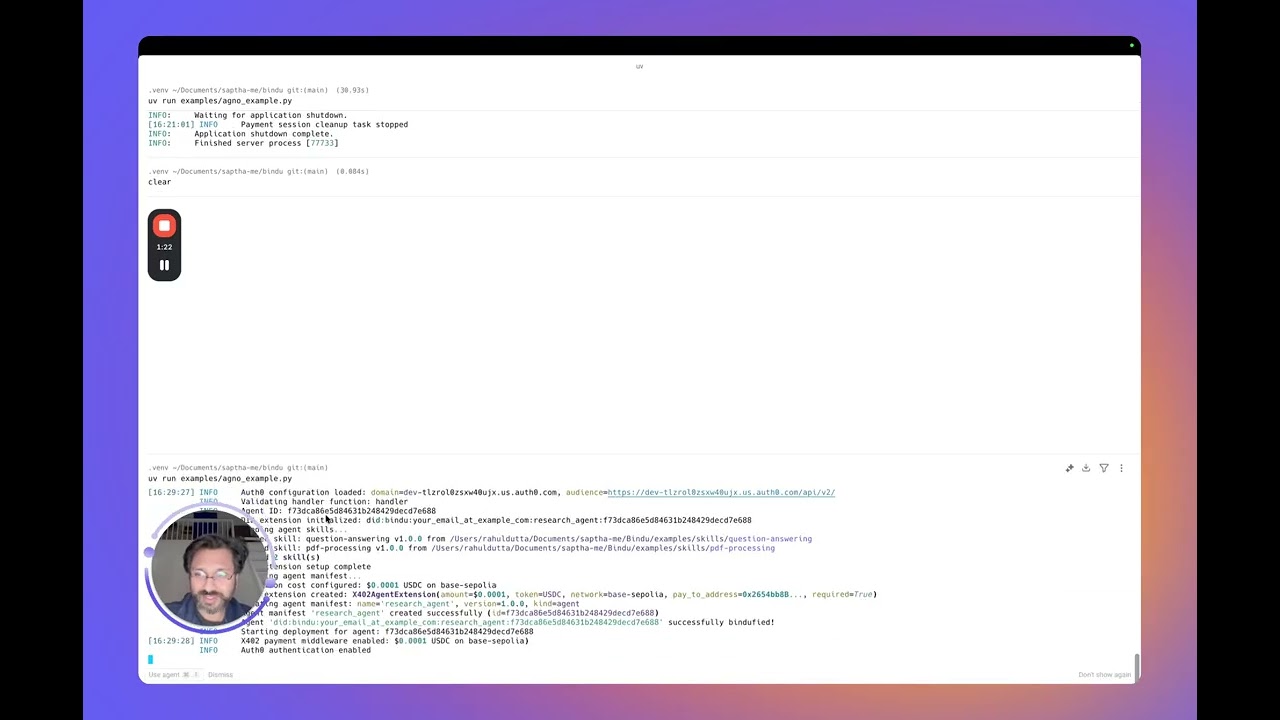
π₯ Watch Bindu in Action
π Prerequisites
Before installing Bindu, ensure you have:
- Python 3.12 or higher - Download here
- UV package manager - Installation guide
Verify Your Setup
# Check Python version python --version # Should show 3.12 or higher # Check UV installation uv --version
π¦ Installation
Windows users note (Git & GitHub Desktop)
On some Windows systems, git may not be recognized in Command Prompt even after installation due to PATH configuration issues.
If you face this issue, you can use GitHub Desktop as an alternative:
- Install GitHub Desktop from https://desktop.github.com/
- Sign in with your GitHub account
- Clone the repository using the repository URL: https://github.com/getbindu/Bindu.git
GitHub Desktop allows you to clone, manage branches, commit changes, and open pull requests without using the command line.
# Install Bindu uv add bindu # For development (if contributing to Bindu) # Create and activate virtual environment uv venv --python 3.12.9 source .venv/bin/activate # On macOS/Linux # .venv\Scripts\activate # On Windows uv sync --dev
Common Installation Issues (click to expand)
| Issue | Solution |
|---|---|
uv: command not found |
Restart your terminal after installing UV. On Windows, use PowerShell |
Python version not supported |
Install Python 3.12+ from python.org |
| Virtual environment not activating (Windows) | Use PowerShell and run .venv\Scripts\activate |
Microsoft Visual C++ required |
Download Visual C++ Build Tools |
ModuleNotFoundError |
Activate venv and run uv sync --dev |
π Quick Start
Option 1: Using Cookiecutter (Recommended)
Time to first agent: ~2 minutes β±οΈ
# Install cookiecutter uv add cookiecutter # Create your Bindu agent uvx cookiecutter https://github.com/getbindu/create-bindu-agent.git
π₯ Create Production Ready Agent in Minutes
That's it! Your local agent becomes a live, secure, discoverable service. Learn more β
π‘ Pro Tip: Agents created with cookiecutter include GitHub Actions that automatically register your agent in the Bindu Directory when you push to your repository. No manual registration needed!
Option 2: Manual Setup
Create your agent script my_agent.py:
from bindu.penguin.bindufy import bindufy from agno.agent import Agent from agno.tools.duckduckgo import DuckDuckGoTools from agno.models.openai import OpenAIChat # Define your agent agent = Agent( instructions="You are a research assistant that finds and summarizes information.", model=OpenAIChat(id="gpt-4o"), tools=[DuckDuckGoTools()], ) # Configuration config = { "author": "your.email@example.com", "name": "research_agent", "description": "A research assistant agent", "deployment": {"url": "http://localhost:3773", "expose": True}, "skills": ["skills/question-answering", "skills/pdf-processing"] } # Handler function def handler(messages: list[dict[str, str]]): """Process messages and return agent response. Args: messages: List of message dictionaries containing conversation history Returns: Agent response result """ result = agent.run(input=messages) return result # Bindu-fy it bindufy(config, handler)
Your agent is now live at http://localhost:3773 and ready to communicate with other agents.
Option 3: Minimal Echo Agent (Testing)
View minimal example (click to expand)
Smallest possible working agent:
from bindu.penguin.bindufy import bindufy def handler(messages): return [{"role": "assistant", "content": messages[-1]["content"]}] config = { "author": "your.email@example.com", "name": "echo_agent", "description": "A basic echo agent for quick testing.", "deployment": {"url": "http://localhost:3773", "expose": True}, "skills": [] } bindufy(config, handler)
Run and test:
# Start the agent
python examples/echo_agent.pyTest the agent with curl (click to expand)
Input:
curl --location 'http://localhost:3773/' \ --header 'Content-Type: application/json' \ --data '{ "jsonrpc": "2.0", "method": "message/send", "params": { "message": { "role": "user", "parts": [ { "kind": "text", "text": "Quote" } ], "kind": "message", "messageId": "550e8400-e29b-41d4-a716-446655440038", "contextId": "550e8400-e29b-41d4-a716-446655440038", "taskId": "550e8400-e29b-41d4-a716-446655440300" }, "configuration": { "acceptedOutputModes": [ "application/json" ] } }, "id": "550e8400-e29b-41d4-a716-446655440024" }'
Output:
{
"jsonrpc": "2.0",
"id": "550e8400-e29b-41d4-a716-446655440024",
"result": {
"id": "550e8400-e29b-41d4-a716-446655440301",
"context_id": "550e8400-e29b-41d4-a716-446655440038",
"kind": "task",
"status": {
"state": "submitted",
"timestamp": "2025-12-16T17:10:32.116980+00:00"
},
"history": [
{
"message_id": "550e8400-e29b-41d4-a716-446655440038",
"context_id": "550e8400-e29b-41d4-a716-446655440038",
"task_id": "550e8400-e29b-41d4-a716-446655440301",
"kind": "message",
"parts": [
{
"kind": "text",
"text": "Quote"
}
],
"role": "user"
}
]
}
}Check the status of the task
curl --location 'http://localhost:3773/' \ --header 'Content-Type: application/json' \ --data '{ "jsonrpc": "2.0", "method": "tasks/get", "params": { "taskId": "550e8400-e29b-41d4-a716-446655440301" }, "id": "550e8400-e29b-41d4-a716-446655440025" }'
Output:
{
"jsonrpc": "2.0",
"id": "550e8400-e29b-41d4-a716-446655440025",
"result": {
"id": "550e8400-e29b-41d4-a716-446655440301",
"context_id": "550e8400-e29b-41d4-a716-446655440038",
"kind": "task",
"status": {
"state": "completed",
"timestamp": "2025-12-16T17:10:32.122360+00:00"
},
"history": [
{
"message_id": "550e8400-e29b-41d4-a716-446655440038",
"context_id": "550e8400-e29b-41d4-a716-446655440038",
"task_id": "550e8400-e29b-41d4-a716-446655440301",
"kind": "message",
"parts": [
{
"kind": "text",
"text": "Quote"
}
],
"role": "user"
},
{
"role": "assistant",
"parts": [
{
"kind": "text",
"text": "Quote"
}
],
"kind": "message",
"message_id": "2f2c1a8e-68fa-4bb7-91c2-eac223e6650b",
"task_id": "550e8400-e29b-41d4-a716-446655440301",
"context_id": "550e8400-e29b-41d4-a716-446655440038"
}
],
"artifacts": [
{
"artifact_id": "22ac0080-804e-4ff6-b01c-77e6b5aea7e8",
"name": "result",
"parts": [
{
"kind": "text",
"text": "Quote",
"metadata": {
"did.message.signature": "5opJuKrBDW4woezujm88FzTqRDWAB62qD3wxKz96Bt2izfuzsneo3zY7yqHnV77cq3BDKepdcro2puiGTVAB52qf" # pragma: allowlist secret
}
}
]
}
]
}
}Postgres Storage
Bindu uses PostgreSQL as its persistent storage backend for production deployments. The storage layer is built with SQLAlchemy's async engine and uses imperative mapping with protocol TypedDicts.
Its Optional - InMemoryStorage is used by default.
π Storage Structure
The storage layer uses three main tables:
- tasks_table: Stores all tasks with JSONB history and artifacts
- contexts_table: Maintains context metadata and message history
- task_feedback_table: Optional feedback storage for tasks
βοΈ Configuration
View configuration example (click to expand)
Configure PostgreSQL connection in your environment or settings: provide the connection string in the config of the agent.
config = { "author": "your.email@example.com", "name": "research_agent", "description": "A research assistant agent", "deployment": {"url": "http://localhost:3773", "expose": True}, "skills": ["skills/question-answering", "skills/pdf-processing"], "storage": { "type": "postgres", "database_url": "postgresql+asyncpg://bindu:bindu@localhost:5432/bindu", # pragma: allowlist secret "run_migrations_on_startup": False, }, }
π‘ Task-First Pattern: The storage supports Bindu's task-first approach where tasks can be continued by appending messages to non-terminal tasks, enabling incremental refinements and multi-turn conversations.
Redis Scheduler
Bindu uses Redis as its distributed task scheduler for coordinating work across multiple workers and processes. The scheduler uses Redis lists with blocking operations for efficient task distribution.
Its Optional - InMemoryScheduler is used by default.
βοΈ Configuration
View configuration example (click to expand)
Configure Redis connection in your agent config:
config = { "author": "your.email@example.com", "name": "research_agent", "description": "A research assistant agent", "deployment": {"url": "http://localhost:3773", "expose": True}, "skills": ["skills/question-answering", "skills/pdf-processing"], "scheduler": { "type": "redis", "redis_url": "redis://localhost:6379/0", }, }
All operations are queued in Redis and processed by available workers using a blocking pop mechanism, ensuring efficient distribution without polling overhead.
Retry Mechanism
Automatic retry logic with exponential backoff for resilient Bindu agents
Bindu includes a built-in Tenacity-based retry mechanism to handle transient failures gracefully across workers, storage, schedulers, and API calls. This ensures your agents remain resilient in production environments.
βοΈ Default Settings
If not configured, Bindu uses these defaults:
| Operation Type | Max Attempts | Min Wait | Max Wait |
|---|---|---|---|
| Worker | 3 | 1.0s | 10.0s |
| Storage | 5 | 0.5s | 5.0s |
| Scheduler | 3 | 1.0s | 8.0s |
| API | 4 | 1.0s | 15.0s |
Sentry Integration
Real-time error tracking and performance monitoring for Bindu agents
Sentry is a real-time error tracking and performance monitoring platform that helps you identify, diagnose, and fix issues in production. Bindu includes built-in Sentry integration to provide comprehensive observability for your AI agents.
βοΈ Configuration
View configuration example (click to expand)
Configure Sentry directly in your bindufy() config:
config = { "author": "gaurikasethi88@gmail.com", "name": "echo_agent", "description": "A basic echo agent for quick testing.", "deployment": {"url": "http://localhost:3773", "expose": True}, "skills": [], "storage": { "type": "postgres", "database_url": "postgresql+asyncpg://bindu:bindu@localhost:5432/bindu", # pragma: allowlist secret "run_migrations_on_startup": False, }, # Scheduler configuration (optional) # Use "memory" for single-process (default) or "redis" for distributed multi-process "scheduler": { "type": "redis", "redis_url": "redis://localhost:6379/0", }, # Sentry error tracking (optional) # Configure Sentry directly in code instead of environment variables "sentry": { "enabled": True, "dsn": "https://252c0197ddeafb621f91abdbb59fa819@o4510504294612992.ingest.de.sentry.io/4510504299069520", "environment": "development", "traces_sample_rate": 1.0, "profiles_sample_rate": 0.1, }, } def handler(messages): # Your agent logic pass bindufy(config, handler)
π Getting Started
- Create Sentry Account: Sign up at sentry.io
- Get Your DSN: Copy from project settings
- Configure Bindu: Add
sentryconfig (see above) - Run Your Agent: Sentry initializes automatically
π See the full Sentry documentation for complete details.
Skills System
Rich capability advertisement for intelligent agent orchestration
The Bindu Skills System provides rich agent capability advertisement for intelligent orchestration and agent discovery. Inspired by Claude's skills architecture, it enables agents to provide detailed documentation about their capabilities for orchestrators to make informed routing decisions.
π‘ What are Skills?
Skills in Bindu serve as rich advertisement metadata that help orchestrators:
- π Discover the right agent for a task
- π Understand detailed capabilities and limitations
- β Validate requirements before execution
- π Estimate performance and resource needs
- π Chain multiple agents intelligently
Note: Skills are not executable codeβthey're structured metadata that describe what your agent can do.
π Complete Skill Structure
View complete skill.yaml structure (click to expand)
A skill.yaml file contains all metadata needed for intelligent orchestration:
# Basic Metadata id: pdf-processing-v1 name: pdf-processing version: 1.0.0 author: raahul@getbindu.com # Description description: | Extract text, fill forms, and extract tables from PDF documents. Handles both standard text-based PDFs and scanned documents with OCR. # Tags and Modes tags: - pdf - documents - extraction input_modes: - application/pdf output_modes: - text/plain - application/json - application/pdf # Example Queries examples: - "Extract text from this PDF document" - "Fill out this PDF form with the provided data" - "Extract tables from this invoice PDF" # Detailed Capabilities capabilities_detail: text_extraction: supported: true types: - standard - scanned_with_ocr languages: - eng - spa limitations: "OCR requires pytesseract and tesseract-ocr" preserves_formatting: true form_filling: supported: true field_types: - text - checkbox - dropdown validation: true table_extraction: supported: true table_types: - simple - complex_multi_column output_formats: - json - csv # Requirements requirements: packages: - pypdf>=3.0.0 - pdfplumber>=0.9.0 - pytesseract>=0.3.10 system: - tesseract-ocr min_memory_mb: 512 # Performance Metrics performance: avg_processing_time_ms: 2000 avg_time_per_page_ms: 200 max_file_size_mb: 50 max_pages: 500 concurrent_requests: 5 memory_per_request_mb: 500 timeout_per_page_seconds: 30 # Rich Documentation documentation: overview: | This agent specializes in PDF document processing with support for text extraction, form filling, and table extraction. Handles both standard text-based PDFs and scanned documents (with OCR). use_cases: when_to_use: - User uploads a PDF and asks to extract text - User needs to fill out PDF forms programmatically - User wants to extract tables from reports/invoices when_not_to_use: - PDF editing or modification - PDF creation from scratch - Image extraction from PDFs input_structure: | { "file": "base64_encoded_pdf_or_url", "operation": "extract_text|fill_form|extract_tables", "options": { "ocr": true, "language": "eng" } } output_format: | { "success": true, "pages": [{"page_number": 1, "text": "...", "confidence": 0.98}], "metadata": {"total_pages": 10, "processing_time_ms": 1500} } error_handling: - "Encrypted PDFs: Returns error requesting password" - "Corrupted files: Returns validation error with details" - "Timeout: 30s per page, returns partial results" examples: - title: "Extract Text from PDF" input: file: "https://example.com/document.pdf" operation: "extract_text" output: success: true pages: - page_number: 1 text: "Extracted text..." confidence: 0.99 best_practices: for_developers: - "Check file size before processing (max 50MB)" - "Use OCR only when necessary (3-5x slower)" - "Handle errors gracefully with user-friendly messages" for_orchestrators: - "Route based on operation type (extract/fill/parse)" - "Consider file size for performance estimation" - "Chain with text-analysis for content understanding" # Assessment fields for skill negotiation assessment: keywords: - pdf - extract - document - form - table specializations: - domain: invoice_processing confidence_boost: 0.3 - domain: form_filling confidence_boost: 0.3 anti_patterns: - "pdf editing" - "pdf creation" - "merge pdf" complexity_indicators: simple: - "single page" - "extract text" medium: - "multiple pages" - "fill form" complex: - "scanned document" - "ocr" - "batch processing"
π API Endpoints
List All Skills:
Get Skill Details:
GET /agent/skills/{skill_id}Get Skill Documentation:
GET /agent/skills/{skill_id}/documentationπ See the Skills Documentation for complete examples.
Negotiation
Capability-based agent selection for intelligent orchestration
Bindu's negotiation system enables orchestrators to query multiple agents and intelligently select the best one for a task based on skills, performance, load, and cost.
π How It Works
- Orchestrator broadcasts assessment request to multiple agents
- Agents self-assess capability using skill matching and load analysis
- Orchestrator ranks responses using multi-factor scoring
- Best agent selected and task executed
π Assessment Endpoint
View API details (click to expand)
Request:
{
"task_summary": "Extract tables from PDF invoices",
"task_details": "Process invoice PDFs and extract structured data",
"input_mime_types": ["application/pdf"],
"output_mime_types": ["application/json"],
"max_latency_ms": 5000,
"max_cost_amount": "0.001",
"min_score": 0.7,
"weights": {
"skill_match": 0.6,
"io_compatibility": 0.2,
"performance": 0.1,
"load": 0.05,
"cost": 0.05
}
}Response:
{
"accepted": true,
"score": 0.89,
"confidence": 0.95,
"skill_matches": [
{
"skill_id": "pdf-processing-v1",
"skill_name": "pdf-processing",
"score": 0.92,
"reasons": [
"semantic similarity: 0.95",
"tags: pdf, tables, extraction",
"capabilities: text_extraction, table_extraction"
]
}
],
"matched_tags": ["pdf", "tables", "extraction"],
"matched_capabilities": ["text_extraction", "table_extraction"],
"latency_estimate_ms": 2000,
"queue_depth": 2,
"subscores": {
"skill_match": 0.92,
"io_compatibility": 1.0,
"performance": 0.85,
"load": 0.90,
"cost": 1.0
}
}π Scoring Algorithm
Agents calculate a confidence score based on multiple factors:
score = ( skill_match * 0.6 + # Primary: skill matching io_compatibility * 0.2 + # Input/output format support performance * 0.1 + # Speed and reliability load * 0.05 + # Current availability cost * 0.05 # Pricing )
π― Skill Assessment
View assessment metadata example (click to expand)
Skills include assessment metadata for intelligent matching:
assessment: keywords: - pdf - extract - table - invoice specializations: - domain: invoice_processing confidence_boost: 0.3 - domain: table_extraction confidence_boost: 0.2 anti_patterns: - "pdf editing" - "pdf creation" complexity_indicators: simple: - "single page" - "extract text" complex: - "scanned document" - "batch processing"
π‘ Example: Multi-Agent Selection
# Query 10 translation agents for agent in translation-agents: curl http://$agent:3773/agent/negotiation \ -d '{"task_summary": "Translate technical manual to Spanish"}' # Responses ranked by orchestrator # Agent 1: score=0.98 (technical specialist, queue=2) # Agent 2: score=0.82 (general translator, queue=0) # Agent 3: score=0.65 (no technical specialization)
βοΈ Configuration
View configuration example (click to expand)
Enable negotiation in your agent config:
config = { "author": "your.email@example.com", "name": "research_agent", "description": "A research assistant agent", "deployment": {"url": "http://localhost:3773", "expose": True}, "skills": ["skills/question-answering", "skills/pdf-processing"], "storage": { "type": "postgres", "database_url": "postgresql+asyncpg://bindu:bindu@localhost:5432/bindu", # pragma: allowlist secret "run_migrations_on_startup": False, }, "negotiation": { "embedding_api_key": os.getenv("OPENROUTER_API_KEY"), # Load from environment }, }
π See the Negotiation Documentation for complete details.
Task Feedback and DSPy
Bindu collects user feedback on task executions to enable continuous improvement through DSPy optimization. By storing feedback with ratings and metadata, you can build golden datasets from real interactions and use DSPy to automatically optimize your agent's prompts and behavior.
Submitting Feedback
Provide feedback on any task using the tasks/feedback method:
curl --location 'http://localhost:3773/' \ --header 'Content-Type: application/json' \ --header 'Authorization: Bearer <your-token>' \ --data '{ "jsonrpc": "2.0", "method": "tasks/feedback", "params": { "taskId": "550e8400-e29b-41d4-a716-446655440200", "feedback": "Great job! The response was very helpful and accurate.", "rating": 5, "metadata": { "category": "quality", "source": "user", "helpful": true } }, "id": "550e8400-e29b-41d4-a716-446655440024" }'
Feedback is stored in the task_feedback table and can be used to:
- Filter high-quality task interactions for training data
- Identify patterns in successful vs. unsuccessful completions
- Optimize agent instructions and few-shot examples with DSPy
- We are working on the DsPY - will release soon.
π¬ Push Notifications
Bindu supports real-time webhook notifications for long-running tasks, following the A2A Protocol specification. This enables clients to receive push notifications about task state changes and artifact generation without polling.
Quick Start
- Start webhook receiver:
python examples/webhook_client_example.py - Configure agent in
examples/echo_agent_with_webhooks.py:manifest = { "capabilities": {"push_notifications": True}, "global_webhook_url": "http://localhost:8000/webhooks/task-updates", "global_webhook_token": "secret_abc123", }
- Run agent:
python examples/echo_agent_with_webhooks.py - Send tasks - webhook notifications arrive automatically
View webhook receiver implementation (click to expand)
from fastapi import FastAPI, Request, Header, HTTPException @app.post("/webhooks/task-updates") async def handle_task_update(request: Request, authorization: str = Header(None)): if authorization != "Bearer secret_abc123": raise HTTPException(status_code=401) event = await request.json() if event["kind"] == "status-update": print(f"Task {event['task_id']} state: {event['status']['state']}") elif event["kind"] == "artifact-update": print(f"Artifact generated: {event['artifact']['name']}") return {"status": "received"}
View notification event types (click to expand)
Status Update Event - Sent when task state changes:
{
"kind": "status-update",
"task_id": "123e4567-...",
"status": {"state": "working"},
"final": false
}Artifact Update Event - Sent when artifacts are generated:
{
"kind": "artifact-update",
"task_id": "123e4567-...",
"artifact": {
"artifact_id": "456e7890-...",
"name": "results.json",
"parts": [...]
}
}βοΈ Configuration
View configuration example (click to expand)
Using bindufy:
from bindu.penguin.bindufy import bindufy def handler(messages): return [{"role": "assistant", "content": messages[-1]["content"]}] config = { "author": "you@example.com", "name": "my_agent", "description": "Agent with push notifications", "deployment": {"url": "http://localhost:3773"}, "capabilities": {"push_notifications": True}, "global_webhook_url": "https://myapp.com/webhooks/global", "global_webhook_token": "global_secret" } bindufy(config, handler)
Per-Task Webhook Override:
"configuration": { "long_running": True, # Persist webhook in database "push_notification_config": { "id": str(uuid4()), "url": "https://custom-endpoint.com/webhooks", "token": "custom_token_123" } }
Long-Running Tasks:
For tasks that run longer than typical request timeouts (minutes, hours, or days), set long_running=True to persist webhook configurations across server restarts. The webhook config will be stored in the database (webhook_configs table).
π Complete Documentation - Detailed guide with architecture, security, examples, and troubleshooting.
π¨ Chat UI
Bindu includes a beautiful chat interface at http://localhost:3773/docs
π Bindu Directory
The Bindu Directory is a public registry of all Bindu agents, making them discoverable and accessible to the broader agent ecosystem.
β¨ Automatic Registration with Cookiecutter
When you create an agent using the cookiecutter template, it includes a pre-configured GitHub Action that automatically registers your agent in the directory:
- Create your agent using cookiecutter
- Push to GitHub - The GitHub Action triggers automatically
- Your agent appears in the Bindu Directory
π Note: You need to collect the BINDU_PAT_TOKEN from bindus.directory and use it to register your agent.
π Manual Registration
We are working on a manual registration process.
π The Vision
a peek into the night sky
}}}}}}}}}}}}}}}}}}}}}}}}}}}}}}}}}}}}}}}}}}}}}}}}}}}}}}}}}}}}}}}}
{{ + + + @ {{
}} | * o + . }}
{{ -O- o . . + {{
}} | _,.-----.,_ o | }}
{{ + * .-'. .'-. -O- {{
}} * .'.-' .---. `'.'. | * }}
{{ . /_.-' / \ .'-.\. {{
}} ' -=*< |-._.- | @ | '-._| >*=- . + }}
{{ -- )-- \`-. \ / .-'/ }}
}} * + `.'. '---' .'.' + o }}
{{ . '-._ _.-' . }}
}} | `~~~~~~~` - --===D @ }}
{{ o -O- * . * + {{
}} | + . + }}
{{ jgs . @ o * {{
}} o * o . }}
{{{{{{{{{{{{{{{{{{{{{{{{{{{{{{{{{{{{{{{{{{{{{{{{{{{{{{{{{{{{{{{{
Each symbol is an agent β a spark of intelligence. The tiny dot is Bindu, the origin point in the Internet of Agents.
NightSky Connection [In Progress]
NightSky enables swarms of agents. Each Bindu is a dot annotating agents with the shared language of A2A, AP2, and X402. Agents can be hosted anywhereβlaptops, clouds, or clustersβyet speak the same protocol, trust each other by design, and work together as a single, distributed mind.
π A Goal Without a Plan Is Just a Wish.
π οΈ Supported Agent Frameworks
Bindu is framework-agnostic and tested with:
- Agno
- CrewAI
- LangChain
- LlamaIndex
- FastAgent
Want integration with your favorite framework? Let us know on Discord!
π§ͺ Testing
Bindu maintains 70%+ test coverage:
pytest -n auto --cov=bindu --cov-report= && coverage report --skip-covered --fail-under=70Troubleshooting
Common Issues
| Issue | Solution |
|---|---|
Python 3.12 not found |
Install Python 3.12+ and set in PATH, or use pyenv |
bindu: command not found |
Activate virtual environment: source .venv/bin/activate |
Port 3773 already in use |
Change port in config: "url": "http://localhost:4000" |
| Pre-commit fails | Run pre-commit run --all-files |
| Tests fail | Install dev dependencies: uv sync --dev |
Permission denied (macOS) |
Run xattr -cr . to clear extended attributes |
Reset environment:
rm -rf .venv uv venv --python 3.12.9 uv sync --dev
Windows PowerShell:
Set-ExecutionPolicy RemoteSigned -Scope CurrentUser
π€ Contributing
We welcome contributions! Join us on Discord. Pick the channel that best matches your contribution.
git clone https://github.com/getbindu/Bindu.git cd Bindu uv venv --python 3.12.9 source .venv/bin/activate uv sync --dev pre-commit run --all-files
π License
Bindu is open-source under the Apache License 2.0.
π¬ Community
We π contributions! Whether you're fixing bugs, improving documentation, or building demosβyour contributions make Bindu better.
- π¬ Join Discord for discussions and support
- β Star the repository if you find it useful!
π₯ Active Moderators
Our dedicated moderators help maintain a welcoming and productive community:
|
Raahul Dutta |
Paras Chamoli |
Gaurika Sethi |
Vishaal LS |
Abhijeet Singh Thakur |
Rajesh Somasundaram |
Want to become a moderator? Reach out on Discord!
οΏ½οΏ½ Acknowledgements
Grateful to these projects:
πΊοΈ Roadmap
- GRPC transport support
- Sentry error tracking
- Ag-UI integration
- Retry mechanism
- Increase test coverage to 80% - In progress
- Redis scheduler implementation
- Postgres database for memory storage
- Negotiation support
- AP2 end-to-end support
- DSPy integration - In progress
- MLTS support
- X402 support with other facilitators
π Workshops
β Star History
Built with π by the team from Amsterdam
Happy Bindu! π»πβ¨
From idea to Internet of Agents in 2 minutes.
Your agent. Your framework. Universal protocols.
β Star us on GitHub β’ π¬ Join Discord β’ π» Read the Docs