On this week's Hot Pursuit!, Bloomberg's hosts worked through the Ferrari Luce before bringing on their guest. One of them landed on a word:
"The more I think about this, the more I think it truly is an aberration for Ferrari. It is weird that they did it."
— Bloomberg Hot Pursuit!, May 2026
A fair-minded take, and it still came out "aberration." Most of the car-podcast world got there too. We index car mentions across automotive podcasts, and in the week after the reveal the Luce ran in roughly 30 episodes across 25 shows, more than any new car we track. The hosts barely brought up the electric motor.
Two things stood out. Ferrari's own fans rejected the badge and shrugged at the technology. And the buyers Ferrari built the car for stayed out of the conversation.
What the Luce actually is
The Ferrari Luce is Maranello's first electric car and its first five-seater. It rides on a bespoke 800-volt platform, makes more than 1,000 horsepower from four motors, and goes about 330 miles on a charge. The name is Italian for "light." Ferrari handed the design to LoveFrom, Jony Ive and Marc Newson's studio, the first time it has gone to a design house outside its own walls. The reveal happened in Rome on May 25, after Ferrari teased the powertrain and interior over the prior year. Ferrari has not set an official price. Reports put it around €550,000, about $640,000.
The data
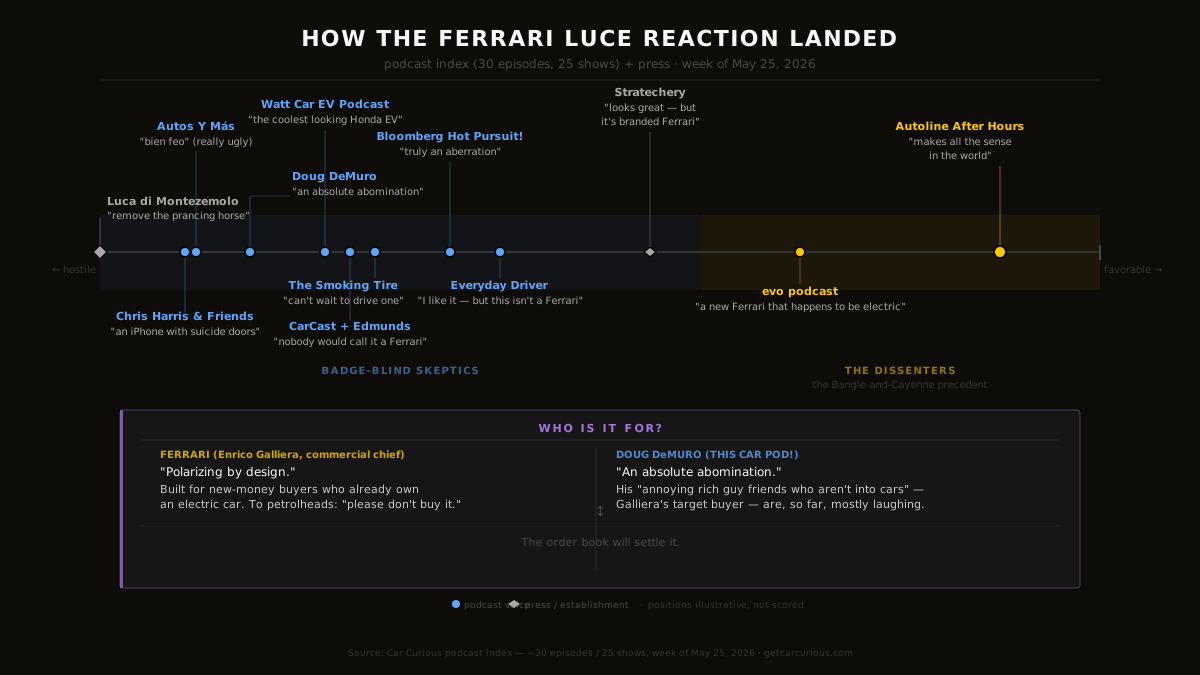
The full episode list is public. (The Luce's episode trail is here.) Those 30 are the reaction in the week after May 25. Add the powertrain and interior teasers from earlier in the year and the count nears 100 episodes; the 90-day pace roughly doubled. One caveat: "luce" means "light," and the Spanish-language shows use "luces" for headlights, so a handful of those hits are not the car.
No one has driven the Luce or seen one on the street, and it still pulled a week of coverage where most reveals get a segment.
What they're objecting to
Hardly anyone objected to the battery. The hosts objected that the car does not look like a Ferrari. On CarCast + Edmunds, they pulled up the configurator on the air: take the badges off, drop it in an LAX parking lot, and no one would call it a Ferrari, or even exotic. If Apple had built it, they said, everyone would nod. Ferrari built it, and that was the shock. A Hot Pursuit! host put it the other way: "If this car had come from Tesla or Lucid, we would not be freaking out. The problem is that it comes from Ferrari." The hosts were grading the Luce as a Ferrari, against sixty years of what the badge has meant.
Chris Harris and his panel cut an emergency episode about it. The panel called the styling "an iPhone with suicide doors," and Harris asked why Ferrari needed to "make something look like an i-Pace that had a 430 crash into the back of it." He read the reveal as defensive, too: Ferrari phoned to ask "how positive I was about electric cars," he said, and when he answered "not very," the launch invite "was not forthcoming."
Everyday Driver got there from the other side. The hosts liked the car. They spent most of the segment praising the aerodynamics and the clean shape, and one of them said, "I encourage clean, beautiful design, that's what this is." Then he hit the wall: "The longer I look at this, the more I like it, but I don't like that it's a Ferrari. This isn't a Ferrari."
The Smoking Tire spent more time inspecting the car than condemning it. The hosts reached for the memes, an "iPad that was a Ferrari," a Waymo, a Leaf, then worked through Marc Newson's "90s wedge" revival, praised the interior and the wheels, and traced the aero down to the carbon vent that pulls air from the wheel well. They would not call it until they saw one in person. Their verdict came to this: it looks wrong in photos, and they still want to drive it. The sharpest reactions ran in Spanish. On Autos Y Más:
"¿Verdad que el Luce bien feo?… Está horrible. O sea, ni Tesla tiene coches tan piñatas."
"The Luce is really ugly, right?… It's horrible. Tesla doesn't even make cars this piñata-like."
— Autos Y Más, May 2026
Who is the Luce for?
The hosts disagreed most about the customer. Two readings emerged: allocation bait, and a reach for new money.
The first reading is a loyalty play. Ferrari sells the Luce to collectors who buy whatever Maranello builds, because it holds their spot in line for the cars they want. The Smoking Tire figured it will mostly go "to people wanting allocations for other Ferraris," a $640,000 ticket to a V12.
The second reading takes Ferrari at its word: a car for buyers it has never had. The same host who called it an aberration made the business case anyway. Ferrari is chasing "drivers in Asia and tech pros" who "don't care even for a minute about dropping six hundred and fifty grand."
Ferrari has been blunt about the target. Enrico Galliera, its commercial chief, told the Financial Times the Luce is meant to be "polarizing." He tells petrolheads, "please don't buy it," and points instead to buyers who already own an electric car. Ferrari sent 81% of its 2025 cars to existing owners, so Galliera is courting strangers on purpose.
The early read on those strangers is one anecdote, and it is not encouraging. On THIS CAR POD!, Doug DeMuro called the Luce "an absolute abomination," then pointed at the exact buyer Galliera wants: "I have a lot of annoying rich guy friends who aren't actually into cars but sort of pretend to be, and all of them are laughing… the kind of people who would normally buy something like this, and they're sitting here like, who would touch this car?"
That is one host's friends, not market data, so hold it loosely. It is the only read so far, and it cuts against the pitch. Only the order book will show whether the new money turns up.
The dissenters
The base did not agree on everything. A minority defended the Luce, and they made the better-read argument: Bangle and the Cayenne. Autoline After Hours called its episode "Why Ferrari's Luce Makes All The Sense In The World." One panelist went back to 1992 and the "Bangle butt" 7 Series:
"There were petitions to have the man fired… Well, Chris Bangle managed to lower the average age of a BMW buyer from the high sixties to the low fifties. And, oh by the way, they managed to outsell Mercedes-Benz."
— Autoline After Hours, May 2026
He brought up the Cayenne too: Porsche sold a million by 2020, faster than the 911 managed in fifty years. Cars that look like brand suicide at launch sometimes pay for everything else. On evo, a reporter who went to all three reveals argued the disappointment is only skin-deep:
"It might not look like a Ferrari, but it has been developed in the same way that every other Ferrari has been. It's not an electric Ferrari. It's a new Ferrari that just happens to have electric power."
— evo podcast, May 2026
That is almost word for word Ferrari's own marketing line.
Why build it at all?
Chris Harris put the question directly on his emergency pod: "did Ferrari need to make an electric car? I'm not sure it did." Two theories answer it.
The first is regulation. Ferrari now sells enough cars to fall under European fleet-emissions rules, and an all-combustion lineup was unlikely to clear them. The Bloomberg host called the Luce "a compliance car." On Everyday Driver, the hosts asked whether it is "an offset car" that lets Ferrari "keep making the big V12s." His panel pushed it furthest. One of them, sitting beside the car, gave the cynical read as praise: Ferrari is "designing something that deliberately, strategically won't sell," so "the European Union will have to change course on this rather silly electrification strategy."
The second is China. Two-seat sports cars sell poorly there and understated luxury sells well, so a four-door electric Ferrari built for Shanghai is easier to explain than one built for the base. The Smoking Tire figured it could be "huge in China," and Harris's panel called it "a Loro Piana car," made for buyers who "don't want to show off."
The question no one could answer
The faithful fear an electric Ferrari with no voice. Ferrari took that literally. Instead of a synthesized soundtrack, it mounts an accelerometer on the rear axle, picks up the real vibration of the motors and gears, and feeds it into the cabin "in a similar way to how an electric guitar's amplifier works."
That addresses the thing the podcasts kept circling. It is also the one thing none of them could judge, because no one has driven the car. The defenders and the skeptics are waiting on the same answer, and they get it when a reviewer finally drives the Luce on a road.
The podcasts weren't alone
The base was not alone. Our sister project suspension.news tracks the wider car-news corpus, and we found the same verdict in the press and inside Ferrari, reached without the podcasts. Luca di Montezemolo, who chaired Ferrari for two decades, said the Luce risks "destroying a legend" and hoped Ferrari would "at least remove the prancing horse from that car." He added that it is at least "a car the Chinese won't copy." Jeremy Clarkson, in his Sun column, went further: "When you take the engine out of a car, the soul is gone… it's just a product, like a washing machine, or a chest freezer." Ben Thompson of Stratechery liked the design and still agreed on the problem. He thinks the Luce "looks great" for an electric car, but "the real problem is that it's branded Ferrari," because an electric car chases efficiency and Ferrari sells performance. The markets agreed: Ferrari shares fell more than 8% in Milan the day after the reveal and about 5% in New York. The Financial Times called the launch "more heat than light."
Ferrari's answer is that none of these people are buyers. CEO Benedetto Vigna says the customers who can afford a Luce already want one.
What the reaction tells us
The Bangle and Cayenne defenses miss one thing. You could hate the 7 Series or the Cayenne and still hear the engine. The 456 and the Purosangue drew the same "that's not a real Ferrari," and they still looked like Ferraris. The Luce doesn't, from its anonymous shape to the design credit that points outside Italy.
So this is worth watching, not waving off as internet noise. The people filling the Luce's feed are the customers Ferrari grew up on, the ones who believe a Ferrari is a feeling before it is a spec sheet. They will take the electric motor. They are not sure they can take a Ferrari they can't stand to look at.
Shows referenced