Data centers create jobs and tax revenue that pay for a lot more than just a park here or there. How do you pay for schools? Firefighters and police? Transit? It’s with tax revenue. And right now, communities are throwing away the biggest tax base expansion opportunity of their lifetimes.
In 2025, 25 data center projects were canceled due to community pushback. That’s up from 6 in 2024 and just 2 in 2023. The opposition is bipartisan, driven overwhelmingly by two things: wildly exaggerated claims about water use (a data center in Chile was reported to use 1000x a city’s water supply when the real figure was 0.2x and concerns about rising electricity prices for local residents.“
In 2025, 25 data center projects were canceled due to community pushback. That’s up from just 6 in 2024 and 2 in 2023. The opposition is notably bipartisan, driven overwhelmingly by one thing: rising electricity prices for local residents. In Q2 2025 alone, 20 projects were blocked or delayed, putting $98B in potential investment at risk. The 2025 cancellations represented ~4.7 gigawatts of lost electricity capacity. Using OpenAI’s own estimate of revenue per gigawatt (~$10B revenue per gigawatt), those cancellations represent ~$50B in lost AI revenue in a single year. Applying a 20x earnings multiple and its $1 trillion in lost enterprise value. In one year! And it’s not getting better… At least 99 data center projects are currently being contested nationwide. Historically, ~40% of projects facing sustained opposition are eventually canceled. This means many more gigawatts, billions in revenues and trillions in enterprise value are at risk if we don’t turn this around. The core problem as I see it: local residents are being asked to subsidize AI infrastructure through higher electricity bills with no upside. That’s not a sustainable ask. Until we solve the electricity cost equation, community opposition will remain a systemic and under-priced risk to the AI sector and the broader economy.
In Q2 2025 alone, 20 projects were blocked or delayed, putting $98 billion in potential investment at risk. Using OpenAI’s estimate of $10 billion revenue per gigawatt, those 2025 cancellations represent $50 billion in lost AI revenue. Apply a 20x earnings multiple and you get $1 trillion in lost enterprise value. In one year.
The $98 Billion Revolt Against the Future

Charlie Kratovil’s victory selfie represents something bigger than one blocked project.
The same playbook shows up everywhere: scare people about water, energy, noise. Rally the neighbors. Kill the project. Declare victory. Never mention what you actually destroyed.
The New Brunswick Victory Lap
A data center in New Brunswick was canceled tonight when hundreds of residents showed up. When fight big tech and private equity we win. https://t.co/doZ63Pdwue
In New Brunswick, the crowd was explicit about who they were fighting. The video shows them chanting about AMZAC Capital Management and BlackRock, framing this as David versus Goliath.
Ben Dziobek, the organizer, claimed the project would create “literally 0 jobs” or maybe 10 permanent positions. The real numbers tell a different story. A typical 100-150 MW data center supports 1,000-1,500 total jobs including indirect employment. In Loudoun County, Virginia, data centers pay $26 for every $1 of local public services required. That’s a 26:1 ratio.
Virginia’s data centers represent $203 billion in accumulated capital investment and 12,140 operational workers. For every job inside a data center, 3.5 additional jobs get supported in the broader economy.
The Warning: Bombed by 2028
Will Manidis saw the New Brunswick celebration and issued a prediction that should alarm anyone who builds technology.
if you don’t understand why a coherent theology of progress matters, it’s because in the absence of one events like this will escalate until data centers are routinely bombed by 2027-8 you need to communicate why you shouldn’t be jailed for your work, those are the stakes
"Events like this will escalate until data centers are routinely bombed by 2027-8,” he wrote. “You need to communicate why you shouldn’t be jailed for your work, those are the stakes.”
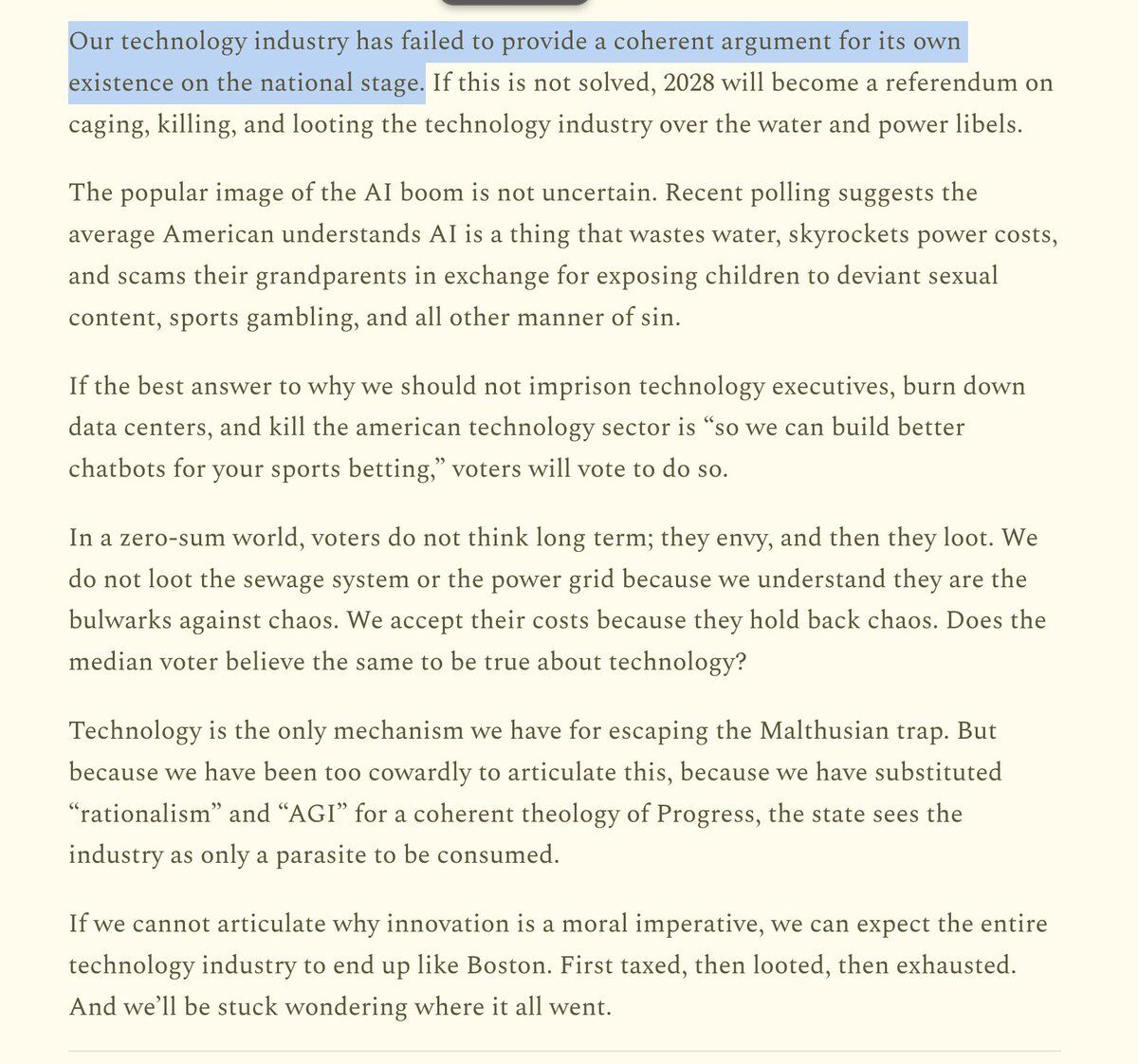
His core argument is devastating in its clarity: tech has substituted “rationalism” and “AGI” for a coherent theology of Progress. The industry has failed to provide a coherent argument for its own existence on the national stage. Recent polling suggests the average American understands AI as something that wastes water, skyrockets power costs, and scams their grandparents.
If the best answer to “why should we not burn down data centers” is “so we can build better chatbots for your sports betting,” voters will vote to burn them down.
We can look to Boston as the preview. SF produced $14 trillion in enterprise value over the last two decades. Boston produced $100 billion. What happened? First taxed, then looted, then exhausted. The same forces are lining up here.
What One Data Center Actually Creates
The same communities rejecting these projects are walking away from transformational economic benefits. Per one-gigawatt data center complex: 5,322 permanent jobs, $157.7 million per year in state taxes, $248.0 million per year in local taxes. During construction: $2.67 billion in combined investment and 45,367 temporary jobs.
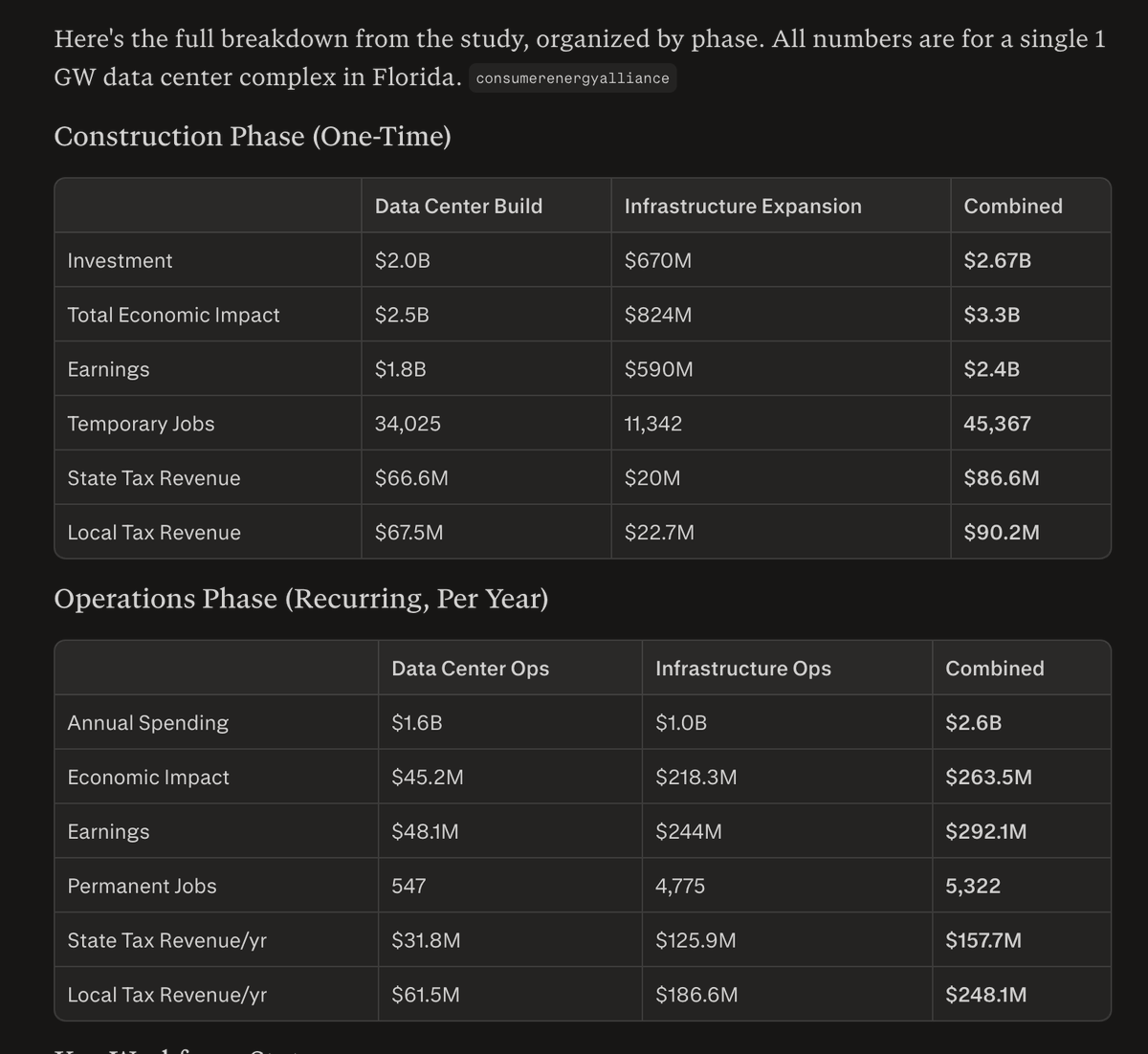
Data center workers earn $34,336 more than regional average. Infrastructure workers earn $42,069 more. And unlike factories that alter community character, the Consumer Energy Alliance study found data centers maintain a relatively modest cultural footprint due to limited workforce requirements.
The question isn’t whether data centers benefit communities. The question is whether communities are structured to capture those benefits.
The Loudoun County Proof
Northern Virginia is the largest data center market in the world. Virginia’s data center capacity equals 23 other US states combined. Loudoun County hosts the densest concentration of them all.
The results? Data centers pay $26 for every $1 of local services they require. A 26:1 ratio. Schools invested $111 million. The county set aside $17 million for affordable housing. Property and vehicle taxes went down. For every data center job, 3.5 additional jobs are created in the broader economy.
That’s not exploitation. That’s abundance.
Housing NIMBYs Took 36% of GDP. Data Center NIMBYs Want the Rest.
Economists Hsieh and Moretti found that housing constraints in high-productivity cities like NYC and San Francisco lowered aggregate US GDP by 36% from 1964 to 2009. That’s $8,775 stolen from every American worker’s paycheck, every year. Not because they wanted different jobs. Because they literally couldn’t afford to move to where the jobs were.
The same dynamic is now playing out with data centers. Local interests blocking infrastructure that benefits everyone. The Guardian celebrates communities stopping data centers as heroic struggle. One organizer called it “like the third act of an Oscar-winning movie.”
Here’s the irony: progressive communities blocking data centers are also blocking the funding that could pay for schools and affordable housing. The very same people who complain about building datacenters also complain that our state and cities are not doing enough to help the people. Which is it?
The Fix Is Simple: Share the Upside
Chamath’s diagnosis is right: local residents are being asked to subsidize AI infrastructure through higher electricity bills with no upside. That’s a real problem. And it’s solvable.
Loudoun County shows the model. Direct community investment in schools, housing, tax relief. When residents see data centers funding their kids’ schools and lowering their property taxes, opposition evaporates. Until communities see the benefit, opposition will remain a systemic risk to AI and the broader economy.
Meanwhile, Microsoft has NVIDIA GPUs sitting in racks that can’t be turned on because there isn’t enough power. The AI economy will scale at the rate power comes online, not at the rate chips improve. Every gigawatt blocked is a year of AI progress delayed.
The states that figure out how to share data center benefits with communities will capture the AI economy. The states that let NIMBYs run the playbook that already cost us 36% of GDP will watch the future get built somewhere else. Virginia figured it out. Loudoun County residents have better schools, more affordable housing, and lower taxes because they said yes.