Jazz on low. John Coltrane, A Love Supreme, the kind of record that doesn’t ask anything from you except presence. One spray of Gentleman Givenchy before sitting down, amber and cedar slowly settling into the room. By the time it’s fully dry I’m usually already deep in whatever I’m thinking about.
Tonight it’s conversation.
Specifically the question of why some people can walk into a room full of strangers and leave with three genuine connections, two phone numbers, and a standing invitation to someone’s dinner party.
And why other people, equally intelligent, equally interesting, equally worth knowing, can barely get through small talk without feeling like they’re performing a role they never auditioned for.
I used to be the second person.
Rooms full of people I didn’t know felt like an exam I hadn’t studied for. I’d stand at the edge of things, drink in hand, calculating entry points into conversations I wasn’t sure I was welcome in.
The frustrating part wasn’t the discomfort. It was watching people who seemed to have no framework at all just talk. Easily. Naturally. Like conversation was something that happened to them instead of something they had to manage.
I spent a long time thinking that was personality. That extroversion was something you either had or you didn’t.
It’s not.
It is a neurological state with a specific biological signature, and it can be learned.

Here is the finding from neuroscience that changed everything for me.
The difference between introverts and extroverts is not sociability. It is not confidence. It is not even preference for people.
MRI research confirms that the dopamine reward network is measurably more active in the brains of extroverts. Their mesolimbic pathway, the system responsible for generating the pursuit of reward, responds with greater intensity to social stimulation. Talking to people, entering new environments, meeting strangers, all of it produces a stronger dopamine signal in the extroverted brain.
The extrovert isn’t braver than the introvert. They are getting more chemical reward from the same social input.
Now here is the part that most people stop at without following the implication all the way through.
Dopamine doesn’t just respond to social interaction. It responds to anticipated social interaction.
Which means the person who has built a history of positive social experiences has a dopamine system that begins firing in anticipation before they even enter a room. Their brain has learned that social environments produce reward. So it primes them for engagement before they walk through the door.
The person with a history of social anxiety has the opposite pattern. The anticipatory signal is threat, not reward. The amygdala activates. Cortisol begins to rise. The room hasn’t happened yet and the body is already in a mild defensive state.
Neither of these patterns is fixed.
Both of them were built through experience.
And both of them can be rebuilt.
In 2010, Uri Hasson and colleagues at Princeton University published research that fundamentally changed how neuroscience understands human conversation.
They placed both speakers and listeners into fMRI scanners during natural verbal communication and measured their brain activity simultaneously.
What they found was astonishing.
When genuine communication occurs, the brain activity of the speaker and the brain activity of the listener begin to mirror each other. Neural patterns align across two separate skulls. The coupling was so precise that the researchers could predict how well a listener understood the speaker based purely on how tightly their brain activity synchronized.
Hasson called this brain coupling, and the research was unambiguous on one point.
This coupling vanishes completely when people fail to communicate.
A real conversation is not two people taking turns producing words at each other. It is two brains entering a state of neurological synchrony. A single event distributed across two nervous systems.
The person who is easy to talk to is not deploying better sentences. They are creating the conditions for this synchrony to occur. They are saying and doing things that make your brain couple with theirs.
And the person who is awkward to talk to is not deploying worse sentences either. They are disrupting the conditions for synchrony. The coupling fails. The conversation feels like work.
Understanding this reframes every social skill in existence.
The goal of conversation is not to be impressive. It is to produce neural coupling in the person you are talking to.
Everything else follows from that.
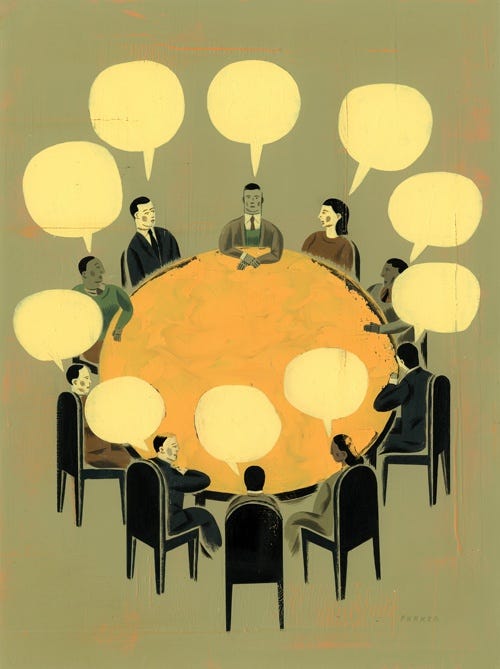
These are not tips. They are the mechanics of what actually creates social ease at the neurological level.
Social awkwardness in almost every case is misread. People think they are bad conversationalists when in reality they are anxious conversationalists. The words are fine. The ideas are fine. The person is fine.
The amygdala is producing a low-grade threat response that is showing up as slight hesitation, slightly reduced eye contact, slightly faster speech, slightly less willingness to take up space.
None of this is character. All of it is neurobiology.
The practical correction is not to become more charming. It is to reduce the threat signal before the conversation starts.
How? By reframing what the room is.
Your brain is generating a threat signal because it has categorized the social environment as evaluative. “These people are judging me. If I say something wrong something bad happens.”
The evidence does not support this. Almost nobody in any room you walk into is critically evaluating you. They are thinking about themselves, wondering how they are coming across, hoping they seem interesting, managing their own version of the same background anxiety.
When you genuinely absorb this, the amygdala gets different data. The threat level drops. The dopamine system gets more room to operate. The conversation becomes easier not because you changed what you say but because you changed what your nervous system thinks is happening.
There is a reason the best conversationalists in the world are remembered as extraordinary despite saying relatively little.
Hasson’s brain coupling research provides the mechanism. When you genuinely listen to someone, and I mean fully, without planning your next sentence, without waiting for your turn, without filtering what they say through how it relates to you, their brain recognizes the coupling. Not consciously. Neurologically.
The sensation they experience is being understood.
And being genuinely understood by another person is one of the most neurochemically rewarding social experiences the human brain can have. Oxytocin releases. The amygdala quiets. Trust builds. The feeling gets attributed to you.
This is why the person who asks one great question and then actually listens to the entire answer leaves an impression that the person who tells three impressive stories does not.
You don’t need more to say. You need to receive more fully what is already being said.
Read that again.
Most people operate at the level of the exchange. “How are you. Good. What do you do. How long have you been here.”
The social brain processes these exchanges efficiently and stores them nowhere. They produce almost no neural coupling because they require no real engagement from either party. The brain is on autopilot. Nothing is actually happening between the two people.
The moment you get specific, everything changes.
Not what do you do, but what part of your work actually keeps you up at night.
Not how long have you been here, but what made you decide to come to this specific thing tonight.
Not do you like it here, but what surprised you most about it.
Specificity requires the other person to actually think. And when a person is actually thinking in front of you, genuinely constructing an answer rather than retrieving a cached one, the neural coupling begins. They are present. You are present. A real exchange is occurring.
One specific question does more work than ten generic ones.
The most socially corrosive habit most people have is the internal commentary that runs alongside their words.
“That was weird. Why did I say that. They look bored. I’m talking too much. Should I have said that differently.”
This internal auditing is the precise mechanism by which anxiety reproduces itself in real time.
Self-monitoring uses cognitive resources that should be going to the conversation. The quality of the conversation drops. The self-monitoring intensifies in response. The spiral tightens.
The antidote is not to become more confident about how you are coming across. It is to redirect attention outward entirely.
Stop monitoring yourself and start genuinely observing them.
Their energy. What lights them up. What flattens their expression slightly. What they say quickly versus what they pause before. Where they are actually alive in the conversation versus where they are going through the motions.
The person who is focused entirely on reading the room has no cognitive bandwidth left for self-monitoring. The anxiety doesn’t get a chance to compound because the attention is elsewhere.
And the other person feels seen. Which is exactly the neural coupling state you were trying to produce.
This is the one most people get backwards.
They wait for the perfect opener. The clever observation. The witty entry point. And while they are calculating, the moment passes and the interaction doesn’t happen.
The brain learns from what you do, not from what you plan.
Every social interaction you initiate, however unremarkable, is depositing evidence in your dopamine system that social initiation produces outcomes. The anticipatory signal shifts over time. The threshold for initiating drops. The room starts to feel less like an exam and more like an environment.
Say something ordinary. Mean it genuinely. Let it lead somewhere or let it not.
The conversation that goes nowhere still moved your dopamine system one increment in the right direction.
Over time, those increments compound into the person who talks to anyone, anywhere, without a second thought.
The person who talks easily to everyone is not a different kind of person.
They have a dopamine system that has been trained through accumulated experience to expect reward from social initiation. Their amygdala has updated its threat assessment of unfamiliar rooms downward. Their brain coupling happens faster because their nervous system is not burning resources on a defensive response before the conversation even starts.
That is all extroversion is.
A trained neurological state.
Not a fixed trait. Not a personality type you either have or don’t.
A pattern of neural expectation built through enough positive social experiences that the anticipatory signal flipped from threat to reward.
By reducing the amygdala activation before you walk in. By listening at a level that produces real neural coupling. By asking the question that requires the other person to actually think. By getting out of your own head and into genuine curiosity about theirs.
Do it enough times with enough genuine presence and the dopamine system recalibrates around the evidence.
The room stops being something you have to manage.
It becomes somewhere you actually want to be.
You just read something most people will never come across.
You’re here reading the actual mechanism.
That gap between you and “them” just got wider.
The “Upgrade” button down below is the final step.
The paid tier is where it goes deeper.
The neuroscience of dopamine and why your reward system is being systematically recalibrated without your knowledge. The nervous system under chronic stress and what it’s doing to your prefrontal cortex in real time. Sleep architecture, working memory, neuroplasticity, emotional regulation, the whole map of how you actually work and why you do what you do.
Not summaries. Not listicles. The real mechanisms, the ones that change how you see yourself and everyone around you permanently.
$10 a month.
Less than a single mediocre lunch.
For a library of material that will make you think differently about your brain, your behavior, and what’s actually possible for you, for the rest of your life.
The people who upgrade don’t do it because they have extra money sitting around. They do it because they recognize the moment when something is genuinely worth it, and they move on that feeling instead of talking themselves out of it.
You already know if this is for you.
The button “Upgrade” is right below. Click it.
Check out some premium posts:
The Brain Spiral: Unraveling the Patterns of Repetitive Thoughts

Jazz on low. Coltrane tonight, A Love Supreme, a record that sounds like it was made inside a cathedral. One spray of Gentleman Givenchy on the wrist before sitting down, amber and cedar settling into the skin. Some rituals just tell your nervous system it’s time to think clearly.
How to maximise your mindset potential

Jazz on low. Bill Evans Trio, Waltz for Debby, the kind of record that sounds like thinking feels when it’s going well. One spray of Gentleman Givenchy on the wrist and I’ve been at the desk since early morning with something I’ve been trying to articulate for weeks.