Last week HSBC made headlines by announcing it’s about to get a whole lot slimmer, with sweeping job cuts across its UK wealth business in an AI push. The FT, which broke the story, said the planned cuts would:
“Drastically reduce (HSBC’s) ranks of financial advisers and other specialists as part of a push to use AI to help serve wealthy clients.”
The source sharing the news claimed the plan was to cut adviser headcount by 70%. The only public information was a mission statement by HSBC CEO Georges Elhedery, and there the only concrete numbers were about adding 100 jobs in an AI Centre of Excellence in Singapore.
When you’ve been writing about financial markets for such a long time — and scraping news for just as long — you tend to recall odd bits of news. When I read this headline I thought, we’ve been here before.
Remember Robo Advisers? They were, quite literally, a big deal in 2017. There was a flurry of buyouts and investments from large incumbents (including UBS and J.P. Morgan), and plenty of consultancy reports lauding robo-investing as the future of financial advice. Writing about it at the time, I quoted one Deloitte report, which enthused:
“ Robo-advisors 4.0 (will) scan single client portfolios and open/close positions without human interaction following self-developed algorithms.”
I had my doubts. Machine learning capabilities at the time were nowhere near hitting this bar; on top, I doubted people would trust such systems with large amounts of capital. This turned out to be true enough; the surviving robo-advice platforms now mostly manage cash accounts.
But we didn’t have AI then, and now we do, so HSBC is once again hoping to automate advisers, and intends to cut jobs. I’m still doubtful, as is The Banker, which wrote about how these claims were “not justified”:
“AI benchmarking firm Evident said the technology is not advanced or well-integrated enough in financial workflows to warrant significant job cuts… More broadly, headcount among banks investing most aggressively in AI and deploying it at scale is increasing.”
Still, the prevailing narrative this year has been that AI is now getting so good that companies using it are shedding jobs. Given how competent AI tools already are, it would seem foolish to challenge this narrative. Well, colour me foolish:
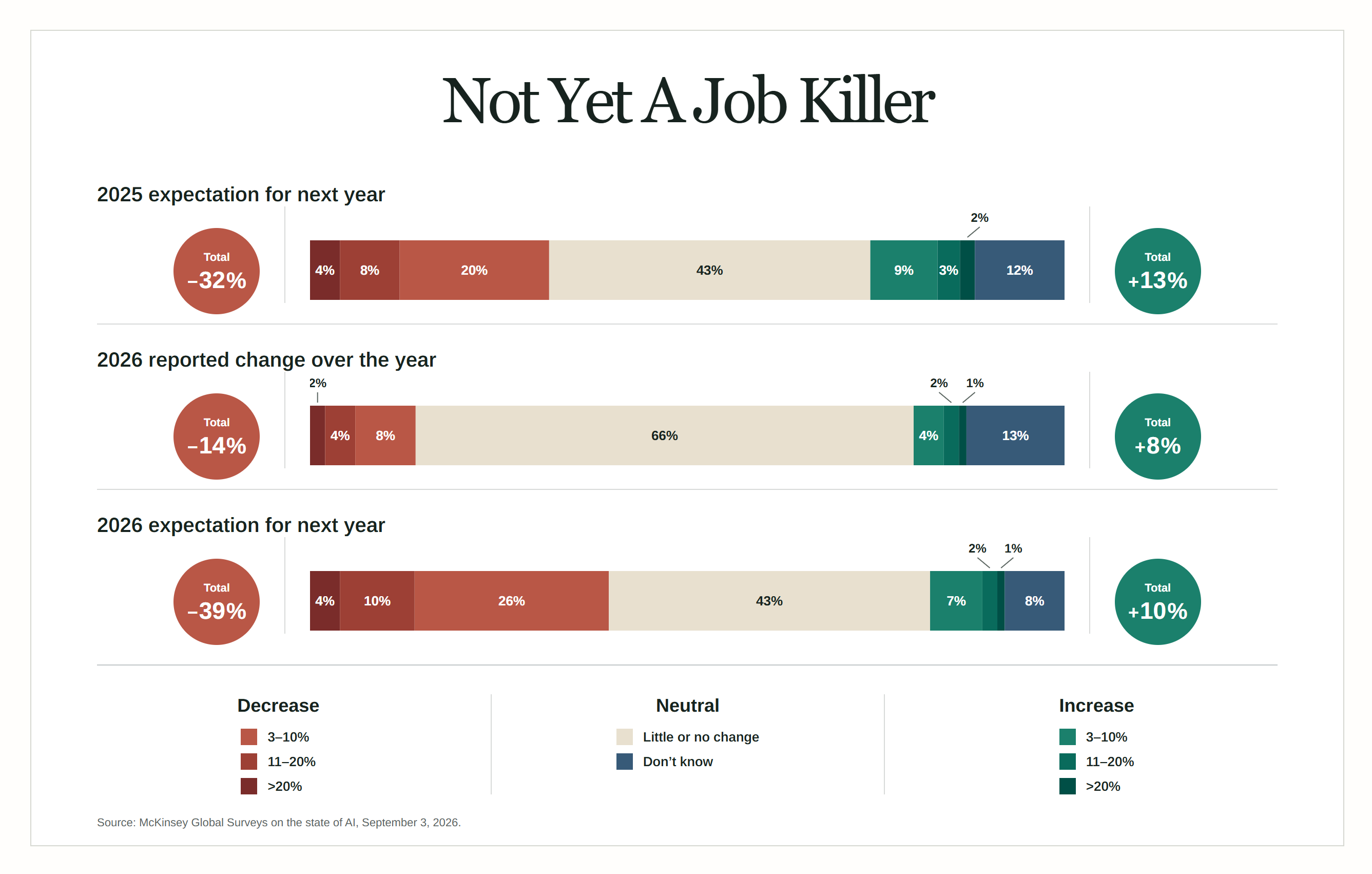
Last month McKinsey released interesting data, collected over the past two years. First, they surveyed companies last year on how they thought jobs would change. Coming back this year, they checked what had actually happened, and asked about expectations for the year ahead.
This chart is extraordinary for several reasons. Most obviously, the ranges for jobs added were far closer to the anticipated marks than the ranges for jobs lost. Also, the most dominant part of the chart was “no change”.
Correlation is not causation. Plenty of data is showing the economy is sluggish, uncertainty is high, and companies are spending less where they can. But when the FT tried to find hard evidence specifically linking AI to job losses it came up empty. And a very recent study across 22,000 companies, which looked at both headcount data and AI adoption metrics, found that the more companies use AI, the more they hire.
With agentic AI superseding previous assumptions about “how AI is used”, the most generous analysis would say it’s simply too soon to tell. Meanwhile, all this AI is costing companies real money, and often much more than they had budgeted for.
Taken together, these statements just don’t add up: AI keeps getting better, and in our day-to-day it’s manifestly useful. Companies are using AI, and it’s adding to their operating costs. But AI has yet to replace employees, even when companies have every incentive to do so.
Why so little change? How are companies using AI without seeing a measurable benefit they can lean into?
To understand what’s happening we need an experiment, a test case. Something sufficiently generic to exemplify common business work, but specific enough to allow for measuring.
Last week I linked to a fun project, a combined infographic and dashboard, which showed the typical family office can be surprisingly risk averse. In a dramatic twist I now reveal that at least half my motivation for building this was to create just this kind of experiment, in a way that could yield hard numbers.
The setup is simple enough: AI allows us to do more, and is especially useful at bridging skill gaps. A wealth or asset manager wanting to create a dashboard experience would typically have commissioned an external agency to do so. It would employ designers and developers, offering skills and expertise the manager would only require sporadically. Now, with AI, it’s natural to wonder if thought leadership can finally break free from its PDF prison, by allowing more of such work to get done in-house.
Let’s investigate.
I have put together a blog post, reviewing how AI was used to turn tables of numbers into a live, dynamic mini-site. It has a qualitative part, covering issues teams can expect no matter the specifics of a project. Its second part, which got me all buzzed, looks at metrics, through which we can start to discuss “value add”.
Money-wise, using AI to build the site cost nearly nothing. (As a personal user - companies now pay costs that are closer to the real cost of tokens.) But in terms of effort the cost was meaningful, and nowhere close to the vision of “zero shot prompting”.
It starts, as it will end, with the problem of “good enough”. Companies establish processes to reliably arrive at a finished output that meets their (often quite high) standards. AI introduces uncertainty into the process. Since a model’s output typically sits well outside the boundary of “meets our standards”, the user aims — through back-and-forth — to converge the output into something a company would proudly call its own.
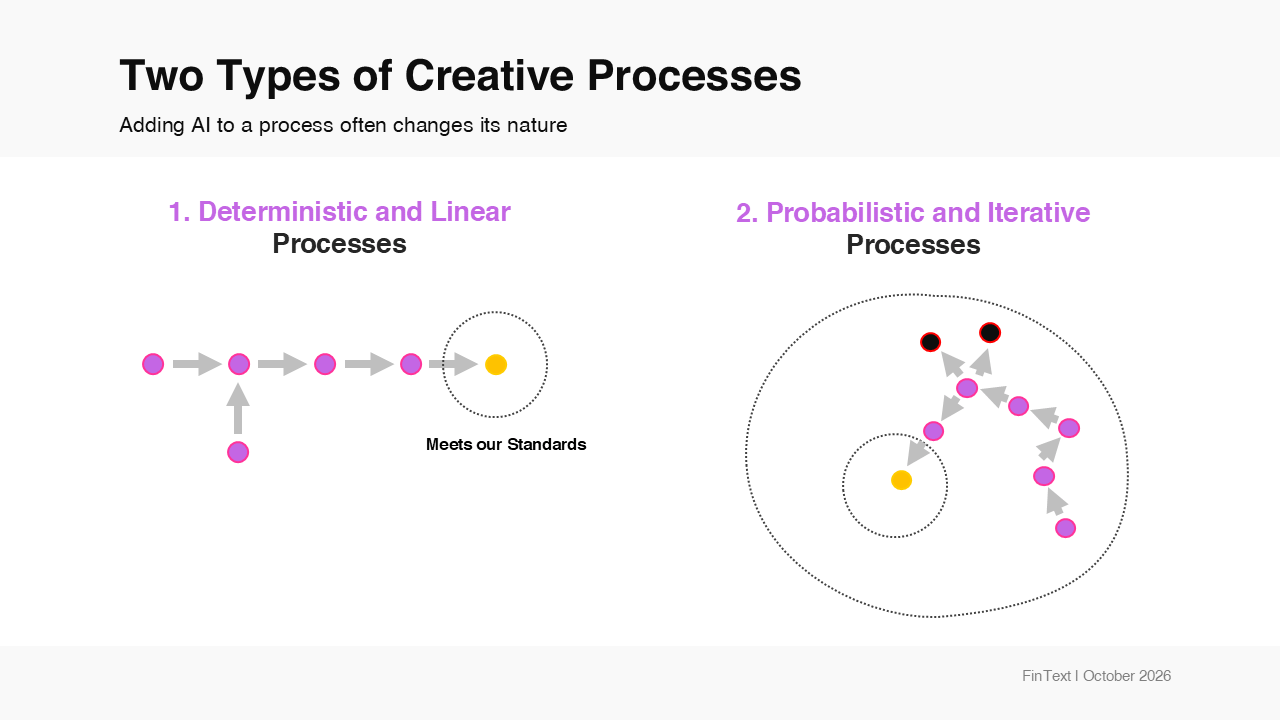
It’s exactly this back-and-forth you want to analyse. In our analysis we looked at over thirty different metrics. Our write-up doesn’t go into all of them, but it offers some examples to illustrate the key point:
“(There is) a delicate phenomenon, where the user’s skill set influenced the efficacy of the process… Any discussion on the efficacy of using AI also has to include metrics that capture this subtlety. Just as models have benchmarks for their capabilities, we need to be able to discuss joint capabilities of user and AI.”
The nature of work is changing, in ways we have barely begun to understand. Expect to see plenty more debate on how to measure the efficacy of AI workflows.