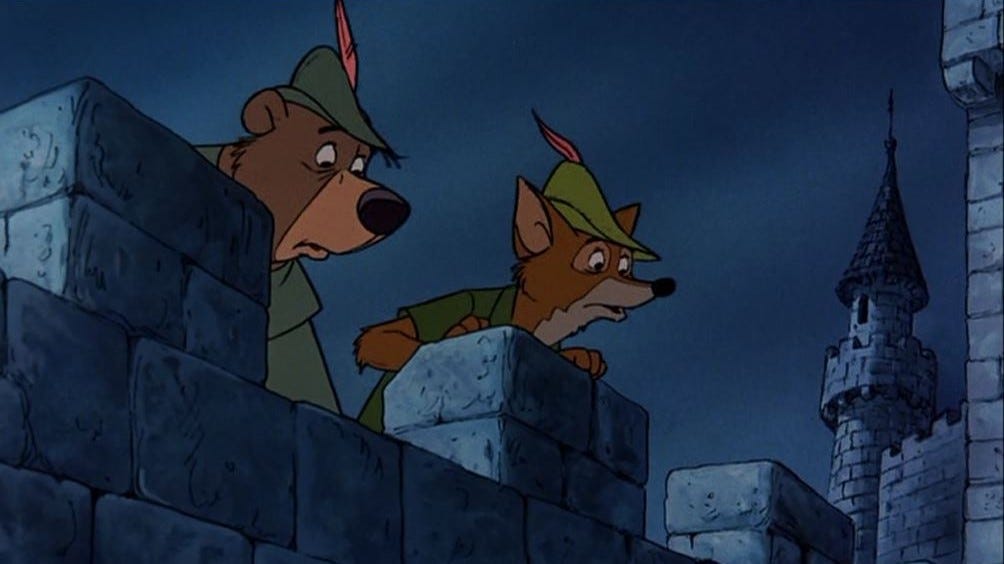
Little John and Robin Hood peek over the castle walls, looking for Friar Tuck. Image from ROBIN HOOD (1973, Wolfgang Reitherman). Credit: The Walt Disney Co.
On March 18, 2026, Josh D’Amaro became the ninth CEO in Disney’s 102-year history. In his first letter to employees, he named emotional storytelling as the company’s North Star. He wrote about his first visit to Disneyland more than forty years ago: riding Peter Pan’s Flight with his father, soaring over a miniature London, his father leaning over to say: “See, I told you. It feels like we’re flying.”
“That feeling of flying I had on Peter Pan all those years ago is still real to me,” he wrote.
On the same day, Disney shareholders declined to support a proposal requiring a review of the company’s accessibility practices for disabled guests.
106 million Americans watched the MASH finale in 1983. At the time, that was approximately seventy-seven percent of US households. The industry mourns that era. The shared references. The lines everyone knows. The intangible place we could all come back to. Analysts call its dissolution feudal media. Executives call it fragmentation. Writers call it the death of monoculture. What none of these laments account for is that the monoculture they’re mourning never fully included the audience nobody saw. The shared cultural experience that became the touchstone was not shared equally. The fragmentation everyone is experiencing now as a new loss is a version of the exclusion that specific audiences have been living with as a structural condition since the pipeline was built.
Piece one of this series diagnosed the pipeline has no owner, no standard, and no mandate. Piece two went inside it. This piece asks the harder question underneath both of them: whose films, whose stories, whose cultural experiences does that pipeline serve? And whose experience the industry has decided is worth preserving.
The canon nobody questioned
Amazon has begun adding audio description to classic Hollywood titles: CITIZEN KANE (1941, Orson Welles), CASABLANCA (1943, Michael Curtiz), REAR WINDOW (1954, Alfred Hitchcock), and THE GOLD RUSH (1925, Charlie Chaplin). However, neither SEVEN SAMURAI (1954, Akira Kurosawa) nor THE SEVENTH SEAL (1957, Ingmar Bergman) are available with audio description on Amazon Prime Video. I’ve only been able to find the English-dubbed version of the latter via The Criterion Collection on the 4k+Blu-ray Special Edition.
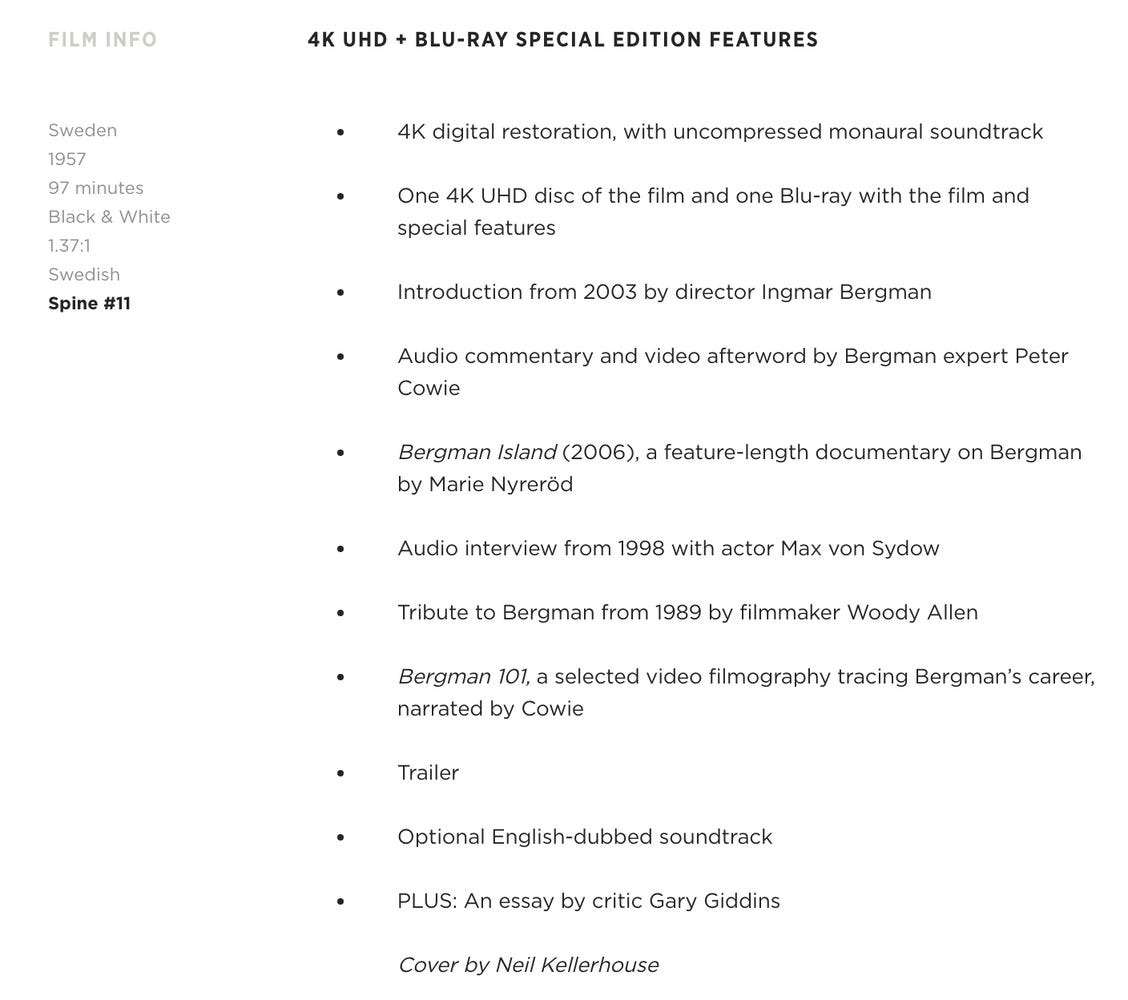
The Criterion Collection’s special edition features for THE SEVENTH SEAL where the optional English-dubbed soundtrack is listed.
The decision about which films belong in the accessible canon is being made somewhere in the pipeline without a stated standard, without community input, and without public accountability. The industry is describing the films it decided were worth describing. The audience nobody saw receives whatever that decision produced.
Amazon Prime Video produces much of its audio description using synthetic speech: the Joanna voice from Amazon Polly, the cloud text-to-speech service Amazon has been expanding since 2017. In 2021, the American Foundation for the Blind’s AccessWorld documented Amazon’s stated goal: to use text-to-speech (TTS) technology to simplify the process of creating audio descriptions to where they become industry standard for all content, just like closed captions.
By August 2025, Amazon Polly had expanded to 27 generative voices across English, French, Spanish, Polish, and Dutch: a multilingual TTS infrastructure capable of describing films in multiple languages while maintaining consistent vocal identity. Three weeks later, Amazon published its Audio Description Style Guide requiring narration that matches the tone of the material and voice quality that does not distract. That standard is written for human narration. The infrastructure for global TTS AD was built and announced before the quality standard for that AD was published.
The Joanna voice. Ruth. Matthew. Amy. Twenty-seven named generative voices trained on human speech. The humans whose voices contributed to that training have no publicly documented consent framework in the context of accessibility production. SAG-AFTRA requires consent and transparency for digital voice replication in performance. On March 20, 2026, SAG-AFTRA released a statement about AI being used to replicate a deceased performer’s likeness and voice in a motion picture. In February 2026, former Morning Edition host David Greene filed suit against Google alleging his voice was used to pattern an AI product without his permission. In May 2024, OpenAI pulled an AI voice that Scarlett Johansson said bore a striking resemblance to hers after she hired lawyers and went public. There is one common thread between the aforementioned cases: someone with enough visibility to make noise got a response.
The voices describing films to blind audiences were trained on human speech. OpenAI uses Voice Engine. Amazon uses Amazon Polly specifically for AD. Microsoft’s commercial product is Azure AI Speech / Dragon HD. Grok uses Voice Agent API. LLMs and the datasets that have been used for training have no equivalent visibility. The people whose voices trained those models have no consent framework, no disclosure requirement, no compensation mechanism in the context of accessibility production. The litigation establishing AI voice consent norms hasn’t reached the AD track.
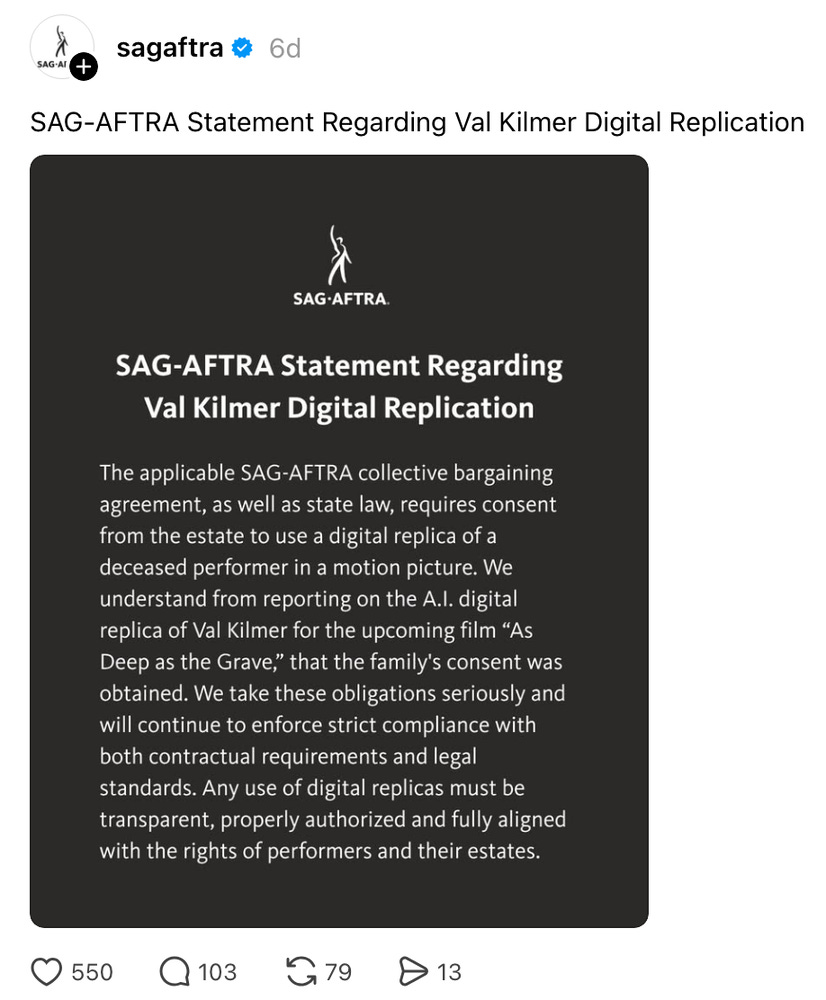
SAG-AFTRA’s statement on Threads released on March 20, 2026 regarding Val Kilmer’s digital replication for the upcoming film AS DEEP AS THE GRAVE. “We take these digital obligations seriously and will continue to enforce strict compliance with both contractual requirements and legal standards. Any use of digital replicas must be transparent, properly authorized and fully aligned with the rights of performers and their estates.”
The highest-rated film on Letterboxd in 2025 is CHAINSAW MAN. The second is THE VOICE OF HIND RAJAB, an Oscar-nominated documentary recently censored by the Indian government in March 2026. Neither have audio description. The audience defining what matters culturally on the platform measuring cinematic engagement most precisely is watching content the AD pipeline wasn’t built to serve.
Remakes and working with non-English languages
INFERNAL AFFAIRS (2004, Andrew Lau and Alan Mak) has no audio description. THE DEPARTED (2006, Martin Scorsese), the American remake, has an American English AD track and a British English AD track, as catalogued by Audiovault. This most likely means two different AD scripts produced by two separate post houses.
RINGU (1998, Hideo Nakata) has no audio description. THE RING (2002, Gore Verbinski) has AD. Specifically on Amazon Prime in the United States, you can access the original Japanese audio track on the physical 3-disc special edition collector’s set.
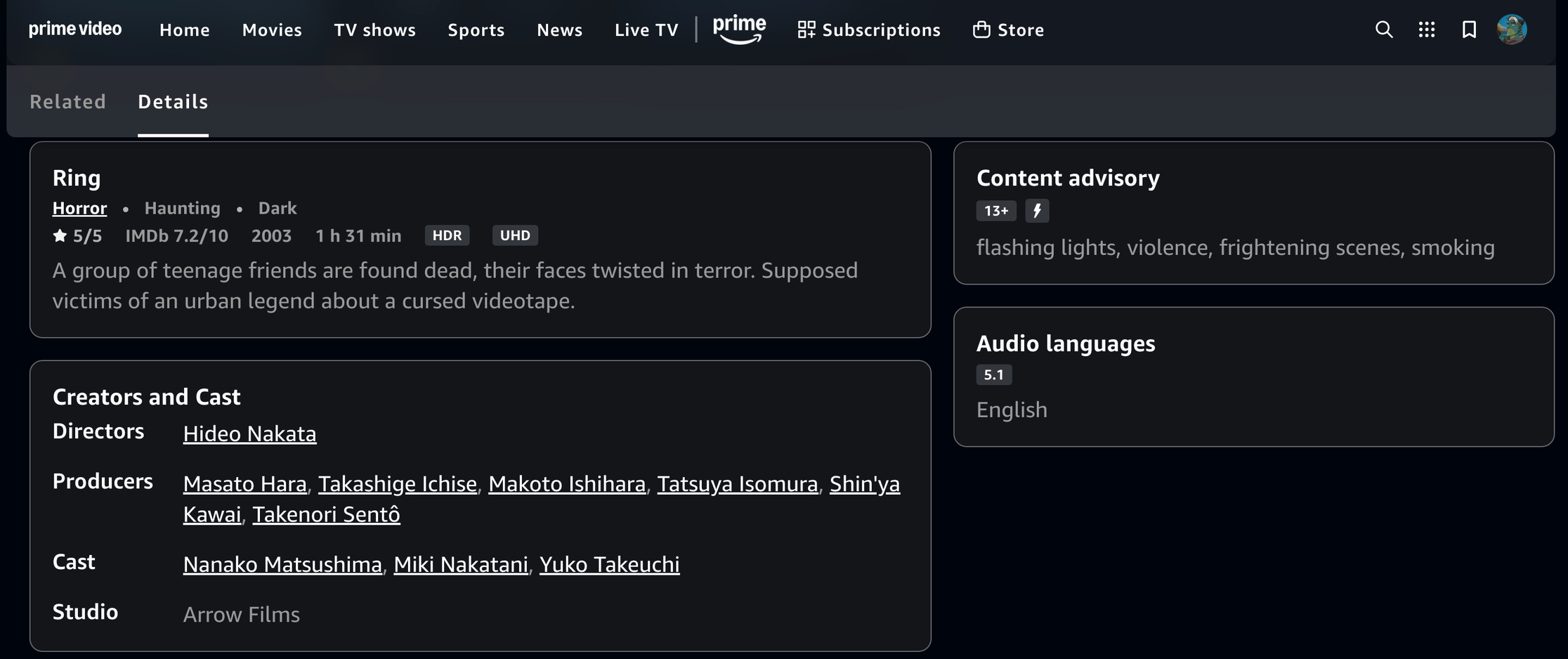
The “details” section for RINGU on Prime Video. For some reason, Prime Video lists this film coming from 2003 and only has English audio when the film originally came out in 1998 and is in the Japanese language.
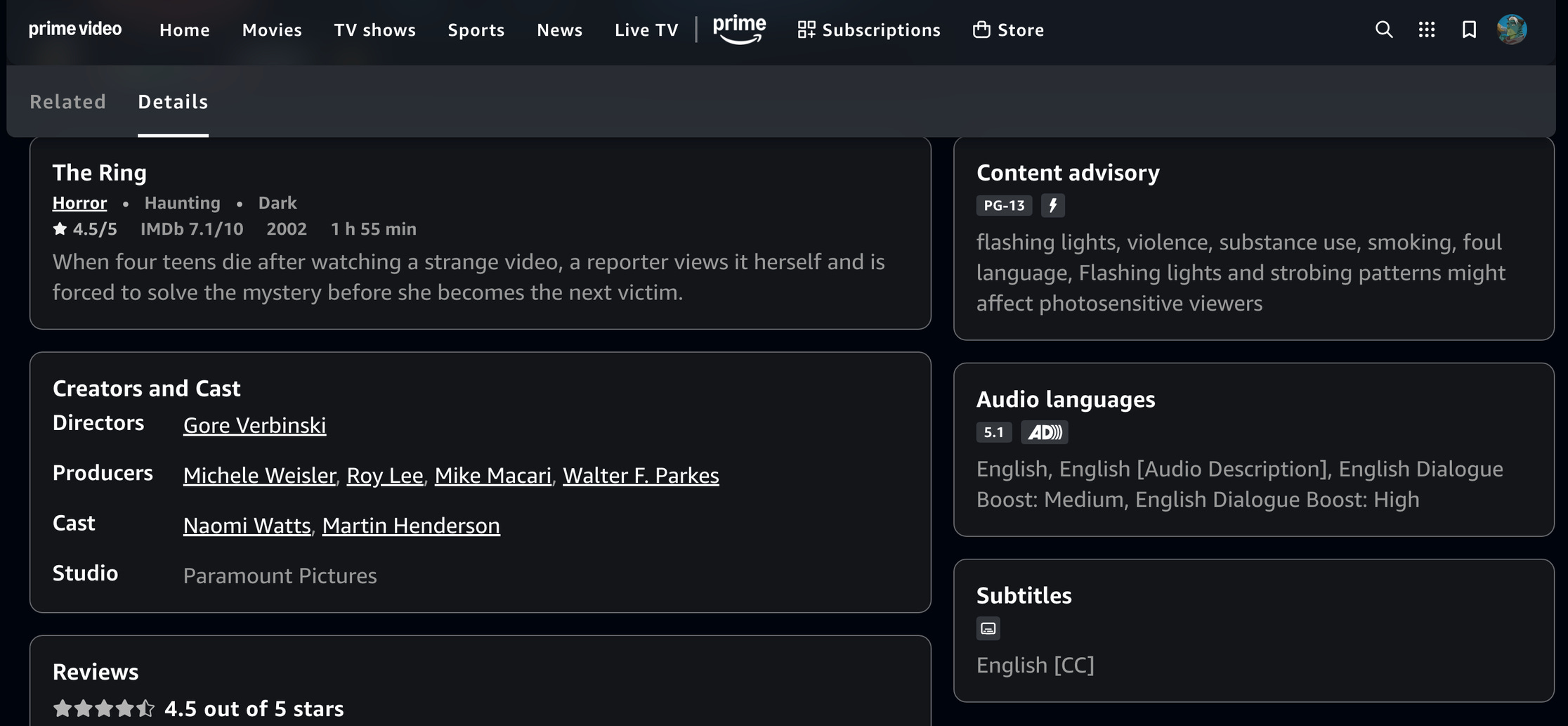
The “details” section for THE RING on Prime Video. There is an English AD track listed.
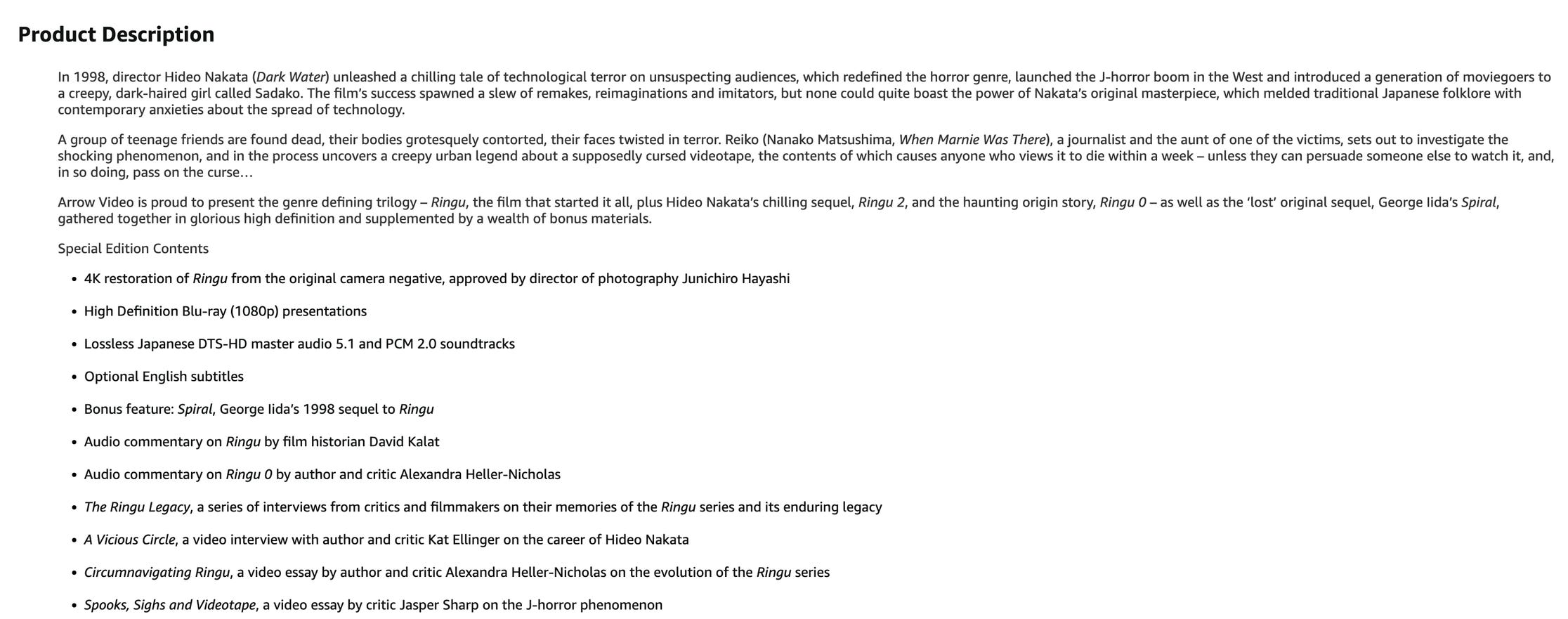
The “product description” section for RINGU’s physical 3-disc special collector’s edition as listed on Amazon Prime where the original Japanese track is available.
PARASITE won Best Picture at the 2020 Academy Awards. It was the first subtitled film to win. It was also the only Best Picture nominee that year without audio description. Its US distributor, Neon, did not include AD for theatrical or home release. Bong Joon-ho had urged American audiences to overcome the one-inch-tall barrier of subtitles to access more films. He was unaware his US distributor hadn’t included AD.
Tom Quinn, Neon’s co-founder, declined NPR’s request for comment.
“English language is no indication of quality in film,” said UK audio describer Matthew Jarman, who recorded an AD track for the film independently. “Everybody is making films so we should be able to enjoy them all.”
Denise Decker, a blind film viewer, described what she does to help sighted friends understand why AD matters: she lets them listen to one side of her headset during a film. ‘Immediately, people say oh yeah, I get it, I understand why it’s important to you.’”
I grew up watching Hong Kong New Wave before I even knew the term “Hong Kong New Wave.” Watched INFERNAL AFFAIRS first and teenage me legit groaned when I heard Scorsese was planning to adapt it. I found these absences because I knew where to look. Another person who depends on audio description to experience films may not have an equivalent way of knowing what they’re missing because the absence is invisible, and because the film that would have told them it was worth looking for never arrived.
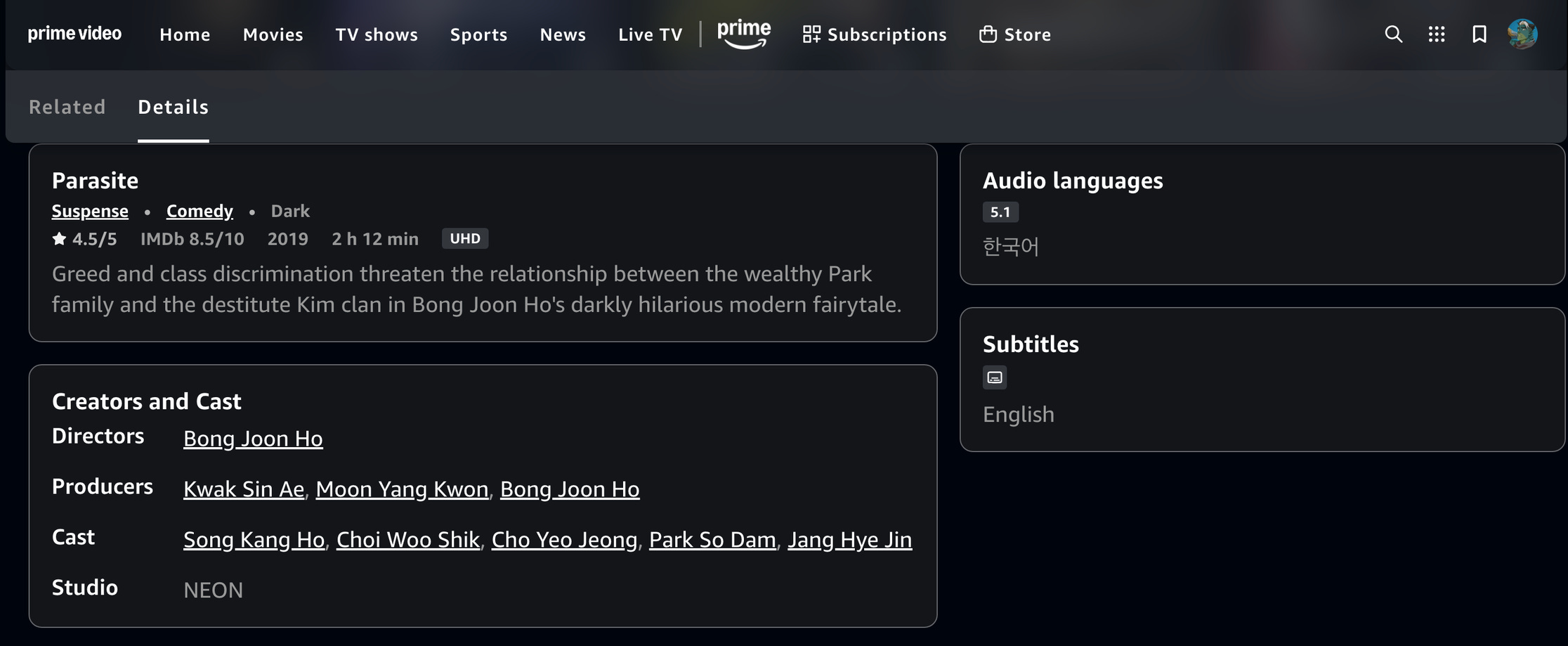
The “details” page for PARASITE on Prime Video. No English AD track is listed.
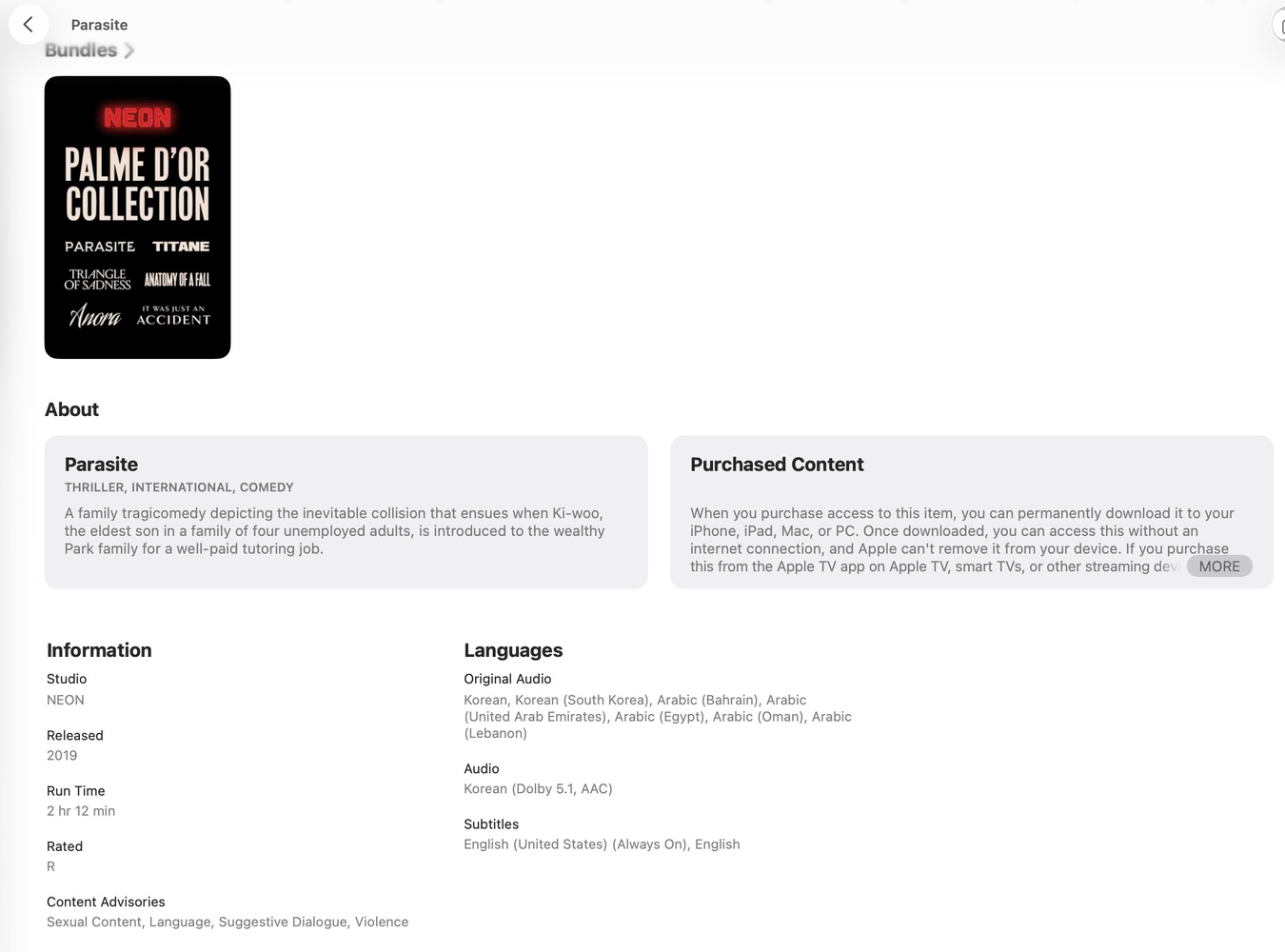
The “about” page for PARASITE on Apple TV+. No English AD track is listed. What is listed are additional dubbed versions into multiple Arabic dialects (Bahrain, UAE, Egypt, Oman, Lebanon).
WINGS OF DESIRE (1988, Wim Wenders), OLDBOY (2003, Park Chan-wook), and LET THE RIGHT ONE IN (2008, Tomas Alfredson) have no audio description on Amazon Prime Video. Their American remakes—CITY OF ANGELS (1998, Brad Silberling), OLDBOY (2013, Spike Lee), and LET ME IN (2010, Matt Reeves)—appear only in the volunteer-run Audiovault archive. There is no English AD listed on Amazon Prime Video for any of these films.
The pattern isn’t that American remakes always have AD. The pattern is that the absence of a standard produces no reliable outcome. The English language version almost always has AD. Except when it doesn’t. The accessible canon reflects the audience the pipeline was built to serve: inconsistently, unpredictably, without accountability.
Roma
The 2016 settlement between Netflix and the American Council of the Blind (ACB), which piece two examined in full, required Netflix to provide audio description for its original productions. It specified no language requirement. It expired in January 2019.
ROMA (2018) is a Netflix original. It won Best Picture at the Academy Awards. It also received Best Cinematography. It’s Alfonso Cuarón’s most personal work and nabbed him Best Director. It’s a Spanish-language film and also won Best International Feature Film. Netflix produced Spanish audio description for it.
There is no English audio description.
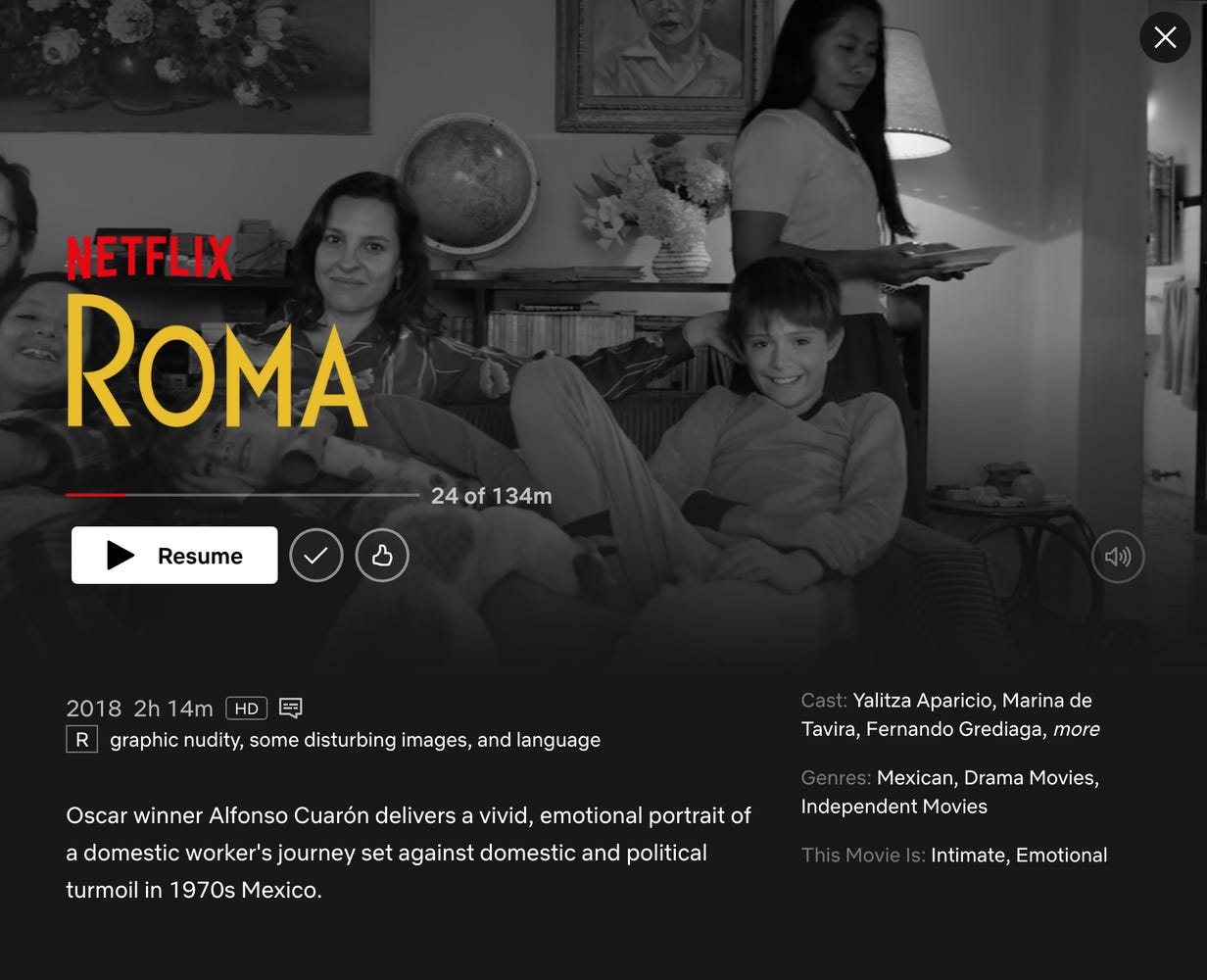
The landing page for ROMA on Netflix. No AD symbol is present that indicates the existence of AD.
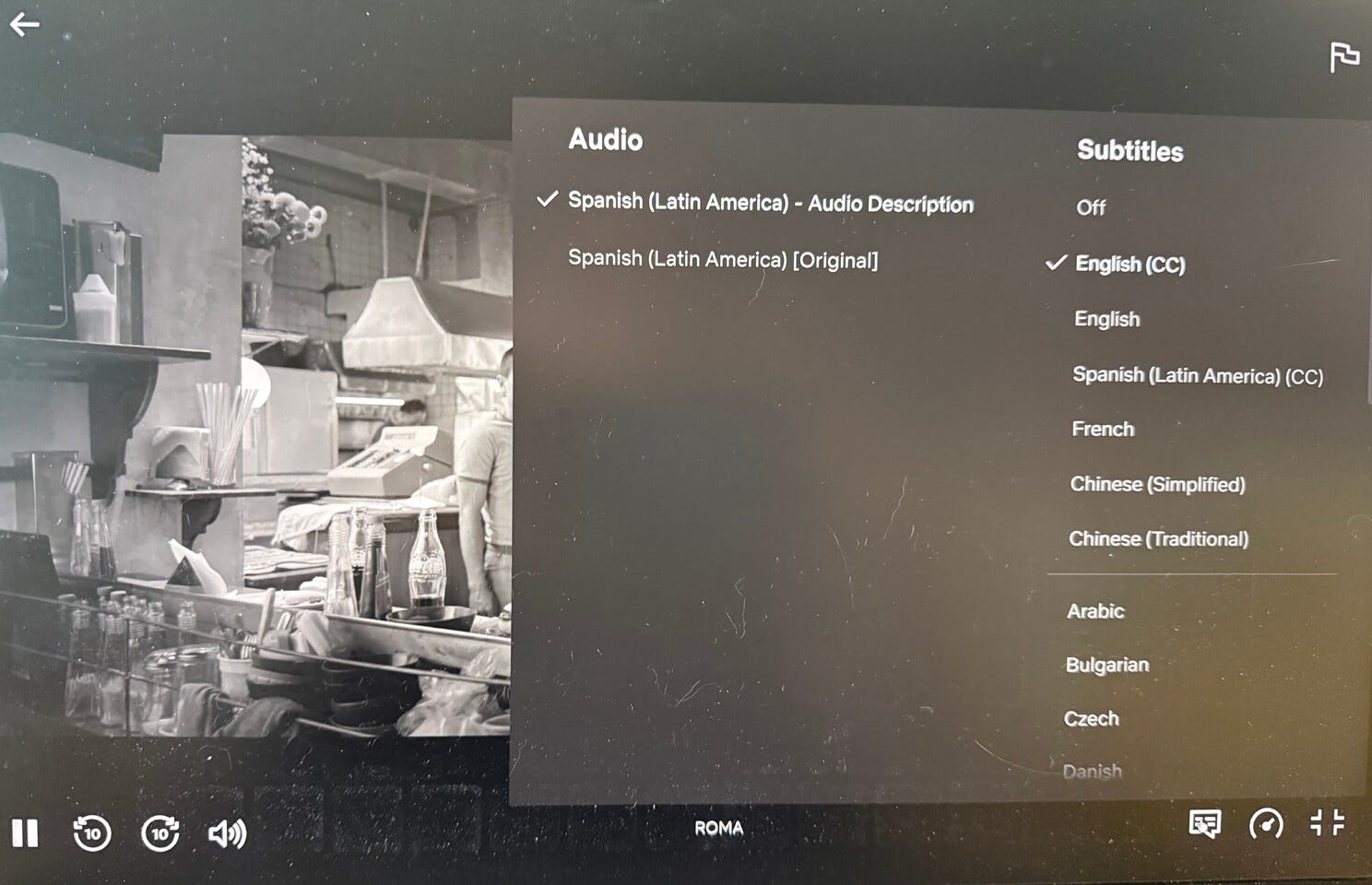
The audio drop down menu when playing ROMA on Netflix. Only Spanish language and Spanish language AD is available.
A blind English-speaking viewer can’t watch ROMA. Not reduced quality. Not TTS instead of human. Not at all. The settlement that was described at the time as a paradigm shift for blind audiences and streaming accessibility never required the English AD that would have made ROMA accessible to blind English-speaking viewers. It expired. Nothing replaced it.
One of the most celebrated films Netflix ever made is inaccessible to a portion of the audience that was supposed to be served by the agreement that celebrated its own ambition.
A clip from ROMA (2018, Alfonso Cuarón) featuring an exchange between Cleo and Sofia. With Spanish AD and English CC. Sourced from Netflix. I’m unable to fully evaluate the quality of the Spanish AD. That evaluation belongs to Spanish-speaking viewer or a Spanish-speaking blind viewer. My biggest question is why the Spanish AD dubs over the actors’ spoken dialogue when they don’t do that other times when both of them appear onscreen. We should not have to do this work alone.
The documentary record
THE FOG OF WAR (2003, Errol Morris) has no audio description. Ken Burns’ The Civil War (1990) has no audio description. EYES ON THE PRIZE (1987, executive produced by Henry Hampton) has no audio description. PARIS IS BURNING (1991, Jennie Livingston) has no audio description. VOICES FROM THE FRONT (1991; Sandra Elgear, Robyn Hutt, David Meieran) has no audio description. BOWLING FOR COLUMBINE (2002, Michael Moore) has no audio description.
These are the films that documented the civil rights movement. The AIDS crisis. Queer Black and Latino culture. The history of social movements that changed the world. THE VOICE OF HIND RAJAB (2025, Kaouther Ben Hania) was nominated for Best International Feature Film at the most recent Academy Awards, is being censored by governments while the pipeline has ensured it was never accessible to blind audiences in the first place. The suppression and the absence are different mechanisms producing the same outcome: the voice doesn’t reach the full audience.
The documentary record of the movements that built disability rights is inaccessible to the community whose rights those movements fought for.
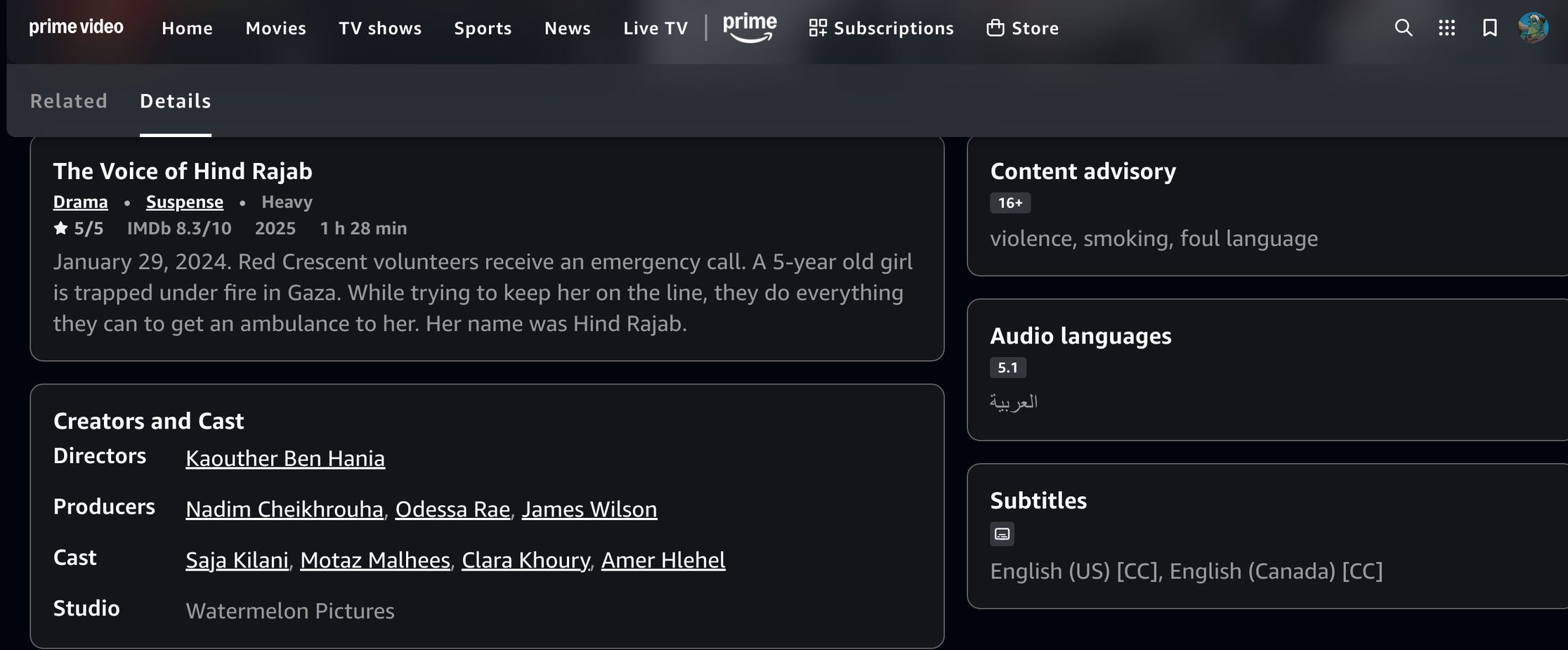
The “about” page for THE VOICE OF HING RAJAB on Prime Voice. No AD track is listed.
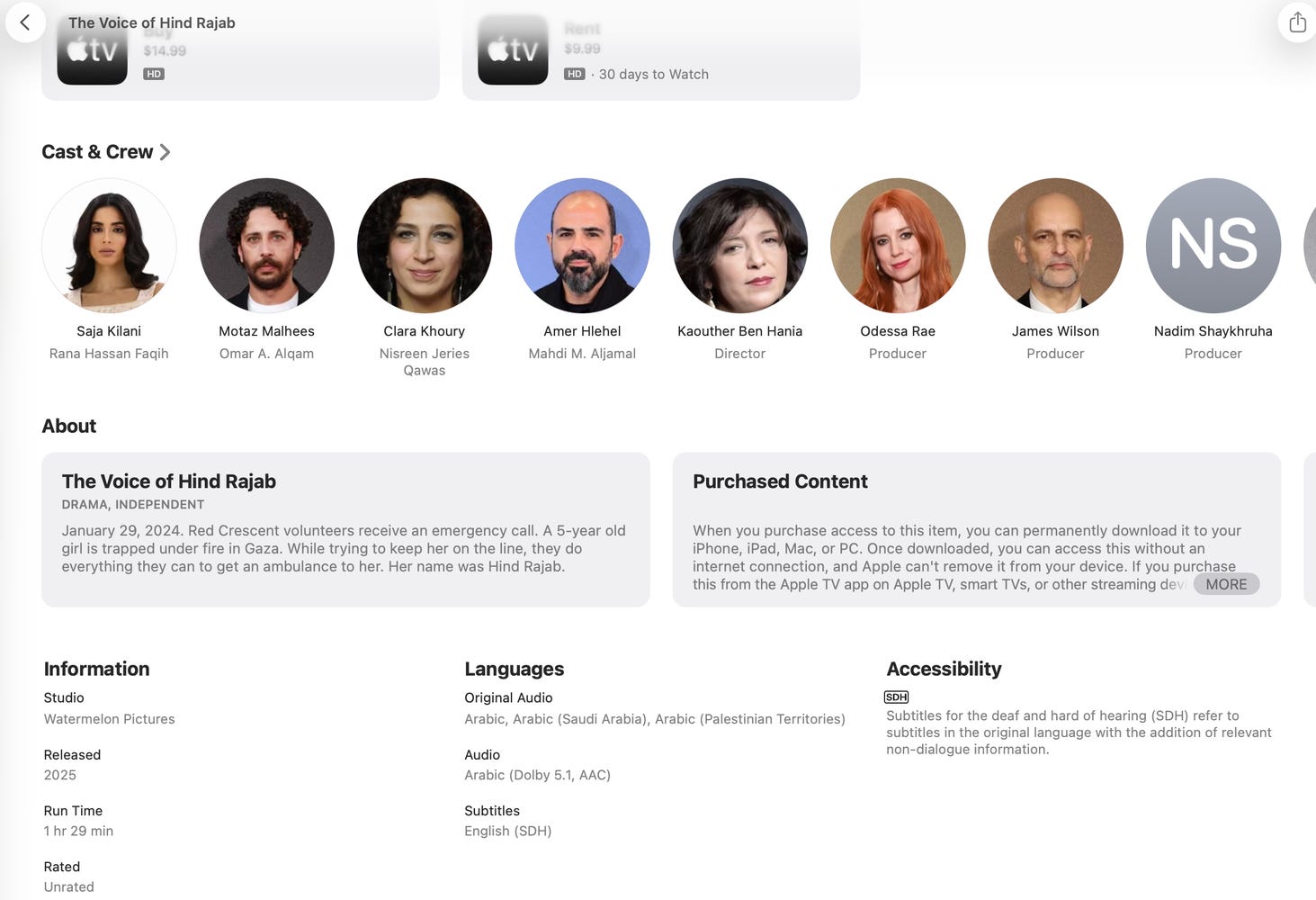
The “about” page for THE VOICE OF HIND RAJAB on Apple TV+. No AD track is listed.
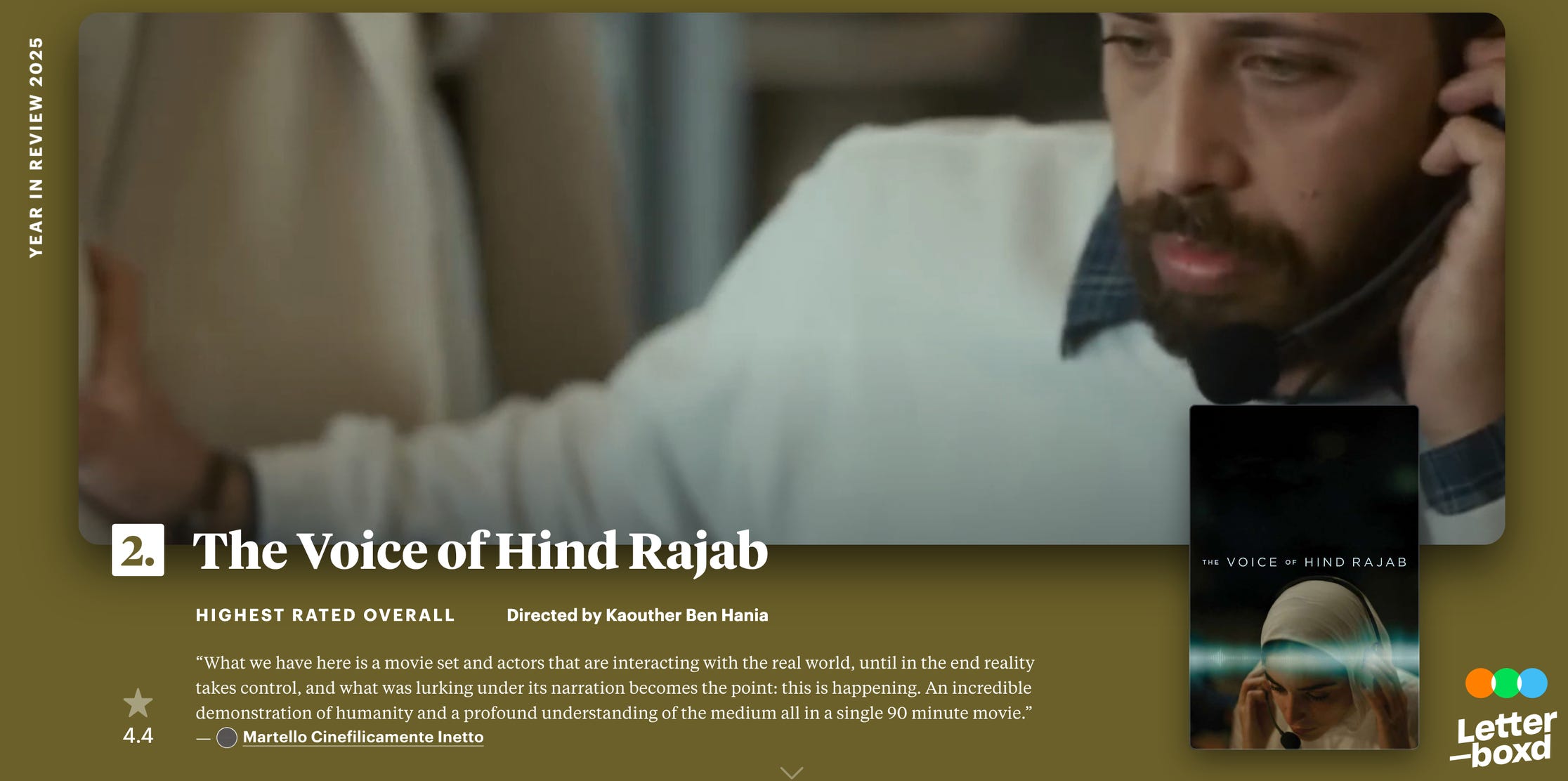
THE VOICE OF HIND RAJAB landing at #2 on Letterboxd’s Highest Rated Overall for their 2025 Year in Review.
What gaming built
The games industry has already demonstrated what becomes possible when someone decides the disabled audience is worth building for.
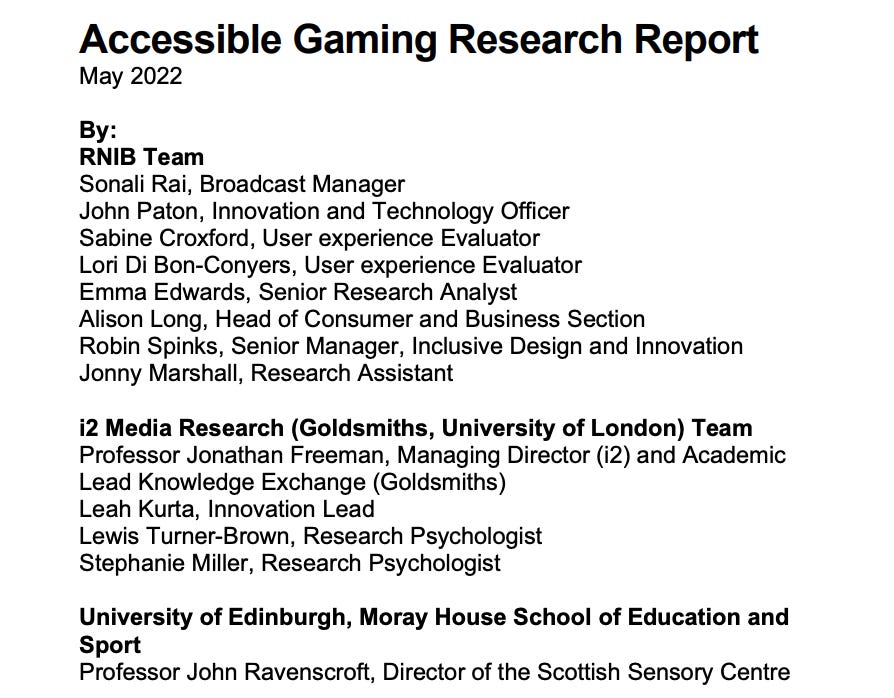
In 2022, the Royal National Institute of Blind People (RNIB) published a comprehensive accessible gaming report. 76 percent of blind gamers said their gaming experience was significantly impacted by poor accessibility. 15 percent of developers had sufficient understanding of the needs of blind players. The RNIB developed the Design for Every Gamer (DFEG) framework, the CAPS test—Challenge, Ambience, Participation, Story—and a Devkit available on GitHub.
Activision responded. Three consecutive CALL OF DUTY titles—Cold War, Modern Warfare III, Black Ops 6—each building on the last. The accessibility settings menu in Black Ops 6 is accessed by nearly half of all players. Not blind players. All players. The features designed for specific populations benefited the general player base. Session times increase when accessibility improves. The RNIB documented it. Activision confirmed it.
YouTuber and accessibility advocate Steve Saylor discusses working with Activision on CALL OF DUTY: BLACK OPS 6. He is a blind gamer who has been credited for his accessibility work on games such as CALL OF DUTY MW2 (2022) and MW3 (2023), ASSASSIN’S CREED VALHALLA, WATCH DOGS LEGION, MARVEL’S GUARDIANS OF THE GALAXY, THE LAST OF US 2, and many more.
The barrier was never audience interest. It was access.
Gaming built the infrastructure in a decade.
Film and television haven’t built it in forty years.
From exclusion to participation
Kim Charlson, executive director of the Perkins Library, grew up going to movies with her parents. Before audio description existed, that meant having a sighted person whisper in her ear while people around them got aggravated. Her parents decided they wouldn’t go to the movies anymore.
Audio description in live theater began in the early 1980s with Metropolitan Washington Ear in Washington D.C. Volunteers were trained to describe what was happening on stage. Ford’s Theatre now has trained describers who attend at least two preview performances, write five to seven pages of program notes, record them in a studio, and provide live real-time narration through earpieces during every accessible performance. Bob Coley has been volunteering at Ford’s Theatre for over twelve years. He grew up with deaf parents. He watched what closed captioning and sign language interpretation opened up for his family when those services finally arrived. He volunteers because he knows from the inside what accessibility produces when someone builds it.
In Boston, there are now 25 to 30 trained describers working in the region assisting 150 live shows with audio description every year. Laura Pailler sits at a music stand at the Boston Citizens Opera House preparing to describe FUNNY GIRL to blind audience members wearing earpieces in the seats below. Her goal: to give blind and low vision patrons as complete an experience of the show as possible. Not compliance. Not a file delivered to spec. As complete an experience as possible.
The Denver Center for the Performing Arts (DCPA) has dedicated ASL nights for two concurrent productions playing now—THE PHANTOM OF THE OPERA and DRACULA: A COMEDY OF TERRORS. Both are sold out or almost sold out. The DCPA’s accessibility services can be found here.
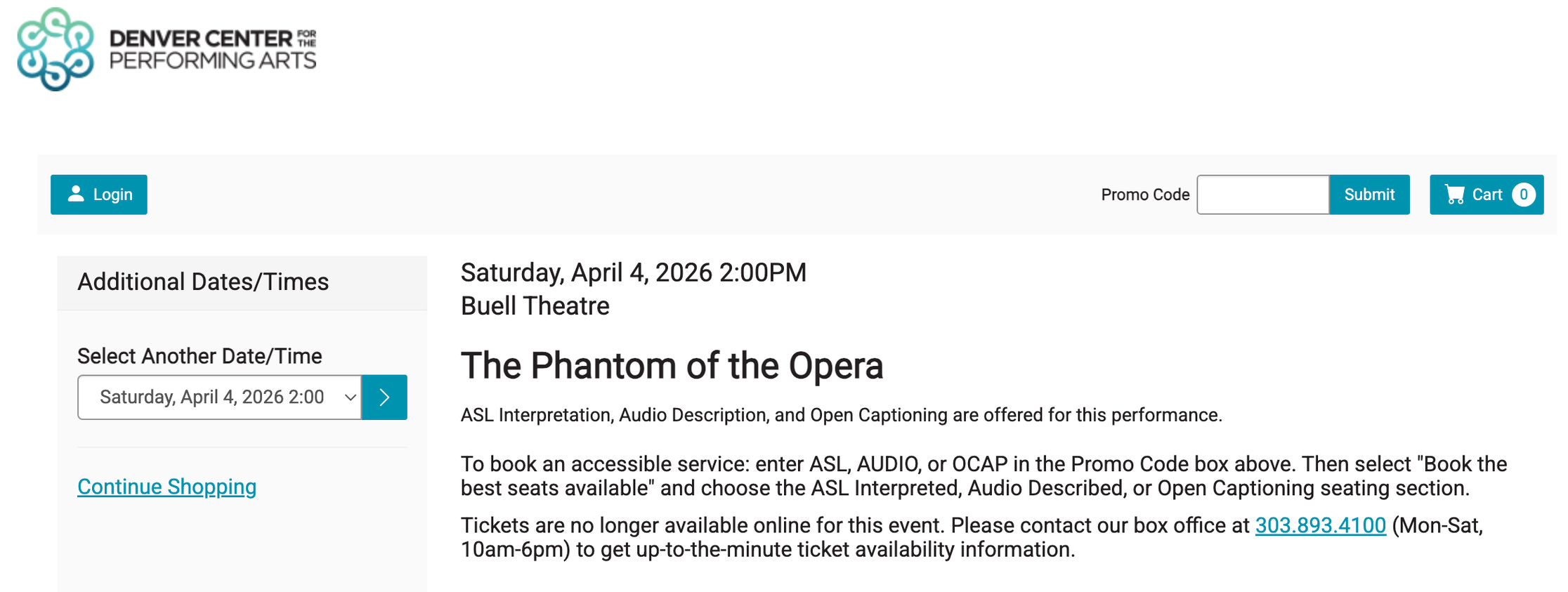
Tickets for THE PHANTOM OF THE OPERA at the Buell Theater are no longer available online. ASL interpretation, audio description, and open captioning are being offered for this performance.
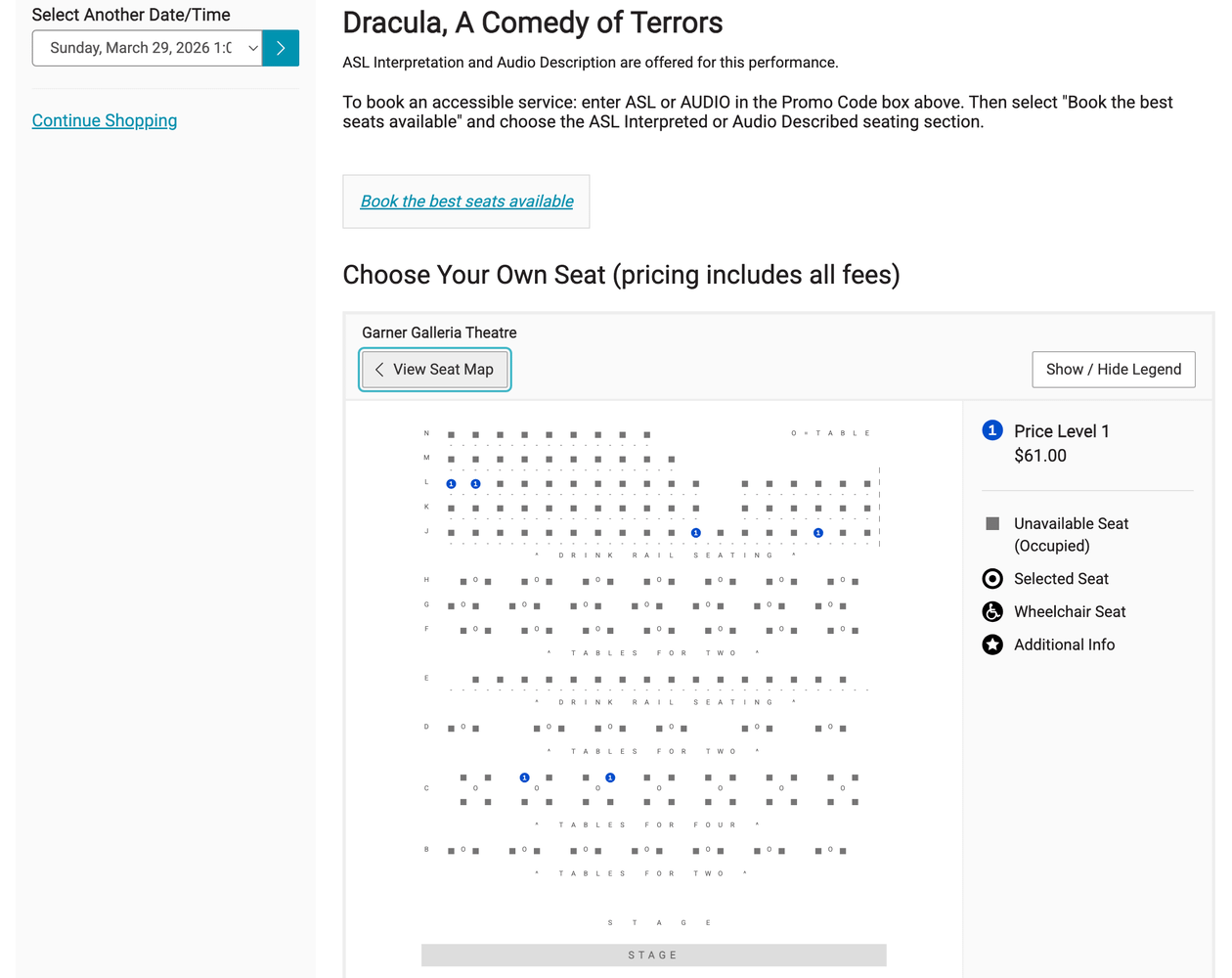
There are only six seats left for the March 29 performance of DRACULA: A COMEDY OF TERRORS where ASL interpretation and audio description are being offered. I took this screengrab the evening of March 26.
Kim Charlson can now go to FUNNY GIRL and talk to her friends about it afterward. She now rarely goes to live theater unless it’s audio described. In her own words: “I attended live theatre regularly and thought I was getting everything that was going on. But the first time I went to an audio-described live theatre performance, I realized how much I was missing. I was filling in gaps with things that probably weren’t even part of the show. Audio description lets you know what’s happening and fills in the information the playwright intended.”
Forty years of community-built infrastructure. Sold-out houses. A trained describer with a microphone and a script and a goal of completeness. The streaming pipeline has had the same forty years.
The audience and the scale
The World Health Organization (WHO) estimates 1.3 billion people, 16 percent of the global population, experience significant disability. 80 percent live in the Global South.
Latin America’s media market is forecast to reach $65 billion in 2026, growing at 10.7 percent annually, outpacing the United States.
Josh D’Amaro described Disney+ as becoming the digital centerpiece of the company: a portal connecting stories, experiences, games, and films for a truly global audience no matter where they are in the world. Disney has spent decades designing physical accessibility into its theme parks. The ADA created requirements. Disney often exceeded them. The digital centerpiece doesn’t inherit that thoughtfulness by default. The shareholder proposal requiring a review of Disney’s accessibility practices for disabled guests failed at the same meeting where D’Amaro named emotional connection as his North Star.
Arts and cultural economic activity in the United States reached $1.17 trillion in 2023: 4.2 percent of GDP, growing at 6.6 percent, more than twice the rate of the broader economy, according to the US Bureau of Economic Analysis. The audience nobody saw is not a niche. They are a portion of the consumer base participating in a $1.17 trillion domestic sector and the fastest growing media markets in the world.
The first streaming BASL interpretation—and who gets access to it
Ryan Coogler and his wife Zinzi Evans Coogler didn’t just ensure a signed version of SINNERS (2025) existed. They ensured it was performed in Black American Sign Language specifically. BASL is not ASL. The community distinction mattered to him. It became the first streaming film to offer a BASL interpretation. Warner Bros. Discovery’s own press release described it as exclusively available to stream on Max.
The 4K Ultra HD Blu-ray packaging lists the audio specifications precisely. Dolby Atmos. English Descriptive Audio. French and Spanish language options. English SDH subtitles. Six special features documenting the craft behind the film, including the making of the Smokestack Twins.
The BASL version isn’t listed. Not in the audio specifications. Not in the special features. Not anywhere on the packaging.
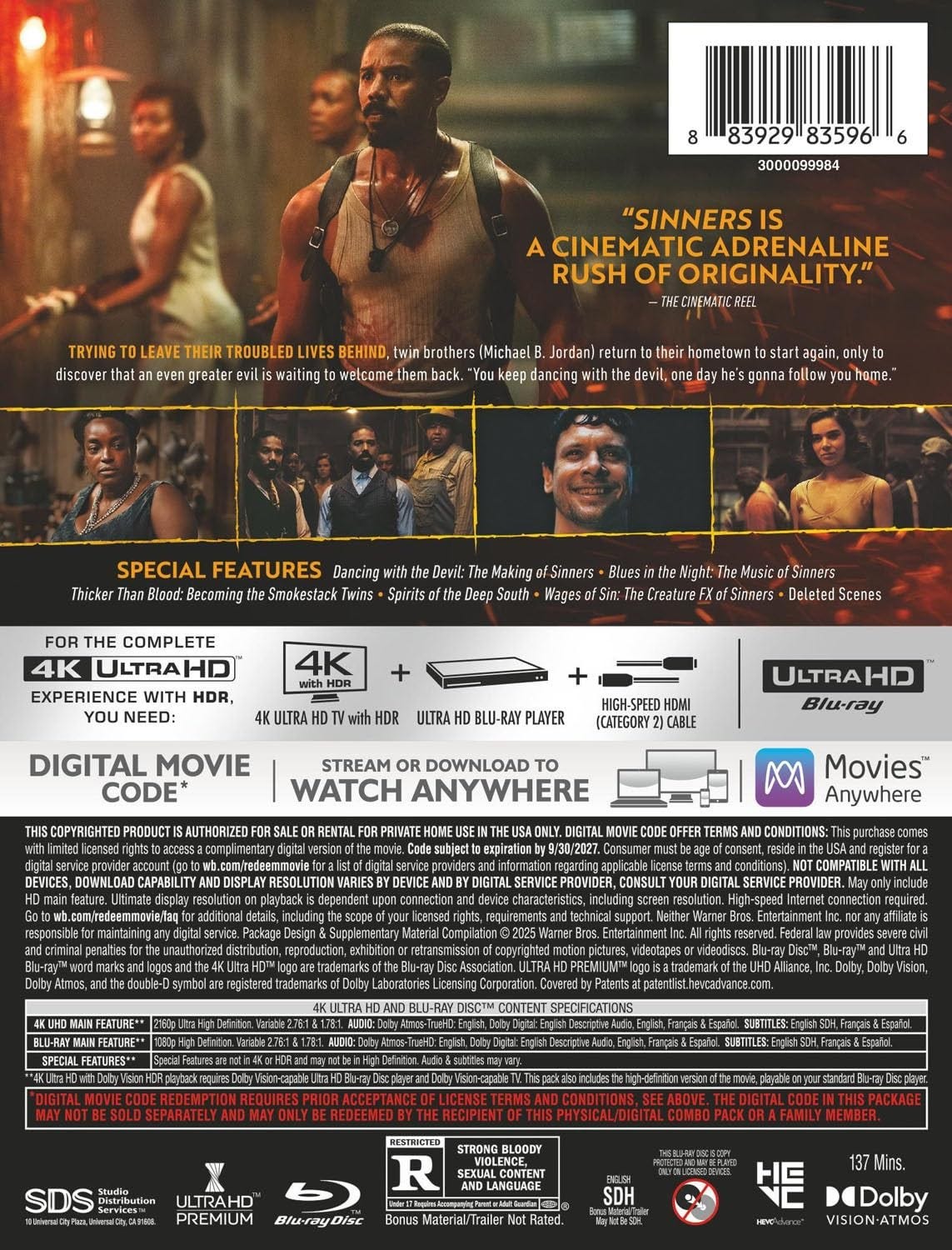
An image from the SINNERS 4K Ultra HD Steelbook + Blu-ray + Digital product listing on Amazon Prime. It lists available audio languages (there is English AD), subtitles, and special features. There is no mention of BASL being available with this physical product.
The first streaming BASL interpretation in history exists exclusively inside a subscription paywall.
Ryan Coogler ensured it existed. Warner Bros. Discovery decided who gets access to it.
The American Council of the Blind (ACB) recognized HBO Max with the 2025 Popular Entertainment award for excellence in audio description. Warner Bros. Discovery is a Take the Lead sponsor of the same awards gala. The audio description for SINNERS on Max is human-voiced.
A clip from SINNERS (2025, Ryan Coogler) as the juke joint starts to open up that fateful evening. With English AD, English CC, and BASL. Sourced from HBO Max.
The end credits for SINNERS. The post house and AD narrator are mentioned. With English AD, English CC, and BASL. Sourced from HBO Max.
I’ve also observed that HBO Max has only provided ASL for select TV series and select films from Warner Bros. Studios. As mentioned in piece two, live comedy special and documentaries do not receive the same treatment. I’ve only recently observed that comedy series rarely get ASL versions as well.
A clip from ONE BATTLE AFTER ANOTHER (2025, Paul Thomas Anderson) where Lockjaw meets members of the Christmas Adventurers Club for the first time. With English AD, English CC, and ASL. Sourced from HBO Max.
The end credits for ONE BATTLE AFTER ANOTHER. The post house and AD narrator are mentioned. With English AD, English CC, and ASL. Sourced from HBO Max.
A clip from HACKS Season 3, Episode 5—titled “One Day” where Deb and Ava go on a hike. With English AD and English CC. Sourced from HBO Max.
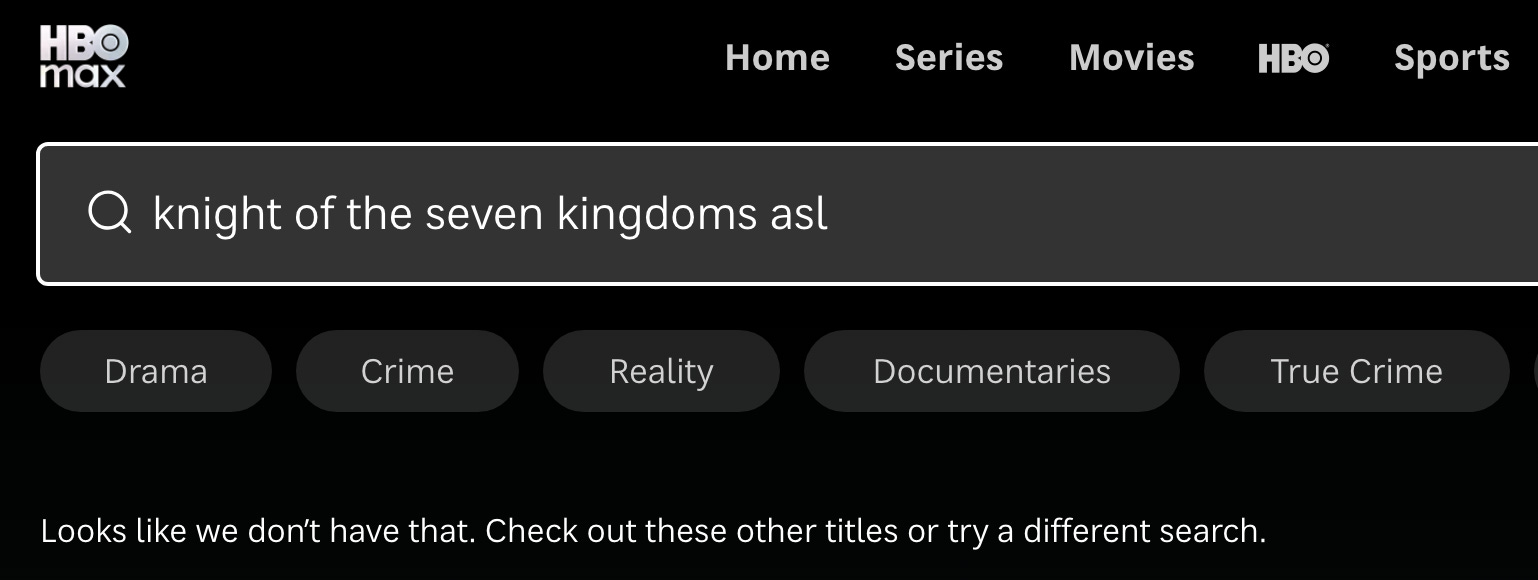
Search results for A KNIGHT OF THE SEVEN KINGDOMS in ASL on HBO Max. “Looks like we don’t have that.”
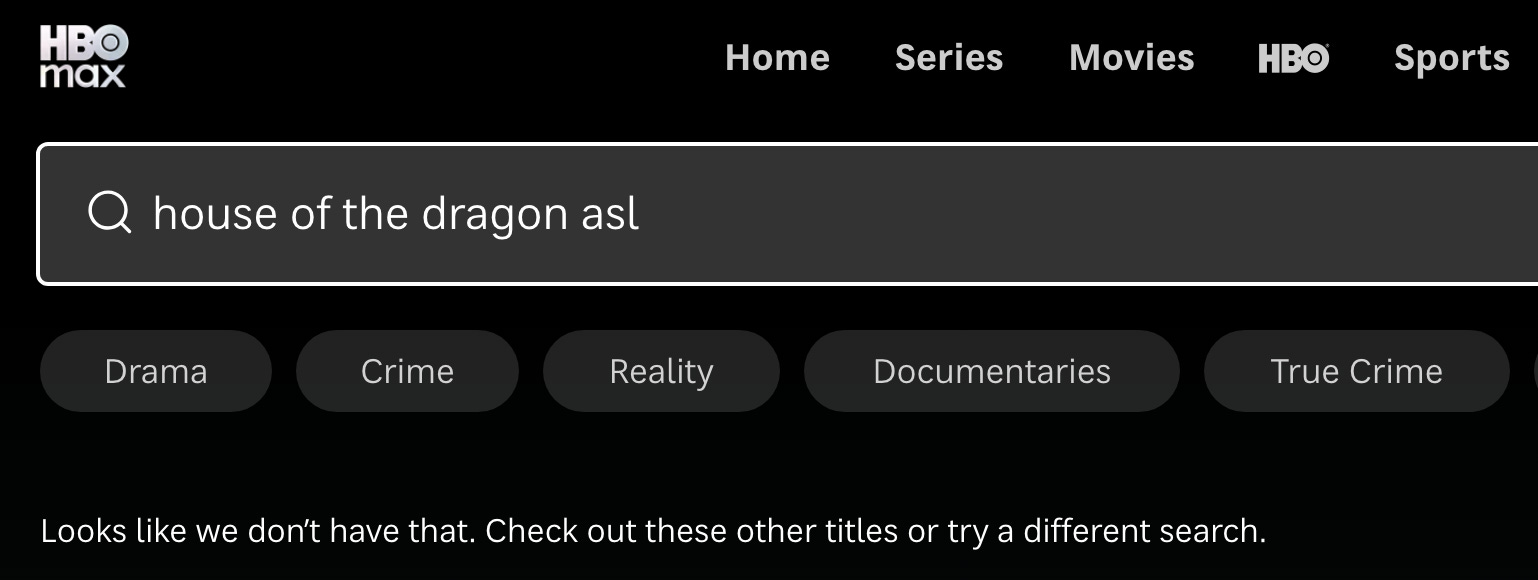
Search results for HOUSE OF THE DRAGON in ASL on HBO Max. “Looks like we don’t have that.”
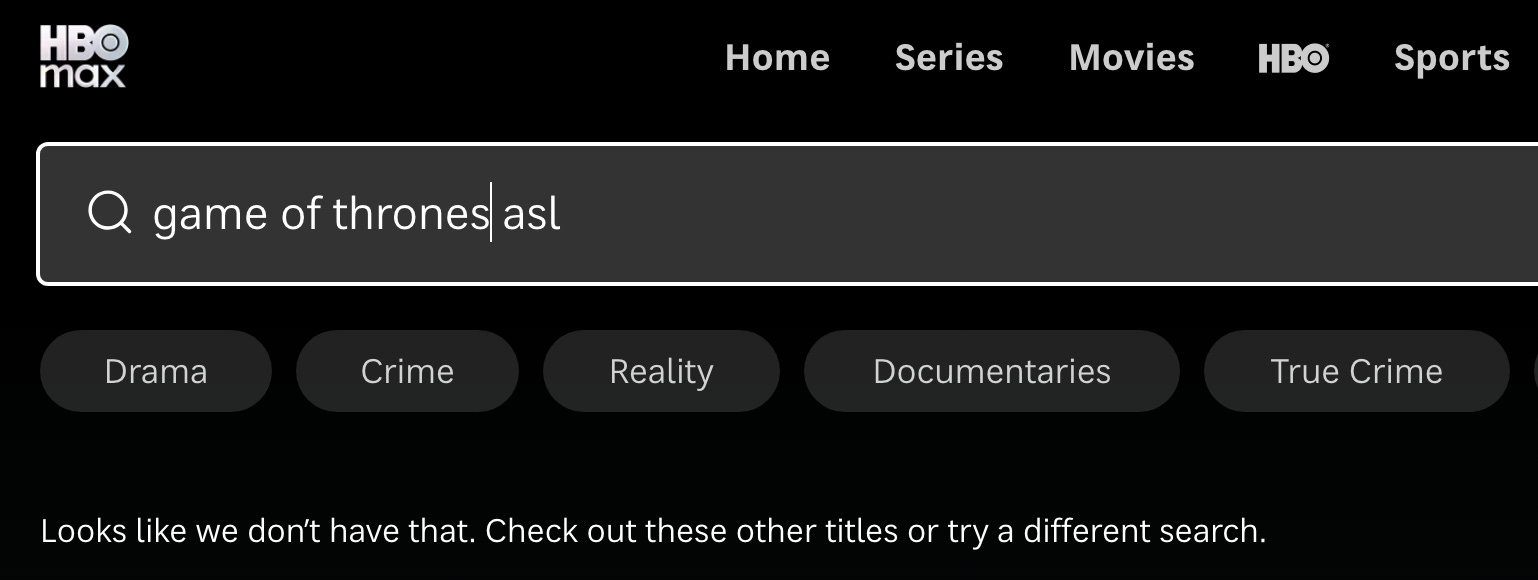
Search results for GAME OF THRONES in ASL on HBO Max. “Looks like we don’t have that.”
None of the extras material gets AD at all.
Both things are true simultaneously. Not because the platform is inconsistent in its values. Because everything is being done at the individual level. A team fighting for funding every year produces peaks when the fight is won and defaults when it isn’t. The award recognizes what the industry can do. The mandate would require it to do it consistently.
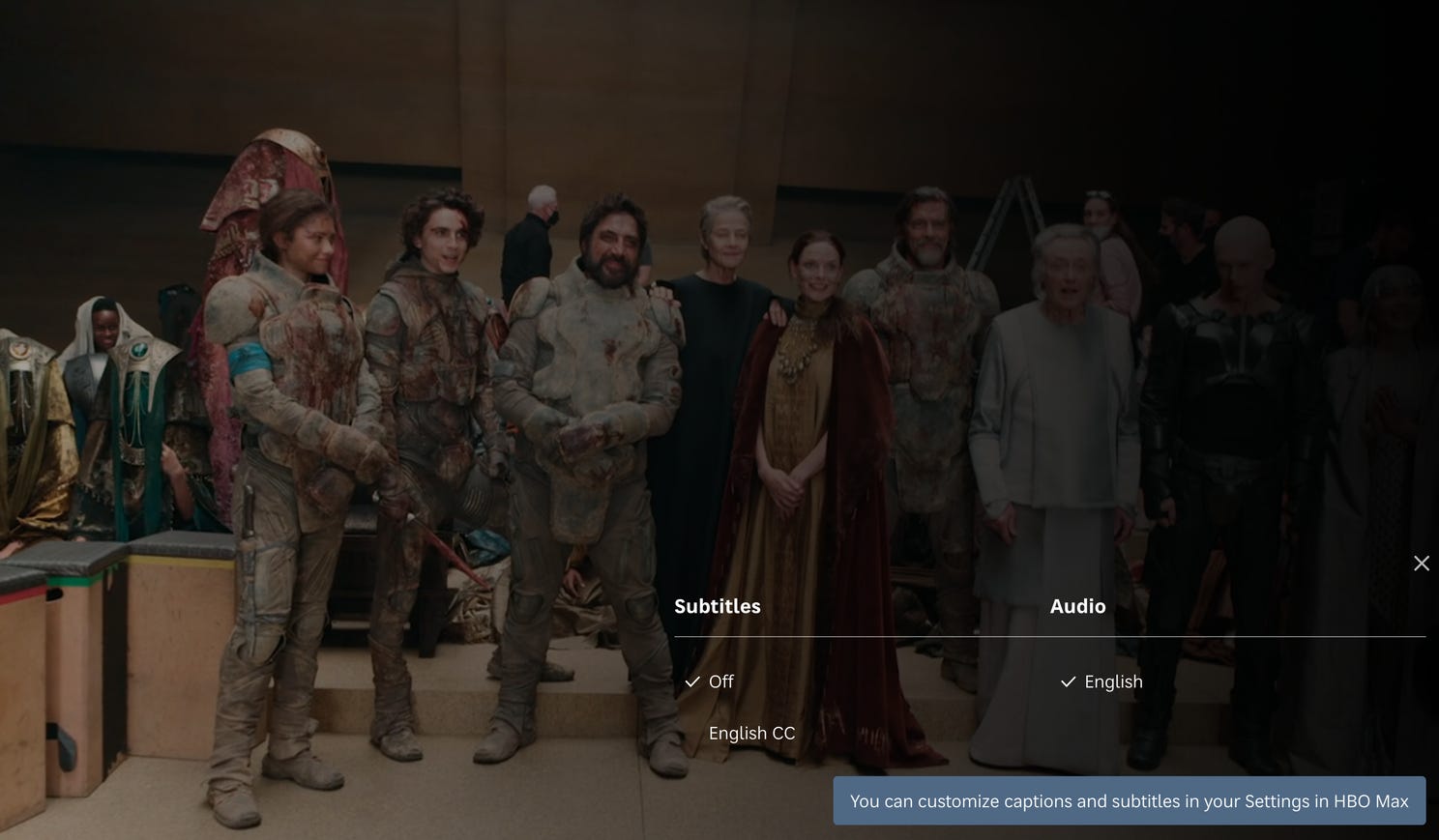
“An Ensemble For The Ages,” one of the extras offered for DUNE: TWO (2024, Denis Villeneuve) on HBO Max. No AD track is available.
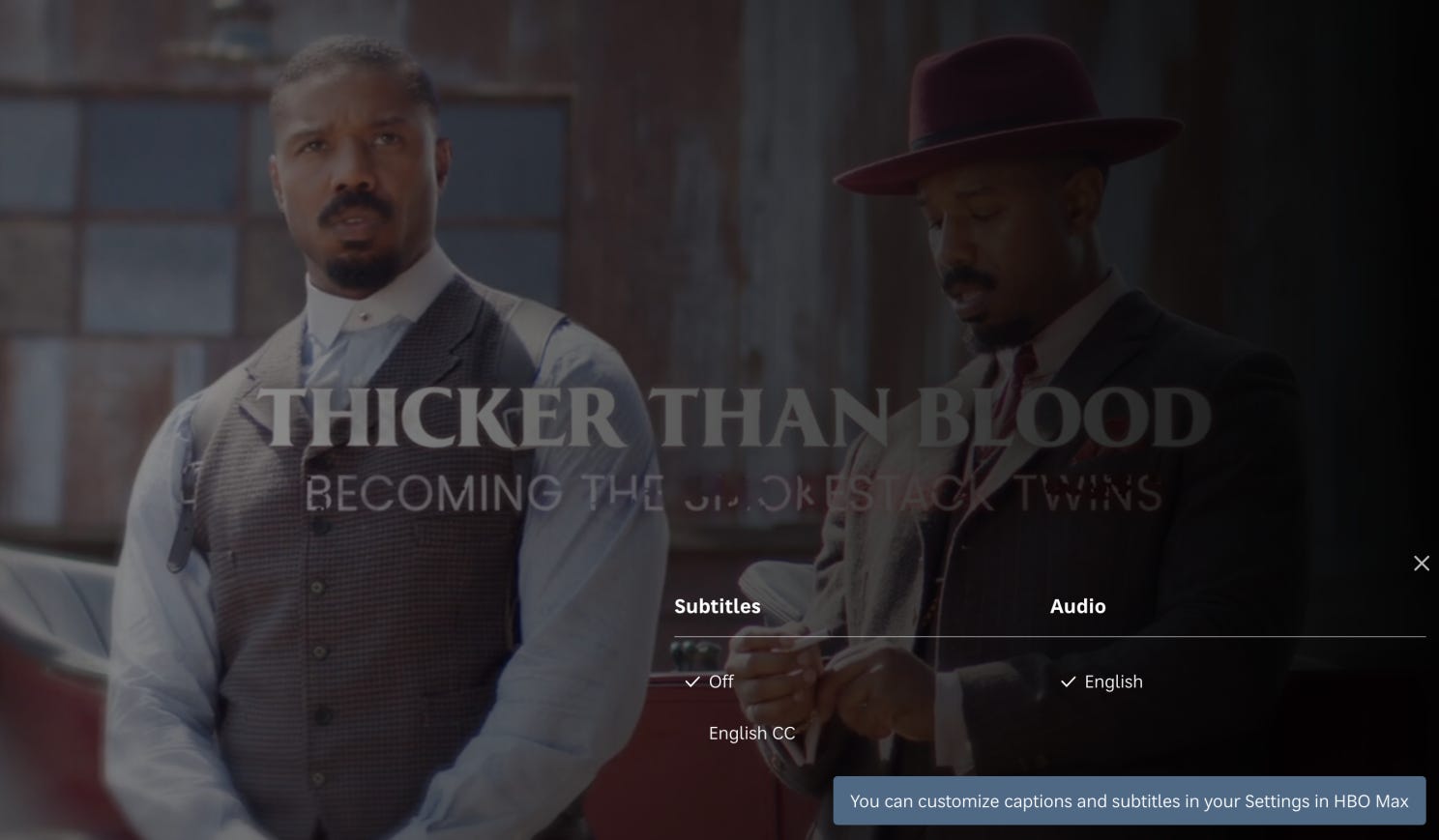
“Thicker Than Blood: Becoming The Smokestack Twins,” one of the extras offered for SINNERS on HBO Max. No AD is track is available.
The accessible versions of these films exist in a hierarchy of access. SINNERS with BASL and ONE BATTLE AFTER ANOTHER with ASL can be streamed on HBO Max or purchased digitally on Amazon Prime Video. No physical release exists for either. BARBIE with ASL can only be streamed on HBO Max. There is no digital purchase nor physical release. No platform other than the one Warner Bros. Discovery controls. The standard versions of all three films are available physically. The accessible versions are not. Ownership is a right that applies to some versions of these films and not others, determined by which version you need.
The separation goes deeper than format. On Prime Video, SINNERS with BASL and SINNERS without BASL are separate product listings with separate prices. They are not the same purchase. They are not the same SKU. From a technical standpoint this isn’t arbitrary—video tracks cannot stack the way audio tracks can, so a version with an embedded BASL interpretation requires its own file, its own listing, its own transaction. The architecture of how accessible media is delivered produces this outcome whether anyone intended it to or not.
But the architecture has consequences the technical explanation doesn’t resolve. A household where a d/Deaf family member and a hearing family member want to watch SINNERS together needs both versions to do what the standard version does for a household that doesn’t need accessibility features. The standard version of SINNERS serves everyone in that household by default. The accessible version serves the d/Deaf family member. Neither version serves both simultaneously. Purchasing access to one does not purchase access to the other. The same film, twice, for the same household, to approximate what one purchase provides everyone else.
This is the ownership asymmetry the pipeline produces. Not as an edge case. As a structural condition of how accessible media is currently sold. The question of whether a household should pay twice for the same film isn’t a hypothetical. It’s the purchasing decision a mixed-access household faces right now, on a major streaming platform, for one of the most celebrated American films of 2025.
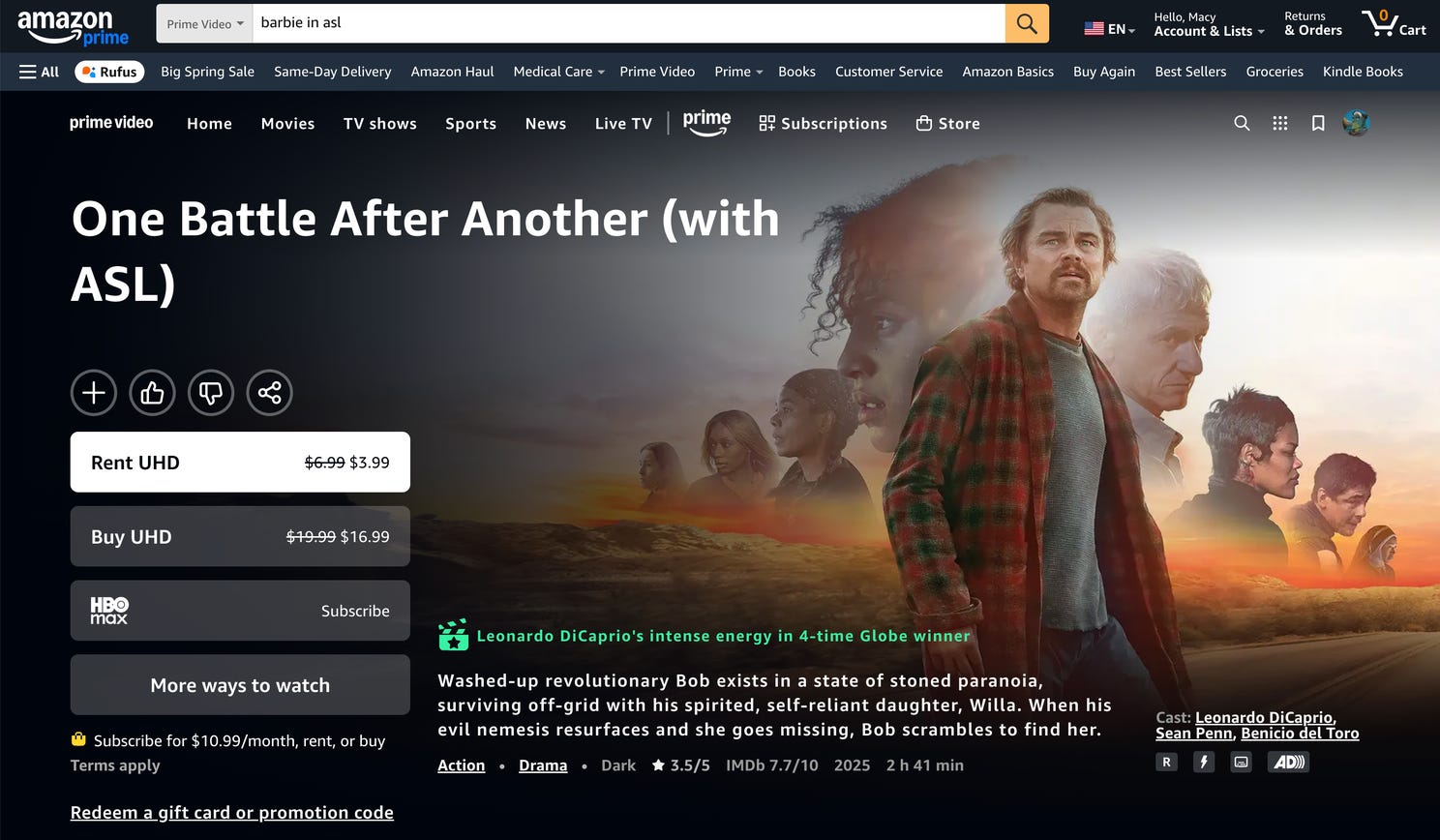
The landing page for ONE BATTLE AFTER ANOTHER with ASL on Prime Video.
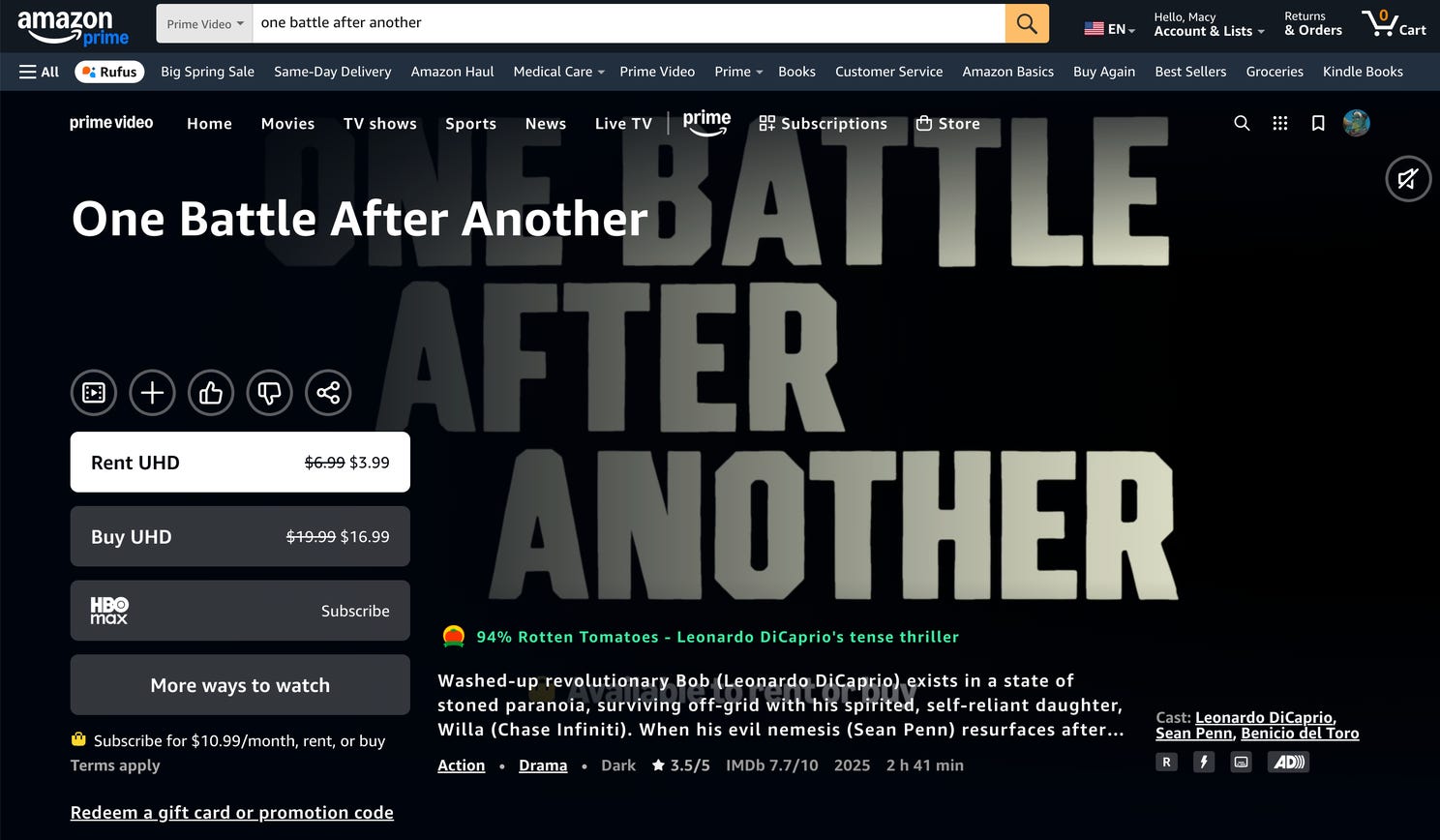
The landing page for ONE BATTLE AFTER ANOTHER (without ASL) on Prime Video.
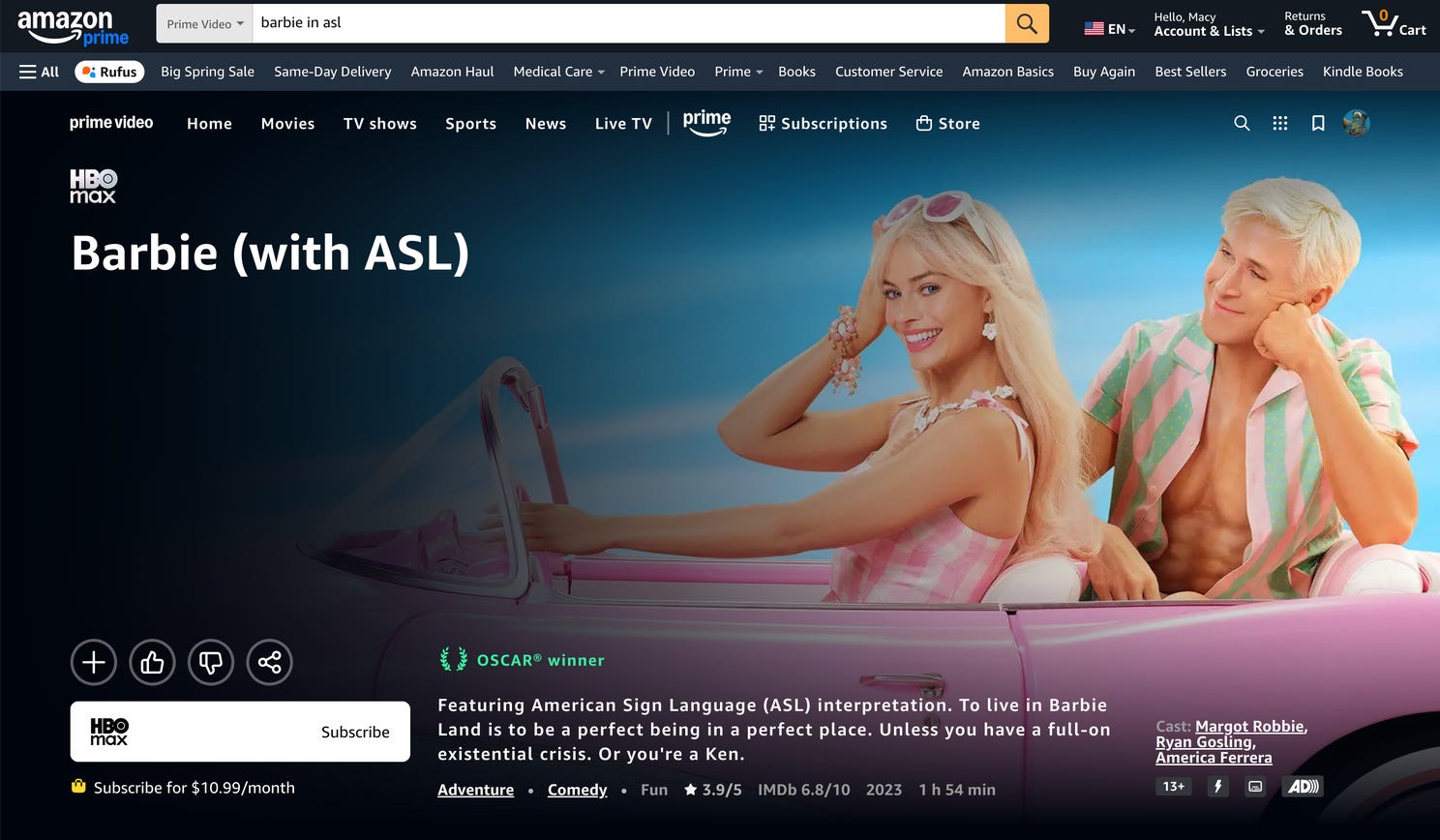
The landing page for BARBIE with ASL on Prime Video.
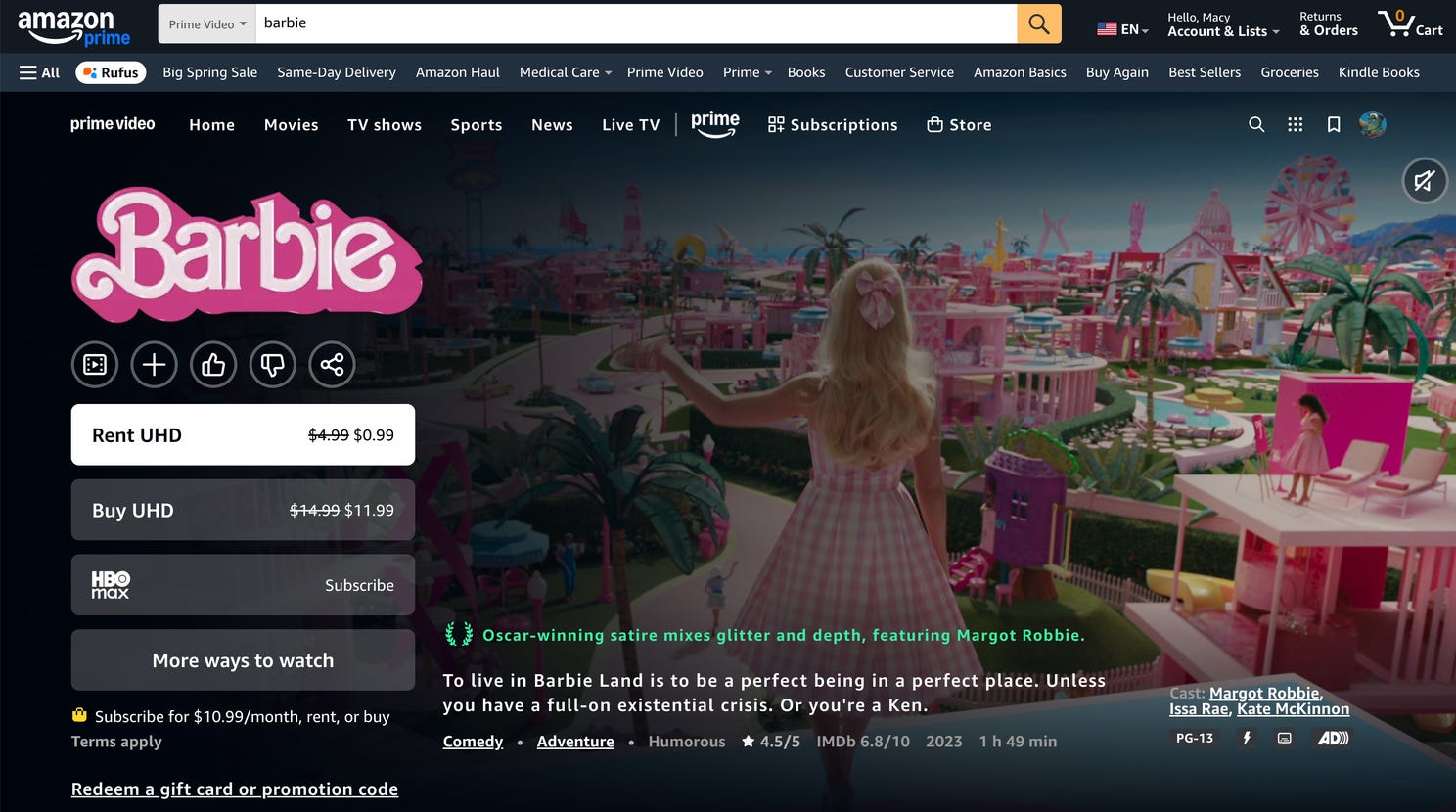
The landing page for BARBIE (without ASL) on Prime Video.
As noted earlier, SINNERS with BASL is streaming exclusively on HBO Max in the United States. Warner Bros. Discovery has a documented history of removing content from Max without notice: original titles made exclusively for the platform, pulled for tax write-downs and cost restructuring. WESTWORLD (2016, Jonathan Nolan and Lisa Joy). MINX (2022, Ellen Rapoport). THE GORDITA CHRONICLES (2022, Claudia Forestieri). Dozens of titles that existed on the platform and then didn’t. The merger with Paramount announced February 27, 2026 will produce what analysts have confirmed are human capital synergies—cost savings through cuts. The BASL version of SINNERS exists exclusively on HBO Max. There is no physical release. There is no other platform. There is no archive. Its continued existence depends entirely on Warner Bros. Discovery deciding to keep it there.
What the community built
There is a volunteer-maintained archive called the Audiovault. It exists because audio described content is, in its own words, spread across multiple platforms and countries—difficult to find, inconsistent in quality, and absent entirely for films the industry didn’t prioritize. It runs on donations. Nobody profits.
The archive also hosts AudioVault Originals: audio description tracks produced entirely by volunteers, from scratch, for films the industry never described or for films that needed a better alternative. OFFICE SPACE (1999, Mike Judge). THE NEVERENDING STORY (1984, Wolfgang Petersen). MONTY PYTHON AND THE HOLY GRAIL (1975, Terry Gilliam and Terry Jones). Films with passionate communities who love them enough to describe them for each other.
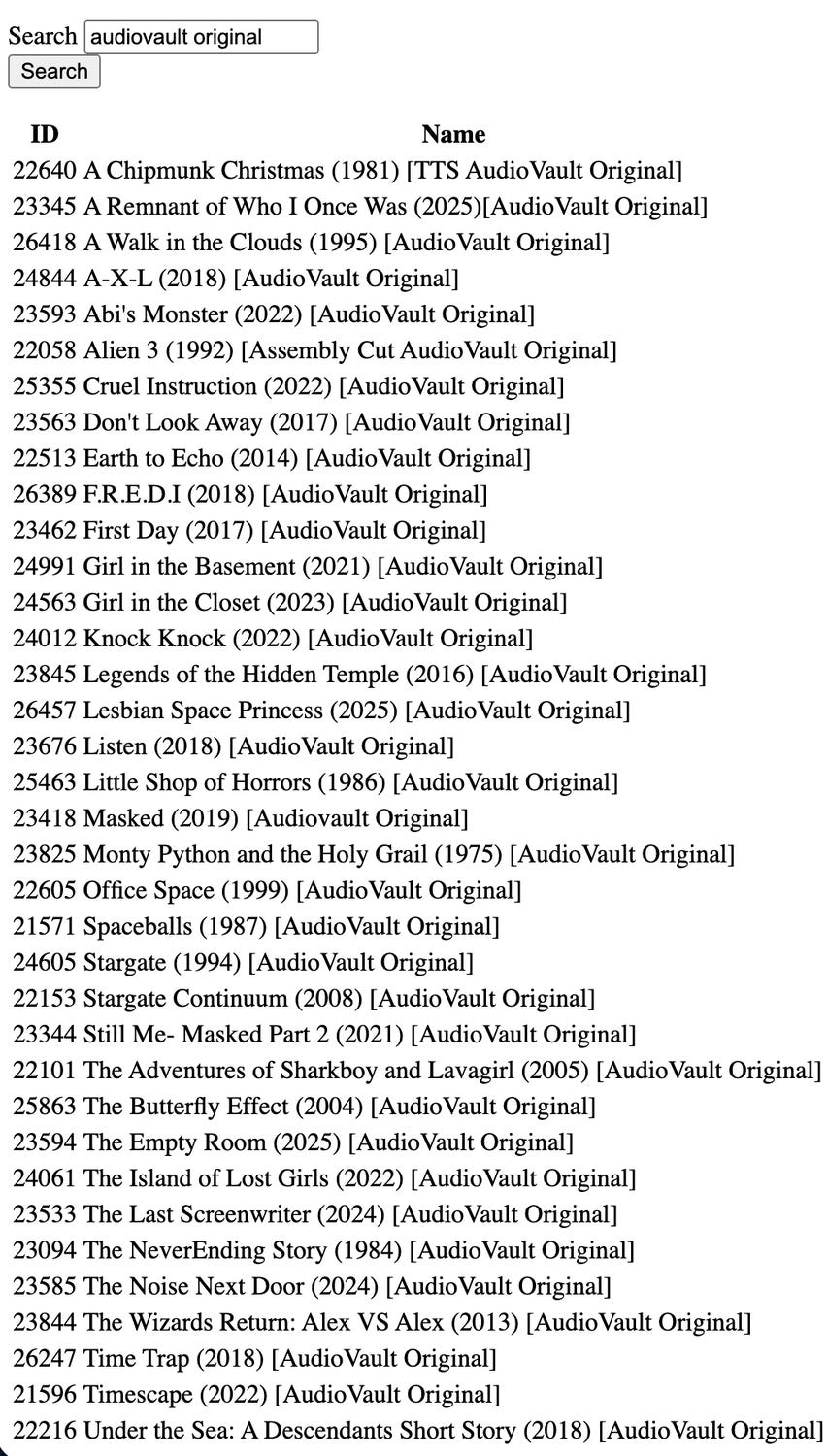
All of the AudioVault Originals: audio descriptions created, uploaded, and vetted by volunteers.
SPACEBALLS (1987, Mel Brooks) has two versions in the archive. An AudioVault Original with human-spoken AD. Another with TTS. Both honestly labeled so blind audiences know what they’re downloading before they do. Amazon doesn’t. Netflix doesn’t. The community that built the archive without institutional resources is more transparent about its product than the platforms with published quality standards and sponsor tables at the ADA Awards Gala.
As covered in piece two, the archive notes four separate AD versions of GLADIATOR. Four versions of TITANIC including a French track whose origin is unclear. Two versions of SINNERS. One version of THE SHAPE OF WATER—the US track, which I only know because I purchased the film on Apple TV+ to find out.
It has nothing for EYES ON THE PRIZE. Nothing for PARIS IS BURNING. Nothing for THE VOICE OF HIND RAJAB.
The volunteer archive built what the industry wouldn’t. And it could only reach as far as the community that built it.
I would be remiss not to include the Audio Description Project (ADP), an initiative of the ACB, which does what no streaming platform does voluntarily. It tracks which titles have audio description across every major streaming service, labels TTS, tracks as TTS, and publishes the data publicly. A note on what the numbers represent: the ADP tracks titles, not episodes or hours. One title can equal many episodes: THE WEST WING, GREY’S ANATOMY, NCIS. At the end of 2025, the ADP tracked 13,109 unique titles with English AD available across cinema, DVD, and over 20 streaming services. Its master database contains nearly 18,000 titles, meaning more than 5,000 additional titles have AD only in non-English languages or aren’t currently available anywhere in English.
The community built the archive. The community built the tracking database. The community built the quality recognition framework at the ADA Awards Gala. The industry built the content. It did not build the infrastructure to make that content accessible, measurable, or accountable.
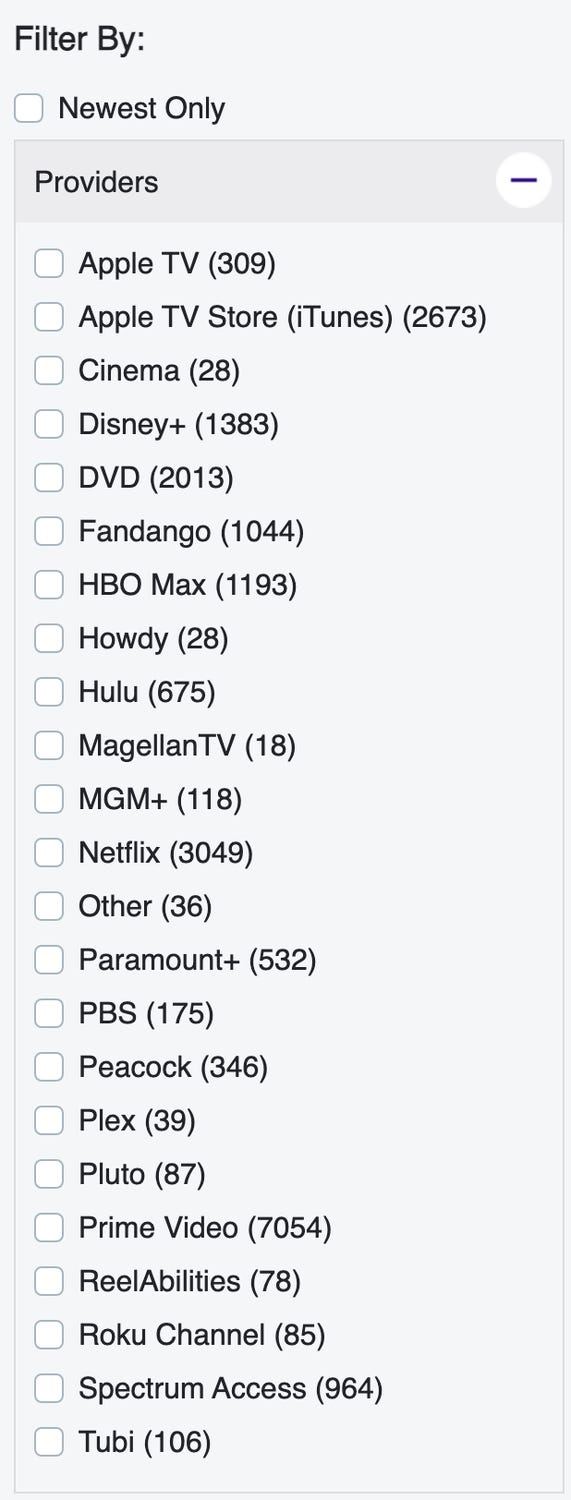
The Audio Description Project lists all of the film and TV series currently available with audio description based on the streaming platform or service provider it can be found.
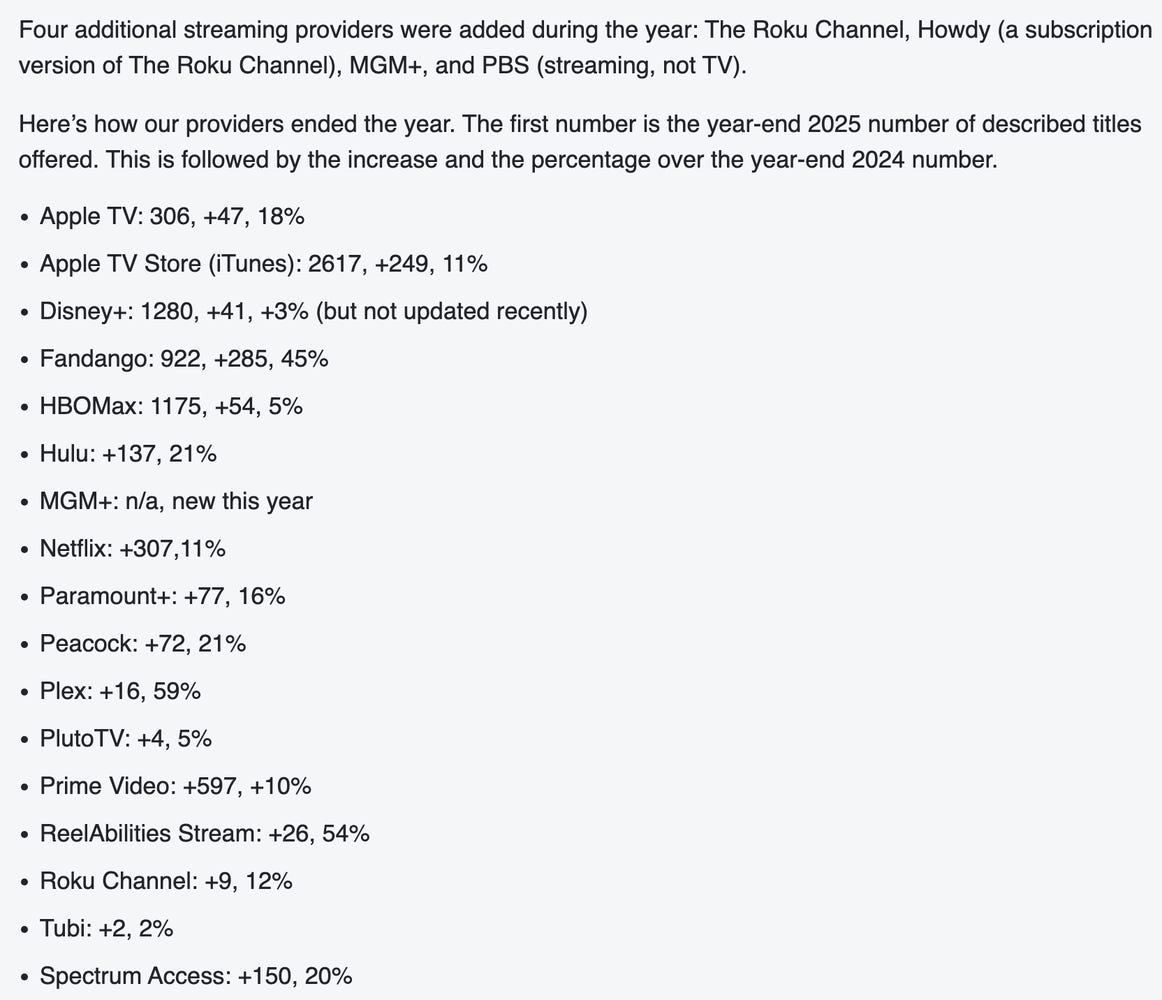
At the end of 2025, the Audio Description Project tracked the year-over-year increase for audio described titles offered over twenty streaming services.
A path forward
The UK has already demonstrated what a mandate produces. Ofcom’s VoD accessibility code now requires Netflix, Disney+, and Amazon Prime Video to ensure at least 10 percent of programs have audio description, 80 percent subtitles, and 5 percent signed content.
On February 6, 2026—six weeks before this piece was published—India’s Ministry of Information and Broadcasting issued accessibility guidelines for OTT platforms, grounding them in constitutional rights and the Rights of Persons with Disabilities Act. The guidelines cover audio description, closed captioning, and Indian Sign Language. The guidelines came days after a contempt petition was filed against the government for failing to implement existing obligations under the Rights of Persons with Disabilities Act 2016. Platforms have 36 months to phase in compliance for new content.
The UK requires specific percentages. India has established the framework. The United States has neither.
The ACB runs an annual Audio Description Awards Gala. Named winners. Named titles. A People’s Choice vote where the blind community chooses the best AD they experienced that year. People’s Choice went to FLOW (2024, Gints Zibalodis) and DYING FOR SEX (2025, Elizabeth Meriweather and Kim Rosenstock). The community has been building a quality recognition framework because the industry hasn’t built a quality requirement.
A clip from FLOW with English AD. Sourced from HBO Max.
A clip from DYING FOR SEX Season 1, Episode 1—titled “Good Value Diet Soda” with English AD and English CC. Sourced from Hulu.
The Directors Guild of America (DGA) fought colorization in the 1980s because altering a director’s black and white image without consent violated the integrity of their work. That fight is central to the guild’s mission and self-image, echoed by Christopher Nolan in a recent Variety interview as DGA president. At his first DGA Awards as president, Nolan told the room: “The amount of money that people spend on our work, on entertainment, is very, very stable. Audiences are invested in us, we have to be sure that we’re able to repay that investment.” He asked why consumer spending on entertainment remains stable while employment for guild members declines 35 to 40 percent. Why aren’t we reinvesting in the consumer who values our work.
His end-of-year letter to members covered tax incentives, health plans, AI, theatrical windows, and residuals. Accessibility is not mentioned. The DGA enters contract negotiations with the AMPTP in May 2026.
AI is on the agenda. Accessibility is not.
The cover of the DGA’s Creative Rights Handbook 2023-2026.
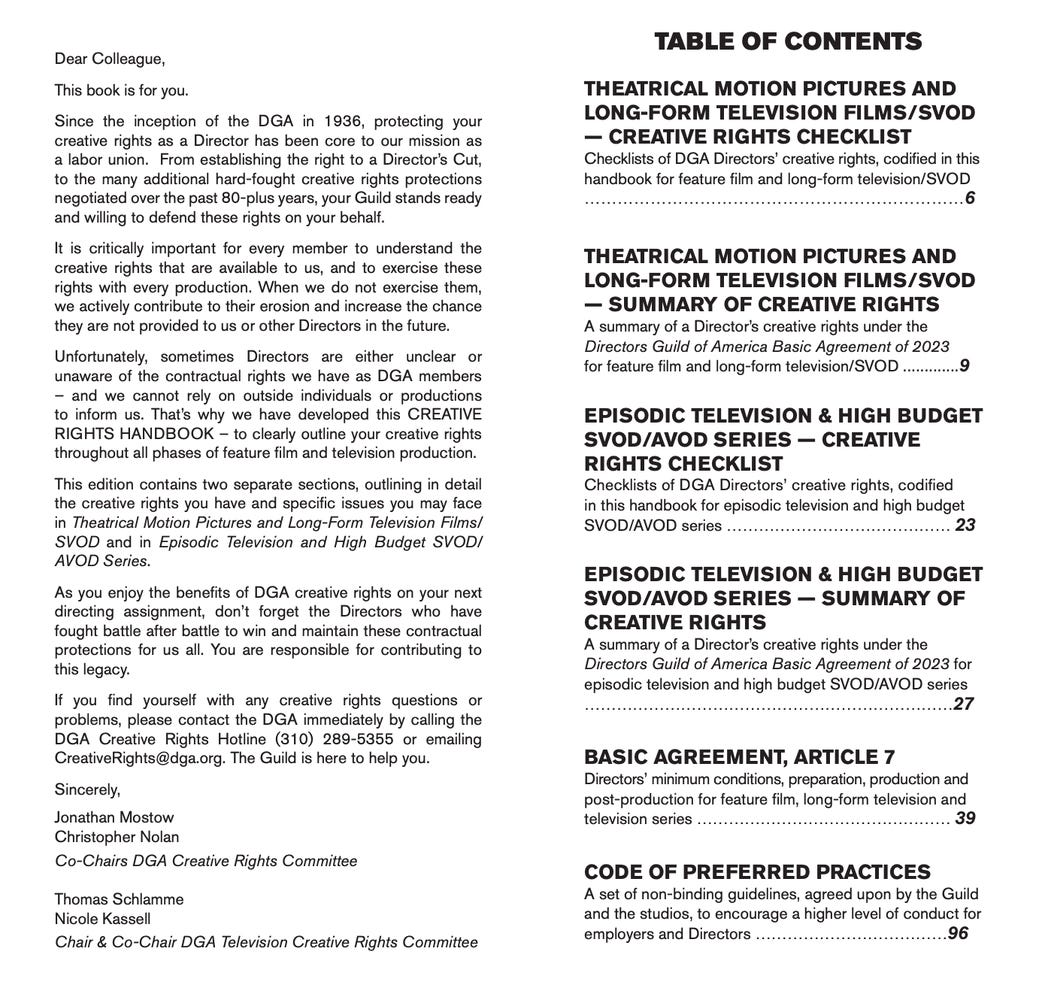
“Dear Colleague, This book is for you. Sincerely, Jonathan Mostow and Christopher Nolan. Co-Chairs DGA Creatives Rights Committee.”
The DGA Basic Agreement 2023-2026 (currently in effect, expiring this year) gives directors the right to be offered the opportunity to direct looping or narration, to participate in the spotting and dubbing of sound and music, and to be consulted on versions edited for ancillary markets. Audio description is narration added to the soundtrack of a film. It travels to every ancillary market where the film is distributed.
The rights that would reach it already exist within the guild’s own published creative rights framework. They have not been applied to audio description. The director whose film receives TTS audio description was offered the opportunity to participate in looping and narration. The AD track wasn’t covered by that offer. The director whose film travels to streaming platforms in versions edited for ancillary markets was consulted on those versions. The AD track’s quality wasn’t part of that consultation. The framework exists. The application doesn’t.
The co-chair of the Theatrical Creative Rights Committee that produced this handbook—the handbook containing the rights that could reach audio description—is now the DGA president leading the negotiations in May 2026 that could explicitly extend those rights to AD.
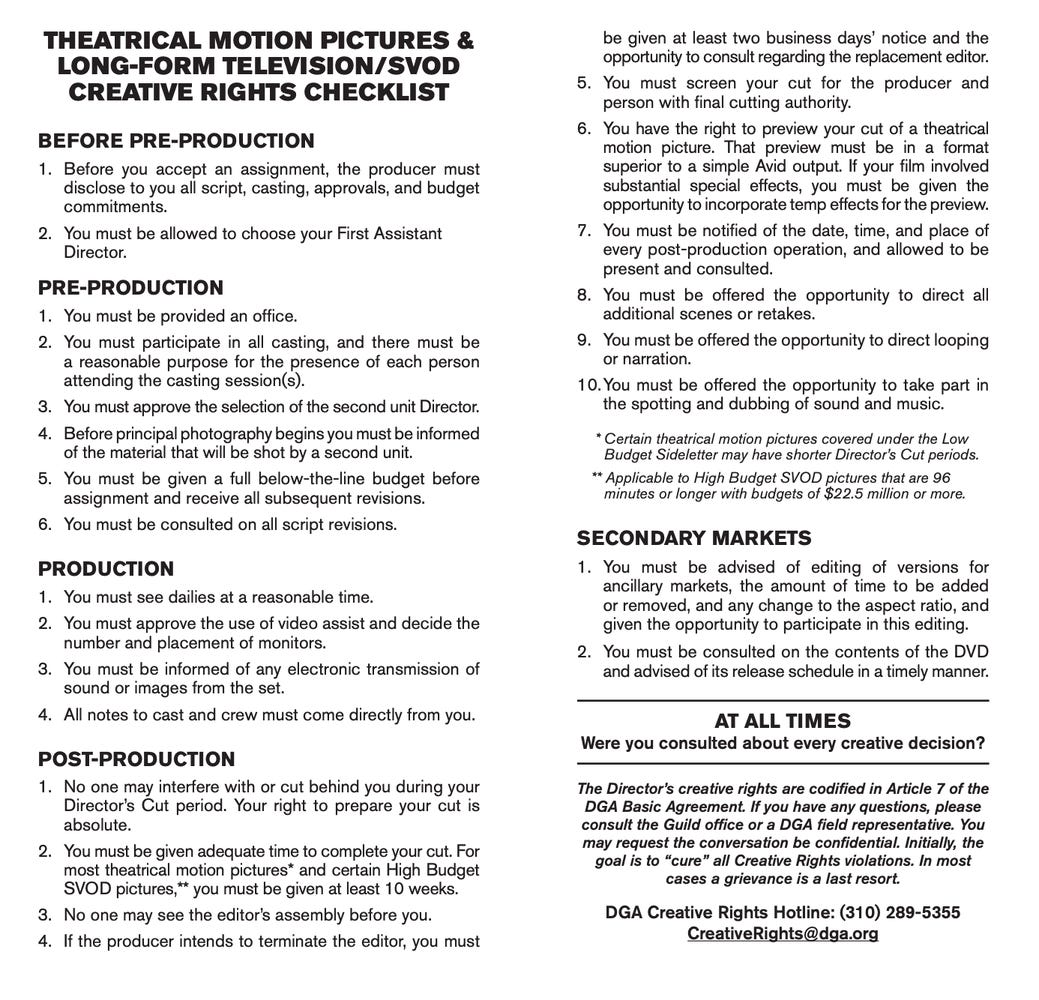
“POST-PRODUCTION, Item 9: You must be offered the opportunity to direct looping or narration. Item 10: You must be offered the opportunity to take part in the spotting and dubbing of sound and music.”
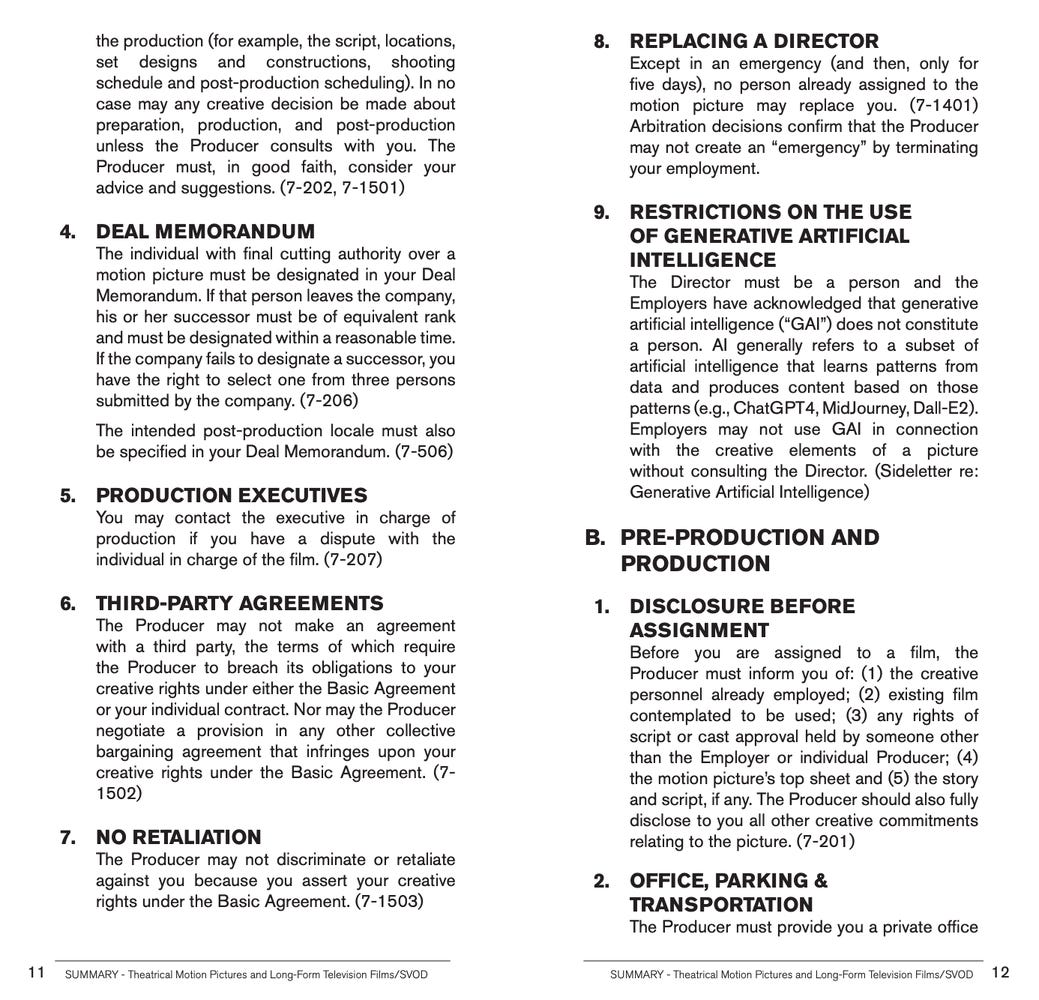
“RESTRICTIONS ON THE USE OF GENERATIVE ARTIFICIAL INTELLIGENCE: The Director must be a person and the Employers have acknowledged that GenAI does not constitute a person. AI generally refers to a subset of artificial intelligence that learns patterns from data and produces content based on those patterns. Employers may not use GenAI in connection with the creative elements of a picture without consulting the Director.”
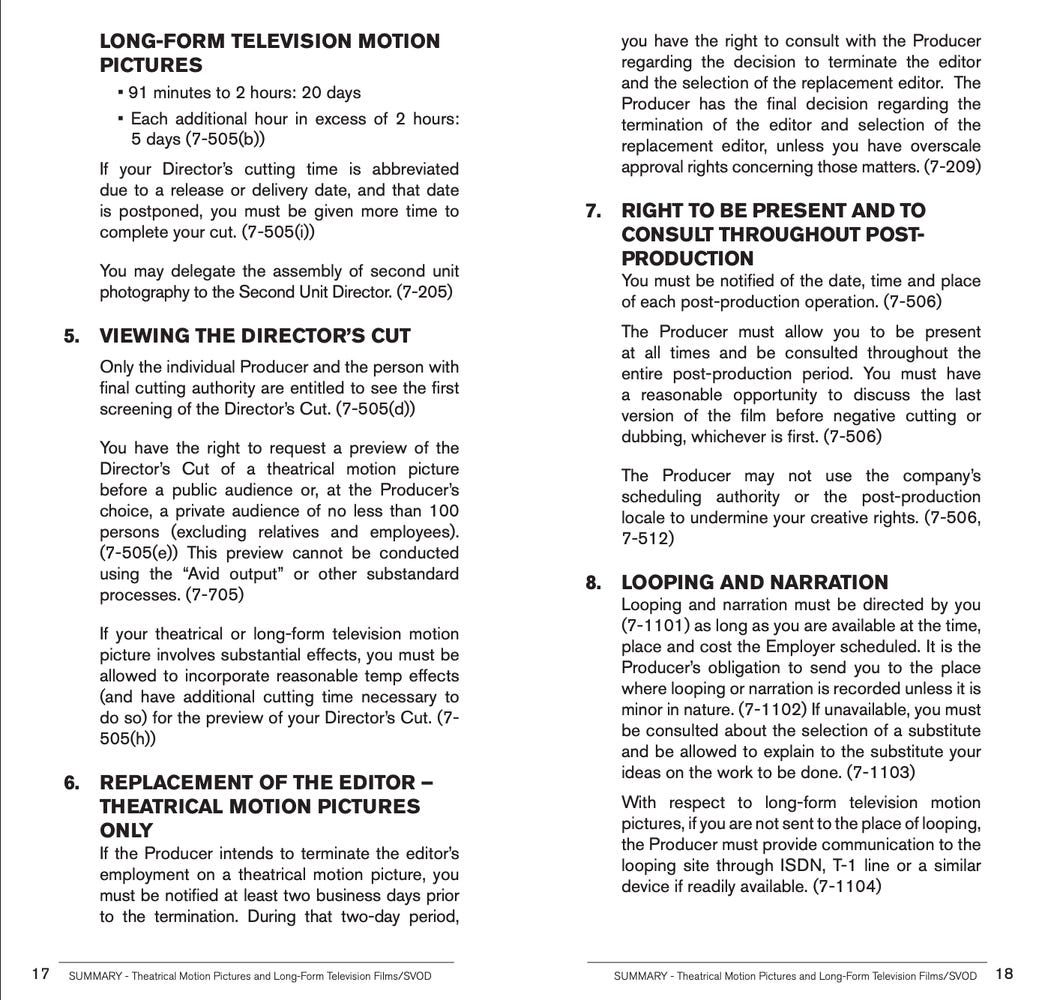
“RIGHT TO BE PRESENT AND TO CONSULT THROUGHOUT POST-PRODUCTION: You have a reasonable opportunity to discuss the last version of the film before negative cutting or dubbing, whichever is first. LOOPING AND NARRATION: Looping and narration must be directed by you as long as you are available at the time, place and cost the Employer scheduled.”
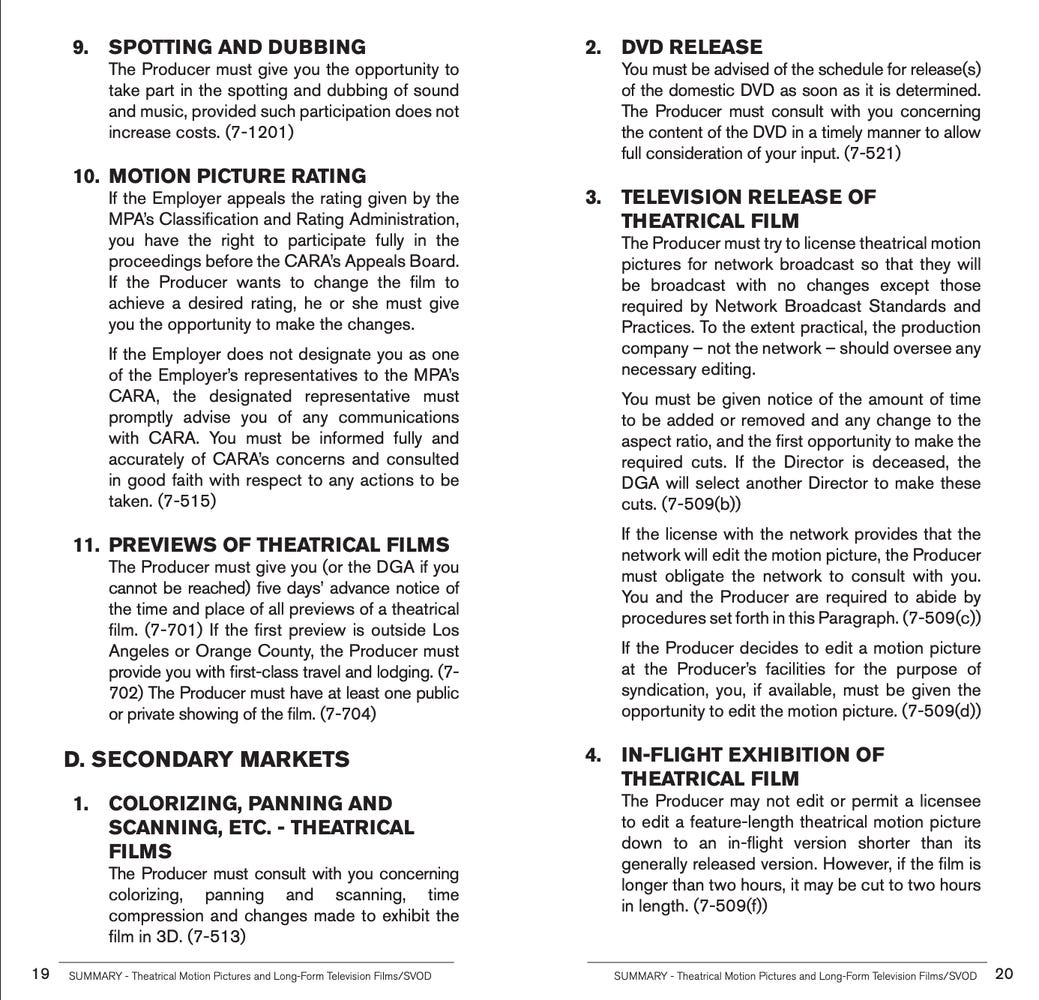
Additional requirements about SPOTTING AND DUBBING, as well as TELEVISION RELEASE OF THEATRICAL FILM. With the latter, “…no changes except those required by Network Broadcast Standards and Practices,” as well as a provision on “if the license with the network provides that the network will edit the motion picture, the Producer must obligate the network to consult with you.”
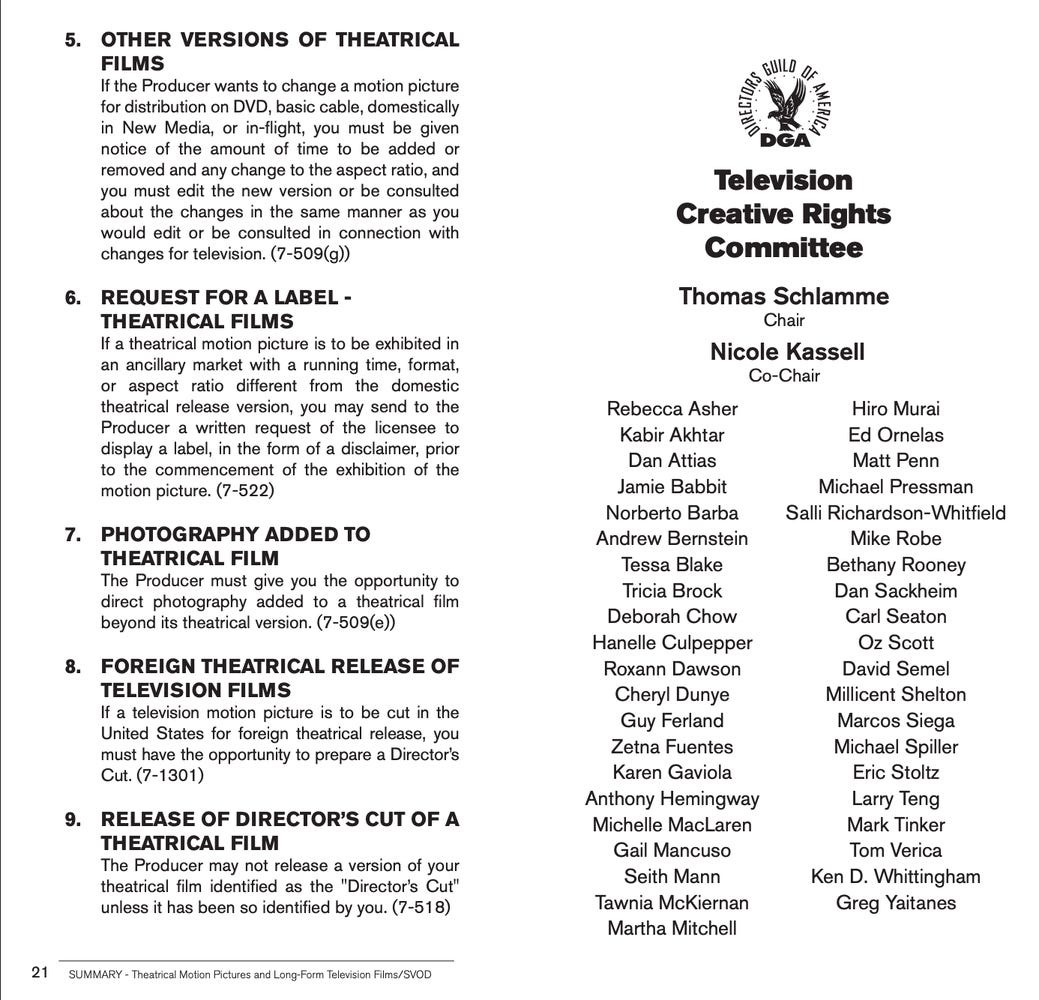
“OTHER VERSIONS OF THEATRICAL FILMS: If the Producer wants to change a motion picture for distribution…you must be given notice of the amount of time to be added, and you must edit the new version or be consulted about the changes in the same manner as you would be consulted in connection with changes for television.”
A Director’s basic rights are codified in Article 7 of DGA Basic Agreement.
The scale of what’s at stake
Analysis of Nielsen and Netflix data published in Forbes on March 22, 2026 reveals that the combined Paramount and Warner Bros. Discovery entity will control 42 percent of acquired series viewing domestically—184 billion minutes—and 38 percent of Netflix’s top 100 acquired series globally, translating to 1.54 trillion minutes of viewing annually. Media analyst Michael Nathanson, writing for Yale School of Management, confirmed that roughly half of all streaming viewing is legacy library content and that the Warner Bros. library was the primary asset both Netflix and Paramount pursued in the merger bidding war. Nathanson also noted that media mergers typically produce human capital synergies, meaning the cost savings come from cutting people. The combined entity will carry significant debt. The accessibility teams inside both organizations fight for funding in good years. They will fight harder in an organization built on cost savings and synergies.
IndieWire published a piece on March 24, 2026—the day I finished the first draft of this piece—on the departure of David Zaslav from Warner Bros. Discovery. It draws a distinction between the old Hollywood chieftains who were brutal, cutthroat, far less interested in art than profit, and today’s decision-makers. The difference, the piece argues, is embedded-ness. The old guard needed the system to work because their fates were inseparable from its health. Today’s decision-makers are not embedded in the same way. As IndieWire puts it: “The real power sits with private equity, Wall Street, and tech—institutions designed to extract value, not sustain ecosystems.”
The accessibility team inside Warner Bros. Discovery is not fighting bad values. It’s fighting structural incentives that don’t account for the long-term cost of the audience nobody saw. In a system designed to extract value, not sustain ecosystems, accessibility infrastructure will always lose the budget fight. Not because nobody cares. Because the system wasn’t built to sustain the things that don’t show up on a quarterly earnings call.
Analysis of Nielsen data published in The Ankler reveals that the most watched acquired content on streaming are not prestige originals. It’s NCIS. THE BIG BANG THEORY. GREY’S ANATOMY. FAMILY GUY. CRIMINAL MINDS. Procedurals and sitcoms with hundreds of episodes that viewers return to week after week. The shows a newly blind viewer turns to because they’re familiar. The shows a newly hard-of-hearing viewer has watched for years suddenly needing captions they can trust. The deep wells of content built to last.
NCIS is a CBS production owned by Paramount. It’s the most watched acquired series on streaming: 48 of 59 weeks on the Nielsen top 10, approximately 730 million minutes consumed every week, 475 episodes. Paramount licenses it to Hulu, Prime Video, and Netflix simultaneously.
There is no audio description for NCIS on Hulu. No audio description on Netflix. It appears to have audio description on Apple TV+, but it’s not accounted for in the ADP database.
Not TTS instead of human. Not inadequate quality. Not a disclosure failure. Nothing. On three platforms simultaneously under licensing agreements Paramount controls. Paramount’s Global Content Delivery Guide, which piece two examined, requests descriptive audio when available. The most watched acquired series on streaming was not available with AD at any point in the chain from CBS production through Paramount ownership through three major distribution relationships. The request traveled through every level of the pipeline. It produced nothing.
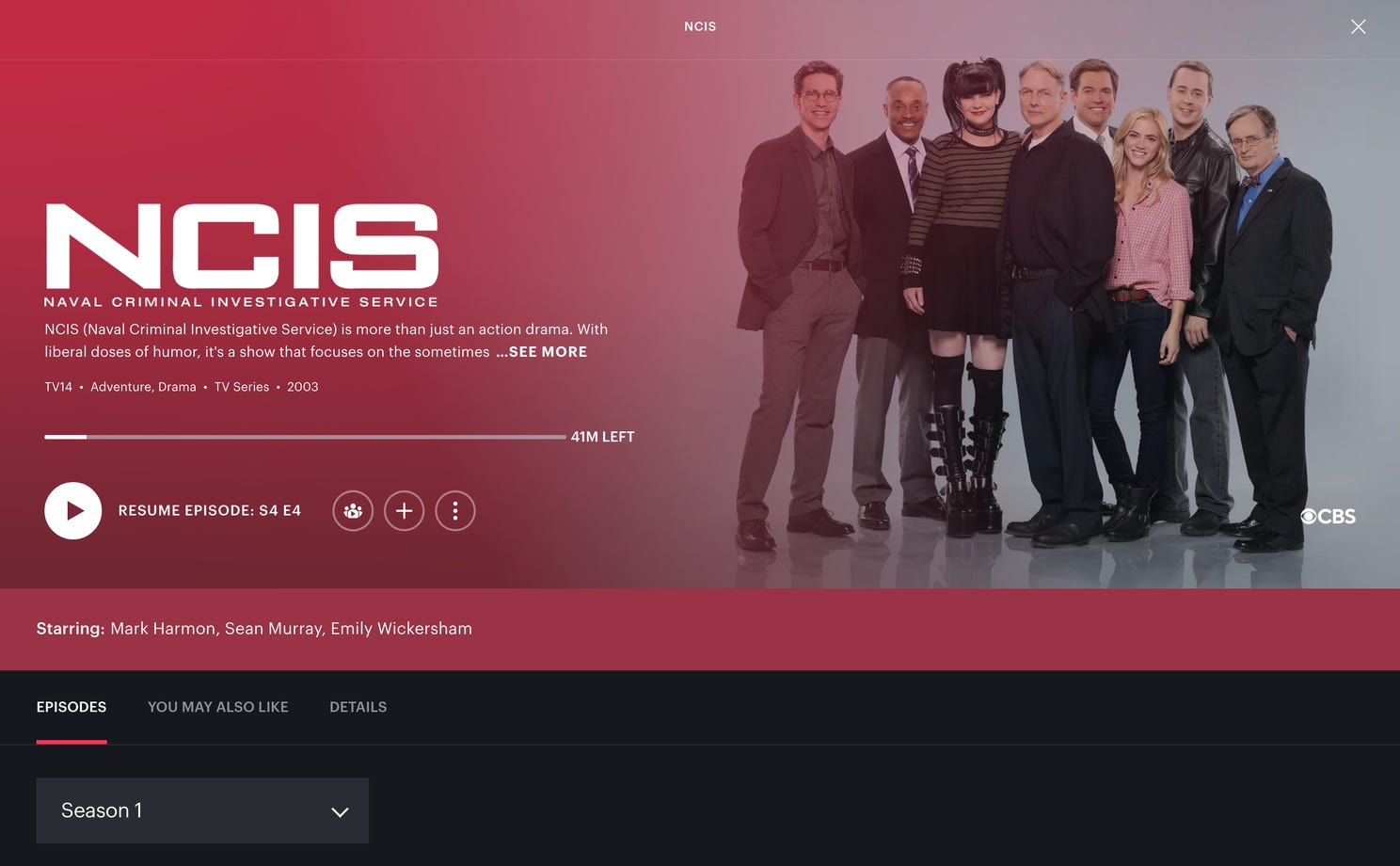
The landing page for NCIS on Hulu. There is no AD symbol.
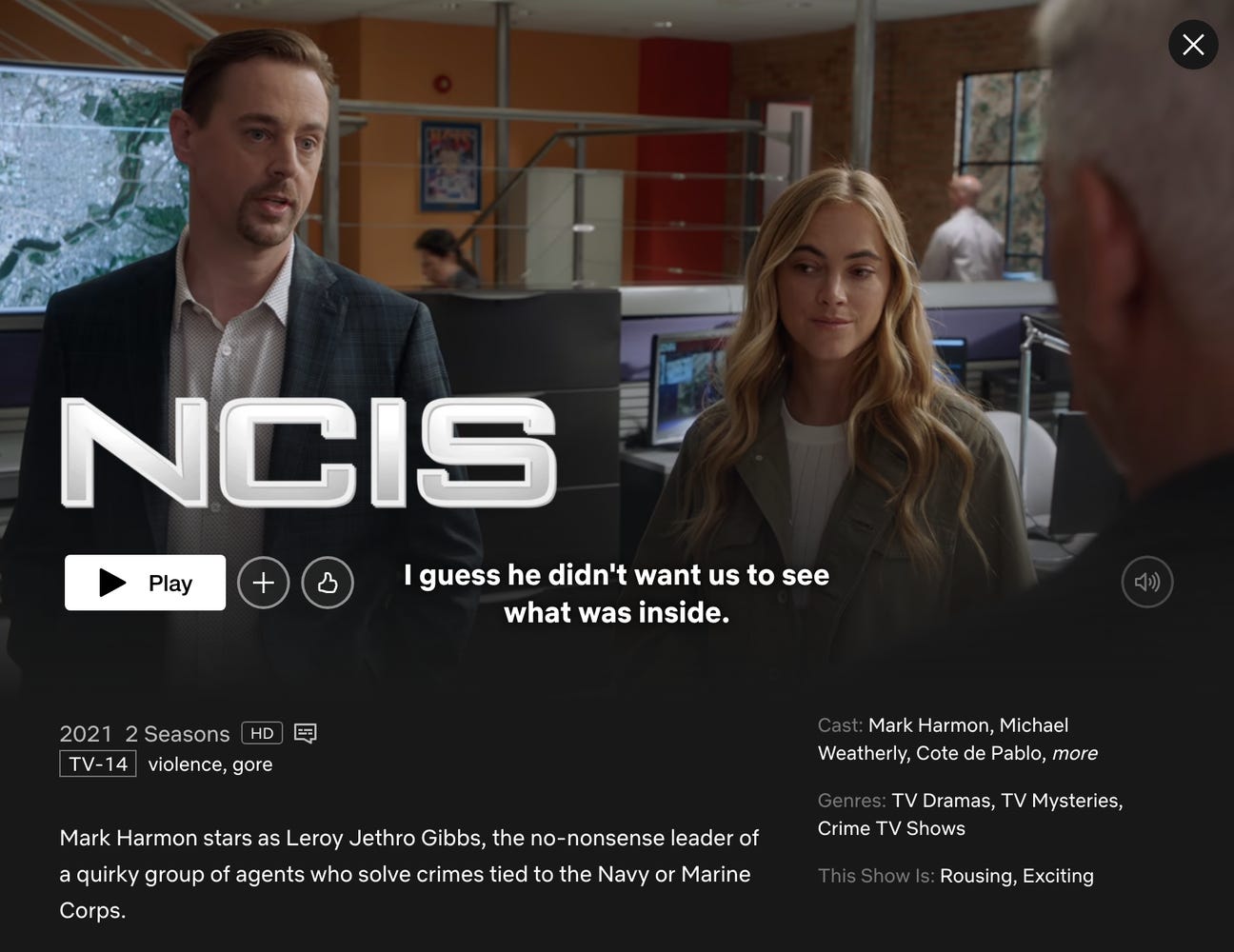
The landing page for NCIS on Netflix. There is no AD symbol.
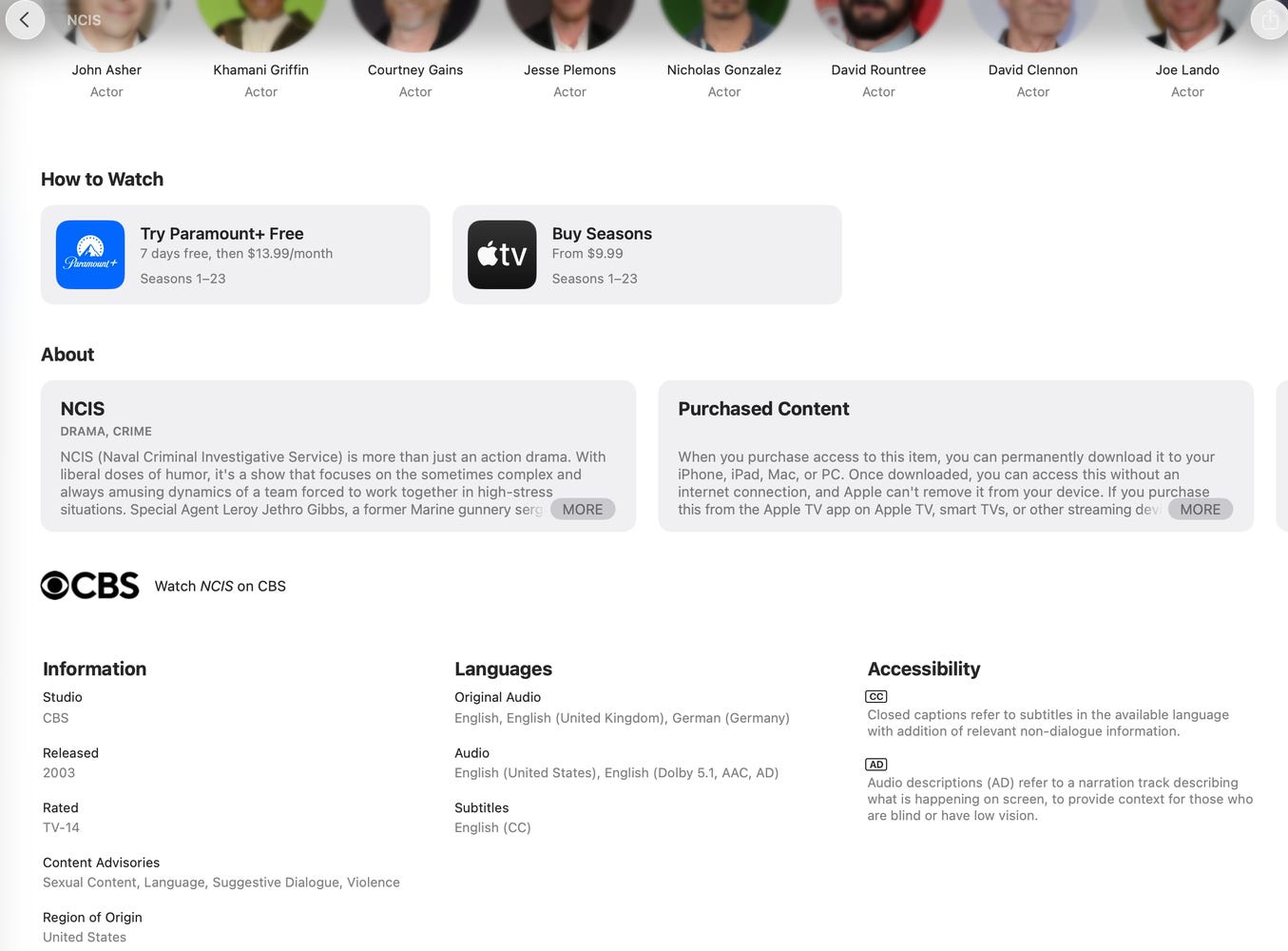
The landing page for NCIS on Apple TV+. There does appear to be AD, but it doesn’t specify exactly where it begins.
It’s worth noting that I get different results for NCIS when I search Amazon Prime Video on my own in comparison when I do a search via the ADP’s database. When I do the former, I land on this landing page: one without the AD symbol. When I do a search on the ADP for “NCIS,” I’m given this landing page instead: identical in almost every way to the former, but it has the AD symbol. The latter contradicting the former.
The metadata tells another story. Navigating to later seasons of NCIS on Amazon Prime Video surfaces an audio description track (example: season 10—now matching the metadata aligned with the AD symbol). Navigating to earlier seasons does not (example: season 2). The pipeline arrived at some point in the run. It did not go back. The most watched acquired series on streaming is partially accessible on one platform—invisibly, through navigation most users would never attempt—and inaccessible on Hulu and Netflix entirely.
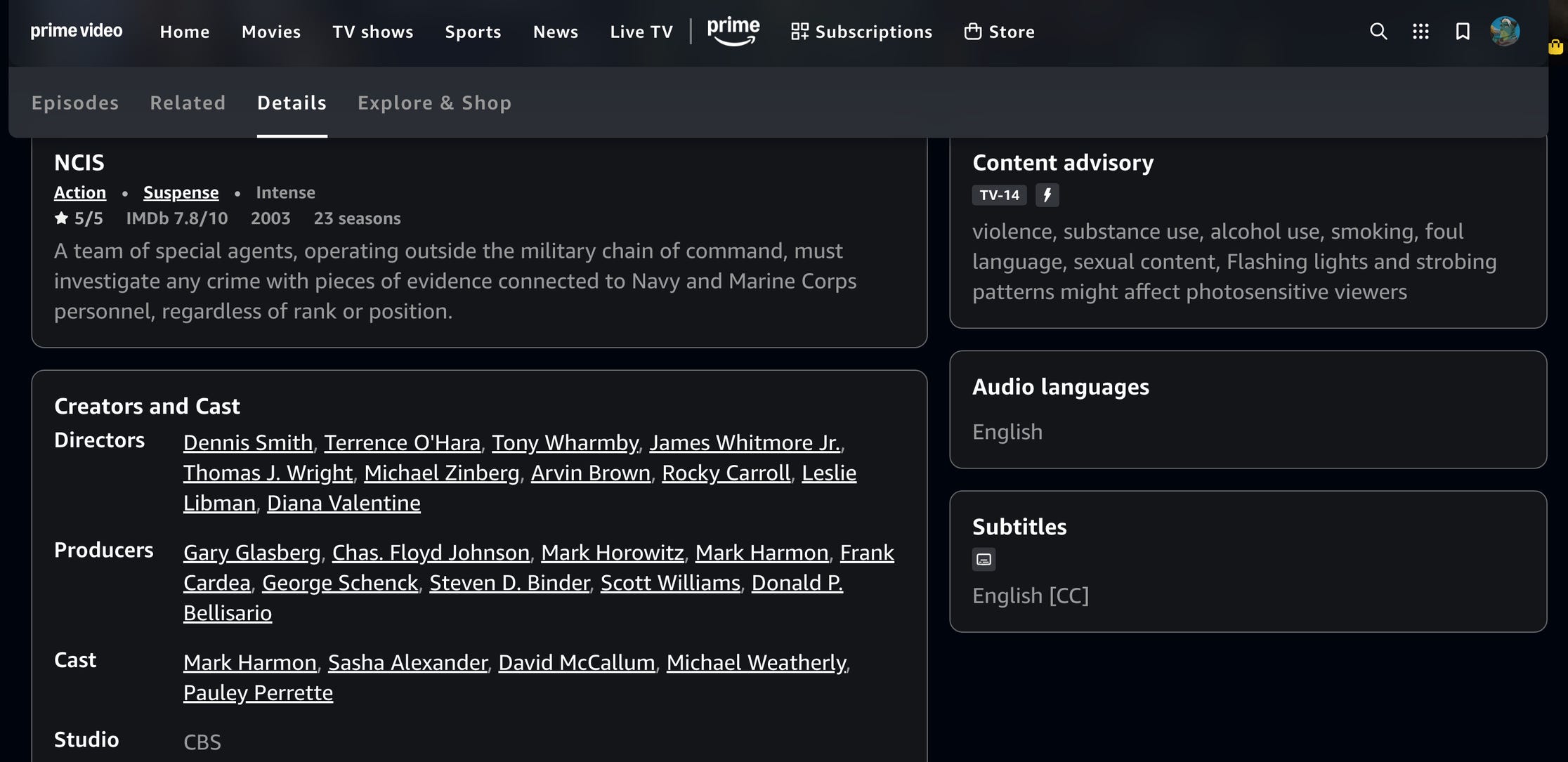
The landing page for NCIS on Prime Video. This what I get when I search solely for “NCIS” as a TV series in Prime Video. There is no AD symbol present.

Searching for NCIS in the Audio Description Project.
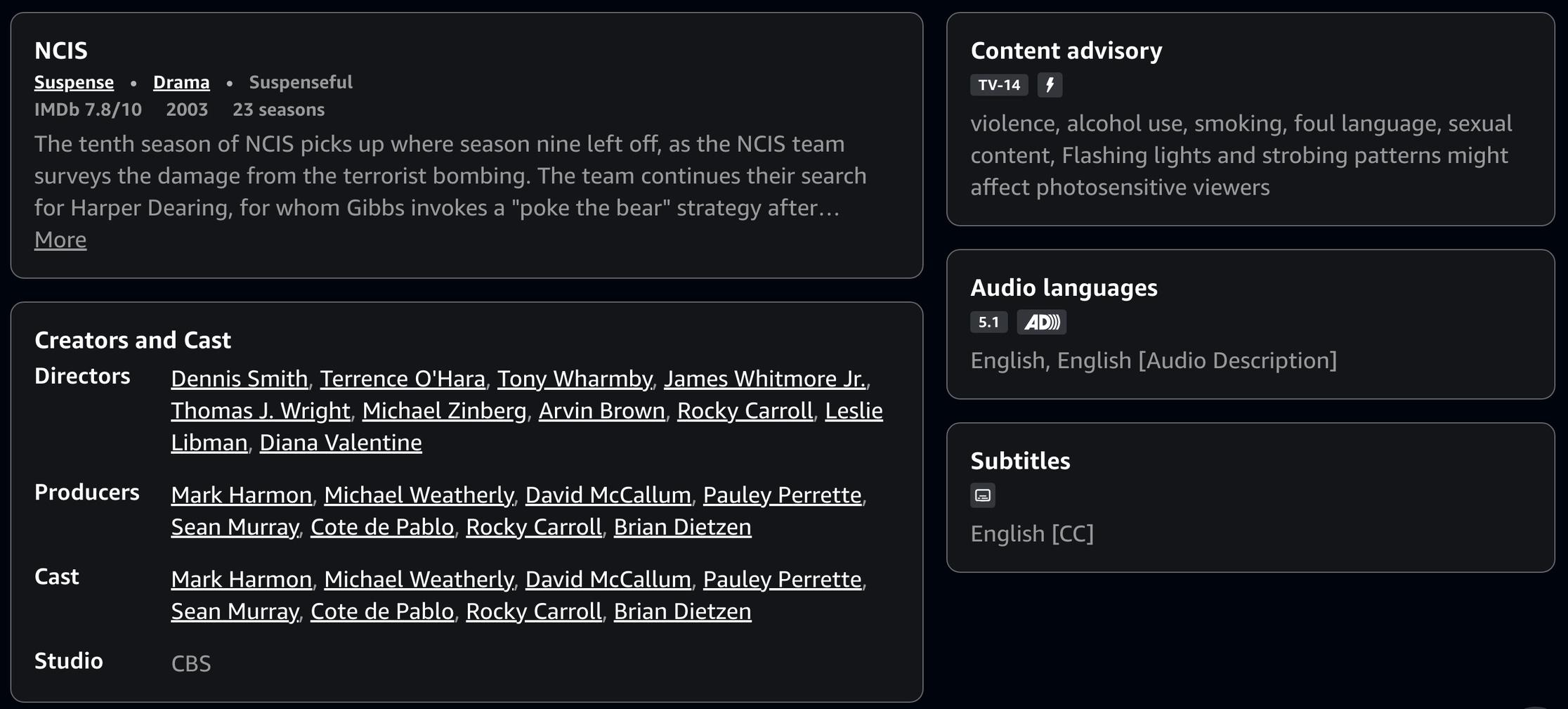
The landing page for NCIS on Prime Video when I use the hyperlink provided by the Audio Description Project. Here, there is an AD symbol available.
In the United States, FAMILY GUY streams exclusively on Hulu and Disney+. On the latter, it does so via the paid tier “Hulu on Disney+.” It appeared on the Nielsen weekly top 10 charts 39 times in 2024 alone. The show is built on visual gags, cutaway jokes, and physical comedy that depend entirely on seeing what is happening on screen. The cutaway either lands in two seconds or it doesn’t land at all. The audio description for FAMILY GUY on Hulu has the challenge of keeping up with a show that is incredibly visually dense. The 2020 peer-reviewed study in ACM CHI proceedings found TTS imposes higher cognitive load and lower comprehension than human speech—a finding with particular relevance for comedy whose architecture is entirely visual and instantaneous.
A clip from FAMILY GUY Season 16, Episode 5—titled “Three Directors” with English AD and English CC. Sourced from Hulu.
A clip from FAMILY GUY Season 18, Episode 9—titled “Christmas is Coming” with English AD and English CC. Sourced from Hulu.
GREY’S ANATOMY is currently in its 22nd season. It’s the most-streamed acquired drama on streaming with 47.85 billion viewing minutes across Hulu and Netflix in 2024. On Netflix, audio description begins at Season 20, Episode 1. Seasons 1 through 19—approximately 400 episodes, nearly two decades of the show—have no audio description. The entry point is inaccessible. The seasons that made viewers love the show are inaccessible. The pipeline arrived at Season 20 and did not go back.
On Hulu, audio description begins at Season 19. There is no marker indicating AD is available. A blind viewer on Hulu can’t discover that AD exists for GREY’S ANATOMY because the platform provides no indication it’s there.
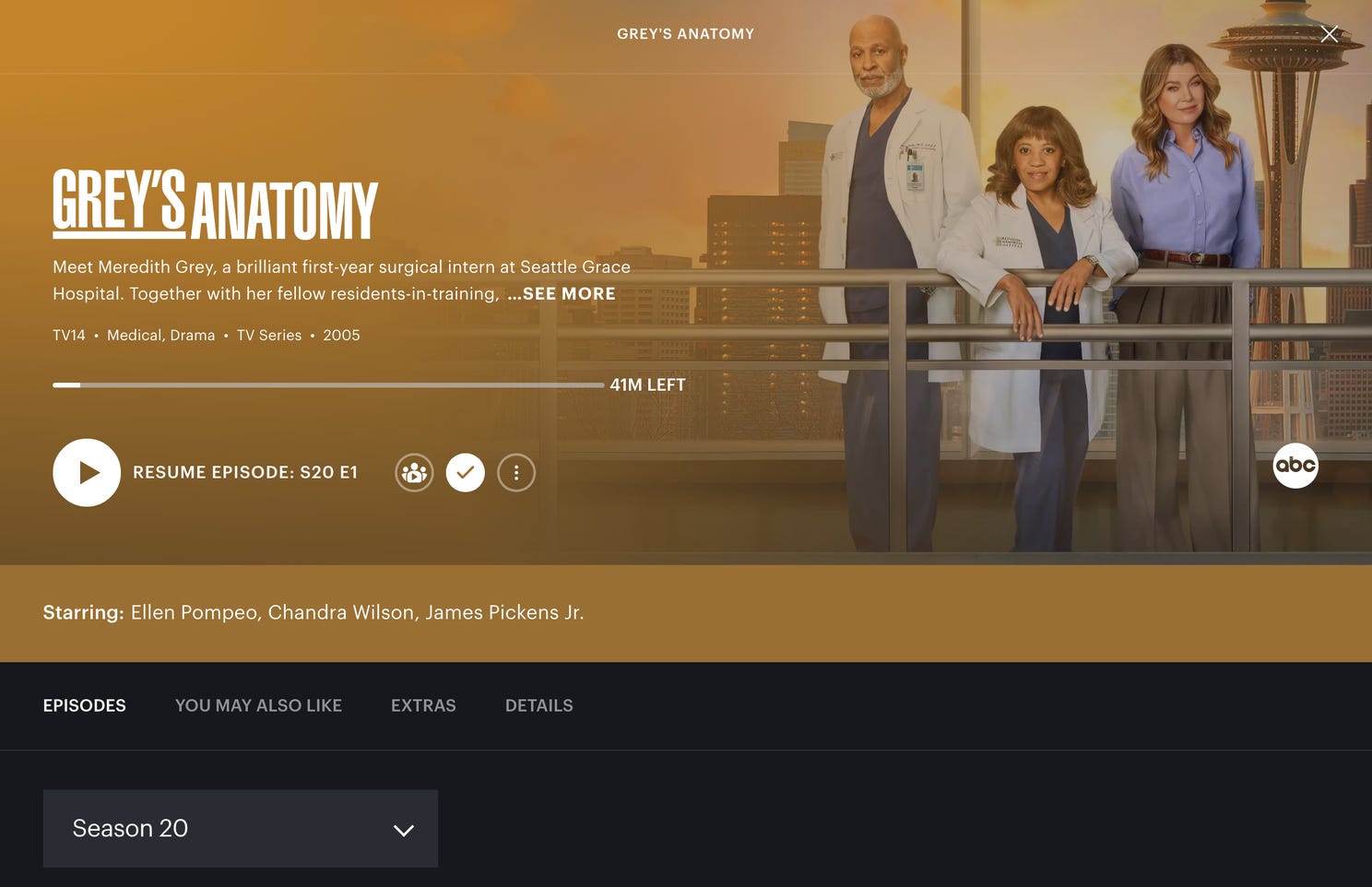
The landing page for GREY’S ANATOMY on Hulu. Note that Hulu does not have the AD symbol directly on its film and TV series landing pages.
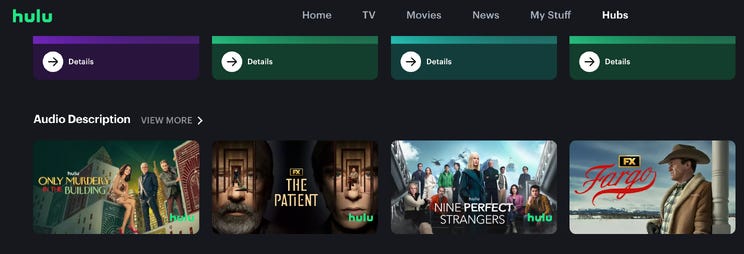
“Audio Description” is a separate hub that one needs to navigate to on Hulu.
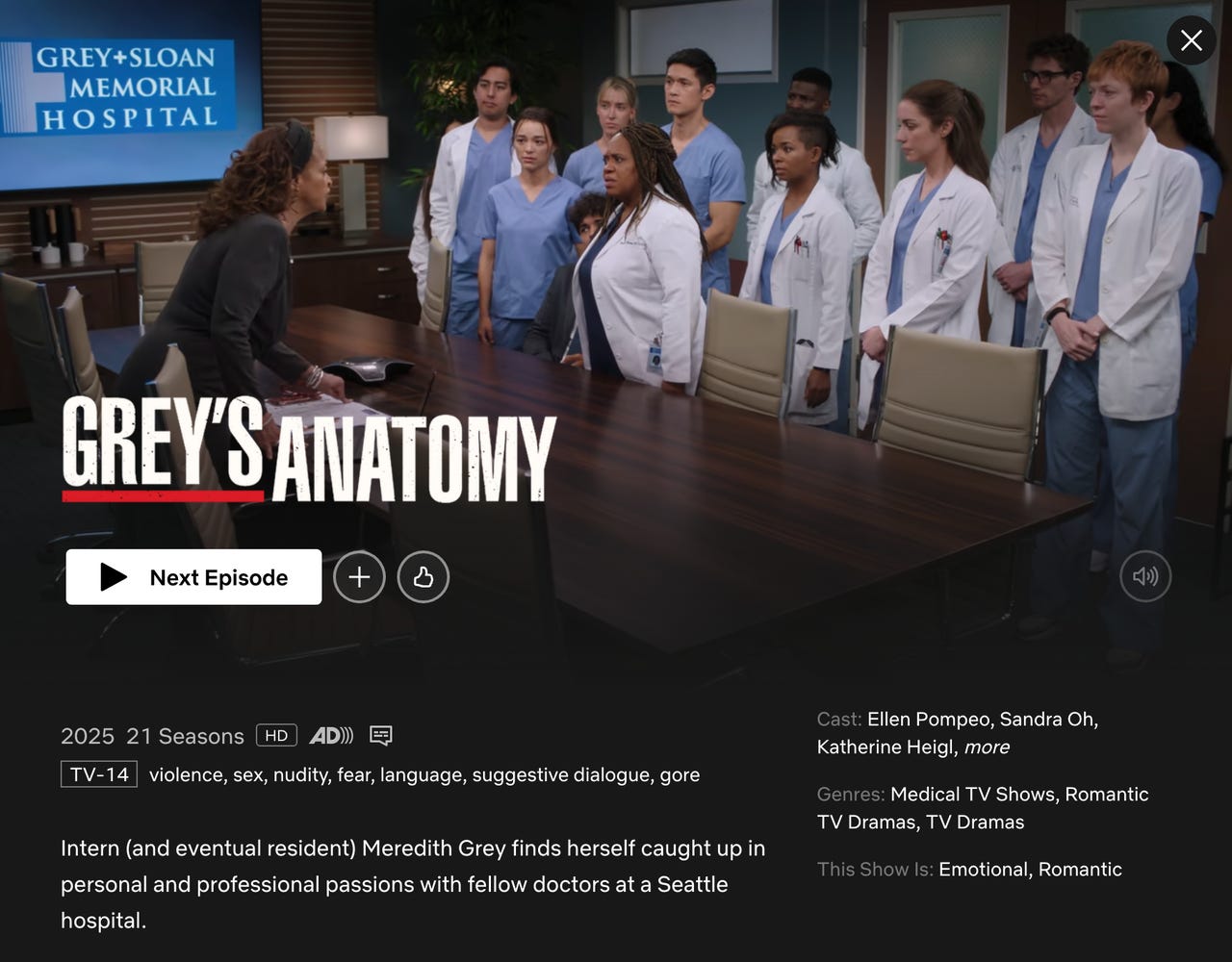
The landing page for GREY’S ANATOMY on Netflix. Note the presence of the AD symbol.
Netflix credits the AD production team at the top of Season 20, Episode 1: over the title card, before the story begins. Four credits for one AD track. The writer is named. The narrator is named. The post houses are named. Separately from the closed captions. Before the first scene.
In Season 19, Hulu provides no marker that AD exists and no credit for the narrator who produced it. Not even when went to the end credits for this episode.
Same show. Two platforms. Netflix has human-voiced AD starting at Season 20 with no access to the preceding 19 seasons. Hulu has AD starting at Season 19. No coordination. No standard. No disclosure. No requirement that what arrives meets a quality threshold or that a blind viewer can find it when it does.
A clip from GREY’S ANATOMY Season 19, Episode 11—titled “Training Day” with English AD and English CC. Sourced from Hulu.
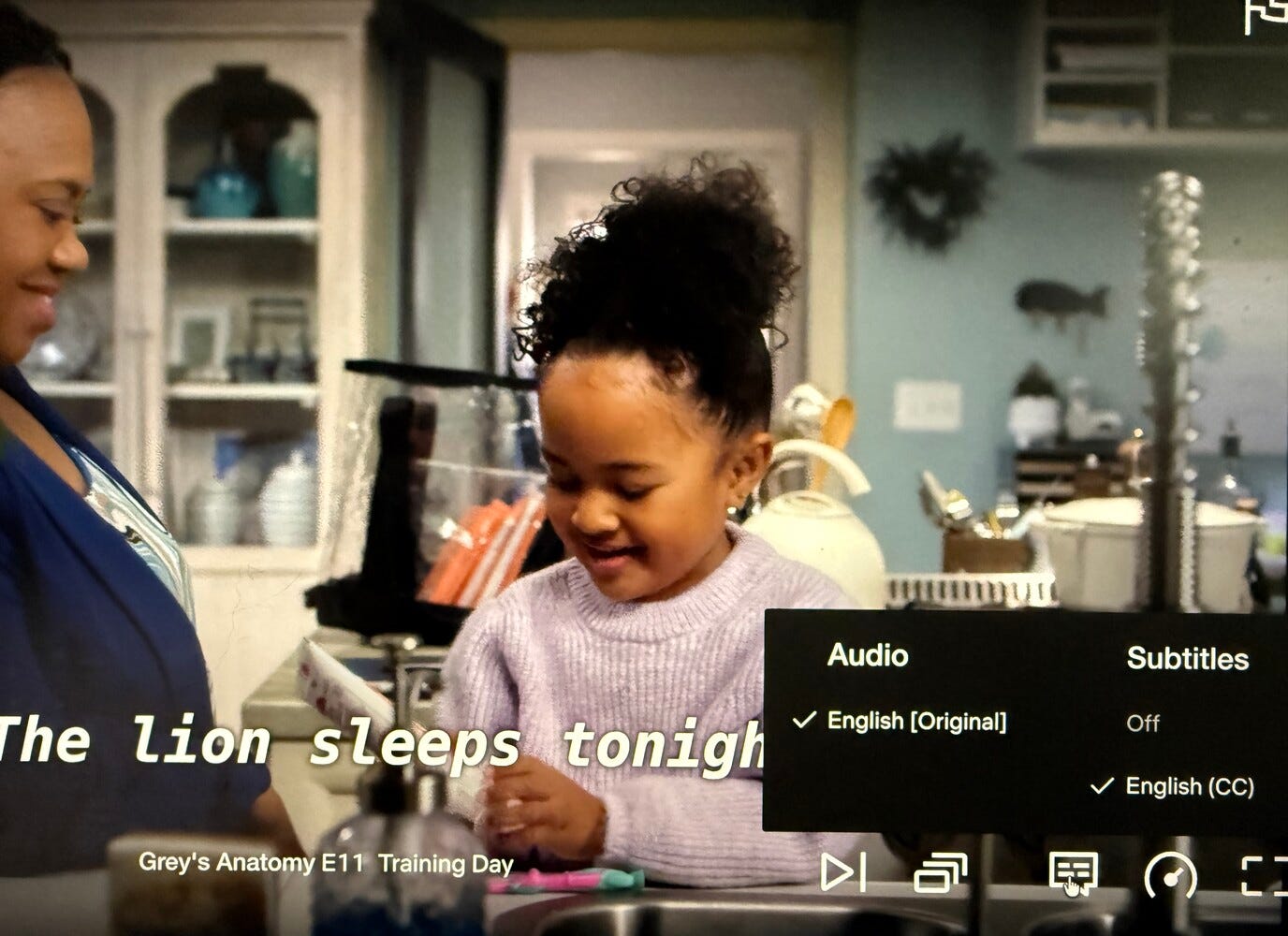
A screengrab from GREY’S ANATOMY Season 19, Episode 11—titled “Training Day.” Bringing up the audio shows that there is no AD track available on Netflix.
A clip from GREY’S ANATOMY Season 20, Episode 1—titled “We’ve Only Just Begun” with English AD and English CC. The post house, AD script writer, and AD narrator are mentioned over the title card. Sourced from Netflix.
Three shows. Four failure modes. Complete absence. Visible wrong quality. Invisible wrong quality. Partial access with no accessible entry point. All confirmed this week. All from the most watched content on streaming.
The studios have a sophisticated strategy for maximizing the value of this library. They move content between platforms deliberately by sending shows to Netflix to drive awareness, licensing titles to generate revenue. As The Ankler observed: a customer doesn’t miss a show they don’t know exists. The same principle applies to accessibility. A blind viewer doesn’t miss the AD track that was never made. A d/Deaf viewer doesn’t miss the ASL version that exists exclusively on one platform. The infrastructure for finding shows is mature and intentional. The infrastructure for finding accessible versions of those shows doesn’t exist.
Nielsen delayed its monthly Gauge report in March 2026 after streaming platforms pushed back against new measurement data that showed a potential diminution of streaming audiences. The platforms didn’t like what the numbers showed. The report was delayed.
There is currently no measurement, no aggregation, and no standardization of how accessible media is presented at scale. No monthly report showing what percentage of new titles have human-voiced AD versus TTS. No disclosed data on catalogue accessibility. No Gauge for the audience nobody saw.
Disabled consumers can’t advocate for a standard they don’t know is missing. Directors can’t object to a misrepresentation of their work they have no mechanism to identify. Guilds can’t negotiate for a quality standard they haven’t measured. The DGA enters contract negotiations in May 2026 without data showing what their members’ films sound like to blind audiences.
Measurement is the foundation that makes education possible. Education is the constituency that makes the mandate politically achievable. The mandate is what produces the measurement and the standard simultaneously. The three absences are not independent failures. They are the same failure at three different levels of the same system.
You can’t fix what you don’t measure. The industry has been unmeasured for forty years. The audience nobody saw has never been counted because counting them was never required.
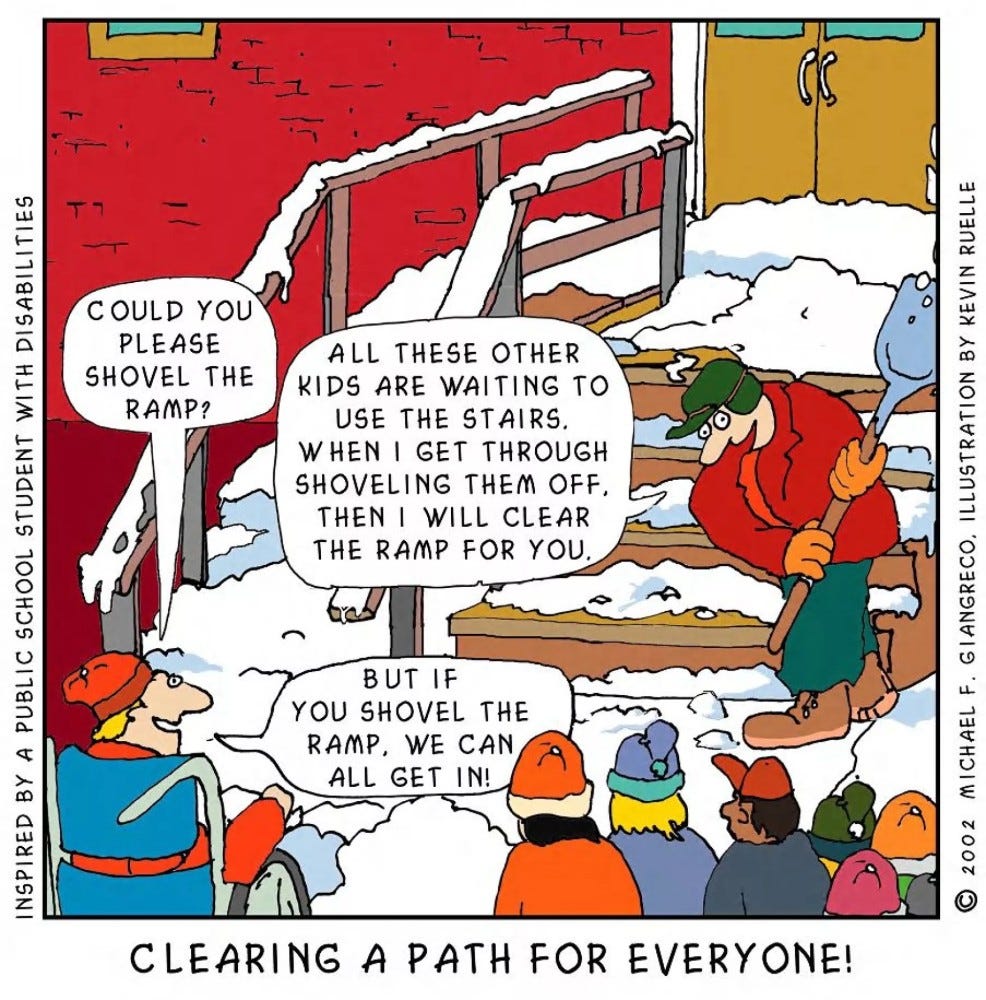
“Clearing a Path for Everyone” by Michael Giangreco and Kevin Ruelle. From the University of Vermont Center For Digital Initiatives Collection.
Michael Giangreco and Kevin Ruelle created this cartoon based on the words of a real student in Vermont. It has become the most widely reprinted image in his collection. A figure shovels a ramp through the snow. Everyone gets in. Not accommodation after the fact. Design from the start.
Everything emerging in real time
Everything documented in this series has been emerging as it was written. The merger that will consolidate 40 percent of acquired streaming viewing was announced February 27. The CEO who named emotional storytelling as his North Star took office March 18. The measurement that might have counted what the audience is actually watching was delayed last week. The first streaming BASL interpretation in history was confirmed as a platform exclusive on July 4, 2025, when I only had feelings and no words to wrap around what this essay series has now become. The comedy special that dropped on YouTube March 24 with no audio description for blind audiences and AI-generated CC happened the day I completed the first draft for this piece.
On March 25, a California jury found Google’s YouTube liable for harms caused by its platform design. In its defense, Google stated that YouTube is a responsibly built streaming platform. The series you have just read documents what responsible streaming platform design has not yet built.
On March 26, Netflix raised subscription prices across all tiers, citing the value it delivers to members. GREY’S ANATOMY Seasons 1 through 19 remain without audio description on the platform.
Warner Bros. Discovery has set April 23 as the date for its shareholder vote on the sale to Paramount Skydance. The merger that will consolidate 40 percent of acquired streaming viewing is two weeks from its next threshold.
This isn’t a problem that was documented after the fact. It’s a problem happening right now. In every distribution decision being made behind castle walls. In every format launched without an accessibility framework. In every merger that consolidates the library without consolidating the standard. In every measurement delayed because the data was inconvenient.
The inherent collision of technology, economy, and cultural participation is happening faster than any regulatory framework can follow. It was always going to. The audience nobody saw is experiencing the gap in real time. Not as a historical failure.
The audience is experiencing that gap right now.
“Always remember the reason you started working is that there’s something inside that you felt that if you can manifest in some way, you will understand more about yourself and how you co-exist with the rest of society.” - David Bowie being interviewed in INSPIRATIONS (1997, Michael Apted)
The audience I know and the audience I don’t
I should be honest about the limits of what this series has examined.
I’ve written predominantly about American and Hollywood-centric projects with English language at the forefront. That’s the industry I worked inside for seventeen years. That’s the lens I brought to this.
But I grew up watching Hong Kong New Wave. INFERNAL AFFAIRS before Marty-patron-saint-of-cinema made THE DEPARTED. IN THE MOOD FOR LOVE (2000, Wong Kar-wai). Wuxia films. Jackie Chan action movies my family watched on weekends. Those films shaped what I knew to look for when I started searching for what I wanted to connect with.
I also remember my parents commenting when Cablevision added channels to our package. We had one television in the house I grew up in. My sister and I spent entire afternoons laughing-crying over MOST EXTREME ELIMINATION CHALLENGE (MXC), the American comedic redub of the Japanese game show TAKESHI’S CASTLE that aired on Spike TV. Spike TV has since rebranded into the Paramount Network. The original Japanese episodes had limited mainstream US broadcast until later streaming options made them more widely available. The version that reached our living room was the localized one. I didn’t go looking for it. The infrastructure delivered it. And because of those afternoons, I went looking for the rest of Takeshi Kitano’s work. The first ones I stumbled across were BATTLE ROYALE (2000, Kinji Fukasaku) and HANA-BI (1998, Takeshi Kitano). The redubbed game show became the beginning of a thread. The thread became a formation I couldn’t have planned.
Josh D’Amaro didn’t know on Peter Pan’s Flight how the ride was made or how the animated film was made. He felt the feeling of flying. That was enough. I didn’t know on those Saturday afternoons how MXC was produced or that Takeshi Kitano has complicated feelings about how his work is received by Western audiences. I felt the laughing-crying. That was enough. That feeling became the thread that led to BATTLE ROYALE and HANA-BI and a formation I couldn’t have planned.
It led me to my career path in film and television. Loving stories. Wanting to understand why people love the things they love.
It led me to writing this.
Audiences don’t need to know how the pipeline works. They need the pipeline to work. They need the content to arrive. They need the choice that makes the thread possible—the Saturday afternoon that becomes the decade of seeking out a filmmaker’s work, the feeling that becomes the North Star, the encounter that becomes the formation.
I was the Head of Social for TLC at Discovery from 2019 to 2021, prior to Discovery’s merger with Warner Bros. The merger was announced in May 2021 and closed in April 2022. I launched the 90 DAY FIANCE TikTok account, as well as new Instagram and Twitter accounts. I led the team that allowed #ILikeTheView to go viral, one of TikTok’s most recognized entertainment brand moments of 2020. Our social team won first place for Overall Social Presence at the Faxies in 2021. I helped bring millions of people to that franchise.
During my time working on this franchise, none of the episodes had audio description. I don’t know how the closed captions were produced.
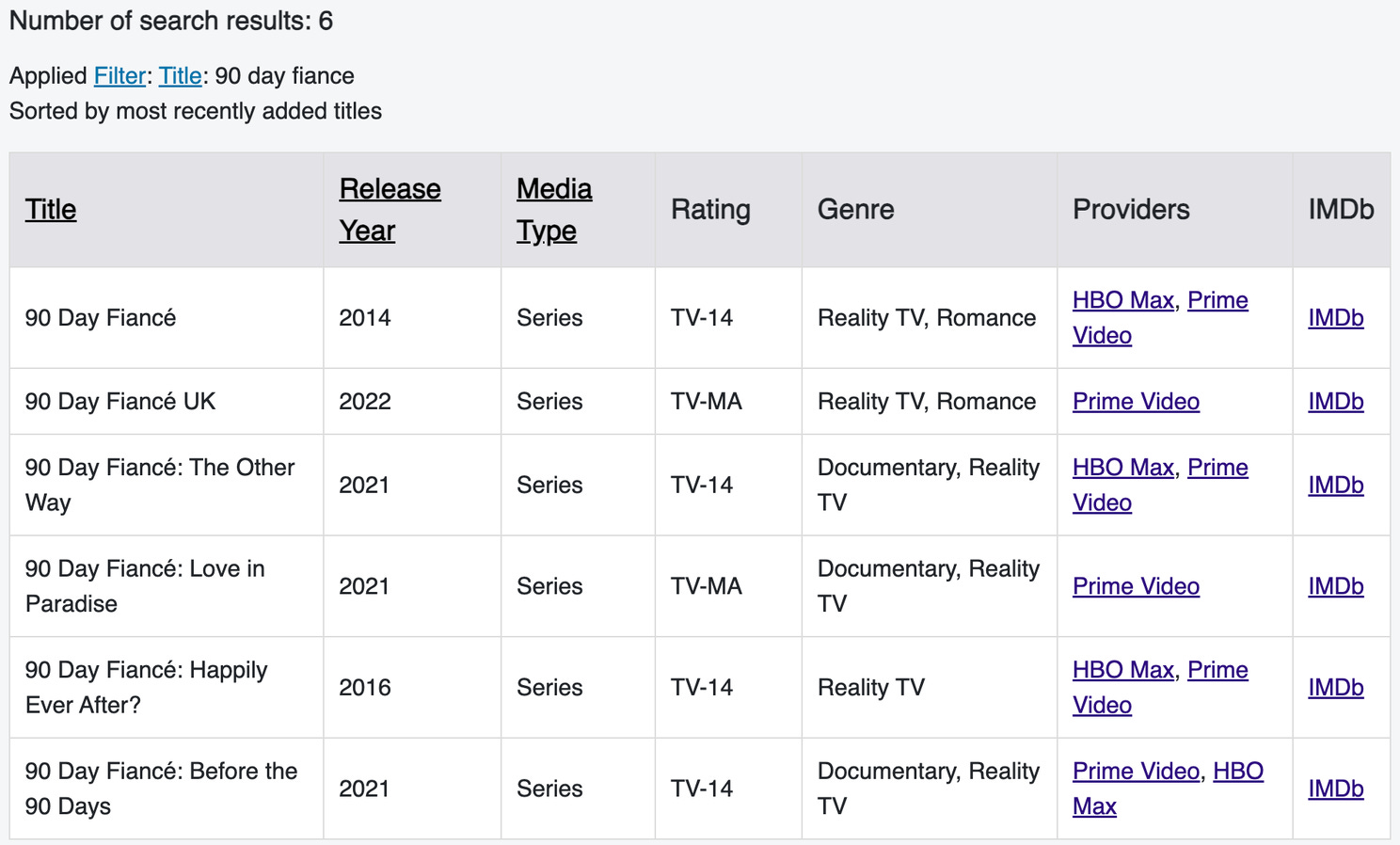
A search for “90 DAY FIANCE” in the Audio Description Project database.
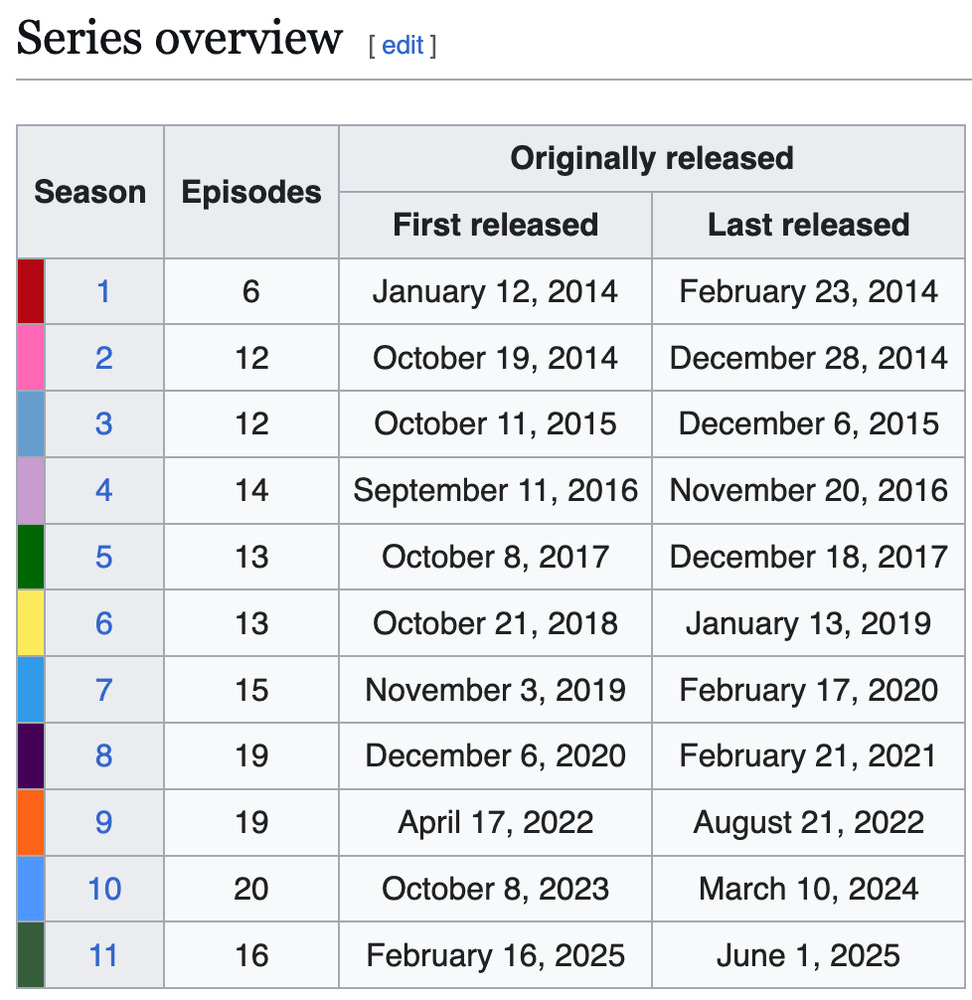
Original broadcast dates in the United States for the flagship series as listed on Wikipedia. I worked at TLC during Seasons 7, 8, and part of 9.
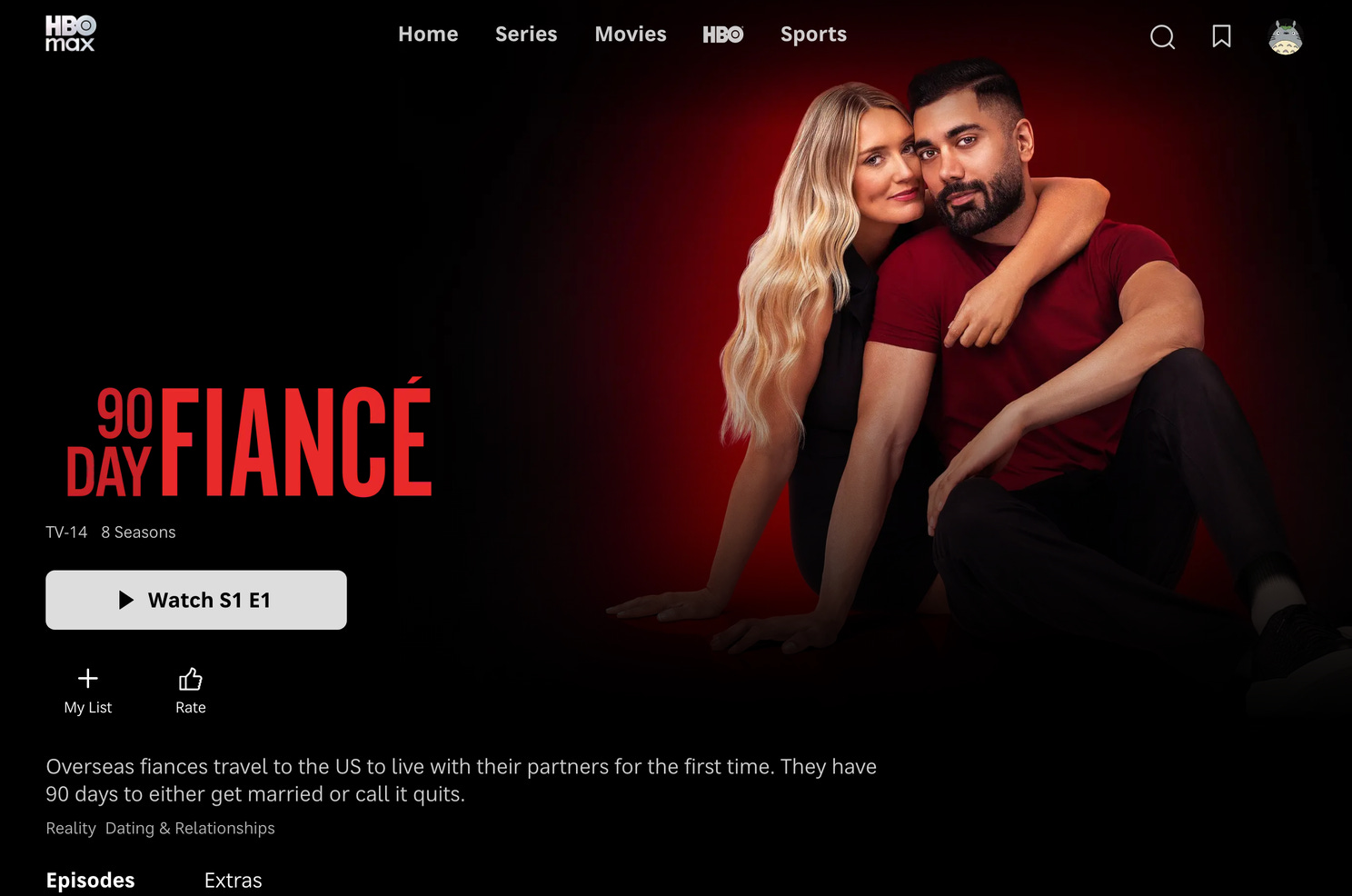
The landing page for 90 DAY FIANCE on HBO Max. There is no AD symbol present.
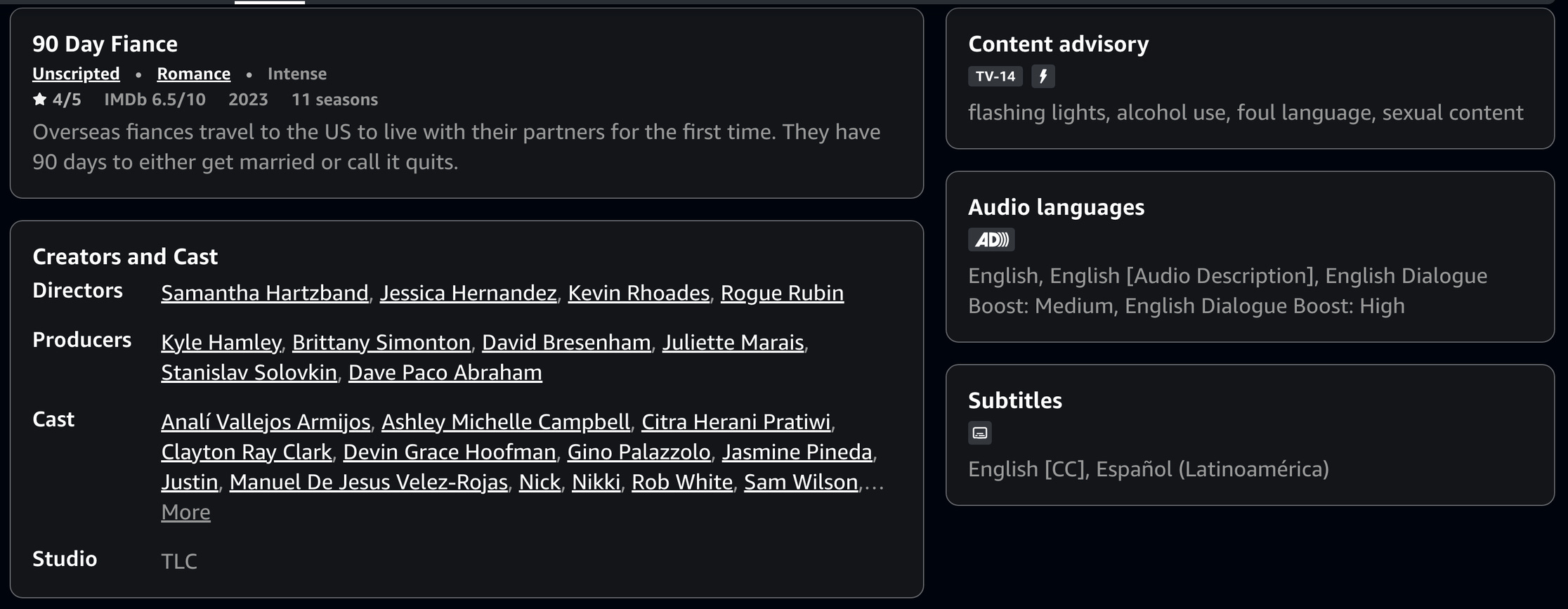
The “details” page on 90 DAY FIANCE on Prime Video when you click the hyperlink provided by the Audio Description Project. Prime Video labels Season 10 to have AD available (as per ADP)…
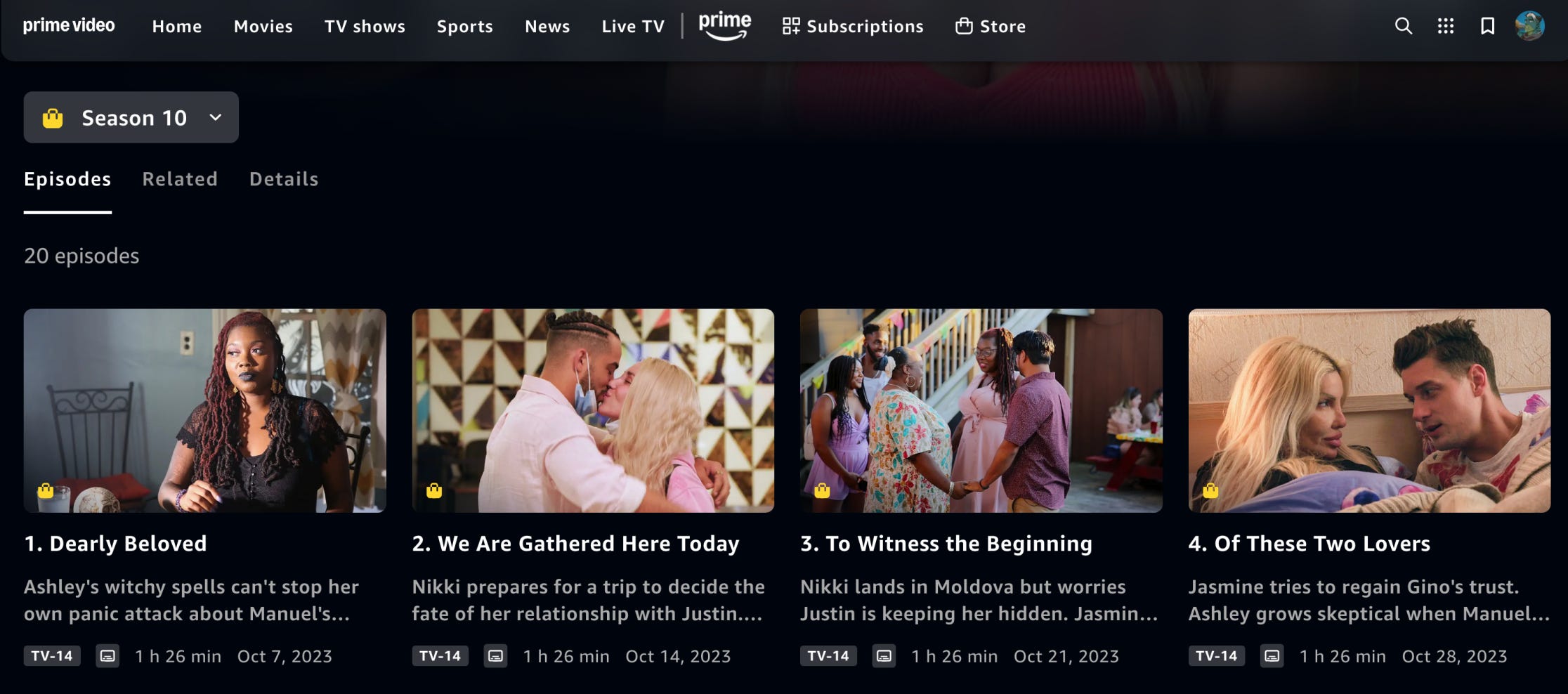
…but I would need to purchase the episodes to verify it.
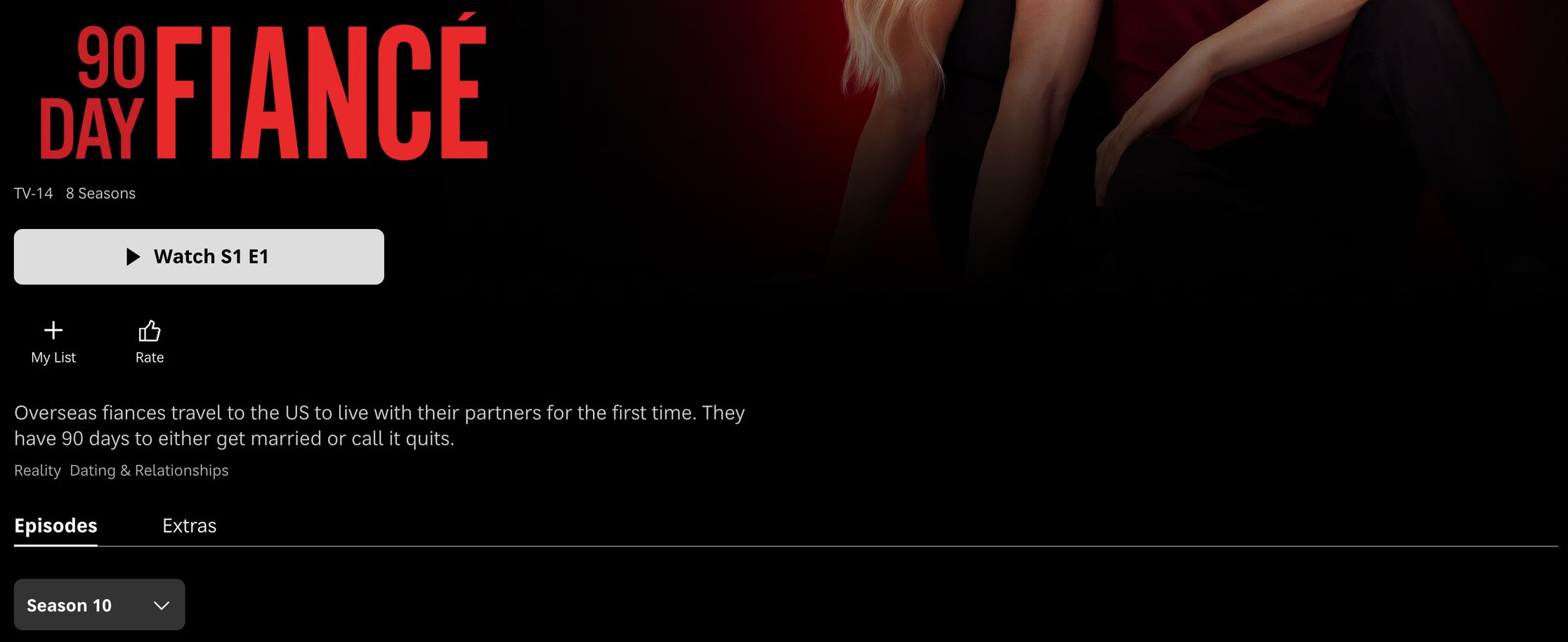
The landing page for 90 DAY FIANCE toggled to Season 10 on HBO Max. No AD symbol is present on the landing page.
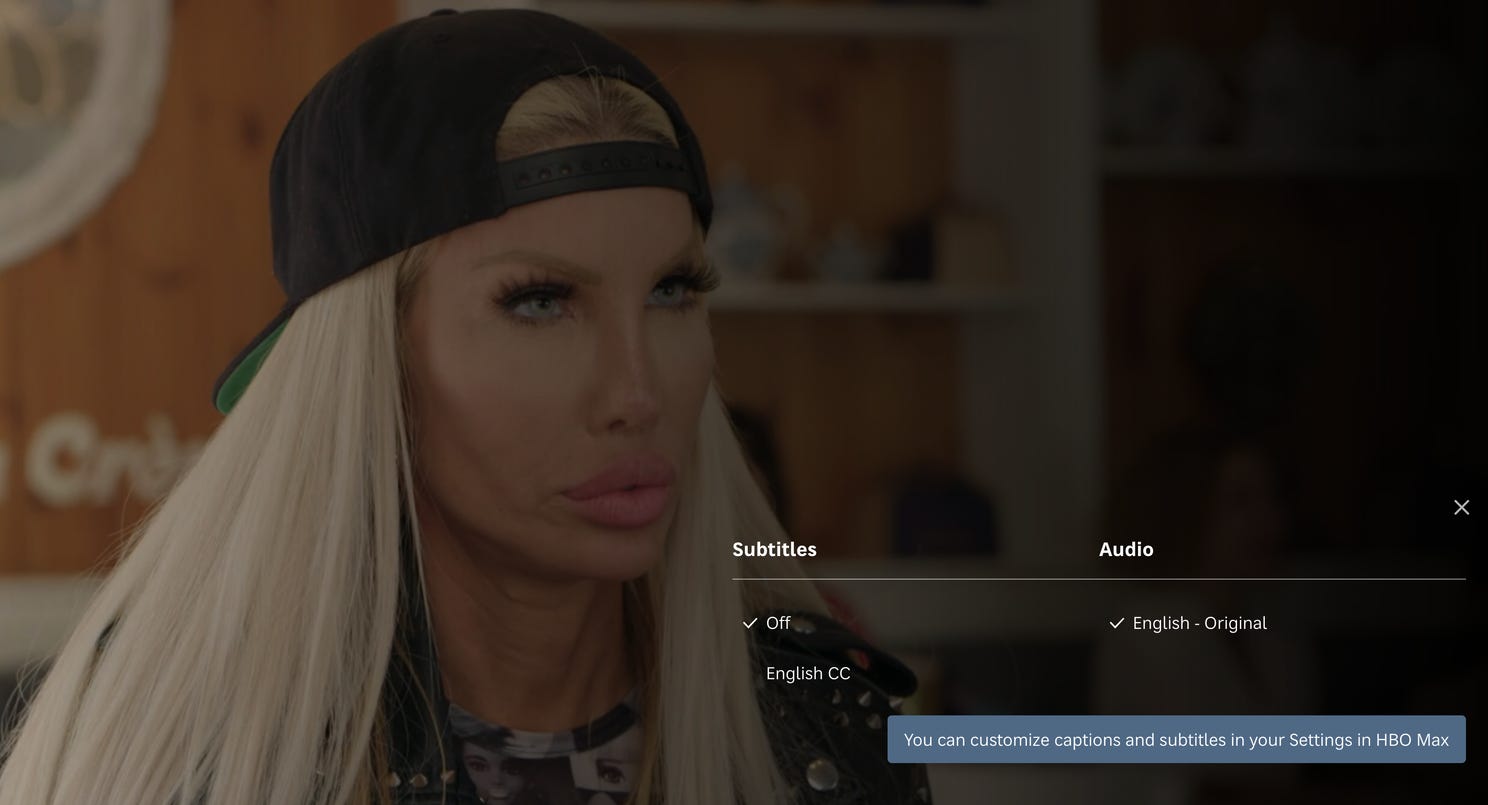
A screengrab from 90 DAY FIANCE Season 10, Episode 4—titled “Of These Two Lovers.” Bringing up the audio options shows that there is no AD track available on HBO Max.
I didn’t know. I wasn’t told. I didn’t ask. I didn’t think to ask. The pipeline that piece one of this series diagnosed as having no owner, no standard, and no mandate produced that invisibility so completely that the person responsible for growing the audience for the franchise didn’t know the franchise was inaccessible to a portion of that audience. The absence was structural. The disclosure didn’t exist. There was nothing to find unless you went looking from outside.
I went looking from outside. I found it while writing this series.
The mandate isn’t only for the audience the pipeline failed to serve. It’s for the people inside the industry who are building on top of content they don’t know is missing something: the people who are bringing audiences to shows, making content go viral, winning awards for social presence. The same people that don’t know that a portion of the audience they’re reaching can’t fully experience what they arrived for.
My father is an electrical engineer. He was part of the team called to evaluate the 2003 Northeast blackout, where 55 million people lost something they had every reason to expect to have. The engineers were asked not just to restore the power, but to redesign the system so the cascade couldn’t happen the same way again. My sister is a mechanical engineer. My husband, a civil engineer, designs tunnels and underground infrastructure. They build systems to get things where they need to go. They don’t accept that the failure was inevitable. They ask what in the design allowed it and how the design can be changed.
I spent seventeen years inside entertainment building systems to connect audiences to the things they love. I thought that being inside the castle walls meant being able to advocate for the audiences outside, particularly the audience nobody was seeing. I found nobody listening.
I went outside and wrote it down.
Even with Hong Kong New Wave cinema and MXC and Jackie Chan as part of my formation, I’ve barely scratched the surface. The wealth of culture, history, and example that exists in places I couldn’t begin to dream about.
The audience nobody saw has been waiting for the choice. Not perfect access. Not unmediated access. Just the version that arrives. Just the thread that becomes possible when the infrastructure is built to reach them.
One television. One cable package. My sister and I avoiding our homework on a late weekday afternoon, laughing until we were both crying.
It will always depend on who your audience is. Always.
The next question is what good actually sounds like—and who’s been doing it without anyone noticing. This series ends here. The traditions I don’t know are waiting for the people who do.
A clip from KPOP DEMON HUNTERS (2025, Maggie Kang and Chris Appelhans) when Rumi, Mira, and Zoey see the state of the honmoon with English AD and English CC. Sourced from Netflix.
A clip from KPOP DEMON HUNTERS during the HUNTR/X and The Saja Boys unplanned joint fan signing event with English AD and English CC. Sourced from Netflix.
The start of the end credits for KPOP DEMON HUNTERS with English AD and English CC. The post house, AD script writer, and AD narrator are mentioned. Sourced from Netflix.
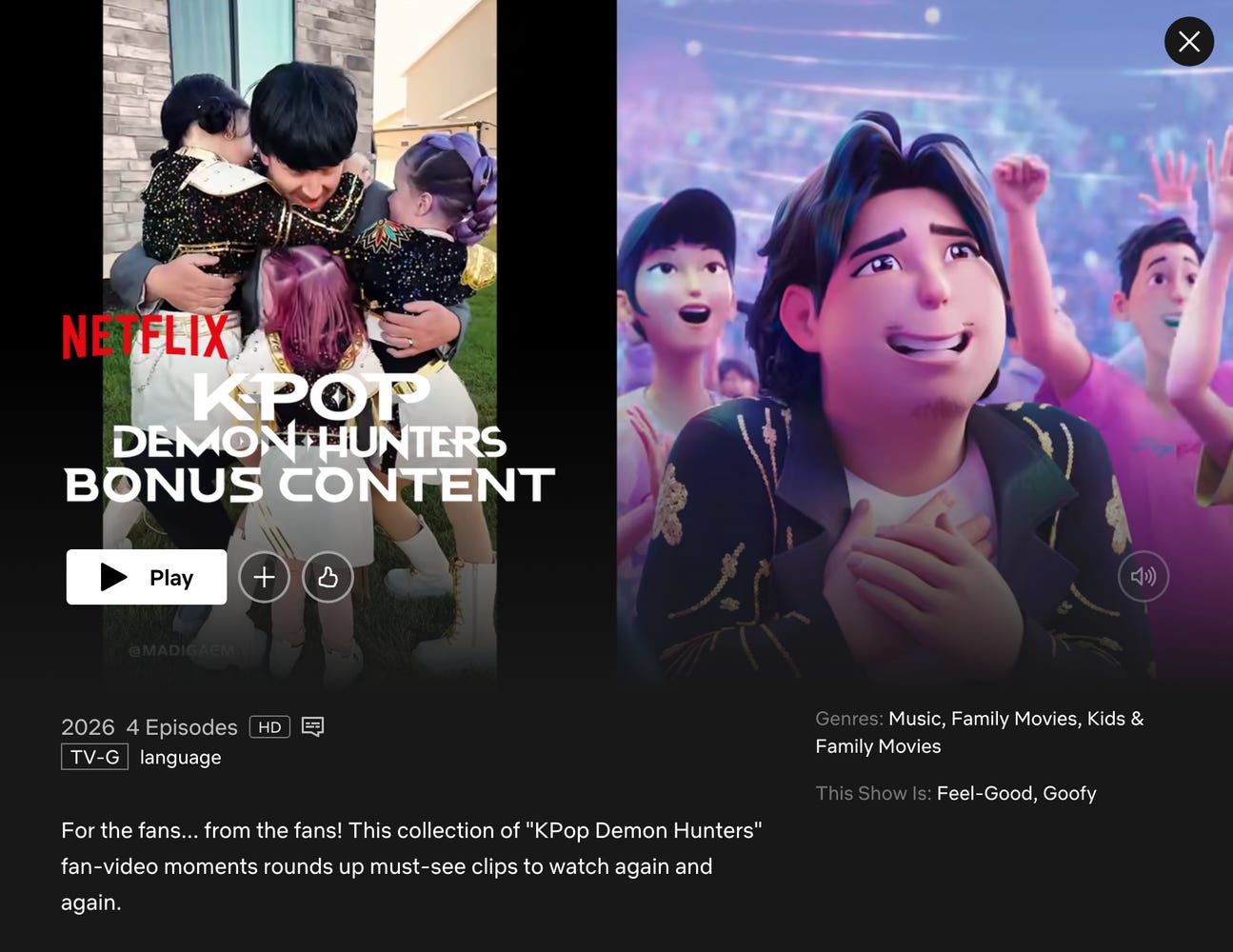
The landing page for KPOP DEMON HUNTERS: BONUS CONTENT where there are four episodes featuring fan-moments from around the world on Netflix. No AD track is available.
A clip from ENCANTO (2021, Jared Bush and Byron Howard) where Mirabel explores the cave in Bruno’s room. With English AD and English CC. Sourced from Disney+.
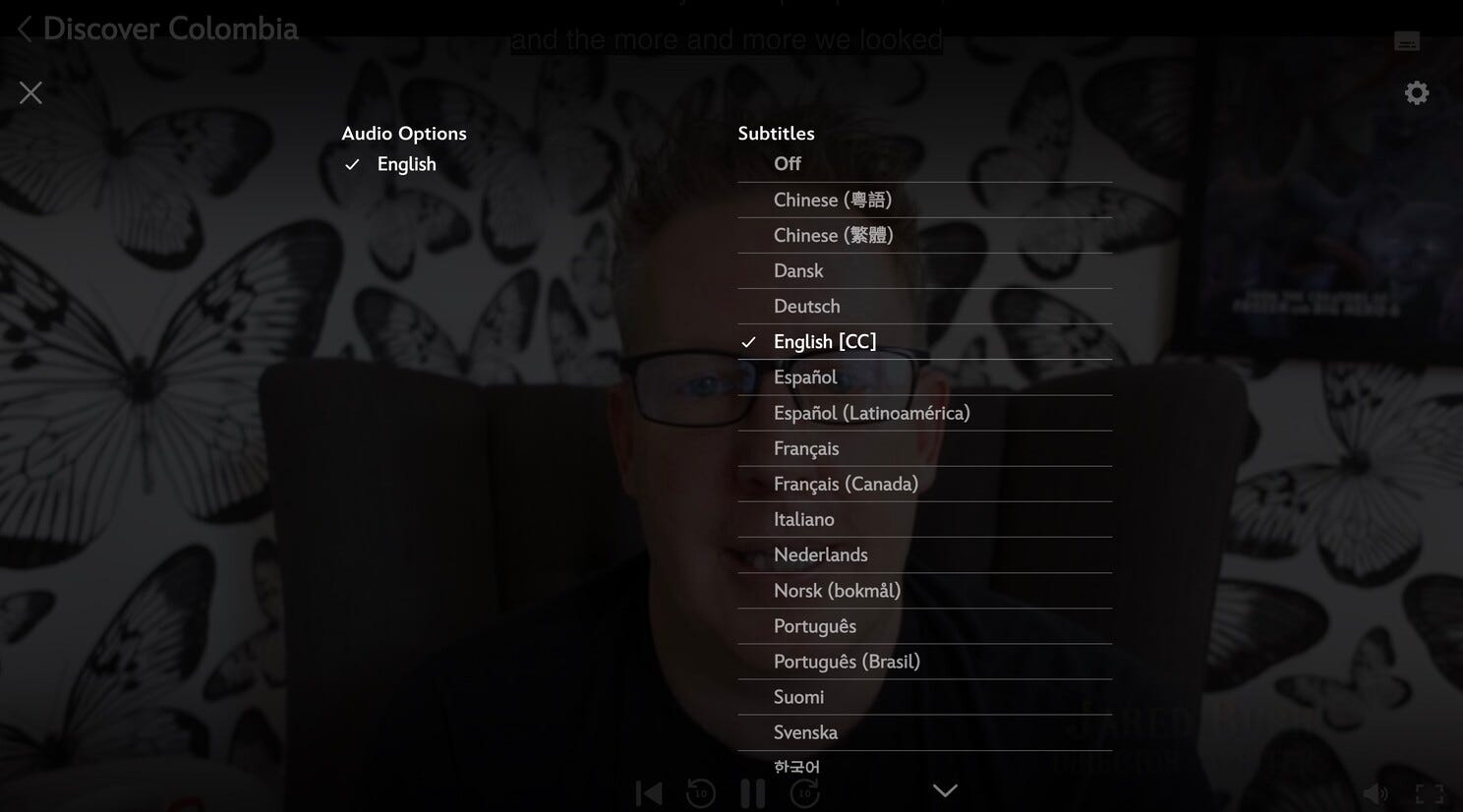
“Discover Colombia,” one of the extras offered for ENCANTO (2021, Jared Bush and Byron Howard) on Disney+. The filmmakers discuss the towns, animals, and cultural experiences that influenced the film. No AD track is available.
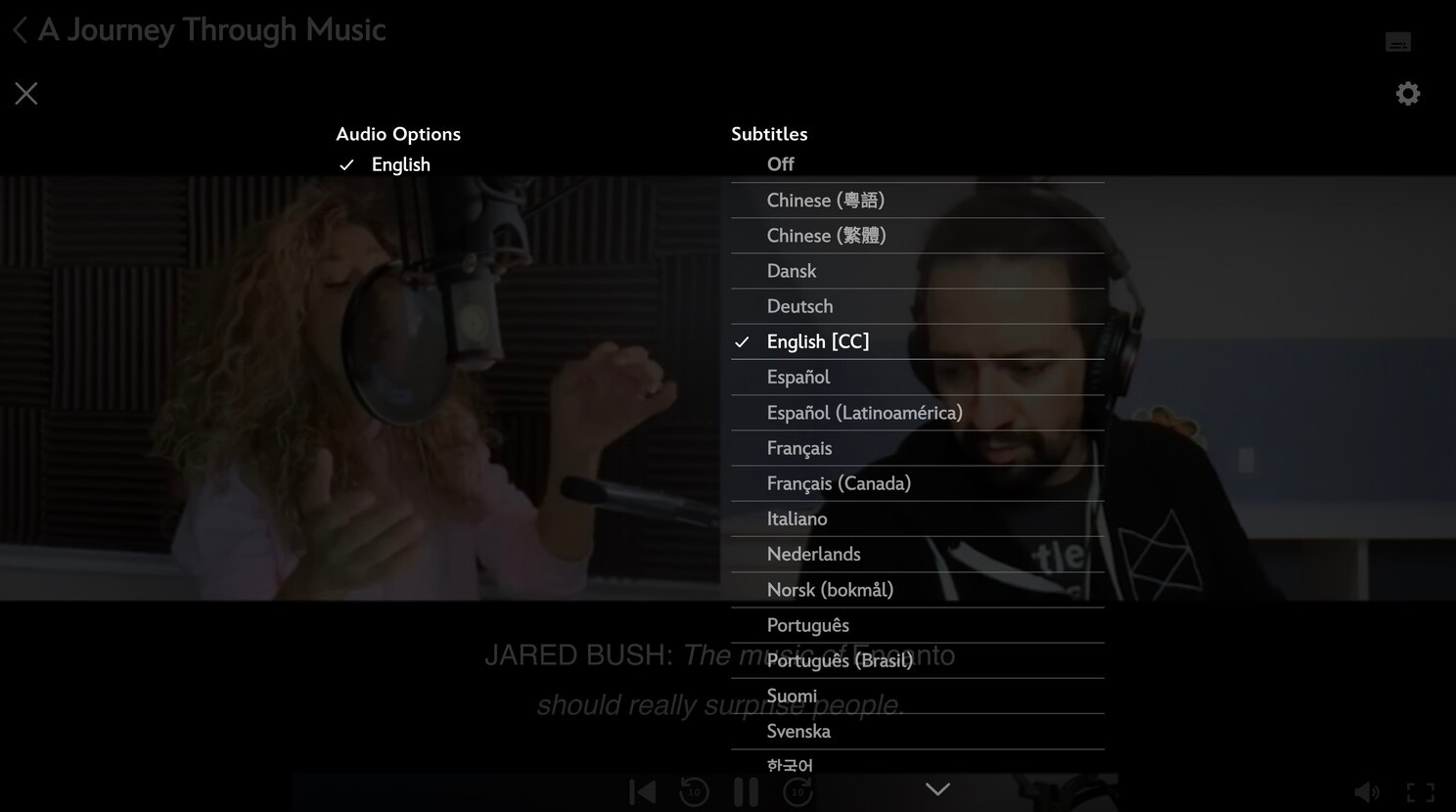
“A Journey Through Music,” one of the extras offered for ENCANTO on Disney+. Lin-Manuel Miranda talks about how he incorporated regional sounds from Colombia, used authentic Colombian instruments, and worked with Carlos Vives. No AD track is available.
A clip from SPIDER-MAN: INTO THE SPIDER-VERSE (2018, Bob Persichetti, Peter Ramsey, Rodney Rothman) when the audience meets Spider Noir, Peni Parker, and Peter Porker. With English AD and English CC. Sourced from Netflix.
A clip from FROZEN (2013, Chris Buck and Jennifer Lee) highlighting the second half of the title song. With English AD and English CC. Sourced from Disney+.
The film and television excerpts embedded in this piece are used for purposes of criticism, commentary, and public interest journalism under the Fair Use doctrine (17 U.S.C. § 107). All clips are brief, selected specifically to illustrate the critical argument being made, and are not a substitute for the original works. I am aware that automated copyright systems may not distinguish between fair use and infringement, and that a copyright strike may result in this article being taken down in its entirety.
A version of this essay was originally published on LinkedIn on March 30, 2026.
FROM THE LITTORAL covers accessibility and localization infrastructure in entertainment and media. The workaround changes. The person changes. The system that required the workaround doesn’t. If you have receipts—or gaps—send them.